
Kazuaki Taira. Boundary Value Problems and Markov Processes
Подождите немного. Документ загружается.

9.3 Proof of Theorem 1.4 149
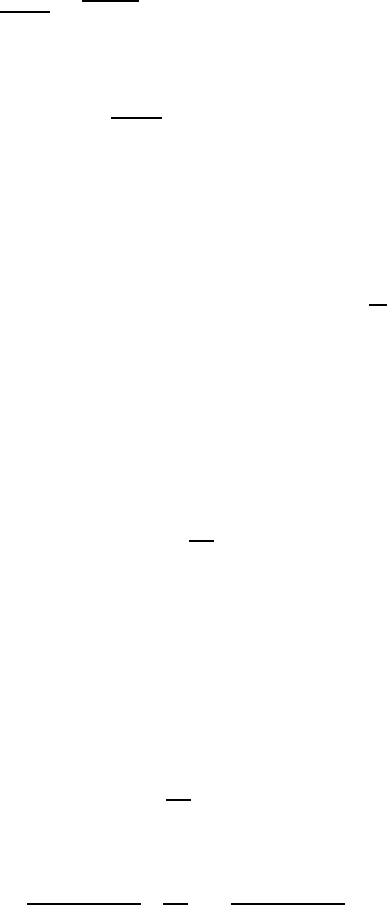
L
N
G
0
α
= L
N
G
0
α
1
∞
= L
N
G
0
β
1 − (α − β)L
N
G
0
α
G
0
β
1
∞
≤L
N
G
0
β
1
∞
.
Hence the second term also converges to zero as α → +∞:
α
α − β
−
L
N
H
α
−1
·
L
N
G
0
α
·g
∞
−→ 0asα → +∞.
It is clear that the third term converges to zero as α → +∞:
β
α − β
ϕ
∞
−→ 0asα → +∞.
Therefore, we have proved assertion (9.37) and hence the desired assertion
(9.36).
The proof of assertion (9.30) is complete.
Step 8: Summing up, we have proved that the operator A
N
, defined by
formula (9.20), satisfies conditions (a) through (d) in Theorem 2.16. Hence it
follows from an application of the same theorem that the operator A
N
is the
infinitesimal generator of some Feller semigroup on
D.
The proof of Theorem 9.14 is now complete.
9.3 Proof of Theorem 1.4
We apply part (ii) of Theorem 2.16 to the operator A defined by formula (1.5).
First, we simplify the boundary condition
Lu = μ(x
)
∂u
∂n
+ γ(x
)u =0 on∂D.
Assume that the following conditions (A) and (B
) are satisfied:
(A) μ(x
) ≥ 0on∂D.
(B
) γ(x
) ≤ 0on∂D and γ(x
) < 0onM = {x
∈ ∂D : μ(x
)=0}.
Then it follows that
μ(x
) − γ(x
) > 0on∂D.
Thus we find that the boundary condition
μ(x
)
∂u
∂n
+ γ(x
)u =0 on∂D
is equivalent to the boundary condition
μ(x
)
μ(x
) − γ(x
)
∂u
∂n
+
γ(x
)
μ(x
) − γ(x
)
u =0 on∂D.
150 9 Proof of Theorem 1.3, Part (ii)
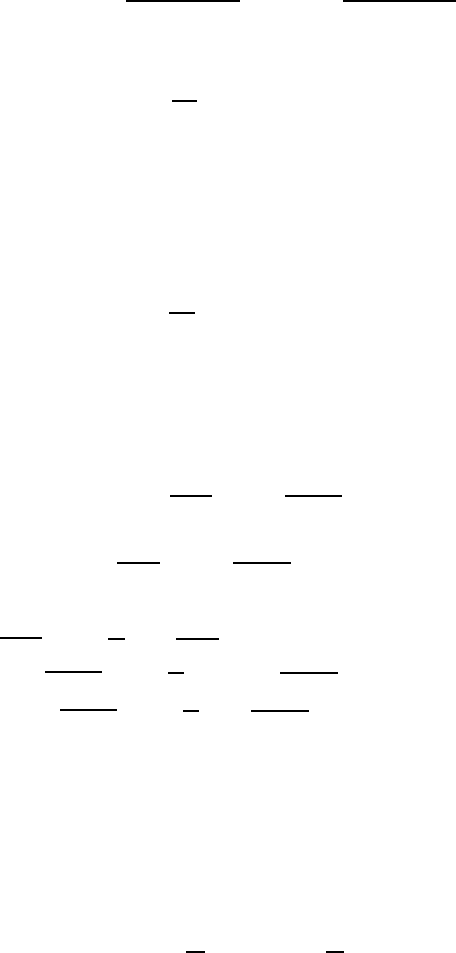
However, if we let
˜μ(x
)=
μ(x
)
μ(x
) − γ(x
)
, ˜γ(x
)=
γ(x
)
μ(x
) − γ(x
)
,
then we have the assertions
˜μ(x
)
∂u
∂n
+˜γ(x
)u =0 on∂D
and
0 ≤ ˜μ(x
) ≤ 1on∂D,
˜γ(x
)=˜μ(x
) − 1on∂D.
Namely, we may assume that the boundary condition L is of the form
Lu = μ(x
)
∂u
∂n
+(μ(x
) − 1)u =0 on∂D,
with
0 ≤ μ(x
) ≤ 1on∂D.
Next we express the boundary condition L in terms of the Dirichlet and
Neumann conditions.
It follows from an application of Lemmas 9.8 and 9.10 that
LG
0
α
= μ(x
) L
N
G
0
α
,
and that
LH
α
= μ(x
) L
N
H
α
+ μ(x
) − 1.
Hence, in view of definition (9.18) we obtain that
Lu =
LG
0
α
(αI −
A)u
+ LH
α
(u|
∂D
)
= μ(x
)L
N
G
0
α
(αI −
A)u
+ μ(x
)L
N
H
α
(u|
∂D
)+(μ(x
) − 1)(u|
∂D
)
= μ(x
)
L
N
G
0
α
(αI −
A)u
+ L
N
H
α
(u|
∂D
)
+(μ(x
) − 1)(u|
∂D
)
= μ(x
)L
N
u +(μ(x
) − 1)(u|
∂D
),u∈D(L).
This proves the desired formula
L = μ(x
)L
N
+ μ(x
) − 1. (9.38)
Therefore, the next theorem proves Theorem 1.4:
Theorem 9.18. We define a linear operator
A : C
0
(D \ M ) −→ C
0
(D \ M)
as follows (cf. formula (9.20)).

9.3 Proof of Theorem 1.4 151
(a) The domain D(A) of A is the space
D(A )=
'
u ∈ C
0
(D \M):Au ∈ C
0
(D \ M ),
Lu = μ(x
)L
N
u +(μ(x
) − 1) (u|
∂D
)=0
(
. (9.39)
(b) Au =
Au, u ∈D(A).
Assume that the following condition (A
)issatisfied:
(A
) 0 ≤ μ(x
) ≤ 1 on ∂D.
Then the operator A is the infinitesimal generator of some Feller semigroup
{T
t
}
t≥0
on D \M , and the Green operator G
α
=(αI −A)
−1
, α>0, is given
by the following formula:
G
α
f = G
N
α
f − H
α
LH
α
−1
LG
N
α
f
,f∈ C
0
(D \ M). (9.40)
Here G
N
α
is the Green operator for the Neumann condition L
N
given by for-
mula (9.21).
Proof. We apply part (ii) of Theorem 2.16 to the operator A. The proof is
divided into six steps.
Step 1:First,weprovethat:
If condition (A
) is satisfied, then the operator LH
α
is the generator
of some Feller semigroup on ∂D, for any sufficiently large α>0.
We introduce a linear operator
T (α):B
2−1/p,p
(∂D) −→ B
2−1/p,p
(∂D)
as follows.
(a) The domain D(T (α)) of T (α)isthespace
D(T (α)) =
ϕ ∈ B
2−1/p,p
(∂D):LH
α
ϕ ∈ B
2−1/p,p
(∂D)
.
(b) T (α)ϕ = LH
α
ϕ, ϕ ∈D(T (α)).
Then, by arguing just as in the proof of Theorem 7.1 with γ(x
):=μ(x
)−1
on ∂D we obtain that
The operator T (α)isbijective for any sufficiently large α>0.
Furthermore, it maps the space C
∞
(∂D)ontoitself. (9.41)
Since we have the assertion
LH
α
= T (α)onC
∞
(∂D),

152 9 Proof of Theorem 1.3, Part (ii)
it follows from assertion (9.41) that the operator LH
α
also maps C
∞
(∂D)onto
itself, for any sufficiently large α>0. This implies that the range R(LH
α
)
is a dense subset of C(∂D). Hence, by applying part (ii) of Theorem 9.12 we
obtain that the operator
LH
α
generates a Feller semigroup on ∂D, for any
sufficiently large α>0.
Step 2:Nextweprovethat:
The operator
LH
β
generates a Feller semigroup on ∂D,
for any β>0.
We take a positive constant α so large that the operator
LH
α
generates
a Feller semigroup on ∂D. We apply Corollary 2.19 with K := ∂D to the
operator
LH
β
for β>0. By formula (9.16), it follows that the operator LH
β
can be written as
LH
β
= LH
α
+ M
αβ
,
where M
αβ
=(α − β)LG
0
α
H
β
is a bounded linear operator on C(∂D)into
itself. Furthermore, assertion (9.15) implies that the operator
LH
β
satisfies
condition (β
) of Theorem 2.18. Therefore, it follows from an application of
Corollary 2.19 that the operator
LH
β
also generates a Feller semigroup on
∂D.
Step 3: Now we prove that:
If condition (A
) is satisfied, then the equation
LH
α
ψ = ϕ
has a unique solution ψ in D
LH
α
for any ϕ ∈ C(∂D); hence the
inverse
LH
α
−1
of LH
α
can be defined on the whole space C(∂D).
Furthermore, the operator −
LH
α
−1
is non-negative and bounded
on the space C(∂D). (9.42)
Since we have, by inequality (9.24),
LH
α
1=μ(x
)
∂
∂n
(H
α
1) + μ(x
) − 1 < 0on∂D,
it follows that
k
α
=min
x
∈∂D
(−LH
α
1(x
)) = − max
x
∈∂D
LH
α
1(x
) > 0.
In view of Lemma 9.16, we find that the constants k
α
are increasing in α>0:
α ≥ β>0=⇒ k
α
≥ k
β
.
Furthermore, by using Corollary 2.17 with K := ∂D, A :=
LH
α
and c := k
α
we obtain that the operator LH
α
+ k
α
I is the infinitesimal generator of some

9.3 Proof of Theorem 1.4 153
Feller semigroup on ∂D. Therefore, since k
α
> 0, it follows from an application
of part (i) of Theorem 2.16 with A :=
LH
α
+ k
α
I that the equation
−
LH
α
ψ =
k
α
I −(LH
α
+ k
α
I)
ψ = ϕ
has a unique solution ψ ∈D
LH
α
for any ϕ ∈ C(∂D), and further that the
operator −
LH
α
−1
=
k
α
I −(LH
α
+ k
α
I)
−1
is non-negative and bounded
on the space C(∂D)withnorm
−
LH
α
−1
=
k
α
I − (LH
α
+ k
α
I)
−1
≤
1
k
α
.
Step 4: By assertion (9.42), we can define the operator G
α
by formula
(9.40) for all α>0. We prove that:
G
α
=(αI −A)
−1
,α>0. (9.43)
By Lemma 9.6 and Theorem 9.14, it follows that we have, for all f ∈
C
0
(D \ M ),
G
α
f ∈D(A),
and
A(G
α
f)=αG
α
f − f.
Furthermore, we obtain that the function G
α
f satisfies the boundary condi-
tion
L(G
α
f)=LG
N
α
f − LH
α
LH
α
−1
LG
N
α
f
=0 on∂D. (9.44)
However, we recall that (see formula (9.38))
Lu = μ(x
)L
N
u +(μ(x
) − 1) (u|
∂D
) ,u∈D(L). (9.45)
Hence it follows that the boundary condition (9.44) is equivalent to the fol-
lowing:
L(G
α
f)=μ(x
)L
N
(G
α
f)+(μ(x
) − 1) (G
α
f|
∂D
)=0 on∂D. (9.46)
By condition (9.46), we have, for all f ∈ C
0
(D \ M ),
G
α
f =0onM = {x
∈ ∂D : μ(x
)=0},
and so
A(G
α
f)=αG
α
f − f =0 onM.
Summing up, we have proved that
f ∈ C
0
(D \ M )
=⇒ G
α
f ∈D(A)=
u ∈ C
0
(D \ M ):Au ∈ C
0
(D \ M),Lu=0
,
154 9 Proof of Theorem 1.3, Part (ii)
and further that
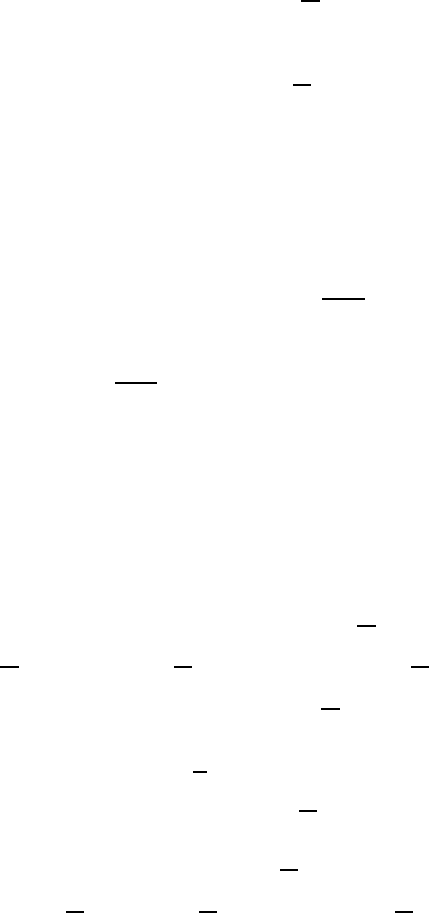
(αI − A)G
α
f = f, f ∈ C
0
(D \ M ).
This proves that
(αI − A)G
α
= I on C
0
(D \ M).
Therefore, in order to prove formula (9.43), it suffices to show the injec-
tivity of the operator αI −A for α>0.
Assume that, for α>0,
u ∈D(A)and(αI − A)u =0.
Then, by Corollary 9.7 it follows that the function u can be written as follows:
u = H
α
(u|
∂D
) ,u|
∂D
∈D= D
LH
α
.
Thus we have the formula
LH
α
(u|
∂D
)=Lu =0.
In view of assertion (9.42), this implies that
u|
∂D
=0,
so that
u = H
α
(u|
∂D
)=0 inD.
This proves the injectivity of αI − A for α>0.
Step 5: Now we prove the following three assertions:
(i) The operator G
α
is non-negative on the space C
0
(D \ M ):
f ∈ C
0
(D \ M ),f≥ 0onD \ M =⇒ G
α
f ≥ 0onD \ M. (9.47)
(ii) The operator G
α
is bounded on the space C
0
(D \ M )withnorm
G
α
≤
1
α
for all α>0. (9.48)
(iii) The domain D(A) is dense in the space C
0
(D \ M ).
Step 5-1: In order to prove assertion (i), we have only to show the non-
negativity of the operator G
α
on the space C(D):
f ∈ C(
D),f≥ 0onD =⇒ G
α
f ≥ 0onD. (9.49)
Recall that the Dirichlet problem
(α − A)u = f in D,
u = ϕ on ∂D
(9.2)
9.3 Proof of Theorem 1.4 155
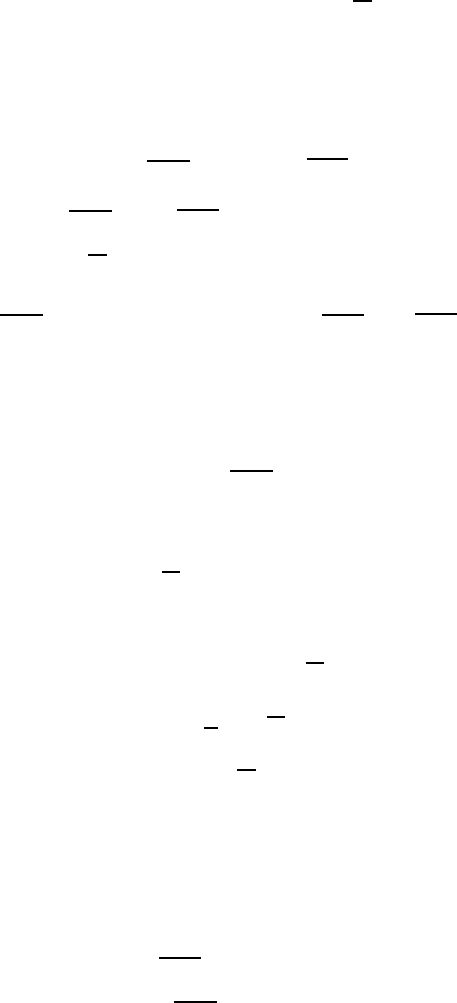
is uniquely solvable. Hence it follows that
G
N
α
f = H
α
G
N
α
f|
∂D
+ G
0
α
f on D. (9.50)
Indeed, the both sides satisfy the same equation (α −A)u = f in D and have
the same boundary values G
N
α
f on ∂D.
Thus, by applying the boundary operator L to the both sides of formula
(9.50) we obtain that
LG
N
α
f = LH
α
G
N
α
f|
∂D
+
LG
0
α
f.
Since the operators −
LH
α
−1
and LG
0
α
are non-negative, it follows that
f ≥ 0on
D
=⇒
−
LH
α
−1
LG
N
α
f
= −G
N
α
f|
∂D
+
−LH
α
−1
LG
0
α
f
≥−G
N
α
f|
∂D
on ∂D.
Therefore, by the non-negativity of H
α
and G
0
α
we find from formulas (9.40)
and (9.50) that
G
α
f = G
N
α
f + H
α
−
LH
α
−1
LG
N
α
f
≥ G
N
α
f + H
α
−G
N
α
f|
∂D
= G
0
α
f
≥ 0on
D.
This proves the desired assertion (9.49) and hence assertion (9.47).
Step 5-2: Next we prove assertion (ii). To do this, it suffices to show the
boundedness of the operator G
α
on the space C(D):
G
α
1 ≤
1
α
on
D, (9.51)
since G
α
is non-negative on the space C(D).
We remark (cf. formula (9.45)) that
LG
N
α
f = μ(x
) L
N
G
N
α
f +(μ(x
) − 1)
G
N
α
f|
∂D
=(μ(x
) − 1)
G
N
α
f|
∂D
,
so that
G
α
f = G
N
α
f − H
α
LH
α
−1
LG
N
α
f
= G
N
α
f + H
α
−
LH
α
−1
(μ(x
) − 1)G
N
α
f|
∂D
.
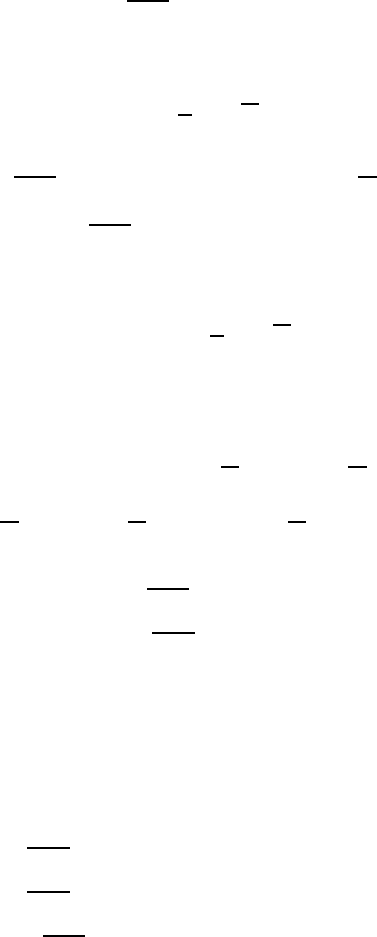
156 9 Proof of Theorem 1.3, Part (ii)
Hence, by using this formula with f := 1 we obtain that
G
α
1=G
N
α
1 − H
α
−
LH
α
−1
(1 − μ(x
))G
N
α
1|
∂D
.
However, we have, by inequality (9.27),
0 ≤ G
N
α
1 ≤
1
α
on
D,
and also
H
α
−
LH
α
−1
(1 − μ(x
))G
N
α
1|
∂D
≥ 0on
D,
since the operators H
α
and −LH
α
−1
are non-negative and since 1−μ(x
) ≥ 0
on ∂D.
Therefore, we obtain that
0 ≤ G
α
1 ≤ G
N
α
1 ≤
1
α
on
D.
This proves the desired assertion (9.51) and hence assertion (9.48).
Step 5-3: Finally, we prove assertion (iii). In view of formula (9.43), it
suffices to show that
lim
α→+∞
αG
α
f − f
∞
=0,f∈ C
0
(D \ M ) ∩ C
∞
(D), (9.52)
since the space C
0
(D \ M) ∩ C
∞
(D)isdenseinC
0
(D \ M ).
We remark that
αG
α
f − f = αG
N
α
f − f − αH
α
LH
α
−1
LG
N
α
f
=
αG
N
α
f − f
+ H
α
LH
α
−1
α(1 − μ(x
))G
N
α
f|
∂D
. (9.53)
We estimate the last two terms of formula (9.53) as follows:
(1) By assertion (9.36), it follows that the first term of formula (9.53) tends
to zero as α → +∞:
lim
α→+∞
αG
N
α
f − f
∞
=0. (9.54)
(2) To estimate the second term of formula (9.53), we remark that
H
α
LH
α
−1
α(1 − μ(x
))G
N
α
f|
∂D
= H
α
LH
α
−1
((1 − μ(x
))f|
∂D
)
+H
α
LH
α
−1
(1 − μ(x
))(αG
N
α
f − f )|
∂D
. (9.55)
However, it follows that the second term in the right-hand side of formula
(9.55) tends to zero as α → +∞. Indeed, we have, by assertion (9.54),
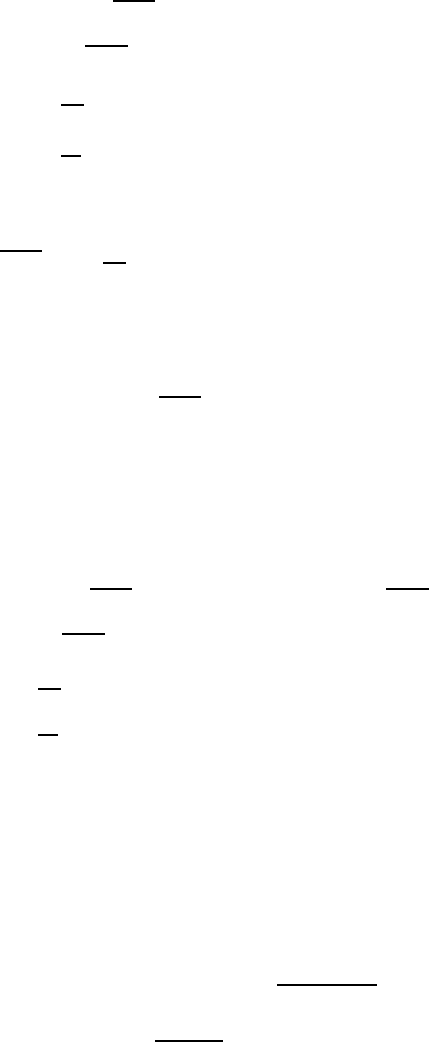
9.3 Proof of Theorem 1.4 157
H
α
LH
α
−1
(1 − μ(x
))
αG
N
α
f − f
|
∂D
∞
≤
−
LH
α
−1
·
(1 − μ(x
))
αG
N
α
f − f
|
∂D
∞
≤
1
k
α
(1 − μ(x
))
αG
N
α
f − f
|
∂D
∞
≤
1
k
1
αG
N
α
f − f
∞
−→ 0. (9.56)
Here we have used the following facts (cf. the proof of assertion (9.42)):
−
LH
α
−1
≤
1
k
α
,α>0.
k
1
=min
x
∈∂D
(−LH
1
1)(x
) ≤ k
α
=min
x
∈∂D
(−LH
α
1)(x
) for all α ≥ 1.
Thus we are reduced to the study of the first term of the right-hand side of
formula (9.55)
H
α
LH
α
−1
((1 − μ(x
))f|
∂D
)
.
Now, for any given ε>0, we can find a function h(x
)inC
∞
(∂D)such
that
h =0 nearM = {x
∈ ∂D : μ(x
)=0},
(1 − μ(x
))f|
∂D
− h
∞
<ε.
Then we have, for all α ≥ 1,
H
α
LH
α
−1
((1 − μ(x
))f|
∂D
)
− H
α
LH
α
−1
h
∞
≤
−
LH
α
−1
·(1 − μ(x
))f|
∂D
− h
∞
≤
ε
k
α
≤
ε
k
1
. (9.57)
Furthermore, we can find a function θ(x
)inC
∞
0
(∂D) such that
θ(x
)=1 nearM,
(1 − θ(x
))h(x
)=h(x
)on∂D.
Then we have the assertion
h(x
)=(1− θ(x
)) h(x
)
=(−LH
α
1(x
))
1 − θ(x
)
−LH
α
1(x
)
h(x
)
≤
1 − θ
−LH
α
1
∞
·h
∞
(−LH
α
1(x
)) .

158 9 Proof of Theorem 1.3, Part (ii)
Since the operator −LH
α
−1
is non-negative on the space C(∂D), it follows
that
−
LH
α
−1
h ≤
1 − θ
−LH
α
1
∞
·h
∞
on ∂D,
so that
H
α
LH
α
−1
h
≤
−
LH
α
−1
h
∞
≤
1 − θ
−LH
α
1
∞
·h
∞
. (9.58)
However, there exists a positive constant δ
0
such that
0 ≤
1 − θ(x
)
μ(x
)
≤ δ
0
for all x
∈ ∂D.
Thus it follows that
1 − θ(x
)
−LH
α
1(x
)
=
1 − θ(x
)
μ(x
)
−
∂
∂n
(H
α
1(x
))
+(1− μ(x
))
≤
1 − θ(x
)
μ(x
)
1
−
∂
∂n
(H
α
1(x
))
≤ δ
0
1
min
x
∈∂D
−
∂
∂n
(H
α
1(x
))
,
and hence from Lemma 9.16 that
lim
α→+∞
1 − θ
−LH
α
1
∞
=0. (9.59)
Summing up, we obtain from inequalities (9.57) and (9.58) and assertion
(9.59) that
lim sup
α→+∞
H
α
LH
α
−1
((1 − μ(x
))f|
∂D
)
∞
≤ lim sup
α→+∞
H
α
LH
α
−1
h
+
H
α
LH
α
−1
((1 − μ(x
))f|
∂D
)
− H
α
LH
α
−1
h
∞
≤ lim
α→+∞
1 − θ
−LH
α
1
∞
·h
∞
+
ε
k
1
≤
ε
k
1
.
Since ε is arbitrary, this proves that the first term of the right-hand side of
formula (9.55) tends to zero as α → +∞:
lim
α→+∞
H
α
LH
α
−1
((1 − μ(x
))f|
∂D
)
∞
=0. (9.60)