
Kelly J.J. Graduate Mathematical Physics, With MATHEMATICA Supplements
Подождите немного. Документ загружается.

76 2 Integration
f z
Φz
0
z z
0
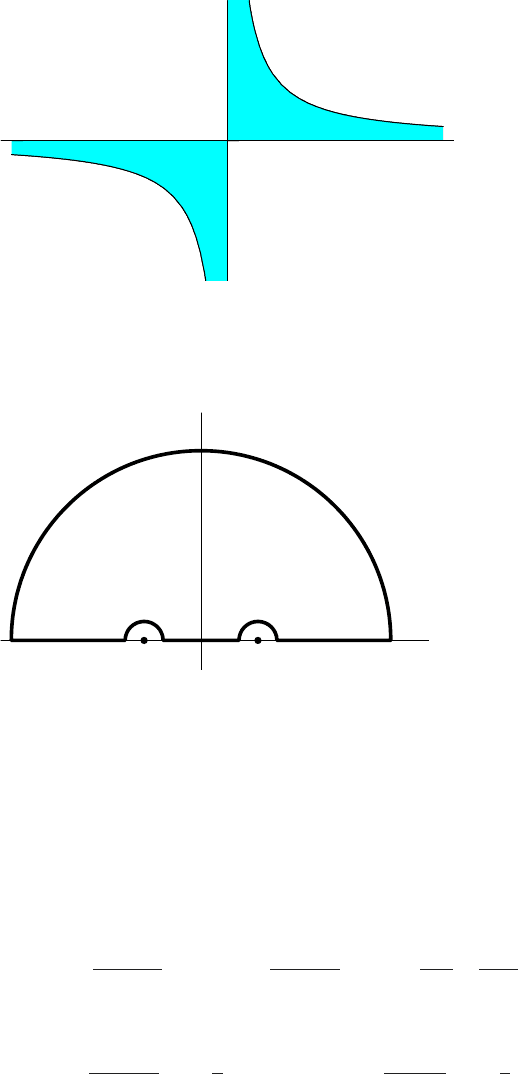
Figure 2.5. Asymmetric behavior of the divergent parts of an integrand with a simple pole.
x
y
aa
Figure 2.6. Kilroy contour: indentations that exclude poles at a resemble the eyes of someone
peeking over a fence.
of the great semicircle. The singularities at x a are avoided using small semicircular
indentations, as sketched in Fig. 2.6. (Those familiar with World War II iconography might
call this the Kilroy contour.)
The contribution from the segments along the real axis sum to the principal value, while
the indentations contribute Π times the sum of the two residues because the semicircles
are traversed in a negative sense. Thus,
0
C
Expkz
a
2
z
2
z
Expkx
a
2
x
2
x Π
ka
2a
ka
2a
(2.56)
gives
Expkx
a
2
x
2
x
Π
a
Sinka
Coskx
a
2
x
2
x
Π
a
Sinka (2.57)

2.5 Integration Around a Branch Point 77
Notice that the principal value is the same whether we choose indentations to exclude
or to include either or both poles (four possibilities) – check this for yourself! Thus, the
contribution to a principal value integral made by a simple pole on the contour is half the
value it would have made if enclosed.
2.5 Integration Around a Branch Point
If the integrand involves a multivalued function, care must be taken with any branch cuts
in the integration region. Such functions often differ in phase on opposite sides of the cut,
so that contours with segments on opposite sides will include contributions of equal mag-
nitude but different phase. Often the presence of a branch cut actually assists in evaluation
of an integral – branch cuts are not always monsters to be feared! While it is difficult to
formulate general rules, a couple of examples should suffice to illustrate the method.
Suppose that we wish to evaluate the integral
0
x
a
x b
x with 1 <a<0 ,b>0 (2.58)
using contour integration. The function
f z
z
a
z b
(2.59)
has a pole at z b and requires a branch cut to define the phase of the numerator when a
is nonintegral. This branch cut will connect singularities at z 0 and z !, but we have
some freedom in choosing its orientation. Although one usually cuts such a function along
the negative real axis, for this purpose it is more convenient to put the cut on the positive
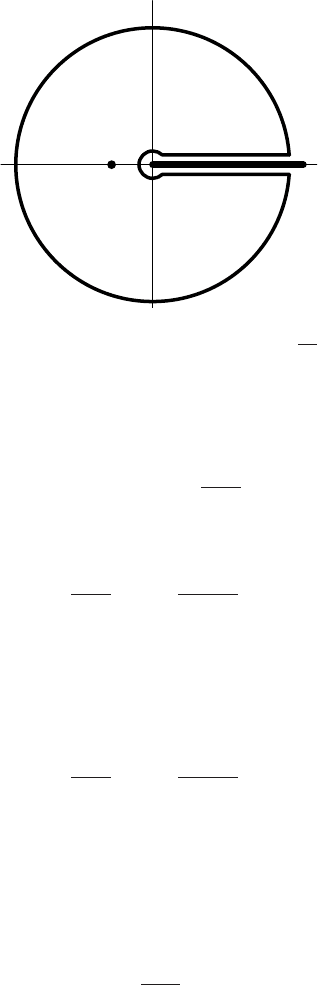
real axis so that the desired integral is found on one segment of the contour sketched in
Fig. 2.7. For now we assume that b>0 so that the pole is on the negative real axis. Thus,
for this problem we will cut just below the positive real axis and define the principal branch
as
z
a
z
a
Expa argz with 0 argz < 2Π (2.60)
by restricting the phase of z to the range (0, 2Π). The residue of the pole is then b
a
ExpΠa
such that
C
f zz 2Πb
a
ExpΠa (2.61)
on the positive contour below, which encloses the pole without crossing the branch cut.
The contribution of the outer circle vanishes in the limit R !because
z!
f z
Bz
a1
(2.62)
falls more rapidly than z
1
when a<0. Similarly, the integral on the inner circle with
radius vanishes in the limit ! 0. The contributions on either side of the real axis are
78 2 Integration
x
y
b
Figure 2.7. Contour used to evaluate
0
x
a
xb
x for positive real b.
both proportional to the desired integral but differ in phase. On the top side of the cut
z
a
! x
a
while on the bottom side z
a
! x
a
Exp2Πa, such that
1 Exp2Πa
0
x
a
x b
x 2Πb
a
ExpΠa (2.63)
Therefore, we obtain the integral
0
x
a
x b
x
b
a
Π
SinΠa
for 1 <a<0 ,b>0 (2.64)
This result can be generalized by recognizing that we need only require 1<Rea<0
to ensure that the contribution of the outer circle vanishes as its radius becomes infinite.
The definition of b
a
ExpaLogb ExpaLogb Argb can be extended to
complex powers. Therefore, we obtain the more general result
0
x
a
x b
x
b
a
Π
SinΠa
for 1 < Rea < 0 and ArgbΠ (2.65)
without extra work. However, this result does not apply if ArgbΠ, because then there
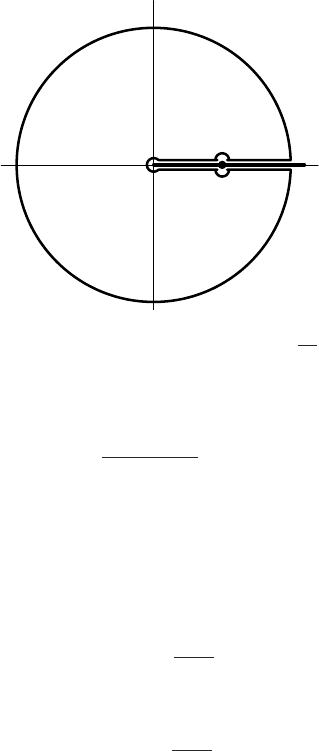
would be a pole on the contour. To handle that situation, we employ the contour shown in
Fig. 2.8 for which the segments on either side of the positive real axis are proportional to
the principal value of the desired integral.
This contour encloses no poles, so that
b<0
C
z
a
z b
z 0 (2.66)
The integral around the great circle vanishes, as before, but we now have two small semi-
circular indentations to evaluate. Using z b
Θ
z
Θ
Θ, both contributions
2.6 Reduction to Tabulated Integrals 79
x
y
b
Figure 2.8. Contour used to evaluate
0
x
a
xb
x for negative real b.
take the form
lim
!0
Θ
2
Θ
1
b
Θ
a
Θ
Θ
Θ b
a
aΦ
Θ
2
Θ
1
b
a
aΦ
$Θ (2.67)
where on the upper semicircle Φ0 and Θ
1
Π, Θ
2
0 $ΘΠwhile on the lower
semicircle we must choose Φ2Π and Θ
1
2Π, Θ
2
Π$ΘΠfor the selected
branch of z
a
. The integrals along the real axis on either side of the branch cut are both
principal-value integrals with different phase factors because on the upper side z
a
x
a
while on the lower side z
a
x
a
2Πa
. Thus, we obtain
1
2Πa
0
x
a
x b
x Πb
a
1
2Πa
(2.68)
and conclude
b<0
0
x
a
x b
x b
a
ΠCotΠa (2.69)
Notice that the cut does not diminish the influence of the pole – choosing the cut to run
over the pole does not mask it; we could have placed the cut somewhere else if that had
been more convenient.
2.6 Reduction to Tabulated Integrals
Some integrals that cannot be evaluated in terms of elementary functions occur sufficiently
frequently to merit naming as special functions. Among the most useful are the gamma
function
Ax
0
t
x1
t
t, x>0 (2.70)

80 2 Integration
and its cousins the incomplete gamma function
Ax, a
a
t
x1
t
t, x>0 ,a2 0 (2.71)
and the beta function
Br, s
ArAs
Ar s
1
0
t
r1
1 t
s1
t (2.72)
Also important are the sine and cosine integrals
Six
x
0
t
t
Sint Cix
x
t
t
Cost (2.73)
and the exponential integrals
E
n
x
1
t
t
n
xt
Eix
x
t
t
t
(2.74)
The error function Erfx and complementary error function Erfcx1 Erfx are
defined by
Erfx
2
Π
x
0
t
t
2
Erfcx
2
Π
x
t
t
2
(2.75)
while their trigonometric cousins are the Fresnel sine and cosine functions
Sx
x
0
t Sin
Πt
2
2
Cx
x
0
t Cos
Πt
2
2
(2.76)
Once an integral has been reduced to one of these special functions, it can be considered
done because these functions have been studied and tabulated extensively and are also
available in many mathematical software packages.
2.6.1 Example:
x
4
x
The integral
I
x
4
x 2
0
x
4
x (2.77)
can be expressed in terms of a gamma function using the variable transformation
y x
4
y 4x
3
x x
1
4
y
3/ 4
y (2.78)
whereby
I
1
2
0
y
3/ 4
y
y
1
2
A
1
4
(2.79)
is obtained directly.

2.6 Reduction to Tabulated Integrals 81
2.6.2 Example: The Beta Function
A surprisingly wide variety of integrals can be expressed in terms of the beta function
Bp, q
ApAq
Ap q
(2.80)
where p, q are generally complex. For the present purposes it will be sufficient to assume
that p, q are nonnegative real numbers so that we can employ the simplest integral repre-
sentation
Ap
0
u
u
p1
u (2.81)
for the more familiar gamma function. The substitution u ! x
2
provides
Ap
0
u
u
p1
u 2
0
x
2
x
2p1
x (2.82)
such that
ApAq4
0
0
x
2
y
2
x
2p1
y
2q1
x y
4
Π/ 2
0
0
r
2
CosΘ
2p1
SinΘ
2q1
r
2p2q1
r Θ
(2.83)
can be represented as integral over the first quadrant in polar coordinates. The radial inte-
gral can be performed in terms of the gamma function
0
r
2
r
2p2q1
r
1
2
Ap q (2.84)
such that
Π/ 2
0
CosΘ
2p1
SinΘ
2q1
Θ
ApAq
2Ap q
1
2
Bp, q (2.85)
is expressed in terms of the beta function. The left-hand side would probably appear for-
midable to the uninitiated! We will find both gamma and beta functions very useful as the
course progresses. Several additional variations are developed in the exercises.
2.6.3 Example:
0
Ω
n
ΒΩ
1
Ω
Integrals of this form appear in the statistical mechanics of Bose systems. Here we assume
that Α > 0 and that n is a nonnegative integer. The integrand can be expanded as a power
series in the small quantity
ΒΩ
, such that
0
Ω
n
ΒΩ
1
Ω
0
Ω
n
ΒΩ
1
ΒΩ
Ω
m1
0
Ω
n
ExpmΒΩ Ω (2.86)

82 2 Integration
We evaluated the integrals on the right-hand side using parametric differentiation at the
beginning of this chapter. Using that result, we write
0
Ω
n
ΒΩ
1
Ω
n!
Β
n1
m1
1
m
n1
n!
Β
n1
Ζn 1 (2.87)
where the Riemann zeta function is defined by
Ζz
m1
1
m
z
(2.88)
for Rez > 1. Special values for integer arguments can be expressed in terms of the
Bernoulli numbers and evaluated in closed form, but for our purposes we can consider the
problem solved because the properties of the Riemann zeta function are well established
and one can find numerical values in standard tables or mathematical software. Alterna-
tively, the series can be evaluated numerically in a straightforward manner, if necessary.
More generally, we combine the same expansion with variable transformations to write
0
Ω
Α
ΒΩ
1
ΩΒ
Α1
0
t
Α
t
1
t
t Β
Α1
m1
0
t
Α
Expmtt
Β
Α1
0
s
Α
Expss
m1
m
Α1
(2.89)
Thus, we identify
ReΑ > 0, ReΒ > 0
0
Ω
Α
ΒΩ
1
Ω Β
Α1
AΑ 1ΖΑ 1 (2.90)
with much less restrictive conditions upon the parameters.
2.7 Integral Representations for Analytic Functions
Special functions motivated by integrals for real variables can usually be extended into a
portion of the complex plane simply by replacing the argument by a complex variable and
employing a contour through the domain of analyticity of the integrand. Thus, one can
define the complex sine integral by
Siz
z
0
t
t
Sint (2.91)
where the contour is any path between the indicated endpoints in the complex t-plane.
This case is particularly simple because the integrand is entire – there is no danger of
encountering singularities or branch cuts during integration. Similarly, the error function
can be extended to the entire complex plane simply by using a complex argument
Erfz
2
Π
z
0
t
t
2
Erfcz
2
Π
z
t
t
2
(2.92)
2.7 Integral Representations for Analytic Functions 83
Re#t'
Im#t'
z
C
1
C
2
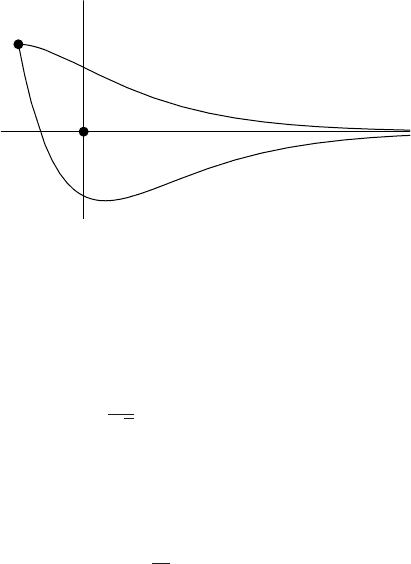
Figure 2.9. Contours for Ciz.
where an upper limit of is interpreted as a path that asymptotically approaches the
positive real axis such that t !R, 0 where R !. It is also useful to define the imaginary
error function ErfizErfz, such that
Erfiz
2
Π
z
0
t
t
2
(2.93)
Conversely, if the integrand is multivalued or has singularities, the definition of a func-
tion by means of an integral representation must constrain the contour enough to produce
a unique value for the integral. For example, the integrand of the complex cosine integral
Ciz
z
t
t
Cost (2.94)
has a simple pole at the origin, with unit residue. Suppose that z is found in the second
quadrant, as shown in Fig. 2.9. The integral along contour C
2
, which dips below the real
axis for Ret < 0 and then approaches the positive real axis from below, differs by 2Π
from the integral for contour C
1
, which remains in the upper half-plane and approaches
the positive real axis from above. (Imagine closing the contour for large Ret where the
integrand is vanishingly small.) Contours which circle the origin several times differ by
multiples of 2Π, representing various branches of a multivalued function. The princi-
pal branch for this function is defined by the requirement that the positive real axis is
approached from above without encircling the origin; this requirement is sufficient to pro-
vide a single-valued definition while still leaving considerable flexibility in the choice of
contour.
The domain of analyticity will often be limited by requirements for the convergence of
the defining integral. For example, the present definition for Ax is limited to x>0, sug-
gesting that straightforward extension to the complex plane would be limited to Rez > 0.
However, we must still be wary of the branch cut needed to establish a unique value for
the integrand when z is not an integer. Thus, for Rez > 0 we could use
Az
0
t
z1
t
t, Rez > 0 (2.95)

84 2 Integration
with the contour in the left side of Fig. 2.10, where the positive real axis is approached from
above. A more general definition can be made by using a theorem of analytic continuation
that we will derive and discuss more thoroughly in a later chapter, which states that if
the functions f
1
z and f
2
z are analytic in domains D
1
and D
2
and if f
1
z f
2
z for
all z D
1
) D
2
, then f
1
and f
2
are representations of the same analytic function f z
within their respective domains and f z is analytic throughout D
1
C D
2
. Therefore, if we
can design an integral representation that provides identical values for Rez > 0 while
avoiding the singularity in the integrand, we would be able to extend the definition of Az
to the entire complex plane. Consider the function
f z
C
t
z1
t
t
C
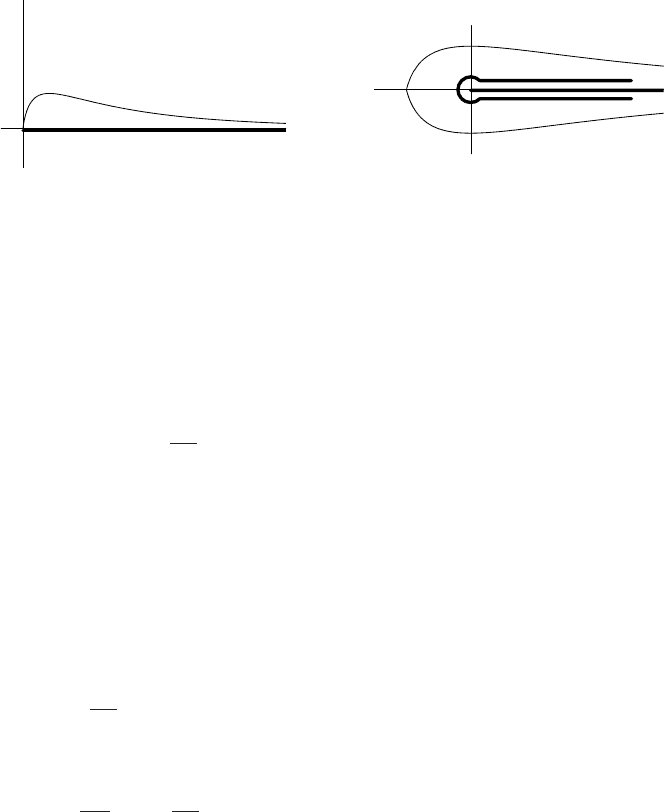
Expt z 1Logt t (2.96)
for the inner keyhole contour around a branch cut on the positive real axis that is shown on
the right side of Fig. 2.10 and is navigated in a counterclockwise sense. The small circle
about the origin does not contribute when Rez > 0. The contributions from either side of
the branch cut differ in phase according to
t x LogtLogx (2.97)
t x LogtLogx2Π (2.98)
such that
f zExp2Πz1
0
t
x1
t
t (2.99)
Thus, we obtain a definition of the gamma function
Az
1
Exp2Πz1
C
t
z1
t
t (2.100)
that can be used for complex variables with positive real parts. The keyhole contour can
now be deformed into the outer contour in the same figure without encountering any sin-
gularities and without altering the value of the integral. We simply require that C enters
from just above the real axis and exits toward just below the real axis without
crossing the positive real axis. Therefore, the proposed integral representation extends the
definition of the gamma function to the entire complex plane. When Rez < 0, one simply
avoids the immediate vicinity of the origin.
It might appear that this integral representation for Az has singularities for any inte-
ger value of z, but the singularities for positive integers are illusory (removable). When
z n is an integer, t
n1
does not require a branch cut such that the contributions from the
segments of the keyhole contour above and below the real axis cancel, leaving only the
small circle about the origin. Alternatively, in the absence of a branch cut the contour can
be deformed into a closed circle about the origin. (We imagine that the original contour is
closed across the real axis so far out that the integrand is vanishingly small.) When n>0
the integrand is analytic and the integral vanishes, leaving a 0/ 0 situation that suggests a
removable singularity whose value should be determined by a limiting process that ensures
2.7 Integral Representations for Analytic Functions 85
Re#t'
Im#t'
Re#t'
Im#t'
Figure 2.10. Left: contour for Az with Rez > 0. Right: more general contours for Az.
continuity. Although we expect that the appropriate value is Ann1!, it is instructive
to demonstrate that this result emerges from a suitable limiting process. Performing Taylor
series expansions around z n,
t
z1
* t
n1
Logtz n , Exp2Πz1 * 2Πz n (2.101)
we find
z * n Az*
1
2Π
C
t
n1
t
Logtt (2.102)
and can employ the keyhole contour for n>0 without obtaining any contribution from the
small circle around the origin because
n>0 lim
!0
n
Log0 (2.103)
Placing the branch cut for Logt immediately below the positive real axis, the contribu-
tions from Logt on opposite sides cancel, leaving the contribution from the phase of
Logt Logt 2Π to give
Az*
1
2Π
0
t
n1
t
2Π t n 1! (2.104)
as expected. When n<0, we use
t
t
t
n1
n
2Π
n!
(2.105)
for a circle about the origin to discover that the residue for a simple pole at z n is
n
/n!. Therefore, the integral representation teaches us that Az is a meromorphic func-
tion with simple poles at negative integers and determines its residues. It should be clear
that the new integral representation offers much more detailed information than the origi-
nal definition on the real axis.
Many special functions have several different integral representations, with one or
another being most useful under differing circumstances or for various purposes. These
integral representations often provide the simplest or most general derivations for the prop-
erties of a function. For example, in the chapter on Asymptotic Series we will use integral