
Kelly J.J. Graduate Mathematical Physics, With MATHEMATICA Supplements
Подождите немного. Документ загружается.


86 2 Integration
representations to study the properties of several useful functions when z is large. There
we take advantage of the flexibility of the contour to concentrate upon a segment which
dominates the integral. However, one must be careful when deforming contours of infi-
nite length because the Cauchy–Goursat theorem on the path-independence of integrals
of analytic functions was derived for finite contours. When one or both of the endpoints
is at infinity, it can matter whether the approach toward infinity is along the real axis, the
imaginary axis, or some intermediate direction. Penalty-free movement of a “free end”
requires that the contribution of an arc of radius R subtending the angle through which the
free end is moved must vanish as R !. Although this requirement should be obvious by
now, from the care with which we studied the return paths for closing a contour of infinite
length, it still bears some repetition. The contours used for integral representations offer
considerable but not unlimited flexibility.
2.8 Using to Evaluate Integrals
2.8.1 Symbolic Integration
Integrals can be entered in typeset form using the BasicInput palette, but if you wish to
modify any options you will need to use the command line. The basic syntax for an indef-
inite integral is
Integrate fx,x
Indefinite integrals like
ans1
x
n
a
x
x
x
1n
Gamma1 n, xLogaxLoga
1n
are returned without constants of integration and can be checked easily by differentiation
Dans1, x / / Simpli fy
a
x
x
n
The integral above is expressed in terms of the incomplete gamma function.
makes no aprioriassumptions about the variable of integration or the con-
stants, so that the result applies to either real or complex variables and parameters. How-
ever, it also makes no assumption regarding the values of parameters, returning results for
generic values that are not always valid for special values of the parameters. Thus, the
simple integral
x
a
x
x
1a
1 a
is not valid if a happens to have the value 1.
2.8 Using to Evaluate Integrals 87
The basic syntax for a definite integral is
Integrate fx, x, a, b
The limits of integration may be numerical, symbolic, or infinite. In early versions any
symbolic parameters or limits would also be interpreted in a generic sense. Thus, one
would obtain a result for
b
a
x
n
x
b
n1
a
n1
n 1
(2.106)
that would valid for most choices of parameters, but fails for n 1, while
b
a
x
1
x LogbLoga (2.107)
would fail for negative limits of integration. In more recent versions usually
returns conditional results
1
0
x
n
x
If
Ren > 1,
1
1 n
, Integrate
x
n
, x, 0, 1, Assumptions Ren1
b
a
x
n
x
a b If
Re
a
a b
1
Re
a
a b
0
Im
a
a b
0,
a
1n
b
1n
a b1 n
, Integrate
a a bx
n
, x, 0, 1,
Assumptions !
Re
a
a b
1
Re
a
a b
0
Im
a
a b
0
b
a
x
1
x
a b If
Re
a
a b
1
Re
a
a b
0
Im
a
a b
0,
LogaLogb
a b
, Integrate
1
a a bx
, x, 0, 1,
Assumptions !
Re
a
a b
1
Re
a
a b
0
Im
a
a b
0
that test any parameters that appear either in the integrand or the limits of integration.
Although such results are less attractive and the conditions are often expressed in unnec-
essarily complicated forms, there is less chance of obtaining incorrect answers due to
careless unstated assumptions about the parameters. Although one can use the option Gen-
erateConditions ! False
Integrate
x
n
, x, a, b, GenerateConditions False
a
1n
b
1n
1 n

88 2 Integration
to obtain a simple expression instead of a conditional statement, we strongly discourage
that reckless practice and recommend instead that one supply the assumptions that apply
to the parameters in your integrand directly, as follows.
Integrate
x
n
, x, a, b, Assumptions Ren > 1,0<a<b
a
1n
b
1n
1 n
claims to be able to produce practically any integral in standard compi-
lations, such as the massive compilation by Gradshteyn and Ryzhik. Thus, one finds that
many seemingly unpromising integrals can be evaluated in terms of recognizable functions
even if the output appears complicated. However, despite its impressive versatility, there
remains a nontrivial error rate in the symbolic integration package. We decline to present
specific examples here because each revision of the program seems to correct some errors
while introducing new ones. Nevertheless, investigation of most (but not all) disagree-
ments you find with will eventually show that you have made a mistake.
The software is good, but not perfect! Therefore, it remains useful to be able to perform
such integrals independently. Furthermore, any result that is important should be checked.
A very useful method for checking a symbolic integral is to compare with numerical eval-
uation for representative choices of the parameters. This technique cannot prove that a
result is valid for all parameters satisfying the requisite conditions, but it will sometimes
find errors.
Moral: trust but verify!
2.8.2 Numerical Integration
The basic syntax for numerical integration is
NIntegrate fx, x, a, b
where the limits must be numerical and the integrand must evaluate to a number when
given a numerical value for x. Numerical integration is generally more reliable than sym-
bolic integration. Symbolic integration requires a vast library of pattern-matching rules for
which it is difficult to ensure that all special cases are handled properly, while numeri-
cal integration is much more mechanical. The basic technique for numerical integration is
to sample the integrand at strategically located positions, construct an interpolating poly-
nomial, and then integrate the polynomial. The accuracy of the integral can be tested by
subdividing the interval and applying the method to smaller parts. One can also sample
more points where the integrand changes most rapidly. Many reliable algorithms have
been developed and the one used by is quite good. If it does encounter
trouble with a particular integrand, there are options that can often be used to overcome
those difficulties. If the difficulties persist, one should examine the integrand and handle
its singularities more carefully.

Problems for Chapter 2 89
2.8.3 Further Information
More information about integration using , including multiple integrals and
symbolic and numerical contour integration, can be found in calculus.nb at my Essential-
Mathematica website.
Problems for Chapter 2
You may use to check your work, but do not trust its symbolic integration
too much. When evaluating integrals, you must specify the contour, convincingly justify
neglect of any vanishing portions, and define phases near any branch cuts carefully. Be
sure to consider special cases and be alert to possible generalizations.
1. Some related trigonometric integrals
Evaluate
2Π
0
Θ
a b CosΘ
for a>b>0 (2.108)
using contour integration and then deduce
2Π
0
Θ
a b CosΘ
2
and
2Π
0
CosΘ Θ
a b CosΘ
2
(2.109)
by more elementary means.
2. Trigonometric integrals on unit circle
a)
2Π
0
SinΘ
2
1 a CosΘ
Θ for 1 <a<1 (2.110)
b)
2Π
0
ExpCosΘ CosnΘSinΘ Θ for integer n (2.111)
c)
Π
0
SinΘ
2n
Θ for nonnegative integer n (2.112)
d)
2Π
0
Θ
a b CosΘ
for arbitrary complex a, b (2.113)
3. Magnetic flux through circle from coplanar wire
An infinitely long wire carries current . Compute the magnetic flux through a coplanar
circle of radius a that is at a distance d from the wire, where d 2 a. Compare the limits
d D a and d a.

90 2 Integration
4. Average power radiated by charged harmonic oscillator
The angular distribution for the power radiated by a charge in simple harmonic motion
with amplitude a and frequency Ω is given by
P
E
K SinΘ
2
CosΩt
2
1 ΒCosΘ SinΩt
5
(2.114)
where ΒaΩ/c is the amplitude for the velocity oscillation (relative to light speed) and
K e
2
a
2
Ω
4
/ 4Πc
3
. Evaluate the angular distribution of radiated power averaged over a
period. Finally, evaluate the total average power integrated over angles.
5. Assorted integrals on infinite range
Use contour integration to evaluate the following integrals.
a)
0
1
1 x
n
x where n>1 is a positive integer. (2.115)
(Hint: try an arc subtending 2Π/nradians.)
b)
CospxCosqx
x
2
x with p, q real (2.116)
c)
Coskx
1 x
3
x with k real (2.117)
d)
0
Cosax
x
2
b
2
2
x for real a, b, b > 0 (2.118)
e)
0
Sinax
x
x
2
b
2
x for real a, b, b > 0 (2.119)
f)
x Sin2Θ
1 x
2
1 2x CosΘ x
2
x for 0 Θ2Π (2.120)
g)
x
Coshkx
with k real and nonzero (2.121)
6. An integral from diffraction theory
Evaluate
Sin
2
x
x
2
x (2.122)

Problems for Chapter 2 91
7. Integrals used in Fourier transform of oscillator wave functions
a) Evaluate
0
ax
2
Cosbxx (2.123)
for a, b > 0.
b) Produce a general method for evaluating integrals of the form
0
ax
2
x
2n1
Sinbxx (2.124)
with a, b > 0 and integer n 2 0. Display explicit results for n 0, 1.
Integrals of this type arise in the Fourier transform of oscillator wave functions.
8. Integration around branch cuts
a) Evaluate
1
1
x
a bx
1 x
2
with a>b>0 (2.125)
using a suitable contour. (Hint: put the branch cut on the integration interval and define
phases carefully.)
b) Evaluate
0
ln x
1 x
2
x (2.126)
using a suitable branch of Logz.
c) Evaluate
0
ln x
2
1 x
2
x (2.127)
using a suitable branch of Logz.
d) Evaluate
1
0
x
1/ 4
1 x
3/ 4
1 x
3
x (2.128)
using a suitable contour. (Hint: put the branch cut on the integration interval and define
phases carefully.)
e) Evaluate
0
x
a
1 x
4
x (2.129)
for complex a and specify the conditions required for convergence.
92 2 Integration
f) Evaluate
0
x
a
1 x
n
x (2.130)
for complex a and integer n and specify the conditions required for convergence.
g) Evaluate
1
0
x
a1
1 x
a
x (2.131)
for 0 < Rea < 1. (Hint: try a large circular contour and then deform the contour to snugly
embrace the branch cut.)
h) Evaluate
0
x
Λ
x a
x (2.132)
for real a>0 and real 0 < Λ < 1.
i)
0
x
1/ 4
x
2
x 2
x (2.133)
9. Using
0
gxx !
C
Logzgzz for meromorphic integrands
Consider an integral of the form
0
gxx (2.134)
where gx is well-behaved on the positive real axis but is not symmetric with respect to
the sign of x, such that the integration interval cannot be extended for use with a great
semicircle. If the corresponding gz is a meromorphic function that decreases sufficiently
rapidly for z !and is sufficiently small at the origin, one can often use f zgzLogz
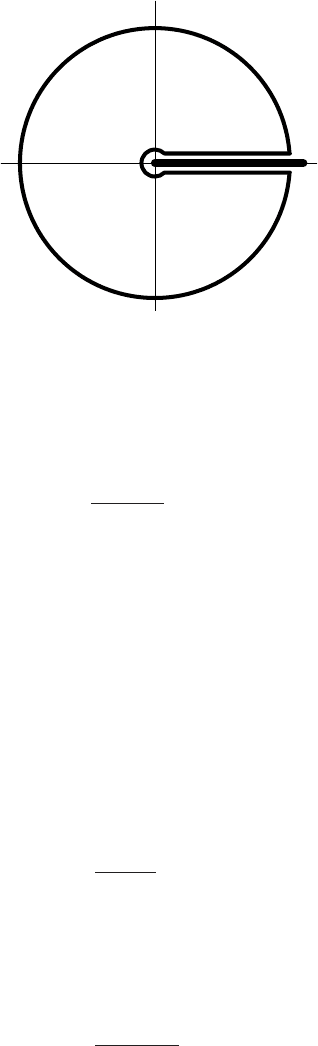
with a branch cut on the positive real axis and a PacMan contour of the form shown in
Fig. 2.11. Apply this method for the following integrals.
a)
0
x
x 1
x
2
2x 2
(2.135)
b)
0
x
x
3
1
(2.136)
10. Reduction to standard functions
Express the following integrals in terms of standard functions.
a)
0
x
m
x
n
x for n>0 (2.137)
Problems for Chapter 2 93
x
y
Figure 2.11. Contour used for
0
gxx !
C
Logzgzz.
b)
0
ax
2
Sinbxx with a, b > 0 (2.138)
c)
0
Ω
Ω
Α
Ω
1
2
Ω with Α > 1 (2.139)
11. Using the beta function
Express each of the following integrals in terms of the beta function and then in terms of
more familiar gamma functions. Be sure to identify the conditions that must be satisfied
by the parameters in each integral.
a)
1
0
t
r1
1 t
s1
t (2.140)
b)
1
0
u
r
1 u
2
s
u (2.141)
c)
0
u
r
1 u
s
u (2.142)
d)
1
1
1 x
r
1 x
s
x (2.143)
e)
0
Sinhx
a
Coshx
b
x Hint: use Sinhx
2
! u and the result of c. (2.144)
94 2 Integration
12. Beta probability distribution
The probability density for the so-called beta distribution is proportional to
Px-x
a1
1 x
b1
(2.145)
for 0 x 1 where a, b are nonnegative constants. Evaluate the normalization, mean, and
variance for this distribution.
13. oscillation period in potential V kx
2n
/ 2
A classical particle with mass m and total energy E oscillates in a potential of the form
V kx
2n
/ 2 where n is a positive integer. Determine its oscillation period. Can you gener-
alize this result?

3 Asymptotic Series
Abstract. Asymptotic series describe the behavior of a function for large values of
an argument. The leading asymptotic behavior can often be deduced from an integral
representation using the method of steepest descent. Repeated partial integration or
expansion of the integrand provide series that improve upon the leading approxima-
tion.
3.1 Introduction
Often we must characterize the behavior of a function of z when z becomes very large.
For example, in scattering theory we require the asymptotic behavior of Bessel functions.
An asymptotic expansion for f z maytaketheform
f z Fzgz (3.1)
where Fz represents the leading asymptotic behavior in terms of familiar functions, often
exponential or logarithmic, while the asymptotic series
gz
k0
a
k
z
k
(3.2)
represents a correction factor expanded in inverse powers of z. Ordinarily we normalize
the series such that a
0
1. However, in the common situation that the ratio f z/ Fz has
an essential singularity at z !, the series for gz diverges. Nevertheless, for any finite
value of z there may be a truncated series
g
n
z
n
k0
a
k
z
k
(3.3)
which provides a very good approximation to f z/ Fz with an accuracy that improves
as z increases. The sequence of analytic functions f
n
zFzg
n
z is then said to con-
verge asymptotically to f z. More formally, the function f
n
is described as asymptotically
equal to f z if
lim
z!
f z f
n
z 0 f
n
z f z (3.4)
such that their difference becomes arbitrarily small if z is sufficiently large. This relation-
ship is represented by the operator or sometimes G. A series is asymptotically convergent
if
lim
z!
z
n
f z
Fz
g
n
z
0 f
n
zFzg
n
z f z (3.5)
Graduate Mathematical Physics. James J. Kelly
Copyright © 2006 WILEY-VCH Verlag GmbH & Co. KGaA, Weinheim
ISBN: 3-527-40637-9