
Kelly J.J. Graduate Mathematical Physics, With MATHEMATICA Supplements
Подождите немного. Документ загружается.

166 5 Integral Transforms
Re s
Im s
J
Ç
JÇ
t0
Re s
Im s
JÇ
JÇ
t!0
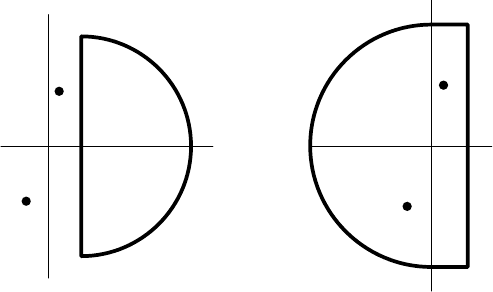
Figure 5.17. Contours for the inverse Laplace transform. We must choose Γ to place the primary
vertical segment to the right of any singularities. Here we show just two poles; additional detours
may be needed to avoid branch cuts in the left half-plane.
of s, the inversion is performed in the complex s-plane using the domain in which
˜
f s is
analytic. Contours for inversion of a Laplace transform are sketched in Fig. 5.17, where the
heavy dots indicate isolated singularities. The region to the left of the vertical portion of
the contour may also contain branch cuts, if needed to define a single-valued function
˜
f s.
When t<0 we close the contour using a great semicircle in the right half-plane, on which
the integrand vanishes in the limit of infinite radius, and conclude that f t<00
because no singularities are enclosed. This result is consistent with the requirements on f
needed for application of the Laplace transform. When t>0 we close the contour using
a great semicircle in the left half-plane, with detours around any branch cuts. The residue
theorem can be used to evaluate the contour integral, but to extract the inverse function we
may need to subtract contributions of unwanted portions of the contour.
Notice that when s ! 0 the Laplace transform becomes the total integral
s ! 0 f
0
f tt (5.201)
However, it is not necessary for this integral to exist for the Laplace transform to exist.
Existence of the Laplace transform requires that for any positive M there exists a real
number Γ such that
Γt
f t
M is bounded for large t. A function satisfying this condi-
tion is described as exponentially bounded. Thus, the Laplace transform of
Λt
for positive
Λ exists in the domain Res > Λ even though its total integral does not. On the other hand,
Expt
2
does not have a Laplace transform because it is not bounded by an exponential
of t. Nor does the Laplace transform exist for t
n
when n>1 because the transformation
integral is divergent at its lower end.
5.6 Laplace Transform 167
5.6.2 Laplace Transforms for Elementary Functions
Let <t represent the unit step function
<t<00 (5.202)
<t>01 (5.203)
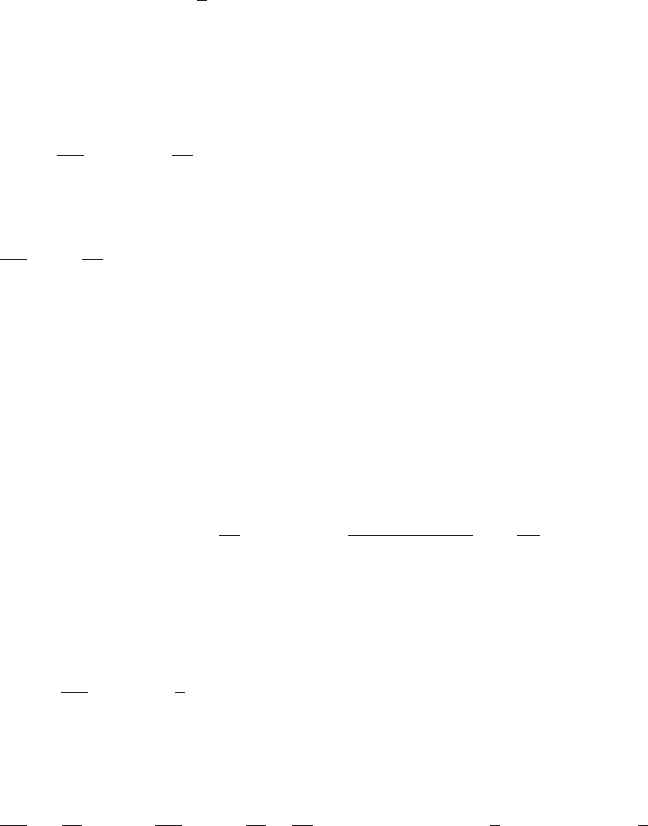
whose Laplace transform
<
0
t
st
<t
1
s
(5.204)
exhibits a simple pole at the origin with unit residue. We will leave the value at t 0
undefined for the moment, and evaluate it using the inverse Laplace transform. The inverse
transform for t 0 is obtained using
<t
1
2Π
Γ
Γ
s
st
s
(5.205)
where Γ > 0 may be taken arbitrarily small. Consider the contour integral
1
2Π
C
s
st
s
(5.206)
where C consists of a vertical line in the right half-plane closed by a great semicircle of
radius R where R !. The only singularity of the integrand is found at the origin. For
t<0 we choose a great semicircle to the right to ensure that closure does not contribute
and that the contour integral reduces to the inverse Laplace transform; hence, the inverse
transform for t<0 vanishes because no singularities are enclosed by C.Fort>0we
must close in the left half-plane and include two short horizontal segments represented
by s ΓΒR where 0 Β1. The contributions of these segments vanish in the limit
R !because
s ΓΒR
segment
s
st
s
Γ
1
0
Β
ExpΓΒ Rt
ΓΒ R
Γ
Γt
R
! 0 (5.207)
Thus, the contour integral again reduces to the inverse Laplace transform but this time has
the value unity because a single pole with unit residue is enclosed. For t 0wemustbe
more careful because the inversion integral takes the form
<0
1
2Π
Γ
Γ
s
1
s
(5.208)
and the contribution of a great semicircle does not vanish. On the contrary, if we close to
the right
1
2Π
C
s
s
lim
R!
1
2Π
ΓR
ΓR
s
s
1
2Π
Π/ 2
Π/ 2
Θ
<0
1
2
0 <0
1
2
(5.209)

168 5 Integral Transforms
or if we close to the left
1
2Π
C
s
s
lim
R!
1
2Π
ΓR
ΓR
s
s
1
2Π
3Π/ 2
Π/ 2
Θ
<0
1
2
1 <0
1
2
(5.210)
where the short horizontal segments can be neglected and where one choice encloses a
pole, while the other does not. Either way, we find that the consistent definition of the step
function in terms of the inverse Laplace transform of s
1
requires <t 01/ 2.
The same result can be obtained using Γ!0 and a contour C consisting of the imagi-
nary axis and an infinitesimal semicircular detour around the origin that ventures into the
right half-plane. For t<0 we again close C to the right while for t>0 we close to the left
and recover the previous results. For t 0 we obtain
t 0
C
s
st
s
2Π
s
s
Π<0
1
2
(5.211)
and is composed of a principal-value integral that gives the inverse transform and the
contribution of the semicircular detour. Therefore, combining these results we obtain
1
2Π
Γ
Γ
s
st
s
<t (5.212)
and recover the original function. Obvious, perhaps, but the unit step function is an implicit
factor for any function for which one applies the Laplace transform because the require-
ment f t<00 can be met by the replacement f t! f t<t. However, if f 00,
there are sometime subtle problems in limits t ! 0
related to the value of <0. These are
usually harmless, but may require careful analysis.
Next consider an exponential function for t>0 whose Laplace transform
f t
Αt
<t
˜
f s
0
t
st
Αt
1
s Α
for s>ReΑ (5.213)
exhibits a simple pole with unit residue at s Α. If the real part of Α is positive, the pole
is in the right half-plane. Thus, poles in the right half-plane correspond to exponentially
growing functions and convergence of the inverse Laplace transform requires Γ to be suf-
ficiently large to overcome the strongest of these exponential features. Poles in the left
half-plane correspond to exponentially decreasing contributions which pose no difficulties
for the inversion procedure. The imaginary parts of these poles correspond to oscillatory
features in the original function. The unit step function without an exponential factor is
equivalent to an exponential with Α0 and contributes a pole at the origin. The Laplace
transforms for trigonometric functions are easily deduced from that for an exponential,
whereby
SinΩt
1
2
1
s Ω
1
s Ω
Ω
s
2
Ω
2
(5.214)

5.6 Laplace Transform 169
CosΩt
1
2
1
s Ω
1
s Ω
s
s
2
Ω
2
(5.215)
Notice that when
s ! 0
SinΩt
!
1
Ω
,
CosΩt
! 0 (5.216)
we obtain finite values for the improper integrals
0
t SinΩt
1
Ω
(5.217)
0
t CosΩt0 (5.218)
that are consistent with earlier results obtained with the aid of a convergence factor (see
Sec. 2.2.2).
If the Laplace transform is a rational function, often the simplest inversion method is
to expand in partial fractions and sum the resulting exponential functions. For example,
given
˜
f s
s
s as b
1
a b
a
s a
b
s b
(5.219)
we can immediately determine
f t
a
at
b
bt
a b
(5.220)
without performing contour integration.
The Laplace transform has a simple shifting property
˜
f s a
0
t
sat
f t
at
f t
(5.221)
which permits one to deduce
Γt
SinΩt
Ω
s Γ
2
Ω
2
(5.222)
Γt
CosΩt
s Γ
s Γ
2
Ω
2
(5.223)
effortlessly. Conversely, if we apply a step function to f t to ensure that the integrand
vanishes for t<0, as required for the Laplace transform, multiplying the transform by an
exponential
Αs
˜
f s
0
t
stΑ
f t
Α
t
st
f t Α
0
t
st
f t Α<t Α
(5.224)
170 5 Integral Transforms
has the effect of shifting the integrand. Hence, we find
f t Α<t Α
Αs
˜
f s (5.225)
Finally, consider the delta function ∆t t
0
with t
0
> 0, for which
∆t t
0
st
0
1
st
0
∆t t
0
(5.226)
In the limit t
0
! 0
, we find formal results
t
0
! 0
∆t
1
1
1∆t (5.227)
that are often useful in initial-value problems. Although this result is similar to that for
Fourier transforms, we must remember that the Laplace transform is limited to t>0.
5.6.3 Laplace Transform of Derivatives
The Laplace transform finds some of its most important applications in the solution of
differential equations. The Laplace transform of a derivative
f
'
t
0
t
st
f
'
t
st
f t
0
s
0
t
st
f t (5.228)
can be integrated by parts. Assuming that f t remains finite as t !or restricting
Res > Γ, we obtain
f
'
t
s
f t
f 0
(5.229)
where the integration constant is evaluated in the limit t ! 0
for infinitesimal positive t.
Iteration now gives
f
''
t
s
2
f t
sf0
f
'
0
(5.230)
or, more generally,
f
n
t
s
n
f t
n1
k0
s
n1k
f
k
0
(5.231)
Therefore, when we apply the Laplace transform to a linear differential equation, the initial
conditions become part of the resulting algebraic equation, making this technique particu-
larly useful for initial-value problems. The Fourier transform, on the other hand, is often
more useful for boundary-value problems.
It is also useful to consider derivatives of the transform
˜
f s
0
t
st
f t
˜
f
'
s
0
t
st
tft (5.232)
5.6 Laplace Transform 171
whereby
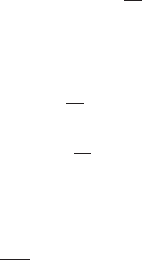
tft
s
(
(s
˜
f s (5.233)
Thus, the Laplace transform of t
n
f t is related to f by the operator
t B
(
(s
(5.234)
t
n
B
(
(s
n
(5.235)
Alternatively, using
st
t
s
Σ
Σt
(5.236)
and changing the order of integration in
0
tt
1
st
f t
0
t
s
Σ
Σt
f t
s
Σ
0
t
Σt
f t (5.237)
we obtain
t
1
f t
s
Σ
˜
f Σ (5.238)
Thus, while positive powers of t are related to differentiation, negative powers of t are
related to integration of the Laplace transform with respect to the conjugate variable s.
5.6.4 Convolution Theorem
Consider a function f t obtained by the convolution of gΤ and ht Τover the finite
interval 0 Τt, such that
f g P h h P g ft
t
0
gΤht ΤΤ
t
0
hΤgt ΤΤ (5.239)
We wish to demonstrate that the Laplace transform satisfies a convolution theorem
g P hgh (5.240)
which is similar to that for Fourier transforms. We assume that both g and h are expo-
nentially bounded so that their Laplace transforms exist. The Laplace transform of the
convolution is then given by an integral
˜
f s lim
T!
T
0
t
st
t
0
ΤgΤht Τ (5.241)
172 5 Integral Transforms
over a triangular area in the (t,Τ) plane. Assuming that we can change the order of inte-
gration
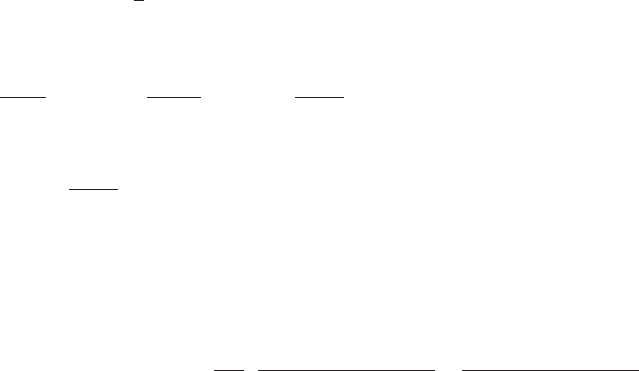
˜
f s lim
T!
T
0
ΤgΤ
T
Τ
t
st
ht Τ (5.242)
and using the variable change u t Τ,
˜
f s lim
T!
T
0
Τ
sΤ
gΤ
TΤ
0
u
su
hu (5.243)
we obtain an integral over a triangular region of the (u, Τ) plane. Recognizing that hu is
exponentially bounded, the relative contribution to the inner integral
˜
f s lim
T!
T
0
Τ
sΤ
gΤ
T
0
u
su
hu
T
TΤ
u
su
hu
(5.244)
made by the region T Τ<u<Tbecomes negligible as T !. Therefore, we obtain
˜
f s˜gs
˜
hs (5.245)
as desired.
The important role of the Laplace convolution theorem in the solution of inhomoge-
neous differential equations, similar to the analogous theorem for the Fourier transform,
will be explored soon and in the exercises. It can also be used to evaluate Laplace trans-
forms for functions defined by definite integrals. By interpreting a definite integral as a
convolution with the step function
t
0
f t
'
t
'
B
t
0
<t t
'
f t
'
t
'
(5.246)
we obtain
t
0
f
t
'
t
'
1
s
f t
(5.247)
whenever f exists. For example, using
Sint
t
s
Σ
1
Σ
2
1
s
1
0
x
1
1 x
2
ArcTans
1
(5.248)
the Laplace transform of the sine integral function becomes
Sit
t
0
Sinx
x
x Sis
1
ArcTans
1
(5.249)
The convolution theorem can also be used as an alternative to the partial-fraction decom-
position. For example, we can use
1
s Α
1
s
2
Ω
2
1
Ω
1
t
0
Αtt
'
SinΩt
'
t
'
1
2Ω
ExpΑt t
'
Ωt
'
ΑΩ
ExpΑt t
'
Ωt
'
ΑΩ
t
0
(5.250)

5.7 Green Functions via Laplace Transform 173
to find
1
s Α
1
s
2
Ω
2
1
Αt
CosΩt
Α
Ω
SinΩt
Α
2
Ω
2
(5.251)
5.6.5 Summary
A brief table of Laplace transforms and their properties is given in Table 5.5. Note that
we assume that t,t
0
> 0 throughout and that initial conditions enter for t ! 0
.The
parameters t
0
, Ω, Γ, and Λ are real. We also assume that the required derivatives exist and
integrals converge. Be careful in applying theorems for derivatives and other operations to
functions with discontinuities.
Table 5.5. Brief table of Laplace transforms.
Type f t
˜
f s
definition f t
1
2Π
Γ
Γ
s
st
˜
f s
˜
f s
0
t
st
f t
step function <t s
1
delta function ∆t t
0
st
0
shifting f t t
0
<t t
0
st
0
˜
f s
attenuation
Γt
f t
˜
f s Γ
dilatation f ΛtΛ
1
˜
f s/Λ
convolution f t
t
0
gΤht ΤΤ
˜
f s˜gs
˜
hs
derivatives f
'
t
f
''
t
s
˜
f s f 0
s
2
˜
f ssf0
f
'
0
integral
t
0
f t
'
t
'
s
1
˜
f s
powers t
Ν
AΝ 1/s
Ν1
multiplication by powers tft
t
1
f t
˜
f
'
s
s
˜
f Σ Σ
exponential
Γt
<t 1/ s Γ
trigonometric SinΩt
CosΩt
Ω/ s
2
Ω
2
s/s
2
Ω
2
periodic f t nTgt
˜
f s1
sT
1
T
0
t
st
gt
5.7 Green Functions via Laplace Transform
Like the Fourier transform, the Laplace transform can be very useful in analyzing the
response of a linear system to external stimuli. An advantage of the Laplace transform is
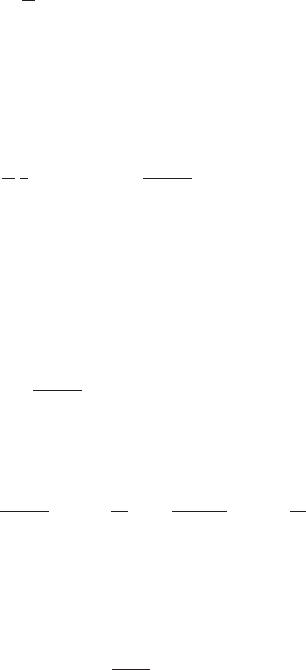
174 5 Integral Transforms
that initial conditions are included automatically. In this section we illustrate this technique
using a few relatively simple examples.
5.7.1 Example: Series RC Circuit
The current in a simple RC circuit with a variable voltage source Vt satisfies
RIt
1
C
t
0
I
t
'
t
'
V t (5.252)
where we assume that the circuit is quiescent for t<0 (no current and discharged capaci-
tor). Although this can be converted into a differential equation for the stored charge, it is
instructive to solve the problem as an integral equation instead. The Laplace transform for
this simple integral equation gives
R
˜
I
1
C
˜
I
s
˜
V
˜
I
s
1 sΤ
C
˜
V (5.253)
where ΤRC is the characteristic time constant for this circuit. Therefore, the general
solution takes the form of a convolution
It
t
0
Gt t
'
Vt
'
t
'
(5.254)
where the Laplace transform of the Green function is
˜
GsC
s
1 sΤ
(5.255)
The inversion can be accomplished either by using the Bromwich integral or by using the
basic properties of Laplace transforms, whereby
1
s
1 sΤ
Τ
1
(
(t
1
1
s Τ
1
Τ
1
(
(t
t/Τ
<t
Τ
1
Τ
1
t/Τ
<t
t/Τ
∆t
(5.256)
We can drop the step function because this Green function is only used for t>0 and we
can evaluate the coefficient of the delta function at t 0 to obtain the simpler form
GtR
1
∆t
t/Τ
Τ
(5.257)
such that
RItVtΤ
1
t
0
Expt t
'
/ ΤV t
'
t
'
(5.258)
or
RItVtΤ
1
t/Τ
t
0
Expt
'
/ ΤVt
'
t
'
(5.259)

5.7 Green Functions via Laplace Transform 175
For example, suppose that the voltage is constant for t>0. Then
VtV
0
<tRItV
0
1 Τ
1
t/Τ
t
0
Expt
'
/ Τ t
'
V
0
1
t/Τ
t/Τ
1
(5.260)
such that
VtV
0
<tRItV
0
t/Τ
(5.261)
Thus, the current is initially determined by Ohm’s law for R and V
0
but decreases to zero
for long times as the capacitor becomes charged. Although this derivation may be unfa-
miliar, the result should be familiar and agrees with our expectations. For more general
Vt profiles, sometimes it may be easier to invert the Laplace transform
˜
Is and at other
times it is easier to perform the convolution with respect to time. These approaches are
compared in the exercises.
5.7.2 Example: Damped Oscillator
Consider once again the initial-value problem for the damped harmonic oscillator
(
2
(t
2
2Γ
(
(t
Ω
2
0
xt f t ,x0x
0
,x
'
0v
0
(5.262)
where we consider only positive times, t>0, that are suitable for the Laplace transform.
An advantage of the Laplace transform is that the initial conditions are included automat-
ically. Thus, the transformed equation
s
2
˜xssx
0
v
0
2Γs˜xsx
0
Ω
2
0
˜xs
˜
f s (5.263)
reduces to
˜xs˜x
1
s˜x
2
s (5.264)
where
˜x
1
s
x
0
s 2Γ v
0
s
2
2Γs Ω
2
0
x
0
s Γ
s Γ
2
Ω
2
0
Γ
2
v
0
s Γ
2
Ω
2
0
Γ
2
(5.265)
is the solution to the homogeneous equation that depends upon the initial conditions and
˜x
2
s
˜
f s
s
2
2Γs Ω
2
0
(5.266)