
Kelly J.J. Graduate Mathematical Physics, With MATHEMATICA Supplements
Подождите немного. Документ загружается.


196 6 Analytic Continuation and Dispersion Relations
where absolute convergence justifies exchanging the order of integrations. Recognizing
that t
z1
is analytic, the innermost integral vanishes and proves that Az is analytic in the
domain Rez > 0.
Using integration by parts,
Az 1
0
t
z
t
t t
z
t
0
z
0
t
z1
t
t (6.14)
one easily obtains a recursion relation
Az 1zAz (6.15)
that can be used to continue A into the region with Rez < 0. First,
Az
Az 1
z
1 Rez0 ,z 0, 1 (6.16)
provides a definition that now extends in the domain Rez21 excluding z 0, 1. Then,
Az
Az 2
zz 1
2 Rez1 ,z1, 2 (6.17)
extends the domain a little further. By repeating this process indefinitely, we obtain an
analytic continuation
Az
Az n 1
Y
n
k0
z k
with n< Rez <n 1 (6.18)
that extends the definition of Az into the entire complex plane excluding nonpositive
integers. Although this might not be the most convenient representation, the uniqueness
theorem ensures that any analytic function that reproduces Az for positive Rez will pro-
duce the same values in its range of analyticity as produced by the representation above,
and hence is really the same function whatever its superficial appearance might be. We
will study the gamma function in more detail later, developing a wider variety of repre-
sentations and relationships, but the present analysis suffices to demonstrate the power of
analytic continuation.
6.2 Dispersion Relations
6.2.1 Causality
Often there are physical arguments, such as causality, that justify extension of a function
of a real variable into the complex plane as an analytic function of the complex variable
whose real part is experimentally accessible. For example, the propagation of an electro-
magnetic wave through a homogeneous isotropic medium is represented by a complex
refractive index of the form ˜n n a where nΩ and aΩ are real functions of fre-
quency Ω that govern the phase velocity and absorption of the wave. These properties
depend upon the electromagnetic properties of the constituents and the collective response

6.2 Dispersion Relations 197
of the system to an electromagnetic field. The dependence of phase velocity upon fre-
quency is known as dispersion. Using quite general arguments based upon causality, one
argues that the combined function ˜nΩ nΩ aΩ is an analytic function of com-
plex frequency whose real and imaginary components reduce to the refractive index and
absorption coefficient on the physical (real) axis. The theory of analytic functions then
provides some very powerful relationships between the dispersive (refractive) properties
and the absorptive properties of the system, known as dispersion relations. Dispersion
relations were first derived by Kramers and Kronig for electromagnetic theory but have
since found widespread application in many areas of physics, including nuclear, particle,
and condensed matter physics. Rather than develop the theory of dispersion relations for
arbitrary analytic functions, we illustrate the general approach using the specific case of
electromagnetic waves in a dielectric medium.
Consider a plane wave of the form Exp
kx Ωt
where the wave number is given by
k ˜n
Ω
c
Ω
c
ΜΕ n a
Ω
c
(6.19)
where ˜nΩ is the complex refractive index and ΕΩ is the dielectric permittivity. For
simplicity we will assume that the medium is nonconducting and nonmagnetic (Μ1),
such that ˜n
2
Ε. Identifying the real and imaginary parts of ˜nΩ as nΩ and aΩ,the
plane wave
Φ-Exp
kx Ωt
Exp
nx ctΩ/c
ExpΑx/2Φ
2
-
Αx
(6.20)
propagates with phase velocity c/n but is absorbed with attenuation length Α
1
c/2Ωa
(reduced in intensity by the factor
1
in distance Α
1
). In Gaussian units the dielectric
permittivity is related to the electric susceptibility Χ by
Ε1 4ΠΧ (6.21)
where the polarization of the medium is related to the electric field by P ΧE.
Next consider the electric displacement DΩ ΕΩEΩ for a wave packet
Dt
1
2Π
Ω
Ωt
DΩ
1
2Π
Ω
Ωt
ΕΩEΩ (6.22)
where
EΩ
t
Ωt
Et (6.23)
Assuming that the integrals converge and interchanging the order of integrations, we obtain
Dt
1
2Π
Ω
Ωt
ΕΩ
t
'
Ωt
'
Et
'
1
2Π
ΤEt Τ
Ω
ΩΤ
ΕΩ
(6.24)

198 6 Analytic Continuation and Dispersion Relations
where Τt t
'
. Then substituting Ε!1 4ΠΧ, we find
Dt
1
2Π
ΤEt Τ
2Π∆Τ 4Π
Ω
ΩΤ
ΧΩ
(6.25)
or
DtEt
Τ Et ΤGΤ (6.26)
where the first term is the incident plane wave in the absence of the medium, while the
second term arises from the contribution of charges in the medium governed by a response
function of the form
GΤ
1
2Π
Ω
ΩΤ
ΕΩ 1
(6.27)
Physically we expect that the response of the system at time t can only depend upon fields
at earlier times t
'
<tΤ> 0. This notion that effects must follow their causes is known
as the causality principle. Therefore, we expect GΤ to vanish for Τ < 0 independent of
any specific properties of the system and can write
DtEt
0
ΤEt ΤGΤ (6.28)
Equations of this form are typical expressions of the delayed response of a linear system to
a driving force. If the damping is weak the present amplitude may be amplified by coherent
contributions from many earlier vibration periods.
We also expect that Ω!Χ!0 Ε!1 for extremely high frequencies
where the electromagnetic field oscillates too rapidly for any charged particles with inertia
to respond. Under these conditions the integral for the response function converges for real
values of Ω. Suppose that we allow Ω to be a complex variable and define
Τ
1
2Π
C
ΩΤ
ΕΩ 1
Ω (6.29)
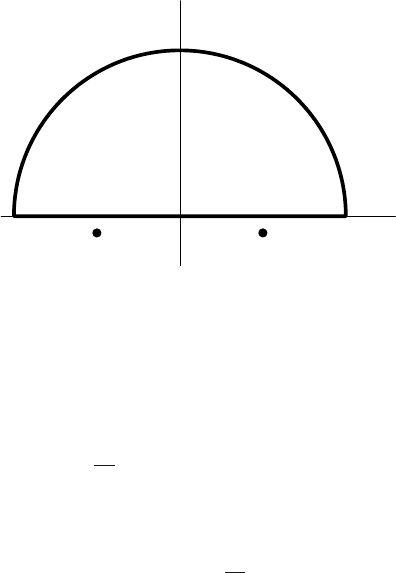
where the contour C includes the real axis. We can close the contour for Τ < 0withagreat
semicircle around the upper half-plane, as sketched below, such that
Τ
1
2Π
R
R
ΩΤ
ΕΩ 1
Ω
R
Π
0
Exp
ΤR SinΘ
Exp
RΤ CosΘ
ΕR
Θ
1
Θ (6.30)
can be expressed in terms of a contribution from the real axis that approaches GΤ in
the limit R !and a contribution from the great semicircle that vanishes for nega-
tive Τ because Ε is bounded and the integrand includes an exponential whose argument
6.2 Dispersion Relations 199
Re Ω
Im Ω
Figure 6.3. Contour for GΤ < 0. Two poles of ΕΩ are indicated by heavy dots. Causality confines
singularities of Ε to the lower half-plane such that GΤ < 00.
approaches . Similarly, for positive Τ we close C around the lower half-plane and again
find that Τ ! GΤ, such that
GΤ
1
2Π
C
ΩΤ
ΕΩ 1
Ω (6.31)
However, the causality principle
Τ < 0 GΤ 0
1
2Π
C
ΩΤ
ΕΩ 1
Ω 0 (6.32)
requires GΤ to vanish for Τ < 0. Therefore, according to the Cauchy integral theorem, we
conclude that ΕΩ is analytic within the upper half of the complex Ω plane. Any singular-
ities, such as poles or branch cuts, are confined to the lower half-plane and are responsible
for the delayed response of the system to an external influence. The two black dots in
Fig. 6.3 represent possible poles in the lower half-plane.
The convolution formula for Dt can be obtained more easily using physical reason-
ing than by the derivation above. Recognizing that ΕΩ does not have a simple Fourier
transform because it approaches unity rather than zero for infinite frequencies, we simply
add and subtract that offset to write
DΩ ΕΩEΩ EΩ ΕΩ 1EΩ (6.33)
where the function ΕΩ 1 is analytic in the upper half-plane and is suitable for Fourier
transformation because it does approach zero for Ω!. Then applying the convolution
theorem to the product of Fourier transforms, we can write
DtEt
0
ΤEt ΤGΤ (6.34)

200 6 Analytic Continuation and Dispersion Relations
where
GΤ
1
2Π
Ω
ΩΤ
ΕΩ 1 (6.35)
practically by inspection.
6.2.2 Oscillator Model
Let us illustrate this argument with a toy model. Consider a particle of mass m and charge q
that is attached to an atom by a spring (linear restoring force) with natural frequency Ω
0
and which experiences an external electric field E
Ω
Ωt
. We also assume that the motion
of the particle is damped, either by interactions with the surrounding medium or by its own
radiation of energy. The equation of motion for a driven damped oscillator takes the form
¨x 2Γ˙x Ω
2
0
x
q
m
E
Ω
Ωt
(6.36)
Using
xtx
Ω
Ωt
x
Ω
q
m
E
Ω
Ω
2
0
2ΓΩ Ω
2
(6.37)
the dipole moment becomes
p
Ω
q
2
m
E
Ω
Ω
2
0
2ΓΩΩ
2
Α
p
Ω
E
Ω
q
2
m
1
Ω
2
0
2ΓΩ Ω
2
(6.38)
where Α is the single-particle polarizability. If we have a dilute system with N oscillators
per unit volume, such that ΧNΑ, the dielectric permittivity becomes
Ε1 4ΠNΑ1
Ω
2
p
Ω
2
0
2ΓΩ Ω
2
, Ω
2
p
4ΠN
q
2
m
(6.39)
where Ω
p
is known as the plasma frequency. According to this oscillator model, Ε is an
analytic function except for two simple poles in the lower half-plane located at
Ω
ΓΩ
0
1
Γ
Ω
0
2
(6.40)
The damping is usually rather weak, such that the pole positions and residues reduce to
ΓIΩ
0
Ω
*ΓΩ
0
R
*
Ω
2
p
2Ω
0
(6.41)
Notice that damping requires Γ > 0. Hence, the absence of spontaneously growing solu-
tions confines the poles to the lower half-plane and is closely related to the property of
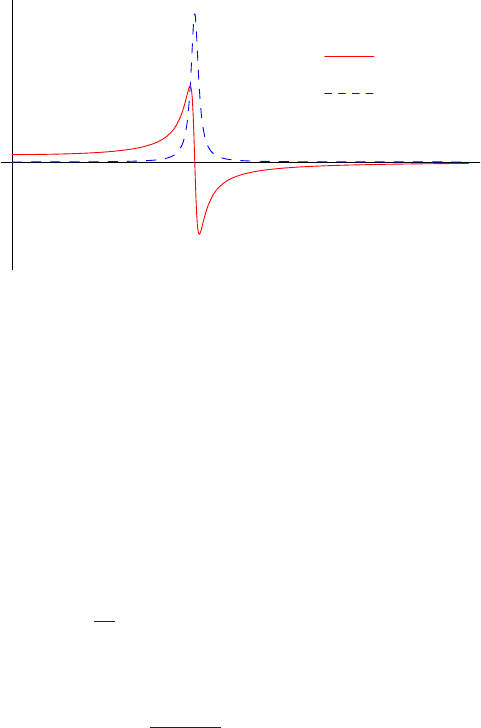
causality in physics. The dielectric permittivity for a single mode is sketched in Fig. 6.4. If
6.2 Dispersion Relations 201
Ω
Ω
0
ImΕ
ReΕ 1
Figure 6.4. Dielectric permittivity for a single mode modeled as a weakly damped oscillator.
the damping is weak, absorption is confined to a narrow peak around the resonant fre-
quency Ω
0
. The refractive index is slightly greater (smaller) than unity below (above)
the peak. Normal dispersion with (n/(Ω > 0 occurs over most of the frequency range,
but in the immediate vicinity of the resonant frequency there is anomalous dispersion
with (n/(Ω < 0.
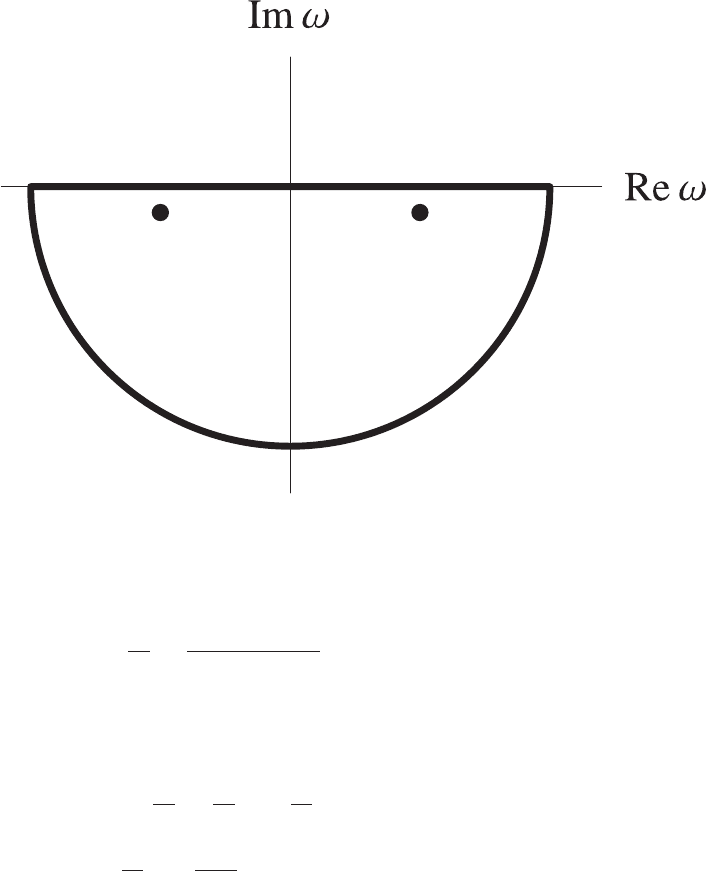
To evaluate GΤ for Τ > 0, we must close the contour in the lower half-plane, as shown
in Fig. 6.5, to ensure that the contribution of the great semicircle vanishes. Thus, the value
of the integral becomes 2Π times the sum of the residues, where the negative sign arises
because the contour is traversed in a negative (clockwise) sense.
GΤ
1
2Π
C
ΩΤ
ΕΩ 1ΩR
Ω
Τ
R
Ω
Τ
for Τ > 0 (6.42)
Therefore, we obtain the response
GΤ Ω
2
p
ΓΤ
SinΩ
0
Τ
Ω
0
<Τ (6.43)
where the Heaviside step function
<Τ 1forΤ > 0
<Τ 0forΤ < 0
(6.44)
enforces causality. Although this model is simplistic, it does satisfy the physical constraints
of causality and analyticity. We find that the response vanishes at Τ0, its initial growth is
governed by Ω
0
, and its decay is determined by Γ. If the applied field is oscillatory, then the
response of the system will be greatest when the driving frequency is close to the system’s
natural frequency and the damping is small enough that many earlier periods reinforce the
response to the current period.
More generally, if the system is composed of a single type of atom with Z electrons and
we assume these atoms have a spectrum of normal modes of vibration with frequencies Ω
j
,
202 6 Analytic Continuation and Dispersion Relations
Figure 6.5. Left: GΤ > 0 contour. Right: response for Λ0.2Ω
0
the dielectric permittivity can be parametrized in the form
Ε1 4ΠN
e
2
m
e
j
f
j
Ω
2
j
2Γ
j
ΩΩ
2
,
j
f
j
Z (6.45)
where the parameters f
j
are described as oscillator strengths. The low-frequency response
is determined by the limit ΩIΩ
j
where
Re Ε*1 4ΠN
e
2
m
e
j
f
j
Ω
2
j
3
4
4
4
4
5
1
Ω
Ω
j
2
6
7
7
7
7
8
(6.46)
Im Ε*4ΠN
e
2
m
e
Ω
j
2 f
j
Γ
j
Ω
4
j
(6.47)
Hence, if all normal modes have nonvanishing frequencies, the low-frequency response of
dielectrics has the form
Re ΕΩ * 1 a bΩ
2
(6.48)
Im ΕΩ * cΩ (6.49)

6.2 Dispersion Relations 203
where a, b, c are constants. At the other extreme, the asymptotic response to large frequen-
cies takes the form
Ω!Ε 1 4ΠN
e
2
m
e
Ω
2
j
f
j
1
2Γ
j
Ω
(6.50)
such that
Re Ε 1
Ω
p
Ω
2
, Im Ε 2¯Γ
Ω
2
p
Ω
3
(6.51)
where
Ω
2
p
4ΠN
e
2
m
e
j
f
j
4ΠNZ
e
2
m
e
(6.52)
is the plasma frequency and
¯Γ
1
Z
j
f
j
Γ
j
(6.53)
is the mean oscillator strength. These asymptotic characteristics are expected to be more
general than this semiclassical oscillator model. Therefore, the high-frequency response
of real dielectrics is often characterized by the parameters
Ω
2
p
lim
Ω!
Ω
2
1 Re ΕΩ
(6.54)
¯Γ lim
Ω!
3
4
4
4
4
5
Ω
3
2Ω
2
p
Im ΕΩ
6
7
7
7
7
8
(6.55)
The behavior of conductors is somewhat more complicated because the frequency of the
lowest mode vanishes and will be considered in the exercises.
6.2.3 Kramers–Kronig Relations
The analyticity of ΕΩ in the upper half of the complex Ω plane allows one to derive useful
relationships between the real and imaginary, or dispersive and absorptive, components of
Ε on the physical (real) axis. Applying the Cauchy integral formula to Ε1, which vanishes
for large Ω, we write
ΕΩ 1
1
2Π
C
ΕΩ
'
1
Ω
'
Ω
Ω
'
(6.56)
where C is any contour in the upper half of the Ω
'
-plane that encloses Ω. Experimental
observations are made for real frequencies, of course, but the integrand appears to be sin-
gular for real Ω. Formally we evaluate the integral for real frequencies by replacing Ω
by Ω∆, where ∆ is a small positive number, and then taking the limit ∆!0
from the
204 6 Analytic Continuation and Dispersion Relations
Re Ω
Im Ω
Ω
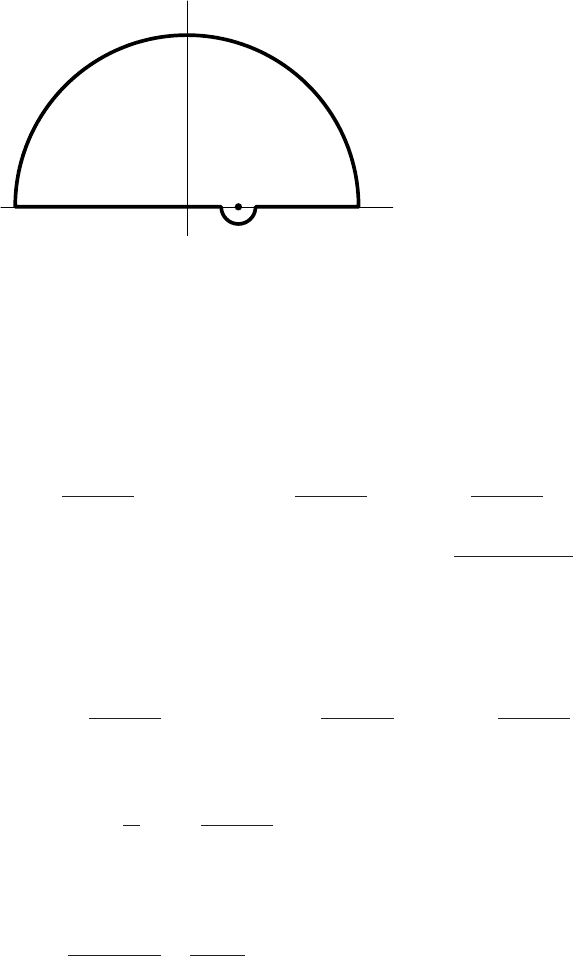
Figure 6.6. Contour in Ω
'
used to evaluate Eq. (6.56) for Ω on the positive real axis.
positive side. Assuming that an infinitesimal excursion into the lower half-plane encoun-
ters no singularities, we can employ a contour that makes a very small detour around the
singularity on the real axis, as sketched in Fig. 6.6. Assuming that the integrand falls suf-
ficiently rapidly at large Ω
'
so that the contribution of the semicircle vanishes, the contour
integral can be separated into three contributions of the form
C
ΕΩ
'
1
Ω
'
Ω
Ω
'
lim
∆!0
Ω∆
ΕΩ
'
1
Ω
'
Ω
Ω
'
Ω∆
ΕΩ
'
1
Ω
'
Ω
Ω
'
2Π
Π
ΕΩ∆
Θ
1
∆
Θ
∆
Θ
Θ
(6.57)
where the first two terms represent the contribution of the real axis and the third is the
contribution of the small semicircle parametrized by Ω
'
Ω∆
Θ
Ω
'
∆
Θ
Θ.
Together the first two terms comprise the Cauchy principal value, denoted by
ΕΩ
'
1
Ω
'
Ω
Ω
'
lim
∆!0
Ω∆
ΕΩ
'
1
Ω
'
Ω
Ω
'
Ω∆
ΕΩ
'
1
Ω
'
Ω
Ω
'
(6.58)
while the third term has the value ΠΕΩ 1. Therefore, we obtain the net result
ΕΩ 1
1
Π
ΕΩ
'
1
Ω
'
Ω
Ω
'
(6.59)
This method of evaluating contour integrals in the limit that a pole approaches the real
axis, appears so frequently that a mnemonic formula
lim
∆!0
1
Ω
'
Ω∆
Ω
'
Ω
Π∆Ω
'
Ω (6.60)
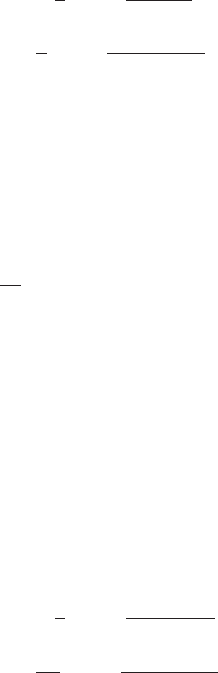
is used to represent the limiting process. Here is interpreted as an operator that converts
an integral along the real axis to its principal value while the second term involving a
Dirac delta function represents the contribution of the pole. Note that the contribution of a
6.2 Dispersion Relations 205
pole on the contour is half the contribution it would have made if it had been interior to the
contour. Another way to interpret this result is that the contribution of a pole on the contour
is the average of its contributions if it is displaced infinitesimally inward or infinitesimally
outward with respect to the region enclosed by the contour (a fence sitter that cannot quite
decide which side to fall on). Incidentally, this result does not depend upon the details of
the deformation of the contour – the same result is obtained using a semicircle around
the other side or using a different parametrization of the detour, provided that its length
vanishes in the limit ∆!0 and that the coefficient of Ω
'
Ω
1
is continuous at Ω.
Separating ΕΩ
'
into its real and imaginary components, we obtain the pair of equa-
tions
Re ΕΩ 1
1
Π
Im ΕΩ
'
Ω
'
Ω
Ω
'
(6.61)
Im ΕΩ
1
Π
Re ΕΩ
'
1
Ω
'
Ω
Ω
'
(6.62)
relating the real and imaginary components of ΕΩ through dispersion integrals. Relation-
ships of this general form can be derived for any function that is analytic in a half-plane
and falls sufficiently rapidly far from the origin. However, functions representing physical
quantities often have a more limited domain. Here, for example, measurements are made
only for positive frequencies. Fortunately, symmetry properties permit extension from pos-
itive Ω
'
to the entire real axis. Recognizing that Dt and Et are real functions, we require
GΤ
1
2Π
Ω
ΩΤ
ΕΩ 1 (6.63)
to be real also, such that
GΤ G
Τ ΕΩ Ε
Ω
(6.64)
On the real axis we find
Ω
ΩRe ΕΩ Re ΕΩ , Im ΕΩ Im ΕΩ (6.65)
and with some straightforward manipulations we can express the dispersion relations in
terms of positive frequencies only. Therefore, we finally obtain the Kramers–Kronig rela-
tions in the form
Re ΕΩ 1
2
Π
0
Ω
'
Im ΕΩ
'
Ω
'2
Ω
2
Ω
'
(6.66)
Im ΕΩ
2Ω
Π
0
Re ΕΩ
'
1
Ω
'2
Ω
2
Ω
'
(6.67)
These relations between the dispersive and absorptive properties of a dielectric medium
are very general, depending only upon the very reliable assumptions of causality and iner-
tial limitations of the polarization induced by extreme frequencies. Thus, if one measures
the absorption spectrum the refractive index can be computed, or vice versa. Notice that