
Kelly J.J. Graduate Mathematical Physics, With MATHEMATICA Supplements
Подождите немного. Документ загружается.


176 5 Integral Transforms
is the particular solution to the inhomogeneous equation that depends upon the forcing
term. The homogeneous solution can be inverted using
1
1
s Γ
2
Α
2
Γt
SinΑt
Α
(5.267)
1
s Γ
s Γ
2
Α
2
Γt
CosΑt (5.268)
to obtain
x
1
t
Γt
x
0
CosΑt
v
0
Α
SinΑt
(5.269)
The particular solution takes the form of a convolution
x
2
t
t
0
Gt t
'
f t
'
t
'
(5.270)
where
Gt
Γt
SinΑt
Α
(5.271)
is the Green function. Notice that the lower limit of integration is t 0 because for
the initial-value we can imagine that the forcing term is absent for t<0, implicitly
using f t!f t<t for the method of Laplace transforms. Also notice the similarity
between the Laplace and Fourier representations of the Green function, which are related
by s Ω. Further analysis of the underdamped (ΑΩ
R
), critically damped (Α!0), and
overdamped (ΑΚ) situations is identical to previous results using the Fourier transform.
5.7.3 Example: Diffusion with Constant Boundary Value
Suppose that Ψx, t satisfies a diffusion equation
(
2
Ψ
(x
2
1
Κ
(Ψ
(t
(5.272)
for x>0, subject to boundary conditions
x>0 and t 0 Ψ0 (5.273)
x 0 and t 2 0 ΨΨ
0
(5.274)
where Ψ
0
is a constant. For example, if a large block of material is brought into contact
with a hotter block that is maintained at constant temperature, Ψ could represent its tem-
perature increase. Alternatively, if a block with pure chemical composition is immersed in
a chemical solution, Ψ could represent the concentration of a foreign chemical diffusing

5.7 Green Functions via Laplace Transform 177
into the block over time. It is useful to perform a Laplace transform with respect to time
˜
Ψx, s
0
t
st
Ψx, t (5.275)
Ψx, t
1
2Π
c
c
s
st
˜
Ψx, s (5.276)
to obtain an ordinary differential equation of the form
(
2
˜
Ψx, s
(x
2
s
Κ
˜
Ψx, s ,
˜
Ψ0,s
Ψ
0
s
(5.277)
where the Laplace constant Ψx, 0
vanishes for x>0. The Laplace transform of the
boundary condition Ψ0,tΨ
0
<t becomes
˜
Ψ0,ss
1
Ψ
0
because of the step function
inherent in the Laplace method. Notice that a Laplace transform with respect to x instead
would yield an inhomogeneous equation because Ψ0
,tΨ
0
does not vanish; hence,
that strategy would not reduce the complexity of the original problem.
The solution for
˜
Ψx, s that satisfies the boundary condition for
˜
Ψ0,s can now be
written by inspection as
˜
Ψx, s
Ψ
0
s
Exp
x
s/Κ
(5.278)
where we must obviously reject the exponentially growing possibility. The problem now
is to obtain Ψx, t by inverting the Laplace transform. There is a simple pole at the origin
and the square root in the exponential is made single-valued by a branch cut along the
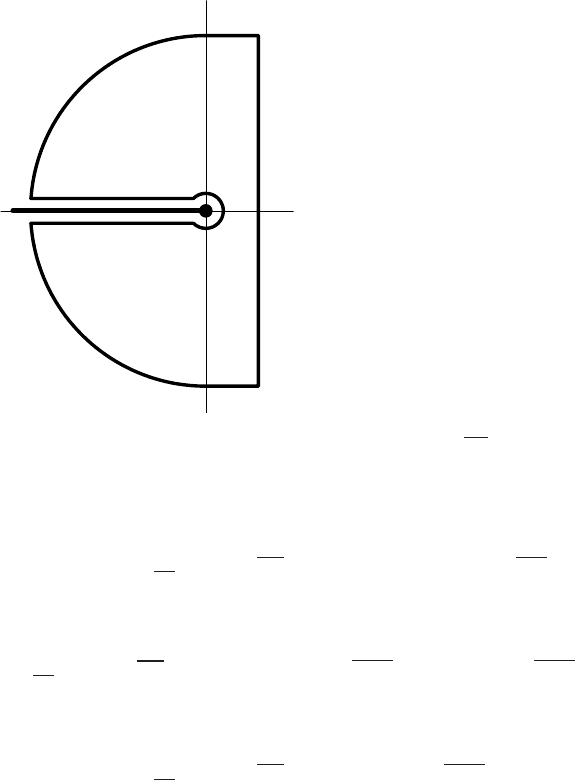
negative real axis. Using the contour sketched in Fig. 5.18, which encloses none of these
features, we can write
C
s
st
˜
Ψx, s0 Ψx, t
Ψ
0
2Π
6
k2
I
k
(5.279)
where
I
k
C
k
s
s
st
Exp
x
s/Κ
(5.280)
represents contributions from each segment of the contour. Segment C
1
corresponds to
the Bromwich integral while the other segments serve to establish its value through the
Cauchy integral theorem.
The contributions to I
2
and I
6
from the left half-plane vanish in the limit R !
because with
s R
Θ
st
s
Exp
x
s/Κ
G R
1
Exp
Rt CosΘ
Exp
x
R/Κ Cos
Θ
2
I
2
I
6
0
(5.281)
the range
Π
2
Θ
3Π
2
ensures that the dominant exponential has a negative argument.
The short horizontal segments in the right half-plane with s Ρ, where Ρ is real
178 5 Integral Transforms
Re s
Im s
C
1
C
2
C
3
C
4
C
5
C
6
Figure 5.18. Contour for inverse Laplace transform of Exp
x
s/Κ
/s.
and s Ρ, do not contribute either because there
s ΡR
st
s
Exp
x
s/Κ
R
1
Exp
Ρt Rt x
R/Κ
Π/ 4
(5.282)
Separating the real and imaginary parts of the argument of the exponential
st
s
Exp
x
s/Κ
R
1
Exp
Ρt x
R/2Κ
Exp
Rt x
R/2Κ
(5.283)
and retaining only the leading dependencies in R
s ΡR
st
s
Exp
x
s/Κ
R
1
Exp
x
R/2Κ
ExpRt (5.284)
we find that the magnitudes of integrands are proportional to R
1
ExpΑR
1/ 2
where
Α > 0. The lengths of these segments is finite and the integrands vanish quickly in the
limit R !.
As C
3
and C
5
approach the real axis, C
4
approaches a complete circle enclosing the
pole with unit residue in a negative sense, such that
I
4
2Π (5.285)

5.7 Green Functions via Laplace Transform 179
The segments neighboring the real axis take the form
I
3
0
Exp
S
T
T
T
T
T
T
T
T
T
T
T
U
st x
Π/ 2
s
Κ
V
W
W
W
W
W
W
W
W
W
W
W
X
s
s
0
Exp
S
T
T
T
T
T
T
T
T
T
T
T
U
st x
s
Κ
V
W
W
W
W
W
W
W
W
W
W
W
X
s
s
2
0
ExpΚtu
2
ux
u
u
(5.286)
I
5
0
Exp
S
T
T
T
T
T
T
T
T
T
T
T
U
st x
Π/ 2
s
Κ
V
W
W
W
W
W
W
W
W
W
W
W
X
s
s
0
Exp
S
T
T
T
T
T
T
T
T
T
T
T
U
st x
s
Κ
V
W
W
W
W
W
W
W
W
W
W
W
X
s
s
2
0
ExpΚtu
2
ux
u
u
(5.287)
such that
I
3
I
5
4
0
u
u
ExpΚtu
2
Sinux (5.288)
To evaluate the integral
Ξx
0
u
u
ExpΚtu
2
Sinux (5.289)
we first consider
Ξ
'
x
0
u ExpΚtu
2
Cosux
1
2
u ExpΚtu
2
Expux (5.290)
which can be obtained by completing the square
u ExpΚtu
2
ExpuxExp
x
2
4Κt
u Exp
Κtu
x
2
Κt
2
Π
Κt
Exp
x
2
4Κt
(5.291)
Hence, the desired integral satisfies a differential equation
Ξ
'
x
1
2
Π
Κt
Exp
x
2
4Κt
, Ξ00 (5.292)
which can be integrated to obtain
Ξx
Π
4Κt
x
0
x
'
Exp
x
'2
4Κt
Π
x/2
Κt
0
y
2
y
Π
2
Erf
x
2
Κt
(5.293)
Therefore, we finally obtain
Ψx, tΨ
0
Erfc
x
2
Κt
(5.294)
where Erfc is the complementary error function.
180 5 Integral Transforms
0 1 2 3 4 5
K xs
r
Nt
0
0.2
0.4
0.6
0.8
1
\ s\
0
Figure 5.19. Diffusion with constant boundary value.
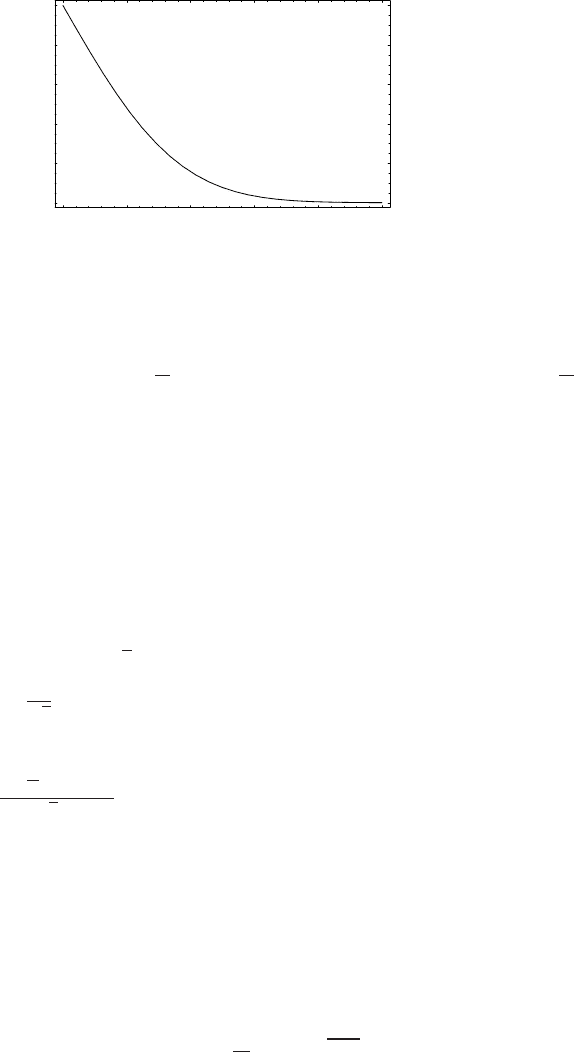
Notice that the natural time scale is determined by Κ
1
while the natural distance scale
is determined by
Κt such that the dimensionless variable Ηx/
Κt provides a sim-
ple one-dimensional function describing both the distance and time dependence of the
approach to equilibrium. Figure 5.19 illustrates the equilibration of the sample in terms of
its natural dimensionless variable. This solution is characteristic of any diffusion problem
(temperature, chemical concentration, etc.) for which a plane is maintained at a constant
boundary value.
It is useful to examine the behavior of this function for both small and large values of
its dimensionless variables using series expansions. For a fixed position, the initial time
variation is determined by the solution for large Η while its asymptotic approach to equi-
librium is determined by the solution for small Η.
Series
Erfc
Η
2
, Η,0,2
1
Η
Π
OΗ
3
SeriesErfcx, x, ,4/.x Η/2/ / Normal / / Simpli fy
2
Η
2
4
2 Η
2
ΠΗ
3
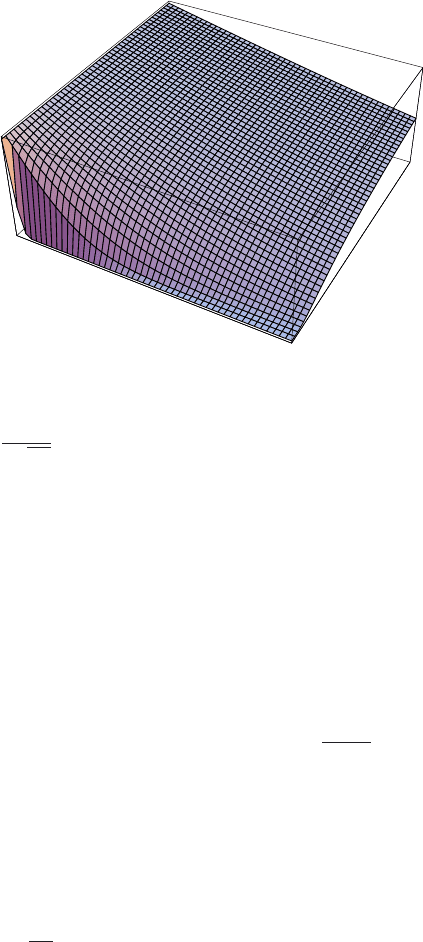
Perhaps it is also useful to visualize the equilibration process using the three-dimensional
Fig. 5.20. The initial temperature elevation at x 0 spreads gradually to more distant areas
and later approaches the final temperature asymptotically.
Integral transforms are so useful that extensive tables of Fourier and Laplace trans-
forms have been compiled. Therefore, once one is comfortable with the basic methodol-
ogy, one can often obtain the necessary transforms either from standard compilations or
from or another symbolic math program. For example, can
provide the inverse transform
InverseLaplaceTrans form
Ψ
0
s
Expx
s/Κ,s,t
//
FullSimpli fy#, t>0,x>0,Κ >0&
Problems for Chapter 5 181
x
Nt
TT
0
x
Figure 5.20. Temperature equilibration (arbitrary units).
Erfc
x
2
t Κ
Ψ
0
needed for this problem without the pain of performing some rather tedious integrals by
hand.
Problems for Chapter 5
1. Moments of form factors
The charge density Ρ
ch
r in an atomic nucleus can be measured using electron scattering.
Analysis of the angular distribution for electron scattering provides the form factor, which
is related to the density by the Bessel transform
˜
Ρ
ch
q4Π
0
rr
2
j
0
qrΡ
ch
r j
0
x
Sinx
x
(5.295)
where r is the radial coordinate, q is the momentum transfer, and j
0
is the spherical Bessel
function of order zero. It is often useful to characterize distributions in terms of moments
M
n
Ρ 4Π
0
rr
2n
Ρr (5.296)
and the mean-square radius
r
2
M
2
M
0
(5.297)
Finally, the nuclear charge density results from a convolution of the proton density Ρ (in
other words, the distribution of protons with the nucleus) and the charge density Ρ
p
within
a proton such that
Ρ
ch
ΡPΡ
p
˜
Ρ
ch
q
˜
Ρq
˜
Ρ
p
q (5.298)

182 5 Integral Transforms
a) Show that a form factor can be expanded in terms of
˜
Ρq
n0
a
n
M
2n
q
2n
(5.299)
and determine the coefficients. How can one extract M
2n
using derivatives with respect
to q
2
? How does r
2
enter a low-q expansion?
b) Determine the general relationship between M
2n
Ρ
ch
, M
2n
Ρ, and M
2n
Ρ
p
.Find
explicit formulas for n 0, 1. In particular, how are the mean-square radii related?
2. Elastic form factor for
16
O
In the harmonic oscillator model, the radial wave functions for the nuclear 1s and 1p
orbitals take the shapes
R
1s
r-Exp
r
2
2b
2
R
1p
r-r Exp
r
2
2b
2
(5.300)
where b is the oscillator constant. The radial wave functions should be normalized so that
0
rr
2
R
n
r
2
1 (5.301)
The proton density for
16
O, containing 2 protons in the 1s orbital and 6 protons in the 1p
orbital, is then
Ρr
2R
1s
r
2
6R
1p
r
2
4Π
(5.302)
The elastic form factor is given by
˜
Ρq4Π
0
rr
2
j
0
qrΡr j
0
x
Sinx
x
(5.303)
where q is the momentum transfer. Compute the elastic form factor and produce a semilog
plot of
˜
Ρq
2
given b 1.8 fm. The momentum transfer q should be measured in units
of fm
1
where 1 femtometer (fm) corresponds to 10
15
m, which is the appropriate length
scale for nuclear physics. Also, determine the rms radius by examining the power series
for
˜
Ρq for small q.
3. Fourier transform of periodic function
Suppose that f t f t T is strictly periodic with period T . Evaluate the Fourier trans-
form,
˜
f Ω].
4. Array theorem
Suppose that
f x
N
n1
gx x
n
(5.304)
consists of an array of identical distributions about a set of positions x
n
.

Problems for Chapter 5 183
a) Evaluate the Fourier transform
˜
f k by expressing the summation as a convolution
with a set of point sources represented by delta functions.
b) Perform the summation for a uniform array x
n
na, n 1,N and evaluate the inten-
sity
˜
f k
2
.
5. Fraunhofer diffraction grating
The Fraunhofer approximation to diffraction takes the form
SΘ
Ax Expqxx
2
(5.305)
where Ax is an aperture function that takes unit values for open regions and vanishes at
obstacles and where q k SinΘ for wave number k 2Π/Λ. The aperture function for a
grating with N identical slits takes the form
Ax
N
n1
<b 2x na (5.306)
where a is the spacing and b<ais the width. Use the convolution theorem to evaluate the
diffraction pattern efficiently.
6. Convolution of a Breit–Wigner resonance with a Gaussian resolution function
Suppose that the energy dependence of the differential cross section for a nuclear reaction
is described by the Breit–Wigner profile
SΩ
A
2Π
S
0
ΩΩ
0
2
A
2
4
(5.307)
where A is the full-width at half-maximum and S
0
is the integral over energy. However, the
measurement of energy is smeared by a Gaussian resolution function
RΩ
1
2ΠΣ
2
Exp
Ω
2
2Σ
2
(5.308)
such that the observed distribution is the convolution Y S P R. Use the convolution
theorem to obtain an explicit formula for YΩ; your result will probably involve the com-
plementary error function. If you have access to suitable mathematical software, compare
your symbolic result with numerical evaluation of the convolution integral. Also compare
YΩ with SΩ. (Note that 5.1 cannot evaluate the convolution integral
symbolically.)
7. Loaded beam
The displacement of an infinitely long beam on an elastic foundation is described by
4
x
4
1
yxPx (5.309)
where we assume that y 0. Use the Fourier transform method to compute the
Green function for this system. Then provide an integral which can be used to compute
the displacement given an arbitrary Px.

184 5 Integral Transforms
8. Diffusion and radiation of heat
Heat diffuses in a medium that also radiates heat at a rate proportional to temperature.
Thus, a one-dimensional spatial distribution of temperature Tx, t satisfies
(T
(t
D
(
2
T
(x
2
ΑT (5.310)
where D and Α are positive constants. A finite amount of heat is released at a point in an
infinite bar such that
Tx, 0Q∆x (5.311)
a) Evaluate and describe the temperature distribution at later times.
b) Compute the total amount of heat lost to radiation between time zero and time t and
interpret the result.
9. Damped oscillator subject to a step function
Use the Fourier transform to solve
(
2
(t
2
2Γ
(
(t
Ω
2
0
xt f t ,t<0 xtx
'
t0 (5.312)
when
f t f
0
<t (5.313)
is a step function that “turns on” at t 0. Find explicit solutions for the underdamped,
overdamped, and critically damped cases. Compare these three solutions graphically and
explain their behavior.
10. Damped oscillator subject to square pulse
Use the Fourier transform to solve
(
2
(t
2
2Γ
(
(t
Ω
2
0
xt f t (5.314)
when
f t f
0
<t Τ<t Τ (5.315)
is a square pulse. Plot the solutions for Γ/ Ω
0
0.5, 1.0, 2.0 with Τ5/Ω
0
as functions
of Ω
0
t and explain their general characteristics. If this were an RLC circuit, under what
conditions would the output follow the input most closely?
11. Orthogonality relations for Fourier sine and cosine transforms
Derive the orthogonality relations:
0
t CosΩt CosΩ
'
t
Π
2
∆Ω Ω
'
∆ΩΩ
'
(5.316)
0
t SinΩt SinΩ
'
t
Π
2
∆Ω Ω
'
∆ΩΩ
'
(5.317)

Problems for Chapter 5 185
12. Relationship between Fourier sine, cosine, and exponential transforms
Demonstrate the equivalence between the representations
f t
1
2Π
Ω
Ωt
˜
f Ω
2
Π
0
Ω
˜
f
C
Ω CosΩt
˜
f
S
Ω SinΩt
(5.318)
where
f
t
1
2
f t f t (5.319)
and
˜
f Ω
t
Ωt
f t (5.320)
˜
f
C
Ω
0
t CosΩt f
t (5.321)
˜
f
S
Ω
0
t SinΩt f
t (5.322)
Finally, demonstrate that
˜
f Ω 2
˜
f
C
Ω
˜
f
S
Ω
(5.323)
13. Green functions using Fourier cosine or sine transforms
The Fourier cosine transform is defined by
˜
f k
C
f
0
f x Coskxx (5.324)
a) Use the Fourier cosine transform to solve
y
''
xΑ
2
yx0 y
'
0b, y 0 (5.325)
b) Next use the Fourier cosine transform to obtain the Green function that satisfies
G
''
Α
x, x
'
Α
2
G
Α
x, x
'
∆x x
'
G
'
Α
0,x
'
0 ,G
Α
,x
'
0 (5.326)
and write a formal solution for the inhomogeneous equation
y
''
xΑ
2
yx f x y
'
0b, y 0 (5.327)
c) Now suppose that the lower boundary conditions are replaced by y0a for the
homogeneous problem and by G
Α
0,x
'
0 for the Green function. How do the
solutions change? Why is the Laplace transform inconvenient for this problem?