
Kenny Anthony. The Rise of Modern Philosophy: A New History of Western Philosophy. Volume 3
Подождите немного. Документ загружается.

of colours, sounds, odours, favours, degrees of hardness and so on, of which I
have sensations, I certainly have the right to infer that in the bodies from
which these various sense-peceptions arise there is corresponding, though not
similar, variety.
Not everything, however, that appears natural to us is actually taught by
nature and so guaranteed by the veracity of God—hence the caveat
‘though not similar’ in the last sentence of the quotation . On ly what we
clearly and distinctly perceive is really taught us by nature, and if we wish
to achieve truth we must carefully restrict our beliefs within those limits.
Only thus will a sound science of material objects be built up to replace the
superannuated physics of the Aristotelian establishment.
Many philosophers nowadays Wnd Descartes’ epistemology quite uncon-
vincing because they regard the existence of God as much more problematic
than the everyday and scientiWc truths that he is called on to guarantee.
None of his contemporary critics was willing to question the existence of
God, although each was happy to challenge his method of proving it. But
there were two diVerent fundamental objections which Descartes had to
meet if he was to defend his method of erecting the ediWce of science on the
basis of God’s veracity.
First, if God is no deceiver, how is it that I constantly fall into error? The
faculties that I have are given me by the truthful God; how then can they
lead me astray? The answer Descartes gives is that, if properly used, our
faculties do not ever lead us astray. I have one faculty, the intellect, which
oVers perceptions of things and of truths; I have a diVerent faculty, the will,
by which I judge whether a proposition is true or false. If I restrict the
judgements of the will to cases in which the intellect presents a clear and
distinct perception, then I will never go astray. Error only arises when I
make a precipitate ju dgement in advance of clear and distinct perception.
The whole intellectual exercise of the Meditations is designed precisely to give
the reader practice in suspending judgement in the absence of clarity and
distinctness.
The second objection to Descartes’ method became famous under the
title ‘The Cartesian Circle’. It was Antoine Arnauld, author of the fourth
objections, who was the Wrst to point out an apparent circularity in
Descartes’ appeal to God as the guarantor of clear and distinct perceptions.
‘We can be sure that God exists, only because we clearly and distinctly
perceive that he does; therefore, prior to being certain that God exists, we
126
KNOWLEDGE
need to be certain that whatever we clearly and evidently perceive is true’
(AT VII.245; CSMK II.170).
Descartes has an answer to this objection, which depends on a distinc-
tion between particular clear and distinct perceptions, on the one hand,
and the general principle, on the other, that whatever we clearly and
distinctly perceive is true. No appeal to God’s veracity is necessary to bring
conviction of the truth of individual perceptions. Intuitions such as that I
exist, or that two and three make Wve, cannot be doubted as long as I
continue clearly and distinctly to perceive them. But although I cannot
doubt something I am here and now clearly and distin ctly perceiving, I
can—prior to establishing God’s existence—doubt the general proposition
that whatever I clearly and distinctly perceive is true. Again, individual
intuitions can be doubted once they are in the past. I can wonder, after the
event, whether there is any truth in what I clearly and distinctly perceived
while reading the second Meditation.
Since simple intuitions cannot be doubted while they are before the mind,
no argument is needed to establish them; indeed Descartes regarded
intuition as superior to argument as a method of attaining truth. Individual
intuitions can only be doubted in the roundabout way I have just illus-
trated: they cannot be doubted in any way that involves advertence to
their content. It is only in connection with the general principle, and in
connection with the roundabout doubt of particular perceptions, that
the appeal to God’s truthfulness is necessary. Hence there is no circularity
in Descartes’ argument. Undoubtedly, however, in the Meditations the mind
is used to validate itself. But that kind of circularity is unavoidable and
harmless.
The Empiricism of Hobbes
Historians of philosophy often contrast British and continental philosophy
in the seventeenth and eighteenth centuries: the continentals were ration-
alists, trusting to the speculations of reason, and the British were empiricists,
basing knowledge on the experience of the senses. In order to assess the real
degree of diVerence between British and continental epistemology we
should look more closely at the teaching of Hobbes, who has a fair claim
to be the founder of British empiricism.
127
KNOWLEDGE
Hobbes’ Leviathan begins with a chapter ‘Of Sense’ and o Vers a resounding
manifesto: ‘There is no conception in a man’s mind, which hath not at
Wrst, totally, or by parts, been begotten upon the organs of sense. The rest
are derived from that original’ (L, 9). Other operations of the mind, such as
memory, imagination, and reasoning, are wholly dependent on sensation.
Imagination and memory are the same thing, namely decaying sense:
For as at a great distance of place, that which we look at, appears dim, and without
distinction of the smaller parts; and as voices grow weak, and inarticulate: so also
after great distance of time, our imagination of the past is weak; and we lose (for
example) of cities we have seen, many particular streets; and of actions, many
particular circumstances. (L , 66)
Reasoning, Hobbes says, is nothing but reckoning the consequences of
general names agreed upon for the marking and signifying of our
thoughts; and thoughts are always, for him, mental images (of names
or things) derived from sensation. ‘They are every one a representation
or appearance of some quality, or other accident of a body without us’
(L, 66).
There are, according to Hobbes, two kinds of knowledge: knowledge of
fact, and knowledge of consequence. Knowledge of consequence is the
knowledge of what follows from what: the knowledge that keeps order in
the constant succession or train of our thoughts. It is expressed in language
by conditional laws, of the form ‘If A then B.’ Knowledge of fact—the kind
of knowledge that we require from a witness—is given by sense and
memory. Mere reasoning, or discourse, can never end in absolute know-
ledge of fact, past or to come (L, 42).
It is true, as empiricists claim, that we can never acquire information
about the world around us, directly or indirectly, without at some stage
exercising our powers of sense-perception. The weakness of British empiri-
cism lies in its naive and unsatisfactory account of what sense-perception
actually consists in. Thinkers in the Aristotelian tradition, which Hobbes
speciWcally rejected, had emphasized that our senses are powers to
discriminate: the power to tell one colour from another, to distinguish
between diVerent sounds and tastes, and so on. They had emphasized that
the senses had an active role in experience: any particular episode of sensing
(e.g. tasting the sweetness of a piece of sugar) was a transaction between an
item in the world (a property of the sugar) and a faculty of a perceiver (the
128
KNOWLEDGE
power of taste). For Hobbes and his successors, by contrast, sensation is a
passive aVair: the occurrence of an image or fan cy in the mind.
There is indeed, according to Hobbes, an active element in sensation;
however, it is not a matter of making discriminations between genuine
qualities in the real world, but rather of projecting on to the world items
that are illusory fancies:
The cause of sense, is the external body, or object, which presseth the organ proper
to each sense, either immediately, as in the taste and touch; or mediately, as in
seeing, hearing, and smelling: which pressure, by the mediation of the nerves, and
other strings, and membranes of the body, continued inwards to the brain and
heart, causeth there a resistance, or counter-pressure, or endeavour of the heart,
to deliver itself: which endeavour because outward, seemeth to be some matter
without. And this seeming or fancy, is that which men call sense; and consisteth, as to
the eye, in a light or colour Wgured; to the ear, in a sound; to the nostril, in an odour;
to the tongue and palate, in a savour, and to the rest of the body in heat, cold, hardness,
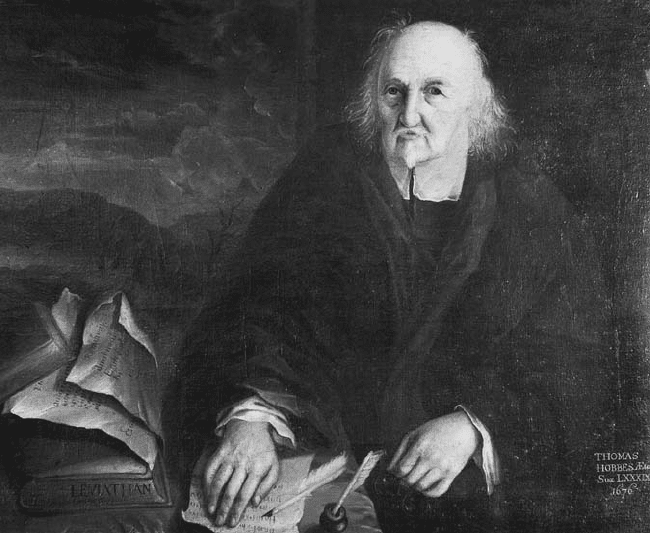
A portrait of Hobbes from Hardwick Hall, seat of his patron the Duke of Devonsh ire
129
KNOWLEDGE
softness, and such other qualities, as we discern by feeling. All which qualities called
sensible, are in the object that causeth them, but so many several motions of the
matter, by which it presseth our organs diversely. (L,9)
The account of sensation in the empiricist Hobbes turns out to be
exactly the same as that of the rationalist Descartes. For both of them,
qualities such as colour and taste are nothing more than deceptive experi-
ences, items of private consciousness: ‘fancies’ for Hobbes; ‘cogitationes’ for
Descartes. Hobbes uses arguments similar to those of Descartes to urge the
subjectivity of such secondary qualities: we see colours in reXections; a bang
upon the eye makes us see stars; and so on. For Hobbes as for Descartes,
there is no intrinsic diVerence between our sensory experience and our
mental imagery and our dreams. Just as Descartes argued that he could be
certain of the content of his thoughts even if he had no body and there was
no external world, so Hobbes argues that all our images would remain the
same even though the world were annihilated (L, 22).
A common error underlies the Descartes–Hobbes attack on the object-
ivity of sensory qualities: a confusion between relativity and subjectivity. It is
true that sensory qualities are relative; that is to say, they are deWned by
their relationships to sensory perceivers. For a substance to have a certain
taste is for it to have the ability to produce a certain e Vect on a human
being or other animal; and the particular e Vect it produces will vary
according to a number of conditions. But the fact that taste is a relative
property does not mean that it is not an objective property. ‘Being larger
than the earth’ is a relative property; yet it is an objective fact that the sun
is larger than the earth.
Where Hobbes diVers from Descartes is that he fails to make any serious
distinction between the imagination and the intellect. If the intellect is,
roughly, the capacity to use and understand language, then it is something
quite diVerent from the Xow of images in the mind. Descartes made clear
the diVerence between intellect and imagination in a luminous passage of
the sixth Meditation:
When I imagine a triangle, I do not just understand that it is a Wgure enclosed in
three lines; I also at the same time see the three lines present before my mind’s eye,
and this is what I call imagining them. Now if I want to think of a chiliagon,
I understand just as well that it is a Wgure of a thousand sides as I do that a triangle
is a Wgure of three sides; but I do not in the same way imagine the thousand sides,
or see them as presented to me. (AT VII.71; CSMK II. 50)
130
KNOWLEDGE
Hobbes nowhere makes a similar distinction, and systematically iden-
tiWes the mind with what Descartes calls the imagination. Hobbes was,
indeed, aware of the role of language in intellectual activity, and saw its
possession as the main privilege that set mankind above other animals. He
wrote, for instance:
By the advantage of names it is that we are capable of science, which beasts, for
want of them, are not: nor man, without the use of them: for as a beast misseth
not one or two out of her many young ones, for want of those names of order,
one, two, three &c, which we call number; so neither would a man, without
repeating orally, or mentally, the words of number, know how many pieces of
money or other things lie before him. (L, 35–6)
He writes, however, as if the fact that a series of images passing through the
mind consists of images of names rather than things is suYcient to turn a
Xow of fancy into an operation of the intellect. But in fact no explanation
in terms of mental images can account for our knowledge even of simple
arithmetic, Hobbes’ favourite paradigm of reasoning. If I want to add 97 to
62, I cannot call upon any mental image of either number; and the mental
image of the numerals themselves will be no help either, unless I have been
through the long and tedious process of learning to do mental arithmetic.
The occurrence of the images does nothing to explain that process, and it is
only as a consequence of that process that the images are useful for
arithmetical purposes.
Locke’s Ideas
Empiricism is not often defended in the crude and blunt form in which it is
put forward by Hobbes, so it is time to turn to the better-known and more
generally admired presentation by John Locke. Locke and Descartes are
often contrasted as the prime exponents of two diVerent philosophical
schools, but in fact they share a number of common assumptions. Locke
bases his system on ‘ideas’, and his ‘ideas’ turn out to be very similar to
Descartes’ ‘thoughts’. Both philosophers make an initial appeal to immedi-
ate consciousness: ideas and thoughts are what we meet when we look
within ourselves. Both philosophers fail to clear up a fatal ambiguity in their
key terms, and this cripples their epistemology and philosophy of mind.
131
KNOWLEDGE
In Locke, for instance, it is often diYcult to tell whether by ‘idea’ is meant
an object (what is being perceived or thought about) or an action (the act
of perceiving or thinking). Locke says that an idea is ‘whatever it is which the
mind can be employed about in thinking’. The crucial ambiguity is in
the phrase ‘what the mind is employed about’, which can mean either
what the m ind is thinking of (the object) or what the mind is engaged in
(the action). The ambiguity is damaging when Locke considers such ques-
tions as whether greennes s is an object in the world or a creation of the mind.
Although Locke often takes issue with Descartes, he adopts much of his
philosophical agenda from Descartes, and asks many of the same questions.
Are animals machines? Does the soul always think? Can there be space
without matter? Are there innate ideas?
This last question is often taken as a deciding issue: the answer a
philosopher gives shows whether she is a rationali st or an empiricist. But
the question is not a simple one. If we break it down into the diVerent
meanings it may have, we Wnd that there is no great gulf Wxed between the
positions of Locke and Descartes.
First, we may ask: ‘Do infants in the womb think thoughts?’ Locke, as
well as Descartes, believed that unborn infants had simple thoughts or
ideas, such as pains and feelings of warmth. Locke mocks the idea that a
child who knows that an apple is not a Wre will give assent to the principle
of non-contradiction (E, 61). But Descartes did not believe any more than
Locke did that infants had complicated thoughts of a philosophical kind.
A child has an innate idea of self-evident principles only in the same way as
it may have an inherited propensity to gout (AT VIII. 357; CSMK I. 303).
In the light of this, we may take the question to concern not the activity
of thinking, but the mere capacity for thought. Is there an inborn, general
capacity for understanding which is speciWc to human beings? Both
Descartes and Locke believe that there is. The Essay begins with the state-
ment that it is the understanding that sets man above the rest of sensible
beings (E, 43).
Locke focuses not on the general faculty of understanding, but on assent
to certain particular propositions, e.g. ‘one and two are equal to three’ and
‘it is impossible for the same thing to be, and not to be’. Does our assent to
such truths depend on experience? No, says Descartes, they are innate
principles we recognize. But Locke does not think they depend on experi-
ence; he claims that experience is necessary to provide us with the concepts
132
KNOWLEDGE
that make up the propositions, not in order to secure our assent to them
once formed. ‘Men never fail, after they have once understood the Words,
to acknowledge them for undoubted Truths’ (E, 56). Descartes, on the
other hand, does not maintain that all innate ideas are principles assented
to as soon as understood: some of them become clear and distinct, and
command assent, only after laborious meditation.
Locke devotes much of his treatment of innate ideas to the question
whether there are any principles, whether theoretical or practical, which
command universal assent. He denies that there are any theor etical prin-
ciples which are held by all human beings, including children and savages.
Turning to practical principles, he enjoys himself piling up examples of
violations, in various cultures, of moral maxims which seem fundamental
to all civilized Christians—including the most basic: ‘Parents preserve and
cherish your children’ (E, 65–84). Even if there were truths universally
acknowledged, this would not be suYcient to prove innateness, since the
explanation might be a common process of learning.
Descartes, however, can agre e that universal consent does not entail
innateness, and he can also retort that innateness does not entail universal
consent either. It is a fundamental presupposition of his method that some
people, indeed most people, may be prevented by prejudice and laziness
from assenting to innate principles that a re latent in their minds.
On the topic of innate ideas, the arguments of Locke and Descartes
largely pass each other by. Descartes argues that experience without an
innate element is an insuYcient basis for scientiWc knowledge; Locke insists
that innate concepts without experience cannot account for the know-
ledge we have of the world. Both contentions may well be correct.
Locke claimed that the arguments of the rationalists would lead one ‘to
suppose all our ideas of colours, sounds, taste, Wgure etc. innate, than
which there cannot be anything more opposite to reason and experience’
(E, 58). Descartes did not believe that our knowledge of the colour or taste
of a particular apple was something innate; but he found nothing absurd in
the general idea of redness or sweetness being innate—and that for a
reason that Locke himself accepted, namely, that our ideas of such qualities
are entirely subjective. Once again the surface dispute between rationalism
and empiricism masks a fundamental agreement.
Locke’s argument for the subjectivity of qualities like colours and tastes
begins with a division between those ideas ‘which come into our minds by
133
KNOWLEDGE
one sense only’, and those ‘that convey themselves into the mind by more
senses than one’. Sounds, tastes, and smells are examples of the Wrst kind; so
too ‘Colours, as white, red, yellow, blue; with their several Degrees or
Shades and Mixtures , as Green, Scarlet, Purple, Sea-green and the rest’. As
examples of ideas that we get by more than one sense, Locke gives extension,
shape, motion, and rest—items we can detect both by seeing and by feeling.
Corresponding to this distinction between two kinds of ideas is a distinc-
tion between qualities to be found in bodies. We should distinguish ideas, as
they are perceptions in the mind, and as they are modi W cations of matter in
the bodies that cause these perceptions; and we should not take it for
granted that our ideas are exact images of something in the bodies that
cause them. The powers to produce ideas in us are called by Locke ‘Qual-
ities’. Qualities perceptible by more than one sense he calls ‘primary qual-
ities’, and qualities perceptible only by a single sense he calls ‘secondary
qualities’. This distinction was no innovation: it had been customary since
Aristotle to distinguish between ‘common sensibles’ (¼primary qualities)
and ‘proper sensibles’ (¼secondary qualities) (E, 134–5). Where Locke
departed from Aristotle was in denying the objectivity of proper sensibles.
In this he had been anticipated by Descartes, who argued that in giving a
scientiWc account of perception only primary qualities needed to be in-
voked. Heat, colours, and tastes were strictly speaking only mental entities,
and it was a mistake to think that in a hot body there was something like my
idea of heat, or in a green body there was the same greenness as in my
sensation (AT VII.82; CSMK, II.56). The bodily events that cause us to see or
hear or taste are nothing more than motions of shaped matter. In support of
this conclusion Locke oVers some of the same considerations as Descartes,
but presents a more sustained line of argument.
First, Locke claims that only primary qualities are inseparable from their
possessors: a body may lack a smell or a taste, but there cannot be a body
without a shape or a size. If you take a grain of wheat and divide it over and
over again, it may lose its colour or taste, but it will retain extension, shape,
and mobility. Descartes had used a similar argument, taking not wheat but
stone as his example, to prove that only extension was part of the essence
of a body.
We have only to attend to our idea of some body, e.g. a stone, and
remove from it whatever we know is not entailed by the very nature of
body. We Wrst reject hardness; for if the stone is melted, or divided into a
134
KNOWLEDGE
very Wne powder, it will lose this quality without ceasing to be a body.
Again, we reject colour: we have often seen stones so transparent as to be
colourless.
What are we to make of such arguments? It may be true that a body
must have some shape or other, but any particular shape can be lost.
As Descartes himself reminds us elsewhere, a piece of wax may cease to be
cubical and become spherical. What Locke says of the secondary qualities
might also be said of some of the primary qualities. Motion is a primary
quality, but a body may be motionless. Indeed, if motion and rest are to be
considered, as Locke considers them, as a pair of primary qualities, at any
time a body must lack one or other of them.
The argument for the permanence of primary properties seems to
depend on taking them generically: a body cannot cease to have some
length or other; some breadth or other; some height or other. The argu-
ment for the impermanence of other qualities seems to depend on taking
them speciWcally: a body may lose its particular colour or smell or taste. It
is true that a body may be tasteless, odourless, and invisible, whereas a
body cannot lack all extension. But the fact that such qualities are inessen-
tial properties of bodies does not show that they are not genuine properties
of bodies, any more than the fact that a body may cease to be cubical
shows that a cubical shape, while it lasts, is not a genuine property of the
body.
Locke says that secondary qualities are nothing but a power to produce
sensations in us. Even if we grant that this is true, or at least an approxi-
mation to the truth, it does not show that secondary qualities are merely
subjective rather than being genuine properties of the objects that appear
to possess them. To take a parallel case, to be poisonous is simply to have a
power to produce a certain eVect in a living being; but it is an objective
matter, a matter of ascertainable fact, whether something is or is not
poisonous to a given organism. Here, as in Descartes and Hobbes, we
meet a confusion between relativity and subjectivity. A property can be
relative while being perfectly objective. Whether a key Wts a lock is a plain
matter of fact, and as Locke’s contemporary Robert Boyle remarked, the
secondary qualities are keys which Wt particular locks, the locks being the
diVerent human senses.
‘The particular Bulk, Number, Figure, and Motion of the parts of Fire, or
Snow, are really in them,’ Locke says, ‘whether any ones senses perceive
135
KNOWLEDGE