
Kenny Anthony. The Rise of Modern Philosophy: A New History of Western Philosophy. Volume 3
Подождите немного. Документ загружается.

content. It is like the way in which distant objects appear round, because we
cannot distinguish their angles, even though we take in some confused impression
of them. It is obvious, for instance, that green is made out of blue and yellow,
mixed together—so you might well think that the idea of green is composed of
those two ideas. And yet the idea of green appears to us as simple as those of blue
or warm. So we must believe that the ideas of blue and warm are only apparently
simple. (G V.109)
Leibniz also rejected Locke’s distinction between secondary qualities, such
as colour, which were subjective, and primary qualities, such as shape,
which were objective: he regarded both primary and secondary qualities as
phenomenal. His position on this issue was to be fully developed by
Berkeley (whose early works were read and approved by Leibniz).
Berkeley on Qualities and Ideas
In the Wrst of his Dialogues between Hylas and Philonous Berkeley argues for the
subjectivity of secondary qualities, using Locke as an ally; then he turns the
tables on Locke by producing parallel arguments for the subjectivity
of primary qualities. He concludes that no ideas, not even those of primary
qualities, are resemblances of objects.
In the dialogue Hylas, the materialist, is hampered in his defence of matter
by his acceptance without question of Locke’s premiss that we do not
perceive material things in themselves, but only their sensible qualities.
‘By sensible things,’ he says, ‘I mean those only which are perceived by
sense; and that in truth the senses perceive nothing which they do not
perceive immediately, for they make no inferences’ (BPW, 138). Material
things may be inferred, but they are not perceived. Sensible things, in fact,
are nothing else but so many sensible qualities. But these qualities are
independent of the mind.
Philonous, the idealist in the dialogue, in order to undermine Hylas’
belief in the objectivity of sensible qualities, takes him through Locke’s
argument to show the subjectivity of heat. All degrees of heat are perceived
by the senses, and the greater the heat, the more sensibly it is perceived.
But a great degree of heat is a great pain; material substance is incapable of
feeling pain, and therefore the great heat cannot be in the material
substance. All degrees of heat are equally real, and so if a great heat is
not something in an external object, neither is any heat.
146
KNOWLEDGE
The argument is full of fallacies that are artfully concealed by Berkeley.
The false moves are placed in the mouth of Hylas, not Philonous. Philo-
nous simply asks leading question s, which Hylas then answers with a ‘yes’
or ‘no’ when he should be making distinctions. Let us give some instances:
Phil. Heat then is a sensible thing?
Hyl. Certainly.
Phil. Doth the reality of sensible things consist in being perceived? or is it
something distinct from their being perceived, and that bears no relation
to the mind?
Hyl. To exist is one thing, and to be perceived is another.
Let us accept that we are talking of heat as a perceptible quality, not as a
form of energy deWnable in physical terms. Hylas is right to say that to exist
is not the same as to be perceived: the Wre in the Wreplace may be hot when
no one is standing near enough to feel the heat. But he should not have
accepted—as he goes on to do—Philonous’ equation of ‘distinct from
being perceived’ and ‘bearing no relation to the mind’. A shrewder
defender of the objectivity of qualities might have admitted that they
have a relation to perception, while still insisting that their existence is
distinct from their actually being perceived. Another example:
Phil. Is not the most vehement and intense degree of heat a very great pain?
Hyl. No one can deny it.
Phil. And is any unperceiving thing capable of pain or pleasure?
Hyl. No certainly.
Phil. Is your material substance a senseless being, or a being endowed with sense
and perception?
Hyl. It is senseless without doubt.
Phil. It cannot therefore be the subject of pain?
Hyl. By no means.
To the Wrst question Hylas should have replied with a distinction: the
maximum degree of heat causes great pain, agreed; the heat is itself a great
pain, no. When asked if senseless things are capable of pain, he should have
made a corresponding distinction: capable of feeling pain, no; capable of
causing pain, yes. And he should never have admitted that material sub-
stances are senseless: some are (e.g. rocks), and some are not (e.g. cats). But
here of course the blame rests with Locke for his argument that a material
substance cannot have sensation because it is what has sensation.
147
KNOWLEDGE
It would be tedious to follow, line by line, the sleight of hand by which
Hylas is tricked into denying the objectivity not only of heat, but of tastes,
odours, sounds, and colours. Halfway through the dialogue, Hylas con-
cedes that secondary qualities have no existence outside the mind. But he
tries to defend Locke’s position that primary qualities really exist in bodies.
Philonous is now in a strong position to show that the arguments used by
Locke to undermine the objectivity of secondary qualities can also be
deployed against primary qualities.
Locke had argued that odours were not real properties because things
that smell foul to us smell sweet to animals. Can one not equally argue
that size is not a real property because what one of us can hardly discern
will appear as a huge mountain to some minute animal (BPW, 152)? If we
argue that neither heat nor cold is in water, because it can seem warm to
one hand and cold to another, we can just as well argue that there are no
real sizes or shapes in the world, because what looks large and angular to a
nearby eye looks small and round to a distant eye (BPW, 153).
At the end of the Wrst dialogue, Hylas, accepting that material objects are
in themselves imperceptible, still maintains that they are perceived
through our ideas. But Philonous mocks this: how can a real thing, in
itself invisible, be like a colour? Hylas has to concur that nothing but an
idea can be like an idea, and that no idea can exist without the mind; hence
he is unable to defend the claim that ideas give us any information about
anything outside the mind.
In the next chapter we will follow the course of the argument in the
second and third dialogues in which Berkeley seeks to establish his meta-
physical immaterialism. But to complete our account of his epistemology
we have to consider what he has to say not only about the ideas of the
senses, but also about the universal ideas that have traditionally been
regarded as the province of the intellect. Locke had said that the ability
to form general ideas was the most important diVerence between humans
and dumb animals. Unlike animals, humans use language; and the word s
of language have meaning by standing for ideas, and general words, such as
sortal predicates, correspond to abstract general ideas. In his Principles
of Human Knowledge Berkeley mounted a destructive attack on Locke’s theory
of abstraction. Abstract ideas are said to be attained in the following
manner:
148
KNOWLEDGE
The mind having observed that Peter, James and John resemble each other in
certain common agreements of shape and other qualities, leaves out of the
complex or compound idea it has of Peter, James, and any other particular man,
that which is peculiar to each, retaining only what is common to all, and so makes
an abstract idea, wherein all the particulars equally partake; abstracting entirely
from and cutting oV all those circumstances and diVerences which might deter-
mine it to any particular existence. And after this manner it is said we come by the
abstract idea of Man.(BPW, 48)
Thus, the abstract idea of man contains colour, but no particular colour;
stature but no particular stature; and so on.
Berkeley thinks this is absurd. ‘The idea of man that I frame myself must
be either of a white or a black, or a tawny, a straight, or a crooked, a tall, or
a low or a middle-sized man. I cannot by any eVort of thought conceive the
abstract idea.’ He is surely wrong about this. If by ‘idea’ we mean a concept,
then there is no doubt that the concept ‘man’ applies to human beings
irrespective of their colour or size, and anyone who possesses the concept
knows that. If, as seems more likely, Berkeley is thinking of an idea as an
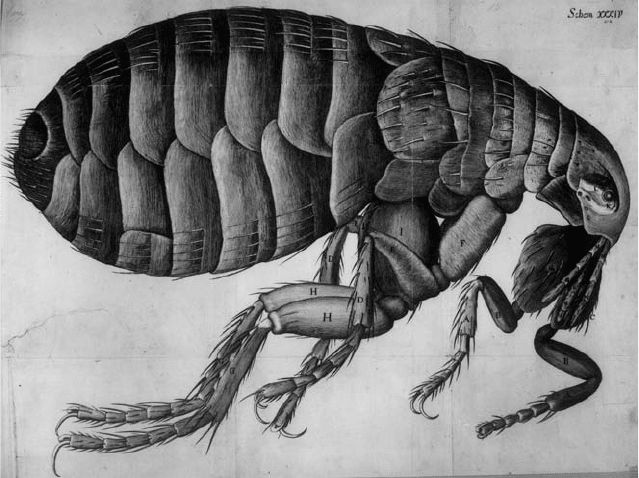
Berkeley used the discoveries of the microscope (such as Hooke’s representation of a
flea) to cast doubt on the objectivity of primary qualities
149
KNOWLEDGE
image, he still seems mistaken: mental images do not need to contain all the
properties of that of which they are images. My mental image of Abraham
does not make him either tall or short; I have no idea which he was. Berkeley
conceives mental images very much on the pattern of real images; but even
allowing for this, he is mistaken. A portrait on canvas need not specify all the
features of a sitter, and a dress pattern need not specify a colour, even
though any actual dress must have some particular colour.
At one point Locke writes that it takes skill to form the general idea of a
triangle, ‘for it must be neither oblique nor rectangle, neither equicrural
nor scalenon, but all and none of these at once’. Berkeley is right to say
that this is a piece of nonsense. But he should really be attacking Locke for
believing that the possession of images of any kind was suYcient to explain
our acquisition of concepts. That is what is really wrong with Locke’s
theory of language, not that he has chosen the wrong images or described
them in self-contradictory terms.
To use an image, or a Wgure, to represent an X, one must already have a
concept of an X. An image does not carry on its face any determination of
what it represents. An image of an oak leaf, like a drawing of an oak leaf,
may represent a leaf, an oak, a tree, a boy-scout achievement, a military
rank, or many other things. And concepts cannot be acquired simply by
stripping oV features from images. What does one strip oV from an image
of blue in order to use it as an image of colour? In any case there are
concepts to which no image corresponds: logical concepts, for instance,
such as those corresponding to ‘some’ or ‘not’ or ‘if ’. There are other
concepts that can never be unambiguously derived from images, for
instance, arithmetical concepts. One and the same image may represent
four legs and one horse, or seven trees and one copse.
Berkeley was correct, against Locke, in separating the mastery of lan-
guage from the possession of abstract general images. But he retained the
idea that mental images were the key to language: for him, a general name
signiWed not a single abstract images but ‘indiVeren tly a great number
of particular images’. But once concept-possession has been distinguished
from image-mongering, mental images become unimportant for the
philosophy of language and mind. Imaging is no more essential to thinking
than illustrations are to a book. It is not our images that explain
our possession of concepts, but our concepts that confer meaning on
our images.
150
KNOWLEDGE
Hume on Ideas and Impressions
The empiricist identiWcation of thinking and imaging is carried to an
extreme point in the philosophy of Hume. Hume does, however, attempt
to improve on Locke and Berkeley by making a distinction between two
classes of perceptions, impressions and ideas, instead of calling them all
‘ideas’. Everyone, Hume says, knows the diVerence between feeling and
thinking. Feeling is a matter of impressions: sensations and emotions.
Thinking involves ideas: the sort of things that come into one’s head
while reading the Treatise, for instance (T,1).
It becomes quite clear that Hume’s ‘ideas’ are mental images. They are,
he says, like impressions except by being less forceful and vivid. Moreover,
simple ideas are copies of impressions. This looks at Wrst like a deWnition of
‘idea’, but Hume appeals to experience in support of it. From time to time
he invites the reader to look within himself to verify the principle and
challenges him to produce a counter-example. He supports the principle
by telling us that a man born blind has no idea of colours. In the case
of colour ideas, however, he is himself willing to produce a counter-
example. Suppose that a man has encountered all colours except one
particular shade of blue:
Let all the diVerent shades of that colour, except that single one, be placed before
him, descending gradually from the deepest to the lightest; it is plain that he will
perceive a blank where that shade is wanting, and will be sensible that there is a
greater distance in that place between the contiguous colours than any other.
Now I ask, whether it be possible for him, from his own imagination, to supply this
deWciency, and raise up to himself the idea of that particular shade, though it had
never been conveyed to him by the senses? I believe there are few but will be of
opinion that he can. (E II.17)
Hume is prepared to accept this thought experiment as providing an
exception to his principle that all ideas are derived from impressions.
‘This instance is so singular,’ he continues, ‘that it is scarcely worth our
observing, and does not merit that for it alone we should alter our general
maxim’. This cavalier dismissal of a counter-example must call in question
the genuineness of Hume’s commitment to ‘the experimental method’ in
the study of the mind. Undeterred, he puts the prin ciple ‘no idea without
antecedent impression’ to vigorous use whenever he wishes to attack
metaphysics.
151
KNOWLEDGE
Having used vivacity as the criterion for di Verentiating between ideas
and impressions, Hume makes a further distinction on the basis of vivacity
between two diVerent kinds of ideas: ideas of memory and ideas of imagin-
ation. ‘Tis evident at Wrst sight’, he tells us, ‘that the ideas of the memory
are much more lively and strong than those of the imagination, and that
the former faculty paints its objects in more distinct colours than any
which are employ’d by the latter.’ In accordance with his general
principle, Hume says that both kinds of ideas must have been preceded
by the corresponding impression, but he also notes a diVerence
between them: the ideas of the imagination, unlike the ideas of the
memory, are not tied down to the order in time and space of the original
impressions.
We are given, then, two criteria for distinguishing memory from im-
agination: vivacity and orderliness. It is not clear, however, how these
criteria are to be used. It is, no doubt, to enable us to distin guish genuine
from delusory memory (‘Do I remember that I posted the letter, or am I
only imagining it?’). The second criterion would make the distinction, but
could never be applied in a case of doubt; the Wrst criterion could be used
by a doubter, but would be unreliable, since fantasies can be more forceful
and obsessive than memories.
Hume thinks of memory as reliving in the mind a series of past events;
but of course remembering the date of the Battle of Hastings, remembering
how to make an omelette, or remembering the way to Oxford from
London, are very diVerent from each other. So are many other diVerent
kinds of memory. Similarly, the word ‘imagination’ covers much more
than the free play of mental imagery: it includes misperception (‘Is that a
knock at the door, or am I only imagining it?’), hypothesizing (‘imagine
what the world would be like if everyone behaved in that way!’), and
creative originality (‘The Lord of the Rings is a work of extraordinary imagin-
ation’). Hume’s treatment of memory and imagination tries to pack a great
variety of mental events, capacities, activities, and errors into a single
empiricist straitjacket.
There are cases which seem to Wt Hume’s account reason ably well. I hear
a bird sing and then try to recapitulate the melody mentally; I gaze at a
patterned wallpaper, and see an after-image after I have closed my eyes. But
even in these cases Hume misrepresents the situation. On the face of it, the
diVerence between the impressions and the ideas is that whereas the bird
152
KNOWLEDGE
and the wallpaper are external to me, the after-image and the subvocal
humming are interior events. But Hume accepts the empiricist thesis that
all we ever know are our own perceptions. My hearing the bird sing is not a
transaction between myself and the bird, but my encounter with a vivid
bird-like sound. For Hume, everyone’s life is just one introspection after
another.
It has to be by introspection, then, that we tell the diVerence between
our memories and our imaginings. The diVerence between the two, one
might think, could best be made out in terms of belief. If I take myself to
be remembering that p, then I believe that p; but I can imagine p’s being the
case without any such belief. As Hume himself says, we conceive many
things that we do not believe. But his classiWcation of mental states makes it
diYcult for him to Wnd a suitable place for belief.
The di Verence between merely having the thought that p and actually
believing that p cannot be a diVerence of content. As Hume puts it, belief
cannot consist in the addition of an extra idea to the idea or ideas which
constitute what is believed. One argument for this is that we are free to add
any ideas we like, but we cannot choose to believe whatever we please.
A more convincing reason would be that if belief consisted in an extra idea,
someone who believes that Caesar died in his bed and someone who does
not believe that Caesar died in his bed would not be in conXict with each
other because they would not be considering the same proposition (T, 95).
In the Enquiry, Hume says that belief is a conception ‘attended with a
feeling or sentiment, diVerent from the loose reveries of the fancy’.
But such a feeling would surely be an impression; and in an appendix to
the Treatise, Hume argues forcefully that this would be directly contrary
to experience—belief consists only of ideas. But he still insists that ‘An idea
assented to feels diVerent from a Wctitious idea,’ and he oVers various names
to describe the feeling: ‘force, vivacity, solidity, Wrmness, steadiness’. He
ends by confessing that ‘’tis impossible to explain perfectly this feeling or
manner of conception’ (T, 629). But he urges us to accept his account on
the implausib le ground that history books (which we believe to be factual)
are much more vivid to read than novels (which we are well aware are
Wction) (T, 97).
Some of the diYculties in Hume’s account of vivacity as a mark of belief
are internal to his system. We observe his embarrassment at discovering a
perception that is neither quite an idea nor quite an impression. We may
153
KNOWLEDGE
wonder how we are to distinguish the belief that Caesar died in his bed
from a memory of Caesar dying in his bed, since vivacity is the mark
of each. But other diY culties are not merely internal. The crucial problem
is that belief need not involve imagery at all (when I sit down, I believe the
chair will support me; but no image or thought about the matter enters
my mind). And when a belief does involve imagery, an obsessive fantasy
(of a spouse’s inWdelity, for instance) may be livelier than a genuine belief.
There is something pitiable about Hume’s delusion that in presenting his
few scattered remarks about the association of ideas he was doing for
epistemology what Newton had done for physics. But it is unfair to
blame him because his philosophical psychology is so jejune: he inherited
an impoverished philosophy of mind from his seventeenth-century fore-
bears, and he is often more candid than they in admitting the gaps and
incoherences in the empiricist tradition. The insights that make him great
as a philosopher can be disentangled from their psychological wrapping,
and continue to provoke reXection. His treatment of c ausation, of the self,
of morality, and of religion will be treated in the appropriate chapters.
His main contribution to epistemology was the presentation of a new form
of scepticism.
This begins from the distinction, which we have met in several philo-
sophers, between propositions expressing relations of ideas, and proposi-
tions expressing matters of fact. The contrary of every matter of fact is
possible, Hume says, because it can never imply a contradiction. That the
sun will not rise tomorrow is as intelligible and coherent as the aYrmation
that it will rise. Why then do we believe the latter but not the former
(E II. 25 –6)?
All our reasonings concerning matters of fact, Hume argues, are
founded on the relation of cause and eVect. But how do we arrive at
our knowledge of causal relations? The sensible properties of objects do not
reveal to us either the causes that produced them or the eVects that will
rise from them. Merely looking at gunpowder would never tell you that it
was explosive; it tak es experience to learn that Wre burns things up. Even
the simplest regularities of nature cannot be established a priori, because a
cause and an eVect are two totally diVerent events and the one cannot be
inferred from another. We see a billiard ball moving towards another, and
we expect it to communicate its motion to the other. But why? ‘May not
both these balls remain at absolute rest? May not the Wrst ball return in a
154
KNOWLEDGE
straight line, or leap oV from the second in any line or direction? All these
suppositions are consistent and conceivable’ (E II. 30).
The answer, obviously enough, is that we learn the regularities of nature
from experience. But Hume carries his probe further. Even after we have
experience of the operations of cause and eVect, he asks, what ground is there
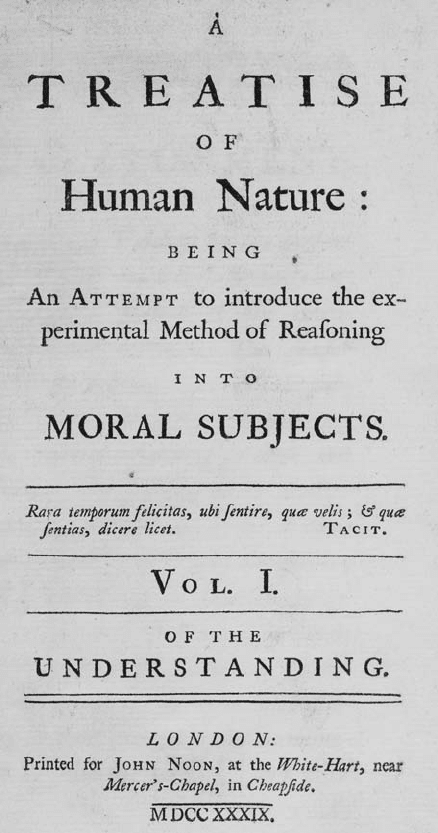
The title page of the first
edition of Hume’s Treatise
which ‘fell dead-born
from the Press’
155
KNOWLEDGE