
Kenny Anthony. The Rise of Modern Philosophy: A New History of Western Philosophy. Volume 3
Подождите немного. Документ загружается.

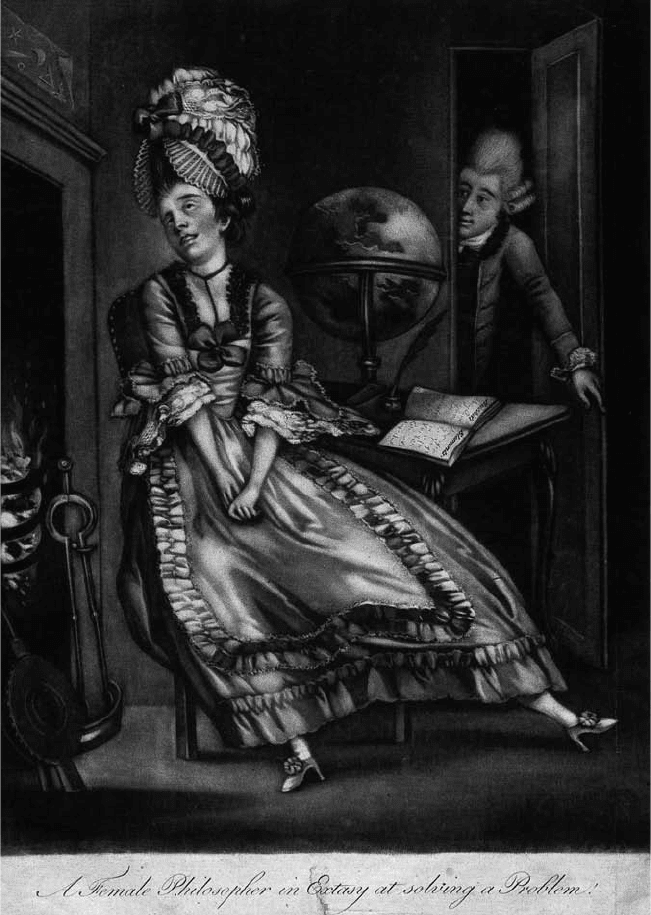
Rousseau, like the author of this cartoon, held the view that women were made for
emotion, not for philosophizing
96
HUME TO HEGEL
WolV and Lessing
In Germany, the Enlightenment took a form that was less threatening to
the existing establishment—partly, no doubt, because it enjoyed for a while
the patronage of Frederick the Great, King of Prussia from 1740–86. In the
Wrst half of the eighteenth century the leading German philosopher was
Christian WolV (1679–1754), who began his career as a professor of math-
ematics at Halle, a post he was oVered on the recommendation of Leibniz.
When he Wrst ventured into philosophy he aroused the hostility of devout
Lutherans, who inXuenced the then monarch to deprive him of his chair
and banish him from Prussia. Such an experience of persecution was almost
the only thing WolV had in common with the philosophes; unlike them, he was
solemn, academic, systematic, and accurately erudite. His rationalism was at
the opposite pole from Rousseau’s romanticism.
WolV taught for seventeen years in a Calvinist university in Marburg,
but when Frederick the Great came to the throne he was restored to his
chair in Halle, which he held until his death. Later, he became vice-
chancellor of the university and was made a baron of the Holy Roman
Empire. His philosophical system was eclectic and capacious, embracing
elements from classical Aristotelianism, Latin scholasticism, Cartesian ra-
tionalism, and Leibnizian metaphysics. He took over from Leibniz the
principle of suYcient reason, which he regarded as the fundamental basis
of metaphysics in conjunction with the principle of identity. The suYcient
reason for the existence of the world is to be found in a transcendent God,
whose existence can be established by the traditional ontological and
cosmological arguments. The world we live in is the best of all possible
worlds, freely chosen by God’s wisdom.
There was little that was original in WolV, except for the system which
he imposed upon his borrowings from earlier authors. He perceived it as
his task, for instance, to impose order on what he saw as the chaos of
Aristotle’s metaphysics. He regimented the diVerent branches of philoso-
phy, popularizing such distinctions as those between natural theology and
general metaphysics (‘ontology’), which had been absent from medieval
discussion. His deWnition of ontology as ‘the science of all possible things
insofar as they are possible’, with its emphasis on possible essences rather
than actual existents, was a continuation of a line begun by Avicenna
HUME TO HEGEL
97
and Duns Scotus. He introduced a novel distinction between physics (the
experimental study of the contingent natural laws of this world) and
cosmology (an a priori investigation of every possible material world).
Like Descartes, Wol V accepted the existence of a human soul that was a
simple substance available to self-consciousn ess; but the relation between
this soul and the body he explained by appeal to a Leibnizian pre-established
harmony. In WolV ’s ethical system the key notion is that of perfection.
Good is what increases perfection, and evil what diminishes it. The funda-
mental human motivation is self-perfection, which includes the promo-
tion of the common good and the service of God’s honour. Although
living bodies, including human bodies, are machines, nonetheless we
enjoy free will: rational choice can, and should, overcome all the pressures
of sensibility.
WolV is nowadays hardly ever read by English readers. His importance in
the history of philosophy is that his system became accepted in Germany as
the paradigm of a rationalist metaphysics, and that later writers deWned their
own positions in relation to his. This is particularly true of Immanuel Kant,
who in his magisterial critique of m etaphysics often has WolV ’s doctrines
immediately in his sights.
A thinker who was much closer to the Enlightenment as understood in
France and Britain was Gotthold Ephraim Lessing (1729–81). The son of a
Lutheran pastor, he was initially destined for the Church, but he aban-
doned theology for a literary career, in which he supported himself by
acting as librarian to the Duke of Brunswick. Like the philosophes he ex-
pressed his thoughts in essays and dramas in preference to academic
textbooks. His Wrst publication was an essay written jointly with the Jewish
philosopher Moses Mendelssohn entitled ‘Pope a Metaphysician!’, which was
partly an attack on the Leibnizian views expressed in Pope’s Essay on Man, but
also a plea for a sharp separation between philosophy and poetry as two
quite diVerent spiritual activities. In Laocoon of 1776 he pleaded for a similar
separation between poetry and the visual arts: the artistic eVect of Virgil’s
description of the death of Laocoon is quite diVerent, he argued, from
that of the famous classical statue in the Vatican. In each case Lessing,
taking as his starting point Aristotle’s Poetics (‘as much an infallible work as
the Elements of Euclid’), delineated a special, semi-prophetic role for the poet.
In doing so he foreshadow ed one of the principal themes of Romanticism.
HUME TO HEGEL
98
Like the Romantics, Lessing admired Spinoza. He regarded the world as
a single uniWed system whose components were identical with ideas in
the mind of God. He was willing to accept that determinism was true and
that freedom was an illusion; on the other hand, he was willing to admit
contingency in the world, with the consequence that some among God’s
ideas were contingent also. He praised Spinoza for realizing that liberation
from anxiety is only to be achieved by accepting the inevitability of destiny.
‘I thank my God’, he said, ‘that I am under necessity, that the best must be.’
Lessing’s most important philosophical work was The Education of the Human
Race (1780). The human race, like the human individual, passes through
diVerent stages, to which diVerent kinds of instruction are appropriate. The
upbringing of a child is a matter of physical rewards and punishment:
the childhood of the human race was the era of the Old Testament. In
our youth, educators oVer us more spiritual rewards for good conduct;
eternal rewards and punishments for an immortal soul. This corresponds to
the period of history dominated by the Christian religion. However, as
Lessing endeavoured to show in a number of critical studies of the New
Testament, the evidence for the divine origin of Christianity is uncompel-
ling. Even the strongest historical evidence about contingent facts, Lessing
went on to argue, cannot justify any conclusion to necessary truths about
matters of divinity.
The Christian religion, therefore, can be no more than a stage in the
education of the human race, and its dogmas can have no more than
symbolic value. Human nature, come of age, must extract from Christian-
ity a belief in the universal brotherhood of man, and must pursue moral
values for their own sake, not for the sake of any reward here or hereafter
(although Lessing toys with the idea of a transmigration of souls into a new
incarnation after death). Like the leaders of the French Enlightenment,
Lessing was a passionate advocate of religious toleration; he gave fullest
expression to this advocacy in his drama Nathan the Wise (1779). One reason
for toleration that Lessing oVers is that the worth of a person does not
depend on whether his beliefs are true, but on how much trouble he has
taken to attain the truth. This novel argument was presented in a vivid
paragraph often quoted since:
If God held all truth in his right hand and in his left the everlasting striving after
truth, so that I should always and everlastingly be mistaken, and said to me, Choose,
HUME TO HEGEL
99
with humility I would pick on the left hand and say, Father, grant me that; absolute
truth is for thee alone. (Gesammelte Werke, ed. Lachmann and Muncker, XIII. 23)
Kant
One man who devoted his whole life to the pursuit of absolute truth was
Immanuel Kant: indeed, apart from this pursuit, there is little to tell about
his biography. Born in 1724 in Ko
¨
nigsberg, which was then in the eastern
part of Prussia, he lived all his life in the town of his birth. From 1755 until
1770 he was a Privatdozent or lecturer in Ko
¨
nigsberg University, and from 1770
until his death in 1804 he held the professorship of logic and metaphysics
there. He never travelled or married or held public oYc e, and the story of
his life is the story of his ideas.
Kant was brought up in a devout Lutheran family, but he later became
liberal in his theological views, though perforce regular in religious obser-
vance. He was always a man of strict life and constant habit, notorious for
exact punctuality, rising at Wve and retiring at ten, lecturing in the morning
from seven to eight, and then writing until a late and ample luncheon. The
citizens of Ko
¨
nigsberg used to joke that they could set their watc hes by
his appearance for his afternoon constitutional. As a university student he
was taught by a disciple of WolV, but his own ea rly interests were more
scientiWc than philosophical, and as a Privatdozent he lectured not only
on logic and metaphysics but on subjects as diverse as anthropology,
geography, and mineralogy. His Wrst books, too, were written on scientiWc
subjects, most notably the General History of Nature and Theory of the Heavens
of 1755.
From 1860 onwards he began to devote himself seriously to philosophy,
but for the next twenty years the works he published were of a cautious
and conventional kind. In 1762 he wrote a short and rather superWcial essay
on the traditional syllogistic, criticizing the unnecessary subtlety (‘Die
falsche SptizWndigkeit’, as the essay’s title has it) of its customary presen-
tation. In the same year he wrote The Only Possible Ground for a Demonstration of
God’s Existence, in which, while rejecting three of the standard proofs of
God’s existence, he argued, in the spirit of WolV and Duns Scotus, that if
there are any possible beings at all there must be a perfect being to provide
the ground of this possibility.
HUME TO HEGEL
100
In 1763 the Berlin Academy set as a prize question ‘whether metaphysical
truths can be demonstrated with the same certainty as truths of geometry’.
Kant’s (unsuccessful) entry for the prize underlined a number of crucial
distinctions between mathematical and philosophical method. Mathemat-
icians start from clear deWnitions which create concepts which they then go
on to develop; philosophers start from confused concepts and analyse them
in order to reach a deWnition. Metaphysicians rather than aping ma themat-
icians should follow Newtonian methods, by applying them not to the
physical world but to the phenomena of inner experience.
The programme that Kant lays out here for the philosopher closely
resembles that which Hume had set himself, and later Kant was to credit
Hume with having woken him from the ‘dogmatic slumber’ of the years
when he accepted the philosophy of Leibniz and WolV. It is not certain when
Kant began the serious study of Hume, but during the 1760s he became
increasingly sceptical of the possibility of a scientiWc metaphysics. The
anonymous, skittish Dreams of a Ghost Seer of 1766 compared metaphysical
speculations with the esoteric fantasies of the visionary Immanuel Sweden-
borg. Among other things, Kant emphasized, in the wake of Hume, that
causal relations could be known only through experience and were never
matters of logical necessity. However, his inaugural dissertation as professor
in 1770 (On the Form and Principles of the Sensible and Intelligible World) still shows the
strong inXuence of Leibniz.
The W rst eleven years of his professorship were spent by Kant in devel-
oping his own original system, which was published in 1781 in The Critique of
Pure Reason, a work which at once put his pre-critical works in the shade and
established him as one of the greatest philosophers of the modern age.
He followed it up with a briefer and more popular exposition of its ideas,
the Prolegomena to any Future Metaphysics (1783), and republished it in a second
edition in 1787.
Kant’s aim in his critical philosophy was to make philosophy, for the Wrst
time, fully scientiWc. Mathematics had been scientiWc for many centuries,
and scientiWc physics had come of age. But metaphysics, the oldest discipline,
the one which ‘would survive even if all the rest were swallowed up in the
abyss of an all-destroying barbarism’, was still far from maturity. Metaphys-
ical curiosity was inherent in human nature: human beings could not but be
interested in the three main objects of metaphysics, namely, God, freedom,
and immortality. But could metaphysics become a true science?
HUME TO HEGEL
101
Hume and others, as we have seen, had tried to do for the philosophy of
mind what Newton had done for the philosophy of bodies, making the
association of ideas the psychic counterpart of gravitational attraction
between bodies. Kant’s programme for rendering metaphysics scientiWc
was on a more ambitious scale. Philosophy, he believed, needed a revolution
like that of Copernicus who had moved the earth from the centre of the
universe to put the sun in its place. Copernicus had shown that when we
think we are observing the motion of the sun round the earth what we see is
the consequence of the rotation of our own earth. Kant’s Copernican
revolution will do for our reason what Copernicus did for our sight. Instead
of asking how our knowledge can conform to its objects, we must start from
the supposition that objects must conform to our knowledge. Only in this
way can we justify the claim of metaphysics to possess knowledge that is
necessary and universal.
Kant distinguishes between two modes of knowledge: knowledge a priori
and knowledge a posteriori. We know a truth a posteriori if we know it through
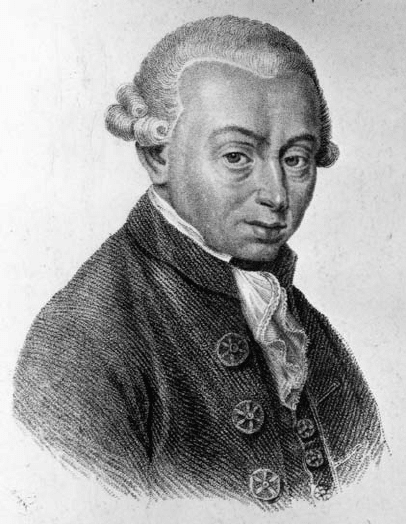
An engraving of Kant at the
age when he published his
first Critique
HUME TO HEGEL
102
experience; we know it a priori if we know it independently of all experience.
Kant agreed with Locke that all our knowledge begins with experience, but
he did not believe that it all arose from experience. There are some things
that we know a priori, fundamental truths that are not mere generalizations
from experience. Among the judgements that we make a priori some, Kant
says, are analytic, and some are synthetic. In an analytic judgement, such as
‘all bodies are extended’, we are merely making explicit in the predicate
something that is already contained in the concept of the subject. But in a
synthetic judgement the predicate adds something to the content of
the subject: Kant’s example is ‘all bodies are heavy’. All a posteriori proposi-
tions are synthetic, and all analytic propositions are a priori. Can there be
propositions that are synthetic, and yet a priori? Kant believes that there are.
For him, mathematics oVers examples of synthetic a priori truths. Most
importantly, there must be propo sitions that are both a priori and synthetic
if it is ever going to be possible to make a genuine science out of meta-
physics.
The philosopher’s W rst task is to make plain the nature and limits of the
powers of the mind. Like medieval and rationalist philosophers before him,
Kant distinguishes sharply between the senses and the intellect; but within
the intellect he makes a new distinction of his own between understanding
(Verstand) and reason (Vernunft). The understanding operates in combin-
ation with the senses in order to provide human knowledge: through the
senses, objects are given us; through the understanding, they are made
thinkable. Experience has a content, provided by the senses, and a struc-
ture, determined by the understanding. Reason, by contrast with under-
standing, is the intellect’s endeavour to go beyond what understanding can
achieve. When divorced from experience it is ‘pure reason’, and it is this
which is the target of Kant’s criticism.
Before addressing pure reason, Kant’s Critique makes a systematic study of
the senses and the understanding. The senses are studied in a section en-
titled ‘Transcendental Aesthetic’, and the understanding in a section entitled
‘Transcendental Logic’. ‘Transcendental’ is a favourite word of Kant’s; he used
it with several meanings, but common to all of them is the notion of
something which (for better or worse) goes beyond and behind the deliver-
ances of actual experience.
The transcendental aesthetic is largely devoted to the study of space and
time. Sensations, Kant says, have a matter (or content) and a form. Space is
HUME TO HEGEL
103
the form of the outer senses, and time is the form of the inner sense. Space
and time are not entities in the world discovered by the mind: they are the
pattern into which the senses mould experience. In expounding his tran-
scendental aesthetic, Kant oVers his own novel solution to the age-old
question ‘Are space and time real?’6
When we move from the transcendental aesthetic to the transcendental
logic we again encounter a twofold division. The logic consists of two
major enterprises, which Kant calls the transcendental analytic and the transcen-
dental dialectic. The analytic sets out the criteria for the valid empirical
employment of the understanding; the dialectic exposes the illusions that
arise when reason tries to operate outside the limits set by the analytic. In
his analytic Kant lays out a set of a priori concepts which he calls ‘categories’,
and a set of a priori judgements which he calls ‘principles’. Accordingly, the
analytic is again subdivided, into two main sections, containing ‘The
Deduction of the Categories’ and ‘The System of Principles’.
The Wrst section presents the deduction, or legitimation, of the categor -
ies. Categories are concepts of a particularly fundamental kind: Kant gives
as instances the concepts of ‘cause’ and ‘substance’. Without these cat-
egories, he argues, we could not conceptualize or understand even the
most fragmentary and disordered experience. His aim here is to meet the
empiricist’s challenge on the empiricist’s own ground. He agrees with
the empiricist that all our knowledge begins with experience, but he denies
that all of it arises from experience. He seeks to show that without the
metaphysical concepts that Hume sought to dismantle, Hume’s own basic
items of experience, impressions, and ideas would themselves disintegrate.
The second section of the analytic, the system of principles, contains a
number of synthetic a priori propositions about experience. Experi ences, Kant
maintains, must possess two kinds of magnitude—extensive magnitude (of
which an instance is the distance between two points) and intensive magni-
tude (of which an instance is a particular degree of heat) Moreover, Kant
maintains, experience is only possible if necessary connections are to be
found among our perceptions. Hume was wrong to think that we Wrst
perceive temporal succession between events, and then go on to regard one
as cause and another as eVect. On the contrary, we could not establish an
6 Kant’s account of space and time is considered at greater length in Ch. 5.
HUME TO HEGEL
104
objective time sequence unless we had already established relationships
between causes and eVects.7
While Kant is hostile to empiricism, he attacks rationalism no less
vigorously. At the end of his analytic he insists that the categories cannot
determine their own applicability, the principles cannot establish their own
truth. Understanding alone cannot establish that there is any such thing
as a substance, or that every change has a cause. All that one can establish
a priori is that if experience is to be possible, certain conditions must hold.
But whether experience is possible cannot be established in advance: the
possibility of experience is shown only by the actual occurrence of experi-
ence itself.
The analytic shows that there cannot be a world of mere appearances,
mere objects of sense that do not fall under any categories or instantiate
any rules. But we cannot conclude from this that there is a non-sensible
world that is established by the intellect alone. To accept the exist ence of
extra-sensible objects that can be studied by the use of pure reason is to
enter a realm of illusion, and in his ‘transcendental dialectic’ Kant explores
this world of enchantment.
‘Transcendental’, as has been said, means something that goes beyond
and behind the deliverances of actual experience, and in his dialectic Kant
has three principal targets: metaphysical psychology, metaphysical cosmol-
ogy, and metaphysical theology. ‘Pure reason’, he tells us, ‘furnished the
idea for a transcendental doctrine of the soul, for a transcendental science
of the world, and Wnally for a transcendental knowledge of God.’ In turn
he tests to destruction the three notions of an immaterial immortal soul, of
a surveyable cosmic whole, and of an absolutely necessary being.
Rationalist psychology, as practised by Descartes, started with the premiss
‘I think’ and concluded to the existence of a substance that was immaterial,
incorruptible, personal, a nd immortal. Kant argues that this line of argu-
ment is littered with fallacies—he lists four of them which he calls ‘the
paralogisms of pure reason’. These paralogisms are not accidental: in
principle, any attempt to go beyond empirical psychology must be guilty
of fallacy.
In order to dismantle a priori cosmology, Kant sets up four antinomies. An
antinomy is a pair of contrasting arguments which lead to contradictory
7 Kant’s account of the relation between time and causation is discussed in Chapter 6.
HUME TO HEGEL
105