
Kenny Anthony. The Rise of Modern Philosophy: A New History of Western Philosophy. Volume 3
Подождите немного. Документ загружается.

member of the state—just as an eye only has any value as part of a living
body.
DiVerent states will have diVerent characteristics corresponding to
the folk-spirit of the nation which they incorporate. At diVerent times
diVerent folk-spirits will be the primary manifestation of the progress of the
world-spirit, and the people to which it belongs will be, for one epoch, the
dominant people in the world. For each nation, the hour strikes once and
only once, and Hegel believed that in his time the hour had struck for the
German nation. The Prussian monarchy was the nearest thing on earth to
the realization of an ideal state.11
The most important manifestation of spirit, however, was not to be
found in political institutions, but in philosophy itself. The self-awareness
of the absolute is brought into existence by the philosophical reXection of
human beings; the history of philosophy brings the absolute face to face
with itself. Hegel Wrmly believed that philosophy made progress: ‘the latest,
most modern and newest philosophy is the most developed, richest and
deepest’, he tells us (LHP I. 41). In his lectures on the history of philosophy
he displays earlier philosophies as succumbing, one by one, to a dialectical
advance marching steadily in the direction of German idealism.
11 Hegel’s political philosophy is considered in detail in Ch. 9.
HUME TO HEGEL
116

4
Knowledge
Montaigne’s Scepticism
I
n the sixteenth century, several factors contributed to make scepticism
enjoy a new popularity. The clash between diVerent Christian sects in
Europe, and the discovery of peoples across oceans with diVerent cultures
and diVerent religions, had as an immediate eVect a surge of proselytizing
and persecution; but these encounters also caused some reXective thinkers
to question the claim of any human system of belief to hold unique
possession of the truth. The rediscovery of ancient sceptical works, such
as those of Sextus Empiricus, brought to the attention of the learned a
battery of arguments against the reliability of human cognitive faculties.
The most eloquent presentation of the new scepticism is to be found in
Montaigne’s Apology for Raimond Sebond.
Montaigne, like Sextus, favoured an extreme form of scepticism, called
Pyrrhonian scepticism after its (half-legendary) founder Pyrrho of Elis, who
in the time of Alexander the Great had taught that nothing at all could be
known. Many of the examples that Montaigne uses to urge the fallibility of
the senses and the intellect are drawn from Sextus’ works, but the classical
quotations that he uses in the course of his argument are taken not from
Sextus, but from the great poem On the Nature of Things by Lucretius, a Latin
follower of Epicurus, itself another great Renaissance rediscovery.
The two most inXuential philosophies of the classical Latin period were
the Epicureans and the Stoics. The Epicureans, Montaigne tells us, maintain
that if the senses are not reliable, then there is no such thing as knowledge.
The Stoics tell us that if there is any such thing as knowledge it cannot come
from the senses, because they are totally unreliable. Montaigne, like Sextus,
uses Stoic arguments to show the fallibility of the senses, and Epicurean
arguments to show the impossibility of non-empi rical knowledge. Using the
negative arguments of each sect, he aims to show against both of them that
there is no such thing as real knowledge.
Montaigne rehearses familiar arguments to show that the senses mislead
us. Square towers look round from a distance, vision is distorted by
pressure on the eyeball, jaundice makes us see things yellow, mountains
seem to travel past us when we look at them from shipboard, and so on.
When two senses contradict each other, there is no way of resolving the
diVerence. Montaigne quotes a famous pas sage of Lucretius:
Can ears deliver verdict on the eyes?
Can touch convict the ears, or taste the touch, of lies?
But he does not go on to conclude, with Lucretius, that the senses are
infallible. Lucretius wrote:
If what the senses tell us is not true
Then reason’s self is naught but falsehood too.1
Montaigne accepts this conditional; but he c oncludes, not that the senses
tell us true, but rather that reason is equally false (ME II. 253).
Sense and reason, so far from cooperating to produce knowledge, each
work on the other to produce falsehood. TerriWed sense, when we look
down, prevents us from crossing a narrow plank across a chasm, although
reason tells us the plank is quite broad enough for walking. On the other
hand, passions in our will can aVect what we perceive with our senses: rage
and love can make us see things that are not there. ‘When we are asleep,’
Montaigne maintains, ‘our soul is alive and active and exercises all its powers
neither more nor less than when it is awake.’ The diVerence between sleep
and waking is less than that between daylight and darkness (ME II. 260–1).
We need some criterion to distinguish between our varying and con-
Xicting impressions and beliefs, but no such criterion is possible. Just as we
cannot Wnd an impartial arbiter to adjudicate the diVerences between
Catholic and Protestant, since any competent judge would already be
one or the other, similarly no human being could set out to settle the
conXicts between the experiences of the young and the old, the heal thy
and the sick, the asleep and the awake:
1 De Rerum Natura 4.484–7; see vol. I, p. 166.
118
KNOWLEDGE
To judge of the appearances that we receive from objects we need some judging
instrument; to calibrate such an instrument, we would need an experiment; to
verify the experiment, we would need some instrument: we are going round in a
circle. (ME II. 265)
Montaigne adds some original material to the arsenal of ancient scepticism.
Reverting to one of his favourite themes, he points out that some animals
and birds have sharper senses than we do. Perhaps they even have senses
which we totally lack. (Is it such a sense that tells the cock when to crow?)
Our Wve senses are perhaps only a small number of those that it is possible
to have. If so, our view of the universe, compared with a true view, is no
less deWcient than the view of a man born blind by comparison with that of
a sighted person.
Descartes’ Response
Descartes, in his Meditations, set himself the task of liberating philosophy
from the threat of scepticism that had developed in the preceding century.
In order to do so, Wrst he had to exhibit the sceptical position that he
wanted to refute. In the W rst of the Meditations, he follows in Montaigne’s
footsteps, but sets out the arguments in brisker and neater form. The
deliverances of the senses are called into question initially by considerations
drawn from sense-deception, and then by the argument from dreaming:
What I have so far accepted as true par excellence, I have got either from the senses or
by means of the senses. Now I have sometime caught the senses deceiving me; and
a wise man never entirely trusts those who have once cheated him.
But although the senses may sometimes deceive us about some minute and remote
objects, yet there are many other facts as to which doubt is plainly impossible,
although these are gathered from the same source: e.g. that I am here, sitting by the
Wre, wearing a winter cloak, holding this paper in my hands and so on . . .
A Wne argument! As though I were not a man who habitually sleeps at night and
has the same impressions (or even wilder ones) in sleep as these men do when
awake! How often, in the still of the night, I have the familiar conviction that I am
here, wearing a cloak, sitting by the Wre—when really I am undressed and lying in
bed! (AT VII. 19; CSMK II.13)
119
KNOWLEDGE
But surely even dreams are made up of elements drawn from reality:
Suppose I am dreaming, and these particulars, that I open my eyes, shake my head,
put out my hand, are incorrect; suppose even that I have no such hand, no such
body; at any rate it has to be admitted that the things that appear in sleep are like
painted representations, which cannot have been formed except in the likeness of
real objects. So at least these general kinds of things, eyes, head, hands, body must
not be imaginary but real objects. (AT VII.20; CSMK II.14)
Perhaps these, in their turn, are imaginary complexes; but then the simpler
elements out of which these bodies are composed—extension, shape, size,
number, place, time—must surely be real. And if so we can trust the
sciences of arithmetic and geometry which deal with these objects. ‘Whether
I am awake or asleep, two and three add up to Wve, and a square has only
four sides; and it seems impossible for such obvious truths to fall under a
suspicion of being false’ (ibid.).
Even mathematics, however, is not immune to Cartesian doubt. It is not
just that mathematicians sometimes make mistakes: it may be that the
whole discipline itself is a delusion. God is omnipotent, and for all we know
he can make us go wrong whenever we add two and three, or count the
sides of a square. But surely a good God would not do that! Well, then:
I will suppose not that there is a supremely good God, the source of truth; but that
there is an evil spirit, who is supremely powerful and intelligent, and does his
utmost to deceive me. I will suppose that sky, air, earth, colours, shapes, sounds,
and all external objects are mere delusive dreams, by means of which he lays snares
for my credulity. I will consider myself as having no hands, no eyes, no Xesh, no
blood, no senses, but just having a false belief that I have all these things. (AT
VII.23; CSMK II.15)
The second Meditation brings these doubts to an end by producing the Cogito,
the famous argument by which Descartes proves his own existence. How-
ever the evil genius may deceive him, he cannot trick him into thinking he
exists when he does not:
Undoubtedly I exist if he deceives me; let him deceive me as much as he can, he
will never bring it about that I am nothing while I am thinking that I am
something. The thought ‘I exist’ cannot but be true when I think it; but I cannot
doubt it without thinking of it. Hence, it is not only true but indubitable, because
whenever I try to doubt it I see its truth.
The Cogito is the rock on which Descartes’ epistemology is built. From his
day to ours, critics have questioned whether it is as solid as it looks. ‘I am
120
KNOWLEDGE
thinking, therefore I exist’ is undoubtedly a valid argument, whose validity
can be taken in at a single mental glance. But so too is ‘I am walking,
therefore I exist’: so what is special abut the Cogito? Descartes responded that
the premiss ‘I am walking’ could be doubted (perhaps I have no body), but
the premis s ‘I am thinking’ cannot be doubted, for to doubt is itself to think.
On the ot her hand, ‘I think I am walking, therefore I exist’ is a perfectly
acceptable form of the cogito: the thinking referred to in the premiss can be a
thought of any kind, not just the self-reXexive thought that I exist.
A more serious question concerns the ‘I’ in ‘I am thinking’. In ordinary
life the Wrst-person pronoun gets its meaning in connection with the body
that gives its utterance. Is someone who doubts whether he has a body
entitled to use ‘I’ in soliloquy? Perhaps Descartes was entitled only to say:
‘There is thinking going on.’ Similar questions can be raised about the ‘I’ in
‘I exist’. Perhaps the conclusion should only have been ‘Existing is going
on.’ Critics have argued that the doubting Descartes has no right to draw
the conclusion that there is an enduring, substantial self. Perhaps he
should have concluded rather to a Xeeting subject for a transient thought,
or perhaps even that there can be thoughts with no owners. Is it certain
that the ‘I’ revealed by the methodical doubt is the same person who,
unpuriWed by doubt, answered to the name ‘Rene
´
Descartes’?
Even on its own terms, the Cogito does not prove the existence of
Descartes as a whole human being. By itself, it proves only the existence
of his mind. After the Cogito Descartes continues to doubt whether he has a
body, and it is only after considerable further reasoning that he concludes
that he does indeed possess one. What he is aware of at all times are the
contents of his mind, and it is from these that he must rebuild science.
From the Cogito, Decartes derives much else besides his own existence: his
own essence; the existence of God; the criterion of truth. But for our
present purposes what is important is to see how he proceeds from this
Archimidean point to re-establish the cognitive system that the sceptical
arguments appear to have overthrown.
Cartesian Consciousness
The contents of our minds are thoughts. ‘Thought’ is used by Descartes very
widely: a piece of mental arithmetic, a sexual fantasy, a severe toothache, a
121
KNOWLEDGE
view of the Matterhorn, or a taste of a vintage port are all, in his terminology,
thoughts. Thinking, for Descartes, includes not only intellectual meditation,
but also volition, emotion, pain, pleasure, mental images, and sensations. The
feature which all such elements have in common, which makes them
thoughts, is the fact that they are items of consciousness. ‘I use this term to
include everything that is within us in such a way that we are immediately
conscious of it. Thus, all the operations of the will, the intellect, the imagin-
ation and the senses are thoughts’ (AT VII. 160; CSMK II. 113). ‘Even if the
external objects of sense and imagination are non-existent, yet the modes of
thought that I call sensations and images, in so far as they are merely modes of
thought, do, I am certain, exist in me’ (AT VII. 35; CSMK II. 34). These
thoughts, then, are the basic data of Descartes’ epistemology.
One passage brings out very strikingly how the word ‘thought’ for
Descartes applies to conscious experience of any kind:
It is I who have sensations, or who perceive corporeal objects as it were by the
senses. Thus, I am now seeing light, hearing a noise, feeling heat. These objects are
unreal, for I am asleep; but at least I seem to see, to hear, to be warmed. This
cannot be unreal, and this is what is properly called my sensation; further
sensation, precisely so regarded, is nothing but an act of thought. (AT VII.29;
CSMK II. 19)
These apparent sensations, possible in the absence of a body, are what later
philosophers were to call ‘sense-data’. The viability of the Cartesian system
depends on whether a coherent signiWcation can be given to such a notion.2
In the third Meditation Descartes singles out an important class of
thoughts, and gives them the name ‘ideas’: ‘Some of my thoughts are as
it were pictures of objects, and these alone are properly called ‘‘ideas’’—for
instance, when I think of a man, or a chimera, or the sky, or an angel, or
God’ (AT VII.37). The word ‘idea’ is now at home in ordinary language, but
it was a new departure to use it systematically, as Descartes did, for the
contents of a human mind: hitherto philosophers had commonly used it
to refer to Plato’s Forms, or to archetypes in the Mind of God. Crudely, we
can say that, for Descartes, ideas are the mental counterpart of words.
‘I cannot express anything in words, provided that I understand what I say,
without its thereby being certain that there is within me the idea of what is
signiWed by the words in question’ (AT VII.160).
2 See Ch. 8 below.
122
KNOWLEDGE
Descartes divides ideas into three classes: ‘Of my ideas, some seem to be
innate, some acquired, and some devised by myself.’ As examples of
innate ideas, Descartes oVers the ideas of thing, truth, and thought. The ideas
that occur when Descartes seems to hear a noise, or to see the sun, or to
feel the heat of a Wre, appear to originate in external objects. Ideas of sirens
and hippogriVs, on the other hand, seem to be creations of Descartes
himself. At this stage of the epistemological journey, all this can only be
a prima facie classiWcation: as yet Descartes knows nothing about the origin
of these ideas that occur in his mind. In particular he cannot be sure that
the ‘acquired’ ideas originate in external objects. Even if they do so, he
cannot be sure that the objects that cause the ideas also resemble the ideas.
There is, however, one idea that can be shown to originate outside
Descartes’ own mind. He has an idea of God, ‘eternal, inWnite, omniscient,
almighty, and creator of all that exists beside himself’. While most of his
ideas—such as the ideas of thought, substance, duration, number—may well
have originated in himself, the attributes of inWnity, independence, supreme
intelligence, and power cannot be drawn from reXection on a limited,
dependent, ignorant, impotent creature like himself. The perfections
which are united in his idea of God are so much superior to anything that
he can Wnd in himself that the idea cannot be a Wction of his own creation.
But the cause of an idea must be no less real than the idea itself. Accordingly,
Descartes can conclude that he is not alone in the universe: there is also,
in reality, a God corresponding to his idea. God himself is the source of
this idea, having implanted it in Descartes from birth:
The whole force of the argument lies in this: I realise that I could not possibly
exist with the nature I actually have, that is, one endowed with the idea of God,
unless there really is a God; the very God, I mean of whom I have an idea; and
he must possess all the perfections of which I can attain any notion, although
I cannot comprehend them; and he must be liable to no defects. (AT VII.52;
CSMK II.35)
God, then, is the Wrst entity outside his own mind that Descartes recog-
nizes; and God plays an essential role in the subsequent rebuilding of the
ediWce of science. Because God has no defects, Descartes argues, he cannot
be deceitful, because fraud or deceit always depends on some defect in the
deceiver. The principle that God is no deceiver is the thread that will enable
Descartes to lead us out of the mazes of scepticism.
123
KNOWLEDGE
There are some truths which are so clear and distinct that whenever the
mind focuses on them they cannot be doubted. But we cannot keep our
minds Wxed for long on any one topic; and often we merely remember
having clearly and distinctly perceived a particular proposition. But now
that we know that God is no deceiver, we can conclude that everything we
clearly and distinctly perceive is true. Hence we are entitled to be certain,
not just of momentary intuitions such as that of our immediate existence,
but of whole a priori sciences such as arithmetic and geometry. These
remain true and evident to us, Descartes claims, whether we are awake
or asleep. So he can count these sciences among his cognitive assets even
while he is still, in theory, uncertain whether he has a body and whether
there is an external world. He can know a great deal about triangles,
without yet knowing whether there is anything in the world that has a
triangular shape (AT VII. 70; CSMK II.48).
It is not until the sixth meditation that Descartes establishes to his own
satisfaction that there are material things and that he does have a body. He
calls our attention to the diVerence between intellect and imagination.
Geometry is the work of the intellect, and by geometry we can establish,
for instance, the diVerence between a polygon with a thousand sides and a
polygon with a million sides. We cannot, though, by any eVort of the
imagination, call up a distinct mental picture of either a chiliagon or a
myriagon in the way that we can call up a picture of a triangle or a
pentagon. The power of imagination appears to be an optional extra to the
power of intellect, which alone is essential to the mind. One way of
explaining the existence of this extra power would be to postulate some
bodily entity in close association with the mind. The diVerence between
imagination and pure understanding would be this: ‘in the act of under-
standing the mind turns as it were towards itself, and contemplates one of
the ideas contained in itself; in the act of imagining, it turns to the body,
and contemplates something in it resembling an idea understood by the
mind itself.’ But this, for the moment, is no more than a probable
hypothesis (AT VII. 73; CSMK II.50).
What is it that establishes the existence of bodies? Descartes Wnds in
himself a passive power of receiving sense-impressions. Corresponding to
this passive power, there must be an active power to produce or make these
impressions. In theory these could be produced by God himself, but there is
not the slightest clue to suggest this:
124
KNOWLEDGE
God has given me no faculty at all to detect their origin; on the other hand, he has
given me a strong inclination to believe that these ideas proceed from corporeal
objects; so I do not see how it would make sense to say that God is not deceitful, if
in fact they proceed from elsewhere, not from corporeal objects. Therefore
corporeal objects must exist. (AT VII.80; CSMK, II.55)
Since God is the author of nature, and God is no deceiver, whatever nature
teaches is true. There are two principal things that nature teaches us:
There is no more explicit lesson of nature than that I have a body; that it is being
injured when I feel pain; that it needs food, or drink, when I suVer from hunger,
or thirst, and so on . . .
Moreover, nature teaches me that my body has an environment of other bodies,
some of which must be sought for and others shunned. And from the wide variety
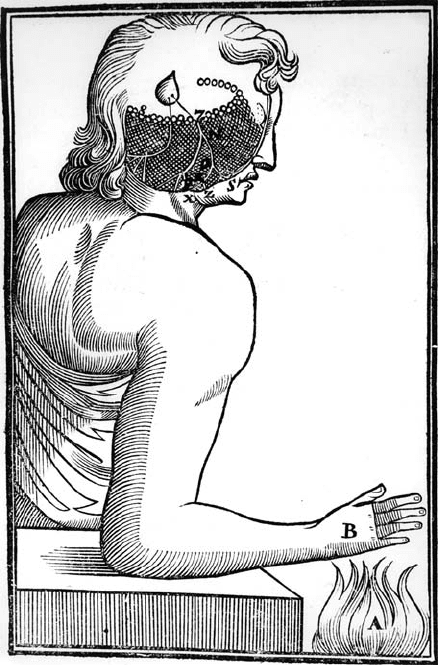
The relationship between
mind and body
illustrated in one of
Descartes’ diagrams.
Motion travels through
the nerves from a burnt
hand up to the pineal
gland, wher e it is
perceived by the soul as
pain
125
KNOWLEDGE