
Kenny Anthony. The Rise of Modern Philosophy: A New History of Western Philosophy. Volume 3
Подождите немного. Документ загружается.

them or no.’ Light, heat, whiteness, and coldness, on the other hand, are
no more really in bodies than sickness or pain is in food which may give us
a stomach ache. ‘Take away the sensation of them; let not the Eyes see
light, or Colours, nor the Ears hear Sounds; let the Palate not Taste, nor
the Nose Smell, and all Colours, Tastes, Odors and Sounds, as they are such
particular ideas, vanish and cease’ (E, 138). This argument is inconsistent
with what Locke has just said, namely, that secondary qualities are powers
in objects to cause sensations in us. These powers, to be sure, are only
exercised in the presence of a sensing organ; but powers continue to exist
even when not being exercised. (Most of us have the power to recite ‘Three
Blind Mice’, but rarely exercise it.)
Locke claims that what produces in us the ideas of secondary qualities is
nothing but the primary qualities of the object having the power. The
sensation of heat, for instance, is caused by the corpuscles of some other
body causing a n increase or diminution of the motion of the minute parts
of our bodies. But even if this were a true account of how a sensation of
heat is caused, why conclude that the sensation itself is nothing but ‘a sort
and degree of motion in the minute particles of our nerves’? The only
ground for this conclusion seems to be the archaic principle that like
causes like. But to take an example of Locke’s own, a substance can cause
illness without itself being ill.
Locke denies that whiteness and coldness are really in objects, because he
says there is no likeness between the ideas in our minds and the qualities in
the bodies. This statement trades on the ambiguity we noted at the outset
in the notion of an idea. If an idea of blueness is a case of the action of
perceiving blueness, then there is no more reason to expect the idea to
resemble the colour than there is to expect playing a violin to resemble a
violin. If, on the other hand, the idea of blueness is what is perceived, then
when I see a delphinium the idea is not an image of blueness, but blueness
itself. Locke can deny this only by assuming what he is setting out to prove.
Locke’s Wnal argument is an analogy between perception and feeling:
He that will consider, that the same Fire, that at one distance produces in us the
Sensation of Warmth, does at a nearer approach, produce in us the far diVerent
Sensation of Pain, ought to bethink himself, what Reason he has to say, that his
Idea of Warmth, which was produced in him by the Fire, is actually in the Fire; and
his Idea of Pain, which the same Fire produced in him the same way, is not in the
Fire. (E, 137)
136
KNOWLEDGE
The analogy is being misapplied. The Wre is painful as well as hot. In saying
that it is painful, no one is claiming that it feels pain; equally, in saying that
it is hot, no one is claiming that it feels heat. If Locke’s argument worked it
could be turned against himself. To take an example of his own, when I cut
myself I feel the slash of the knife as well as the pain—does that mean that
motion, too, is a secondary quality?
Locke insists, drawing on familiar examples, that the sensations produced
by the same objec t will vary with circumstances (lukewarm water will
appear hot to a cold hand and cold to a hot hand, what colours we see in
porphyry depends on the intensity of the light shining on it, and so on). But
the moral of this is not that secondary qualities are not objective. Grass is
green, all right; but ‘green’ is not, as Locke thought it was, the name of a
private ineVable experience, and being green is not a simple property, but a
complicated one that includes such features as looking blue under certain
conditions of lighting.
Spinoza on Degrees of Knowlege
In Spinoza’s system epistemology is not as prominent as it is in Locke’s, but
it presents a number of subtle features. In his early Improvement of the
Understanding Spinoza describes four levels of knowledge or perception.
First, there is knowledge by hearsay: the kind of knowledge I have of
when I was born and who were my parents. Second, there is knowledge
‘from crude experience’: Spinoza is thinking of inductive conclusions such
as that water puts out Wre and that one day I shall die. Third, there is
the kind of knowledge where ‘the essence of one thing is inferred from the
essence of another, but not adequately’. Spinoza illustrates this rather
obscure deWniti on by giving as an example our knowledge that the sun is
larger than it looks. Finally, there is knowledge of things by their essences:
an instance is the knowledge of a circle we are given by geometry.
This fourth kind of knowledge is the only one which gives us an adequate,
error-free, grasp of things (E II.11). It is noteworthy that although Spinoza
calls all of these forms of knowledge ‘perception’, raw sense-perception
itself does not Wgure as a kind of knowledge.
In his later work, Ethics, Spinoza gives a threefold rather than a fourfold
division of knowledge. We are told nothing more about hearsay, an
137
KNOWLEDGE
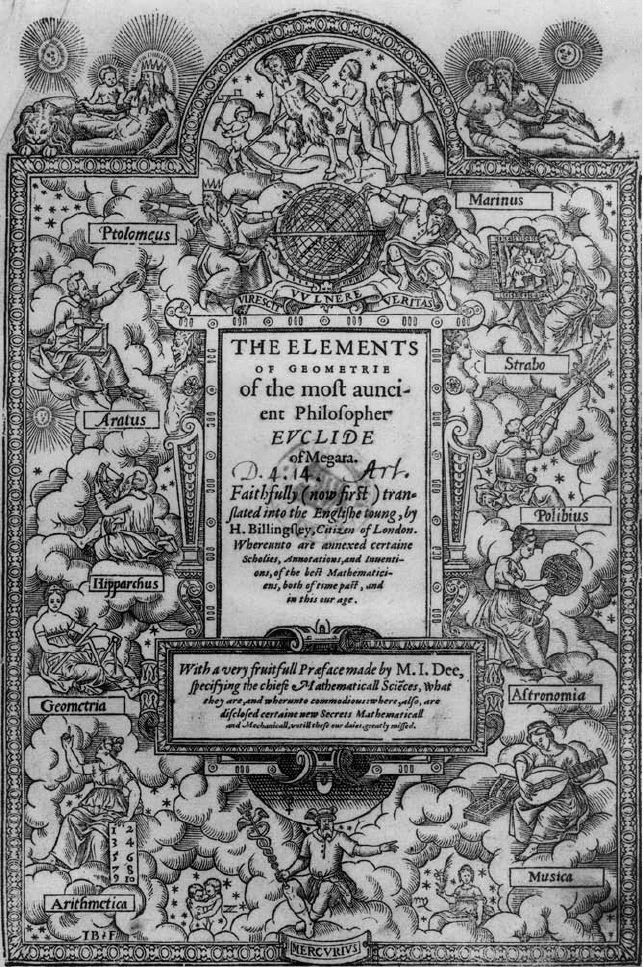
Geometry, for Spinoza, was the paradigm of knowledge. His presentation of his own
system is modelled on Euclid’s Elements
138
KNOWLEDGE
important topic commonly neglected by philosophers—the honourable
exceptions being Hume in the eighteenth century, Newman in the nine-
teenth, and Wittgenstein in the twentieth. Instead we are told of three
levels of knowledge, namely, imagination, reason, and intuition. Hearsay
becomes a subdivision of the level of imagination, which is the second item
of the earlier classiWcation. Reason and intuition correspond to the last two
items of the earlier classiWcation.
Like Descartes and Locke, Spinoza describes knowledge in terms of ideas
in our minds, and like them he includes under the under the term ‘idea’
both concepts (the idea of a triangle) and propositions (the idea that a
triangle has three sides). Concepts and propositions of this kind, he
maintains, are inseparable. I cannot aYrm that a triangle has three sides
without having a concept of a triangle; and I cannot have a concept of a
triangle without aYrming that it has three sides (Eth, 63).
There is often an ambiguity when Spinoza speaks of ‘the idea of X’: we
may wonder whether the ‘of’ is a subjective or objective genitive; that is to
say, is the idea of X an idea belonging to X, or is it an idea whose content is
X? When Spinoza tells us that the idea of God includes God’s essence and
everything that necessarily follows from it, he is clearly speaking of the idea
that God has, God’s idea, rather than the idea that you and I might have of
God (Eth, 33). But not every reference to ‘the idea of God’ is similarly
unambiguous. And a correspond ing ambiguity attaches to Spinoza’s state-
ment that the human mind is the idea of the human body.3
However, Spinoza expressly excludes an ambiguity in the term ‘idea’
that often gives us trouble when reading Descartes and Locke:
A true idea—for we do possess such a thing—is something diVerent from its
object (ideatum). Thus, a circle is one thing, and the idea of a circle is another. The
idea of a circle is not a thing that has a circumference and a centre, as a circle has.
Again, the idea of a body is something other than the body itself. (E II. 12)
A man Peter is something real; the idea of Peter is also a real thing, but a
diVerent one. We can also have an idea of the idea of Peter, and so on
indeWnitely.
If we know something, Spinoza maintains, we know that we know it,
and know that we know that we know it. Philosophers ask how we know
3 See Chapter 7 below.
139
KNOWLEDGE
when we have knowledge, and look for some criterion to distinguish
knowledge from mere belief; without this, they think, we can never
achieve certainty. But this, Spinoza says, is to begin at the wrong end. In
order to know that we know, we must Wrst know; and in order to achieve
certainty we need no special sign beyond the possession of an adequate
idea. He who has a true idea knows eo ipso that he has a true idea, and
cannot doubt its truth (Eth, 58). ‘How can a man be sure that his idea
corresponds to its object?’ philosophers ask. Spinoza replies: ‘His knowledge
arises simply from his having an idea that does in fact correspond to its
object; in other words, truth is its own criterion’ (Eth ,59).
The di Verent stages of knowledge correspond to ideas with diVerent
properties. An idea may be true without being adequate, and it may be
adequate without being clear and distinct. From the experience of our body
coming into contact with other objects, we gather not only ideas of
individuals like Peter but also general ideas such as man, horse, or dog.
Spinoza explains the origin of such general ideas in the following manner:
They arise from the fact that so many images, for instance, of men are formed
simultaneously that they overpower the faculty of imagination—not entirely, but
to the extent that the mind loses count of small diVerences between individuals
(colour, size, and so on) and of their actual number. It imagines distinctly only
that which the individuals have in common in so far as the body is aVected by
them—for that is the point in which each of the individuals principally aVected
it—and this the mind expresses by the name man and it predicates it of inWnite
individuals. (E II.112)
Other ideas are formed from symbols, from our having read or heard
certain words. These ideas, while they are true, are confused and unsys-
tematic. Our repertoire of such notions constitutes our knowledge of the
Wrst kind, which we may call ‘opinion’ or ‘imagination’.
There are some ideas, however, which are common to all human beings,
which represent adequately the properties of things. Such are the ideas of
extension and motion. Spinoza deWnes an a dequate idea as ‘an idea which,
insofar as it is considered in itself, without relation to the object, has all the
properties or intrinsic marks of a true idea’ (Eth, 32). It is not quite clear
how this is to be reconciled with his statement that a true idea needs no
mark of its truth. It is tempting to think that Spinoza means merely that
adequate ideas express truths that are self-evident and are not derived by
deduction from other truths. But in fact adequate ideas are linked by logical
140
KNOWLEDGE
connections to each other, forming a system of necessary truths. This is the
province of reason (ratio) and constitutes knowledge of the second kind
(Eth, 57). Both the second and third kind of knowledge, then, can give us
true and adequate ideas.
Knowledge of the third kind is called by Spinoza ‘intuitive knowledge’,
and it is clearly the form of knowledge that is most to be valued. We are
oVered little help, however, in understanding its nature. It is clear that
reason operates step by step; intuition is an immediate mental vision. More
importantly, intuition grasps the essences of things; that is to say, it
understands their universal features and their place in the general causal
order of the universe. Reason may tell us that the sun is larger than it
looks; only intuition can give us a full grasp of why this is so. But Spinoza’s
formal deWnition of intuitive knowledge raises as many questions as it
solves: ‘This kind of knowledge proceeds from an adequate idea of the
formal essence of certain attributes of God to the adequate knowledge
of the essence of things’ (Eth, 57). Perhaps only a complete mastery of the
whole philosophical system of the Ethics would provide us with such
knowledge.
Spinoza twice attempts to illustrate the three degrees of knowledge by
inviting us to consider the problem of Wnding the number x which has to a
given number c the same proportion as a given a has to a given b. Merchants,
he says, will have no diYculty in applying the rule of three that they have
gathered from experience or learnt by rote. Mathematicians will apply the
nineteenth proposition of the seventh book of Euclid. This illustration
distinguishes the Wrst and second degree clearly enough; but we are left in
the dark about the intuitive method of solving the problem. Perhaps
Spinoza has in mind something like the achievements of Indian mathemat-
icians who can solve such problems instantaneously without calculation.
Spinoza’s epistemology has to answer one Wnal question. In the content
of any idea, he maintains, there is no positive element other than truth
(Eth, 53). But if there is no positive element in ideas on account of which
they can be called false, how is error possible at all? Descartes had explained
error in the following m anner: error is wrong judgement, and judgement
is an act of the will, not of the intellect; error occurs when the will makes
a judgement in the absence of enlightenment from the intellect. Spinoza
cannot oVer this explanation, since for him the will and the intellect are
not distinct; he cannot, therefore, give the advice that in order to avoid
141
KNOWLEDGE
error one should suspend judgement whenever the intellect fails to
present a clear and distinct idea.
Spinoza’s response is to say that error is not anything positive. Error—
which occurs only at the Wrst level of knowledge—consists not in the
presence of any idea, but in the absence of some ot her idea which should be
present:
Thus, when we look at the sun, and imagine that it is about two hundred feet
away from us, this imagination by itself does not amount to an error; our error is
rather the fact that while we thus imagine we do not know either the true distance
of the sun or the cause of our fancy. (Ibid.)
As for suspension of judgement, that is possible indeed, but not by any free
act of will. When we say that someone suspends judgement, we merely
mean that she sees that she does not have an adequate perception of the
matter in question. Even in dreams we suspend our judgement , when we
dream that we dream (Eth, 66).
The Epistemology of Leibniz
Spinoza’s epistemology consists of a series of attempts to reconcile what
we naturally say and think about knowledge and experience with his
metaphysical thesis that ideas in the mind and motions in the body are
just two aspects of individual items in the life of the single substance which
is God and nature. Leibniz’s epistemology is likewise an attempt to match
ordinary speech and thought to a metaphysical system—but to one
diametrically opposite to Spinoza’s, in which ideas and motions, so far
from being substantially identical with each other, have no interaction at
all and belong to two diVerent and wholly independent series of events,
linked only by the harmony pre-established in the mind of God.
Given Leibniz’s oYcial theory of monads, it is hard to see how he could
have, in the normal sense, any epistemology at all. How, for instance,
could he give any account of sense-perception, since there are no transac-
tions between the mind and the external world? How could he take an
interest in the debate about which of our ideas are innate and which are
acquired, since for him every single idea is an internal product of the mind
alone? Yet in fact one of the most substantial of Leibniz’s works is a work of
142
KNOWLEDGE
epistemology: New Essays on Human Understanding, in which he oVers a detailed
critique of Locke’s empiricist theory of knowledge. New Essays is a 500-page
long debate between Philalethes, a spokesman for Locke, and Theophilus,
the mouthpiece of Leibniz. Each chapter of the work corresponds to
a chapter of Locke’s Essay, and answers it point by point.
Many of the positions that Leibniz defends in the New Essays, and many of
the arguments he employs, could in fact be adopted by a philosopher with
a much more commonsensical metaphysic. Leibniz is aware of this, and
defends himself by saying that for expository purposes he has a right to talk
of bodies acting on minds just as a Copernican philosopher goes on talking
of the sun rising and setting (G V.67). It is indeed diYcult to make
everything in the New Essays consistent with the oYcial metaphysical
system, but this makes the book more rather than less interesting to
those who are more interested in epistemology than monadology.
Empiricists claim that there is nothing in the intellect that was not in
the senses. Leibniz responds by adding ‘except the intellect itself’. Our
soul is a being, a substance, a unity, identical with itself, a cause, and the
locus of ideas and reasoning. Consequently, the ideas of being, substance
and so on can be acquired by the soul’s reXection on itself. Moreover,
they could never be acquired from the senses (G V. 45, 100–1). These
ideas, then, are innate in the fullest sense. This does not mean that a
newborn child already thinks of them; but it has more than a mere
ability to learn them: it has a predisposition to grasp them. If we want to
think of the mind as being initially like an unpainted canvas, we can do
so; but it is a canvas already pencil-marked for painting by numbers
(G V.45, 132).
Among ideas that are innate in this sense, Leibniz includes the principles
of logic, arithmetic, and geometry. But what of truths such as ‘red is
not green’ and ‘sweet is not bitter’? Leibniz is prepared to say that ‘sweet
is not bitter’ is not innate in the sense in which ‘a square is not a circle’ is
innate. The feelings of sweet and bitter, he says, come from the senses
(G V.79). How can this be reconciled with the denial that the external
world acts on the mind and the thesis that all the thoughts and actions of
the soul originate internally?
To answer this, we must recall that for Leibniz the human soul is a
dominant monad, situated at the top of a pyramid of monads, which are
animated entities corresponding to the diVerent parts and organs of the
143
KNOWLEDGE
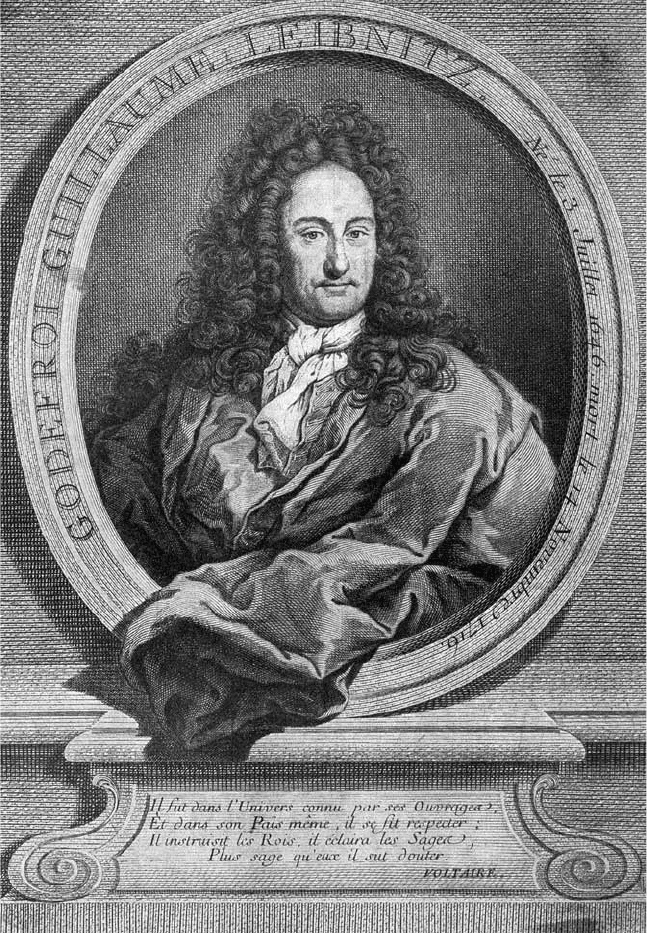
Leibniz as remembered by admirers in the age of enlightenment.
144
KNOWLEDGE
human body. Translated into monadese, the statement that some feelings
come into the mind from the senses appears to mean that some of the ideas
of the dominant monad originate from the inferior monads. Perceptions
of inferior monads are brought into focus by the apperception, the self-
conscious awareness of the dominant monad. Monads are windowless,
Leibniz says, and let in nothing from the external world; but perhaps
monad can talk to monad by a kind of telepathy.4
Leibniz cashes this out in a study of levels of awareness that is one
of the most interesting parts of his epistemology. ‘There are a thousand
indications which lead us to think that there are constantly numberless
perceptions in us, but without apperception and without reXection’
(G V.46). A man living by a mill or a waterfall soon ceases to notice the
noise it makes. Walking by the seashore we hear the roar of the tide coming
in, but we do not distinguish the crash of each individual wave. Much
of our conscious experience is in this way composed of a multitude of
tiny perceptions of which we have no distinct idea. The perceptions
characteristic of inferior monads are confused ideas; the apperception
of the dominant monad brings clarity and distinction into our ideas. It is
because sense-perceptions are confused that they appear to come from
outside.
Leibniz uses his distinction between levels of awareness to answer a
standard objection to innate ideas, namely, that we learn individual truths
long before we are aware of the fundamental laws of logic. ‘General
principles’, he says, ‘enter into our thoughts and form the soul of each
and the link between them. They are as necessary as muscles and tendons
are necessary for walking, even though we don’t think of them.’ The mind
relies on logic all the time, but it takes an eVort to identify its laws and make
them speciWc. The Chinese speak in articulate sounds just as Europeans do;
but they have not invented an alphabet to express the recognition of this
(G V.69–70).
For Locke, the basic building blocks of knowledge were simple ideas
presented by the senses. Leibniz regards the notion of a simple idea as an
illusion:
I believe that one can say that the ideas of the senses appear to be simple because
they are confused: they do not give the mind scope for distinguishing their
4 On perception and apperception, see below, p. 234.
145
KNOWLEDGE