
Kenny Anthony. The Rise of Modern Philosophy: A New History of Western Philosophy. Volume 3
Подождите немного. Документ загружается.

The problem seemed to be this. Since space is inWnitely divisible, bodies
that occupy space must be inWnitely divisible too. They must, therefore,
contain an inWnite number of parts. How big are these parts? If they lack
any size, like a point, then even an inWnite number of them will lack size
too, and no body will have any extension. On the other hand, if they have
size, then any body containing an inWnite number of them will itself be
inWnite in extension.
Aristotle had long ago shown that the way to avoid this problem was to
make a distinction between two senses of in W nite divisibility. ‘Divisible to
inWnity’, he insisted, means ‘unendingly divisible’, not ‘divisible into inW-
nitely many parts’. However often a magnitude has been divided, it can
always be divided further—there is no end to its divisibility. But that does
not mean that the continuum has inWnitely many parts: inWnity is always
potential, never actual.4 Gassendi had shown that this metaphysical inWnite
divisibility need not conXict with the atomistic theory that some physical
objects are indivisible by any physical power.
The ‘labyrinth of the continuum’, as Leibniz called it, is an illusion that
rests on two bases: the rejection of the Aristotelian metaphysic of actuality
and potentiality; and the acceptance of the Cartesian identiWcation of
matter with extension. Without the former, there is no reason to see
any contradiction in the notion of in W nite divisibility. Without the latter,
there is no reason to believe that bodies must be inWnitely divisible because
space is inWnitely divisible. Matter may be atomic without extension being
lumpy.
Throughout the eighteenth century, however, the continuum was
regarded as one of the greatest conundrums of philosophy. David Hume
took a robust way out: he simply denied the inWnite divisibility of space and
time, mocking it as one of the strangest and unaccountable opinions,
supported only by ‘mere scholastick quibbles’. He based his argument
against inWnite divisibility upon the Wnite nature of the human mind:
Whatever is capable of being divided in inWnitum must consist of an inWnite number
of parts, and ’tis impossible to set any bounds to the number of parts, without
setting bounds at the same time to the division. It requires scarce any induction to
conclude from hence, that the idea, which we form of any Wnite quality, is not
4 See vol. I, p. 180.
PHYSICS
176
inWnitely divisible, but that by proper distinctions and separations we may run up
this idea to inferior ones, which will be perfectly simple and indivisible. In rejecting
the inWnite capacity of the mind, we suppose it may arrive at an end in the division
of its ideas; nor are there any possible means of evading the evidence of this
conclusion. ’Tis therefore certain, that the imagination reaches a minimum, and
may raise up to itself an idea, of which it cannot conceive any sub-division, and
which cannot be diminished without a total annihilation. (T, 27)
What goes for ideas, goes also for impressions: ‘Put a spot of ink upon
paper, Wx your eye upon that spot, and retire to such a distance, that at last
you lose sight of it; ’tis plain, that the moment before it vanished the image
or impression was perfectly indivisible’ (T , 27).
Kant’s Antinomies
Kant had a novel way of dealing with the problems of the continuum. He
took over the arguments of his predecessors (for and against inWnite
extension of time, for and against the inWnite divisibility of matter), and
instead of taking sides between them he proclaimed that the impossibility
of resolving the debate showed that it was a mistake to talk of the universe
as a whole or to treat space and time as having reality in themselves. This is
the tactic he adopted in the part of the transcendental dialectic called ‘the
antinomies of pure reason’.
The Wrst antinomy concerns the extension of time and space. If we leave
aside space for the moment, the thesis is ‘The world had a beginning in
time’ and the antithesis is ‘The world had no beginning in time’. Both
propositions had long been discussed by philosophers. Aristotle thought
the antithesis could be proved, Augustine thought the thesis could be
proved, and Aquinas thought that neither could be proved. Kant now
proposes that both can be proved: not, of course, to show that there are
two contradictory truths, but to show the impotence of reason to talk
about ‘the world’ as a whole (A, 426–34).
The argument for the thesis is this. An inWnite series is one that can never
be completed, and so it cannot be the case that an inWnite series of temporal
states has already passed away. This argument fails, because of an ambiguity
in the word ‘completed’. It is true that any discrete series which has two
termini cannot be inWnite; but such a series may be closed at one end and go
PHYSICS
177
on for ever in the other. Elapsed time would then be ‘completed’ by having
a terminus in the present, while reaching forever backward.
The argument for the antithesis is equally unconvincing. If the world
had a beginning, it goes, then there was a time when the world did not
exist. There is nothing to diVerentiate any moment of this ‘void time’ from
any other; hence there can be no answer to the question ‘why did the
world begin when it did?’ One may agree that it is not possible to date the
beginning of the world from outside (‘at such a point in void time’), while
maintaining that one can locate it from within (‘so many time-units before
now’). Augustine and Aquinas would have agreed in rejecting the notion
of void time: for them, time began when the world began.
The second antinomy concentrates not on time but on space—or
rather, the spatial divisibility of substances. The thesis is: ‘Every composite
substance in the world is made up of simple parts’; the antithesis is: ‘No
composite thing in the world is made up of simple parts.’ The thesis is the
aYrmation, and the antithesis the denial, of atomism. Once again the
arguments Kant presents on each side of the antinomy are inconclusive:
they fail to take full account of Aristotle’s distinction between something’s
being divisible into inWnite parts, and something’s being in W nitely divisible
into parts.
The antinomies are designed to exhibit the general pointlessness of
asking or answering questions about the world as a whole, but in the
particular case of space and time Kant had already argued for their unreality
earlier in the Wrst Critique, in the transcendental aesthetic. He started from
an inherited distinction between inner and outer senses. Space, he claimed,
is the form of outer sense; it is the subjective condition of our awareness of
objects outside ourselves (A, 26). Time, on the other hand, is the form of
inner sense, by means of which the mind experiences its own inner states,
which have no extension in space but are all ordered in time:
What, then, are space and time? Are they real existences? are they only determin-
ations or relations of things, yet such as would belong to things even if they were
not intuited? Or are space and time such that they belong only to the form of
awareness, and therefore to the subjective constitution of our mind, apart from
which they could not be ascribed to anything whatsoever?
A dogmatic metaphysician, Kant tells us, would say that inWnite space and
inWnite time are presupposed by e xperience, and that we can imagine space
PHYSICS
178
and time without objects but not objects without space and time. But
we may ask how it is that we can know truths about space and time which
are based on awareness (because they are not analytic) and yet are a priori
(because they are necessary and universal). Kant’s answer is that the
knowledge of synthetic a priori truths about space and time is only explic-
able if they are formal elements of sense-experience rather than properties
of things in themselves.
Does this mean that they are unreal? Empirically, Kant replies, they are
real, but transcendentally they are ideal. ‘If we take away the subject, space
and time disappear: these as phenomena cannot exist in themselves but
only in us.’ What things are in themselves, beyond the phenomena, is
something that is unknown to us.
During the period covered by this volume, as we have seen, the philo-
sophical study of the material world passed through two stages. In the Wrst
phase, the seventeenth century saw the gradual separation of the old
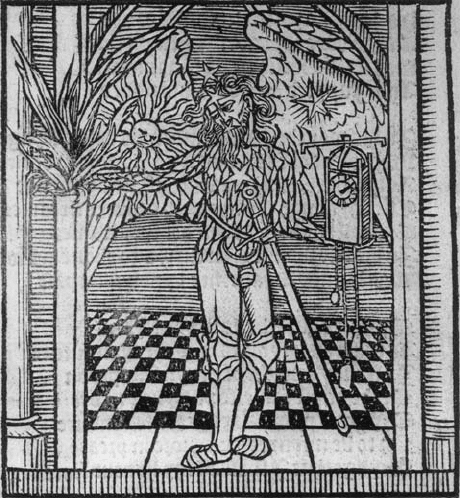
Philosophers over the
centuries have
debated the reality or
otherwise of time.
Kant’s view of it as a
subjective phenom-
enon contrasts with
this personification of
it as a causal agent in a
sixteenth-century
French woodcu t
PHYSICS
179
discipline of natural philosophy into the science of physics, whose role was
the empirical investigation of actual natural laws, and the philosophy of
physics, whose task it was to analyse the concepts presupposed by any
physical inquiry. In the second phase, philosophers examined a wide gamut
of possible conceptions of space and time, ranging from the extreme
realism of Newton and Clarke to the subjective idealism of Kant. In our
next and Wnal volume, there will not be a thematic chapter devoted to the
philosophy of physics. By the nineteenth century physics was a fully
mature empirical science, operating independently of philosophy; the
history of physics is now quite separate from the history of philosophy.
To be sure, the philosophy of physics continues on its way, as an analysis of
the conceptual implications of novel physical theories. Such a discipl ine,
however, can be pursued only by those with more knowledge of the
modern science of physics itself than can be presumed in the readership
of an introductory history of philosophy.
PHYSICS
180

6
Metaphysics
The Metaphysics of Suarez
I
t was through the Disputationes Metaphysicae of Francisco Suarez, directly or
indirectly, that the metaphysics of the medieval scholastics became
known to the philosophers of the early modern age. Suarez was well
acquainted with the works of his medieval predecessors, and he summar-
ized their views, codiWed their positions, and built up his own system by
choosing options from the menu that they oVer. A summary of the main
positions of the Disputationes accordingly provides a good starting point for a
consideration of the metaphysics of our period.
Suarez starts from Aristotle’s deWnition of the subject as the discipline
that studies being qua being. He expands on this by oVering a classiWcation
of diVerent types of being, proceeding by a series of dichotomies. First there
is the divisio n between inWnite being and Wnite being, or, as he often says,
between ens a se (that which has being of itself ) and ens ab alio (that which
has being from elsewhere). The creaturely world of Wnite being is then
divided Wrst of all into substance and accident. Substan ces are things like
stars and dogs and pebbles which subsist on their own; accidents are entities
like brightness, Werceness, and hardness which exist only by inhering in
substances and have no independent history. We can proceed further if we
wish by subdividing substances into living and non-living, and living
substances into animal and vegetable and so on; we can also identify at
least nine diVerent kinds of accidents corresponding to Aristotle’s categor-
ies. But such further division will take us outside the scope of general
metaphysics, which operates at the most abstract level. All these items are
beings, but metaphysics is interested in studying them only qua beings. The
study of living beings qua living, for instance, is for physical rather than
metaphysical disciplines—biology, say, and zoology or psychology.
To Aristotle’s deWnition Suarez adds a qualiWcation. The subject matter
of metaphysics, strictly speaking, is not any old being, but real being. All the
items we have considered in the previous paragraph , including items like
Werceness and hardness, count as real bein gs. If so, one might wonder, what
other beings are there? In addition, Suarez says, there are creations of the
reason (entia rationis) that have being only in the mind and not in reality.
Blindness is an ens rationis: this does not mean that it is something unreal or
Wctitious; it means that it is not a positive reality, as the power of sight is,
but an absence of such a power. Certain types of relation form another
class of entia rationis: when I become a great-uncle, I acquire a new relation-
ship but there is no real change in myself. Finally, there are the creations of
the imagination: chimeras and hippogriVs. So there are three kinds of entia
rationis: nega tions, relations, and Wctions. These are fringe topics for the
metaphysician rather than his principal concern.
Let us return then to the centre: real being. Is there a single, univocal
concept of being that applies in the same sense to all the varied kinds of
being? Aquinas had said no: ‘being’ was an analogous term, and God is not
a being in the same sense as ants are beings. Scotus had said yes: ‘being’
could be used about God in exactly the same sense as about creatures.
Suarez oVers a subtle answer which he believes enables him to take sides
with both Aquinas and Scotus. There is a single abstract concept of being
which applies to everything alike, and Scotus is so far correct; but this is
not a concept that tells us anything real or new about the objects to which
it applies, a nd to that extent Aquinas is right. Sentences like ‘this animal
is a dog’ or ‘this dog is white’ can be instructive, because the predicate
carries information that is not already implicit in the subject. But the
predicate ‘...is a being’ can never be instructive in the same way: being
is not an activity or attribute distinct from being an animal or being a dog
(DM 2.1, 9; 2.3, 7).
In saying this, Suarez is touching on a dispute much ventilated in the
Middle Ages, namely, whether in creatures there is a real distinction
between essence and esse. The issue is not a clear one, and its signiWcance
depends on two decisions. First, it matters whether we take ‘essence’ a s
generic essence or individual essence (e.g. as ‘humanity’ or as ‘Peter’s
humanity’). Second, it matters whether we take esse as equivalent to
METAPHYSICS
182
‘existence’ or as the all-embracin g predicate ‘being’. There is one option
which gives a clear answer. If we take essence in the generic sense, and
esse as existence, then there is an undeniable diVerence between essence
and existence: essence is what answers the question ‘What is an X?’ and
existence is what answers the question ‘Are there Xs?’ The diVerence
between the questions is so enormous that talk of a ‘real distinction’
seems to fail only by understatement.
Suarez in fact denies that there is a real distinction between essence and
esse; the distinction, he says, is only mental (tantum ratione) . We have to look
closely to see which of the options he is taking. It becomes clear that by
‘essence’ he means individual essence; the essence of an individual person,
Peter, not anything like humanity in the abstract. And by esse he means the
all-embracing predicate which delineates the subject matter of metaphysics.
In denying the real distinction he is denying that there is any real diVerence
in Peter between being and being Peter. These are di Verent predicates we can
apply to Peter: we can say ‘Peter is Peter’ and (in Latin, if not idiomatically
in English) ‘Peter is’. But in using these two forms of speech we are not
referring to two diVerent real items in Peter, a s we are when we say ‘Peter is
tall’ and ‘Peter is wise’.
Some earlier scholastics, notably Thomas Aquinas, would have said that
the sentence which tells us the essence of Peter is not ‘Peter is Peter’ but
rather ‘Peter is human’. This was because Aquin as believed that the
principle of individuation was matter: what makes two peas two rather
than one is not any diVerence between their properties, but the fact that
they are two diVerent lumps of matter. According to Aquinas, in an
individual human like Peter there was no extra formal element in addition
to humanity which gave him his individuality. For Duns Scotus and his
school, on the other hand, Peter possessed, in addition to his humanity, a
further individuating feature, his haecceitas or ‘thisness’. Once again, Suarez
wants to side with both his great predecessors. ‘The adequate principle of
individuation is this matter and this form in union, the form being the
chief principle and suYcient by itself for the composite, as an individual
thing of a certain species, to be considered numerically one’ (DM 5.6,15). In
eVect, Suarez comes down deWnitely on the side of Scotus. There is in Peter
a real formal element, a diVerentia individualis, in addition to the speciW c
nature of humanity, which is what makes him Peter and not Paul (DM
5.2, 8–9).
METAPHYSICS
183
Scotus, as we have just seen, adds an extra metaphysical item to the
apparatus employed by Aquinas. Suarez, in his turn, adds an extra item of
his own. In Peter we have not just the matter and form which all followers
of Aristotle accepted, and not just the individuating element that Scotists
accepted, but an extra thing, that makes Peter a substance and not an
accident. Subsistence, the form of existence peculiar to substance as
opposed to accident, adds to an individuated essence a mode, and there is a
special form of composition which is that of mode-plus-thing-modiWed.
Suarez employed his notion of mode in an attempt to illuminate the
diVerence between a soul existing embodied and a soul existing in separ-
ation after death. But his new terminology was to be widely employed, and
made popular, especially by Descartes.
Descartes on Eternal Truths
Descartes took over many of the technical terms of scholastic metaphysics—-
substance, mode, form, essence, and so on—but used many of them in
novel ways. His most important innovation in metaphysics was one that
was not fully spelt out in his published works and only became clear when
his copious correspondence was made public after his death. This was his
doctrine of the creation of eternal truths.
In 1630, when he was completing his treatise The World, Descartes wrote
to Mersenne:
The mathematical truths that you call eternal have been laid down by God and
depend on him entirely as much as all other creatures . . . Please do not hesitate to
assert and proclaim everywhere that it is God who has laid down these laws in
nature just as a king lays down laws in his kingdom. (AT I. 135; CSMK III. 23)
As for the eternal truths, I say once more that they are true or possible only
because God knows them as true or possible. They are not known as true by God
in any way which would imply that they are true independently of Him...In
God willing and knowing are a single thing, in such a way that by the very fact of
willing something He knows it, and it is only for this reason that such a thing is
true. (AT I.147; CSMK III. 13)
It was a new departure to say that the truths of logic and mathematics
depended upon the will of God. Scholastic philosophers agreed that they
were dependent on God, but dependent on his essence, not on his will:
METAPHYSICS
184
they did not believe, as Descartes did, that God was free to make it not be
true that the three angles of a Euclidean triangle were equal to two right
angles (AT IV. 110; CSMK. III.151; Aquinas, ScG II.25). Moreover, scholastics
believed that prior to the creation of the world logical and mathematical
truths had no reality independent of God; whereas for Descartes these
truths were creatures, distinct from God, brought into existence from all
eternity by His creative power. ‘It is certain that He is no less the author of
creatures’ essence than he is of their existence; and this essence is nothing
other than the eternal truths ...I know that God is the author of
everything and that these truths are something and consequently that
he is their author’ (AT I. 151; CSMK III.25).
For Descartes, the truths of logic and mathematics had their being
neither in the material world nor in the mind of anyone, divine or
human. The eternal truths were not truths about m aterial objects: the-
orems about triangles could be proved even if there was not a single
triangular object in existence, and geometry held true even if the external
world was a complete illusion. The eternal truths were prior to, and
independent of, any human minds, and though they were dependent on,
they were distinct from, the mind of God. The eternal truths belonged in a
third realm of their own, similar to the domain in which in Antiquity Plato
had located his Ideas. St Augustine had relocated the Platonic Ideas in the
mind of God, and that had been ever since the standard position among
Christian philosophers right up to Suarez. Descartes’ novel doctrine makes
him the founder of modern Platonism.1
The theory of the creation of eternal truths plays a fundamental role in
Descartes’ metaphysics and physics. At the time when he was explaining his
theory to Mersenne, Descartes was writing a sustained attack on the
Aristotelian metaphysics of real qualities and substantial forms. Rejection
of substantial forms entailed rejection also of essences, since the two are
closely connected in the Aristotelian system—essence being identical with
form in the case of immaterial beings, and in the case of material beings
consisting of form plus the appropriate matter. Descartes did not reject the
terminology of essence as Wrmly as he rejected that of form and quality,
but he reinterpreted it drastically. Essences, as he told Mersenne, are
nothing but eternal truths.
1 For Plato, see vol. I, pp. 52–3. Among scholastics, Henry of Ghent (whom Descartes is most
unlikely to have read) came closest to anticipating his position (see vol. II, p. 85).
METAPHYSICS
185