
Kenny Anthony. The Rise of Modern Philosophy: A New History of Western Philosophy. Volume 3
Подождите немного. Документ загружается.

Luther, though no friend to the scholastics, Wnds this outrageous. ‘If this
is irreligious, curious, and superXuous,’ he asks, ‘what, then, is religious,
serious and useful knowledge?’ God, Luther maintains, foresees nothing
contingently. ‘He foresees, purposes, and does all things according to His
immutable, eternal, and infallible will. This thunderbolt throws free will
Xat and utterly dashes it to pieces’ (WA VII.615).
Luther endorses the opinion that the Council of Constance ascribed to
Wyclif: that everything happens of necessity. He distinguishes, however,
between two senses of ‘necessity’. The human will is subject to ‘necessity of
immutability’: it has no power to change itself from its innate desire for
evil. But it is not sub ject to another form of necessity, namely compulsion:
a human being lacking grace does evil spontaneously and willingly. The
human will is like a beast of burden: if God rides it, it wills and goes where
God wills; if Satan rides it, it goes where Satan wills. It has no freedom to
choose its rider.
Luther prefers to abandon altogether the term ‘free will’; other writers,
before and after, have regarded the spontaneity that he accepts as being the
only thing that can genuinely be meant by the term.2 Luther’s principal
concern was to deny free will in matters that make the diVerence between
salvation and damnation. In other cases he seems to allow the possibility of
genuine choice between alternative courses of action. Humans have free
will in respect not of what is above them, but in respect of what is below
them. The sinner, for instance, can make his choice between a variety
of sins (WA VII.638).
The Bible, as Erasmu s had copiously shown, contains many passages that
imply that human choices are free, and also many passages that proclaim
that the fate of humans is determined by God. Over the centuries, scholastic
theologians had sought to reconcile these contradictory messages by mak-
ing careful distinctions. ‘Much toil and labour has been devoted to excusing
the goodness of God,’ Luther says, ‘and to accusing the will of man.
Here those distinctions have been invented between the ordinary will of
God and the absolute will of God, between the necessity of consequence and
the necessity of the consequent, and many others. But nothing has been
achieved by these means beyond imposing upon the unlearned.’ We should
not waste time, Luther believe s, in trying to resolve the contradiction
2 See vol. I, p. 197, on the distinction between liberty of spontaneity and liberty of indiVerence.
SIXTEENTH-CENTURY PHILOSOPHY
6
between diVerent Bible texts: we should go to extremes, deny free will
altogether, and ascribe everything to God.
Distaste for schola stic subtlety was not peculiar to Luther: it was shared
by Erasmus, and also by More. More himself entered the debate on free will
in his controversy with Luther’s English admirer, the Bible translator
William Tyndale. To counter Lutheran determinism More uses a str ategy
which goes back to discussions of fate in Stoic philosophy:
One of their sect was served in a good turn in Almayne, which when he had
robbed a man and was brought before the judges, he would not deny the deed, but
said it was his destiny to do it, and therefore they might not blame him; they
answered him, after his own doctrines, that if it were his destiny to steal and that
therefore they must hold him excused, then it was also their destiny to hang him,
and therefore he must as well hold them excused again. (More 1931: 196)
The claim that if determinism is true everything is excusable, would no
doubt be rejected by Luther, since he believed that God justly punished
sinners who could not do otherwise than sin.
From a philosophical point of view these early Reformation debates on
freedom and determinism do no more than rehearse arguments which
were commonplaces of ancient and medieval philosophy. They illustrate,
however, the negative side of humanist education. Scholastic debates, if
sometimes arid, had commonly been sober and courteous. Thomas Aqui-
nas, for instance, was always anxious to put the best possible interpretation
on the theses of those he disagreed with. Erasmus shared something
of Aquinas’ eirenic spirit; but More and Luther attack each other with
bitter vituperation made only the more vulgar by the elegant Latin in
which it is phrased. The pugnacious conventions of humanist debate were
a factor which led to the hardening of positions on either side of the
Reformation divide.
Authority and Conscience
The debate on free will continued and ramiWed through and beyond the
sixteenth century, and, as we shall see in later chapters, more sophisticated
controversialists were to bring new subtlety into the philosophical treat-
ment of the topic. For the present the most important new element
introduced into the debate by Luther was a general hostility not just to
SIXTEENTH-CENTURY PHILOSOPHY
7
scholasticism but to philosophy itself. He denounced Aristotle, and in
particular his Ethics, as ‘the vilest enemy of grace’. His contempt for the
powers of unaided reason was the outcome of his belief that in Adam’s Fall
human nature had become totally corrupt and impotent.
In one way, Luther’s scepticism about philo sophical speculation was a
continuation of a tendency already strong in late medieval scholasticism.
Since the time of Scotus philosophers had become ever more reluctant to
claim that reason alone could establish the nature of the divine attributes,
the content of divine commands, or the immortality of the human soul.3
The counterweight to their increasing philosophical scepticism had been
their accept ance of the authority of the Church, expressed in Christian
tradition and the pronouncements of popes and councils. This attitude
found expression at the beginning of Erasmus’ treatise: ‘So great is my
dislike of assertions that I prefer the views of the sceptics wherever the
inviolable authority of the Scriptures and the decision of the Church
permit’ (E, 6).
The Lutheran Reformation, by taking away this counterweight, gave
new impetus to the sceptical trend. To be sure, the Bible was retained and
indeed emphasized as a decisive authority: with respect to the teaching of
the Scriptures, Luther insisted, the Christian had no liberty to be a sceptic
(WA VII.604). But the content of the Bible was no longer to be subjected
to professional scrutiny by philosophically trained theologians. Every
Christian, Luther said, had the power of discerning and judging what
was right or wrong in matters of faith. Tyndale boasted that his translation
would make a boy driving the plough understand the Bible better than the
most learned divine. Pessimism about the moral capacity of the trained
intellect unaided by grace went hand in hand with optimism about the
intellectual ability of the untrained mind illumined by faith. Squeezed
between the two, philosophy found its role greatly diminished among
devout Protestants.
The problem for Luther was that individual consciences, unconstrained
by universal authority, and unwilling to submit faith to rational arbitra-
ment, began to produce a great diversity of beliefs. French and Swiss
reformers, such as Jean Calvin and Ulrich Zwingli, agreed with Luther in
rejecting papal authority but diVered from him in their understanding of
3 See vol II, pp. 247, 274.
SIXTEENTH-CENTURY PHILOSOPHY
8
the presence of Christ in the Eucharist and of the decrees through which
God chose the elect. Calvin, like Luther, placed the ultimate criterion of
religious truth within the individual soul: every faithful Christian experi-
enced within himself a marvellous conviction of heavenly revelation which
was more reassuring than any reasoning could ever be. But how could one
tell who were faithful Christians? If one counted only the reformed, then
Calvin’s criterion was question-begging; on the other hand, if one counted
all those who had been baptized, it led to an anarchy of belief.
Protestants argued that the Church could not be the ultimate authority
because its claims rested on biblical texts. Catholics, quoting Augustine,
claimed that the only reason for accepting the Bible was that it had been
given us by the Church. The questions at issue in Europe a t the Reforma-
tion were in the end settled neither by rational argument nor by interior
enlightenment. In country after country conXicting answers were imposed
by force of arms or by penal legislation. In England Henry VIII, irked by
Vatican refusal to free him from a tedious marriage, broke with Rome and
executed More for his loyalty to the pope. The country then lurched from
his schismatic version of Catholicism to Calvinism under his son Edward
VI, to Counter-Reformation Catholicism under his daughter Mary, and
Wnally to an Anglican compromise under her sister Elizabeth. This che-
quered history produced hundreds of martyrs, both Protestant and Cath-
olic; but England was spared the sanguinary wars of religion which raged
for many decades in continental Europe.
By the mid-sixteenth century doctrinal positions had hardened into a
form that they were to retain for some 400 years. Luther’s lieutenant
Melancthon formulated at Augsburg in 1530 a confession of faith to
provide the test of orthodoxy. A concordat agreed in the same city in
1555 provided that the ruler of each state within the Holy Roman Empire
could decide whether his subjects were to be Lutheran or Catholic: the
principle later know n as cuius regio, eius religio. Calvin’s Institutes of the Christian
Religion (1536) provided the standard for Protestants in Switzerland, France,
and later Scotland. In Rome Pope Paul III (1534–9) promoted a Counter-
Reformation, instituting a new religious order of Jesuits, and convening a
Council at Trent to reform Church discipline. The council condemned the
Lutheran doctrine of justiWcation by faith alone, and the Calvinist doctrine
that God predestined the wicked to hell prior to any sin. Free will, it
insisted, had not been extinguished by Adam’s Fall. It reaYrmed the
SIXTEENTH-CENTURY PHILOSOPHY
9
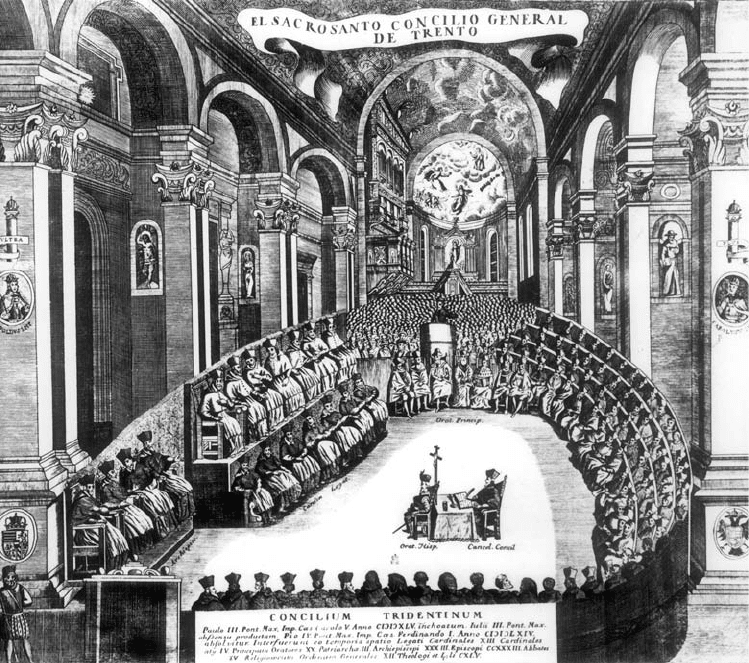
doctrine of transubstantiation and the traditional seven sacraments. By the
time the council had Wnished its work, in 1563, Luther was dead and Calvin
was dying.
The division of Christendom was an unnecessary tragedy. The theo-
logical issues which separated Luther and Calvin from their Catholic
opponents had been debated many times in the Middle Ages without
leading to sectarian warfare; and few twenty -first-century Catholics and
Protestants, if not professionally trained in theology, are aware of the real
nature of the diVerences between the contrasting theories of the Eucharist,
of grace, and of predestination which in the sixteenth century led to
The Council of Trent in its final session, as represented in a contemporary Spanish
engraving
SIXTEENTH-CENTURY PHILOSOPHY
10
anathema a nd bloodshed. Questions of authority, of course, are easier to
understand and more diYcult to arbitrate than questions of doctrine. But
the unity of Christendom could have been maintained under a constitu-
tional papacy sub ject to general councils, such as Ockham had suggested,
such as had been the practice in the Wfteenth century, and such as even
Thomas More, for the greater part of his life, believed to be the divine design
for the Church.
The Decline of Logic
The combined eVects of the Renaissance and the Reformation made the
sixteenth century a barren one in most areas of philosophy. Logic was
perhaps the branch of philosophy that suVered most severely. Logic did
continue to be taught in the universities, but humanist scholars were
impatient of it, regarding its terminology as barbarous and its complexities
as pettifogging. Rabelais spoke for them when in Pantagruel (1532) he
mocked logicians for inquiring whether a chimera bombinating in a
vacuum could devour second intentions. Most of the advances in the
subject that had been made by Stoic and medieval logicians were lost for
four centuries. Instead, a bowdlerized version of Aristotle was taught at an
elementary level in popular textbooks.
In the mid-cent ury these began to be published in vernacular languages.
The Wrst in English was Thomas Wilson’s The Rule of Reason, dedicated to
Edward VI in 1551: he was the Wrst to use the English words that are now
the common terms of logic, such as ‘proposition’. Others rejected such
Latinisms and did their best to invent a solid Anglo-Saxon terminology.
Ralphe Lever thought that logic should be called ‘Witcraft’; and when he
wanted to explain in his textbook that a contradictory proposition con-
sisted of two propositions, one aYrmative and one negative, with similar
subject, predicate and verb, he produced the following: ‘Gaynsaying shew-
sayes are two shewsayes, the one a yeasaye and the other a naysaye,
changing neither foreset, backset nor verbe.’4
These English logic texts left little mark. Matters were diVerent in
France: Peter Ramus (Pierre de la Rame
´
e, 1515–72) achieved lasting fame
4 W. and M. Kneale, The Development of Logic (1979), p. 299.
SIXTEENTH-CENTURY PHILOSOPHY
11
quite out of propo rtion to his actual merits as a logician. Legend has it that
for his master’s degree he defended the thesis that everything Aristotle had
ever taught was false. Certainly he went on to publish a short anti-
Aristotelian treatise, and after his appointment as prof essor at the Colle
`
ge
Royale he followed this up with twenty books of Animadversions on
Aristotle. His Dialectic, which was published in French in 1555, in Latin in
1556, and in English in 1574, was meant to supersede all previo us logic texts.
For the Wrst time, he maintained, it set out the laws which governed
people’s natural thinking.
Logic, he tells us, is the art which teaches how to dispute well. It is
divided into two parts: invention and judgement, to each of which a book
of his text is devoted. Treating of ‘invention’, he lists nine places or topics to
which one may look to Wnd arguments to support a conclusion one wishes
to defend. They are cause, eVect, subject, adjunct, opposite, comparative,
name, division, and deW nition. He illustrates each of these topics with
copious quotations from classical authors, which take up nearly half of
his short Wrst book. For instance, Ramus deWnes ‘adjunct’ as ‘that which
has a subject to which it is adjoined, as virtue and vice are called the
adjuncts of the body or soul; and to be short all things that do chance to
the subject, beside the essence, is called the adjunct’. He then illustrates this
with a long quotation from a speech of Cicero’s, beginning:
Doth not his very head and over brow altogether shaven and scraped so clean
signify that he is malicious and savoureth of knavery? Do they not utter and cry
that he is a crafty fox? (L, 33)
Despite his o Ycial contempt for Aristotle, most of the topics for argument
that he lists are taken from various places in the Aristotelian corpus and
deWned in similar ways. The only novelty is the discussion, at the end of
the book, of what he calls ‘inartiW cial’ arguments, examples of which are the
pronouncements of divine oracles and human testimony in a court of law.
The second book comes closer to the traditional subject matter of logic.
Once again Ramus draws heavily on Aristotle in his classiWcation of
diVerent kinds of statement and his analysis of syllogisms of diVerent
forms. His main innovation is that he devotes much more attention than
Aristotle did to arguments containing proper names, such as ‘Caesar
oppresseth his native country; Tullius oppresseth not his native country;
Tullius therefore is not Caesar’ (L, 37).
SIXTEENTH-CENTURY PHILOSOPHY
12
Modern historians of logic can Wnd little merit or originality in Ramus’
work, but for long after his death debates raged between Aristotelians and
Ramists, and there were even groups of semi-Ramists campaigning for
compromise. Ramus became a Calvinist in 1561 and was killed in the
massacre of Protestants on St Bartholomew’s Day in 1572. His status as a
martyr gave his writings a prestige they could never have earned in their
own right, and his inXuence lasted through the centuries. John Milton, for
instance, published a volume of Ramist Logic Wve years after the comple-
tion of Paradise Lost. The popularity of Ramist works impoverished logic for a
long period. No further progress was made in formalizing the logic of
modality and counterfactuality that had fascinated medieval logicians, and
much of their own work passed into oblivion.
Scepticism, Sacred and Profane
It was not only Catholics who killed heretics. In 1553 Michael Servetus, a
Spanish physician who had discovered the pulmonary circulation of the
blood, was burnt in Calvin’s Geneva for denying the Trinity and the
divinity of Jesus. A French classicist teaching at Basel, named Sebastian
Castellio, was shocked at the execution of Servetus and wrote a treatise
Whether Heretics are to be Persecuted (Magdeburg, 15 54) in which he pleaded in
favour of toleration. His arg uments are mainly quotations of authoritative
texts or appeals to the example of Christ. ‘O Christ, when thou didst live
upon earth, none was more gentle, more merciful, more patient of
wrong . . . Art thou now so changed? ...Ifthou, O Christ, hast commanded
these executions and tortures, what hast thou left for the devil to do?’5 But
in a later work, The Art of Doubting, Castellio developed more epistemological
arguments. The diYculty of interpreting Scripture, and the variety of
opinions among Christian sects, should make us very cautious in laying
down the law on religious matters. To be sure, there are some truths that
are beyond doubt, such as the existence and goodness of God; but on other
religious topics no one can be suYciently certain so as to be justiWed in
killing another man as a heretic. Castellio, in his time, was a lone voice; but
later supporters of toleration looked back to him as a forerunner.
5 Quoted by O. Chadwick, The Reformation (Harmondsworth: Penguin, 1964), p. 402.
SIXTEENTH-CENTURY PHILOSOPHY
13
Some contemporaries who regarded Castellio as excessi vely sceptical
about religion began to feel the attractions of scepticism in non-religious
areas. This was greatly reinforced when, in mid-century, the works of the
ancient Greek sceptic, Sextus Empiricus, were rediscovered after total
oblivion in the medieval period. Sextus’ sceptical arguments were made
popular by the French nobleman Michel Eyquem de Montaigne (1533 –92)
in an essay which is nominally a commentary on a century-old work of
natural theology translated by him at the request of his father. The Apology
for Raimond Sebond (1569), written in clear and witty French prose, became the
classic modern statement of scepticism.6
The Apology contains much more than a rehearsal of ancient sceptical
arguments. Prior to presenting them, Montaigne works hard to induce in
his reader a proper degree of intellectual humility. Human beings are
inclined to regard themselves as being at the summit of creation; but are
men really super ior to the other animals who share the earth with them?
‘When I play with my cat,’ Montaigne asks, ‘who knows whether she
is passing her time with me no less than I am passing my time with her?’
(ME, 2, 119).
Animals of diVerent kinds have individual senses sharper than ours ; they
can acquire by swift intuition information that humans have to work out
laboriously. They have the same needs and emotions as we have, and they
display, often to a more remarkable extent, the same traits and virtues that
humans take pride in. Montaigne piles up stories of faithful and magnani-
mous dogs and grateful and gentle lions, to contrast with the cruelty and
treachery of human beings. Most of his examples of beasts’ ing enuity are
drawn from Greek and Latin texts, such as the legendary logical dog, who
while following a scent reaches a crossroads, and sniVs out two of the
routes, and on drawing a blank charges immediately down the third route
without further sniYng. But Montaigne also draws on his own experience,
for instance of guide-dogs leading the blind, and some of his examples of
animal tool-usage would not look out of place in papers discussed at
present-day associations for the advancement of science.
Montaigne was particularly impressed by the skills of migratory birds
and Wshes:
6 Montaigne’s sceptical arguments will be considered in Ch. 4 below. See vol. I, p. 175.
SIXTEENTH-CENTURY PHILOSOPHY
14
The swallows which we see exploring all the nooks of our houses when spring
returns: do they search without judgement, and choose without discretion, that
one of a thousand places which is the most commodious for their residence? In the
course of building their wonderful and beautiful nests they choose square shapes
rather than round, obtuse angles rather than right angles: can they do that
without knowing the appropriate conditions and eVects? (ME, 2, 121)
Tuna Wsh, Montaigne assures us, not only compete with humans in
geometry and arithmetic, but are actually superior to them in astronomy.
They swim in battalions formed into a perfect cube, and at the winter
solstice they stop dead where they are and do not move again until the
spring equinox (ME, 146).
Montaigne believes that the skilful performances of animals prove that
the same thoughts go through their heads as through ours. A fox will cock
his ear to listen in order to Wnd the safest way over a frozen river. ‘Surely
we have therefore reason to judge that there passes through his head the
same discourse as would run through ours, reasoning from sensation to
conclusion: what makes a noise, moves; what moves, is not frozen; what is
not frozen is liquid; what is liquid gives way’ (ME, 127).
The two spheres in which above all humans plume themselves on their
unique gifts are religion and philosophy. Montaigne makes a gallant
attempt to prove that we a re not alone in our capacity for worship by
describing the funeral rites of ants and the sun-worship liturgy of
elephants. He is more persuasive when he shows that humans can take
little pride in their theological beliefs and activities, given the variety
of contradictory doctrines on oVer, and given the often debasing nature
of religious practices. As for philosophy, he has no diYculty at all in
showing that there has never been a philosopher whose system has been
able to withstand the criticism of other philosophers. Like many another
after him, he presses into service a dictum of Cicero: ‘It is impossible to say
anything so absurd that it has not been said already by some philosopher or
other’ (ME, 211).
Montaigne’s deXation of human nature in Raimond Sebond is the antithesis
of the gloriWcation of mankind in Pico della Mirandola’s 1486 On the Dignity of
Man.7 The optimism generated by the rediscovery of classical texts and the
exuberance of the visual arts in Renaissance Florence gave way to the
7 See vol. II, p. 109.
SIXTEENTH-CENTURY PHILOSOPHY
15