
Kenny Anthony. The Rise of Modern Philosophy: A New History of Western Philosophy. Volume 3
Подождите немного. Документ загружается.

pessimism natural in a Counter-Reformation France torn by sectarian
warfare. Montaigne contrasted the educated and civilized citizens of Euro-
pean states, to their disadvantage, with the simplicity and nobility of the
inhabitants of the recently discovered New World.
However, Montaigne’s emphasis on the limits of the human intellect
does not prev ent him from claiming to be quite certain of the truth of
Catholic Christianity. On the contrary, he can claim that in his scepticism
about philosophy he is following in the footsteps of St Paul in First
Corinthians: ‘Hath not God made foolish the wisdom of this world? For
after that in the wisdom of God the world by wisdom knew not God, it
pleased God by the foolishness of preaching to save them that believe.’
Pauline texts such as these were painted on the beams of Montaigne’s study
along with quotations from Sextus such as ‘all that is certain is that
nothing is certain’.
To reconcile his scepticism with his orthodoxy, Montaigne emphasizes
that what he has been attacking are the pretensions of the human intellect
to achieve truth by its own eVorts. But faith is not an achievement, it is a
free gift of God:
It is not by reasoning or understanding that we have received our religion, it is by
authority and command from above. The weakness of our judgement is more
help than its strength, and our blindness is more help than our clear sight. It is
through ignorance, not through knowledge that we become wise with divine
wisdom. (ME, 166)
Counter-Reformation Philosophy
Montaigne’s exaltation of revelation to the exclusion of reason—‘Wdeism’
as it came to be called—was not typical of the Counter-Reformation. In
reaction against Luther’s insistence that the human intellect and will had
been totally corrupted by the sin of Adam, Catholic controversialists
tended to emphasize that basic religious truths were within the scope of
unaided human intellect, and that faith itself needed the support and
defence of reason.
In the forefront of this optimistic thrust of the Counter-Reformation
were the Jesuits, the members of the new Society of Jesus. This order was
founded by the Spanish ex-soldier Ignatius Loyola and was approved by
SIXTEENTH-CENTURY PHILOSOPHY
16
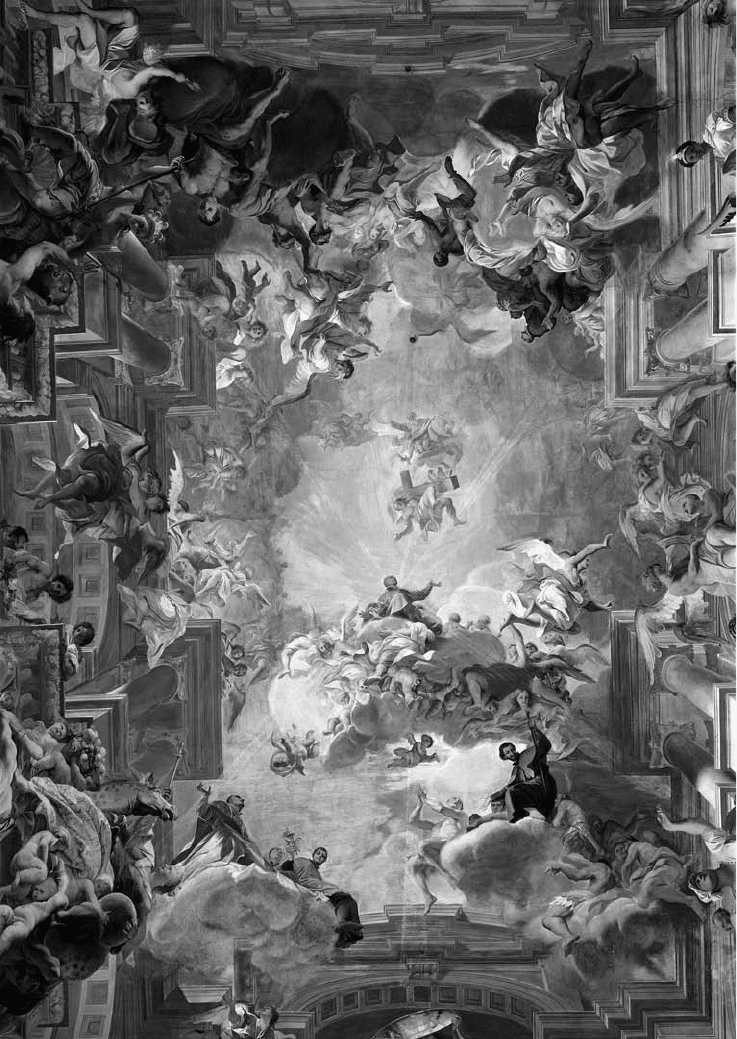
The ceiling of the church of S. Ignazio in Rome, painted by Andrea Pozzo, depicts the
glorification of the founder of the Society of Jesus
17
Pope Paul III in 1540. In addition to the vows of poverty, chastity, and
obedience taken by all members of religious orders, the Jesuits took a
further vow of unquestioning loyalty to the papacy. Its members soon
distinguished themselves in educational and mission ary work in many
parts of the world. In Europe they were happy to risk martyrdom in the
Counter-Reformation cause; in America, India, and China they showed
more sympathy with indigenous religions than many other Christian
proselytizers, Catholic or Protestant. In philosophy and theology in the
universities they were soon able to compete with the long-established
religious orders such as the Franciscans and Dominicans. They promoted
a new and, as they saw it, improved version of scholasticism.
Whereas medieval scholastics had based their university lectures upon
canonical texts such as the works of Aristotle and the Sentences of Peter
Lombard,8 Jesuits in universities began to replace commentaries with self-
standing courses in philosophy and theology. By the early seventeenth
century this pattern was adopted by Dominicans and Franciscans, and this
led to a sharper distinction between philosophy and theology than had
been common earlier. The pioneer of this movement to reform philosophy
into independent textbook form was the Spanish Jesuit Francisco Suarez,
whose Disputationes Meta physicae (1597) were the W rst such systematic treat-
ment of scholastic metaphysics.
Born in Granada in 1548, Suarez joined the Society of Jesus in 1564 and
spent the whole of his professional life as a university professor, lecturing at
six diVerent universities in Spain and in the Jesuit college in Rome. He was a
devout and erudite man, and in terms of sheer intellectual power he has a
strong claim to be the most formidable philosopher of the sixteenth
century. In the history of philosophy, however, he does not have a place
commensurate to his gifts, for two reasons. First, most of his work is
a restatement and reWnement of medieval themes, rather than an explor-
ation of new territory. Second, as a writer he was not only proliWc, leaving
behind a corpus that Wlls twenty-eight volumes, but also prolix and
tedious. In so far as he had an inXuence on subsequent philosophy, it
was through the writings of lesser but more readable imitators.
The two areas in which he was, indeed, inXuential were metaphysics and
political philosophy. He had a great reverence for St Thomas Aquinas, but
8 See vol. II, p. 56.
SIXTEENTH-CENTURY PHILOSOPHY
18
as a metaphysician he followed in the footsteps of Avicenna and Duns
Scotus rather than those of Aquinas himself. Paradoxically, much that was
to pass for Thomism during the seventeenth, eighteenth, and nineteenth
centuries was closer to Suarezian metaphysics than to the Summa Contra
Gentiles. In political philosophy Suarez’s contribution was the De Legibus of
1621, which was the unacknowledged source of many of the ideas of better-
known thinkers. In his own day he was most famous for his controversy
with King James I about the divine right of kings, in which he attacked the
theory that temporal monarchs derived their sovereignty directly from
God. King James had his book publicly burnt.9
Of the philosophical issues dividing the Catholic and Protestant camps in
the sixteenth century none was more thorny than human free will, which
had been proclaimed at the Council of Trent in opposition to Lutheran
determinism and Calvinist predestinarianism. The Jesuits made themselves
champions of the libertarian account of human freedom. Suarez and his
Jesuit colleague Luis de Molina oVered a deWnition of free agency in terms
of the availability of alternative courses of action—‘liberty of indiVerence’
as it came to be known. ‘That agent is called free which in the presence of
all necessary conditions for action can act and refrain from action or can do
one thing while being able to do its opposite.’
Such a deWnition did ample justice to humans’ consciousness of their
own choices and their attribution of responsibility to others. But by
comparison with more restrictive accounts of freedom, it made it very
diYcult to account for God’s foreknowledge of free human actions, to
which both Catholics and Protestants were committed. Molina, in his
famous Concordia (1589), presented an elaborate solution to the problem,
in terms of God’s comprehensive knowledge of the actions of every possible
human being in every possible world.10 Ingenious though it was, Molina’s
solution was unpopular not only among Protestants but also among his
Catholic co-religionists.
Dominican theologians, of whom the most vociferous was the Thomist
Domingo Banez (1528–1604), thought that the Jesuit theologians were
excessively exalting human freedom and derogating from divine power.
The dispute between the two religious orders became so bitter that in 1605
9 Suarez’s metaphysics is discussed at greater length in Ch. 6 and his political theory in Ch. 9.
10 Molina’s theory of ‘middle knowledge’ is reported in detail in Ch. 10.
SIXTEENTH-CENTURY PHILOSOPHY
19
Pope Clement VIII, without resolving the question at issue, imposed silence
on both sides. Ironically, within the reformed camp, a Leiden divine named
Arminius propounded views which were similar to, if less sophisticated
than, those of Molina. The Synod of Dort in 1619 declared them incom-
patible with Calvinist orthodoxy.
Giordano Bruno
The most colourful philosopher of the latter part of the sixteenth century
operated far outside the bounds of orthodoxy, whether Catholic or Prot-
estant. Giordano Bruno (1548–1600) was born near Naples and became a
Dominican there in 1565. By 1576 he was already suspected of heresy and
expelled from the order. He Xed northwards to Geneva, but there became
equally unpopular with the Calvinists. He had better success in France,
studying and lecturing in Toulouse and Paris and enjoying, for a time, the
favour of King Henri III.
Bruno’s Wrst ma jor work, On the Shadows of Ideas, combined an elaborate
Neoplatonic metaphysical system with practical advice on the art of mem-
ory. There is a hierarchy of ideas with human ideas at the lowest level and at
the topmost level the divine Ideas forming a unity in God’s mind. These are,
in themselves, impenetrable to us; but they are expressed in Nature, which is
the universal eVect of God. Images of the celestial world are closer to God
than images of our sublunar world; hence, if we wish to organize our
knowledge in such a way that we can recall it systematically we should
mentally dispose our thoughts within the pattern of the signs of the zodiac.
In 1583 Bruno moved to England and visited Oxford, where he gave
some lectures. His stay there was not a success. He was not to be the last
continental philosopher to visit the university and Wnd himself treated as a
charlatan, and in his turn to regard his philosophical hosts as more
interested in words than in ideas. He expressed his disdain for Oxford
pedantry, along with ideas of more universal philosophical concern, in a
series of dialogues in 1584 beginning with Supper on Ash Wednesday (La cena de le
ceneri). He seems to have written these while acting as a double agent in
London for both the French and the English secret services.
Bruno’s dialogues are not easy reading. They are peopled by beings of
grand but mysterious status, like Wagner’s gods and Tolkien’s creatures,
SIXTEENTH-CENTURY PHILOSOPHY
20
with powers of uncertain limits and motives of slender intelligibility.
Although bearing the names of classical deities, they operate at some
distance from Homer and Vergil. The Latin Mercury, for instance, corres-
ponds not only to the Greek Hermes, but to the Egyptian god Thoth: he
represents often the teachings of the fashionable Hermetic cult. This was
based on recently discovered documents believed to go back to the Egypt of
Moses’ time. Hermetism, in Bruno’s view, was superior to Christianity and
was destined to supersede it.
In the system propounded in the dialogues, the phenomena we observe
are the eVects of a world-soul which animates nature and makes it into
a single organism. The world of nature is inWnite, with no edge, surface, or
limit. But the world’s inWnity is not the same as God’s inWnity because
the world has parts that are not inWnite, whereas God is wholly in the whole
world and wholly in each of its parts. This diVerence perhaps suYces to
distinguish Bruno’s position from pantheism, but the relation between God
and the world remains obscure. It is not really clariWed by Bruno’s august
formulation that God is the Nature making Nature (natura naturans) while the
universe is the Nature made by Nature (natura naturata).
Two features of Bruno’s system have caught the attention of historians
and scientists: his adoption of the Copernican hypothesis, and his postula-
tion of multiple universes. Bruno accepted that it was the earth that went
round the sun, and not the sun that went round the earth. He went on to
develop Copernicus’ ideas in a bold and dramatic manner. The earth was
not the centre of the universe: but neither was the sun. Our sun is just one
star among others, and in boundless space there are many solar systems.
No sun or star can be called the centre of the universe, because all positions
are relative.
Our earth and our solar system enjoy no unique privilege. For all
we know, there may be intelligent life at other times and places within
the universe. Particular solar systems come and go, temporary phases in the
life of the single inWnite organism whose soul is the world-soul. Within
the universe each intelligent being is a conscious, immortal atom, mirroring
in itself the whole of creation. If in his interfusing of God and Nature Bruno
anticipated Spinoza, in his account of rational atoms he anticipated Leibniz.
Bruno’s championship of Hermetism and his theory of multiple universes
challenged the orthodox teaching that God was incarnate uniquely in
Jesus and that Christianity was the deWnitive divine revelation. Nonetheless,
SIXTEENTH-CENTURY PHILOSOPHY
21
after leaving England he was accepted for a while as a Lutheran at Wittenberg
and in 1591 was lecturing in Zurich. Unwisely, he accepted an invitation
from the Doge of Venice, and found himself in the prison of the local
Inquisition in 1592. A year later he was passed on to the Roman Inquisition,
and after a trial that dragged on for nearly seven years in 1600 he was
burned as a heretic in the Campo dei Fiori, where his statue now stands.
There is no doubt that the ideas expressed in Bruno’s writings were
unorthodox. The remarkable things about his trial are that he showed such
constancy in defending his ideas and that it took his inquisitors so long to
Wnd him guilty of heresy. But although theories of multiple universes are
once again popular with cosmologists today, it is a mistake to think
of Bruno as a martyr to science. His speculations were based not on
observation or experiment but on occult traditions and on a priori philoso-
phizing. He was condemned not because he supported the Copernican
system, but because he practised magic and denied the divinity of Christ.
Galileo
Matters are very diVerent when we turn to another Italian philosopher
who suVered at the hands of the Inquisition, Galileo Galilei. Galileo, twelve
years younger than Bruno and an exact contemporary of Shakespeare, was
born in Pisa and studied at the university there, eventually becoming
professor of mathematics in 1589. In 1592 he moved to Padua, and held a
professorship there for eighteen years, which he would recall as the
happiest period of his life.
Already as a young man Galileo had begun to criticize the still dominant
physics of Aristotle, not, like Bruno, on the basis of Neoplatonic metaphys-
ics, but as a result of observation and experiment. His years at Pisa became
famous for one observation that he made and one experiment that he
probably did not make. Observing the motion of a chandelier in the
cathedral he discovered that the length of time taken by the swing of
a pendulum depends only on its own length, not on its weight or the
scope of its swing. He almost certainly did not, as legend tells, drop balls
of diVerent weights from the cathedral’s leaning tower to prove that
Aristotle was wrong to say that heavier bodies fell faster than light ones.
His contemporary Aristotelian opponents, however, did carry out such
SIXTEENTH-CENTURY PHILOSOPHY
22
an exper iment, and their results were closer to his prediction than to
Aristotle’s: a 100 lb ball hit the ground very little sooner than a 1 lb ball.
It was in Padua that Galileo did conWrm by experiment—with balls
rolling down inclined planes—that bodies of diVerent weight, in the
absence of resistance, take the same time to fall a given distance, and that
they accelerate at the same uniform rate. His experiments also tended to
show the falsity of the principle, fundamental to Aristotelian physics, that
nothing moves unless acted on by an external source of motion. On the
contrary, he maintained, a body in motion will continue to move unless
acted on by a contrary force, such as friction. This thesis enabled him to
dispense with the notion of impetus, which earlier critics of Aristotle such
as Philoponus had invoked to explain the continued motion of project-
iles.11 It prepared the way for the principle of inertia stated later by
Descartes and Newton, that any moving object, unless acted on from
outside, tends to move in a straight line at a constant speed. Galileo himself
did not quite arrive at this principle, since in order to explain the orbits of
the planets, he postulated that inertial motion was basically circular.
On its own, Galileo’s work in mechanics would entitle him to a place
among the great scientists, and he also made important discoveries in
hydrostatics. But it was his research into astronomy that brought him
fame and tribulation. Using the newly invented telescope, which he
himself substantially improved, he was able to observe four moons of
Jupiter, which he named ‘Medicean Stars’ in honour of Grand Duke
Cosimo II of Tuscany. He discovered the mountains of the moon and
the variable spots on the sun; discoveries which showed that he heavenly
bodies were not, as Aristotle thought, made out of a uniform crystalline
quintessence, but consisted of the same sort of material as our own earth.
These discoveries were published in 1610 in a book entitled A Messenger from
the Stars (Sidereus Nuncius). The book was dedicated to Duke Cosimo,
who forthwith gave him a lifetime appointment as philosopher and
mathematician to the court of Tuscany.
Shortly afterwards, Galileo observed that the planet Venus went
through phases similar to the phases of the moon. This could only be
explained, he concluded, if Venus was orbiting the sun and not the earth: it
provided a powerful argument in favour of the Copernican hypothesis.
11 See vol. II, p. 180.
SIXTEENTH-CENTURY PHILOSOPHY
23
The discovery of the moons that revolved around Jupiter in its planetary
orbit had already disposed of one of the strongest arguments urged against
heliocentrism, namely that the moon would only be able to orbit the earth
if the earth itself was stationary.
Galileo was initially cautious in publicly expressing the conclusions he
drew from his astronomical discoveries. However, after an ecclesiastical
commission in Rome had taken oYcial notice of his major observations, he
began to propagate heliocentric ideas to a wide circle of friends, and in 1613,
in an appendix to a book on sunspots, he declared his adherence to
Copernicus. A Dominican friar in Florence, in a sermon on Acts 1: 11
(‘Ye Galileans, why stand ye gazing up to heaven?’) denounced heliocentr-
ism as being in conXict with biblical texts, such as the one in which Joshua
tells the sun to stand still so that the Israelites may complete their victory
over the Philistines. Galileo decided to travel to Rome to clarify his
theological status.
In advance he wrote to the powerful Jesuit cardinal, St Robert Bellar-
mine, urging that the sacred authors who spoke of the sun as moving were
merely using popular idiom and were not intending to teach geometry.
Bellarmine referred the matter to a committee of the Inquisition who
determined that the opinion that the sun was the centre of the cosmos was
heretical, and the opinion that the earth moved was at the least erroneous.
On the instructions of Pope Paul V, Bellarmine instructed Galileo that he
must not hold or defend either of these opinions. If there was a real proof
of heliocentrism, he told one of Galileo’s friends, then we would have to
re-examine the biblical texts which appeared to contradict it; but as matters
stood, Copernicus’ theory was only an unproved hypothesis. And indeed,
Galileo’s own heliocentric system, though it Wtted the phenomena better,
was almost as complicated as the geocentric system of his opponents,
demanding constant appeal to epicycles.12 The evidence he had discovered
did not justify the degree of certainty with which he maintained his thesis.
It is often said that in this exchange Bellarmine showed a sounder grasp
of the philosophy of science than the age’s greatest scientist and Galileo
showed a sounder grasp of biblical exegesis than the age’s most famous
theologian. The paradox is an agreeable one, but it is not really a fair
12 Galileo did not incorporate Kepler’s discovery of the elliptical orbits of the planets, which
was needed to achieve the appropriate simpliWcation of heliocentrism.
SIXTEENTH-CENTURY PHILOSOPHY
24
representation of the debate on either side. And whatever the merits of the
case, the upshot was that while Galileo’s writings were not condemned, he
was silenced for several years to come.
In 1624 Galileo travelled to Rome once more. Paul V and Bellarmine
were now dead, and there was a diVerent pope wearing the tiara: Urban
VIII, who as Cardinal Barberini had shown himself an admirer of Galileo’s
astronomical discoveries. Galileo was given permission to write a systematic
treatment of the Ptolemaic and the Copernican models, on condition that
he presented them both impartially without favouring heliocentrism.
In 1632 Galileo published, with the approval of the papal censor, Dialogue
on the Two Chief World Systems. In the book one character, Salviati, presents the
Copernican system, and another, Simplicius, defends the traditional one.
‘Simplicius’ was an appropriate name for the defender of Aristotelianism,
since it had been borne by the greatest of Aristotle’s Greek commentators.
However, it could also be interpreted as meaning ‘simpleton’ and the pope
was furious when he found some of his own words placed in the mouth of
Simplicius. He concluded that Galileo had presented the Copernican
system in a more favourable light than its opponent, and had therefore
deviated from the terms of his licence to publish. In 1633 Galileo was
summoned to Rome, tried by the Inquisition, and under the threat
of torture forced to abjure heliocentrism. He was condemned to life
imprisonment, a sentence that he served out until his death in 1642, in
conWnement in the houses of distinguished friends and eventually in his
own home at Bellosguardo outside Florence.
While under house arrest he was allowed to receive visitors. Among
them was John Milton, who in Areopagitica recorded: ‘I found and visited the
famous Galileo grown old, a prisoner of the Inquisition, for thinking in
Astronomy otherwise than the Franciscan and Dominican licensers
thought.’ The newly founded college at Harvard in the commonwealth
of Massachusetts made an oVer of a visiting professorship, which was
politely declined. Even though going blind, Galileo continued to write,
and incorporated the fruit of his lifetime’s work in Discourses and Mathematical
Demonstrations Concerning Two New Sciences. This was published in Leiden in 1638
and became the most widely inXuential of his works.
Galileo was treated more humanely than Bruno and many another
prisoner of the Inquisition, but the evil eVects of his condemnation were
felt throughout Europe. ScientiWc investigation in Italy went into decline:
SIXTEENTH-CENTURY PHILOSOPHY
25