
Kenny Anthony. The Rise of Modern Philosophy: A New History of Western Philosophy. Volume 3
Подождите немного. Документ загружается.

Amidst a great and populous nation, extremely industrious and more concerned
with their own business than curious about other people’s, while I do not lack any
conveniences of the most frequented cities, I have been able to live a life as solitary
and retired as though I were in the most remote deserts. (AT VI. 2, 9, 31; CSMK
I.111, 115, 126)
But the Discourse is much more than Descartes’ intellectual autobiography:
it presents in minature a summary of his philosophical system and his
scientiWc method. Descartes had an extraordinary gift for presenting com-
plicated philosophical doctrines so elegantly that they appear fully intelli-
gible on Wrst reading and yet can provide material for reXection to the most
expert philosophers. He prided himself that his works could be read ‘just
like novels’.
There are two key ideas that are presented in the Discourse and elaborated
in later works. First: human beings are thinking substances. Second: matter
is extension in motion. Everything in his system is to be explained in terms
of this dualism of mind and matter. If we nowadays tend naturally to think
of mind and matter as the two great mutually exclusive and mutually
exhaustive divisions of the universe we inhabit, that is because of Descartes.
Descartes reaches these conclusions by the application of a method of
systematic doubt. To prevent being ensnared in falsehood, the philo sopher
must begin by doubting whatever can be doubted. The senses sometimes
deceive us; mathematicians sometimes make mistakes; we can never be
certain whether we are awake or asleep. Accordingly:
I decided to feign that everything that had entered my mind hitherto was no more
true than the illusions of dreams. But immediately upon this I noticed that while I
was trying to think everything false, it must needs be that I, who was thinking this,
was something. And observing that this truth ‘I am thinking, therefore I exist’ was
so solid and secure that the most extravagant suppositions of sceptics could not
overthrow it, I judged that I need not scruple to accept it as the Wrst principle of
philosophy that I was seeking. (AT VI. 32; CSMK I.127)
This is the famous Cogito, ergo sum, which achieves the second task of the
philosopher, that of preventing the systematic doubt from leading to
scepticism. But from it Descartes goes on to derive the principles of his
system. If I were not thinking, I would have no reason to believe that I
existed; hence I am a substance whose whole essence is to think; being a
body is no part of my e ssence. The same goes for every other human being.
So Descartes’ Wrst main thesis is established.
DESCARTES TO BERKELEY
36
What assures me that the Cogito is correct? Only that I see clearly that it is
true. Whenever I conceive something clearly and distinctly, I am assured of
its truth. But when we turn to material objects, we Wnd that of all their
properties the only ones we clearly and distinctly perceive are shape, size,
and movement . So Descartes gains his second main thesis, that matter is
extension in motion.
But what guarantees the principle that whatever I see clearly and
distinctly is true? Only the truthful nature of the God to whom I owe
my existence as a thinking thing. So establishing the existence of God
is a necessary part of Descartes’ system. He o Vers two proofs that there
is a God. First, I have in myself the idea of a perfect being, and this idea
cannot be caused in me by anythin g less than a being that is itself perfect.
Second, to be perfect a being must include in itself all perfections; but
existence is a perfection, and therefore a perfect being must exist.1
Like Bacon, Descartes compared knowledge to a tree, but for him the
tree’s roots were metaphysics, its trunk was physics, and its fruitful
branches were the moral and useful sciences. His own writings, after the
Discourse, followed the order thus suggested. In 1641 he wrote his meta-
physical Meditations, in 1644 his Principles of Philosophy, which is a pruned
version of the physical system of The World, and in 1649 a Treatise on the
Passions, which is largely an ethical treatise.
The Meditations contain a full statement of the system sketched in the
Discourse. Before publication the text was sent to Mersenne to circulate for
comment to a number of scholars and thinkers. Six sets of objections were
received. They were printed, with replies from Descartes, in a long appen-
dix to the Wrst edition of 1641, which thus became the Wrst peer-reviewed
work in history. The objectors were a varied and distinguished group: apart
from Mersenne himself they included a scholastic neighbour in Holland,
an Augustinian theologian from Paris, Antoine Arnauld, plus the atomist
philosopher Pierre Gassendi, and the English materialist and nominalist,
Thomas Hobbes.
Criticisms of the Meditations continued to come in after publication,
and critical reaction was not only literary. The rector of Utrecht Univer-
sity, Gisbert Voetius, denounced Descartes to the magistrates as a dangerous
1 Descartes’ natural theology is considered in detail in Ch. 10.
DESCARTES TO BERKELEY
37
propagator of atheism, and the University of Leiden accused him of the
Pelagian heresy. Descartes wrote two tracts, which survive, to defend his
orthodoxy; but it was really the intervention of inXuential friends that
prevented him from being arrested and having his books burnt.
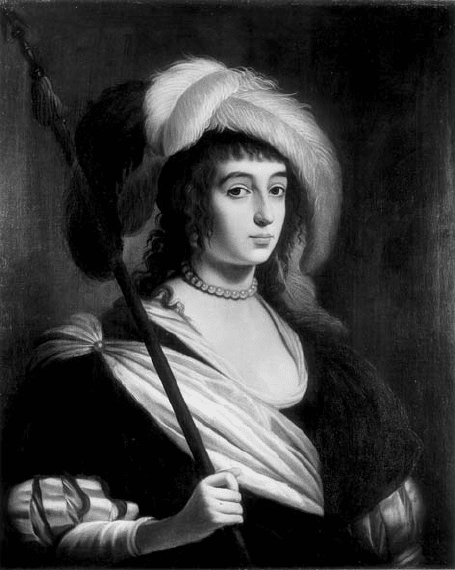
One of his most supportive friends was Princess Elizabeth, the daughter
of the Elector Frederick against whom he had once soldiered. He corre-
sponded with her from 1643 until his death, answering (and sometimes
failing to answer) her acute criticisms of his writings. He gave her much
medical and moral advice, and consoled her on the execution of her uncle
King Charles I. It was to her that he dedicated The Principles of Philosophy. The
Wrst part of that book summarizes the metaphysics of the Meditations and its
three remaining parts deal with physical science, propounding laws of
motion and explaining the nature of weight, heat, and light. The account
given of the solar system is disguisedly heliocentric and discreetly
Princess Elizabeth of
Bohemia, one of
Descartes’ first readers
and shrewdest critics
DESCARTES TO BERKELEY
38
evolutionary. Descartes explains that he is describing not how the world
was actually made, but how God might have made it otherwise, if he had so
pleased.
Descartes’ correspond ence with Princess Elizabeth led him to reXect
further on the relationship between the body and the soul, and to
construct an ethical system resembling ancient Stoicism. He developed
these reXections into The Passions of the Soul. When the treatise was published,
however, it was dedicated not to Elizabeth, but to another royal lady who
had interested herself in philosophy, Queen Christina of Sweden. The
queen was so impressed that she invited Descartes to be her court phil-
osopher, sending an admiral with a battleship to fetch him from Holland.
Descartes was reluctant to sacriWce his solitude and the appointment
proved disastrous. He felt lonely and out of place: he was employed in
writing a ballet and forced to rise at 5 a.m. to instruct the queen in
philosophy.
Descartes had immense conWdence in his own abilities, and still more in
the method he had discovered. Given a few more years of life, he thought,
and given suYcient research funding, he would be able to solve all the
outstanding problems of physiology and learn thereby the cures of a ll
diseases. At this point he fell a victim to the rigours of the Swedish winter.
While nursing a sick friend he caught pneumonia, and died on 11 February
1650. There was an ironic Wttingness about the motto which he had chosen
for himself as an epitaph:
No man is harmed by death, save he
Who, known too well by all the world,
Has not yet learnt to know himself.
Descartes was a man of extraordinary and versatile genius. His ideas on
physiology, physics, and astronomy were superseded within a century: they
enjoyed a much shorter currency than the Aristotelian system they were
designed to replace. But his work in algebra and geometry entered into the
abiding patrimony of mathematics; and his philosophical ideas remain—for
better or worse—enormously inXuential to the present day. No one can
question his claim to rank among the greatest philosophers of all time.
We should not, however, take him altogether at his own valuation. In
the Discourse he insists that systems created by an individual are to be
preferred to those created by communities:
DESCARTES TO BERKELEY
39
As a rule there is not such great perfection in works composed of several parts, and
proceeding from the hands of various artists, as in those on which one man has
worked alone. Thus we see the buildings undertaken and carried out by a single
architect are generally more seemly and better arranged than those that several
hands have sought to adapt, making use of old walls that were built for other
purposes. Again, those ancient cities which were originally mere boroughs, and
have become towns in process of time, are as a rule badly laid out, as compared
with those towns of regular pattern that are laid out by a designer on an open plan
to suit his fancy. (AT VI. 11; CSMK I.116)
This is not merely the expression of a taste for classical rather than Gothic
architecture: laws too, Descartes goes on, are better if devised by a single
legislator in a single code. Similarly, he thought, a true system of philoso-
phy would be the creation of a single mind; and he believed himself to be
uniquely qualiWed to be its creator.
It is true that Descartes initiated a new, individualistic, style of phil-
osophizing. Medieval philosophers had seen themselves as principally en-
gaged in transmitting a corpus of knowledge; in the course of transmission
they might oVer improvements, but these must remain within the bounds
set by tradition. Renaissance philosophers had seen themselves
as rediscovering and republicizing the lost wisdom of ancient times. It was
Descartes who was the Wrst philosopher since Antiquity to oVer himself as a
total innovator; as the person who had the privilege of setting out the truth
about man and his universe for the very Wrst time. Where Descartes trod,
others followed: Locke, Hume, and Kant each oVered their philosophies as
new creations, constructed for the Wrst time on sound scientiWc principles.
‘Read my work, and discard my predecessors’ is a constant theme of
seventeenth- and eighteenth-century thinkers and writers.
With medieval philosophers like Aquinas, Scotus, and Ockham, a stu-
dent has to read the texts closely to realize the great degree of innovation
that is going on: the new wine is always decanted so carefully into the old
bottles. With Descartes and his successors, the diYculty is the opposite: one
has to look outside the text to realize that much that is presented as
original insight is in fact to be found stated in earlier authors. There is no
need to doubt the sincerity of Descartes’ repeated statements that he owed
nothing to his scholastic predecessors. He was not a plagiarist, but he had
no appreciation of how much he had imbibed from the intellectual
atmosphere in which he grew up.
DESCARTES TO BERKELEY
40
When Descartes tried to doubt everything, the one thing he did not
call into question was the meaning of the words he was using in his solitary
meditation. Had he done so, he would have had to realize that even
the words we use in soliloquy derive their meaning from the social
community which is the home of our language, and that therefore it
was not, in fact, possible to build up his philosophy from solitary private
ideas. Again, Descartes thought that it was not possible to call into question
propositions that he was taught by natural light—the clear and distinct
perceptions that form the basic building blocks of his system. But in fact,
as we shall see in detail in later chapters, too often when he tells us
that something is taught by the natural light in our souls, he produces
a doctrine that he had imbibed from the Jesuits at La Fle
`
che.
There is no doubt of the enormous inXuence Descartes has exercised
from his own day to ours. But his relation to modern philosophy is not
that of father to son, nor of architect to palace, nor of planner to city.
Rather, in the history of philosophy his position is like that of the waist of
an hourglass. As the sand in the upper chamber of such a glass reaches its
lower chamber only through the slender passage between the two, so too
ideas that had their origin in the Middle Ages have reached the modern
world through a narrow Wlter: the compressing genius of Descartes.
Hobbes
Of those who had been invited to comment on Descartes’ Meditations in
1641, the most distinguished was Thomas Hobbes, the foremost English
philosopher of the age. At that time Hobbes was Wfty-three years old,
having been born in 1588, the year of the Spanish Armada. He had been
educated at Oxford and had served as a tutor to the Cavendish family and
as an amanuensis to Francis Bacon. In 1629 he had published an English
translation of Thucydides’ History of the Peloponnesian War. During a visit to
Paris in the 1630s he had met Descartes’ Franciscan friend Marin Mersenne,
whom he described as ‘an outstanding exponent of all branches of phil-
osophy’. In 1640 he had written a treatise in English, Elements of Law, Natural
and Political, which contained in essence the principles of his philosophy of
human nature and human society. He Xed in the same year to Paris,
anticipating the Civil War which was heralded by the activities of the
DESCARTES TO BERKELEY
41
Long Parliament. He remained there more than ten years, and was, for a
period, tutor to the exiled heir to the throne, the future King Charles II. In
1642 he presented a number of the ideas of the Elements of Law in a Latin
treatise, De Cive, which established his reputation in France.
Hobbes’ comments on Descartes show little comprehension of the
Meditations, and the two thinkers have traditionally been regarded as stand-
ing at opposite poles of philosophy. In fact they resembled each other in
several ways. Both, for instance, were Wred by a passion for mathematics.
Hobbes’ most lively biographer, the gossipy John Aubrey, described his Wrst
encounter with geometry:
He was 40 years old before he looked on geometry; which happened accidentally.
Being in a gentleman’s library, Euclid’s Elements lay open, and ’twas the 47th
Element at Book I. He read the proposition. ‘By G —’ said he, ‘this is impossible!’
So he reads the demonstration of it, which referred him back to such a propos-
ition; which proposition he read. Et sic deinceps [and so on], that at last he was
demonstratively convinced of that truth. This made him in love with geometry.
(Aubrey 1975: 158)
He did not, however, grasp the importance of Descartes’ analytic geometry,
which he thought ‘lacked bite’. He thought even more poorly of his
philosophy, in particular his physics or natural philosophy. ‘Mr Hobbes
was wont to say,’ Aubrey tells us, ‘that had Des Cartes kept himself wholly
to Geometrie that he had been the best Geometer in the world, but that his
head did not lye for Philosophy.’ There is an irony here. When, later in life,
Hobbes betook himself to the serious study of geometry, he wasted years
debating with the mathematical professors of Oxford in a futile attempt to
square the circle.
Descartes and Hobbes had much in common. They shared a contempt
for Aristotle and the Aristotelian establishment in the universities. Both
were solitary thinkers who spent signiWcant parts of their lives in exile—
each, for a time, beholden to banished Stuart courts. Both of them had very
modest libraries, and were contemptuous of book-learning. Those who rely
on reading, Hobbes said, ‘spend time in Xuttering over their books; as birds
that entering by the chimney, and W nding themselves enclosed in
a chamber, Xutter at the false light of a glass window, for want of wit
to consider which way they came in’ (L, 24). Hobbes, like Descartes , was a
master of vernacular prose, and wrote for popular reading as well as for
the learned world.
DESCARTES TO BERKELEY
42
The most signiWcant philosophical agreement between the two men
was that each of them was convinced that the material world was to be
explained solely in terms of motion. ‘The causes of universal things
(of those, at least, that have any cause) are manifest of themselves, or
(as they say commonly) known to nature; so that they need no method
at all; for they have all but one universal cause, which is motion,’ wrote
Hobbes (De Corpore VI.5). Like Descartes, Hobbes denied the objective reality
of secondary qualities such as colour, sound, and heat, and indeed of all real
accidents. ‘Whatseover accidents or qualities our senses make us think there
be in the world, they are not there, but are seemings and apparitions only.
The things that really are in the world without us, are those motions
by which these seemings are caused’ (Elements of Law I.10). Like Descartes,
Hobbes regarded the science of optics as being a key to the understanding
of the true nature of sensation.
However, while Hobbes was close to one half of Descartes’ philosophy,
his philosophy of matter, he was strongly opposed to the other half, his
philosophy of mind. Indeed he denied the existence of mind in the sense in
which Descartes understood it. There was, for Hobbes, no such thing as a
non-bodily substance, unextended and unmoving. There were no incor-
poreal spirits, human, angelic, or divine. The very expression ‘incorporeal
substance’, he said, was as absurd as ‘round quadran gle’. Historians disagree
whether Hobbes’ materialism involved a denial of the existence of God,
or implied that God was a body of some inWnite and invisible kind. It is
unlikely that he was an atheist; but he certainly denied the dualism of
mind and matter in human beings.
Hobbes’ materialism justiWes his reputation as a great opponent of
Descartes, despite the many attitudes and prejudices they shared. But in
addition to the metaphysical contrast between materialism and dualism,
the two are often treated by historians of philosophy as founders of
opposing schools of epistemology: British empiricism and continental
rationalism. In Chapter 4 I will argue that the diVerence between these
two schools is not as great as it appears on the surface.
Hobbes outlived Descartes by nearly thirty years, but he did not remain
long in France after Descartes’ death in 1650. He found the position of a
Protestant in Paris uncomfortable: he had resisted Mersenne’s attempts to
convert him to Catholicism, and when suVering from a life-threatening illness
he had insisted on receiving the sacrament according to the Anglican rite. In
DESCARTES TO BERKELEY
43
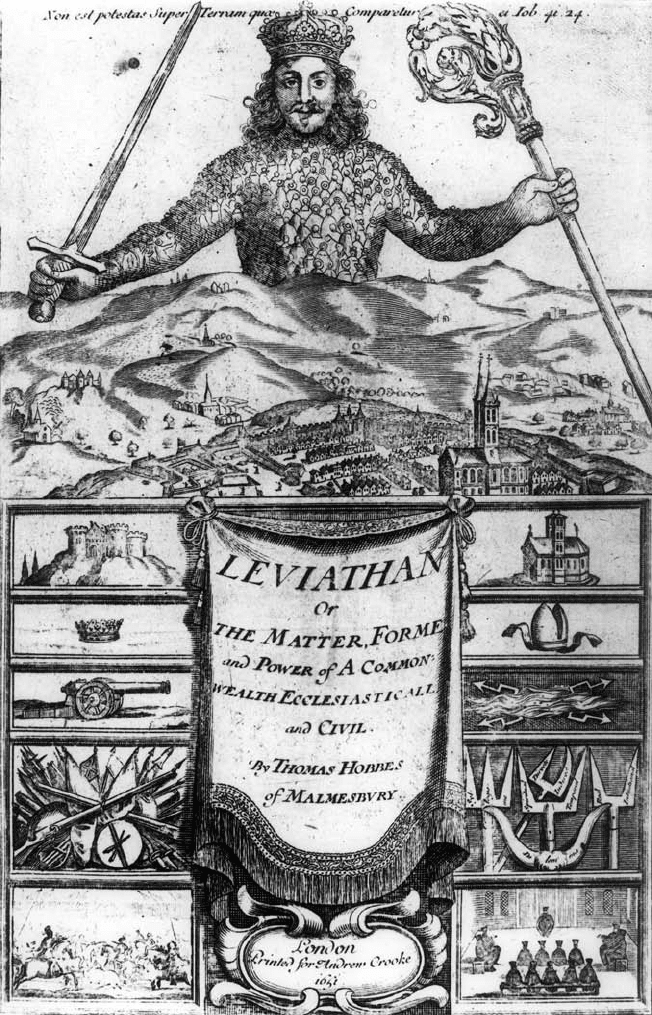
The title page of the first edition of Leviathan, probably designed by Hobbes himself. The
sovereign, whose body is composed of those of his subjects, bears both civil and
ecclesiastical power, represented by the sword and the crozier
his last years in Paris he wrote the work that was to give him immortality,
Leviathan, or the Matter, Form and Power of a Commonwealth Ecclesiastical and Civil.
Starting from the premiss that in a state of nature, outside any com-
monwealth, there would be nothing but a mere war of all against all,
Hobbes argues that principles of rational self-interest would urge men to
give up some of their unfettered liberty in return for equal concessions by
others. Such principles would lead them to transfer their rights, save that
of self-defence, to a central power able to enforce laws by punishment. A
covenant of every man with every man sets up a supreme sovereign,
himself not a party to the covenant and therefore incapable of breaching
it. Such a sovereign is the source of law and property rights, and it is his
function to enforce, not just the original covenan t that constitutes the
state, but individual covenants that his subjects make with each other.2
Leviathan was published in London in 1651. Despite its eloquent presen-
tation of the case for absolute sovereignty, the work was not well received
by Charles II’s entourage when copies were brought across the Channel.
Banished from court and deprived by death of his best Catholic friends,
Hobbes decided to return to England, now, since the execution of Charles I,
a commonwealth under a Protector.
During the Protectorate Hobbes lived quietly in London and wrote no
political philosophy. He published his physical philosophy under the title
De Corpore (On Body) in Latin in 1655 and in English in 1656. He engaged in
controversy with Bishop Bramhall of Derry on the topics that Milton tells
us engaged the devils of Paradise Lost, ‘Providence, Foreknowledge, Will and
Fate, / Fixed Fate free will, foreknowledge absolute’. The disputation was
inconclusive, like that of the devils ‘who found no end, in wand’ring mazes
lost’. In 1658 he published a Latin work, De Homine, which, like the earlier De
Cive, presented for an international readership some of the ideas of The
Elements of Law.
Hobbes was reinstated in the favour of Charles II on his restoration to the
throne in 1660. He was awarded a pension and made welcome at court,
though much teased by the courtiers. ‘Here comes the bear to be baited,’ the
King is reported to have said on seeing him; but he was able, we are told, to
give as good as he got in wit and drollery. Leviathan, however, remained an
object of suspicion. ‘There was a report,’ Aubrey tells us, ‘that in Parliament,
2 Hobbes’ political philosophy is considered in detail in Ch. 9 below.
DESCARTES TO BERKELEY
45