
Kenny Anthony. The Rise of Modern Philosophy: A New History of Western Philosophy. Volume 3
Подождите немного. Документ загружается.

not long after the King was settled, some of the bishops made a motion to
have the good old gentleman burn’t for a heretic.’
From 1660 to his death Hobbes lived mainly at the houses of the Earl of
Devonshire in London and at Chatsworth and Hardwick. He wrote no
more philosophy, but translated the Iliad and the Odyssey, and wrote a
history of the Civil War entitled Behemoth which, at the request of the King,
he withheld from publication. He died at Hardwick Hall in December 1679,
at the age of ninety-one, full of energy to the last in spite of Parkinson’s
disease. He attributed his vigorous old age to three things: regular tennis
until the age of seventy-Wve, abstinence from wine from the age of sixty,
and the continued exercise of the voice in singing. ‘At night,’ Aubrey tells
us, ‘when he was abed, and the doors made fast, and was sure nobody heard
him, he sang aloud (not that he had a very good voice) but for his health’s
sake: he did believe it did his lungs good and conduced much to prolong
his life.’
Hobbes’ fame in the history of philosophy rests above all on his contri-
bution to political philosophy. He himself, however, attached great im-
portance to his philosophy of language. The invention of printing, he
observes, was no great matter compared wit h the invention of writing, and
that in its turn is insigniWcant compared to the invention of speech, which
is what marks us oV from beasts and makes us capable of pursuing science.
Without words ‘there had been amongst men, neither commonwealth,
nor society, nor contract, nor peace, no more than amongst lions, bears,
and wolves’ (L, 20).
The purpose of speech is to transfer the trai n of our thoughts into a
train of words, and it has four uses:
First, to register, what by cogitation we Wnd to be the cause of any thing, present or
past; and what we Wnd things present or past may produce, or e Vect: which in
sum, is aquiring of arts. Secondly, to show to others that knowledge which we
have attained; which is, to counsel and teach one another. Thirdly, to make
known to others our wills and purposes, that we may have the mutual help of one
another. Fourthly, to please and delight ourselves, and others, by playing with our
words, for pleasure or ornament, innocently. (L, 21)
There are four abuses corresponding to the four uses of words, and great
pains are needed to avoid such abuses. ‘For words are wise men’s counters,
they do but reckon by them; but they are the money of fools’ (L, 21).
DESCARTES TO BERKELEY
46
Hobbes is a thoroughgoing nominalist: all words are names, and names
refer only to individuals. Names may be proper, such as ‘Peter’, or common,
such as ‘horse’; and they may also be abstract, such as ‘life’ or ‘length’. They
may even be descriptions (which Hobbes calls ‘circumlocutions’), such as
‘he that writ the Iliad’. But whatever form a name takes, it never names
anything other than one or more individuals. Universal names like ‘man’
and ‘tree’ do not name any universal thing in the world or any idea in the
mind, but name many individuals, ‘there being nothing in the word
Universall but Names; for the things named, are every one of them
Individual and Singular’.
For Hobbes, names are put together to make sentences. If we say ‘Socrates
is just’, the semantic relationship of the word ‘just’ to the man Socrates is
just the same as the relationship of the word ‘Socrates’: both are names,
and the predicate term in the sentence signiWes in the same way as the
subject tem does. Sentences are true when the two names they contain are
both names of the same thing. ‘A man is a living creature’ is true because
‘living creature’ is a name of everything that is signiWed by ‘man’. ‘Every
man is just’ is false because ‘just’ is not a name of every man, the greater
part of mankind deserving the name ‘unjust’ (L, 23; G, 38).
The two-name theory is a naive piece of semantics which would not
survive serious logical criticism such as it had received in the medieval
period and as it was to receive in the nineteenth century in the work of
Gottlob Frege. Hobbes’ version of the theory is a particularly crude one
by comparison with that of its leading medieval proponent, William
Ockham.3 It remained inXuential, however, among the British empiri-
cists whom many have seen as the heirs of the tradition of Ockham
and Hobbes.
The Cambridge Platonists
A group of half a dozen English philosophers in the mid-seventeenth
century occupied a position at odds with both Hobbes and Descartes. Five
of them, of whom the most important was Ralph Cudworth (1617– 88),
were graduates of Emmanuel College, Cambridge, and one of them, Henry
3 See vol. II, pp. 127–8.
DESCARTES TO BERKELEY
47
More (1614–87), was a graduate of Christ’s College, Cambridge, of which
Cudworth was for thirty years master. All of them shared an admiration
for Plato, Plotinus, and their followers among the early Church Fathers.
Hence the group is commonly called the ‘Cambridge Platonists’.
Despite their Cambridge aYliation, the members of the group were
hostile to the Puritanism that prevailed in that town and university
during the Civil War. They rejected Calvinist doctrines of predestination,
aYrmed human freedom, and preached the merits of religious toleration.
Their toleration, however, did not extend to atheists, and the focus of their
hostility was Hobbes, whose materialism they regarded as tantamount to
atheism. During the reign of Charles I Puritan hostility to the Anglican
hierarchy had been followed by the deposition and execution of the king.
For the Cambridge Platonists the politi cal slogan ‘No Bishop, No King’ had
a philosophical counterpart: ‘No Spirit, no God’. One could not be a
materialist and a theist at the same time.
Up to this point, the Cambridge Platonists sided with Descartes against
Hobbes in emphasizing the distinction of mind from matter. They devoted
themselves to proving the immortality of the human soul and the exist-
ence of a spiritual God in such treatises as More’s Antidote Against Athei sm
and The Immortality of the Soul, and Cudworth’s True Intellectual System of the
Universe. For More, a human being is ‘a created spirit endowed with sense
and reason, and a power of organizing terrestrial matter into human
shape’.4 Like Descartes, Cudworth argues that God’s existence can be
proved by the presence in us of the idea of God: ‘Were there no God,
the idea of an absolutely or inWnitely perfect Being could never have
been made or feigned, neither by politicians, nor by poets, nor philo-
sophers, nor any other.’ The idea of God is a coherent one, ‘therefore
must it needs have some kind of entity or other, either an actual or a
possible one; but God, if he be not, is not possible to be, therefore he doth
actually exist.’5
Like Descartes, the Cambridge Platonists believed in innate ideas: the
mind is not a blank page on which the senses write, but a closed book,
which the senses merely open. Innate ideas, More said, are present in our
minds in the way that melodies are present in the mind of a musician while
4 The Immortality of the Soul (1659), bk 1, ch. 8.
5 The True Intellectual System of the Universe (1678), II.537, III. 49–50.
DESCARTES TO BERKELEY
48
he is sleeping upon the grass (Antidote, 17). Among the innate ideas imme-
diately evident to the human mind are fundamental and undeniable moral
principles, of which More was prepared to list, in a handbook of 1668, no
fewer than twenty-three. Hobbes, Cudwo rth maintained, was quite wrong
to think that justice and injustice arose as a result of a merely human
compact. There was no way in which individual humans could confer
upon a sovereign a power of life and death which they did not themselves
possess.
The Cambridge Platonists parted company with Descartes when they
came to explain the basis of fundamental ethical principles. It was quite
wrong, Cudworth complained, to say that moral and other eternal truths
depended on the omnipotent will of God and were therefore in principal
variable. ‘Virtue and holiness in creatures’, he told the House of Commons
in a 1647 sermon, ‘are not therefore Good because God loves them, and will
have them be accounted such; but rather, God therefore loves them
because they are in themselves simply good.’6
The Platonists’ disagreement with Descartes was much sharper when
they came to consider his account of the material world. They were not
opposed to new developments in science—both Cudworth and More were
members of the Royal Society—but they denied that the phenomena
could be accounted for mechanistically in terms of matter and motion.
Unlike Descartes, they believed that animals had consciousness and sensi-
tive souls; and even the fall of a heavy body, they believed, needed to be
explained by the action of an immaterial principle. This did not mean that
God did everything directly, as it were with his own hands, but rather that
he had entrusted the physical world to an intermediary, ‘a plastic nature’
akin to a world-soul, that acted regularly and teleologically. Those like
Descartes who rejected teleology were mere ‘mechanic theists’ and were
little better than the materialist Hobbes.
Locke
Hobbes was a pioneer of modern empiricism, but his fame has been
eclipsed by that of a more polished practitioner, John Locke. Locke was
6 Quoted in C. Taliaferro, Evidence and Faith (Cambridge: Cambridge University Press, 2005), 11.
DESCARTES TO BERKELEY
49
born in Somerset in 1632, the son of a minor gentleman who fought in the
parliamentary cavalry. He was educated at Westminster School, not only in
Greek and Latin but also in Hebrew, and went on to a closed studentship at
Christ Church, Oxford, whence he took his MA in 1658. After the restor-
ation of Charles II in 1660 he wrote several Latin pamphlets in de-
fence of Anglican orthodoxy, taught Greek in the university, became
a college tutor, a nd held a number of college oYces. He became interested
in chemistry and physiology, and spent seven years studying to qualify in
medicine.
In 1667 Locke left Oxford to become physician and political adviser to
Anthony Ashley Cooper, a member of Charles II’s inner cabinet, shortly to
become the Earl of Shaftesbury. Soon after arriving in London he wrote a
brief Essay on Toleration advocating, in contradiction to his earlier tracts, the
removal of doctrinal constraints on all except Roman Catholics. The years
1676–8 he spent in France, meeting a number of followers of Descartes and
making a serious study of his philosophy.
As his reign progressed, Charles II became unpopular, particul arly after
the conversion to Catholicism of his brother and heir, James, Duke of
York. Protestant dissatisfaction came to a head in 1679 when many Cath-
olics were tried and executed for alleged complicity in an imaginary popish
plot to kill the king and place his brother on the throne. Shaftesbury
became leader of the Whig Party, which sought to exclude James from the
succession; his attempts to secure the passing of an Exclusion Bill were
defeated when Charles dissolved Parliament in 1681. After being implicated
in a plot against the royal brothers in 1682, Shaftesbury had to Xee to
Holland, where he died in 1683.
Locke was suYciently identiWed with Shaftesbury’s projects to Wnd it
necessary to go into exile during the Tory revival at the end of Charles II’s
life and during the short reign of his brother James II (1685–8). Around the
time of the popish plot and the exclusion crisis he had written Two Treatises
on Government. In the Wrst he made a devastating attack on a work by Sir
Robert Filmer in defence of the divine right of kings. In the second he
presented an account of the state of nature—a much more optimistic
one than Hobbes’—and argued that governments and commonwealths are
created by a social contract in order to protect the property of individ-
uals. He argued that if a government acts arbitrarily, or if one branch of
DESCARTES TO BERKELEY
50
government usurps the role of another, the government is dissolved and
rebellion is justiWed.7
While in Holland, Locke worked on the composition of his greatest
philosophical work, the Essay Concerning Human Understanding. Notes for this
work date back to his early days in London, but it was not published until
1690, after which it went through four editions during Locke’s lifetime.
The Essay consists of four books. The Wrst and shortest, entitled ‘Of
Innate Notions’, argues that there are no innate principle in our minds,
whether speculative or practical. All our ideas are derived, either directly or
by combination or reXection, from experience. Even in the case of a priori
disciplines such as geometry, the ideas that we employ are not innate. The
thirty-three chapters of the second book treat exhaustively of ideas, ‘idea’
being the catch-all term that Locke employs to characterize our mental
skills and the concepts of our minds:
Every Man being conscious to himself, That he thinks, and that which his Mind is
employ’d about whilst thinking, being the Ideas that are there, ’tis past doubt, that
Men have in their Minds several ideas, such as those expressed by the words
Whiteness, Hardness, Sweetness, Thinking, Motion, Man, Elephant, Army, Drunkenness, and
others. (E, 104)
Locke classiWed ideas in various ways: there are simple ideas and complex
ideas; there are clear and distinct and obscure and confused ideas; there are
ideas of sensation and ideas of reXection. In dealing with simple ideas, Locke
divides the qualities to be found in bodies into two categories, primary
qualities such as solidity, motion, and Wgure, which are in bodies ‘whether
we perceive them or no’, and secondary qualities such as colours, which ‘are
nothing in the objects themselves, but powers to produce various sensations
in us by their primary qualities’. Among the ideas of reXection the Wrst and
most important is the idea of perception, for this is the Wrst exercise of the
mind upon ideas. Perception is a purely passive experience, and everyone
knows what it is by looking within himself. The passive experiences of
perception are the bedrock on which Locke builds his philosophy.
The second book of the Essay presents an empiricist philosophy of mind
and will, but it contains much else: reXections on time, space, and number,
for instance, and a catalogue of human passions. It deals with causal and
7 Locke’s political philosophy is considered in detail in Ch. 9.
DESCARTES TO BERKELEY
51
other relations, and it contains an elaborate and highly inXuential discus-
sion of the nature of personal identity.
Although Locke believes that we can recognize simple ideas within
ourselves unaided, and that if we cannot recognize them no words will
help us to do so, he does in practice identify the ideas that he is talking
about by means of the words that express them. He admits that ‘our
abstract ideas, and general words, have so constant a relation one to
another, that it is impossible to speak clearly and distinctly of our Know-
ledge, which all consists in propositions, wit hout consider ing, Wrst, the
Nature, Use and SigniWcation of Language’ (E, 401).
To that topic, then, he devotes his third book. The most famous sections
of this book are the discussion of abstract ideas and the theory of substance.
The mind, Locke says, observing likenesses among natural objects, sorts
them under abstract general ideas, to which it attaches general names.
These general ideas have, he tells us, remarkable properties: the general
idea of a triangle, for instance ‘must be neither oblique nor rectangle,
neither equilateral, equicrural nor scalenon, but all and none of these at
once’. Substances in the world possess various qualities and powers which
we make use of when we deWne things of diVerent kinds; but the deWn-
itions we give them do not reveal their real essences, but only a ‘nominal
essence’. Of substance in general the only idea we have is of ‘something we
know not what’ in which properties inhere.
Epistemological considerations are ubiquitous throughout the Essay, but
it is the fourth book that is oYcially devoted to the topic of knowledge.
Because the real essences of things are unknown to us, we cannot have true
science about items in the natural world, but only probable belief. We can
have genuine knowledge of our own existence and of the existence of God;
and provided we keep within the bounds of actual sensation, we can have
knowledge of the exist ence of other things. The love of truth should
prevent us from entertaining any proposition with greater assurance
than the evidence we have for it: ‘Whoever goes beyond this measure of
assent, it is plain, receives not truth in the love of it, loves not truth for
truth’s sake, but for some other by end’ (E, 697).
During his exile, perhaps in 1685 when King Louis XIV revoked the
Edict of Nantes which had hitherto given toleration to French Protestants,
Locke wrote a Latin letter on toleration (Epistola de Tolerantia) advocating to a
European audience, as he had earlier done to an English one, the
DESCARTES TO BERKELEY
52
acceptance by Christians of a wide variety of doctrinal beliefs. When, in
1688, the ‘Glorious Revolution’ drove out James II and replaced him with
the Dutch Protestant William of Orange, the English monarchy was placed
on a new legal basis, with a Bill of Rights and a much enhanced role for
Parliament. The way was now free for Locke to return and to publish works
which it had hitherto been too dangerous to print. In 1689 and 1690 there
appeared Two Treatises on Government, the Wrst edition of the Essay, and an
English version of the letter on tolerance. In response to controversy Locke
published two further letters concerning toleration, the third of which
appeared in 1692.
Locke had been deprived of his studentship at Christ Church by Charles
II in 1684 and on his return from exile he spent much of his time in
London. He held a number of posts in the civil service, notably as a
commissioner of the Board of Trade. He found time to write Some Thoughts
on Education (1693), two papers on the nature of money (1691 and 1695), and
The Reasonableness of Christianity (1695). The form of Christianity which Locke
considered reasonable was a very liberal one, and he had to defend himself
against conservative critics in two Vindications of his treatise (1695 and 1697).
Between 1696 and 1698 he was engaged in controversy with Bishop Stil-
lingXeet of Worcester, who regarded the Essay as too rationali stic for the
comfort of religion. Most of these controversial works were published
anonymously; of Locke’s principal works only the Essay appeared under
his own name in his lifetime.
Since 1691 Locke had been given accommodation at Oates, the Essex
manor house of Sir Francis Masham, who had married Damaris, the
daughter of the Cambridge Platonist Ralph Cudworth. As the years went
on Locke spent more and more time at Oates, and from 1700 until his death
in 1704 it was his home. He spent the last years of his life, partly incapaci-
tated by ill health, in writing a devout, if critical, commentary on the
Epistles of St Paul. He died on 28 October 1704, while Lady Masham was
reading the Psalms to him.
Pascal
Hobbes and Locke saw themselves as oppon ents of Descartes, one during his
lifetime and one after his death. In fact, as I have tried to show in the present
DESCARTES TO BERKELEY
53
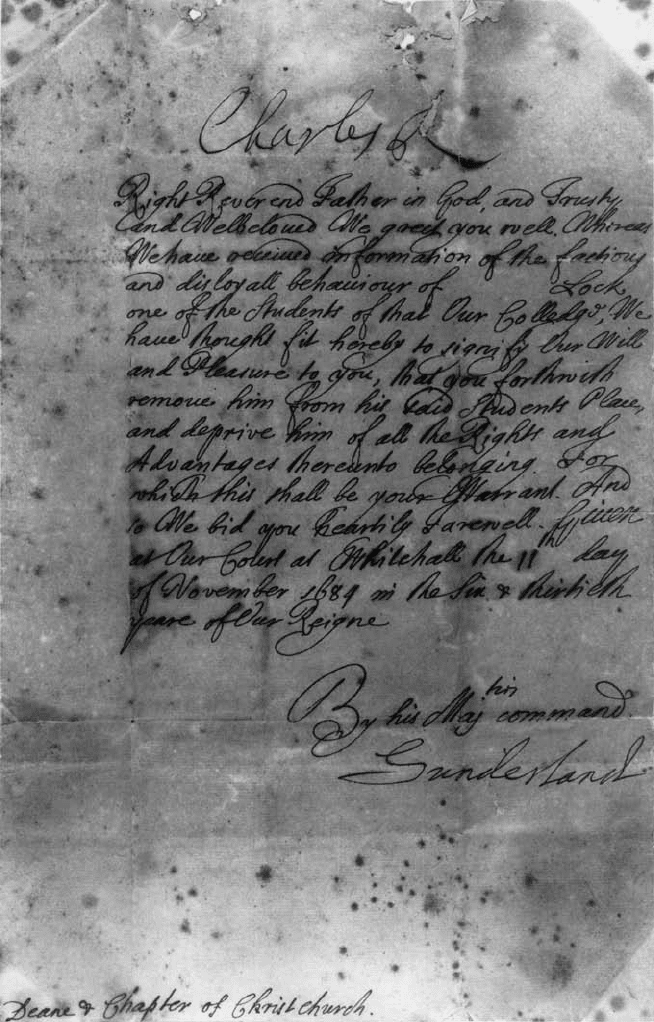
Instruction from King Charles II to the Dean and Chapter of Christ Church to deprive
Locke of his studentship
and in later chapters, both of them shared many of his fundamental
assumptions. The same is true of the French philosophers of the generation
after Descartes, whether they presented themselves as critics or continu-
ators of his work. The most distinguished of the former group was Blaise
Pascal; the most distinguished of the latter was Nicholas Malebranche.
Born in 1632, Pascal was the son of a royal oYcial in the Auvergne.
A precocious child, educated at home, he was already publishing on
the geometry of conic sections at the age of sixteen, and he invented a
rudimentary computer to assist his father in tax assessment. He inspired
a series of experiments which proved the empirical possibility of a vacuum,
which had been denied a priori by Descartes. Later in life he took a signiWcant
part in the development of the mathematical study of probability, and he
can claim to be one of the founders of game theory.
In his own mind, his work in mathematics and physics came to seem
a matter of secondary importance. In 1654 he had a religious experience
which led him to make devotion and theology his main concern. He became
a close associate of a group of ascetics which centred on the convent of
Port Royal, where his sister Jacqueline had become a nun in 1652. Members
of the group were called ‘Jansenists’ because they revered the memory of
the Dutch Bishop Jansenius who had written a famous treatise on St
Augustine, which defended a pessimistic and rigorist version of Catholicism.
Jansenism stressed the corruption of fallen human nature, and held
out hope of salvation only to a small minority of the human race. In our
present state, some divine commands were impossible for human beings to
obey, even with the best will in the world. There was little scope for free will:
on the one hand, sin was unavoidable, and on the other hand, grace was
irresistible.
Such teaching was condemned by Pope Innocent X in 1653, but the
Jansenists fought a long rearguard battle, and their inXuence on Pascal
remained profound. In accord with their devaluation of the powers of
fallen human nature, Pascal was sceptical of the power of philosophy,
especially in relation to knowledge of God. ‘The true way to philosophise’,
he once wrote, ‘is to have no time for philosophy’; as for Descartes, he was
‘useless and uncertain’ (P, 445,671). Because the Jansenists took a poor view
of the freedom of the will, they were constantly at war with its principal
Catholic defenders, the Jesuits. Pascal joined the battle by writing a book,
The Provincial Letters, in which he attacked Jesuit moral theology as excessively
DESCARTES TO BERKELEY
55