
Kenny Anthony. The Rise of Modern Philosophy: A New History of Western Philosophy. Volume 3
Подождите немного. Документ загружается.

lax and indulgent to sinners.8 When he died in 1662 a paper was found
stitched into his coat with the words ‘God of Abraham, God of Isaac, God
of Jacob, not of the philosophers and scholars’.
At his death Pascal left behind a series of brief remarks which were
published in 1670 as Pense
´
es (thoughts). He was a master of aphorism, and
many of his sayings have become familiar quotations: ‘The eternal silence
of the inWnite spaces terriWes me’; ‘Had Cleopatra’s nose been shorter, the
whole face of the world would have been changed’, ‘We die alone’. One of
the most striking is this:
Man is only a reed, the frailest thing in nature; but he is a thinking reed. To crush
him it does not take the whole universe in arms: a breath of wind, a drop of water
is enough to kill him. But were the universe to crush him, man would still be
nobler than his killer. For he knows that he is dying and that the universe has the
better of him. But the universe knows nothing of this. (P, 231)
Many of the remarks were designed to form part of an apology for the
Christian religion, and to convert unbelievers and reform worldly be-
lievers. The project, however, was never completed and no consensus
has been reached among scholars about the form it was intended to take.
Two themes, however, recur in the surviving fragments: the misery of
humanity without God, and the happiness promised by the religious life:
The wretchedness of our condition is made clear by the philosophical debate
between sceptics and rationalists. The sceptics are right that we cannot even be
certain whether we are awake or asleep; the rationalists are right that there are
some natural principles we cannot doubt. But whether these principles are true or
not, depends on whether we come from a good God or from an evil demon. And
we cannot know, without faith, whether there is a God: nature oVers no
satisfactory proof that he exists. The best we can do, if we do not accept revelation,
is to bet on his existence.9 (P, 38,42)
Human nature as we know it is a mass of contradiction. We have an ideal of
truth, and yet we possess only untruth. We have a yearning for happiness,
and we cannot achieve it. Humanity is something monstrous: ‘Chaotic,
contradictory and prodigious; judge of everything and mindless earth—
worm, storehouse of truth and cesspool of error; the glory and refuse of
the universe.’ Pascal anticipates Pope’s Essay on Man:
8 The moral philosophy of the Provincial Letters is discussed in Ch. 10 below.
9 Pascal’s wager is considered in Ch. 10 below.
DESCARTES TO BERKELEY
56
Chaos of thought and passion, all confused;
Still by himself abused or disabused;
Created half to rise and half to fall;
Great lord of all things, yet a prey to all;
Sole judge of truth, in endless error hurled—
The glory, jest, and riddle of the world! (P II,13)
The solution to this riddle is contained in the Christian doctrine of the Fall.
It is as clear as day that the human condition is twofold. If humans had
never been corrupted they would have enjoyed in their innocent state both
truth and happiness. If they had never been other than corrupted, they
would never have any notion of either truth or happiness. But the Fall,
which is the key to understanding of ourselves, is of all Christian teachings
the one most shocking to reason:
What is more contrary to the laws of our wretched justice than eternally to damn
a child with no will of its own for a sin in which the child had so small a part to
play that it was committed six thousand years before the child came into existence?
Certainly, nothing shocks us more deeply than this doctrine. Nevertheless with-
out this most incomprehensible of all mysteries we are incomprehensible to
ourselves. ( P, 164)
But if reason revolts at the idea of the Fall, reason c an also establish the
idea’s truth. The starting point is nothing other than human misery:
The greatness of man is so evident that it can be inferred even from his wretch-
edness. For that which is nature in animals we call wretchedness in man. And by
this we recognize that his nature being now like that of the animals, he is fallen
from a better nature which formerly was his. For who is unhappy at not being a
king, except a deposed king? (Ibid.)
Although Pascal believed that only faith could lead us to saving truth and
that only grace could give us lasting happiness, in his philosophical writing
he was not the enemy of reason that he is often made out to be. His best-
known aphorism, of course, is ‘the heart has its reasons of which reason
knows nothing’. But if we study his use of the word ‘heart’ we can see
that he is not placing feeling above rationality, but contrasting intuitive
with deductive reasoning—rather as we speak of learning mathematical
tables ‘by heart’. We can see this when he tells us that it is the heart that
teaches us the foundations of geometry. In this he was not at all at odds with
Cartesian rationalism.
DESCARTES TO BERKELEY
57
Malebranche
Nicolas Malebranche, the son of one of Louis XIV’s secretaries, was born in
1638, the year in which Descartes published The Discourse on Method.Atthe
age of twenty-six, in 1664, he was ordained a priest of the French Oratory,
founded by Descartes’ patron Cardinal Berulle, and in the same year he
came across the posthumously published Treatise on Man. He was so ravished
by this book, his biographer tells us, that he felt ‘such violent palpitations
of the heart that he was obliged to leave the book at frequent intervals’. He
became the most enthusiastic of all Cartesians, and devoted his life to the
pursuit of clear and distinct ideas.
In 1674–5 Malebranche published his most signiWcant philosophical
work, The Search after Truth (De la recherche de la Ve
´
rite
´
), and in 1688 he
summarized his system in Entretiens sur la Metaphysique. Most of his other
writings were works of theological controversy, beginning with his Treatise
on Nature and Grace of 1680. He fell foul of many of the leading theologians of
the age, quarrelling with Arnauld about grace and with Fe
´
nelon about the
right way to love God: his Treatise was placed on the index in 1690. Shortly
before his death in 1715 he found himself the target of a posthumously
published polemic of John Locke.
The account of sensation, imagination, intellect, and will presented in
Malebranche’s works is essentially the same as that of Descartes. The main
new item is an explanation of the association of ideas in terms of networks
of Wbres in the brain. Some of these networks are inborn: from birth, for
instance, the brain Wbre corresponding to the idea of a steep cliV is linked to
the brain Wbre corresponding to the idea of death. Other networks are
created by experience: if you attend some historic event, for instance,
a brain network will be created linking together ever afterward the persons,
times, and places involved (RdeV2.1, 5).
Malebranche accepted Cartesian dualism: minds were thinking sub-
stances and the essence of matter was extension. But he tried to improve
upon Descartes’ account of the relationship between mind and body, long
recognized as the weakest point in the Cartesian system. More consistently
than Descartes, Malebranche argued that if mind was pure thought, and
matter was pure extension, neither could act upon the other. Mind and
body run parallel, but do not interact. ‘It seems to me quite certain that the
will of spiritual beings is incapable of moving the smallest body in the world.
DESCARTES TO BERKELEY
58
It is evident, for example, that there is no necessary connection between
our will to move our arm and our arm’s movement.’ Sure, my arm
moves when I will, but not because I will. If it was really myself moving my
arm, I would know how I do it; but I cannot even explain how I wiggle my
Wnger.
If I do not move my arm, who does? God does, answers Malebranche.
God is the only true cause. From all eternity he has willed all that is to
happen and when it is to happen. So he has willed the act of my will and
the simultaneous movement of my arm. My willing is not the cause, but
only provides an occasion for God to do the causing. (For this reason,
Malebranche’s system is called ‘occasionalism’.) Not only can minds not act
on body; neither can bodies act on bodies. If bodies collide and move away
from each other, what really happens is that God wills each of them to be
in the appropriate places at the appropriate moments. ‘There is a contra-
diction in saying that one body can move another’ (EM . 7, 10).
If minds cannot act on bodies, and bodies cannot act on bodies, can
bodies act on minds? Normally we imagine that our minds are constantly
being fed information from the world via our senses. Malebranche denies
that our ideas come from the bodies they represent, or that they are
created by ourselves. They come directly from God, who alone is capable
of acting causally on our intellects. If I prick my Wnger with a needle, the
pain does not come from the needle: it is directly caused by God (EM, 6).
We see all things in God: God is the environment in which minds live, just
as space is the environment in which bodies are located. It was this teaching
which particularly aroused the indignation of John Locke.
Many Christian thinkers, from St Augustine onwards, had held that
human beings see the eternal truths and the moral laws by contemplating,
in some manner, ideas in the mind of God. In making this claim Malebranche
could claim august authority. But it was a novelty to say that our knowledge
of changeable material objects depends on immediate divine illumination.
God, after all, is not himself material or changeable: all there is to be seen in
God is the pure idea of intelligible extension. How does contemplation of the
eternal divine archetype of extension convey to us any knowledge of
the contingent history of bodies moving and changing in the world about us?
The answer that Malebranche gives is that in seeing the archetype of
extension we are also made aware of all the laws of Cartesian physics that
govern the behaviour of the material world. If this is to be suYcient to
DESCARTES TO BERKELEY
59
predict the actual course of the universe the laws must fulWl two conditions:
they must be simple laws and they must be general laws. This is the theme of
Malebranche’s Treatise on Nature and Grace:
God, discovering in the inWnite treasures of his wisdom an inWnity of possible
worlds (as the necessary consequences of the laws of motion which he can
establish) determines himself to create that world which could have been pro-
duced and preserved by the simplest laws, and which ought to be the most perfect,
with respect to the simplicity of the ways necessary to its production or to its
conservation. (TNG, 116)
Two simple laws of motion, according to Malebran che, suYce to explain
all physical phenomena—the Wrst, that bodies in motion tend to con-
tinue their motion in a straight line; the second, that when two bodies
collide, their motion is distributed in both in proportion to their size.
Malebranche’s belief in the simplicity and generality of fundamental
laws not only solves the epistemological problem about our knowledge of
the external world, but also the moral problem of the presence of evil
among the creatures of a good God. God could have made a world more
perfect than ours; he might have made it such that rain, which makes
the earth fruitful, fell more regularly on cultivated ground than on the
sea, where it serves no purpose. But to do that he would have had to alter
the simplicity of the laws. Moreover, once God has established laws it is
beneath his dignity to tinker with them; laws must be general not only for
all places but for all times:
If rain falls on certain lands, and if the sun roasts others; if weather favourable for
crops is followed by hail that destroys them; if a child comes into the world with a
malformed and useless head growing from his breast, it is not that God has willed
these things by particular wills; it is because he has established laws for the
communication of motion, of which these eVects are necessary consequences.
(TNG, 118)
It is not that God loves monsters or devises the laws of nature to engender
them: it is simply that he was not able, by equally simple laws, to make a
more perfect world. The key to the problem of evil is to realize that God
acts by general laws and not by particular volition s.
Once again, we have ideas that were later summarized in Pope’s Essay on
Man. We are tempted, Pope says, to see nature as designed for our individual
beneWt. But here we meet an objection, and receive an answer:
DESCARTES TO BERKELEY
60
But errs not nature from this gracious end,
From burning suns when livid deaths descend
When earthquakes swallow, or when tempests sweep
Towns to one grave, whole nations to the deep?
‘No’ (’tis replied) ‘the Wrst almighty cause
Acts not by partial, but by general laws.’ (I. 140–5)
Malebranche’s teaching that God acts by general laws of nature, rather
than by particular acts of providence, was what angered the theologians,
who regarded it as incompatible with biblical and traditional accounts of
the occurrence of miracles. The error was regarded as suYciently wicked to
be denounced by the greatest preacher of the age, Bishop Bossuet, in his
funeral oration for Queen Maria Theresa of France in 1683.
Spinoza
Meanwhile, in Protestant Holland, a Jewish philosopher had developed
Descartes’ ideas in a way even more adventurous than that of Malebranche.
Baruch Spinoza was born in Amsterdam in 1632, into a prosperous
merchant family which had migrated from Portugal at the end of the
previous century. His father, Michael Spinoza, a respected member of
the Jewish community, ensured that he acquired a knowledge of Hebrew
and a familiarity with the Bible and the Talmud at the local rabbinic
school. When Michael died in 1654 Baruch took over the commercial
Wrm in partnership with his brother, but he took much greater interest
in philosophical and theological speculation. Having spoken Portuguese,
Spanish, and Dutch from childhood, he now learnt Latin from a Christian
physician, Francis Van den Enden, who introduced him to the writings of
Descartes and had a consider able inXuence on the development of his
thought.
By his teens, Spinoza had become sceptical of Jewish theology and on
becoming an adult he gave up much of Jewish practice. In 1656 he was
excommunicated from the synagogue and devout Jews were forbidden to
talk to him, to write to him, or to stay under the same roof as him. He
trained himself to grind lenses, and manufactured spectacles and other
optical instruments. This profession gave him leisure and opportunity for
scientiWcreXection and research; it also made him the Wrst philosopher
since Antiquity to have earned his living by the work of his hands.
DESCARTES TO BERKELEY
61
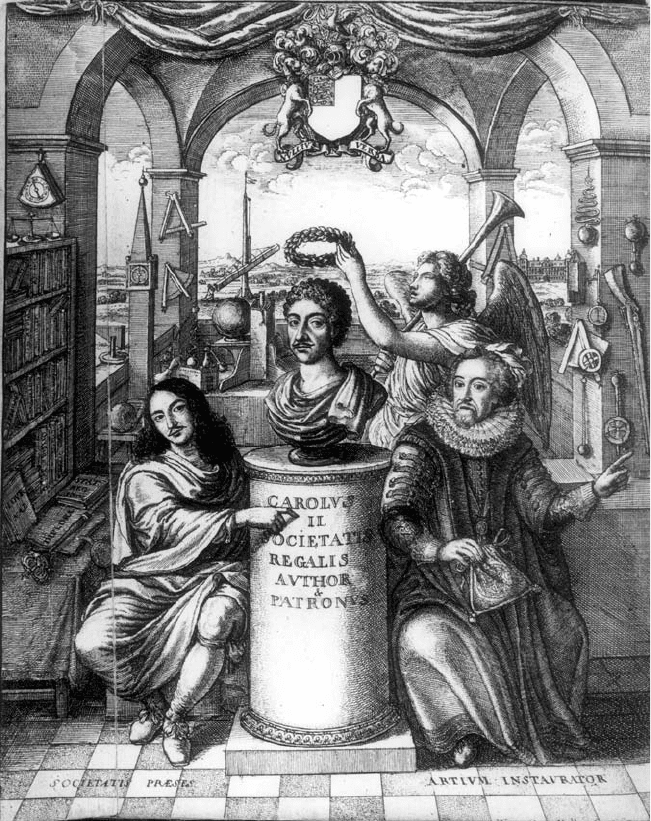
In 1660 he moved from Amsterdam to the village of Rijnsburg near Leiden.
In the same year the Royal Society was founded in London, and shortly after
its foundation its secretary, Henry Oldenburg, wrote to Spinoza inviting him
to enter into a philosophical correspondence about the Cartesian and Bacon-
ian systems. The Royal Society, he told him, was a philosophical college in
The frontispiece of Thomas Sprat’s History of the Royal Society
DESCARTES TO BERKELEY
62
which ‘we devote ourselves as energetically as we can to making experiments
and observations, and are much occupied with putting together a History of
Mechanical Arts’ (Ep,3).
A Dutch traveller who visited Rijnsburg in 1661 reported that in the
village there lived:
somebody who had become a Christian from a Jew and now was nearly an atheist.
He does not care about the Old Testament. The New Testament, the Koran and
the fables of Aesop would have the same weight according to him. But for the rest
this man behaves quite sincerely and lives without doing harm to other people,
and he occupies himself with the construction of telescopes and microscopes.10
There is no evidence that Spinoza ever became a Christian after his
excommunication by the Jews, but in his writings on religion he does
give Jesus a place above the Hebrew prophets.
At this time Spinoza had already begun to write his Wrst work, a treatise
on the improvement of the understanding (Tractatus de intellectus emendatione)
which he did not complete and which was not published until after
his deat h. This resembled Descartes’ Discourse on Method in recounting an
intellectual conversion and setting out a research agenda. It was probably
also in this period that Spinoza wrote a Dutch treatise for private circula-
tion, a Short Treatise on God, Man, and Happiness, which was not discovered
until 1851.
In 1663 Spinoza published a solemn exposition ‘in geometrical form’ of
Descartes’ Principles of Philosophy. Descartes himself had praised the merits of
the geometrical method of deducing truths from de W nitions and axioms,
and in his response to the second set of objections to his Meditations he had
set out ten deWnitions, Wve postulates, and ten axioms, from which he
proved four propositions establishing the existence of God and the real
distinction between mind and body (AT VII. 160–70; CSMK II. 113–19).
Spinoza had taken this project further in teaching Cartesian philosophy to
a private pupil, and at the request of a friend, Dr Lodewijk Meyer of Leiden
University, he worked up his dictation notes into a complete formalization
of the Wrst two books of the Principles.
Spinoza took over and enlarged Descartes’ set of deWnitions and axioms,
and proved Wfty-eight propositions, of which the Wrst is ‘We can be
10 Quoted by W. N. A. Klever in CCS, p. 25.
DESCARTES TO BERKELEY
63
absolutely certain of nothing, so long as we do not know that we ourselves
exist’, and of which the last is ‘If a particular body A can be moved in any
direction by a force however small, it is necessarily surrounded by bodies all
moving with an equal speed.’ The exposition is generally very faithful to
the Principles, but in a preface to the publication Meyer warned the reader
against thinking that Spinoza’s own views coincided in all respects with
those of Descartes. Spinoza, for instance, had already departed from
Descartes’ philosophy of mind: he did not believe that the intellect and
the will were distinct from each other, and he did not believe that human
beings enjoyed the degree of freedom which Descartes attributed to them
(Ep, 8). A number of salient points of Spinoza’s own developing philosophy
were expounded in an appendix to the geometrical exposition, entitled
‘Thoughts on Metaphysics’.
In 1663 Spinoza moved to Voorburg near The Hague, where he was
visited in 1665 by the astronomer Christiaan Huygens, with whom he
discussed microscopes and telescopes and made observations of the planet
Jupiter. In 1665 he decided to write an apologia justifying his departure
from Judaism: this grew into a much more general work of biblical
criticism and political theory, the Tractatus Theologico-Politicus, which was
published anonymously in 1670.
The Tractatus concludes from a careful examination of the texts that the
Hebrew Bible as we have it is a compilation, from more ancient material,
made no earlier than the Wfth century bc. There was no canon of sacred
books earlier than the time of the Maccabees, and it is foolish to regard
Moses as the author of the Pentateuch or David as the author of all the
Psalms (E I. 126, 146). It is clear that the sacred writers were ignorant human
beings, children of their time and place, and full of prejudices of various
sorts. If a prophet was a peasant he saw visions of oxen; if a courtier, he saw a
throne. ‘God has no particular style in speaking, but according to the
learning and capacity of the prophet he is cultivated, compressed, severe,
untutored, prolix, or obscure’ (E I. 31).
The defects of the prophets did not hinder them from carrying out their
task, which was not to teach us truth but to encourage us to obedience. It is
absurd to look to the Bible for scientiWc information; anyone who does so
will believe that the sun revolves round the earth, and that the value of is 3.
Science and Scripture have diVerent functions, and neither is superior to the
other; theology is not bound to serve reason, nor reason theology (E I. 190).
DESCARTES TO BERKELEY
64
How a passage in the Bible is intended m ust be determined only by
examining the biblical context itself: one cannot argue from the fact that
a statement is unreasonable that therefore it must be meant metaphoric-
ally. God is the author of the Bible only in the sense that its fundamental
message—to love God above all things and one’s neighbour as oneself—is
the true religion, common to both Old and New Testaments. The Jews
were God’s chosen people only while they lived in Israel under a special
form of government: at the present time ‘there is absolutely nothing which
the Jews can arrogate to themselves beyond other people’ (E I. 55).
If you believe all the stories in the Bible but miss its message, you might as
well be reading Sophocles or the Koran. On the other hand, a man who lives
a true and upright life, however ignorant he is of the Bible, ‘is absolutely
blessed and truly possesses in himself the spirit of Christ’ (E I. 79). But the
Bible should not be a stumbling block, once one understands how to read it.
Jews, Spinoza says, do not mention secondary causes, but refer all things to
the Deity; for instance, if they make money by a transaction, they say God
gave it to them. So when the Bible says that God opened the windows of
heaven, it only means that it rained very hard; and when God tells Noah
that he will set his bow in the cloud, ‘this is but another way of expressing
the refraction and reXection which the rays of the sun are subjected to in
drops of water’ (E I. 90).
The Tractatus is carefully argued and courteously expressed, and in draw-
ing critical attention to the literary genres of Scripture, Spinoza was merely
anticipating what devout Protestants were to say in the nineteenth century
(‘the Bible must be read like any other book’) and what devout Catholics
were to say in the twentieth century (the interpreter of the Bible must ‘go
back in spirit to those remote centuries of the East’). Nonetheless, the book’s
liberal interpretation of the Old Testament drew a storm of protest not only
from Jews but from the Dutch Calvinists, who condemned the work in
several synods. Other contemporaries, however, admired the book and
when its authorship became generally known it gave Spinoza an inter-
national reputation.
This led, in 1673, to an oVer from the Elector Palatine of a chair in
philosophy at Heidelberg University. ‘You will have’, the Elector’s secretary
promised, ‘the most ample freedom in philosophical teaching, which the
prince is conWdent you will not misuse to disturb the religion publicly
established.’ But Spinoza was wary, and politely declined the oVer:
DESCARTES TO BERKELEY
65