
Kenny Anthony. The Rise of Modern Philosophy: A New History of Western Philosophy. Volume 3
Подождите немного. Документ загружается.

‘nothing has been there written now these many years,’ Milton could
complain, ‘but Xattery and fustian.’ Even in Protestant Holland, Descartes
was for many years deterred by Galileo’s fate from publishing his own
scientiWc cosmology. When in 1992 Pope John Paul II publicly acknow-
ledged the injustice the Church had done to Galileo, the apology came
350 years too late.
Bacon
An English contemporary of Galileo, Francis Bacon, shared his antipathy to
Aristotle, but was more interested in the theory than in the practice of
scientiWc method. Born in London in 1561, Bacon was educated at Trinity
College, Cambridge, and studied law at Gray’s Inn. He entered Parliament
in 1584 and later became a client of Queen Elizabeth’s favourite, the Earl of
Essex. When, in 1598, Essex plotted an insurrection, Bacon took a leading
part in his prosecution for treason. On the accession of James I he became
solicitor-general and was knighted. In 1606 he published the Wrst of
his major philosophical writings, The Advancement of Learning, a systematic
classiWcation of scientiWc disciplines.
The climax of Bacon’s career was his appointment in 161 8 as Lord
Chancellor with the title Lord Verulam. He planned a massive work, the
Instauratio Magna (The Great Instauration), which was to take all knowledge for
its province. Only two parts of this were completed: the Wrst was a revision
of The Advancement of Learning, and the second was the Novum Organum which
was his principal work on scientiWc method. In 1621, in the course of a
parliamentary inquiry, he pleaded guilty to charges of accepting bribes, and
was disgraced and brieXy imprisoned. He wrote other scientiWc and histor-
ical works and also the essays for which he is nowadays best remembered.
He died at Highgate in 1626. Legend represents him as a martyr to science,
oVering his life in the cause of experimental refrigeration; for he died, it is
said, from a chill caught stuYng a hen with snow to see whether the cold
would preserve the meat.
‘The parts of human learning’, Bacon says in Book Two of The Advance-
ment, ‘have reference to the three parts of Man’s Understanding, which is
the seat of learning: History to his Memory, Poesy to his Imaginati on, and
Philosophy to his reason’ (AL , 177). Poesy, which includes not only poetry
SIXTEENTH-CENTURY PHILOSOPHY
26
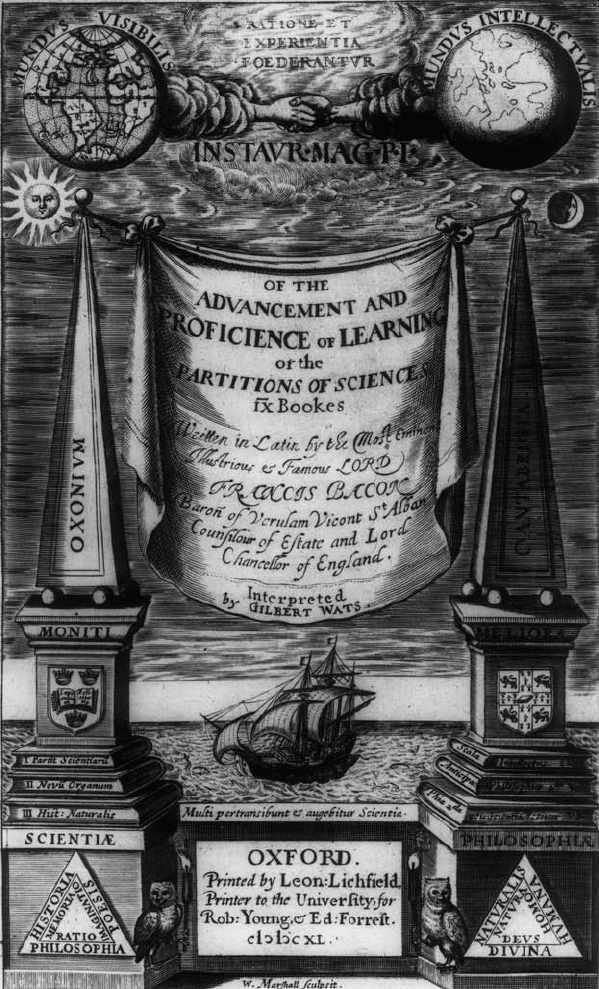
The title page of the Oxford edition of Bacon’s Advancement of Learning (1640)
27
SIXTEENTH-CENTURY PHILOSOPHY
but prose Wction, is treated only perfunctorily by Bacon: the kind of poesy
he most admires is a story with a moral message, like Aesop’s fables. But
history and philosophy are addressed at length, and given further subdivi-
sions.
The most important parts of history are Natural and Civil. ‘Civil history’
is what we would now adays call history: Bacon himself contributed to it a
narrative of the reign of Henry VII. ‘Natural history’ is a discipline of broad
scope with three subdivisions: the history of ‘nature in course, of nature
erring or varying, and of nature altered or wrought’. It will include, then,
treatises of natural science, records of extraordinary marvels, and manuals
of technology. Bacon’s own contribution to natural history consisted
of two compilations of research material, a History of the Winds, and a
History of Life and Death. The ‘history of nature erring’, he thought,
should include records of superstitious narrations of sorceries and
witchcrafts, in order to ascertain how far eVects attributed to superstition
could be attributed to natural causes. But the third subdivision, ‘history
mechanical’, was the most fundamental and useful for natural philosophy,
whose value, according to Bacon, was above all in its practical application
and utility.
In his classiWcation of philosophy, Bacon Wrst puts on one side ‘divine
philosophy’ or natural theology: it suYces, he tells us, to refute atheism
but not to inform religion. He then divides philosophy into natural and
human. Natural philosophy may be speculative or operative: the specula-
tive kind includes both physics and metaphysics, and the operative kind
includes both mechanics and magic. Mechanics is the practical application
of physics, and magic is the practical applicati on of metaphysics.
This brisk and provocative anatomy of philosophy is not as neat as it
seems, and many of the names Bacon gives to the various disciplines are
employed in idiosyncratic ways. His ‘natural magic’, he tells us, must be
sharply distinguished from the ‘credulous and superstitious conceits’ of
alchemy and astrology. It is not at all clear what he has in mind: the one
thing he seems to oVer as an example is the mariner’s compass. Why, we
may ask, is this a matter of ‘magic’ rather than ‘mechanics’?
An answer suggests itself when we read that physics deals with the
eYcient and material causes of things, while metaphysics deals with
the Wnal and formal causes. So the sail, which gives the boat its motion,
operates in the realm of physics, while the compass, which guides the boat’s
SIXTEENTH-CENTURY PHILOSOPHY
28
direction, operates in the realm of metaphysics. Bacon admits candidly that
he is using ‘metaphysics’ in a novel way. What others call metaphysics he
calls ‘Wrst philosophy’ or ‘summary philosophy’: it is a receptacle, he tells
us, for all the universal principles that are not exclusive to particular
disciplines. (An example is ‘If equals be added to unequals the result will
be unequal,’ an axiom which he believes applies in law as well as in
mathematics.)
But the distinction made between physics and metaphysics on the basis
of the Aristotelian four causes is itself misleading. Bacon’s scheme for
natural magic leaves no real room for teleology: ‘inquiry into Wnal causes’,
he tells us, ‘is sterile, and like a virgin consecrated to God, produces
nothing.’ And when he speaks of ‘forms’ he is not thinking of Aristotle’s
substantial forms—such as the form of a lion, or of water—because these,
he believes, are too varied and complicated to be discovered. Instead
of studying these, we should look rather for the simpler forms which go
into their composition, in the way that letters go to make up words. The
task of metaphysics is to investigate the simpler forms which correspond to
individual letters:
To enquire the forms of sense, of voluntary motion, of vegetation, of colours, of
gravity and levity, of density, of tenuity, of heat and of cold, and all other natures
and qualities, which like an alphabet are not many, and which the essences
(upheld by matter) of all creatures do now consist. (AL, 196)
Bacon’s elementary forms are obscure characters in comparison with the
mathematical shapes and symbols which Galileo declared to be the alpha-
bet in which the book of the world is written. But most probably when he
talked of forms he had in mind hidden material structures underlying the
overt appearance and behaviour of things.
So much for natural philosophy. Human philosophy, the other great
branch of the subject, has two parts, Bacon tells us, one which considers
‘man segregate’ and another which considers ‘man congregate’. The Wrst
part corresponds to a natomy, physiology, and psychology, and the second
embraces what would nowadays be called the social sciences. The detailed
subdivisions Bacon enumerates appear arbitrary and haphazard. The
sciences of the body include medicine, ‘cosmetic’, ‘athletic’, and the ‘Arts
Voluptuary’, which include practical joking. The study of the nature of the
soul is a matter for theology, but there is a human science which studies
SIXTEENTH-CENTURY PHILOSOPHY
29
the operations of the soul. These fall into two classes, one set belonging to
the understanding or reason, whose function is judgement, and the other
set belonging to the will or appetite, whose function is action or execution.
What of the imagination, which had a privileged place in Bacon’s initial
classiWcation of human faculties?
The Imagination is an agent or nuncius in both provinces, both the judicial and the
ministerial. For sense sendeth over to Imagination before Reason have judged: and
Reason sendeth over to Imagination before the Decree can be acted; for Imagin-
ation ever precedeth Voluntary Motion: saving that this Janus of Imagination hath
diVering faces; for the face towards Reason hath the print of Truth, but the face
towards Action hath the print of Good. (AL, 217)
But imagination is no mere servant of the other faculties, Bacon insists:
it can triumph over reason, and that is what happens in the case of
religious belief.
It is clear that Bacon envisioned the mind as a kind of internal society,
with the diVerent faculties enshrined in a constitution respecting the
separation of powers. When he comes to treat of the social sciences
themselves he oVers another threefold division, corresponding to associ-
ations for friendship, for business, and for government. Political theory is a
part of civil philo sophy, that branch of human philosophy that concerns
the beneWts that humans derive from living in society.
Having Wnished his classiWcation, Bacon can boast ‘I have made as it were
a small globe of the intellectual world’ (AL, 299). The various sciences
which appear in his voluminous catalogue are not all at similar stages of
development. Some, he thinks, have achieved a degree of perfection, but
others are deWcient, and some are almost non-existent. One of the most
deWcient is logic, and the defects of logic weaken other sciences also. The
problem is that logic lacks a theory of scientiWc discovery:
Like as the West-Indies had never been discovered if the use of the mariner’s needle
had not been Wrst discovered, though the one be vast regions and the other a small
motion; so it cannot be found strange if sciences be no further discovered if the art
itself of invention and discovery hath been passed over. (AL, 219).
Bacon set out to remedy this lack and to provide a compass to guide
scientiWc researchers. This was the task of his Novum Organum.
Bacon’s project of introducing discipline into research had a negative
and a positive component. The researcher’s Wrst, negative, task is to be on
SIXTEENTH-CENTURY PHILOSOPHY
30
his guard against the factors that can introduce bias into his observations.
Bacon lists four of these, a nd calls them ‘idols’ because they are fetishes
which can divert us from the pursuit of truth: there are the idols of the
tribe, the idols of the den, the idols of the marketplace, and the idols of
the theatre. The idols of the tribe are temptations endemic in the whole
human race, such as the tendency to judge things by superWcial appear-
ances, the tendency to go along with popular belief, and the tendency to
interpret nature anthropomorphically. The idols of the den, or cave, are
features of individual temperaments which hamper objectivity: some
people, for instance, are too conservative, others too ready to seize on
novelties. Each person has ‘a certain individual cavern of his own, which
breaks and distorts the light of nature’. The idols of the marketplace (or
perhaps ‘idols of the courts’— idola fori) are snares lurking in the language
we use, which contains meaningless, ambiguous, and ill-deWned words.
Finally the idols of the theatre are false systems of philoso phy which are no
more than stage plays, whether ‘sophistical’, like Aristotle’s, or ‘empirical’,
like contemporary alchemists, or ‘superstitious’ like the Neoplatonists who
confuse philosophy with theology.
The positive task of the researcher is induction, the discovery of scientiWc
laws by the systematic examination of particular cases. If this is not to
be rash generalization from inadequate sampling of nature, we need a
carefully schematized procedure, showing us how to mount gradually
from particular instances to axioms of gradually increasing generality.
Bacon oVers a series of detailed rules to guide this process:
Suppose that we have some phenomenon X and we wish to discover its true form
or explanation. We must Wrst make a table of presences—that is to say, we list the
items A, B, C, D . . . which are present when X is present. Then we make a table of
absences, listing items E, F, G, H . . . which are present when X is absent. Thirdly,
we make a table of degrees, recording that J, K, L, M . . . are present to a greater
degree when X is present to a greater degree, and present to a lesser degree when X
is present to a lesser degree.
This is only the preparatory step in the method. The real work of
induction comes when we start the process of eliminating candidates for
being the form of X. To be successful a candidate must be present in every
case occurring in the table of presences, and absent in every case occurring
in the table of absences. Bacon illustrates his method with the example of
SIXTEENTH-CENTURY PHILOSOPHY
31
heat. We list cases when heat is present (e.g. the rays of the sun and the
sparks of a Xint) and cases in which it is absent (e.g. in the rays of the moon
and the stars). Since light is present in cases listed in the table of absence, we
can eliminate light as being the form of heat. After some further elimina-
tive moves, and making use also of the table of degrees (e.g. that the more
exercise animals take the hotter they get), Bacon concludes that heat is a
special kind of motion (‘an expansive motion held in check and pushing its
way through tiny particles’).
Bacon never completed the series of guidelines that he set out to present
in the Novum Organum, and it cannot be said that his system adds up to a
‘logic of induction’. However, he did establish the important point that
negative instances are more signiWcant, in the process of establishing laws,
than positive ones. Twentieth-century philosophers have been willing to
give him c redit for being the Wrst person to point out that laws of nature
cannot be conclusively veriWed, but can be conclusively falsiWed.
Bacon’s insistence on the importance of precise and repeated observa-
tions went hand in hand with an appreciation that natural science could
make progress only by a massive cooperative endeavour. In the New
Atlantis, an unWnished fragment published posthumou sly, a ship’s crew
in the South Seas land on an island containing a remarkable institution
known as Salomon’s House. This turns out to be a research establish-
ment, where scientists work together to embody Bacon’s utilitarian ideal
of science as the extension of men’s power over nature for the better-
ment of the human race. Their projects include plans for telephones,
submarines, and aeroplanes. The president of the institute described its
purpose thus:
The End of our Foundation is the knowledge of Causes, and secret motions of
things, and the enlarging of the bound of Human Empire, to the eVecting of all
things possible. (B, 480)
Salomon’s House was a Utopian fantasy; but it was given a counterpart in
the real world when, thirty-Wve years after the New Atlantis, Bacon’s
compatriots of the next generation founded the Royal Society of London.
SIXTEENTH-CENTURY PHILOSOPHY
32

2
Descartes to Berkeley
Descartes
T
he seventeenth century, unlike the sixteenth century, was fertile in
the production of philosophers of genius. The man who is often
considered the father of modern philosophy is Rene
´
Descartes. He was
born in 1596, about the time when Shakespeare was writing Hamlet,ina
village in Touraine which is now called after him La-Haye-Descartes.
A sickly child, he was exempted at school from morning exercises and
acquired a lifelong habit of meditating in bed. From his eleventh to his
nineteenth year he studied classics and philosophy at the Jesuit college of
La Fle
`
che. He remained a Catholic throughout his life, but chose to spend
most of his adult life in Protestant Holland.
In 1616, having taken a degree in law at Poitiers, Descartes gave up his
studies for a while. In the wars of religion that divided Europe, he enlisted
in both camps. First, he was an unpaid volunteer in the army of the
Protestant Prince of Orange; later he served in the army of the Catholic
Duke Maximilian of Bavaria, who was then at war with the Palatine Elector
Frederick, son-in-law of King James I of Britain. After he left the army he
did not adopt a profession. Unlike the great philosophers of the Middle
Ages he was a layman in both the ecclesiastical and the academic sense. He
never lectured in a university, and he lived a private life as a gentleman of
means. He wrote his most famous work not in the Latin of the learned
world, but in good plain French, so that it could be understood, as he put
it, ‘even by women’.
While serving in the army, Descartes acquired a conviction that he had a
call to philosophy. He spent a winter’s day of 1619 huddled beside a stove,
engrossed in meditation. He conceived the idea of undertaking, single-
handed, a reform of human learning that would display all disciplines as
branches of a single wonderful science. His conviction of vocation was
reinforced when, that night, he had three dreams that he regarded as
prophetic. But it was not until some years later that he settled permanently
to philosophical studies.
From 1620 to 1625 he travelled in Germany, Holland, and Italy, and from
1625 to 1627 he mixed in society in Paris, gambling heavily and becoming
involved in a duel over a love aVair. His surviving early writings show his
interest in mechanical and mathematical problems, and include a brief
treatise on music. In 1627 he intervened impressively in the discussion of a
grand public lecture in Paris: a cardinal who was present exhorted him to
devote himself to the reform of philosophy.
A year later Descartes left for Holland, where he lived until 1649, shortly
before his death. He chose the country for its climate and its reputation for
tolerance: he looked forward to a life free from the distractions of the city
and from morning callers. He dwelt in thirteen diVerent houses during his
twenty-year sojourn and kept his address secret from all but close friends.
Amid Protestant surroundings, he continued to practise as a Catholic.
Descartes kept in touch with the learned world by letter. His principal
correspondent was a Franciscan friar, Father Marin Mersenne, who was the
centre of an erudite international network. Mersenne acted as Descartes’
literary agent, handling the publication of his works and keeping him
informed of recent scienti W c discoveries. Of the ten volumes of the stand-
ard edition of Descartes’ works, Wve are taken up by his letters, which are a
highly important source for the developmen t of his thought.
In Holland Descartes lived comfortably and quietly; he was not wholly
without company, and in 1635 he had an illegitimate daughter, Francine,
who lived only Wve years. He brought a few books with him from Paris,
including the Summa Theologiae of Thomas Aquinas. He claimed that he spent
very little time reading: he had no great admiration for classical languages
and he boasted that he had not opened a scholastic textbook once in
twenty years. When a stranger asked to see his library, he pointed to a half-
dissected calf. Besides purchasing carcasses from the butcher for dissection,
he ground his own lenses in order to make experiments in optics. He
trusted experiment rather than learning, but more than either he trusted
his own philosophical reXection.
DESCARTES TO BERKELEY
34
During his Wrst years in Holland his work was mainly mathematical and
physical. He laid the foundations of analytical geometry: the Cartesian
coordinates that every schoolchild learns about derive their name from the
Latin form of his surname, Cartesius. He studied refraction and pro-
pounded the law of sines, the result of careful theoretical and experimental
work on the nature of light and of the eye. He also worked on meteor-
ology, trying to ascertain the true nature of rainbows.
By 1632 Descartes had in mind to publish a substantial volume which
would explain ‘the nature of light, the sun and the Wxed stars which emit it;
the heavens which transmit it; the planets, the comets and the earth which
reXect it; all the terrestrial bodies which are either coloured or transparent
or lu minous; and Man its spectator’. The system that it propounded was a
heliocentric one: the earth was a planet, moving around the sun.
The treatise was entitled The World and it was ready for the press when
Descartes learned that Galileo had been condemned for upholding the
Copernican system. Anxious to avoid conXict with ecclesiastical authority,
he returned the treatise to his desk. It was never published in his lifetime,
although much of its material was incorporated twelve years later in a
textbook called Principles of Philosophy.
Instead of publishing his system, in 1637 Descartes decided to make public
‘some specimens of his method’: his dioptrics, his geometry, and his meteor-
olgy. He prefaced them with ‘a discourse on the right way to use one’s reason
and seek truth in the sciences’. The three scientiWc treatises are nowadays
read only by specialists in the history of science, but the Discourse on Method has
a claim to be the most popular of all philosophical classics. In signiWcance it
compares with Plato’s Republic and with Kant’s Critique of Pure Reason, but it has
the advantage of being much briefer and more readable than either.
Among other things, the Discourse is a witty and urbane piece of auto-
biography, as the following extracts illustrate:
Good sense is the most fairly distributed thing in the world; for everyone thinks
himself so well supplied with it, that even those who are hardest to satisfy in every
other way do not usually desire more of it than they already have. . . .
As soon as my age allowed me to pass from under the control of my instructors,
I entirely abandoned the study of letters, and resolved not to seek after any science
but what might be found within myself or in the great book of the world. . . .
I spent nine years in roaming about the world, aiming to be a spectator rather than
an actor in all the comedies of life.
DESCARTES TO BERKELEY
35