
Kenny Anthony. The Rise of Modern Philosophy: A New History of Western Philosophy. Volume 3
Подождите немного. Документ загружается.

In the Aristotelian system it was the forms and essences that provided
the element of stability in the Xux of phenomena—the stability that was
necessary for there to be universally valid scientiWc knowledge. Having
rejected essences and forms, Descartes needed a new foundation for
physics, and he found it in the eternal truths. If there are no substantial
forms, then what connects one moment of a thing’s history to another is
nothing but the immutable will of God (AT VII.80; AT XI.37).
God has laid down the laws of nature, enshrined in the eternal truths.
These include not only the laws of logic and mathematics, but also the law
of inertia and other laws of motion. Consequently they provide the
foundations of mechanistic physics. But if they are dependent on God’s
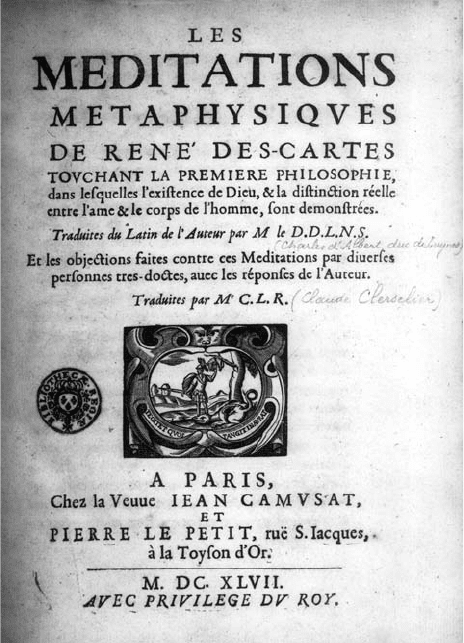
The title page of the
first French edition
of Descartes’
Meditations
METAPHYSICS
186
unfettered will, how do we know that they will not change? There can, of
course, be no question of God changing his mind; but might he not have
decreed from all eternity that at a certain point in time the laws should
change? To rule out that possibility, Descartes once again appeals to the
notion that God is no deceiver. The veracity of God, in his post-Aristotelian
system, is necessary to establish the permanent validity of these clearly and
distinctly perceived truths.
The doctrine of the creation of the eternal truths was, as we have said,
from one point of view a gigantic innovation. But it can also be looked at as
the culmination of a philosophical development which had been taking
place throughout the later Middle Ages—the gradual extension of the
scope of divine omnipotence. In respect to the determination of moral
truths, for instance, Scotus and Ockham had allotted to the divine will a
much freer scope than Aquin as had done. In the religio us sphere this
tendency had been taken to an extreme by Jean Calvin’s doctrine of the
absolute sovereignty of God, who freely and unaccountably predestines
humans to salvation or damnation. Descartes’ extension of divine freedom
into the realm of logic and mathematics might be seen as the philosophical
counterpart of Calvinist absolutism.
Three Notions of Substance
In the Aristotelian system, the notion of substance was all important:
all qualities and other properties were accidents belonging to substances,
and only substances were real and independent. Descartes, too, assigned
to substance a fundamental role. ‘Nothing has no qualities or properties,’
he wrote, ‘so that where we perceive some there must necessarily be a
thing or substance on which they depend.’ That was a step in the argument
from cogito to sum, to the existence of the Wrst discoverable substance,
Descartes’ own self. In his Principles he oVered a deWnition of substance
as ‘a thing which so exists that it needs no other thing in order to
exist’. Strictly speaking, he observed, only God counted as a substance
by this deWnition, but created substances could be said to be things which
need only the concurrence of God in order to exist (AT VIII.24; CSMK
I.210).
METAPHYSICS
187
For the Aristotelians, there were many diVerent kinds of substances,
each speciWed by a particular substantial form—humans by the form of
humanity and so on. According to Descartes there were no such things as
substantial forms, and there were only two kinds of substance: mind, or
thinking substance, and body, or extended substance. These did not have
substantial forms, but they did have essences: the essence of mind was
thought and the essence of body was extension. How particular substances
of these two kinds are individuated remains unclear in Descartes’ system,
and in the case of body he sometimes writes as if there was only one single,
cosmic, substance, of which the objects we encounter are simply local
fragments engaging in local transactions (AT VIII.54, 61; CSMK I.233, 240).
The Aristotelians believed that substances were visible and tangible
entities, accessible to the senses, even though it took the intellect to
work out the nature of each substance. When I look at a piece of gold,
I am genuinely seeing a substance, though only science can tell me what
gold really is. Descartes took a diVerent view. ‘We do not have immediate
awareness of substances,’ he wrote in the Fourth Replies , ‘rather, from
the mere fact that we perceive certain forms or attributes, which must
inhere in something in order to have existence, we name the thing in
which they exist a substance’ (AT VII. 222; CSMK II.156). So substances are
not perceptible by the senses—not only their underlying nature, but their
very existence, is something to be established only by intellectual inference.
Locke took much further the thesis that substances are imperceptible.
The notion of substance, he says, arises from our observation that certain
ideas constantly go together. If, to some idea of substance in general, we
join ‘the simple Idea of a certain dull whitish colour, with certain degrees of
Weight, Hardness, Ductility and Fusibility, we have the Idea of Lead’. The
idea of any particular kind of substance always contains the notion of
substance in general; but this is not a real idea, certainly not a clear and
distinct one, but only a ‘supposition of we know not what support of such
qualities which are capable of producing simple Ideas in us; which are
commonly called Accidents’ (E, 295).
The operative part of our idea of a distinct kind of substance, then,
will be a complex idea made up of a number of simple ones. The idea
of the sun, for instance, is ‘an aggregate of those several simple Ideas,
Bright, Hot, Roundish, having a constant regular motion, at a certain
distance from us, and, perhaps some other’ (E, 299). The ideas of kinds of
METAPHYSICS
188
substance such as horse or gold are called ‘sortal ideas’: collections of simple
co-occurent ideas plus the confused idea of the unknown substratum.
Particular substances are concrete individuals belonging to these diVerent
sorts or species.
The substances of diVerent sorts have essences: to be a man, or to be an
oak, is to have the essence of man or the essence of oak. But there are, for
Locke, two kinds of essence: real and nominal. The real essence is: ‘The
real, internal, but generally in substances, unknown constitution of things,
whereon their discoverable Qualities depend.’ The nominal essence is the
collection of simple ideas that have been assembled and attached to names
in order to rank things into sorts or species. The nominal essence gives the
right to bear a particular name, and nominal essences are largely the
arbitrary creation of human language.
In the case of a triangle, the real essence and the nominal essence (three-
sided W gure) are the same. Not so in the case of substances. Locke considers
the gold ring on his Wnger:
It is the real constitution of its insensible Parts, on which depend all those
Properties of Colour, Weight, Fusibility, Fixedness etc. which are to be found in
it. Which Constitution we know not; and so having no particular Idea of it, have
no Name that is the sign of it. But yet it is its Colour, Weight, Fusibility and
Fixedness etc. which makes it to be Gold, or gives it a right to that Name, which is
therefore its nominal Essence. Since nothing can be called Gold, but what has a
conformity of Qualities to that abstract complex Idea, to which that Name is
annexed. (E, 419)
The real essences of things, like the hidden constitution of gold, are
generally unknown to us. Even in the case of a human being we have no
more idea of his real essence than a peasant has of the wheels and springs
which make a church clock strike (E 440).
Essences belong to sorts, not individuals. Individuals have neither real
nor nominal essences. ‘Nothing I have’, Locke says, ‘ is essential to me. An
accident or Disease, may very much alter my Colour, or Shape; a Fever, or
Fall, may take away my Reason, or Memory, or both; and an Apoplexy
leave neither Sense, nor Understanding no nor Life’ (E, 440). The real
Locke, it seems to follow, is the underlying, impenetrable, substratum of
various properties; something quite other than a human being.
Locke maintains that substance itself is indescribable because it is proper-
tyless. But it seems incredible that someone should argue that substance
METAPHYSICS
189
has no properties precisely because it is what has the properties. The thesis
that individuals have no nominal essence means that one could identify an
individual, A, and then go on to inquire whether that individual did or did
not have the properties which would qualify it to be called ‘man’ or
‘mountain’ or ‘moon’. But how is a propertyless individual to be identiWed
in the Wrst place?
In the Aristotelian tradition there was no such thing as a propertyless
substance, a something that could be identiWed as a particular individual
without reference to any sortal. Fido is an identiWable individual only so long
as he remains a dog, so long as the sortal ‘dog’ can be truly applied to him. We
cannot ask whether A is the same indidividual as B without asking whether A is
the same individual F as B, where ‘F’ holds a place for some sortal: ‘man’,
‘mountain’, or whatever. Locke’s confused doctrine of substance led him into
insoluble diYculties about identity and individuation: we shall meet them
again when we come, in Chapter 8, to consider the topic of personal identity.
Single Necessary Substance
While Locke, in England, evacuated the notion of substance of any sign-
iWcant content, Spinoza, in Holland, had made it the basis of his meta-
physical system. One of the Wrst deWnitions in the Ethics reads: ‘By substance
I mean that which is in itself, and is conceived through itself: that of which
a concept can be formed independently of the concept of anything else’
(Eth, 1). Descartes had deWned substance as ‘that which requires nothing
but itself in order to exist’. Such a deWnition, Spinoza thought, could apply
at most to God; Wnite minds and bodies, which Descartes counted as
substances, needed to be created and conserved by God in order to exist.
Spinoza, like Descartes, links the notion of substance with the notions of
attribute and of mode. An attribute is a property conceived to be essential
to a substance; a mode is a property only conceivable by reference to a
substance. Armed with these deWnitions, Spinoza proves that there can be
at most one substance of a given kind. If there are two or more distinct
substances, they must be distinguished from each other either by their
attributes or by their modes. They cannot be distinguished by their modes,
because substance is prior to mode and therefore any distinction between
modes must follow, and cannot create, a distinction between substances.
METAPHYSICS
190
They must therefore be distinguished by their attributes, which they could
not be if there were two substances having an attribute in common.
Moreover, no substance can cause any other substance, because an eVect
must have something in common with its cause, and we have just shown
that two substances would have to be totally diVerent in kind.
The seventh proposition of Book One of the Ethics is ‘It belongs to the
nature of substance to exist’, and its proof runs as follows:
A substance cannot be produced by anything other than itself; it must therefore be
its own cause—that is, its essence necessarily involves existence, or it belongs to its
nature to exist. (Eth,4)
So far, the word ‘God’ has not been mentioned in the Ethics, except in the
introductory deWnition where it is said to mean inWnite substance. By now,
however, every reader must suspect where Spinoza is leading him. In the
very next proposition we are told that any substance is necessarily inWnite.
At this point one may feel inclined to object that now that substance has
been given such august properties, we cannot take it for granted that there
are any substances in existence at all. Spinoza would agree: the Wrst few
propositions of the Ethics are designed to show that at most one substance
exists. Only at proposition 11 does he move on to show that at least one
substance exists, namely, God.
Spinoza’s treatment of God’s existence and nature will be considered in
detail in Chapter 10. Here we are concerned with the consequ ences that
he draws for the metaphysics of Wnite beings. Mind and matter are not
substances, for if they were they would present limitations on God and
God would not be, as he is, in W nite. Everything that there is is in God,
and without God nothing else can exist or be conceived. Thought and exten-
sion, the deWning characteristics of mind and matter, are in fact attributes
of God himself, so that God is both a thinking and an extended thing: he is
mental and he is bodily (Eth, 33). Individual minds and bodies are modes, or
particular conWgurations, of the divine attributes of thought and extension.
It is thus that the idea of any individual thing involves the thought of the
eternal and inWnite essence of God.
All Spinoza’s contemporaries agreed that Wnite substances were depen-
dent on God as their Wrst cause. What Spinoza does is to represent the
relationship between God and W nite substances not in terms of physical
cause and eVect, but in the logical terms of subject and predicate. Any
METAPHYSICS
191
apparent statement about a Wnite substance is in reality a predication about
God: the proper way of referring to creatures like us is to use not a noun
but an adjective. Indeed the word ‘creature’ is not really in place: it suggests
a distinction between a creator and what he creates, whereas for Spinoza
there is no such distinction between God and nature.
The key element in Spinoza’s monism is not the doctrine that there is
only one substance; it is the collapsing of any distinction between entail-
ment and causation. There is just a single relation of consequence: it is this
which unites an eVect with its causes and a conclusion with its premiss.
Smoke follows from Wre in just the same way as a theorem follows from
axioms. The laws of nature, therefore, are as necessary and exceptionless as
the laws of logic. From any given cause there necessarily follows its eVect,
and everything is ruled by absolute logical necessity. For most other
thinkers causes had to be distinct from their eVects. Not so for Spinoza,
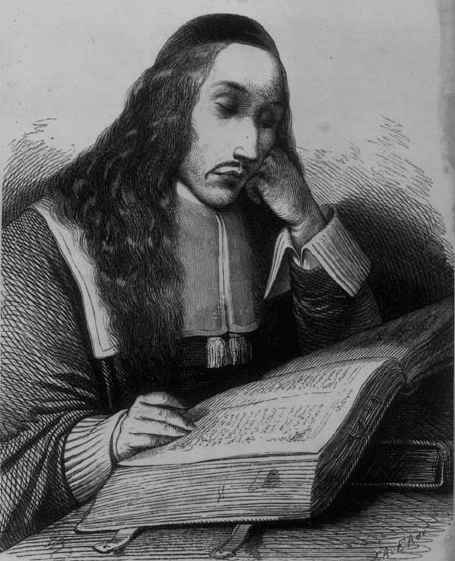
This engraving of
Spinoza makes him
appear a more
observant student of
the Bible than he
really was
METAPHYSICS
192
given his identiWcation of causation with entailment. Just as a proposition
entails itself, God is His own cause and He is the immanent, not the
transient, cause of all things.
This system is extremely diYcult to understand, and may well be
ultimately incomprehensible. It is more proWtable to follow another line
of thought which Spinoza oVers in order to explain the structure of the
universe. Our bodies, he remarks, are composed of many diVerent parts,
varying in kind from each other; the parts may change and vary, and yet
each individual retains its nature and identity. ‘We may easily proceed thus
to inWnity, and conceive the whole of nature as one individual, whose
parts, that is, all bodies, vary in inWnite ways, without any change in the
individual as a whole’ (Eth, 43). This invites us to see the relationship
between W nite bein gs and God not in terms of eVect and cause but in
terms of part and whole.
We often talk of parts of our body as performing actions and undergoing
changes—but it is not too diYcult to see that this is an improper way of
talking. It is not my eyes which see, or my liver which puriWes my blood.
My eyes and liver do not have a life of their own, and such activities are
activities of my whole organism. Philosophers from Aristotle onwards have
pointed out that it is more correct to say that I see with my eyes and that
my body uses my liver to purify my blood. If we follow Spinoza’s hint we
will see that he is inviting us to see nature as a single organic whole, of
which each of us is a particle and an instrument.
This vision of nature as a single whole, a uniWed system containing
within itself the explanation of all of itself, is found attractive by many
people. Many, too, are willing to follow Spinoza in concluding that if the
universe contains its own explanation, then everything that happens is
determined, and there is no possibility of any sequence of events other than
the actual one. ‘In nature,’ Spinoza says, ‘there is nothing contingent;
everything is determined, by the necessity of the divine nature, to exist and
operate in a certain manner’ (Eth,20).
Making Room for Contingency
Of all Spinoza’s contemporaries, the philosopher closest to him was Male-
branche. Like Spinoza, Malebranche thought that the connection between a
METAPHYSICS
193
cause and its eVect must be a necessary one. ‘A true cause as I understand it’,
he wrote, ‘is one such that the mind perceives a necessary connection
between it and its eVects’ (RdeV6.2, 3). Many people, having read Hume
on causation, believe that before his time it was a unanimous philosophical
opinion that there must be a necessary connection between cause and eVect.
But, in fact, Spinoza and Malebranche were unusual in treating the follow-
ing of an eVect from a cause as being on a par with the following of a
conclusion from a premiss. Aquinas, for instance, had insisted that rela-
tionship to a cause is no part of the deWnition of the thing that is caused. He
considers an argument purporting to show that things can come into
existence without a cause. The argument goes like this:
Nothing prevents a thing’s being found without what does not belong to its
concept, e.g. a man without whiteness; but the relation of caused to cause does not
seem to be part of the concept of existent things: for they can be understood
without that. Therefore they can exist without that. (ST. 1a, 44. 1)
Aquinas does not accept that things can come into existence without a
cause, but he does not Wnd fault with the minor premiss of the argument.
For Spinoza and Malebranche, on the other hand, the necessary
connection between cause and eVect was indeed a conceptual one. In
laying this down as a condition for a true causal relation, both of them
realized that they were making it more di Ycult to Wnd in the world
examples of genuine causal relations. Parcels of matter in motion could
not be genuine causes. A body could not move itself, because the concept
of body did not include that of motion, and no body could move another,
for there was no logical relationship between motion in one body and
motion in another body. Both Spinoza and Malebranche, in fact, came to
the conclusion that there is only one genuine cause operating in the
physical world, and that is God.
Malebranche’s position, however, was more complicated than Spinoza’s.
For Spinoza, God was the only cause, not just in the physical world, but in
the universe as a whole (since for him mind and extension are two aspects
of the same entity). Again, for Spinoza, God is not just the only cause in the
universe, but also the only substance, and his existence and his operation
are all matters of logical necesssity.
Malebranche, on the other hand, allows that in addition to God and the
material world there are Wnite spirits, which are genuine agents and enjoy a
METAPHYSICS
194
degree of freedom. Human beings, for instance, can direct their thoughts
and desires in one direction rather than another. But created spirits
are incapable of causing any eVe ct in the natural world. I cannot even
move my own arm. It is true that it moves when I will; however, I am not,
he says, the natural cause of this movement, but only its occas ional cause.
That is to say, my internal act of willing provides the occasion for God to
cause the movement of my arm in the external world. What goes for parts
of my body goes a fortiori for other material objects: ‘There is a contradiction
in saying that you can move your armchair ...No power can transport it
where God does not transport it or place it where God does not place it’
(EM, 7, 15).
For Malebranche, unlike Spinoza, there is contingency in the physical
universe, therefore, but it derives only from the eternal free decree of God.
God wills without any change or succession all that will take place in
the course of time. He is not (unlike Spinoza’s God) necessitated to will the
course of natural history, but other than Him there are no other causal
agents to introduce contingency into the material world.
Leibniz took issue here with Malebranche and Spinoza: in order to allow
for divine and human freedom he wished to make room for contingency
throughout the universe. In the Monadology Leibniz makes a distinction
between truths of reason and truths of fact. Truths of reason are necessary
and their opposite is impo ssible; truths of fact are contingent and their
opposite is possible. Truths of reason are ascertained by a logical analysis
parallel to the mathematicians’ derivation of theorems from axioms and
deWnitions; their ultimate basis is the principle of non-contradiction.
Truths of fact are based on a diVerent principle: the principle that nothing
is the case without there being a suYcient reason why it should be thus
rather than otherwise (G, 6, 612–13).
Leibniz attached great importance to the principle of suYcient reason,
which was his own innovation. It is not immediately obvious how to
reconcile the statement that truths of fact are contingent with the state-
ment that they rest on the principle of suYcient reason. We discover that
consistency is purchased at the price of a new, and minimalist, account of
contingency.
On the face of it, human beings seem to have some properties that are
necessary and others that are contingent. Antoine is necessarily human,
but it is a contingent matter whether he is a bachelor or is married. It was
METAPHYSICS
195