
Kenny Anthony. The Rise of Modern Philosophy: A New History of Western Philosophy. Volume 3
Подождите немного. Документ загружается.

relation of cause and eVect totally depends’ (T, 173). Because ma ny diVer-
ent eVects are logically conceivable as arising from a particular cause, only
experience leads us to expect the actual one. But on what basis?
Hume oVers three rules by which to judge of causes and eVects:
1. The cause and eVect must be contiguous in space and time.
2. The cause must be prior to the eVect.
3. There must be a constant union betwixt the cause and the eVect.
(T, 173)
The third rule is the most important one: ‘Contiguity and succession are
not suYcient to make us pronounce any two objects to be cause and eVect,
unless we perceive that these two relations are preserved in several
instances.’ But how does this take us further? If the causal relationship
was not to be detected in a single instance, how can it be detected in
repeated instances?
Hume’s answer is that the observation of the constant conjunction
produces a new impression in the mind. Once we have observed a suYcient
number of instances of a B following an A, we feel a determination, when next
we encounter an A, to pass on to B. This is the origin of the idea of necessary
connection which was expressed in the third of the traditional axioms.
Necessity is ‘nothing but an internal impression of the mind, or a determin-
ation to carry our thoughts from one object to another’. This account enables
Hume to claim that once again the thesis is veriWed that there is no idea
without an antecedent impression. The felt expectation of the e Vect when
the cause presents itself, an impression produced by customary conjunction,
is the impression from which the idea of necessary connection is derived.
Hume sums up his discussion by oVering two deWnitions of causation.
The Wrst is this: a cause is ‘an object precedent and contiguous to another,
and where all the objects resembling the former are placed in a like relation
of priority and contiguity to those objects that resemble the latter’. In this
deWnition nothing is said about necessary connection, and no reference is
made to the activity of the mind. Accordingly, we are oVered a second
deWnition that makes the philosophical analysis more explicit. A cause is
‘an object precedent and contiguous to another, and so united with it in
the imagination that the idea of the one determines the mind to form the
idea of the other, and the impression of the one to form a more lively idea
of the other’ (T, 170, 172).
METAPHYSICS
206
There are problems with both these deWnitions. Take the second one
Wrst. The mind, we are told, is ‘determined’ to form one idea by the
presence of another idea. Is there not a circularity here, since ‘determin-
ation’ is not very diVerent from ‘causation’? Remember that Hume’s theory
of necessary connection is supposed to apply to moral necessity as well as
to natural necessity, to mental as well as to physical causation. If we go
back to the Wrst deWnition, we need to look more closely at the notion of
resemblance. If we took Hume’s deWnition literally we would have to deny
such things as that my young son’s white mouse was the cause of the
disappearance of that piece of cheese in his cage; for all white things
resemble my mouse, but not all white things cause cheese to disappear.
It must be doubtful whether the notion of resemblance could be appropri-
ately reWned (e.g. by reference to natural kinds) without some tacit
reference to causal concepts.
The Response of Kant
Hume’s account of causation deserves, and has received, intense philo-
sophical scrutiny. Kant attacked the idea that temporal succession could be
used to deWne causality; rather, we make use of causal notions in order to
determine temporal sequence. More recently it has been questioned
whether a causeless beginning of existence is conceivable: here, too, it is
arguable that we use causal notions in order to determine when things
begin.7 Nonetheless, Hume introduced a completely new approach to the
philosophical discussion of causation, and the agenda for that discussion
remains to this day the one that he set.
Kant’s response to Hume occurs in the system of principles in the
Critique of Pure Reason, in a section unhelpfully entitled ‘Analogies of
Experience’. This section sets out to establish the followin g thesis: experi-
ence is only possible if necessary connections are to be found among
our perceptions. There are three stages in the proof, which are called by
Kant the Wrst, second, and third analogies. The Wrst two are as follows: (a) If I
am to have experience at all I must have experience of an objective realm,
7 See G. E. M. Anscombe, ‘Times, Beginnings and Causes’, in Metaphysics and the Philosophy of
Mind, pp. 148 – 62.
METAPHYSICS
207
and this must contain enduring substances; (b) If I am to have an experience
of an objective realm, I must have experience of causally ordered substances.
Each of these stages takes oV from reXection on our awareness of time: time
considered Wrst as duration, and then as succession. The third anal ogy,
which appears as something of an appendix to the argument oVered in the
Wrst two, arises from a consideration of coexistence in time. Distinct objects
which exist at the same time as each other must coexist in space, and if they
do so they must form a system of mutual interaction.
Kant begins by pointing out that time itself cannot be perceived. In a
momentary sensation considered as an independent atom of experience,
there is nothing to show when it occurs, or whether it occurs before or
after any other given inner event. We can only be aware of time, then, if we
can relate such phenomena to some permanent substratum. Moreover, if
there is to be genuine change, as opposed to mere succession, there has to
be something that is Wrst one thing and then another. But this permanent
element cannot be supplied by our experience, which is itself in constan t
Xux; it must therefore be supplied by something objective, which we may
call ‘substance’. ‘All existence in time and all change in time have to be
viewed simply as a mode of the existence of something that remains and
persists’ (A, 184).
The conclusion of the Wrst analogy is not altogether clear. Does Kant
think that he has shown that there must be one single permanent thing
behind the Xux of experience—something such as an everlasting quantity
of conserved matter? Or is his conclusion simply that there must be at least
some permanent things, objective entities with non-momentary duration,
such as we commonly take rocks and trees to be? Only the latter, weaker,
conclusion is necessary in order to refute empiricist atomism.
The second analogy is based on a simple observation, whose signiW cance
Kant was the Wrst philosopher to see. If I stand still and watch a ship
moving down a river I have a succession of diVerent views: Wrst of the
ship upstream, then of it downstream, and so on. But, equally, if I look at a
house, there will be a certain succession in my experiences: Wrst, perhaps,
I look at the roof, then at the upper and lower Xoors, and Wnally at the
basement. What is it that distinguishes between a merely subjective suc-
cession of phenomena (the various glimpses of the house) and an objective
observation of a change (the motion of the ship downstream)? In the one
case, but not the other, it would be possible for me at will to reverse the
METAPHYSICS
208
order of perceptions. But there is no basis for making the distinction except
some necessary causal regularit y:
Let us suppose that there is an event which has nothing preceding it from which it
follows according to a rule. All succession in perception would then be only in the
apprehension, that is would be merely subjective, and there would be no way to
determine which perceptions really came Wrst and which came later. We should
then have only a play of impressions relating to no object and it would be
impossible in our perceptions to make temporal distinctions between one phe-
nomenon and another. (A, 194)
This shows that there is something deeply wrong with Hume’s idea that
we Wrst perceive temporal succession between events, and then go on to
regard one as cause and one as eVect. Matters are the other way round:
without relationships between cause and eVect we cannot establish order in
time. Even if we could, Kant goes on, bare temporal succession is insuY-
cient to account for causality, because cause and eVect may be simultan-
eous. Augustine had long ago said that a foot causes a footprint, not the
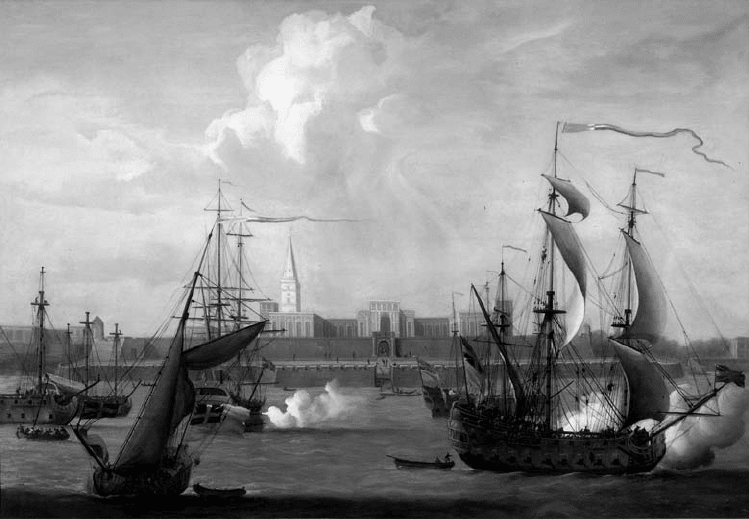
In this eighteenth-century picture of Fort William, Calcutta we can easily decide what is stationary
and what is moving. But what is it, Kant asks, that tells us this?
METAPHYSICS
209
other way round, and Kant echoes him by saying that a ball laid on a
stuVed cushion m akes a hollow as soon as it is laid on it, yet the ball is the
cause and the hollow is the eVect. We know this because every such ball
makes a dent, but not every such hollow contains a ball.
The third analogy starts from the same point as the second, but moves
in the opposite direction:
I can direct my perception Wrst to the moon and then to the earth, or, conversely,
Wrst to the earth and then to the moon; and because the perceptions of these
objects can follow each other in either order I say that they are coexistent. (B, 258)
But nothing in either perception tells me that the order between them
can be reversed, that is, that they coexist with each other. ‘Thus,’ Kant
concludes, perhaps too swiftly, ‘the coexistence of substances in space
cannot be known in experience save on the assumption of their reciprocal
interaction’ (B, 258).
Whatever criticisms may be made of details of Kant’s analogies, there is no
doubt that they establish that the relation between time and causation is
much more complicated than Hume imagined, and that Berkeley’s abolition
of the notion of substance demolishes along with it the ordered sequence of
phenomena, held out by virtue of his idealism as the reality of the world.
Whereas Kant, in The Critique of Pure Reason, tried to show the futility of
claims to knowledge divorced from the conditioned world of experience,
Hegel, especially in Th e Phenomenology of Spirit, tried to establish the authen-
ticity of a metaphysics which would provide unconditioned knowledge of
the absolute. In one sense, Hegel’s idealism marks the high point of
metaphysical speculation, and opponents of metaphysics have often
chosen gobbets of his text as examples to illustrate the necessary obscurity
and futility of any such enterprise. Yet it is surprisingly diYcult to select
and present passages from his writings which display insights relevant to
the topics that have been the concerns of this chapter. This is not because
Hegel lacked genius; it is because of the holism that is the dominant
characteristic of his thought. At every level, Hegel maintained, parts can
only be understood as parts of a whole. We can have no real knowledge
even of the smallest item unless we understand its relationship to the
entire universe. There is no truth short of the whole truth. Some of his
writings can be quarried for nuggets of golden insight, but his metaphysical
system must either be taken as a whole or passed by.
METAPHYSICS
210
The period between Descartes and Hegel was the great age of metap hys-
ical system-building. In the medieval period there were many gifted meta-
physicians, but they did not think of themselves as creating a new system;
rather, they oVered piecemeal improvements to a system already given by
the teaching of the Church and the genius of Aristotle. Descartes, Spinoza,
Kant, and Hegel, on the other hand, saw themselves as setting out, for the
Wrst time, a complete system to harmonize all the fundamental truths that
could be known. It cannot be said that any of them succeeded in this
gigantic task; but there is much to be learnt from their heroic failures.
In the nineteenth and twentieth centuries, when Western philosophy
split into conXicting traditions on the European continent and in the
anglophone world, one tradition adopted the medieval pattern and the
other followed the lead of the early modern metaphysicians. In Germany
and France, philosophers continued to see it as their task to create a new
system which would supersede that of their predecessors. In England and
the United States, most philosophers contented themselves with the
attempt to clarify or amend particular elements within a framework
given us by the work of the natural scientists and the language of our
everyday lives. But many philosophers have resisted being judged by either
paradigm; and the best way to avoid being obsessed with either is a study of
philosophy’s history over the long term.
METAPHYSICS
211

7
Mind and Soul
Descartes on Mind
T
he area of philosophy that underwent the most signiWcant develop-
ment in the early modern period was the philosophy of mind. This
was due above all to the work of Descartes. Whereas Cartesian physics had a
short and inglorious life, Cartesian psychology was widely adopted and to
this day its inXuence remains powerful in the thinking of many who have
never read his work or who explicitly reject his system.
Descartes redrew the boundaries between mind and body, and intro-
duced a new way of characterizing the mental. Since his time it has been
natural for philosophers and scientists to structure psychology in a way
quite diVerent from that employed by his Aristotelian predecessors in the
Middle Ages and the Renaissance.1 This has aVected even everyday thinking
about human nature and about the natural world.
The Aristotelians regarded mind as the faculty, or set of faculties, that
mark oV human beings from other animals. Dumb animals share with us
certain abilities and activities: dogs, cows, and pigs can all, like us, see and
hear and feel; they have in common with us the faculty or faculties of
sensation. But only human beings can think abstract thoughts and take
rational decisions: they are set oV from other animals by the possession of
intellect and will. It was these two faculties which, for the Aristotelians,
essentially constituted the mind. Intellectual activity was in a particular
sense immaterial, whereas sensation was impossible without a material
body.
1 See vol. II, Ch. 8.
For Descartes and those who followed him, the boundary between mind
and matter was set elsewhere. It was consciousness, not intelligence or
rationality, that was the deWning criterion of the mental: the mind is the
realm of whatever is accessible to introspection. So the mind included not
only human understanding and willing, but also human seeing, hearing,
feeling, pain, and pleasure. Every form of human experience, according
to Descartes, included an element that was spiritual rather than material,
a phenomenal component that was no more than contingently connected
with bodily causes, expressions, and mechanisms.
Descartes, like his Aristotelian predecessors, believed that the mind was
what distinguished human beings from other animals; but he did so for quite
diVerent reasons. For the Aristotelians, the mind was restricted to the
intellectual soul, and this was something that only humans possessed. For
Descartes, mind extends also to sensation, but only humans had genuine
sensation. The bodily machinery that accompanies sensation in human
beings may occur also in animal bodies, but in an animal a phenomenon
like pain is a purely mechanical event, unaccompanied by any consciousness.
Not many people have followed Descartes in regarding animals as mere
machines, but there has been very widespread acceptance of his substitution
of consciousness in place of rationality as the deWning characteristic of the
mental. This has the consequence of making the mind appear a specially
private place. The intellectual capacities characteristic of language-users are
not marked by any special privacy: another person may know better than I
do whether I understand quantum physics or am motivated by ambition.
On the other hand, if I want to know what experiences someone is having, I
have to give his utterances a special status. If you tell me what you seem to
see or hear, or what you are imagining or saying to yourself, what you say
cannot be mistaken. Of course it need not be true—you may be lying, or
misunderstand the words you are using—but your utterance cannot be
erroneous. Experiences, thus, have a certain property of indubitability, and
it was this property that Descartes took as the essential feature of thou ght,
and used as the foundation of his epistemological system.2
To see the way in which Descartes eVects this revolutionary change, we
need to go back to the second Meditation. Having proved to his own
satisfaction that he exists, Descartes goes on to ask: ‘What am I, this I
2 See above, Ch. 4.
MIND AND SOUL
213
whom I know to exist?’ The immediate answer is that I am a thing that
thinks (res cogitans). ‘What is a thing that thinks? It is a thing that doubts,
understands, conceives, a Yrms, denies, wills, refuses, which also imagines
and feels’ (AT VII.28; CSMK II.19). As always in Descartes ‘thought’ is to be
understood broadly: thinking is not always to think that something or
other, and not only intellectual meditation but also volition, sensation,
and emotion count as thoughts. No previous author had used the word
with such a wide extension, but Descartes did not believe that he was
altering the sense of the word. He applied it to unusual items because he
believed that they poss essed the feature which was the most important
characteristic of the usual items, namely, immediate consciousness. ‘I use
this term to include everything that is within us in such a way that we are
immediately conscious of it’ (AT VII.16 0; CSMK II.113).
Let us examine in turn the activities that Descartes lists as characteristic
of a res cogitans. Understanding and conception—the mastery of concepts
and the formulation of articulate thoughts—are, for him as for the
Aristotelians, operations of the intellect. Thoughts and perceptions that
are both clear and distinct are for him operations of the intellect par
excellence. The next items, aYrming and denying, would have been
regarded prior to Descartes as acts of the intellect; but for Descartes the
making of judgements is the task not of the intellect but of the will. For
instance, understanding the proposition ‘115þ28¼143’ is a perception of
the intellect, but making the judgement that the proposition is true,
actually aYrming that 115 plus 28 is 143, is an act of will. The intellect
merely provides the ideas which are the content on which the will is to
make a judgement (AT VII.50; CSMK II.34). The mind’s consciousness of its
own thoughts is not a case of judgement: simply to entertain an idea or set
of ideas, without aYrming or denying any relation between them and the
real world, is not to make a judgement. ‘AYrming and denying’, then, go
not with the preceding items in Descartes’ list, ‘understanding and con-
ceiving’, but rather with the following items, ‘willing and refusing’. The
will is the faculty for saying ‘yes’ or ‘no’ to propositions (about what is the
case) and projects (about what to do).
The intellect, then, is the faculty of knowing ( facultas cognoscendi) and the
will is the facu lty of choosing ( facultas eligendi). In many cases the will can
choose to refrain from making a judgement about the ideas that the
intellect presents. Doubting, too (which comes Wrst in Descartes’ list
MIND AND SOUL
214
because he is just emerging from his universal doubt), is an act of the will,
not of the intellect. However, when the intellectual perception is clear and
distinct, doubt is not possible. A clear and distinct perception is one that
forces the will, a perception that cannot be doubted however hard one
tries. Such is the perception of one’s own existence produced by the cogito.It
is possible, but wrong, for the will to make a judgement in the absence of
clear and distin ct perception. To avoid error one should suspend judge-
ment until perception achieves the appropriate clarity and distinctness
(AT VII.50; CSMK II.34).
Descartes believed in the freedom of the will; but to understand his
teaching we have to recall the distinction between liberty of indiVerence
(the ability to chose between alternatives) and liberty of spontaneity (the
ability to follow one’s desires). Descartes placed no great value on liberty of
indiVerence: that was only possible when there was a balance of reasons for
and against a particular choice. Clear and distinct perception, which left
the will with no alternative to assent, took away liberty of indiVerence but
not liberty of spontaneity: ‘If we see very clearly that something is good for
us it is very diYcult—and on my view impossible, as long as one continues
in the same thought—to stop the course of our desires.’ The human mind
is at its best when assenting, spontaneously but not indiVerently, to the
data of clear and distinct perception.
So much, then, for the faculties of intellect and will. But among the
activities of a res cogitans, imagination and sensation are listed also. Here it is
that Descartes makes his most striking innovation. For Aristotelians, sensa-
tion was impossible without a body, because it involved the operation of
bodily organs. Descartes sometimes uses the verb ‘sentire’ in a similar way,
when he has not yet weaned his readers oV their Aristotelian prejudices. But
within the Cartesian system sensation is strictly nothing other than a mode
of thought. We have already met the passage where, striving to emerge from
his doubt, he says, ‘I am now seeing light, hearing a noise, feeling heat. These
objects are unreal, for I am asleep; but at least I seem to see, to hear to be
warmed. This cannot be unreal, and this is what is properly called my
sensation.’ Here he seeks to isolate an indubitable immediate experience, the
seeming-to-see-a-light that cannot be mistaken, the item that is common to
both veridical and hallucinatory experience. This does not involve any
judgement: it is a thought that I can have, while refrainin g, as part of the
discipline of Cartesian doubt, from making any judgements at all. But of
MIND AND SOUL
215