
Kenny Anthony. The Rise of Modern Philosophy: A New History of Western Philosophy. Volume 3
Подождите немного. Документ загружается.

thus that scholastic philosophers distinguished between the essential prop-
erties of a substance, and its accidental ones. But this is not at all how
Leibniz saw the matter. He believed that every predicate which was, as a
matter of fact, true of a particular subject was in some way part of its
essence, ‘so that whoever understood perfectly the notion of the subject
would also judge that the predicate belongs to it’ (D VIII).
Consider the history of Alexander the Great, which consists in a series of
truths of fact. God, seeing the individual notion of Alexander, sees
contained in it all the predicates truly attributable to him: whether he
conquered Darius, whether he died a natural death, and so on. The
predicate ‘conqueror of Darius’ must appear in a complete and perfect
idea of Alexander. A person of whom that predicate was not true would
not be our Alexander but somebody else (D VIII).
Leibniz tells us that necessary truths, such as the truths of geometry and
arithmetic, are analytic: ‘when a truth is necessary , the reason for it can be
found by analysis, that is, by resolving it into simpler ideas and truths until
the primary ones are reached.’ As an example of how this is to be done, we
may take Leibniz’s proof that 2þ2¼4. We start with three deW nitions: (i)
2¼1þ1; (ii) 3¼2þ1; (iii) 4¼3þ1; and the a xiom that if equals are substi-
tuted for equals the equality remains. We then demonstrate as follows:
2 þ 2 ¼ 2 þ 1 þ 1(df i)
¼ 3 þ 1(df ii)
¼ 4(df iii)
2
Now truths of fact are not capable of demonstration of this kind; human
beings, it seems, can discover them only by empirical investigation. But
Leibniz’s account of individual notions means that in every statement of
fact the predicate is covertly included in the subject. Hence, statements
of fact are in a sense analytic. But the analysis necessary to exhibit this
would be an inWnite one, which only God could complete.
But if statements of fact are from God’s point of view analytic, how can
they be contingent? Leibniz answers that the demonstration that their
2 As Frege was later to point out, there is a gap in this proof: Leibniz has tacitly assumed that 2þ
(1þ1) ¼ (2þ1) þ1, which depends on the associative law for addition.
METAPHYSICS
196
predicates belong to their subjects ‘is not as absolute as those of numbers or
of geometry, but that it supposes the sequence of things that God has freely
chosen and which is founded on the Wrst free decree of God, the import of
which is always to do what is most perfect’ (D XIII). There are two elements
in this answer: Wrst, there is no internal contradiction in the notion of an
Alexander who was defeated by Darius, such as there is in the notion of a
triangle with four sides. Second, the inclusion of the predicate in the
notion of our Alexander is the result of a free decree of God to create
such a person. To be sure, this makes Alexander’s conquest in a sense
necessary, but only by moral necessity, not metaphysical necessity. God
cannot but choose the best, but this is because of his goodness, not because
of any limit on his almighty power (T, 367).
The contingency that we are left with seems very slender. There is
nothing contingent about the actual Alexander’s possession of each of his
properties and going through each event in his life. What is contingent is
the existence of this particular Alexander, with this particular history,
rather than any of the other possible Alexanders that God might have
created. This is something that is contingent even from God’s point of
view: the only necessary existence is God’s own existence.
There is clearly a remarkable notion of identity at work here. If I imagine
myself with one hair more on my chin than I have, then on Leibniz’s terms
I am imagining a diVerent person altogether. Leibniz gave considerable
thought to the logic of identity, and enunciated two theorems about it.
One is that if A is identical with B, then whatever is true of A is true of B,
and whatever is true of B is true of A. The other is that if whatever is true of
A is true of B, and vice versa, then A is identical with B. The Wrst principle,
though common ly known as ‘Leibniz’s law’, was widely accepted both
before and after his time. The second, commonly called the principle of the
identity of indiscernibles, has always been more controversial: this is the
thesis that no two individuals have all their properties in common. Leibniz
himself, when he stated in the Discourse (IX) that it was not possible for two
substances to resemble each other entirely and diVer only numerically,
described this as ‘a notable paradox’ .
He could, however , cite authorities in support. Scholastic Aristotelians
had held that the principle of individuation, that is to say what distin-
guished one individual from another, was matter: two peas, however alike,
were two peas and not one because they were two diVerent pieces of
METAPHYSICS
197
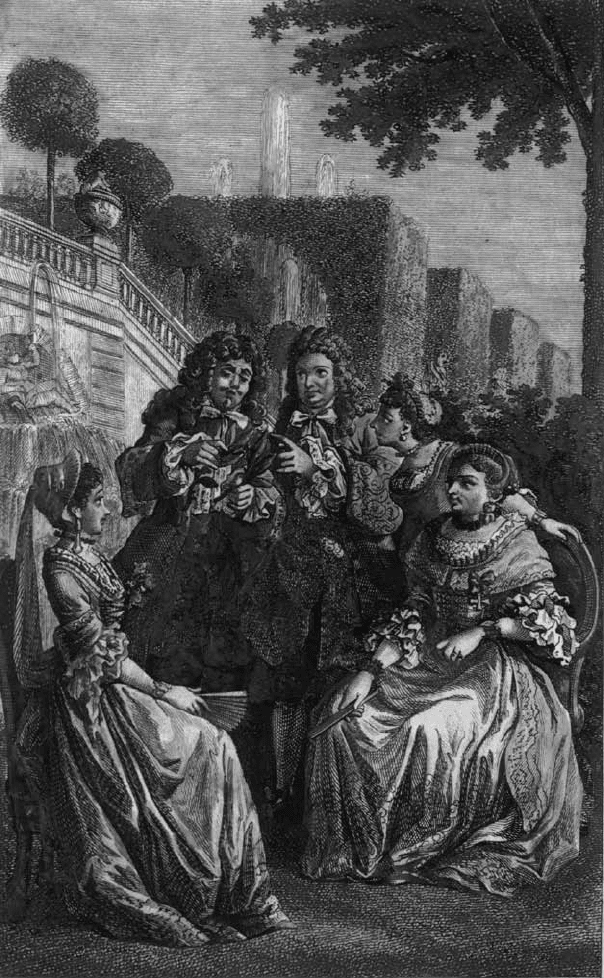
Leibniz illustrates the identity of indiscernibles by showing the ladies of the court
that no two leaves are exactly similar
METAPHYSICS
198
matter.3 As a consequence of this, thinkers like Aquinas had argued that if
there were substances that were immaterial—angels, say—then there
could be only one of each kind, since there was no matter to distinguish
one member of a species from another. Leibniz’s doctrine of individual
notions or essences forced him to generalize this: all substances, and not
just Aquinas’ angels, were unique specimens of their kind. He argued that if
there were in nature two beings indiscernible from each other, then God
would act without suYcient reason in treating one diVerently from the
other (G VII. 393).
Is the principle of the identity of indiscernibles itself necessary or
contingent? Leibniz does not seem to have made up his mind. Since, to
establish it, he appeals to the principle of suYcient reason, not to that of
non-contradiction, it appears contingent; and in a letter he wrote that it
was possible to conceive two indiscernible substances, even though it was
false to suppose they existed (G VII. 394). In his New Essays, however, he says
that if two individuals were perfectly alike and indistinguishable there
would not be any distinction between them; and he goes on to draw the
conclusion that the atomic theory must be false. It was not enough to say
that one atom was at a diVerent time and place from another: there must
be some internal principle of distinction or there would be only one atom,
not two (G V. 214).
Berkeley’s Idealism
Leibniz’s philosophy is the Wrst systematic presentation since Antiquity of
idealism, the theory that reality consists ultimately of mental entities, that
is to say immaterial perceivers along with their perceptions. During his
lifetime another version of idealism was propounded by Bishop Berkeley.
The two systems resemble each other, but there are important diVerences
between them: Leibniz’s idealism is a rationalist idealism; Berkeley’s is an
empiricist idealism. The diVerences arise from the diVerent starting points
of the two philosophers. Before comparing the systems in detail, therefore,
we should follow the track of argument by which Berkeley arrives at his
destination.
3 Vol. II, pp. 204–6.
METAPHYSICS
199
In the second of Berkeley’s Dialogues, Hylas, having earlier been made to
agree that primary and secondary qualities are alike only mental,
nonetheless attempts to defend the concept of material substance. His argu-
ments for the existence of matter are swiftly despatched. Matter is not
perceived, because it has been agreed that only ideas are perceived. It must,
therefore, be something discovered by the reason, not the sense. Shall we
say then that it is the cause of ideas? But matter is inert and unthinking; so
it cannot be a cause of thought. But perhaps, Hylas pleads, the motions of
matter may be an instrument of the supreme cause, God. But matter,
having no sensible qualities, cannot have motion or even extension; and
surely God, who can act by mere willing, has no need of lifeless tools. Shall
we say, as Malebranche did, that matter provides the occasion for God to
act? Surely the all-wise one needs no promptin g! ‘Do you not at length
perceive’, taunts Philonous, ‘that in all these diVerent acceptations of
Matter, you have been only supposing you know not what, for no manner
of reason, and to no kind of use?’ He sums up his argument triumphantly:
Either you perceive the being of Matter immediately or mediately. If immediately,
pray inform me by which of the senses you perceive it. If mediately, let me know
by what reasoning it is inferred from those things which you perceive immedi-
ately. So much for the perception. Then for the Matter itself, I ask whether it is
object, substratum, cause, instrument or occasion? You have already pleaded for each
of these, shifting your notions, and making Matter to appear sometimes in one
shape, then in another. And what you have oVered hath been disapproved and
rejected by yourself. (BPW, 184)
If Hylas continues to defend the existence of matter, he does not know
what he means by ‘matter’ or what he means by ‘existence’ (BPW, 187).
I think we must agree that Berkeley has successfully exploded the
Lockean notion of substance, with which poor Hylas has been saddled.
But suppose that Philonous were to debate not with Hylas but with
Aristotle. What answers would he receive? Material substances, he would
be told, are indeed perceived by the senses. Take a cat: I can see it, hear it,
feel it, smell it, and if I feel so inclined, taste it. It is true that it is not by
sense but by intellect that I know what kind of substance it is—I know that
it is a cat because I have learnt how to classify animals—but that does not
mean that I infer by reasoning that it is a cat. So much for material
substance; what of matter itself? That too I perceive by the senses, in that
METAPHYSICS
200
the substances we encounter are chunks of matter, matter in this case with
the form of cattishness. Prime matter, matter devoid of any form, is indeed
not perceptible by any sense; but that is because there is no such thing in
reality; prime matter is a philosophical abstraction for the purpose of the
analysis of substantial change.4
It cannot, of course, be taken for granted that the Aristotelian account
of substance and matter can be reconciled with, or adapted to, the progress
made by seventeenth-century scientists in the analysis and explanation of
motion and change. The point I wish to make here is simply that the
traditional notion of substance is not disposed of by Berkeley’s demolition
of the quite diVerent, internally incoherent, notion propagated by Locke.
The criticism of matter is not in fact essential to the construction of
Berkeley’s idealism; it merely removes an obstacle to its acceptance. Matter
was fantasized in order to be the basis of our ideas. That role in Berkeley’s
system belongs not to matter but to God. The Wrst premiss of the argu-
ment to that conclusion is that human beings know nothing except ideas;
and that premiss is stated long before the onslaught on the notion of
material substance. The Wrst book of the Principles begins thus:
It is evident to any one who takes a survey of the objects of human knowledge, that they
are either ideas actually imprinted on the senses; or else such as are perceived by
attending to the passions and operations of the mind; or lastly ideas formed by help
of memory and imagination. (BPW, 61)
This is surely not evident at all. Use the word ‘idea’, if you wish, in such
a broad sense as to make it true that whenever I perceive, remember, or
think of X I have an idea of X, and that whenever I learn, believe, or know
that p I have a corresponding idea. It still does not follow that the objects of
all human knowledge are ideas. From the very broad nature of the
deWnition it follows that any cognitive act or state will involve my having
ideas; but that does not mean that every cognitive act or state is about
those ideas, or has those ideas as its object. If I see a giraVe, I will, given
this terminology, have an idea of a giraVe; but what I see is a giraVe, not an
idea. If I think of the larch at the end of my garden, I will, again, have
an idea of that tree; but what I am thinking about is the tree, not the idea.
To be sure, I can also think of that idea; for instance, I can think that it is a
pretty hazy one. But that is quite a diVerent thought, a thought about
4 See vol. I, p. 192.
METAPHYSICS
201
an idea, not a thought about a tree. In thinking it, I am not thinking that
the tree is a pretty hazy one. Ideas, if you must speak of ideas in this
way, are the things we think with; they are not, in general , the things that
we think about.
The opening passage quoted from the Principles already assumes the
idealism that is supposed to be the conclusion of a long argument. Idealism
is implicit in the initial confusion between mental acts and their objects. It
cannot be said that Berkeley was unaware that this criticism could be
levelled. Hylas, near the end of the W rst Dialogue, makes a distinction
between object and sensation. He says:
The sensation I take to be an act of the mind perceiving; besides which, there is
something perceived; and this I call the object. For example, there is red and yellow
on that tulip. But then the act of perceiving those colours is in me only, and not in
the tulip. (BPW, 158)
Philonous’ rejection of this takes a very oblique route. He picks on the
word ‘act’ and proceeds to argue that a sensation—e.g. smelling the
tulip—is something passive, not active.
Dubious though that claim is, there is no need for Hylas to controvert it
in order to defend his distinction. All he has to do is to substitute the
expression ‘event in the mind’ for ‘act of the mind’. But Philonous sails on
to his conclusion by substituting the ambiguous word ‘perception’ for the
ambiguous word ‘idea’, and taking it casually for granted that the object of
a perception is a part of the perception (BPW, 159).
If there is nothi ng that we can know except ideas, and if ideas can exist
only in a mind, then it is not diYcult for Berkeley to reach his conclusion
that everything that we can know to exist is in the mind of God:
When I deny sensible things an existence out of the mind, I do not mean my mind
in particular but all minds. Now it is plain they have an existence exterior to my
mind; since I Wnd them by experience to be independent of it. There is therefore
some other Mind wherein they exist, during the intervals between the times of my
perceiving them: as likewise they did before my birth, and would do after my
supposed annihilation. And as the same is true with regard to all other Wnite
created spirits, it necessarily follows that there is an omnipresent eternal Mind, which
knows and comprehends all things.5
5 Berkeley’s proof of the existence of God is considered in detail in Ch. 10.
METAPHYSICS
202
In the Wnal dialogue, Berkeley gives Philonous the task of showing that the
thesis that nothing exists except ideas in a Wnite or inWnite mind is
something that is perfectly compatible with our common -sense beliefs
about the world. This involves a heroic reinterpretation of ordinary
language. Statements about material substances have to be translated
into statements about collections of ideas: a cherry, for instance, is nothing
but a congeries of sensible impressions, or ideas perceived by various senses
(BPW, 211). It is much easier to do this, Philonous argues, than to interpret
them as statements about inert Lockean substrata. ‘The real things are
those very things I see and feel and perceive by my senses ...A piece of
sensible bread, for instance, would stay my stomach better than ten
thousand times as much of that insensible, unintelligible, real bread you
speak of ’ (A, 192). Only his own phenomenalist system, Berkeley believes,
enables one to say truly that snow is white and Wre is hot.
A material substance, then, is a collection of sensible ideas of
various senses treated as a unit by the mind because of their constant
conjunction with each other. This thesis is, according to Berkeley, perfectly
consistent with the use of scienti W c instruments and the framing of
natural laws. Such laws state relationships not between things but
between phenomena, that is, ideas; and what scientiWc instruments do
is to bring new phenomena for us to relate to the old ones. If we make
a distinction between appearance and reality, what we are really doing
is contrasting more vivid ideas with less vivid ideas, and comparing
the diVerent degrees of voluntary control that accompany our ideas.
There is no hidden reality: everything is appearance. That is the doctrine
of ‘phenomenalism’, to use a word which was not invented until the
nineteenth century.
Both Leibniz and Berkeley are phenomenalists in the sense that they
agree that the material world is a matter of appearance rather than reality.
But they give di Verent accounts of the nature of the phenomena, and
diVerent explanations of their underlying causes. For the empiricist Berkeley,
ideas are not inWnitely divisible, since there is a Wnite limit to the mind’s
ability to discriminate by the senses. The rationalist Leibniz, on the other
hand, rejects such atomism: the phenomenal world has the properties
exhibited by geometry and arithmetic. With this diVerence in the nature
of the phenomena goes a diVerence in their sustaining causes. For Leibniz,
METAPHYSICS
203
the underlying reality is the inWnity of animate monads; for Berkeley, it is
the single all-comprehending God.
Hume on Causation
If neither of these two philosophies is in the end credible, this is not due to
any lack of ingenuity in their inventors. Rather, the defects in each system
can be traced back to a single root: the confused epistemology of ideas,
which was bequeathed to rationalists by Descartes and to empiricists by
Locke. The philosopher in whose work we can see most fully the conse-
quences of such an epistemology is David Hume. His oYcial system,
according to which everything whatever is a mere collection of ideas and
impressions, is nothing less than absurd. Nonetheless, Hume’s genius is
such that despite the distortions and constraints which his system imposed
upon him, he was able to make highly signiWcant contributions to phil-
osophy. Nowhere is this more evident than in his treatment of causality.
Prior to Hume, the following propositions about causes were very widely
held by philosophers:
1. Every contingent being must have a cause.
2. Cause a nd e Vect must resemble each other.
3. Given a cause, its eVect must necessarily follow.
The W rst two propositions were common ground between Aristotelian
philosophers and their opponents. Paradigm examples of Aristotelian eY-
cient causes were the generation of living beings and the operation of
the four elements. Every animal has parents, and parents and oVspring
resemble each other: dog begets dog and cat begets cat, and in general like
begets like. Fire burns and water dampens: that is, a hot thing makes other
things hot and a wet thing makes other things wet; once again, like causes
like. Early modern philosophers oVered other more subtle examples of
causal relations, but they continued to subscribe to propositions (1) and (2).
The third proposition was not quite such a simple matter. Spinoza stated
‘Given a determinate cause, the eVect follows of necessity’ (E I,3), and
Hobbes claimed that when all causal elements of a situation are present, ‘it
cannot be understood but that the eVect is produced’. Aristotle, however,
was not so determinist as Spinoza and Hobbes were, and he made a
METAPHYSICS
204
distinction between natural causes and rational causes. A natural cause,
like Wre, was ‘determined to one thing’; a rational cause, such as a human
being, had a two-way power, a power that could be exercised or not at will.
Even in such a case, Aristotle was willing to link the notions of cause and
necessity: the possessor of a rational power, if it has the desire to exercise it,
does so of necessity.6
Hume sets out to demolish all three of the theses set out above. He does
so by altering the standard examples of causation. For him, a typical cause
is not an agent (like a dog or a stove) but an event (like the rolling of a
billiard ball across a table). The change in paradigm is masked by his talking
of causes and eVects as ‘objects’. Strictly speaking, the only events possible
in a Humean world are occurrences of ideas and occurrences of impres-
sions; but this rule, fortunately, is not uniformly observed in the discus-
sion. A rule that does hold Wrm is this: cause and eVect must be two events
identiWable independently of each other.
In attacking the traditional account of causation, Hume Wrst denies that
whatever begins to exist must have a cause of existence:
As all distinct ideas are separable from each other, and as the ideas of cause and
eVect are evidently distinct, ’twill be easy for us to conceive any object to be non-
existent this moment, and existent the next, without conjoining to it the distinct
idea of a cause or productive principle. (T, 79)
Since the ideas can be separated, so can the objects; so there is no
contradiction in there being an actual beginning of existence without a
cause. To be sure, ‘eVect’ and ‘cause’ are correlative terms, like ‘husband’
and ‘wife’. Every eVect must have a cause, just as every husband must have
a wife. But that does not mean that every event must be caused, any more
than that every man must be married.
If there is no absurdity in conceiving something coming into existence
without any cause at all, there is a fortiori no absurdity in conceiving of it
coming into existence without a cause of a particular kind. Anything,
Hume says, may produce anything. There is no logical reason to believe
that like must be caused by like. ‘Where objects are not contrary, nothing
hinders them from having that constant conjunction, on which the
6 See G. E. M. Anscombe, ‘Causality and Determination’, in Metaphysics and the Philosophy of Mind
(Oxford: Blackwell, 1981), pp. 133 – 47.
METAPHYSICS
205