
Kenny Anthony. The Rise of Modern Philosophy: A New History of Western Philosophy. Volume 3
Подождите немного. Документ загружается.

course the thought may be accompanied by judgement, and a person not yet
puriWed of Aristotelianism will indeed accompany it with the erroneous
judgement that there are real things in the world which totally resemble
my perceptions (AT VII.437; CSMK II.295).
Human sensation is accompanied and occasioned by motions in the
body: vision, for instance, by motions in the extremities of the optic nerves.
But such mechanical events are only contingently connected with the
purely mental thought, and Descartes can be certain of the occurrence of
his sensations at a stage when he still doubts whether he has a body and
whether there is an external world. It is only after meditation on the
veracity of God, and the nature of the faculties God has given him, that
he is in a position to pronounce upon the mechanical element involved in
the sensations occurring in an embodied mind.
The same mechanical motions may occur in the body of a non-human
animal. If we like, we can call these sensations in a broad sense. But an
animal cannot have thoughts, and it is thought in which sensation, strictly
so called, consists. It follows that, for Descartes, an animal cannot suVer
pain, though the machine of its body may ca use it to react in a way which,
in a human, would be the expression of a pain:
I see no argument for animals having thoughts except that fact that since they
have eyes, ears, tongues and other sense-organs like ours it seems likely that they
have sensations like us; and since thought is included in our mode of sensation,
similar thought seems to be attributable to them. This argument, which is very
obvious, has taken possession of the minds of all men from their earliest age. But
there are other arguments, stronger and more numerous, but not so obvious to
everyone, which strongly urge the opposite.
The doctrine that animals have no feelings and no consciousness did not
seem as shocking to Descartes’ contemporaries as it does to most people
nowadays. But people reacted with horror when some of his followers
claimed that human beings, no less than animals, were only complicated
machines.
Dualism and its Discontents
In human beings, Descartes argues for a sharp distinction between mind
and body. In the sixth Meditation he says that he knows that if he can clearly
MIND AND SOUL
216
and distinctly understand one thing without another, that shows that the
two things are distinct, because God at least can separate them. Since he
knows that he exists, but obser ves nothing else as belonging to his nature
other than that he is a thinking thing, he concludes that his nature or
essence consists simply in being a thinking thing; he is really distinct from
his body and can exist wit hout it. In considering this argument, it is hard
to avoid the conclusion that Descartes is confusing ‘I can clearly and
distinctly perceive A without clearly and distinctly perceiving B’ with
‘I can clearly and distinctly perceive A without B.’
As a matter of contingent fact, human beings in this world are, Descartes
agrees, compounds of mind and body. But the nature of this com position,
this ‘intimate union’ between mind and body, is one of the most puzzling
features of the Cartesian system. The matter is made even more obscure,
when we are told (AT XI.353; CSMK I. 340) that the mind is not directly
aVected by any part of the body other than the pineal gland in the brain.
All sensations and emotions consist of motions in the body which travel
through the nerves to this gland and there give a signal to the mind which
occasions a certain experience.
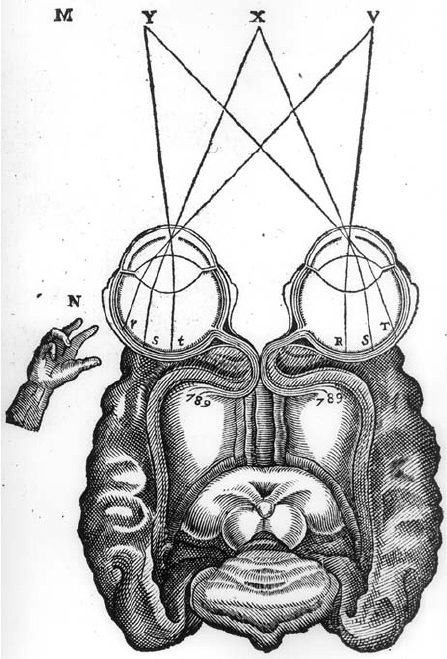
Descartes explains the mechanism of vision as follows:
If we see some animal approach us, the light reXected from its body depicts two
images of it, one in each of our eyes, and these two images form two others, by
means of the optic nerves, in the interior surface of the brain which faces its
cavities; then from there, by means of the vital Xuids with which its cavities are
Wlled, these images so radiate towards the little gland that is surrounded by these
Xuids, that the movement that forms each point of one of the images tends
towards the same point of the gland towards which tends the movement that
forms the point of the other images which represents the same part of this animal.
By this means the two images which are in the brain form but one upon the gland,
which, acting immediately on the soul, causes it to see the form of this animal.
(AT IX.355; CSMK I. 341)
To speak of the soul as seeing, or reading oV, images in the brain is to
imagine the soul as a little human being or homunculus. This is a fallacy
that Descartes himself warned against in his Dioptrics when he was describing
the formation of retinal images. These images, he informed the reader,
were part of the process of conveying information from the world to the
brain, and they retained a degree of resemblance to the objects from which
they originated. ‘We must not think’, he warned, ‘that it is by means of this
MIND AND SOUL
217
resemblance that the image makes us aware of the objects—as though we
had another pair of eyes to see it, inside our brain.’
But the homunculus fallacy is no less involved in treating the transaction
between the soul and the pineal gland as if it was a case of seeing or reading.
The interaction between mind and matter is philosophically as puzzling a few
centimetres behind the eye as it is in the eye itself. The mind–body problem is
not solved, but merely miniaturized, by the introduction of the pineal gland.
Interaction between mind and matter, as conceived by Descartes, is highly
mysterious. The only form of material causation in Descartes’ physical
system is the communication of motion, and the mind is not the kind of
thing to move around in space. ‘How can soul move body?’ Princess Elizabeth
asked. Surely, motion involves contact, and contact involves extension, and
Descartes’ diagram, in
the Discourse on Method,
of the mechanics of
vision
MIND AND SOUL
218
the soul is unextended. Descartes, in reply, told her to think of weight, of the
heaviness of a body which pushed it downward wit hout there being any
surface contact involved. But this conception of weight, as Elizabeth was
quick to point out, was one that Descartes himself regarded as a scholastic
muddle. After a few more exchanges, Descartes was reduced to telling the
princess not to bother her pretty head further about the problem.
Elizabeth had, in fact, located the fundamental weakness in Descartes’
philosophy of mind. Descartes’ system was dualist, that is to say, it was
tantamount to belief in two separate worlds—the physical world contain-
ing matter, and a psychical world containing private mental events. The
two worlds are de W ned and described in such systematically diVerent ways
that mental and physical realities can interact, if at all, only in a mysterious
manner that transcends the normal rules of causality and evidence. Such
dualism is a fundamentally mistaken philosophy. The incoherence spotted
by Princess Elizabeth was to be pointed out with exhaustive patience in later
centuries by Kant and Wittgenstein. But Cartesian dualism is still alive and
well in the twenty-Wrst century.
Determinism, Freedom, and Compatibilism
In Descartes’ own time the most vociferous critic of dualism was the
materialist Thomas Hobbes, who denied the existence of any non-
extended, spiritual entities like the Cartesian mind. Whereas Descartes
exaggerated the diVerence between humans and animals, Hobbes minim-
ized it. He described human action as a particular form of animal behav-
iour. There are two kinds of motion in animals, he says, one called vital and
one called voluntary. Vital motions include brea thing, digestion, and the
course of the blood. Voluntary motion is ‘to go, to speak, to move any of
our limbs, in such manner as is Wrst fancied in our minds’. The operations
that Descartes (and the Aristotelians before him) attributed to reason are
by Hobbes assigned to the imagination, a faculty common to
all animals that is purely material, all thoughts of any kind being small
motions in the head. If a particular imagining is caused by words or other
signs, it is called ‘understanding’. But this too is common to all animals,
‘for a dog by custom will understand the call or the rating of his Master,
and so will many other Beasts’ (L, 3, 10).
MIND AND SOUL
219
The diVerenc e between animals and humans here is simply that when a
man imagines a thing, he goes on to wonder what he can do with it. But
this is a matter of will, not intellect. Not that the will is a faculty peculiar to
humans: a will is simply a desire, the desire that comes last at the end of a
train of deliberation, and ‘beasts that have deliberation must necessarily
also have will’. Human and animal desires are alike consequences of
mechanical forces. The diVerence is simply that humans have a wider
repertoire of wants, in the service of which they employ their imaginations.
The freedom of the will is no greater in humans than in animals.
This thesis caused great oVence, and led to a celebrated debate with John
Bramhall, a royalist Bishop of Derry who had shared Hobbes’ exile.3 Hobbes
insisted, ‘Such a liberty as is free from necessity is not to be found in the will
either of men or of beasts.’ He claimed, however, that liberty and necessity
were not necessarily incompatible:
Liberty and Necessity are Consistent: as in the water, that hath not only liberty,
but a necessity of descending by the Channel; so likewise in the Actions which
men voluntarily do; which, because they proceed from their will, proceed from
liberty; and yet, because every act of man’s will, and every desire and inclination
proceedeth from some cause, and that from another cause, in a continuall chaine,
whose Wrst link is in the hand of God, Wrst of all causes, they proceeed from
necessity. (L, 140)
‘This is a brutish liberty,’ Bramhall objected, ‘such a liberty as a bird hath to
Xy when her wings are clipped. Is not this a ridiculous liberty?’ Hobbes replied
that a man was free to follow his will, but was not free to will. The will to
write, for instance, or the will to forbear from writing, did not come upon a
person as a result of some previous will. ‘He that cannot understand the
diVerence between free to do it if he will and free to will is not Wt’, Hobbes snorted,
‘to hear this controversy disputed, much less to be a writer in it.’
Hobbes’ account of liberty gives him a claim to be the founder of the
doctrine called ‘compatibilism’, the thesis that freedom and determinism
are compatible with each other. He presents it in a crude form which, as
Bramhall pointed out, fails to do justice to the obvious diVerences between
the modes of action of inanimate agents and of rational agents like human
beings. His version depends on a linear model of causation as a series of
3 Published in 1663 as The Questions Concerning Liberty, Necessity and Chance, from which the
following quotations are taken.
MIND AND SOUL
220
events following in sequence, each linked to the next by a causal relation.
Thus my action is preceded and caused by my willing, which is preceded
and caused by my deliberation, which is preceded and caused by a series of
motions outside my control which terminates ultimately in the primal
causation by God. My action is free, because the event which immediately
precedes it is an act of will; it is necessitated, because it comes at the end of a
series each of whose items is a necessary consequence of its predecesssor.
There are problems with the notion of a series which alternates in this
manner between mental and physical events. It is true that for Hobbes
mental events (a thought or a will) do not take place, as they did for
Descartes, in a spiritual realm outside material space; for him all the motions
of the mind are actually motions in the body. But there are further problems,
which later philosophers would explore, in simply identifying mental and
physical events in this manner. Moreover, in many cases of voluntary
behaviour, there is in advance of the action no identiWable mental event to
fulWl the causal role that Hobbes’ version of compatibilism requires of the
will. The pros and cons of compatibilism are better evaluated in the versions
developed by later, more sophisticated, thinkers such as Immanuel Kant.4
Locke’s treatment of the will is already an improvement on Hobbes. We
Wnd in ourselves, he says, a power to begin or forbear actions of our minds
and bodies ‘barely by a thought or preference of the mind ordering, or as it
were commanding the doing or not doing such or such a particular
action’. This power is what we call the will, and the exercise of such a
power—the issuing of such an order—is volition, or willing. An action in
obedience to such an order is what is called voluntary. Whenever a man
has a power to think, or not to think, to move or not to move, in
accordance with the direction of his mind, he is so far free (E, 236–7).
Liberty or freedom requires two things: a volition to act, and a power to
act or forbear. A tennis ball is not free, because it has neither of these.
A man who falls from a broken bridge has a volition to stop falling, but no
power to do so; his fall is not a free action. Even if I have a volition to do
something, and am actually doing it, that may not be enough to make my
action a free one:
Suppose a man be carried, whilst fast asleep, into a Room, where is a person he
longs to see and speak with; and be there locked fast in, beyond his Power to get
4 See below, p. 243, and my Will, Freedom and Power (Oxford: Blackwell, 1975), pp. 145–61.
MIND AND SOUL
221
out: he awakes, and is glad to Wnd himself in so desirable a Company, which he
stays willingly in, i.e. prefers his stay to going away. I ask, Is not this stay voluntary?
I think, no Body will doubt it: and yet being locked fast in, ’tis evident he is not at
liberty not to stay, he has not freedom to be gone. (E, 238)
This shows that an action may be voluntary without being free. Freedom is
the opposit e of necessity, but voluntariness is compatible with necessity.
A man may prefer the state he is in to its absence or change, even though
necessity has made it inalterable. But although voluntariness is not a
suYcient condition for freedom, it is an essential prerequisite. Agents
that have no thought or volition at all are all necessary agents.
What are we to make of the question whether the human will is free or not?
Locke tells us that the question is as improper as asking whether sleep is swift or
virtue is square. The will is a power, not an agent, and liberty belongs only to
agents. When we talk of the will as a faculty, we should beware of personifying
it. We can, if we wish, talk of a singing faculty and a dancing faculty; but it
would be absurd to say that the singing faculty sings or that the dancing
faculty; dances. It is no less foolish to say that the will chooses, or is free.
Here, Locke seems to be avoiding the question that preoccupied Hobbes.
On Locke’s own account a volition is an act of the mind directing or
restraining a particular action. Can we say that the agent is free to perform
or forbear such a particular act of the mind? Locke states as a general
proposition, that if a particular thought is such that we have power to take
it up, or lay it by, at our preference, then we are at liberty. But volition, he
says, is not such a thought. ‘A man in respect of willing, or the Act of
Volition, when any action in his power is once proposed to his Thoughts,
as presently to be done cannot be free’ (E, 245).
It is not just that we cannot, during waking life, help willing something
or other; we cannot, Locke says, help the particular volitions that we have.
‘To ask whether a Man be at liberty to will either Motion or Rest; Speaking
or Silence; which he pleases, is to ask, whether a man can will what he
wills’—and this is a question that needs no answer. Here, Locke seems to be
guilty of a fallacy which trapped other great philosophers: the invalid
argument from the true premiss ‘Necessarily, if I prefer X, I prefer X’, to
the dubious conclusion ‘If I prefer X, I necessarily prefer X’.
But Locke has a positive reason for denying liberty to the choices of the
will. Every choice to perform an action, he maintains, is determined by a
preceding mental state: one of uneasiness at the present state of things.
MIND AND SOUL
222
Uneasiness alone acts on the will and determines its choices. We are
constantly beset with sundry uneasinesses, and the most pressing one of
those that are removable ‘determines the will successively in that train of
voluntary actions which make up our lives’. The most we can do is to
suspend the execution of a particular desire while we decide whether to act
on it would make us happy in the long run. This, Locke says, is the source
of all liberty, and this is what is called (improper ly) free will. But once
the pros and cons have been weighed up, the resulting desire will deter-
mine the will (E, 250–63).
Locke is aware that the objection can be made to his system that a man is
not free at all, if he be not as free to will, as he is to act what he wills. He
does not oVer a direct answer to this objection; instead he considers at
length what are the factors which lead people to make wrong choices. His
principal explanation is the same as that given by Plato in the Protagoras:
that, by the intellectual equivalen t of an optical illusion, we misjudge the
proportion between present pains and pleasu res and future pains and
pleasures. He illustrates this with the example of a hangover:
Were the Pleasure of Drinking accompanied, the very moment a Man takes oV his
Glass, with that sick Stomack, and aking Head, which in some Men are sure to
follow not many hours after, I think no body, whatever Pleasure he had in his
Cups, would, on these Conditions, ever let Wine touch his Lips; which yet he daily
swallows, and the evil side comes to be chosen only by the fallacy of a little
diVerence in time. (E, 276)
Locke on Personal Identity
Locke’s most inXuential contribution to the philosophical study of human
beings concerned not the freedom of the will, but the nature of personal
identity. In discussing identity and diversity, Locke accepts that identity is
relative rather than absolute: A may be the same F as B, but not the same
G as B. The criterion for the identity of a mass of matter (no particles added
and no particles taken away) is not the same as the criterion for the identity
of a living being:
In the state of living Creatures, their Identity depends not on a Mass of the same
Particles; but on something else. For in them the variation of great parcels of
Matter alters not the Identity: An Oak, growing from a Plant to a great Tree, and
MIND AND SOUL
223
then lopp’d, is still the same Oak; and a Colt grown up to a Horse, sometimes fat,
sometimes lean, is all the while the same Horse: though, in both these Cases, there
may be a manifest change of the parts: So that truly they are not either of them
the same Masses of Matter, though they be truly one of them the same Oak, and
the other the same Horse. (E, 330)
The identity of plants and animals consists in continuous life in accordance
with the characteristic metabolism of the organism. Human beings are animal
organisms, and Locke oVers a similar account of ‘the Identity of the same Man’.
(By ‘man’ of course he means a human being of either sex.) The identity of a
human being consists in ‘nothing but a participation of the same continued
Life by constantly Xeeting Particles of Matter, in succession vitally united to
the same organized Body’. Only such a deWnition, he says, will enable us to
accept that an embryo and ‘one of years, mad and sober’ can be one and the
same man, without having to accept wildly improbable cases of identity.
So far, Locke’s deWnition of human identity seems sound and straight-
forward; but it is complicated by his having to position himself with respect
to ancient theories of the reincarnation and transmigration of souls, together
with Christian doctrines of the survival of disembodied souls and the
eventual resurrection of long-dead bodies. We cannot, Locke says, base
our account of the identity of a human being on the identity of a human
soul. For if souls can pass from one body to another, we cannot be sure that
Socrates, Pontius Pilate, and Cesar e Borgia are not the same man. Some
have supposed that the souls of wicked men—such as the Roman Emperor
Heliogabalus—were sent as a punishment after death into the bodies of
brutes. ‘But yet I think no body, could he be sure that the Soul of
Heliogabalus were in one of his Hogs, would yet say that Hog were a
man or Heliogabalus’ (E, 332). A man is an animal of a certain kind, indeed
of a certain shape. However rational and intelligent a parrot might turn
out to be, it would still not be a man.
However, settling the question of human identity does not yet settle the
nature of personal identity. Locke distinguishes the concept man from the
concept person. A person is ‘a thinking intelligent Being, that has reason and
reXection, and can consider it self as itself, the same thinking thing in
diVerent times and places’. Self-consciousness is the mark of a person, and
the identity of a person is the identity of self-consciousness. ‘As far as this
consciousness can be extended backwards to any past Action or Thought,
so far reaches the Identity of that Person; it is the same self now as it was
MIND AND SOUL
224
then; and ’tis by the same self with this present one that now reXects on it,
that that Action was done’ (E, 335).
So if we want to know whether A (at this moment) is the same person as B
(some time ago) we ask whether A’s consciousness extends back to the actions
of B. If so,A is the same person as B; if not, not. But what is it for a consciousness
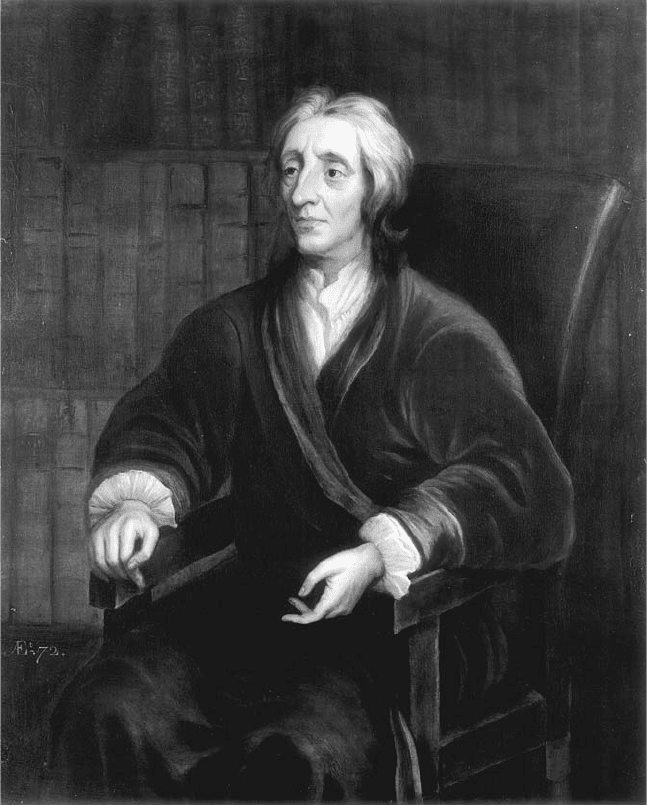
Kneller’s por trait of John Locke, in Christ Church hall
MIND AND SOUL
225