
Kerry J., Butler P. Smart Packaging Technologies for Fast Moving Consumer Goods
Подождите немного. Документ загружается.

OTE/SPH OTE/SPH
JWBK126-14 JWBK126-Kerry March 15, 2008 18:46 Char Count= 0
Aerosol and Cleaning Sprays 259
0
10
20
30
40
50
60
70
80
90
100
02468101214
Time (minutes)
knockdown (%)
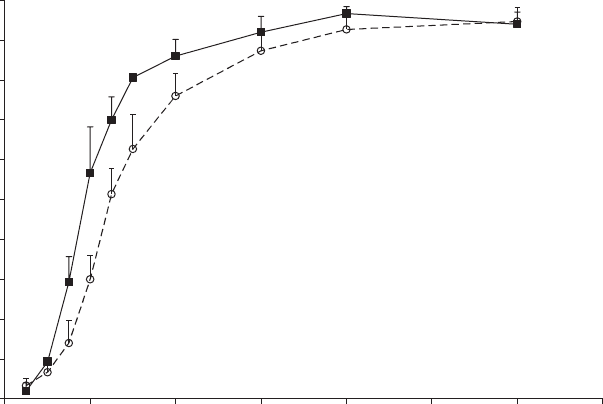
Figure 14.12 Rates of knockdown of house flies ( Musca domestica) by a conventional in-
secticide aerosol
e
(q/m = 20 μCkg
−1
) and an electrostatically charged insecticide aerosol
(q/m = 200 μCkg
−1
). (Reprinted from L.F. Gaunt et al., Journal of Electrostatics, 57, 35–47.
Copyright 2003, with permission from Elsevier).
to spend more time in the upper portions of a room. Thus, space charge dispersion makes
the availability of the insecticide spray in a room more biologically appropriate.
The advantages of charged domestic sprays do not only pertain to improved targeting and
coverage of a surface. There are also benefits for the ubiquitous air freshener. In a similar
manner to electrostatic precipitators, charged sprays can also be used to control airborne
particulate pollutants and allergens in the domestic environment.
A fine spray of water droplets is a well-known and industrially implemented method
for removing airborne particles. The fine sprays produced by domestic aerosols can also
deplete the concentration of dust particles, and this effect is increased where the spray
is electrostatically charged. As in the previous case study, a commercially available air
freshener spray with a charge-to-mass ratio of 14 μCkg
−1
has been compared with the
same product, which had been modified to deliver a spray with a charge-to-mass ratio of
14 μCkg
−1
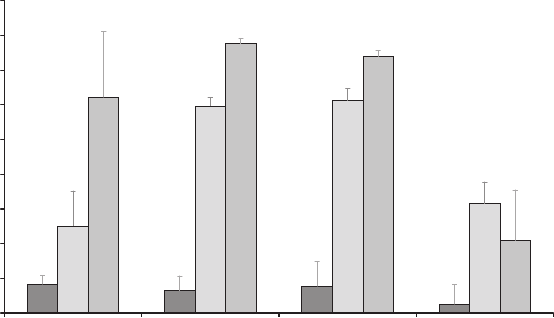
(Gaunt et al., 2003b). Using an air particle counter to record the airborne
concentration of particulates, a conventional air freshener removes up to 60 % of dust
particles in a room immediately after use. The same spray when charged removes nearly 80
% of particles, as shown in Figure 14.13. Further analysis shows that the most significant
effects are seen with small particulates below 5 μm in diameter, and that charged sprays
demonstrate the greatest percentage improvement over the effect of conventional sprays on
submicrometre (<1 μm) particles.
A fine spray of water droplets removes airborne particulates as a result of contacting them
by interception and inertial impaction as they move through the air. As the droplets settle
OTE/SPH OTE/SPH
JWBK126-14 JWBK126-Kerry March 15, 2008 18:46 Char Count= 0
260 Smart Packaging Technologies for Fast Moving Consumer Goods
0
10
20
30
40
50
60
70
80
90
0.7-1.0
1.0-2.0 2.0-5.0 5.0-10.0
Particle size band, mm
Reduction in particle concentration (%)
Figure 14.13 Rate of depletion of 2.0 to 5.0 μm diameter particles by a conventional aerosol
(q/m = 14 μCkg
−1
) and an electrostatically charged aerosol (q/m = 140 μCkg
−1
) compared
with the natural rate of particle depletion . (Reprinted from L.F. Gaunt, et al., Journal of
Electrostatics, 58, 159–169. Copyright 2003, with permission from Elsevier).
onto surfaces, particles are removed. Enhanced particle removal by charged sprays arises
due to enhanced particle collection by the charged droplets, arising from the attractive force.
The attractive force will also reduce the chance of particulates bouncing off the droplets
when contact is made. Space charge forces will improve the dispersal of the spray droplets
through the room, allowing cleaning of a greater volume of the air.
Electrostatic spraying is recognised as offering significant performance benefits. When
spraying a product onto a surface, the charge on the droplets causes attraction to surfaces
leading to higher deposition rates. The mutual repulsion of like-charged droplets also causes
them to be evenly distributed in space, so deposition is more even.
14.9 Conclusions
The advantages of electrostatic spraying are well exploited in a number of industrial pro-
cesses, yet rarely available in consumer products due to the technical and cost-related issues
surrounding provision of a power supply. By exploiting natural charge separation mecha-
nisms such as frictional charging and flow electrification, electrostatic spraying becomes
available to a diversity of product categories. Delivering electrostatic technologies in this
way demands an understanding of the principles of the charging processes and the influ-
ential factors. Armed with this knowledge it becomes a relatively simple design process to
incorporate charging into product design.
The benefits are numerous and visually demonstrated to the consumer. Attraction of
charged droplets or particles to surfaces results in increased product contact with target
surfaces, up to three times that achieved without charge. Electrostatic spraying also delivers
OTE/SPH OTE/SPH
JWBK126-14 JWBK126-Kerry March 15, 2008 18:46 Char Count= 0
Aerosol and Cleaning Sprays 261
wrap-around, where surfaces not in the direct line of fire are coated as particles deviate from
their straight line trajectory to follow electric field lines onto the rear of target objects. In
this way the difference between a conventional and electrostatically charged spray become
immediately apparent, due to the presence of product where it was not aimed. The evenness
of coating with the latter is also clear. Space charge forces cause the like-charged particles to
be repelled from each other. In so doing they become equidistant in their distribution in the
space, and thus impact a surface more evenly distributed. The real advantages have been
demonstrated for a number of household products, including insecticide sprays, surface
cleaners and air freshener sprays, although this is not a comprehensive list.
Acknowledgments
This research was funded by Reckitt Benckiser plc, whose support is gratefully acknowl-
edged. The author would also like to thank the other members of the research team who
contributed to this research activity, including Karen Baxter, Sabrina Higgins and John
Hughes.
References
Cross, J. A. (1987) Electrostatics: Principles, Problems and Applications, Adam Hilger, Bristol.
Gaunt, L.F., J.F. Hughes and N. M. Harrison (2003a) Electrostatic deposition of charged insecticide
sprays on electrically isolated insects, Journal of Electrostatics, 57: 35–47.
Gaunt, L.F., J.F. Hughes and N. M. Harrison (2003b) Removal of domestic airborne dust particles by
naturally charged liquid sprays, Journal of Electrostatics, 58: 159–169.
Gaunt, L.F. and J.F. Hughes. (2003a) Electrostatic charging of trigger actuated spray devices, Institute
of Physics Conference Series No. 178, Edinburgh IOP Publishing, Bristol, pp. 59-64.
Gaunt, L.F. and J.F. Hughes (2003b) Spraying device, Patent WO 03/004170.
Gavis, J. and I. Koszman (1961) Development of charge in low conductivity liquids flowing past
surfaces; a theory of the phenomenon in tubes, Journal of Colloid Science, 16: 375–391.
Klinkenberg, A. and L.J. Van der Minne (1958) Electrostatics in the Petroleum Industry, Elsevier,
New York.
Sanders, P. A. (1970) Principles of Aerosol Technology, Van Nostrand Reinhold Company, New York.
Singh, S., B.C. O’Neil and A.N. Bright (1978) A parametric study of electrostatic powder coating,
Journal of Electrostatics, 4: 325–334.
Splinter, W.E. (1968) Electrostatic charging of agricultural sprays, Transactions of the American
Society of Agricultural Engineers, 11: 491–495.
Taylor, D.M. and P.E. Secker (1994) Industrial Electrostatics: Fundamentals and Measurements,
John Wiley & Sons, Inc., 1994.
Whitmore L.F., R.T. Fox, J.F. Hughes and N.M. Harrison (1999) Improved targeting of flying insects
with insecticides and apparatus for charging liquids, Patent WO 99/01227.

OTE/SPH OTE/SPH
JWBK126-15 JWBK126-Kerry March 18, 2008 13:34 Char Count= 0
15
Smart Packaging in the Health,
Beauty and Personal Care Sectors
Paul Butler
15.1 Introduction – Drivers and Packaging Needs
15.1.1 Health
Packaging is being challenged to support the health industry in the problem of patient
medication compliance, to provide more effective and convenient forms of product de-
livery, and to help strengthen product authentication. There has been, and still is, sig-
nificant activity in innovative packaging solutions that address these issues and positive
cost/benefit trade-offs for the use of smarter packaging can generally be established.
Increasingly a pharmaceutical package has to be much more than just a container for
pills.
Patient Compliance and Product Delivery. Non-compliance is a serious health and cost
issue in virtually all countries and has the greatest effect in terms of health on the ageing
population. According to IDTechEx, a Cambridge UK-based consultancy, medication non-
compliance costs the US alone about $100 billion and 125 000 deaths yearly. It is responsible
for 10 % of hospital and 23 % of nursing home admissions, affecting in excess of 3.5 million
patients.
Clinical research trials used to test new pharmaceuticals is also an important area where
non-compliance is a serious problem. The essential need is for reliable clinical data and
this is directly related to patient compliance in taking drugs according to the established
protocols of the trial. On the basis of the results of such trials, new medications are either
approved for general medical use or abandoned.
Smart Packaging Technologies for Fast Moving Consumer Goods Edited by Joseph Kerry and Paul Butler
© 2008 John Wiley & Sons, Ltd. ISBN: 978-0-470-02802-5
OTE/SPH OTE/SPH
JWBK126-15 JWBK126-Kerry March 18, 2008 13:34 Char Count= 0
264 Smart Packaging Technologies for Fast Moving Consumer Goods
Over the years, the healthcare and pharmaceutical industries have devoted much effort
to the development of packaging delivery systems that aid compliance. A significant trend
has been towards the blister pack, with the assumption that this form of convenient pack-
aging with intuitive graphics can improve medication compliance, but without remind and
record functionality, only limited improvements are possible. Smart packaging technolo-
gies are now emerging with these improved functionalities, including the tracking of actual
medication use and communication with the healthcare provider.
A further area affecting non-compliance is the difficulty many people have in reading
or understanding the contents and instructions of prescription medications. The small print
and look-alike packaging of medicine vials can lead to confusion and mistakes, particularly
in those with sight impairments, dyslexia, or reading problems. Many people want the
packaging to explain more clearly how a drug works, suggesting that it would probably
be beneficial if the pack used visual rather than text-based instructions and explanations.
Improved on-pack communication will be one of the principal features of electronic smart
packaging. Branded pharmaceutical packaging with built-in smart features such as moving
colour images accompanied by a sound track in the language of choice could have a dramatic
effect on assisting the old and infirm to take their medication, help encourage compliance
and make it harder for generics to copy a product.
Authenticity. Authentication issues are – for obvious reasons – even more important with
pharmaceuticals than they are with food and beverages. The World Health Organization
estimates that counterfeit drugs cost the pharmaceutical industry $40 billion yearly and the
US government has already issued guidelines for the use of electronic pedigree systems for
the pharmaceutical supply chain. These systems may use RFIDs or bar codes on item-level
packaging that record the details of every transfer by wholesalers and re-packagers, until
the final sale or use of the drug. Alarmed by the increasing cases of fake Viagra, Pfizer
has announced in January 2006 that it will use RFID tags on all Viagra bottles in the US
to authenticate the products. The subject of RFID on packaging and authenticity is an
important subject in its own right but lies outside of the scope of this chapter.
Authenticity is key to the market branding of leading products, and the issue of product
counterfeiting has long been a problem for certain luxury and high-end consumer products.
Smart RFID tags confirming product authenticity, and other difficult-to-copy technologies
offering high security, will become commonplace, initially in combating stock loss of high
value products, such as spirits and perfume.
‘Health in the Home’ Concepts. Future growth opportunities exist in ‘health in the home’
concepts, where low-cost, convenience, portability and ease-of-use will drive the develop-
ment of smarter packaging and product delivery devices, empowering people to take more
responsibility for the state of their health. The challenge will be to develop new meth-
ods of diagnosing or predicting illness early, in order to prevent or reduce the subsequent
costs of diagnosis and treatment. Smart medical packaging will give the consumer greater
control and the ability to easily, accurately and quickly personally monitor their condi-
tion in the home. In the longer term, the integration of health information provision and
monitoring will enable individuals to become custodians of their health and that of their
families.
OTE/SPH OTE/SPH
JWBK126-15 JWBK126-Kerry March 18, 2008 13:34 Char Count= 0
Health, Beauty and Personal Care 265
15.1.2 Beauty and Personal Care
Enhanced Quality of Life. Many consumers want value-added cosmetics that offer the
advantages of the prestige brands, but cost less and are available in convenient mass mar-
ket outlets. Young women are looking for trendy, portable products to suit their hectic
lifestyles, offering all kinds of opportunities for consumer smart packaging. Just as for
pharmaceuticals, delivery systems based on packaging will continue to play a dominant
role in cosmetics and personal care products.
Anti-ageing Formulations. The ageing population in the developed world has increased the
need for technologies and products such as anti-wrinkle products, hair regrowth, cosme-
ceuticals with vitamins, nutritionals, sunscreens, herbs and various anti-ageing ingredients.
Anti-ageing treatments already account for the major share of growth in the skin care
market. Consumers expect fast, visible results in the form of healthier, and particularly
younger-looking, skin. To deliver these results there is a growing trend by companies to
rely on the use of advanced technologies. Much of this development will be in formula-
tion, but innovative delivery systems designed to deliver active cosmetics ingredients into
the skin using smart packaging technologies such as iontophoresis will find increasing
application.
Fragrances Aimed at Younger Consumers. Fragrances aimed at this growing part of the
market now need to perform to lifestyle expectations by using new technologically based
packaging delivery systems designed specifically with the younger consumer in mind to
help a fragrance and its wearer stand out from the crowd.
15.1.3 Summary of Drivers and Packaging Needs
The importance of smart packaging in the health, beauty and personal care markets is greater
than in almost any other sector. The higher than average margins that generally characterise
the sector should enable more innovative packaging to be developed and introduced, having
strong emotional branding appeal or offering new levels of convenience and functionality
for the consumer. Some future key drivers and their associated packaging needs are shown
in Table 15.1.
15.2 Current Smart Packaging Examples
15.2.1 Innovative Product Delivery and Dispensing
Dual Dispensing Packaging – Fixed Ratio. Smart packaging designs have been developed
that allow two incompatible products to be kept separated and only mixed at point of use.
This concept has been exploited in the cosmetics and personal care markets with tube-
within-tube packaging for complex and fragile formulations. A major advantage offered is
the potential development of innovative dual-phase formulations that would not be stable
as intimate mixtures.
As an example, Procter & Gamble’s Crest Dual Action Whitening Toothpaste combines
peroxide-based whiteners in one formulation together with other sensitive ingredients in a
OTE/SPH OTE/SPH
JWBK126-15 JWBK126-Kerry March 18, 2008 13:34 Char Count= 0
266 Smart Packaging Technologies for Fast Moving Consumer Goods
Table 15.1 Summary of key drivers and packaging needs for the health, beauty and
personal care sectors
Driver Packaging Need
Health
Patient compliance Unit dosing
Ergonomic packaging designs
Non-spill, non-drip
Easier portability
Security/Safety Cognitive child-resistant closures
Packaging integrity
Label integrity
Easy to store
Better, tailored information Ease of disposal
Ease of recycling
‘Health in the home’ Personal diagnostic patches and devices, e.g. smart combs
Disposable one-shot unit packaging
Smart bandages
Beauty/Personal Care
Convenience Better, faster, non-messy, delivery systems
More powered packaging (like electric toothbrushes)
Ageing population Easy to open
Easy to dispense
Easy to read/audiovisual labelling
Aesthetics Pocket-friendly compact designs
Beautiful objects used in public places
Communication-capable devices
Sexual attraction Innovative perfume delivery systems
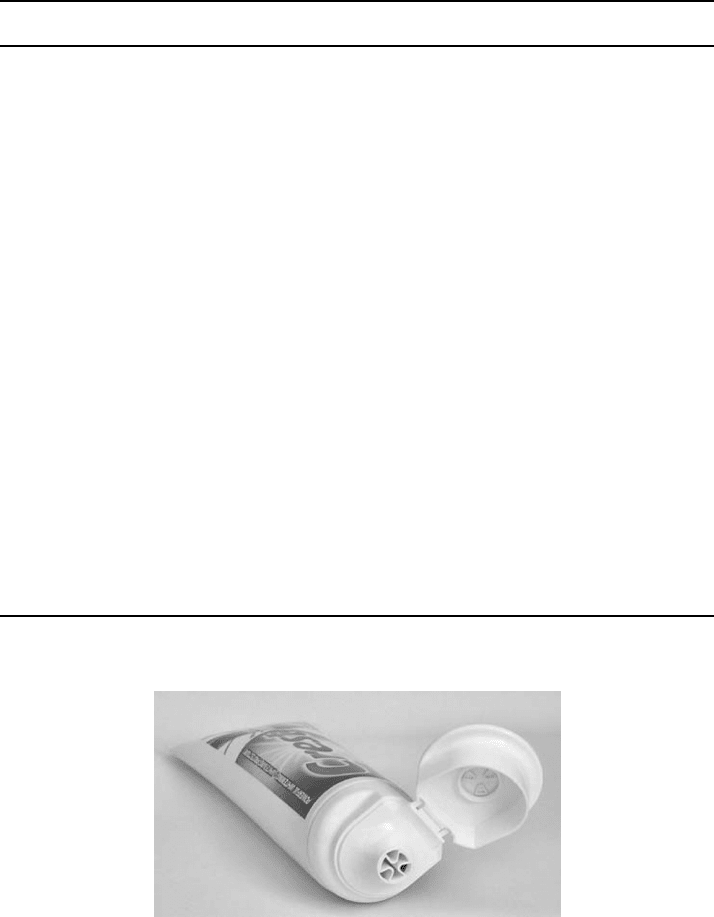
Figure 15.1 Crest Dual Action Whitening toothpaste comes in a dual tube-in-tube package
keeping two active ingredients separate until point of use.
OTE/SPH OTE/SPH
JWBK126-15 JWBK126-Kerry March 18, 2008 13:34 Char Count= 0
Health, Beauty and Personal Care 267
second formulation. The tube-in-tube package is shown in Figure 15.1, where the dispensing
nozzle can clearly be seen. The nozzle has three grooves formed into its outer surface,
through which product from the outer tube flows and three internal channels through which
product from the inner tube passes. When the tube is squeezed, the toothpaste is discharged
through the six openings as separate, alternating streams.
Examples of other fixed ratio dual-dispensing packaging can be found in commercial
skin-care products such as Coppertone
r
Endless Summer sunless tanning lotion range,
Merck’s Exfoliac
r
Twin AC skin smoothing product, and in certain household cleaning
products (e.g. SC Johnson’s Drano
r
and Bissel OxyKic
TM
).
Dual Dispensing Packaging – Variable Ratio. Increased flexibility and control is possible
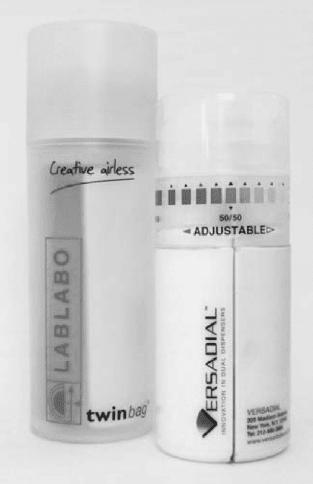
if the packaging allows variable ratio dispensing (Figure 15.2). An innovative dispensing
pack that allows dual dispensing in variable proportions from 0–100 % has been devel-
oped by the German company Variotec. Termed Dialpack, the packaging requires a simple
twisting of a dial to adjust the pump dispensers in each chamber to allow different ratio
mixes of two components with high mixing accuracy. The two substances are drawn from
their two separate cartridges by the pumps, mixed by a static mixer and then dispensed
from a pump- or spray-style closure. Cartridges can be purchased and replaced according
to need.
One of the first applications for Dialpack was Variosun, a dual dispense packaging
system containing suncream with sun protection factor adjustable from 2 to 30, so that one
Figure 15.2 Examples of dual dispense cosmetic product packaging in the form of a fixed
ratio pack from Lablabo (left) and a variable ratio product from Versadial (right).
OTE/SPH OTE/SPH
JWBK126-15 JWBK126-Kerry March 18, 2008 13:34 Char Count= 0
268 Smart Packaging Technologies for Fast Moving Consumer Goods
container for sun protection can be used for the whole family regardless of skin type and
sun sensitivity. Fiji Blend
TM
’s Shades of Darkness uses the Versadial concept to package a
tanning formulation consisting of a ‘light’ formula lotion in one half and a ‘dark’ bronzer
containing a higher percentage of the active ingredients including self-tanners and bronzers
in the other. The consumer can then decide on the required tanning level.
lonisation-enhanced Cosmetic Foundation Delivery. A packaging device that generates
low energy electrostatic charges to help deliver particulate skincare products onto the face
in a safe and effective manner, akin to airbrushing, has been developed initially for the
Japanese market but is now available more widely through Procter & Gamble’s prestige
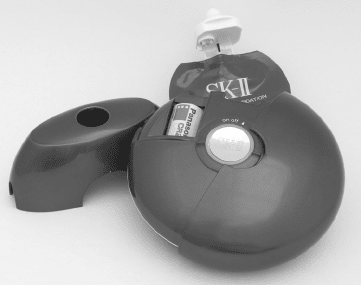
skincare line SK-II. The SK-II Air Touch Foundation (Figure 15.3) is a light, hand-held
disk that houses an ioniser and a sachet of foundation colour. The thumb-operated ioniser
positively charges the particles of foundation colour, so they are attracted to the negative
charge of hydrated skin and not to the eyes, eyebrows and eyelashes. Application of the
foundation is extremely even, producing a natural flawless complexion with no need for
blending.
Programmable Delivery of Aerosol Air Freshener. AromaPulse
TM
is a newly available
packaging technology from Hush
TM
Fragrances (St-Hyacinthe, Quebec, Canada) that de-
livers programmable air freshening for the home. Long-lasting essential oil aromas in four
separate fragrances, Mediterranean Fig, Summer Bloom, Laundered Linen and Thai Co-
conut Lime, are contained in refillable capsules and are fitted within a conventional metal
aerosol container to which is attached a programmable electronic device that controls the
delivery of the fragrance throughout the day. The user can choose from three settings to
adjust fragrance delivery: the intensity of the spray (small, medium or large), the frequency
(time) between each spray and the time intervals during the day when the device is activated.
Extra bursts of fragrance are available at anytime by activating the device manually. The
Figure 15.3 The SK-II Air Touch Foundation dispenser uses ionisation to charge foundation
particles so they are attracted to the face without covering areas of hair or the eyes, producing
a smooth, blemish-free even application.
OTE/SPH OTE/SPH
JWBK126-15 JWBK126-Kerry March 18, 2008 13:34 Char Count= 0
Health, Beauty and Personal Care 269
AromaPulse
TM
system allows the user to add scent to the air in the home without altering
the fragrance by burning it or passing it through a wick.
Ionic Charge-enhanced Skin Patch Delivery. Delivery systems based on absorption through
the skin have been used for years in the application of medication or cosmetic products.
However the skin is an effective barrier to large chemical molecules so absorption is gen-
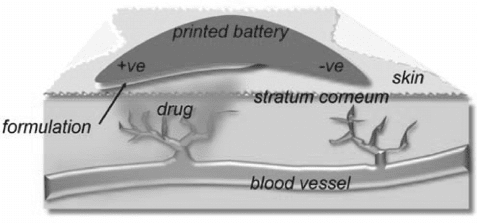
erally poor. The process of iontophoresis improves absorption and is based on the ionic
diffusion of charged radicals under a mild electrical current potential, provided by a small
flat flexible printed battery located in the skin patch, together with a self-adhesive mem-
brane impregnated with the required ionic formulation as an ointment or gel. Most drug
and cosmetic molecules are positively charged; since like electrical charges repel, the ap-
plication of a positive current will drive these positively charged molecules away from the
electrode and through the outer protective layer of the skin (stratum corneum) and into the
underlying tissues and eventually the blood (Figure 15.4). Typically the current increases
penetration through the skin by around sixteen times.
Pioneering development was done by printed battery specialists PowerPaper of Israel,
through PowerCosmetics, a separate division; since then the technology has been taken up
by a number of other companies. The initial focus has been on cosmetic formulations for
skin lightening and whitening, firming and lifting, moisturizing, slimming, and cellulite
reduction, including such problem areas as skin ageing and wrinkling, dark spots or dis-
coloration. A commercial product for facial skin applications is currently being marketed
by the Est´ee Lauder company as Perfectionist Power Correcting Patch.
Iontophoresis is also under study in oncology, lumbar punctures, and as an alternative
form of paediatric medicine, particularly for children who fear injections. Another focus of
interest concerns medications that cannot be administered in traditional ways. Some drugs,
such as insulin, cannot be given orally because they are hydrolysed in the digestive tract.
Others are excreted or metabolised, and hence intravenous administration is not effective.
This area is developing rapidly and Vyteris of Fair Lawn, New Jersey, USA, has been
granted the first FDA approval to use iontophoresis to deliver the pain killer lidocaine.
This active patch technology, termed LidoSite
r
, allows precise dosing, giving physicians
and patients control in the rate, dosage, and pattern of pain management that can result
Figure 15.4 A smart skin patch: positively charged cosmetic and drug molecules can be
driven through the tough outer skin by the process of iontophoresis.