
Kerry J., Butler P. Smart Packaging Technologies for Fast Moving Consumer Goods
Подождите немного. Документ загружается.

OTE/SPH OTE/SPH
JWBK126-14 JWBK126-Kerry March 15, 2008 18:46 Char Count= 0
Aerosol and Cleaning Sprays 249
F
+
+
r
q
q'
(a)
F
−+
r
q'
q
(b)
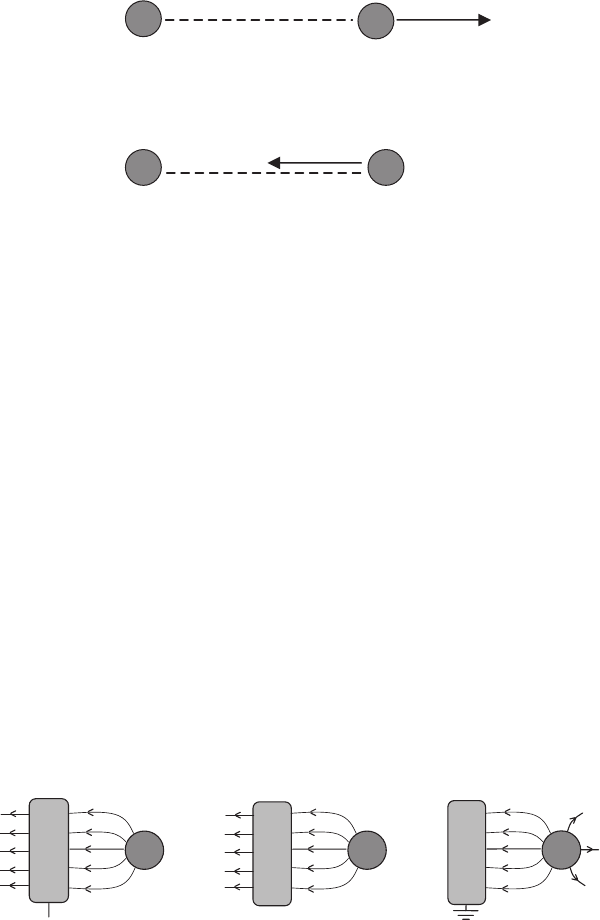
Figure 14.2 The direction of electrostatic force, F, acting on a point charge +q
in the field
of a point charge q where (a) q is positive, or (b) q is negative.
yet electrically isolated, an image charge is induced by polarisation as the charged particle
approaches, as shownin Figure 14.3(b). The worst case scenario arises where the target to be
sprayed is insulating, yet here too electrostatics spraying can still deliver some improved
performance. No polarisation or image charge can be induced in an insulating surface.
Such surfaces can exhibit long-lasting surface charges arising through triboelectrification
with objects they have been in contact with, and this can result in coulombic forces of
attraction. Where a surface does not retain a surface charge opposite in polarity to the spray
droplets, deposition efficiency can still be increased where the two are at different electrical
potentials, and thus droplets will deposit on the surface to equalise this difference.
A sufficient level of charge on the spray is a prerequisite for performance improvements
to be demonstrated. For the chargeon a particle to influence its trajectory in the air, the forces
of attraction or repulsion must overcome gravitational and inertial forces. It is generally con-
sidered that only above a charge-to-mass ratio of 100 μCkg
−1
will electrostatic forces start
to influence the trajectory of droplets (Gaunt et al., 2003a; Singh et al., 1978; Splinter, 1968).
The charge-to-mass ratio of typical off-the-shelf domestic aerosol products is in the
region of 0.01 – 1 μCkg
−1
, and in exceptional cases is as high as 10 μCkg
−1
(Gaunt
et al., 2003a,b). Similar charge levels are recorded for other household spray devices. This
−
−
−
−
−
+
+
+
+
+
+
(b)
−
−
−
−
−
+
(c)
−
−
−
−
−
−
−
−
−
−
+
−V
(a)
Figure 14.3 Attractive forces between a charged droplet or particle and a target surface. (a)
The target is maintained at the opposite potential to the charged particles. (b) The isolated
surface is polarised in the field of the charged particle. (c) The target surface is connected to
earth so as the surface is polarised the negative charge is conducted away so as to reduce the
potential to zero.
OTE/SPH OTE/SPH
JWBK126-14 JWBK126-Kerry March 15, 2008 18:46 Char Count= 0
250 Smart Packaging Technologies for Fast Moving Consumer Goods
(b)
(a)
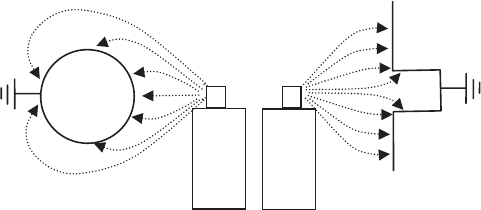
Figure 14.4 Electrostatic spraying (a), wrap-around, (b), Faraday cage effect.
charge level is insufficient to influence the trajectory of spray droplets. However, sprays
incorporating designs that include passive charging technology or promote natural charge
separation phenomena, as discussed in the following sections, can produce higher levels of
charge, sufficient to demonstrate the benefits of electrostatic spraying.
The benefits of electrostatic spraying arise when particles follow electric field lines to a
target. This results in high deposition efficiency and particles reaching the back of the target,
which is usually shielded, as shown in Figure 14.4(a). However, because particles follow
field lines it is difficult to coat inside recesses due to a Faraday cage effect (Figure 14.4b).
Estimates from the paint spraying industry suggest that electrostatic spray systems deliver
improvements from 40 % efficiency to 70 % efficiency on flat surfaces (Cross, 1987).
14.3 Natural Charge Separation Phenomenon
When liquids or solids come in contact with dissimilar materials, separation of positive and
negative charges readily occurs at the interface. Consequently, one of the materials becomes
positively charged and the other negatively charged. This process can occasionally lead to
significant static problems but can also be exploited for industrial purposes. Industries that
rely on static charge to achieve a particular process require controlled sources of static
charge, so they generally make use of corona or induction charging, powered by an active
power supply. However, it is possible to exploit the natural charge separation phenomena
to good effect, giving reliable operation over long periods of time yet eliminating the need
for bulky, expensive power supply equipment. The process for charge separation in liquids
is known as flow electrification and for solids it is called frictional or triboelectric charging.
The natural charge separation phenomena of tribocharging and flow electrification are
rarely exploited in industrial processes. However, suitable levels of charge can readily
be attained by appropriate techniques and used to generate charged sprays. Employing
passive charging realises the advantages of electrostatic spraying whilst eliminating the
disadvantages associated with power supply equipment. In delivering passively charged
sprays, the spray device usually requires little modification, or demands a novel design that
can be little more costly or complex than a conventional system. What can be necessary
is more careful attention to quality control and the need to earth components of the spray
device, usually through the user.
OTE/SPH OTE/SPH
JWBK126-14 JWBK126-Kerry March 15, 2008 18:46 Char Count= 0
Aerosol and Cleaning Sprays 251
−
+
−
+
−
−
−
+
Metal
−
+
−
−
+
−
+
Compact
layer
Diffuse layer
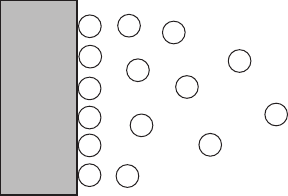
Figure 14.5 Schematic diagram of the electrical double layer of a solid–liquid interface.
14.4 Flow Electrification for Charge Separation
Flow electrification, sometimes known as double-layer charging, is a phenomenon whereby
liquids accumulate charge as they flow. The phenomenon is observed during pumping and
transport of petroleum products, where it can be particularly hazardous if uncontrolled (as
reviewed by Klinkenberg and Van der Minne, 1958). Electrification in liquids can also be
exploited to generate naturally highly charged liquid sprays.
Charge reorganisation occurs on a microscopic scale in liquids at any interface, with a
solid, a gas or another liquid. One polarity of charge is held relatively tightly bound at the
interface, known as the compact layer, with ions of the opposite polarity held much more
weakly as a diffuse layer. The immobile ions of the compact layer and the diffuse layer
of counterions in the liquid together make up the electrical double layer, as represented
schematically in Figure 14.5. The nature of the electrochemical reaction at the interface
depends upon the interaction between the solid and liquid constituents, and this determines
the net flux of electrical charge comprising the double layer. The distance that the diffuse
layer extends into the bulk of the liquid depends on the liquid’s conductivity. For water
based liquids where conductivity is greater than 10
−6
Sm
−1
the diffuse layer is only a few
molecules thick. For liquids where the conductivity is of the order of 10
−11
Sm
−1
, the
diffuse layer may extend a macroscopic distance from the interface. When the liquid is
moved across a surface, such as during spraying, the diffuse, weakly bound, layer of charge
is entrained within the liquid bulk, leaving the compact charge layer attached to the solid.
As charge from the diffuse layer is entrained, the electrical potential in the bulk liquid rises,
and when the liquid loses contact with the surface, such as on atomisation, the charge is
retained on the droplets. If the charging process is to continue, then the charge at the surface
must be replenished by moving through the walls of the pipe. In a metal pipe, current of
the order 10
−9
to 10
−14
A is recorded. Such low levels of current are able to flow through
some insulating pipes and not limit charge separation. Alternatively, the more conducting
boundary layer at the solid–liquid interface can also provide a conduction path to earth and
thus allow charging to continue indefinitely.
The amount of charge accumulated by liquid flowing in a pipe is limited by liquid
conductivity, among other factors. A highly conducting liquid cannot accumulate charge
OTE/SPH OTE/SPH
JWBK126-14 JWBK126-Kerry March 15, 2008 18:46 Char Count= 0
252 Smart Packaging Technologies for Fast Moving Consumer Goods
as the rate at which ions diffuse to the pipe wall to be discharged is very rapid. A perfectly
pure insulating liquid will not charge because there are insufficient dissociated ions to carry
the charge. The conductivity over which charging is observed is 10
−13
to 10
−7
Sm
−1
, while
the charge generation rate reaches a maximum at the order of 10
−10
Sm
−1
(Cross, 1987).
Flow factors are equally important in determining the charge levels attained. Liquid
charging increases with increasing flow velocity and turbulence. During laminar flow there
is little or no radial movement of the double layer. With the transition from laminar to
turbulent flow, the diffuse layer of charge begins to be distributed across the bulk of the
liquid by turbulent transport, and as turbulence increases the thickness of the laminar
sublayer at the solid surface is reduced. The presence of a filter, valve or pump in the flow
line can also enhance charging by several orders of magnitude, due to increased turbulence
and the increase in surface contact in relation to the volume of liquid.
14.5 Frictional Charging
The effects of contact and frictional charging can be easily observed when scraps of tissue
paper are picked up after rubbing a comb, from the small electric shocks delivered when
touching a door handle after dragging your feet across a carpet, or the crackle heard as a
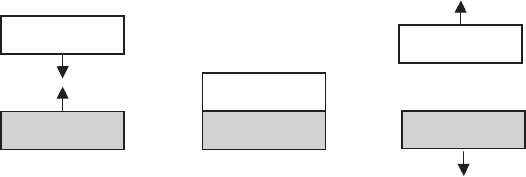
woollen jumper is removed on a dry day. When two solids come into contact, charges are
exchanged as shown in Figure 14.6. This represents an over simplification of the situation,
as both surfaces retain areas of negative and positive charge, yet one charge predominates.
Charge reorganisation at the interface brings the materials into thermodynamic equilibrium,
and as the surfaces are separated the excess charge is retained.
The amount of charge transferred during contact is determined by a number of factors.
In a simple, non-sliding, contact the amount of charge transferred to an insulator is gener-
ally proportional to the work function of the materials, and can be influenced by surface
imperfections and impurities (Cross, 1987). In practice charging is often achieved when
surfaces are rubbed together and in this case the energy of rubbing is more influential than
the nature of the materials. From knowledge of the materials it is seldom possible to pre-
dict how much charge will be transferred in a particular circumstance since the frictional
charging process is so complex. It is possible though, within limits, to predict the relative
Material A
Material B
−
+
−
+
−
+
−
+
−
+
−
+
−
+
−
+
−
+
−
+
(a)
(b)
(c)
Figure 14.6 The three stages of triboelectric charging: (a) two dissimilar materials are brought
into contact; (b) charge transfer occurs at the interface; (c) separation of the surfaces each with
its excess charge.
OTE/SPH OTE/SPH
JWBK126-14 JWBK126-Kerry March 15, 2008 18:46 Char Count= 0
Aerosol and Cleaning Sprays 253
Table 14.1 Triboelectric series. Materials at
the top of the table charge positively when
rubbed against materials below them in the
series (from Taylor and Secker, 1994).
Material
+ Asbestos
Glass
Human hair
Nylon
Wool
Lead
Aluminium
Cotton
Steel
Copper
Silver
Sulfur
Polyester
Polyurethane
Polypropylene
PVC
Silicon
− Teflon
polarities of the materials using a triboelectric series, such as given in Table 14.1. Materials
tend to charge positively against materials below them in the series, and this prediction is
more reliable the further apart the materials are from each other. The series does not give
any predictions relating to the magnitude of charge transferred, however. This is shown
when samples of identical materials are rubbed together, and substantial charge transfer
can occur. Many triboelectric series exist, and can differ from each other in some respects
due to small differences in the basic material and the test procedure used. However, it is
possible to identify trends. Contact between a metal and a plastic surface invariably leaves
the metal with a net positive charge and the plastic with a net negative charge. A rubbing
contact will impart several orders of magnitude more charge than will a simple, non-sliding
contact. Since charge transfer depends on the force and velocity of the contact, the charge
acquired by a particular material depends much on the energy of rubbing. As an example,
the level of charge generated during powder handling by grinding is in the order of 0.1 to
1 μCkg
−1
and by pneumatic transfer in the order of 1 to 100 μCkg
−1
.
14.6 Domestic Aerosol Sprays
Passively charging domestic aerosol sprays have recently been developed and success-
fully marketed for the household pest control sector. The technology (Gaunt and Hughes,
2003b), although challenging to implement, represents one of the most significant technical
OTE/SPH OTE/SPH
JWBK126-14 JWBK126-Kerry March 15, 2008 18:46 Char Count= 0
254 Smart Packaging Technologies for Fast Moving Consumer Goods
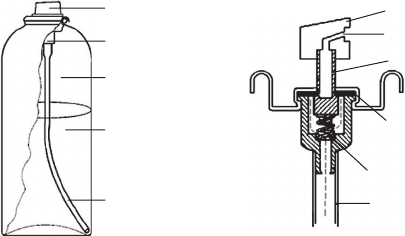
Actuator
Actuator
Valve Stem
Terminal Orifice
Valve
Gaseous
Propellant
Mounting Cup
Liquid
Formulation
Valve gasket
Spring
Dip tube
Dip tube
Figure 14.7 Schematic drawing of the main components of a domestic aerosol product and
a valve in the open position.
advances in aerosol technology since the invention of the pressure-pack spray in the late
1800s (Sanders 1970). Sprays with optimised formulation and pressure parameters fitted
with an actuator that promotes shearing of the electrical double layer can produce higher
levels of charge, sufficient to demonstrate the benefits of electrostatic spraying. Charging is
achieved by exploiting flow electrification. Formation and shearing of the electrical double
layer at the liquid/solid interface is maximised to promote the level of charge carried on
the formulation as it is atomised. Factors that affect the level of charge accumulated include
the electrochemistry of the liquids and solids interacting, flow parameters such as turbulence
and velocity, and the contact area between liquid and solid (Gavis and Koszman, 1961).
The modern domestic aerosol comprises a propellant, a solvent and an active, ingredient
packaged in a container equipped with a valve for discharging the liquid formulation when
required and an actuator for delivering the desired spray characteristics of flow rate, droplet
size distribution and cone angle. The main components of a typical dispenser are shown in
Figure 14.7. The propellants commonly used are liquid hydrocarbon gas (butane/propane
mix) or compressed gas. The formulation can be a homogeneous or a heterogeneous emul-
sion, the latter either having a water or oil continuous phase. Spray characteristics are
critical to good spray performance, and largely determined by actuator parameters such as
swirl chamber geometry, orifice dimensions and also by propellant type and pressure.
The conductivity of the formulation is one important factor in successfully delivering
this electrostatic technology. It is the conductivity of the formulation that determines the
depth of the electrical double layer that forms at the interface of the liquid and solid,
and thus the level of electrification of the liquid. The range of conductivities over which
charging is observed is between 10
−7
and 10
−13
Sm
−1
, where the double layer may extend
a macroscopic distance from the interface (Cross, 1987). Where the formulation must
comprise a significant percentage of water for reasons of economy and performance, this
seems impossible to achieve. The conductivity of tap water is typically in the order of 10
−2
Sm
−1
and deionised water is in the order of 10
−4
Sm
−1
, resulting in a double layer only
a few molecules thick. In overcoming this, the properties of emulsions can be exploited.
By enclosing the water in a water-in-oil emulsion, it is possible to obtain a formulation of
more suitable conductivity, such that formation of the double layer is promoted and a high
water content can be retained.

OTE/SPH OTE/SPH
JWBK126-14 JWBK126-Kerry March 15, 2008 18:46 Char Count= 0
Aerosol and Cleaning Sprays 255
To maintain formulation conductivity within suitable boundaries, it is also useful to use
liquid hydrocarbon gas (LPG) propellants rather than compressed gas. The conductivity of
a butane/propane mix, being of the order of 10
−8
Sm
−1
, makes LPG a suitable ingredient.
Conversely carbon dioxide, a commonly used compressed gas propellant, dissolves in and
increases the conductivity of the water phase. The use of liquid hydrocarbon propellants is
also important in maintaining a high and constant pressure, ensuring consistent charging
for the lifetime of the product. LPG propellants also contribute to generating an aerosol
product with a small and even droplet size distribution. This is important as a higher level
of charge would be required to impart electrostatic benefit to larger diameter droplets.
Selection of the dispenser components primarily influences shearing of the double layer.
Promoting flow velocity, flow turbulence and increasing the contact area between liquid
and solid can increase the charge imparted to the spray on atomisation. As charge accu-
mulated in the liquid bulk always has an opportunity to relax further along the system, it
is the modifications made at the actuator level that are most influential in determining the
ultimate charge imparted. Thus, selection of actuator orifice diameter and swirl chamber
configuration can affect the charge-to-mass ratio by over two orders of magnitude. To in-
crease further the contact area between liquid and solid at the point of atomisation, novel
terminal orifice designs have been developed. A standard circular orifice has the lowest
possible area of contact, so any deviation from this can be expected to promote charge
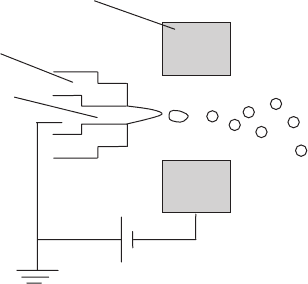
levels. For example, Figure 14.8 shows the commercialised novel actuator orifice design
along side a conventional orifice delivering the same flow rate.
Through combinations of suitable formulations and actuator selections, charges in excess
of 100 μCkg
−1
can be attained. Such systems consistently generate this level of charge
for the lifetime of the product due to the stability of an optimised assembly. Variations
in ambient temperature and relative humidity affect charging very little. Once generated,
aerosol droplets in the air do not lose their charge. As a droplet evaporates, charge is retained
on the droplet and thus the charge-to-mass ratio actually increases, enhancing electrostatic
effects.
(a) (b)
Figure 14.8 Actuator orifice shapes: (a) a conventional circular orifice; (b) a charge-promoting
segmented orifice with the same cross-sectional area as (a). The grey shaded area represents
the solid parts.
OTE/SPH OTE/SPH
JWBK126-14 JWBK126-Kerry March 15, 2008 18:46 Char Count= 0
256 Smart Packaging Technologies for Fast Moving Consumer Goods
14.7 Induction Charging for Charge Separation
Exploitation of the flow electrification phenomenon is not suitable for all spray applications.
Where very high water content formulations are to be used, or where a liquid hydrocarbon
propellant in a pressurised devicecannot be used, an alternativecharging method is required.
In industrial applications, charging is usually achieved by corona or induction charging.
Corona charging is not appropriate for a passive charging technology, as the high electrical
potential required to drive a corona discharge can realistically only be achieved using a
conventional power supply. A system using induction charging can be designed, exploiting
only natural charge separation phenomena. Real charges induce image charges in adjacent
conductors, as shownin Figure 14.3(c). This can be used in spray applications by atomising a
conducting liquid in an electric field, as shown in Figure 14.9. The liquid will be earthed and
act as the earth electrode to create the electric field. As the liquid filament enters the electric
field region, charges flowinto the liquid from earth. Once the liquid is atomised into droplets,
the excess charge is retained and a charged aerosol is produced. The principle determinants
of charge are the liquid’s conductivity and the voltage between the two electrodes. This
technique is suitable for devices such as pump- and trigger-actuated sprays of the type used
for some domestic cleaning products and beauty and personal care products.
In conventional induction charging spray devices, the voltage on the induction electrode
is achieved with a power supply. In a passive system however, it can be charged by triboelec-
trification (Gaunt and Hughes, 2003a,b). The charge imparted to spray droplets is highly
dependent upon the design of the induction electrode, but a charge in the region of 1–100
nC on the induction electrode is sufficient to achieve charge levels on the spray in excess of
100 μCkg
−1
. 1–100 nC of surface charge can be readily attained by tribocharging between
two materials. The induction electrode when appropriately designed and constructed from
a conducting material allows intensification of an electric field at the point where a liquid
filament fragments into droplets. The induction electrode must be electrically isolated to
minimise leakage of static charge. Contact or rubbing with a suitable polymer or other
insulating material then imparts high levels of surface charge to the induction electrode.
−
+ + +
+ + +
−−
−
−
Cylindrical induction
electrode
Continuous with
liquid reservoir
Spray nozzle
−
−
−
−
−
−
−
+ + +
+ + +
Figure 14.9 Schematic representation of induction charging of a liquid aerosol.
OTE/SPH OTE/SPH
JWBK126-14 JWBK126-Kerry March 15, 2008 18:46 Char Count= 0
Aerosol and Cleaning Sprays 257
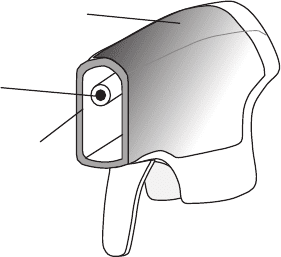
Induction electrode
Spray orifice
Induction charging
zone
Figure 14.10 Schematic drawing of the passive-charged trigger-actuated spray device.
In pilot studies, an induction electrode of aluminium was electrically isolated using
a polymer-supporting base. The induction electrode surrounds the components making
up the spray device, such that the electric field is intensified around the point of liquid
atomisation. The induction electrode is conducting so that charge is mobile in the material,
allowing the electric field to intensify in the desired location. A prototype device is shown
in Figure 14.10. The induction electrode is charged by rubbing with an insulating material.
It is preferred that this material be relatively insulating in order to maximise the level of
charge imparted. A charge of 20 nC on the induction electrode charges a spray of water to
a charge-to-mass ratio of 140 μCkg
−1
, which compares with a conventional charge level
of 5 μCkg
−1
when there is no static charge on the electrode. Higher electrode charges
generate higher spray charge-to-mass ratio values.
The design of the electrode with respect to the point of liquid atomisation is critical in
maximising aerosol charging. Droplets must break away from the grounded liquid filament
at the point of highest electric field in order to maximise charge levels. One advantage of
this device is that charge is retained on the induction electrode rather than being lost or
given up during spray generation. Surface charge will decline with time due to relaxation
and surface leakage, and thus spray charge levels will similarly decline. This is reflected
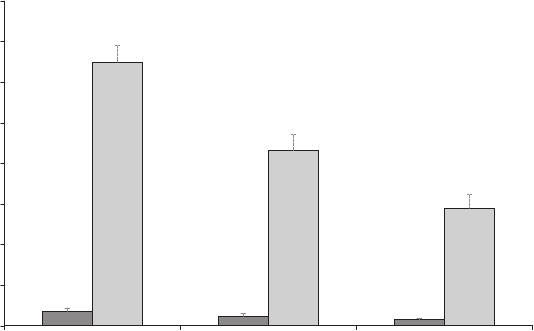
in Figure 14.11, which shows how successive atomisations from a trigger-actuated spray
are charged without the level of charge on the induction electrode being topped up. The
implications for the technology here are that for each successive spray achieved by trigger
actuation, the charge on the induction electrode only needs to be topped up and not totally
generated in each actuation.
This technology is not currently restricted from commercial applications by the ability
to impart charge to the droplets, which can readily be achieved. Instead it is the pump- and
trigger-actuated spray technology which presently limits application of this technology.
The droplet size distribution of the aerosol produced from these types of spray in relatively
large, having a MMD (mass median diameter) in the region of 50 to 150 μm compared with
20 to 50 μm for LPG-pressurised aerosols. In order to realise the benefits of electrostatic
spraying, droplets of this size would require a charge-to-mass ratio exceeding that rea-
sonably achievable by passive charging techniques. As better spray technology inevitably
becomes available, two-stage passive charging by triboelectrification and induction will
become worthwhile.
OTE/SPH OTE/SPH
JWBK126-14 JWBK126-Kerry March 15, 2008 18:46 Char Count= 0
258 Smart Packaging Technologies for Fast Moving Consumer Goods
0.0E+00
2.0E−05
4.0E−05
6.0E−05
8.0E−05
1.0E−04
1.2E−04
1.4E−04
1.6E−04
First spray Second spray Third spray
Spray charge (C/kg)
Figure 14.11 Charge-to-mass ratio of successive trigger sprays of water. The induction elec-
trode is charged once by triboelectrification to 0 C or to 20 nC .
14.8 Realised Benefits
Modern domestic aerosols are widely used to deliver air fragrances, insecticides, deodor-
ants, household surface care and other products. In the majority of these applications the
purpose is to deliver an active ingredient onto a surface, and therefore electrostatic spray-
ing will achieve a performance enhancement as a result of attraction of the spray onto the
surface, and a more even coating and deposition of droplets onto surfaces not in the direct
line of fire by wrap-around.
A case study of charged domestic insecticide aerosols provides evidence for the level
of efficiency improvements attainable. In this example, the bioefficacy of a commercially
available insecticide aerosol with a charge-to-mass ratio of 20 μCkg
−1
was compared
with the same product, which had been modified according to the principles described
above to give a charge-to-mass ratio of 200 μCkg
−1
. In two bioassays using house flies
and mosquitoes the rate at which the insecticide spray took effect was increased by 25 %
(Gaunt et al., 2003a). The bioassay mimics the use of an insecticide spray against insects
in flight, so involves releasing 50 insects into a room in which a spray of insecticide has
recently been introduced. A typical result for the rate of knockdown (a state of paralysis in
which the insect is incapable of coordinated movement) in house flies is shown in Figure
14.12. The charged aerosol consistently achieves faster knockdown than the conventional
spray, signifying a faster rate of deposition onto insects in flight.
Insects in free flight are electrically isolated, conducting, targets. Charged droplets in
close proximity to an insect will cause local polarisation of charges, as indicated in Figure
14.3(b). Attraction of droplets to the insect in this way will increase deposition efficiency.
Space charge forces within the cloud of charged aerosol droplets will disperse the spray to
a greater degree into all areas of a space. Typical behaviour of insects means that they tend