
Kerry J., Butler P. Smart Packaging Technologies for Fast Moving Consumer Goods
Подождите немного. Документ загружается.

OTE/SPH OTE/SPH
JWBK126-15 JWBK126-Kerry March 18, 2008 13:34 Char Count= 0
270 Smart Packaging Technologies for Fast Moving Consumer Goods
in considerable therapeutic, economical, and lifestyle advantages over existing methods of
drug administration.
15.2.2 New Forms of Consumer Convenience and Functionality
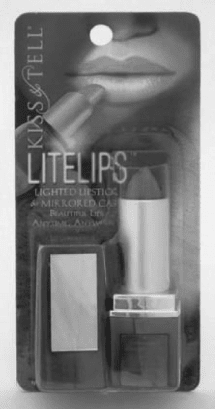
Packaging with Built-in Illumination. On-the-go convenience when using a cosmetic
product such as makeup is a major driver in the development of smarter packaging. Poorly
lit environments are commonplace in situations where makeup needs to be applied or
readjusted, for example in the back of a taxi, and this consumer need has lead to the devel-
opment of a range of light-up cosmetic packaging by Robert DuGrenier Associates under
the brand name Litelips. The collection includes packages for lipstick, lipgloss, mascara
and nail polish; each has one or two small LED lights incorporated into the packaging,
either in the base or cap of the unit that shines directly in line with the applicator, together
with a small mirror built into the case (Figure 15.5). Various switch options are offered: a
push button at the end of the cap, a sliding switch or an internal switch that is activated as
the product is twisted to remove the applicator. The estimated lifespan of the LED lights is
56 hours.
Self-cooling Packaging for Face Cream. Lipids (fats, oils, waxes, etc.), the basic materials
used in cosmetic products, are believed to undergo molecular retraction on rapid cooling,
which make them penetrate the skin better. Once absorbed, they regain their initial structure
and can have an immediate cosmetic uplifting effect on the skin of the face and neck,
markedly reducing wrinkles and other blemishes.
Figure 15.5 Application of make-up in poorly lit environments is facilitated by the built-in
illumination and mirror of the product packaging in the Litelips range of cosmetics.
OTE/SPH OTE/SPH
JWBK126-15 JWBK126-Kerry March 18, 2008 13:34 Char Count= 0
Health, Beauty and Personal Care 271
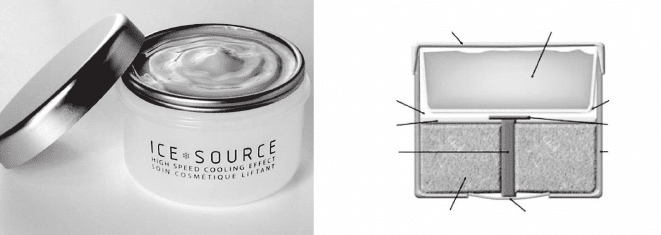
cover cosmetic cream
water gel layer
valve
insulation
button actuator
zeolite
actuation
tube
separator
vacuum
Figure 15.6 Cosmetic face cream in a self-cooling container. Cooling is initiated via a button
at the base; this breaks a vacuum seal between an upper chamber surrounding the metal dish
containing the cream, and a lower chamber containing zeolite. Water evaporates from the
dish surface, cooling the cream.
Packaging for face cream that allows this rapid quenching effect has been developed by
Thermagen, based on heat pump technology. The self-cooling packaging contains around
22 ml of Ice Source
r
face cream in the upper container, whose external surface is coated
with a water-containing gel, and a zeolite desiccant in a lower chamber (Figure 15.6). To
use, a button is pressed at the base of the container to start the cooling process. This opens
a vacuum valve between the upper and lower chambers, causing water to evaporate from
the gel and be absorbed by the desiccant in the base of the device, leading to a fall in
temperature of the face cream of around 20
◦
C within 2 minutes. The ice-cold cream is
then applied to the face and neck and it is claimed to result in a reduction in wrinkles by
up to 21 % by relaxing the skin, particularly around the eyes.
15.2.3 Improved Consumer Communication
Packaging that Communicates the Product Attributes. Syrups, elixirs, solutions and sus-
pensions are traditional dosage forms for oral medication, where liquid formulations are
typically measured by pouring into a spoon. This approach has the great drawback of
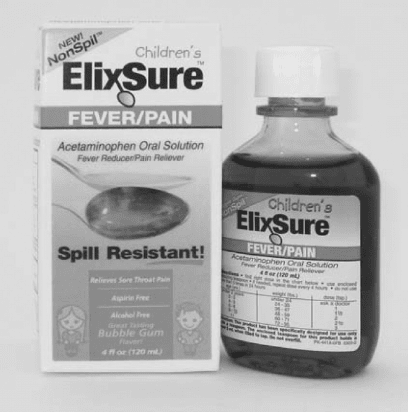
spillage, particularly when dosing small children. A no-spill medication for fever/pain and
cough or congestion has been developed by Taro Pharmaceuticals in the form of a liquid
gel, made by combining a pharmaceutically active ingredient in a liquid base with a thick-
ening agent, so that the medication will stay on a spoon even if it is turned 90 degrees or
upside down. The spill-resistant paediatric formulations are designed to provide parents
with increased ease and accuracy of dosing. The products using this technology, called
NoSpil
TM
, are sold across the US under the ElixSure brand (Figure 15.7).
In order to signal ‘spill proof’ to the consumer, the paperboard outer packaging features
a lenticular graphic on the spoon illustration on the front panel. Initially this produces
an attention-grabbing ‘winking’ effect as two images of a spoon flip back and forth as
consumers pass by the product on the store shelf. But the secondary communication plays
to the product’s unique attribute of spill resistance. One image shows a level spoon with
OTE/SPH OTE/SPH
JWBK126-15 JWBK126-Kerry March 18, 2008 13:34 Char Count= 0
272 Smart Packaging Technologies for Fast Moving Consumer Goods
Figure 15.7 Increased ease of use and accuracy of dosing is provided by this spill-resistant
medicine for children by Elixsure. The outer packaging communicates the no-spill character-
istics of the formulation by lenticular graphics.
product in it, while the other image displays the spoon tipped on its side. The product
remains in the tipped spoon.
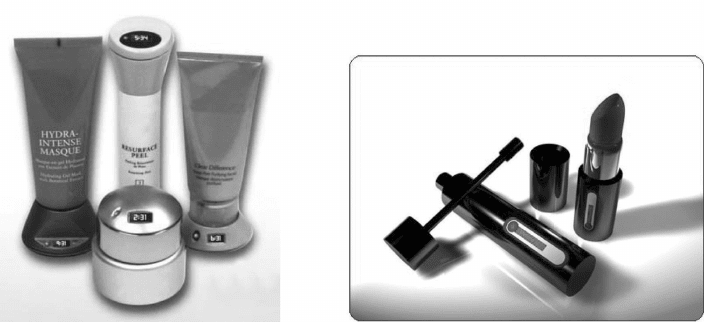
Packaging that Helps Users Manage Cosmetic Product Application and Shelf Life. An
electronic packaging innovation that helps consumers time how long their cosmetic treat-
ment should last, and even alerts them as to the time and date of their next treatment,
has been developed by Production Innovations, a California-based packaging technology
company. It is claimed that P3 – which stands for Precise, Product, Performance – can
help consumers using time-sensitive products to use them more precisely and even more
regularly. The innovation incorporates a microprocessor into the packaging cap, compli-
mented by an LED light that blinks, as well as an LCD readout that times the length of the
application. The timing mechanism is activated when the cap is opened, and begins when
the cap is closed after an application dose has been removed from the packaging. At the
end of a preprogrammed time, the cap beeps and the LED flashes. The targeted application
products are any time-sensitive cosmetic treatments, such as facial peels, face masques
and hair dyes. The product has been designed to have a minimum impact on the appear-
ance of the packaging, blending into the cap in a way that does not detract from branding
or the overall design, and can also be retrofitted to a wide variety of packaging styles
(Figure 15.8).
Many cosmetic products contain ingredients whose effectiveness ages with time once
the packaging is opened, and products that are used infrequently by the consumer may
well become ineffective, unsuitable, or even dangerous to health, after long periods of
storage. This is because although most cosmetic products contain preservatives that inhibit
OTE/SPH OTE/SPH
JWBK126-15 JWBK126-Kerry March 18, 2008 13:34 Char Count= 0
Health, Beauty and Personal Care 273
Figure 15.8 (Left) Electronic programmed packaging closures that help consumers time the
length of a cosmetic treatment, and remind them of the next. Reproduced with permission
of production Innovations LLC. (Right) Integrated colour-change label signals consumers to
throw away ineffective and possibly contaminated cosmetics that have exceeded their shelf-
life. Reproduced with permission from Timestrip Plc.
microbiological growth, eventually bacterial breakdown can occur, leading to possible
harmful effects if the product is then applied to delicate parts of the body, such as the eyes.
This may be a growing problem with the increased use of ‘natural’ or ‘green’ cosmetics,
which may not contain preservatives and therefore once opened may have very short shelf-
lives. The issue becomes one of remembering when the product was opened in the first
place, particularly for short shelf-life products that are easily contaminated.
The shelf-life for eye-area cosmetics is more limited than for other products. Mascara is a
good example. This normally has a shelf life of around 3 to 6 months. Apart from drying out
after an extended opening period, the biggest danger is contamination by the pump action
of the bush, which can force bacteria into the container where the moist, wet environment
is ideal for growth. Subsequent application to the eye area may result in infection, such as
conjunctivitis. Moisturisers and creams can also harbour bacteria picked up from the hands
and fingers. In development for such products is Timestrip
r
, a smart label that monitors
how long a product has been open. Once activated, in this case as the cosmetic product is
first opened, the label turns progressively red as liquid diffuses from a small reservoir along
a porous strip, indicating the passage of time. The strips can be manufactured to measure
elapsed time from minutes up to over a year, at various temperatures, and the simple visual
signal tells a consumer when to discard a product safely. Concept mascara and lipstick prod-
ucts are illustrated in Figure 15.8 where the Timestrip
r
is integrated within the packaging.
Compliance Packaging for Pharmaceuticals. An example of a simple and cost-effective
mechanical closure for medication packaging in bottles, jars and vials has been launched
by Neville & More. The closure works by automatically indexing each time it is operated,
indicating when the bottle or jar was last opened and acting as a reminder to the patient to
take their next dose of medication. The closure supports four different prescription regimes,
OTE/SPH OTE/SPH
JWBK126-15 JWBK126-Kerry March 18, 2008 13:34 Char Count= 0
274 Smart Packaging Technologies for Fast Moving Consumer Goods
from once to four times daily. Increased functionality can be obtained from a packaging
closure by incorporating electronic circuitry, simple displays and LEDs, together with a
miniature battery power source. Such electronic smart packaging devices are slowly gaining
acceptance although cost remains an issue.
Remind Cap
r
closures are simple electronic timing closures that fit vials or bottles and,
once programmed for a particular dosing regime, signal to the patient the intervals between
doses via a series of beeps and a flashing light. The ScripTalk
r
Talking Prescription Label
System has been developed by En-Vision America to improve compliance and safety for
patients who have difficulty reading or understanding instructions or warnings on prescrip-
tion labels. The device has a microchip embedded in the label that is automatically printed,
programmed and fixed to the container at the pharmacy. At home, the patient uses a hand-
held ScripTalk Reader, which is capable of reading the prescription information stored on
the microchip in the language of choice using speech synthesis technology, enabling the
visually impaired to take their medication correctly.
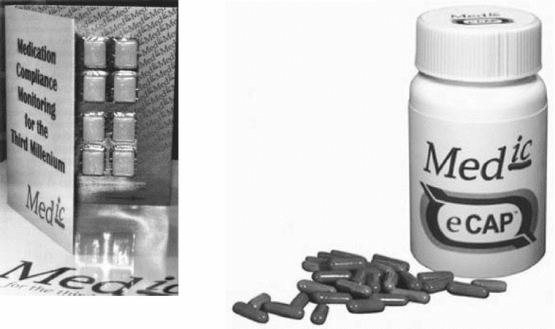
The Med-ic
TM
Smart Package uses an onboard CPU embedded in a blister package to
record each time a pill or capsule is removed. The RFID tag records the time for later
analysis, such as at repeat prescription time or on a follow-up visit to a health centre, when
the information can be downloaded through a 13.56 MHz RF wireless reader and displayed
graphically. When used for clinical trials, at the end of the trial period the patient returns
the blister package and the information is downloaded to a database.
A second variant has been launched – a smart medication bottle termed eCAP
TM
.It
reminds the patient when the next dose is due and records the time the patient opens the
bottle to remove the tablet or capsule, without active patient input. The information is then
retrieved by the reader for review by a doctor or pharmacist. Both variants of these smart
pharmaceutical packages are shown in Figure 15.9.
Cerepak
TM
by MeadWestvaco employs smart technology to measure and improve pa-
tient compliance. It reminds patients when to take medication, records when they do, and
Figure 15.9 Two variants of smart pharmaceutical packaging from Information Mediary – for
blister packs (left) and tablets or capsules (right). Reproduced with permission from Information
Mediary Corp (IMC).
OTE/SPH OTE/SPH
JWBK126-15 JWBK126-Kerry March 18, 2008 13:34 Char Count= 0
Health, Beauty and Personal Care 275
reports that data back to their doctor or pharmacist. The technology was developed in con-
junction with Cypak AB, a Swedish technology firm. Low cost, non-metallic (graphite),
non-toxic, screen-printable, conductive inks are used to create the circuit board, sensors
and antenna on a paperboard substrate in a single stage production process. The sensors
are capable of detecting and recording events – such as a broken seal, an opened lid, or
damage to the package – with a timestamp, and can also form an electronic questionnaire
for subjective data collection. A small (7 mm
2
) silicon microchip is adhesively bonded
to the printed circuitry having 32 kb of memory (15 pages of information), 32 inputs for
sensors detection, a clock, piezoelectric reminder signal and temperature sensor capabil-
ity. A lithium-manganese dioxide button battery powers the device, which has low power
consumption that gives a long operating time using minimal battery power.
Cerepack and the initial Cypak electronic compliance packaging (ECP) use standard blis-
ter packaging, and each removed dose is recorded with current date and time-stamped, then
transferred to a target database over the Internet, with maximum security. Information from
the ECP can be retrieved at any time by placing the wallet onto a scanner connected to a PC.
The Helping Hand
TM
from Bang & Olufsen Medicom is a convenient packaging device
designed to help people to manage their medication. It discreetly reminds the patient when
it is time to take a tablet, and also has a guiding function that records how well the dosing
schedule has been followed.
15.3 Latest Developments and Future Opportunities
15.3.1 Better Product Protection
Functional three-component polymers havebeen developed and are starting to be introduced
as packaging materials for the pharmaceutical industry. In film, insert or as part of the
container, these materials will be capable of absorbing degrading gaseous components,
such as oxygen and water vapour, or any other chemically active molecule that might
migrate through the interconnecting transmitting channels into the polymer matrix. One
potential application is in the packaging of complex and sensitive chemical DNA test
strips and diagnostic strips and patches, which will increasingly be found as part of home
healthcare diagnostic kits.
CSP Technologies is commercialising a new series of patented polymeric materials
consisting of three-phases – a polymer, a channelling agent, and an active component
in particulate form, such as silica gel, desiccant combinations, zeolite, cations, biocides,
herbicides or pigments. The three components are thoroughly mixed and processed to
create a three-phase system that contains a network of interconnecting channels leading
from the surface to the entrapped active particles. This unique polymer matrix technology
enables active functionality in the control of humidity for containers for pharmaceutical,
nutriceutical, and personal care products by maintaining a constant, predetermined relative
humidity. Activ-Vial
TM
is a one-piece, injection-moulded container with a flip-top lid that
has been commercially introduced to eliminate moisture damage in glucose strip packaging.
Tamper evidence packaging assurance is a further need. Tamper evidence technologies
that cannot easily be replicated, e.g. based on optically variable films, or gas sensing dyes
involving irreversible colour changes, are becoming more widespread and cost effective
OTE/SPH OTE/SPH
JWBK126-15 JWBK126-Kerry March 18, 2008 13:34 Char Count= 0
276 Smart Packaging Technologies for Fast Moving Consumer Goods
for the disposable packaging of commodity items, but smart materials might offer a better
route. For example, piezochromic polymeric materials might be incorporated into package
construction so that the package changes colour at a certain stress threshold. In this way,
for example, a ‘self-bruising’ closure on a bottle or jar might indicate that attempts had
been made to open it.
15.3.2 Better Product/Packaging Communication
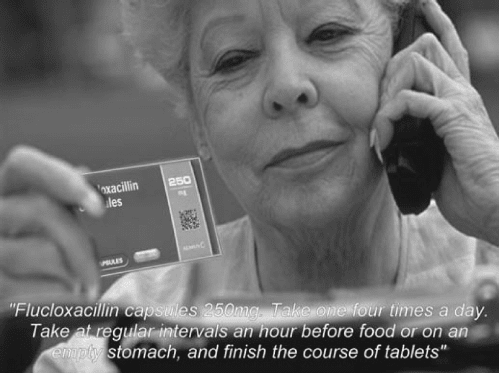
With so much focus on RFID in packaging, the humble barcode is frequently presumed
to be on a fast track to obsolescence with nothing new to offer. However, when printed
as a two-dimensional data matrix code, content is significantly increased, and although
still requiring a line-of-sight reader, these barcodes could offer potential applications in
improving the consumer/packaging interface. As an example, a stand-up retort pouch of
Heinz soup sold in Japanese grocery stores has a printed 2-D barcode that when interrogated
by consumers via the camera mode on their mobile phones, connects the user to the Heinz
website, where recipes, branding information and various downloads can be found. In the
future as the amount of legal and discretionary label information grows, there will be a need
for supplementary audio and visual components to communication, particularly where the
ageing population is concerned, which can have difficulty reading fine text (see Figure
15.10).
In the past, the evolution of electronic smart packaging has been hampered by the lack of
small, low-cost, powersources. This translates to relativelybulkyand expensivedevices that
characterise the commercial examples of electronic smart packaging today. In the future,
technological developments in piezoelectric materials, organic photovoltaics and thin-film
printed batteries are expected to overcome these limitations and become cost effective for
Figure 15.10 Smart packaging of the future might communicate messages about the product
via simple printed 2-D barcodes that can be interrogated and then listened to, with a camera
phone.
OTE/SPH OTE/SPH
JWBK126-15 JWBK126-Kerry March 18, 2008 13:34 Char Count= 0
Health, Beauty and Personal Care 277
packaging applications even of commodity products. On-board power will deliver sound,
vision and sensing opportunities for packaging and, in an increasingly track and trace world,
active RFID tagging at item level.
15.3.3 Better Product Delivery
The objective of an ideal drug delivery system is to place effective medical agents in specif-
ically targeted parts of the body. From advances in nanotechnology, nanoparticles, micro-
capsules and nanoemulsion technologies are becoming important as carriers for healthcare,
cosmeceuticals, colour cosmetics and personal care products, which in turn require new
and innovative packaging delivery systems. More acceptable, effective and convenient
packaging devices under consideration include aerosol inhalation devices, forced-pressure
injectables, biodegradable polymer networks designed specifically to transport new gene
therapies, and transdermal methodologies such as iontophoresis. As an example, new types
of electronic aerosol inhaler are being developed that provide not only more efficient de-
livery but also user-friendly features such as dose counting, overdose prevention, dose-due
alarm, breath-delivery coordination and data logging. The need for user effort and coordi-
nation is significantly reduced.
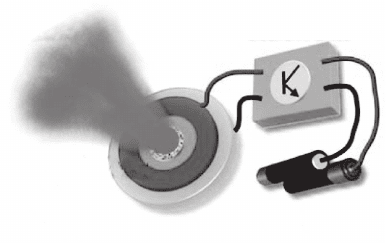
One particularly promising technology, TouchSpray
TM
is an electronic, propellant-free,
aerosol for delivering liquid drugs via the lungs and nasal cavity developed by The Tech-
nology Partnership (TTP). It uses conventional battery power to activate a piezoelectric
element attached to a thin foil membrane containing multiple tiny holes. As the surface of
the foil comes into contact with a solution or suspension of drug, the liquid is micro-pumped
through the small holes in the foil, an action that converts the drug solution into a very fine
stream of low velocity, precisely controlled, droplets (Figure 15.11).
15.3.4 New Forms of Functionality
One of the few objects having acceptable exposure activity in public places for females
is makeup, either in the form of lipstick or a small compact. In both instances small,
spray head
batteries
formulation
electronic circuit
Figure 15.11 Precise droplet control from electronic atomiser technology developed by The
Technology Partnership.
OTE/SPH OTE/SPH
JWBK126-15 JWBK126-Kerry March 18, 2008 13:34 Char Count= 0
278 Smart Packaging Technologies for Fast Moving Consumer Goods
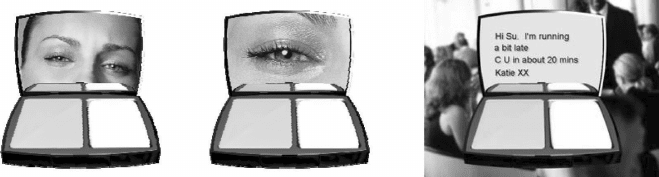
Figure 15.12 Concept design for a smart ladies compact with self-adjusting magnifying mirror
and simple message receiving capabilities. Image used with permission of PI3.
handbag-friendly and aesthetically pleasing packaging is vital. Conceptual design work for
a leading fragrance house by PI3 has investigated socio-cultural trends in the evolution of
female toiletries and linked these to possible future technological packaging developments.
The concept colour compact (Figure 15.12) has a smart magnifying mirror that can
be instantly adjusted by piezoelectric control to make the magnification of the mirror
reflection tailored to suit a particular user’s make-up application. In addition, the issue of
social acceptability in terms of communication in restricted social situations, such as in a
restaurant, is addressed in this concept by creating the ability of the compact to double as
a communication device and receive limited text messages.
Today’s contemporary perfume bottles are beautifully sculpted containers that look de-
sirable on the shop counter or bathroom shelf, but their basic design has been unchanged
for thousands of years. Glass bottles containing scent or fragrant oil look fundamentally
the same today as they did in ancient Greece, so the manner and processes of applying fra-
grances to the body have also remained largely unchanged. The female rituals, experiences
and the desire for self-expression of the modern world require a more innovative approach
to fragrance delivery.
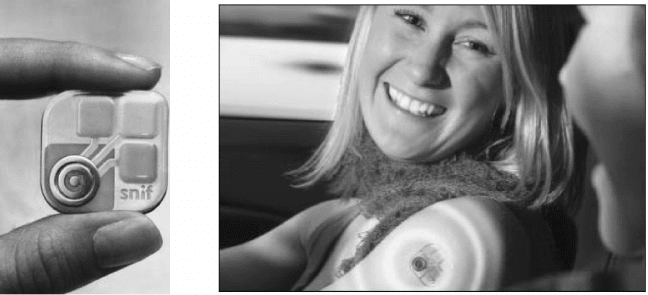
A futuristic smart packaging proposal by PDD, a London-based structural design agency,
is SNIF
TM
– Sexy New Intelligent Fragrance – a concept fragrance system that can be
placed anywhere on the body (Figure 15.13). It has dual sensory intelligence and monitors
the bodily conditions of the person wearing it, as well as the changing environmental
conditions, to release the optimum level of fragrance from three fragrance reservoirs. The
device is sensitive to an individual’s skin balance, and is as much a fashion accessory as a
fragrance product.
15.3.5 Health in the Home
As previously discussed, it is predicted that an important future trend will be the move to
give people more control over their own health in their own home, with the help of advanced
electronics, computers and the Internet, so that they and their doctors are better prepared
to deal with health issues. This will involve the development and transfer of portable,
miniature, intuitive and accurate diagnostic smart packaging devices of the type that are
currently used in the laboratory into the home. Complex diagnostic tools could very well
become affordable hand-held machines in bathrooms in the next 10 years, while portable
packaged devices will allow monitoring of health parameters while outside of the home.
OTE/SPH OTE/SPH
JWBK126-15 JWBK126-Kerry March 18, 2008 13:34 Char Count= 0
Health, Beauty and Personal Care 279
Figure 15.13 The SNIF fragrance device (left) can be placed anywhere on the body releas-
ing perfume in accordance with the body conditions of the wearer (right). Reproduced with
permission from PDD Ltd.
Smart packaging developments for on-the-go health monitoring are expected in the
following areas:
r
smart bandages that change colour dramatically to tell you whether you have a serious
infection;
r
smart skin indicators for alerting of danger to allergic reactions, particularly in young
children;
r
programmed skin patches using smart gels that rely on changes in skin properties to
trigger drug delivery, replacing conventional pill-taking medication.