
Kerry J., Butler P. Smart Packaging Technologies for Fast Moving Consumer Goods
Подождите немного. Документ загружается.


OTE/SPH OTE/SPH
JWBK126-16 JWBK126-Kerry March 3, 2008 13:30 Char Count= 0
16
Laser Surface Authentication –
Biometrics for Brand Protection
of Goods and Packaging
Russell Cowburn
16.1 Introduction
In recent years a number of highly successful human biometric technologies have been
introduced, such as fingerprint recognition and iris scanning [1]. These work on the principle
that no two people have the same small scale detail in the pattern of their fingertips or
irises and that these naturally occurring variations can be used as a unique identifier for
the individual. Laser Surface Authentication (LSA) is a new technology that mimics this
biometric principle, but applies it to inanimate objects such as documents, goods and
packaging [2]. A newly developed laser scattering probe allows the equivalent of a unique
fingerprint to be rapidly measured from each item that is to be identified and protected.
Like human biometrics, the fingerprint is derived from naturally occurring microscopic
randomness that is inherently present in virtually all surfaces.
16.2 Naturally Occurring Randomness
Naturally occurring randomness is an extremely attractive proposition for brand protec-
tion. The traditional approach to brand protection technologies is to apply some complex
manufacturing process to an item, e.g. a hologram or a special formulation of ink. The se-
curity comes from a presumed asymmetry in technical capability between the brand owner
Smart Packaging Technologies for Fast Moving Consumer Goods Edited by Joseph Kerry and Paul Butler
© 2008 John Wiley & Sons, Ltd. ISBN: 978-0-470-02802-5

OTE/SPH OTE/SPH
JWBK126-16 JWBK126-Kerry March 3, 2008 13:30 Char Count= 0
282 Smart Packaging Technologies for Fast Moving Consumer Goods
and those who would attempt to counterfeit it. In reality, one finds an arms race of such
technologies: a new hologram is introduced in January, the counterfeits are available on
the street by June (or in some cases February!). Naturally occurring randomness, be it in
traditional human biometric form or the new inanimate biometric technology LSA, uses
a different principle. In this case, the security rests upon the asymmetry between reading
and writing the security feature. Since the feature is naturally occurring, the brand owner is
never involved in writing or creating the identifier – nature does that. The brand owner only
ever reads the feature, either at an initial registration time or later when the person or item
is to be identified. This is very important, as it changes the nature of the arms race. In order
to overcome the technology, it is necessary for the attacker not simply to be as technically
capable as the brand owner, but more so. The attacker would be required to learn how to
create artificial identifiers, which is something the brand owner was not required to do. We
call this principle ‘intrinsically read-only’. The more detailed and complex the naturally
occurring randomness, the greater the technical challenge posed and hence the more secure
the technology. For example, human fingerprints are relatively coarse and attackers have
developed techniques using latex overlays (or even Jelly Baby sweets!).
If naturally occurring randomness is to be used for identifying and protecting documents,
goods and packaging, there are three requirements: (i) the items must possess a high degree
of microscopic complexity – if it is not microscopic it will be easy to copy and if it is not
complex there will not be enough unique combinations to identify each item in a large
collection; (ii) it must be possible to read the feature easily and rapidly; (iii) the feature
must be robust when subjected to normal or even heightened levels of wear and tear.
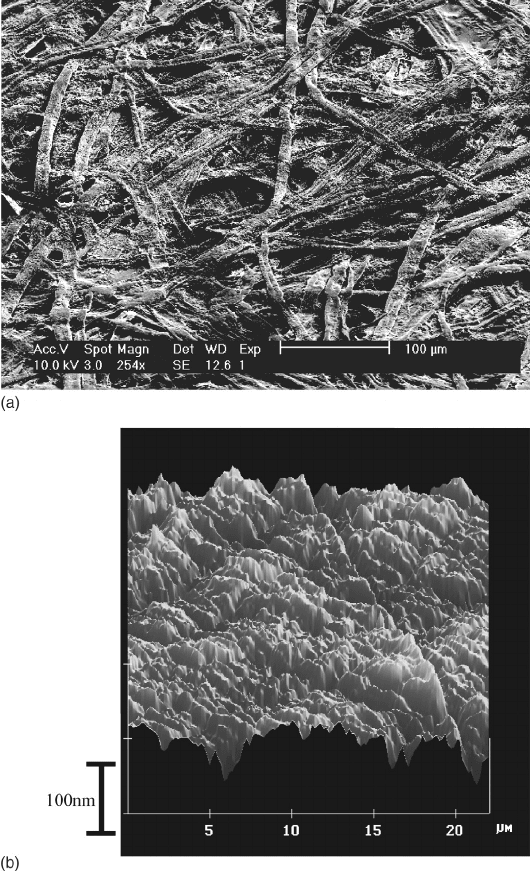
Figure 16.1 shows high-resolution microscope images of the surfaces of normal office
paper and a plastic (PVC) card, such as used for bank cards. In both cases one sees a high
degree of complexity. The supposedly smooth paper surface upon close inspection actually
reveals an intricate tangle of fibres. Similarly, the smooth and shiny plastic surface actually
reveals a mountainscape of hills and valleys if viewed with nanometre-scale precision.
Although multiple examples of the same type of item would probably exhibit similar
average statistics for these features (e.g. the width of the fibres or the average roughness
of the surface), the specific pattern formed should be unique to each item since the exact
place of each fibre or the exact location of each plastic peak is entirely random.
16.3 Diffuse Laser Scattering
Although high resolution microscopy clearly reveals the naturally occurring randomness,
it is too expensive, bulky and difficult to use as a practical brand protection technology.
In its place, we have developed a simple, low-cost, portable laser probe that allows much
of the same information content as shown in Figure 16.1 to be obtained, but without the
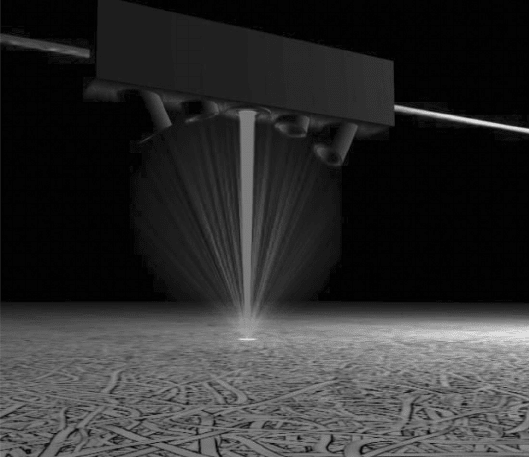
expense and complexity of full microscopy. The laser probe uses the principle of diffuse
laser scattering, as shown schematically in Figure 16.2. A low-power laser (1 mW, 635 nm,
continuous wave solid state) is focused onto a surface at normal (i.e. perpendicular to
the surface plane) incidence. Physicists use the Rayleigh criterion to determine what then
happens to the beam. The Rayleigh criterion uses the Rayleigh parameter R
a
=
2πσ
λ
cos θ,
where σ is the r.m.s. (root mean square) roughness of the surface, λ is the wavelength of
the incident light and θ is the angle of incidence of the light, as measured from the surface
OTE/SPH OTE/SPH
JWBK126-16 JWBK126-Kerry March 3, 2008 13:30 Char Count= 0
Laser Surface Authentication 283
Figure 16.1 (a) A scanning electron micrograph of the surface of a sheet of office paper. (b)
An atomic force micrograph of the surface of piece of shiny PVC card.
normal. The criterion says that if R
a
<π/4 then the surface can be considered to be smooth
and should be treated as a mirror in traditional geometrical optics. This means that the angle
of reflection of the laser beam will equal the angle of incidence, and the light should return
in the direction that it came from. This is known as ‘specular scattering’. If R
a
>π/4, then
the surface is rough enough to influence the reflection of the light, and much of the power
OTE/SPH OTE/SPH
JWBK126-16 JWBK126-Kerry March 3, 2008 13:30 Char Count= 0
284 Smart Packaging Technologies for Fast Moving Consumer Goods
Figure 16.2 A graphic representation of the LSA technique. A focused laser beam is shone
onto the surface. Any imperfections in the surface (shown here as paper fibres) cause some
of the light to be diffusely scattered to the sides, where it is captured by photodetectors. The
complete sensor is then scanned across the surface of the item.
of the laser beam will be scattered in directions other than the surface normal. This is what
is shown schematically in Figure 16.2 and is known as ‘diffuse scattering’. We experience
this effect every day without even realising it. When we look at a sheet of paper, it appears
bright white regardless of how we view it. This is diffuse scattering. When we look at a
mirror, we see a reflection from a specific angle. This is specular scattering. Setting λ = 635
nm and θ = 0 allows the Rayleigh criterion to be recast as optically smooth surfaces occur
when σ<80 nm; otherwise they are optically rough. One sees from Figure 16.1(b) that
even very smooth PVC plastic cards have enough surface roughness to be close to the
threshold of optical roughness and that one should expect some diffuse light scattering
from their surface. Paper and coated paperboard are certainly rough enough to scatter light
diffusely.
The LSA laser probe simply places photodetectors at various angles to catch part of
the diffusely scattered light, and the intensity at each detector is recorded as the probe is
scanned over the surface of the item. Each point in the scan corresponds to a snapshot
of a small part of the diffuse scattering from that precise laser position. The complete
sequence of recordings is as random as the fluctuations in the surface. Note that this is a
one way physical function: because we only record a small subset of the complete diffuse
scattering from each position, we cannot infer the profile of the surface from the sequence
of recordings, although in principle one could infer the sequence of recordings from the
OTE/SPH OTE/SPH
JWBK126-16 JWBK126-Kerry March 3, 2008 13:30 Char Count= 0
Laser Surface Authentication 285
profile of the surface. Diffuse scattering is therefore no substitute for microscopy if one
actually wishes to see the surface. However, since the LSA signal is derived from the profile
of the surface, it is as good a unique identifier as the picture of the surface itself would have
been, and it is much easier to measure.
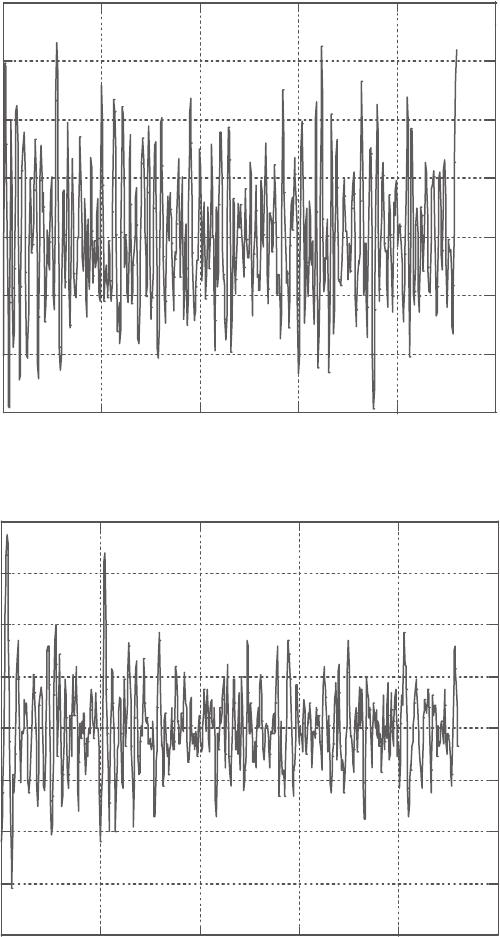
Figure 16.3 shows typical LSA scans obtained from a sheet of normal white office paper,
a piece of coated paperboard as used in pharmaceutical packaging and a plastic PVC card.
Care was taken in this figure to apply precisely the same signal processing conditions so
that the amplitudes of the signals from the different materials can be compared. In all
cases, one sees a signal that looks like random white noise. The signal size from the white
paper is approximately 10-times stronger for office paper than for the other materials.
This is consistent with the roughness amplitudes measured directly in Figure 16.1. The
autocorrelation function of all of the scans of Figure 16.3 falls off has a full width, half
maximum, of approximately 100 μm, which is comparable to the focused beam size, as
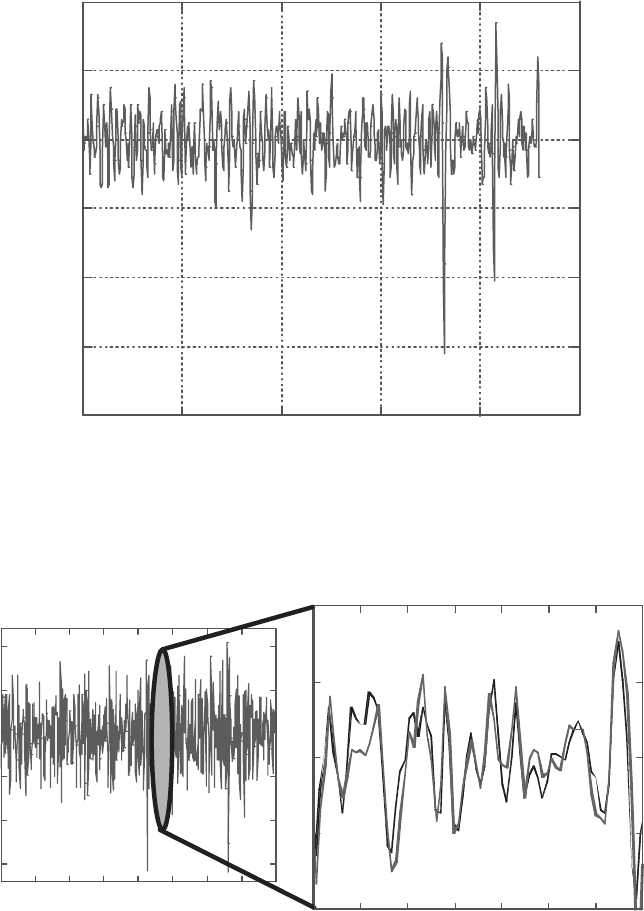
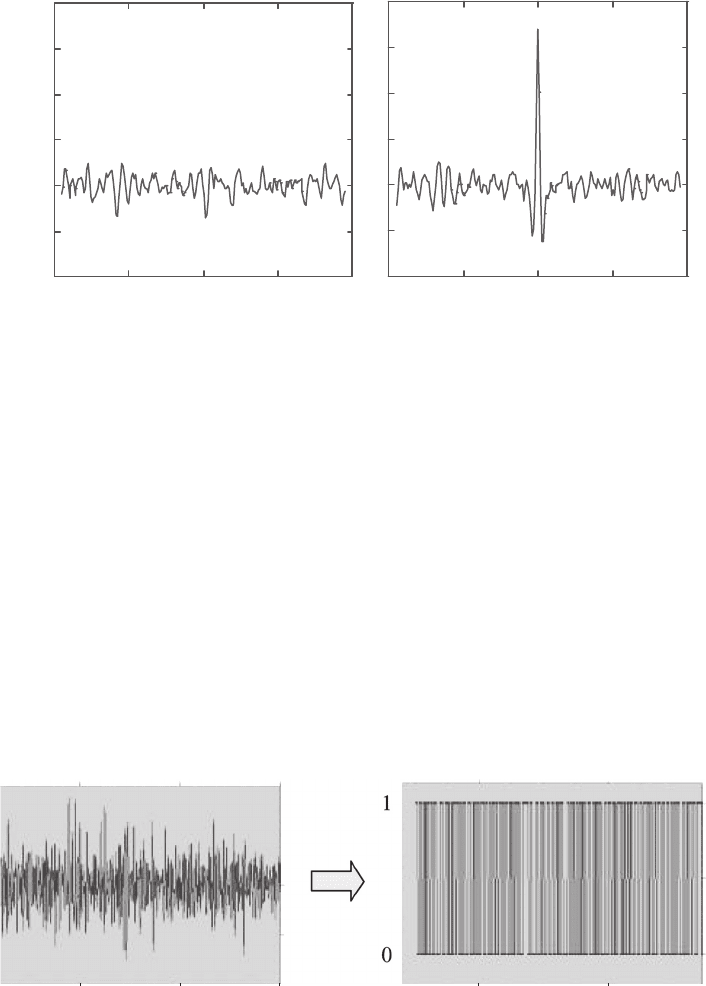
would be expected for a random signal. Figure 16.4 shows a close up of part of a scan from
office paper where we have overlaid the results from a second scan taken later after the paper
had been removed from the scanner, handled and then replaced onto the scanner. One sees
excellent agreement between the first and second scan of the same item. The exact degree
of match between the two scans in Figure 16.4 is shown in Figure 16.5 where we have
computed the cross correlation function between these two scans. The sharp spike in the
middle rising to 0.85 shows an excellent match when the two scans are correctly aligned
with each other. For comparison, Figure 16.5 also shows the cross correlation function
computed between two scans taken from different sheets of paper (although of the same
type and manufacturer). The lack of any such spike shows that the two scans are derived
from different items.
Similar results have been obtained from a wide range of materials, including metal
(aluminium, copper and brass), polycarbonate (as used in laser-engraved identity cards),
many different types of coated paperboard, bank note paper, passport back covers and
laminated photograph pages, holograms and paper clothing labels. It appears that virtually
everything except perfect mirrors and transparent materials possesses a unique fingerprint
that can be easily measured through diffuse light scattering.
It should be noted that attempts have been made in the past to use naturally occurring
randomness from specific material systems as unique identifiers. These include using the
randomness in magnetic grain alignment in the magnetic stripe of credit cards and other
magnetic media as a unique identifier [3], the randomness of miniature beads in a solid
token [4], and direct imaging of paper fibres [5]. What makes LSA distinctive is the fact
that it makes very few assumptions about the physical origin of natural randomness. Any
form of surface roughness, regardless of whether it comes from fibres, watermarks or any
other origin, all lead to diffuse laser scattering.
16.4 The Statistics of LSA
The first step in analysing the statistics of LSA is to convert the analogue sequence into a
sequence of binary bits. We do this by applying a simple digitisation rule that if the analogue
OTE/SPH OTE/SPH
JWBK126-16 JWBK126-Kerry March 3, 2008 13:30 Char Count= 0
286 Smart Packaging Technologies for Fast Moving Consumer Goods
–300
–200
–100
0
100
200
300
400
0 5 10 15 20 25
Position (mm)
(a)
Signal
–80
–60
–40
–20
0
20
40
60
80
0 5 10 15 20 25
Position (mm)
Signal
(b)
Figure 16.3 LSA scans taken from (a) white office paper, (b) coated paper board as used in
pharmaceutical and branded product packaging, (c) white PVC as used in credit cards and
access control cards. The experimental and signal processing conditions were identical, so the
signal amplitudes may be compared.
OTE/SPH OTE/SPH
JWBK126-16 JWBK126-Kerry March 3, 2008 13:30 Char Count= 0
Laser Surface Authentication 287
–80
–60
–40
–20
0
20
40
0 5 10 15 20 25
Position (mm)
Signal
(c)
Figure 16.3 (Continued)
–1.5
–1
–0.5
0
0.5
1
0 5 10 15 20 25 30 35 40
Change in reflectivity (%)
Position (mm)
-1
-0.5
0
0.5
1
21.5 22.5 23 23.5 24 24.5 25
Position (mm)
22
Figure 16.4 A typical LSA scan from office paper. The right hand panel shows a close-up of
part of the scan and also shows overlaid a second scan taken from the same item at a later
time. Very good agreement between the first and second scans can be seen.
OTE/SPH OTE/SPH
JWBK126-16 JWBK126-Kerry March 3, 2008 13:30 Char Count= 0
288 Smart Packaging Technologies for Fast Moving Consumer Goods
0.3
0.4
0.5
0.6
0.7
0.8
0.9
–5000 –2500 0 2500 5000
Fraction of bits matching
Positional shift (µm)
Different documents
–5000 –2500 0 2500 5000
Positional shift (µm)
Same document
Figure 16.5 Digital cross correlation curves calculated between the LSA fingerprints of two
different sheets of office paper (left hand panel) and two scans taken at different times from
the same sheet of office paper (right hand panel). The central spike in the cross correlation
function indicates recognition of an item.
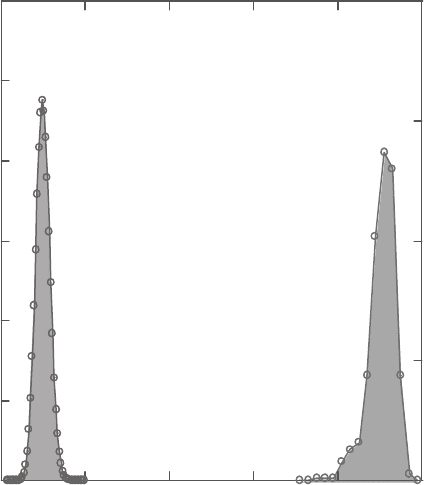
value is above the mean level (usually zero because of band pass filtering which is applied
to the analogue signal – see later in this chapter) then this corresponds to a binary ‘1’ and if
it is below the mean then a binary ‘0’, see Figure 16.6. A sequence of binary bits is usually
modelled statistically using the binomial distribution. In order to test whether a recorded
LSA scan corresponds to the same item as a database target, a digital cross-correlation is
performed between the two binary sequences and the maximum value of the digital cross-
correlation obtained. The digital cross-correlation value, which we usually refer to as the bit
match ratio or BMR can vary between 0 (no bits matched) through to 1 (all bits matched).
One would expect that two signatures from different items should have a BMR of a little
100 200 200 300300
Figure 16.6 Digitising the LSA signature. After bandpass filtering, the LSA signature is uni-
formly distributed about zero. Analogue values greater than zero then become digital ‘1’ and
values lower than zero become digital ‘0’.
OTE/SPH OTE/SPH
JWBK126-16 JWBK126-Kerry March 3, 2008 13:30 Char Count= 0
Laser Surface Authentication 289
above 0.5, while two signatures from the same item should have a BMR close to 1. The
BMR for different items does not have an expectation of precisely 0.5 because we search
for the maximum value in the digital cross correlation function, i.e. we attempt to move the
two sequences with respect to each other in order to improve the match quality as much
as possible. This is necessary in case the two items are not in exactly the same physical
position during each scan. This has the effect of increasing the expectation of BMR for
items which are different from 0.5 to around 0.55 to 0.6.
Figure 16.7 shows a plot known as a Hamming plot. This is similar to the way in which the
human biometric research community usually presents data (footnote about axis direction)
and is two histograms of the BMRs measured from a large collection of items, each of
which has been scanned twice. The first histogram (shown on the left hand side of Figure
16.7) is obtained by comparing the first scan of each item to the second scan of every other
item (but not the second scan of itself). Since, by definition, these are always comparisons
between different items, one would not expect a high BMR. Indeed, one sees a distribution
that is tightly centred around 0.55. This histogram is a measure of the uniqueness of the
0
5,000
10,000
15,000
20,000
25,000
30,000
0
50
100
150
200
0.5 0.6 0.7 0.8 0.9 1
Count
Bit Match Ratio (BMR)
Figure 16.7 A Hamming plot obtained by scanning 500 sheets of office paper twice. The left-
hand histogram is obtained by cross correlating scans from different sheets and hence shows
the uniqueness of the signatures. The right-hand histogram is obtained by cross correlating two
scans from the same sheet and hence shows the quality of recognition. A useful authentication
and tracing system will have a finite separation between these two histograms, as indeed is
shown here.

OTE/SPH OTE/SPH
JWBK126-16 JWBK126-Kerry March 3, 2008 13:30 Char Count= 0
290 Smart Packaging Technologies for Fast Moving Consumer Goods
signature of each item, as it easily identifies unexpected collisions between the signatures
of different items. The second histogram (shown on the right hand side of Figure 16.7) is
obtained by comparing the first scan of each item with the second scan of the same item.
Since these are always comparisons between different scans of the same item, one would
expect a high BMR. In Figure 16.7 one sees a distribution centred on 0.95. This histogram
is a measure of the repeatability of a signature.
The simplest test which can be applied to the Hamming plot is to see where an accep-
tance threshold should be drawn. In the case of Figure 16.7, a threshold could be placed
anywhere between 0.65 and 0.8. The acceptance threshold can be used to answer questions
of authenticity, since a BMR below the threshold would be expected when comparing an
LSA scan of an item with that of a different item and so does not constitute a reliable
identification; a BMR above the threshold only occurs when comparing an LSA scan of an
item with a scan previously obtained from the same item and so does constitute a reliable
identification.
This mode of analysis can be used to implement an authentication technology. A database
is constructed of all of the LSA signatures of items manufactured by the brand owner. To
authenticate subsequently in the field an item as genuine, its LSA signature is remeasured
and then compared to that from every item in the database. If any BMR is greater than the
threshold, then the item can be said to be genuine. If no BMR is greater than the threshold,
then the item can be said to be counterfeit (or badly scanned).
The next level of analysis is to apply a degree of confidence to the declaration of authen-
ticity. This takes the form of posing the following statistical question: ‘The BMR of this
rescanned item is high enough to be considered as genuine. Given the known distribution
of BMRs from items that are not the same (i.e. the left hand histogram of Figure 16.7),
what is the probability that this item could have this BMR if it were not genuine?’ This
probability is usually known as the false positive probability.
This question is answered by finding a statistical model that fits the experimentally
observed distribution of the left hand histogram of Figure 16.7 and then extrapolating it to
BMR values that were too high to be observed experimentally for that sample size. For a
sequence of independent random bits, the binomial distribution is the appropriate model.
There are two parameters: p (the probability of a given bit matching) and N (the number
of degrees of freedom or effective bits). In order to simplify the statistics, we work now
with the cross correlation at zero shift rather than the maximum of the cross correlation
across its full range. This is called the native match and excludes any attempt to optimise
the match by shifting the two signatures. The advantage of using native match data is that
p should become 0.5 and the validity of the binomial model is more self-evident.
Figure 16.8 shows on a logarithmic scale the fitting of a binomial distribution to the
experimental data by varying only N and p. One sees that the binomial model fits extremely
well, even down to the low occurrence events in the tails of the distribution.
Once N and p are known,a general formula can be written for the falsepositiveprobability
at a given BMR level. The false positive probability is one minus the cumulative probability
up to that BMR level, i.e. it is the probability that a randomly selected item would match
this item as well or better. The formula is:
Probability that BMR is k/N or greater =
N
k=m
N!
k!
(
N − k
)
!
p
k
(
1 − p
)
N−k