
Kosevich A.M. The crystal lattice
Подождите немного. Документ загружается.

116
3 Vibrations of Polyatomic Lattices
It is evident that (3.7.7), (3.7.8) admit the solutions
ϕ = ϕ
0
e
−q|z|
e
ikζ−iωt
, A = A
0
e
−q|z|
e
ikζ−iωt
, ξ = ξ
0
e
ikζ−iωt
q
2
= k
2
− ω
2
/c
2
, ζ =(x, y).
(3.7.9)
The p resence of the delta-like right-h and sides in (3.7.3) is equivalent to jumps
of the space derivative of the potentials with respect to the coordinate z at z = 0.
Therefore,
ϕ
0
= −2πi
en
s
q
kξ
0
, A
0
= −2πi
en
s
ω
q
c
ξ. (3.7.10)
We substitute (3.7.10) into (3.7.8) to obtain
mω
2
ξ
0
=
2πe
2
n
s
q
k(kξ
0
) −
ω
2
c
2
ξ
0
. (3.7.11)
Multiplying both parts of (3.7.11) by the vector k, we write implicitly the dispersion
law for longitudinal (plasma) vibrations
ω
2
=
2πe
2
n
s
m
q ≡
2πe
2
n
s
m
k
2
−
ω
2
c
2
. (3.7.12)
Solving (3.7.12) for ω
2
, we renormalize the dispersion law for longitudinal vibra-
tions to include the electromagnetic wave retardatio n
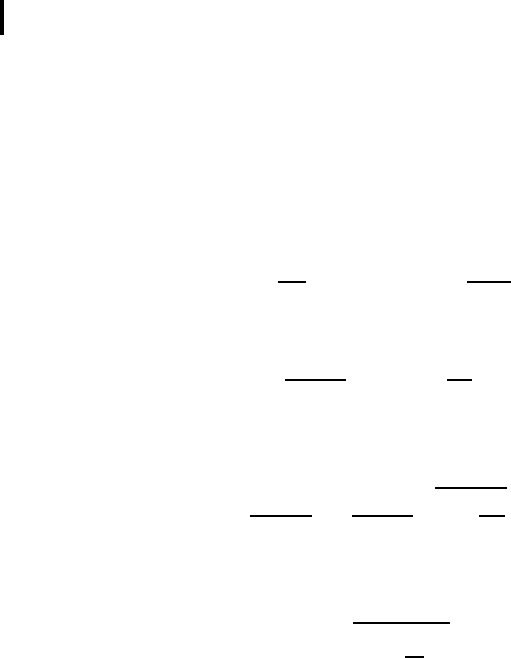
ω
2
= 2(ck
∗
)
2
1 +
k
k
∗
2
−1
, (3.7.13)
where k
∗
= πe
2
n
s
/mc
2
is the characteristic wave vector whose value is shared by two
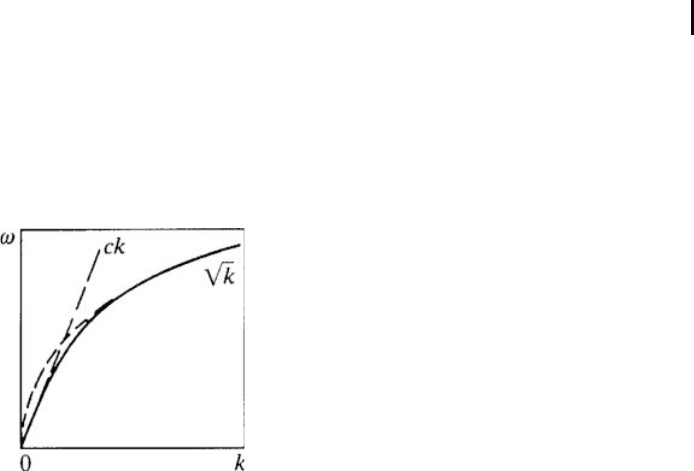
regions of a different behavior of the dispersion law (3.7.13). A plot of the dispersion
law for longitudinal vibrations of a 2D electron crystal is given in Fig. 3.6.
For k k
∗
, we get the dispersion law of electromagnetic waves in a medium
with ε = 1: ω = ck. Thus, the maximum long-wave longitudinal vibrations of an
electron crystal (k k
∗
) prove to be consistent with field vibrations: for ω → ck the
parameter q → 0 and the electromagnetic wave penetrates deep inside the medium.
For k k
∗
we come back to the dispersion law (3.7.3). Thus, shorter-wave vibrations
(but under the condition ak 1) have the dispersion law that differs greatly from
that for electromagnetic waves in the medium. Therefore, the corresponding field
vibrations cannot exist in the bulk far from a 2D electron crystal and they are localized
near it.
However, it should be noted that the region where the dispersion law (3.7.13) is
essentially renormalized is n ot important in experim e nts with a 2D electron crystal on
the helium surface. Indeed, with existing electron densities n
s
∼ 10
8
− 10
10
cm
−2
,
we have k
∗
∼ 10
−5
−10
−3
cm
−1
, so that the characteristic wavelength λ
∗
= 2π/k
∗
is too large for laboratory conditions.
3.8 Long-Wave Vibrations of an Ion Crystal
117
Finally, we dwell briefly on the renormalization of the dispersion law for transverse
sound vibrations. Equation (3.7.11) admits no transverse vibrations (for q > 0) local-
ized near a 2D electron crystal. This is due to the fact that (3.7.11) is obtained in the
continuum approximation, completely ignoring the periodic structure of a 2D electron
crystal. Both the derivation of the dispersion law (3.7.5 ) an d its renor malization can
be obtained only on the basis of a certain discrete model.
Fig. 3.6 Transformation of limiting long-wave dispersion law for 2D
plasma vibrations.
3.8
Long-Wave Vibrations of an Ion Crystal
Let us discuss the equation s for the vibration s of a 3D lattice composed of ions. The
equations of motion of a crystal (2.8.6) in the long-wave approximation and the elas-
ticity theory equations (2.8.7) were obtained using the assumption that the interaction
of vibrating atoms decreases rapidly with increasing distance between them. Thus,
expanding the displacement fields in a series, we can use only its leading terms and
reduce the equation of crystal motion to a system of second-order differential equa-
tions. However, our experience of studying the optical vibrations of two-dimensional
dipole lattices shows that this procedure is not always possible. I f a polyatomic lattice
does not consist of neutral a toms, but of electrically or magnetically active dipoles
or ions (electrons), the interaction potential between them decreases weakly with dis-
tance and the standard method of expansion in a series over the displacement gradients
is inapp licable.
Apart from that, under lattice vibrations the moving ions excite dynamical electro-
magnetic fields in a crystal whose retardation effect is important. But, for long-wave
3D crystal vibrations the electromagnetic interaction is easily taken into account by
means of the Maxwell equations for a continuous medium.
A macroscopic approach allows one to divide the ionic interactions (for simplicity
we assume these to be point charges) into two types with an essentially different physi-
cal origin. The first type is represented by the interactions (determined unambiguously
118
3 Vibrations of Polyatomic Lattices
by local conditions) that are described by the matrix of atomic force constants α(n).
These interactions as well as the atomic ones are responsible for the elastic properties
of nonionic crystals. The second type is generated by the action of the mean electric
field in a crystal on the ion charge (the effect of the mean magnetic field on moving
ions can be neglected
4
). This type, also involving the Coulomb ion interaction, cannot
be determined by local conditions only and is described by introducing macroscopic
fields.
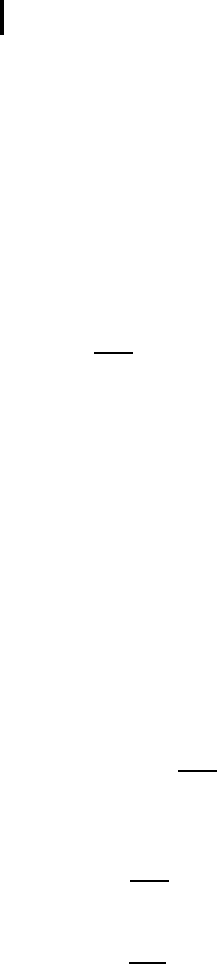
We now realize the program proposed. In the ionic crystal, equations of the type
(1.8.4) should be written for each ion sublattice separately. If u
s
(n) is the displace-
ment of the n-th site of the sublattice with number s,wehave:
m
s
d
2
u
i
s
dt
2
=
∑
s
{C
ik
ss
u
k
s
+ C
ikl
ss
l
u
k
s
+ C
iklm
ss
l
m
u
k
s
} + e
s
E
i
, (3.8.1)
where e
s
is the s-th ion charge in the unit cell (by virtue of electric neutrality,
∑
s
e
s
= 0), E is the averaged electric field strength in a crystal. The tensors of second,
third and fourth rank C
ss
, are obviously connected with the elements of the matrix of
atomic force constants in a p olyatomic lattice. It follows from their definition and the
equality (3.2.4) that
∑
s
C
ik
ss
=
∑
s
C
ik
ss
=
∑
ns
α
ik
ss
(n)=0. (3.8.2)
Furthermore, in the ionic crystal where each ion is an inversion center, C
ikl
ik
≡ 0.
For crystals such as NaCl, we shall further use the last identity. We introduce by
(3.2.13) the displacement of the center of mass of a unit cell u,aswellastherelative
displacement of ions ξ
s
= u
s
− u. We keep on the r.h.s. of (3.8.1), the lowest-order
space derivatives of the vector u and independent displacements ξ
s
m
s
d
2
u
i
s
dt
2
=
∑
s
{C
ik
ss
ξ
k
s
+ C
iklm
ss
l
m
u
k
} + e
s
E
i
. (3.8.3)
In this approximation, the dynamic equations for the vectors u and ξ
s
are separated
M
s
d
2
u
i
s
dt
2
= c
iklm
k
l
u
k
+ e
s
E
i
, c
iklm
=
∑
ss
C
iklm
ss
;
m
s
d
2
ξ
i
s
dt
2
=
∑
s
C
ik
ss
ξ
k
s
+ e
s
E
i
.
(3.8.4)
Equations (3.8.3) should be solved together with the system of macroscopic
Maxwell equations whose form is well known. We note some points that refer to
4) Even in the region of limiting vibration frequencies (ω ∼ 10
13
c
−1
)theion
motion velocities are less than the sound velocities in a crystal (v < s ∼
10
5
cm/s) and the Lorentz force generated by the magnetic field is vanish-
ingly small compared to the electric force.
3.8 Long-Wave Vibrations of an Ion Crystal
119
writing and solving the Maxwell equations. First, ionic crystals are dielectric (in-
sulator) crystals and have no marked magnetic properties. Thus, the only quantity
that refers to th e characteristics of the medium properties and is involved in Maxwell
equations is the crystal polarization vector P. We remind ourselves that the vector P
is included in the definition of electric induction of a dielectric D: D = E + 4πP.
Then, since we consider the ions as point charges, we should relate the vector P only
with the displacement of the ions from their equilibrium positions
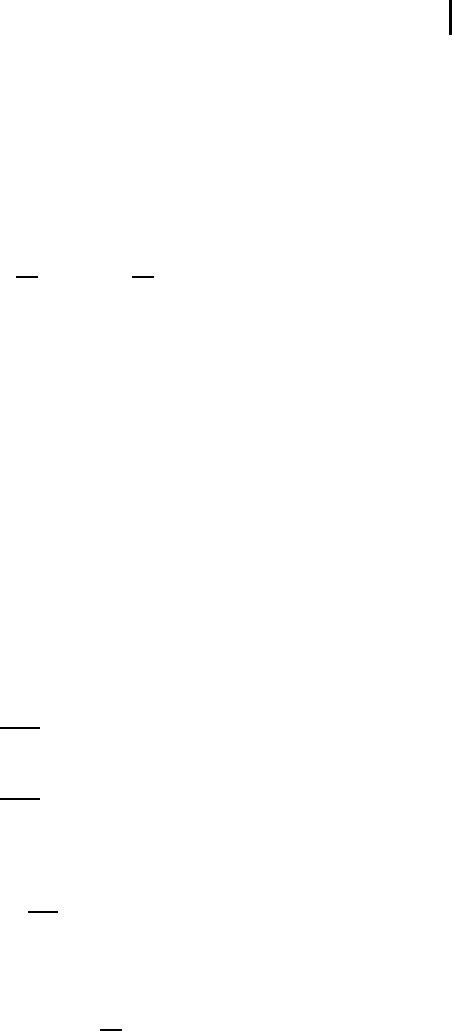
P =
1
V
0
∑
s
e
s
u
s
≡
1
V
0
∑
e
s
ξ
s
. (3.8.5)
We analyze the equations for crystal ion vibrations by considering NaCl-type crys-
tals that possess cubic symmetry and contain only two ions in the unit cell. Each of
the ions is a center of symmetry (Fig. 0.2). In this case (3.8.4) will be much simplified
m
1
¨
ξ
i
1
= C
ik
11
ξ
k
1
+ C
ik
12
ξ
k
2
+ e
1
E
i
;
m
2
¨
ξ
i
2
= C
ik
21
ξ
k
21
+ C
ik
22
ξ
k
2
+ e
2
E
i
.
(3.8.6)
By virtue of the cubic symmetry of a crystal and the properties (3.8.2) all the elements
of the matrix C
ik
ss
, are expressed through one scalar quantity:
C
ik
ss
= C
ss
δ
ik
, C
11
= C
22
= −C
12
= −C
21
= −α
0
. (3.8.7)
To be specific, let the subscript 1 refer to a positive ion (e
1
= e, e
2
= −e). Then
(3.8.6), taking into account (3.8.7), will be
m
1
d
2
ξ
1
dt
2
= −α
0
(ξ
1
− ξ
2
)eE;
m
2
d
2
ξ
2
dt
2
= −α
0
(ξ
2
− ξ
1
)eE.
(3.8.8)
Equations (3.8.8) can be replaced by a single equation for the relative displacement
ξ = ξ
1
− ξ
2
:
µ
d
2
ξ
dt
2
= −α
0
ξ + eE, (3.8.9)
where µ is the reduced mass of a unit cell (µ = m
l
m
2
/M). The crystal polarization
is expressed through the displacement ξ
P =
e
V
0
ξ. (3.8.10)
Equations (3.8.9), (3.8.10) and also the Maxwell equations describe the combined
(coupled) optical ion crystal vibrations and the electromagnetic field vibrations. Thus,
the above system of equations allows one to take into account the interaction of a free
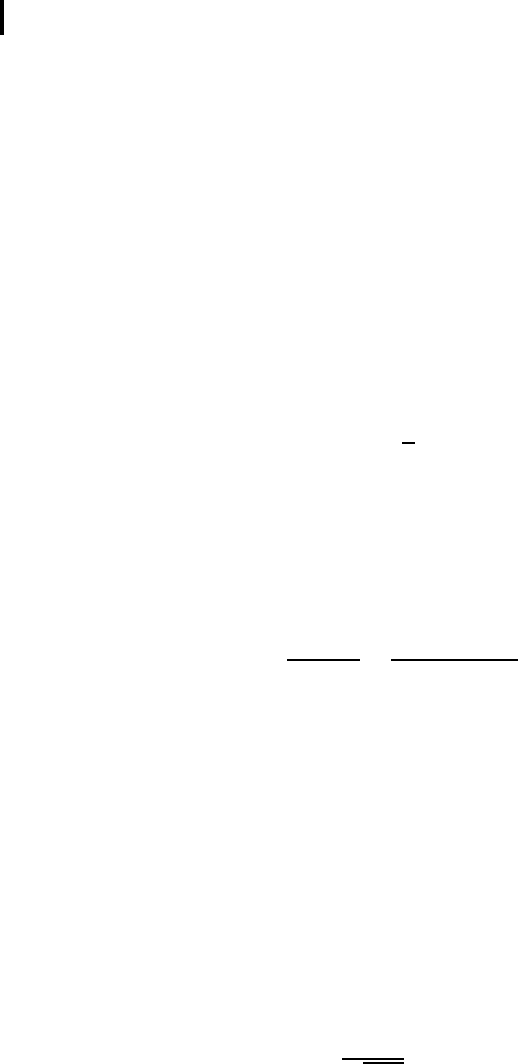
120
3 Vibrations of Polyatomic Lattices
electromagnetic field and independent optical vibrations of a crystal. The interaction
between electromagnetic waves and the optical eigenvibrations of a crystal is espe-
cially large when their frequencies and the wave vectors almost coincide (under the
resonance conditions). As a result of such an interaction, collective excitations of a
new type known as polariton vibrations appear. This is why the long-wave ion crystal
vibrations are analyzed within a macroscopic theory of polaron excitations.
It is known from electrodynamics that the displacement field ξ is excluded from
Maxwell equations by incorporating the dielectric permeability of the medium
5
, ε,
relating the Fourier time components of the vectors D and E:
D(ω)=ε(ω)E(ω). (3.8.11)
To obtain the dielectric permeability, we consider the harmonic vibrations of all
fields. For stationary vibrations with frequency ω, (3.8.9) is transformed to the alge-
braic one
(ω
2
0
− ω
2
)ξ =
e
µ
E, (3.8.12)
where ω
2
0
= α
0
/µ is the square of the characteristic frequency th a t is the limiting
optical frequency for a crystal wh ere there is no interaction with an electromagnetic
field.
If ω = ω
0
, we obtain trivially from (3.8.10)–(3.8.12) an expression for the dielec-
tric permeability
ε(ω)=1 +
ω
2
pl
ω
2
0
− ω
2
≡
ω
2
0
+ ω
2
pl
−ω
2
ω
2
0
− ω
2
, (3.8.13)
where ω
2
pl
= 4πe
2
/µV
0
is the square of the so-called plasma frequency (ω
pl
is
the frequency of the eigenvibrations of an ionic 3D plasma whose ions interact only
through a macroscopic Coulomb field), µ is the reduced mass of a pair of ions with
opposite signs, V
0
is the volume of this pair. If we take V
0
∼ 10
−23
cm
3
and assume
µ ∼ 5 ×10
−23
g, it is easily seen that ω
pl
∼ 10
13
c
−1
. Therefore, we may assume
that ω
pl
∼ ω
0
.
With formula (3.8.1 3) for dielectric permeability, we can directly write th e dis-
persion law of transverse vibrations for a crystal–electromagnetic field system (the
possible trivial decomposition of electromagnetic vibr ations into transverse and lon -
gitudinal ones results from the symmetry of a cubic crystal). In fact, the transverse
electromagnetic vibrations (electromagnetic waves) in a m edium with dielectric per-
meability ε(ω) have the dispersion law
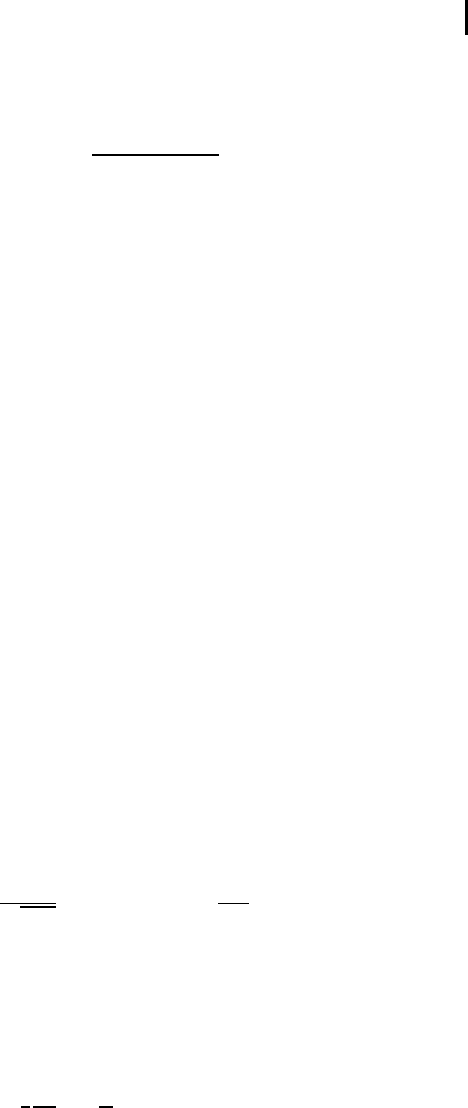
ω =
ck
ε(ω)
, (3.8.14)
5) As the NaCl-type crystal has cubic symmetry , the dielectric permeability
tensor of such a medium reduces to a single constant.
3.8 Long-Wave Vibrations of an Ion Crystal
121
where c is the light velocity in vacuum. Substitu ting (3.8.13) into (3.8.14), we write
the dispersion law for transverse vibrations as
c
2
k
2
= ω
2
ω
2
− ω
2
0
− ω
2
pl
ω
2
− ω
2
0
. (3.8.15)
The longitudinal electromagnetic vibrations with nonzero frequency are possible
in the medium only when
6
D = 0,whenE = −4πP.ButforE = 0, it follows
from (3.8.11) that the frequencies of the corresponding vibrations are zeros of the
functions ε(ω): ε(ω)=0. Thus, longitudinal vibrations are possible only at frequen-
cies ω = ω
1
, ω
2
l
= ω
2
0
+ ω
2
pl
. Therefore, their dispersion law reduces to a trivial
dependence; the frequency coincident with the value ω
l
is constant.
The dispersion laws for noninteracting electromagnetic waves and optical crystal
vibrations can be written in a simpler form by formally excludin g th e interaction in
the system concerne d, i. e., by setting e = 0. The Maxwell equations will then reduce
to the field equations in vacuum and the dispersion law for electromagnetic waves will
be of a simple form
ω = ck. (3.8.16)
The dispersion law for optical vibrations follows from (3.8.12) with e = 0
ω = ω
l
. (3.8.17)
The limiting simplicity of this dispersion law follows from the condition ak 1.
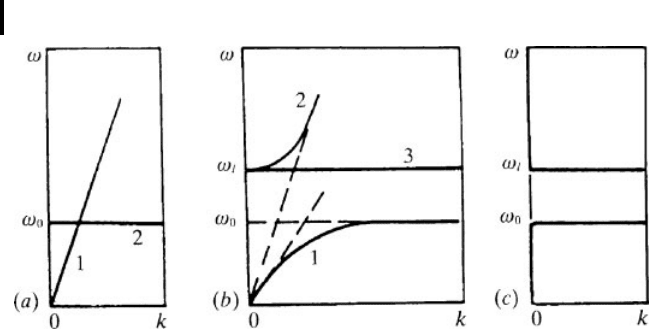
We note that the plots of the dispersion laws (3.8.16), (3.8.17) (Fig. 3.7a, straight lines
1 and 2, respectively) intersect. At the intersection point of the plots the frequ e ncies
and wavelengths of vibrations of different nature coincide and the above-mentioned
cross situation arises. Therefore, when even a small interaction between vibrations oc-
curs, resonance considerably affecting the electromagnetic and mechanical processes
of the system concerned is observed.
Indeed, we come back to the dispersion law of transverse vibrations (3.8.15) where
we have taken into account the interaction required. If ω ω
0
, (3.8.15) gives the
dispersion law for electromagnetic waves in the medium with a certain static dielectric
permeability
ω =
ck
ε(0)
, ε(0)=1 +
ω
pl
ω
0
.
Under such low-frequency v ibrations, the lattice manages to adapt to the electro-
magnetic field, causing a decrease in the electromagnetic wave velocity only.
If ω ω
l
the dispersion law for electromagnetic waves in vacuo (3.8.16) follows
from (3.8.15). The electromagnetic waves with such frequencies that arise in a crystal
6) The condition D = 0 for ω = 0 is a result of Maxwell’s equation for the
dielectric
curl H =
1
c
∂D
∂t
= −i
ω
c
D,
and the longitudinal character of vibrations (curl H = 0).
122
3 Vibrations of Polyatomic Lattices
Fig. 3.7 Dispersion law of polariton vibrations: (
a
) dispersion curves
of independent field and crystal vibrations when there is no interaction;
(
b
) removal of degeneracy; (
c
) vibration frequencies when the retarda-
tion (c = ∞) is neglected.
do not force the lattice to move because of its inertia, so that the crystal does not react
to the wave transmission.
In the frequency range ω ∼ ω
0
, the dispersion law ceases to be linear (Fig. 3.7b).
A radical rearrangement of the dispersion law at frequencies ω ∼ ω
0
testifies to
a resonance character of the interaction between the electromagnetic field and the
optical vibrations at ω = ω
0
.
It follows from (3.8.13) that at frequencies that do not correspond to the crystal vi-
brations concerned, the d ielectric p ermeability becomes negative (total wave reflection
from a crystal).
Finally, we consider an extreme form of the dispersion law for transverse vibrations
in a special case when the retardation of the electromagnetic waves are entirely ne-
glected (c → ∞). In this case for k = 0, (3.8.15) yields the relation ω = ω
0
that is
the same as the dispersion law of optical vibrations (3.8.17) for the lattice noninter-
acting with the field. For ω = ω
0
, (3.8.15) is consistent only for k = 0.
The longitudinal vibrations are retardation independent (they are quasi-static), so
that the plots of the dispersion laws at c = ∞ have the form shown in Fig. 3.7c.
The difference in the plots in Fig. 3.7b is manifest at wavelengths for which
ak
˜
<a(ω
0
/c) ∼ s/c,wheres is the sound velocity in a crystal. As the ratio
s/c ∼ 10
−5
, the retardation effects the crystal vibration spectrum in a small part of
the allowed interval of k. Thus, in all problems where the vibrations with wavelengths
satisfying the condition s/c ak 1 are dominant, the retardation is insignificant
and the optical vibrations in an ionic crystal should be associated with the frequency
ω
0
for transverse mechanical vibrations, and with the frequency ω
l
for longitudinal
vibrations, caused by a purely static electric field.
The ratio between transverse and longitudinal vibration frequencies is related to
macroscopic characteristics of the ionic crystal, namely, the limiting values of its d i-
3.8 Long-Wave Vibrations of an Ion Crystal
123
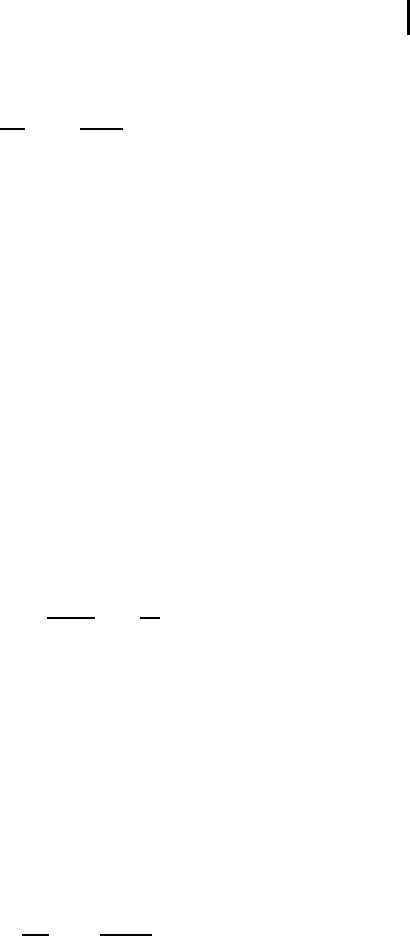
electric permeability. In fact, it directly follows from (3.8.13) th at
ω
l
ω
0
2
=
ε(0)
ε(∞)
. (3.8.18)
Although, using (3.8.13) it is possible to conclude that ε(∞)=1. But this property
of the model concerned is not used in (3.8.18). If we reject the point charges model
and take into account the electric structure of ions that allows one to consider them
being polarizable in an external field, we c ome to the conclusion that ε( ∞) = 1,but
in this case too (3.8.18) remains valid
7
.
3.8.1
Problems
1. Find the dispersion relation for longitudinal vibrations of a 1D chain with equidis-
tant oscillators. Discuss the possible existence of similar 1D systems with an inhomo-
geneous ground state.
Hint. Assume each atom possesses the energy U
n
=(1/2)mω
2
0
u
2
n
and take into
account the interaction of nearest neighbors only.
Solution. The dispersion law is
ω
2
= ω
2
0
+
2α(0)
m
sin
2
ak
2
,
if α(0) < 0 and 2 |α(0)| > mω
2
0
then for a certain k = k
0
in the r ange 0 < k <
π/a the vibration frequency ω vanishes. Thus, such a system has an equilibrium
superlattice with period b = π/k
0
.
2. Find the long-wave dispersion relation for librational vibrations of a 2D dipole
lattice, taking into account the electromagnetic wave retardation.
3. Find the long-wave dispersion relation for a 2D electron crystal in a magnetic field
H perpendicular to the crystal plane.
Solution.
ω
2
=
eH
mc
2
+
Ak
m
∗
(k)
.
7) By the frequency ω = ∞ we mean, in the last case, the frequenc y satisfying
the condition ω ω
l
, but still remaining small compared to the character -
istic frequencies of the interatomic electron motion.

4
Frequency Spectrum and Its Connection with the Green
Function
4.1
Constant-Frequency Surface
A set of the polarization vectors e(k, α) of crystal vibrations and the dispersion law
ω = ω
α
(k) (4.1.1)
provide full information on the character of vibrational states of the lattice. However,
to understand some phenomena generated by lattice vibrations, the geometric (more
exactly, topographic) representation of the dispersion law seems to be more instru-
mental than its analytical notation (4.1.1). This can be done by the introduction and
analysis of so-called isofrequency surfaces.
Isofrequency surfaces are constructed independently for each branch of vibrations,
so that in writing the dispersion law (4.1.1), we omit the index α, implying one of the
branches.
An isofrequency surface or a constant-frequency surface is the surface in k-space
described by
ω(k)=ω, ω = constant. (4.1.2)
Let us elucidate how the form of isofrequency surfaces changes when the frequency
ranges from ω = 0 up to the maximum possible one. For small frequencies the
dispersion law of a crystal coincides with the dispersion law of sound waves, so that
the isofrequency surface is determined by
k =
ω
s(κ)
, κ =
k
k
, (4.1.3)
where s(κ) is the sound velocity. Expression (4.1.3) is a reason to introduce another
name of the isofrequency surface for low-frequency sound vibrations, namely, a slow-
ness surface.
As the sound velocity in a crystal is a finite quantity for all directions of κ, it follows
from (4.1.3) that the corresponding slowness surfaces are closed (and similar to each
The Crystal Lattice: Phonons, Solitons, Dislocations, Superlattices, Second Edition. Arnold M. Kosevich
Copyright
c
2005 WILEY-VCH Verlag GmbH & Co. KGaA, Weinheim
ISBN: 3-527-40508-9
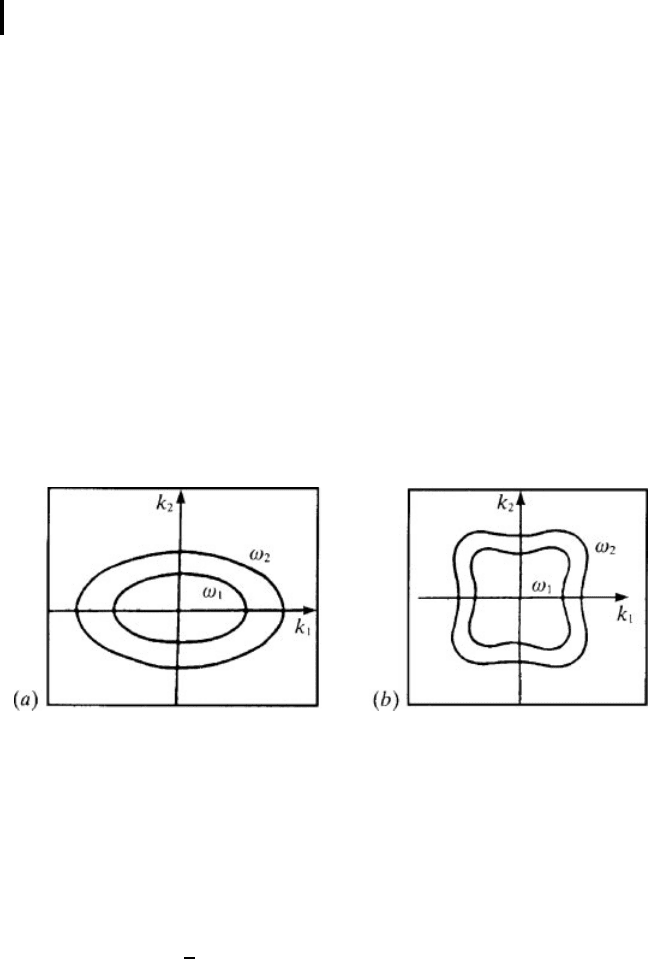
126
4 Frequency Spectr um and Its Connection with the Green Function
other). If we look at the figure where these surfaces are crossed by the plane that goes
through a point k = 0 (Fig. 4.1a), we see that the freq uencies ω
1
and ω
2
satisfy the
condition ω
1
< ω
2
(an isofrequency surface for a smaller frequency is inside that for
larger frequency). The slowness surfaces for ω → 0 are not necessarily convex, they
can be “pillow”-shaped (Fig . 4.1b).
The fact that the constant-frequency surface even of long-wave crystal vibrations
may be other than convex leads to some interesting physical results. The parts where
the cross section of an isofrequency surface is convex are isolated from those where
it is concave by the points with zero cross-sectional curvature (Fig. 4.1b). In a 3D
k-space, the convex parts of an isofrequency surface are isolated from the concave
ones by the lines along which the Gaussian (total) surface curvature vanishes. As an
example, we consider a constant-frequency surface for one of the transverse vibration
modes in a germanium crystal, where the larger part of the mode is convex. Since the
Ge crystal has cubic symmetry, only one octant is shown in Fig. 4.2. The thick lines
illustrate the geometrical position of the points with zero Gaussian cu rvature. The
characteristic directions, for which the curvature is concave, are also shown.
Fig. 4.1 Cross sections: (
a
) of convex isofrequency surfaces; (
b
)of
nonconvex isofrequency surfaces.
The isofrequency surfaces for frequencies close to the maximum frequency of
acoustic vibrations ω
m
have a much simpler form. Indeed, it follows from (1.4.4)
that constant frequency surfaces are as ellipsoids with centers at the point k = k
m
corresponding to the maximum frequency ω
m
. Counting the vector k from this point,
we get the following equation for an ellipsoid
1
2
γ
ij
k
i
k
j
= ω
m
− ω, ω
m
− ω ω
m
. (4.1.4)
A set of ellipsoids (4.1.4) crossed by the plane that goes through their common
center may be compared with those in Fig. 4.1a, but now ω
1
> ω
2
(an isofrequency
surface for larger frequency is placed inside that for smaller frequency).
On clearing up the topology of isofrequency surfaces at the boundaries of the eigen-
frequency band of acoustic vibrations, we note that the points where ω = 0 and
ω = ω
m
repeat periodically in a reciprocal space due to the periodicity properties