
Kosevich A.M. The crystal lattice
Подождите немного. Документ загружается.


96
3 Vibrations of Polyatomic Lattices
The orthogonality and normalization properties of the functions (3.2.12), based on
the conditions (3.2.11), are such that
∑
ns
m
s
ψ
∗
kα
(n, s)ψ
k
α
(n, s)=δ
kk
δ
αα
.
The eigenvalues, i. e., the squared eigenfrequencies corresponding to the functions
(3.2.12), are determin ed by th e dispersion law (3.2.9). Unfo rtunately, a consistent
analysis of the dispersion laws for a polya tomic crystal lattice that are determined as
solutions to equations (3.2.9) is difficult. But we can easily perform a qualitative study
where the guidelines will be the properties of vibrations in a two-component crystal
model.
We proceed from the limiting case k = 0. Introduce the displacement of the center
of mass of a unit cell u(n):
Mu =
q
∑
s=1
m
s
u
s
, M =
q
∑
s=1
m
s
, (3.2.13)
and the sum (3.2.6) over all s
ω
2
Mu
i
=
∑
ss
A
ij
ss
(k)u
j
s
. (3.2.14)
We now put k = 0 on the r.h.s. of (3.2.14) and see that it vanishes due to (3.2.4)
ω
2
(0)Mu
i
=
∑
ss
A
ij
ss
(0)u
j
s
=
∑
s
∑
ns
α
ij
ss
(n)
u
j
s
= 0.
Thus, if u = 0 equations (3.2.6) have solutions whose frequency vanishes together
with the value of the quasi-wave vector. Since there are three independent components
of the unit cell center of mass there exist three branches of vibrations where, for k = 0
(λ = ∞), the un it cell of a polyatomic lattice moves as a single whole with ω = 0.
One may show that for ak 1 the linear dispersion law holds for these branches
ω(k)=s
α
(κ)k, κ =
k
k
, α = 1, 2, 3,
where s
α
(κ) are the three sound velocities in the corresponding anisotropic medium.
Thus, in a polyatomic crystal lattice there are always three acoustic branches of
vibrations. The long-wave vibrations for these branches coincide with ordinary sound
vibrations of a crystal.
Equations (3.2.6) also have other solutions corresponding to ω = 0 at k = 0.In
order to obtain such vibrations, we exclude from our discussion the unit cell vibrations
discussed above. For this purpose, we put directly in (3.2.6) k = 0
∑
s
A
ij
ss
(0)u
j
s
= ω
2
m
s
u
i
s
, (3.2.15)
3.2 General Analysis of Vibrations of Polyatomic Lattice
97
and impose on the atom displacement the requirement
∑
s
m
s
u
s
= 0. (3.2.16)
It is easily seen that (3.2.16) is the compatibility condition of (3.2.15) for ω = 0.
Using (3.2.16), (3.2.15) can be reduced to a set of 3q −3 homogeneous linear alge-
braic equations to determine the same number of independent displacements. Equat-
ing the determinant of this system to zero, we obtain an equation of degree 3q − 3
relative to ω
2
that yields 3q − 3 nonzero and generally different frequency values at
k = 0
ω
α
(0)=ω
0
α
= 0, α = 4, 5, 6, . . . , 3q.
The frequency of these vibrations with k = 0 is nonzero because there occurs a
finite relative displacement of atoms in one unit cell, requiring finite energy.
The presence of nonzero frequency for the maximum long-wave vibrations is typ-
ical for the optical branches of a crystal. Therefore, we can conclude that in a poly-
atomic crystal lattice there are 3q −3 optical branches of vibrations. Since, at k = 0,
the conditio n (3.2.16) is valid for all th ese vibrations the unit cell center of mass re-
mains fixed under relevant optical vibrations. Thus, the limiting long-wave optical
vibrations of a polyatomic lattice are vib rations of various monatomic sublattices (var-
ious Bravais lattices) relative to another.
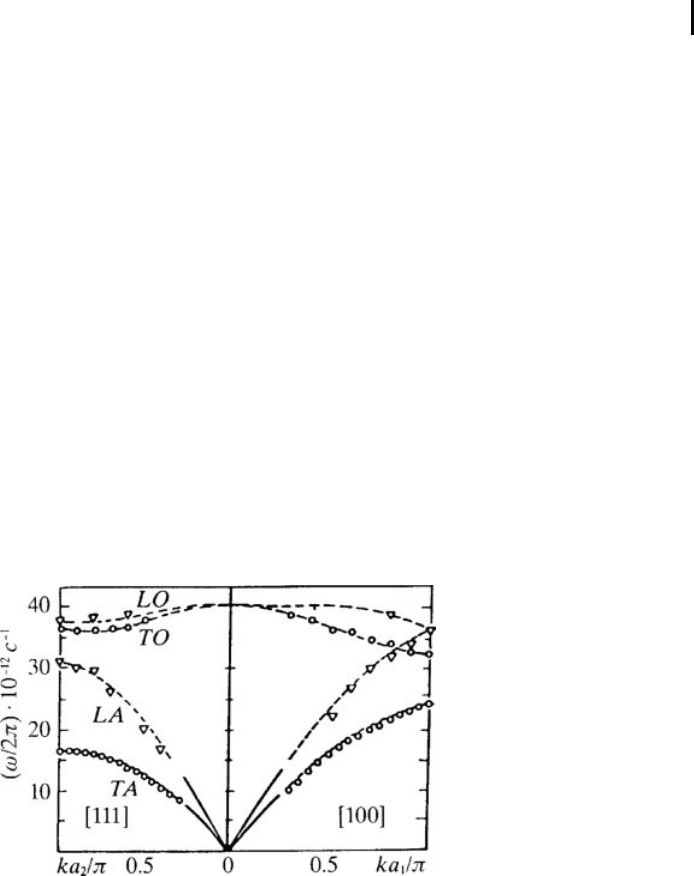
Fig. 3.2 Experimental dispersion curves of acoustic (A) and optical (O)
vibrations for diamond in the directions [100] and [111] (Warren et al.
1965).
The real spectrum of vibrations of a crystal with two atoms in the unit cell is shown
in Fig. 3.2, where the dispersion curves for diamond with two wave-vector directions
are given. The plots show the acoustic branches (LA is the longitudinal acoustic and
TA is the transverse acoustic branch) and optical branches (LO is the longitudinal
optical, and TO is the transverse optical branch). Since both the chosen directions of
the vector k are symmetric directions in the reciprocal lattice, all transverse modes
prove to be doubly degenerate.

98
3 Vibrations of Polyatomic Lattices
In conclusion, we note that the presence of optical branches of vibrations is eas-
ily taken into account by introducing the normal coordinates of a crystal. Indeed,
the transition to a polyatomic lattice is formally the adding of an extra index s (the
atom number in the unit cell). The expansion of arbitrary displacements u
s
(n) in the
functions (3.2.12) remains the same as above:
u
s
(n)=
∑
kα
Q(k, α)ψ
kα
(n, s), (3.2.17)
where Q(k, α) are the complex normal coordinates of a polyatomic lattice. The
Hamiltonian func tion of small crystal vibrations (2.6.8) as well as th e Hamilton ian
function expressed through the real normal coordinates and momenta (2.11.14) also
retain their previous form. However, the summation over α is now from 1 to 3q.
3.3
Molecular Crystals
A crystal with a polyatomic lattice whose unit cell has a group of atoms interacting
one with another stronger than with the atoms of neighboring groups is said to be
a molecular crystal. The atoms from the chosen group are assumed to form an in-
dividual molecule, with the surrounding lattice producing an insignificant effect on
its internal motion. Generally, such a crystal consists of molecu les of the substance
whose structure differs insignificantly from their structure in a gaseous phase. The
space lattice of a molecular crystal is, as a rule, p olyatomic and its unit cell of ten con-
tains several molecules. Since the molecules of certain complex chemical compounds
(e. g., organic ones) include a great number of atoms the linear dimension of the unit
cell (identity periods) of molecular crystals may be hundreds of Angstroms.
The optical branch of molecular crystal vibrations that is responsible for intramolec-
ular motions of strongly coupled atoms and, thus, having very high frequencies can be
described as shown in Section 3.1. Such vibrations also involve the covalent atomic
bonds in a molecule, and are studied as a rule independently of low-frequency types of
vibrations. They represent a separate form of crystal motions and are conventionally
called the internal modes of vibrations.
It is clear that the internal modes of vibrations do not exhaust all forms of motions
of molecular crystals. There exist molecular motions that do not practically deform
the covalent intramolecular bonds. These are the rotations of a molecule as a single
whole relative to the unit cell, more exactly, around a certain crystallographic axis.
These motions (“swings” of m olecules) are often called librations, implying the clas-
sifications of mechanical motions of a top.
Thus, in a molecular crystal, apart from internal modes, other physically differ-
ent types of motions are possible. Therefore, special terms for the corresponding
vibrations are introduced. The displacements of molecular centers of mass determine
the translational vibrations and the molecular libration s manifest themselves in the
3.3 Molecular Crystals
99
orientational vibrations. The interaction between molecular librations is comparable
in intensity with the interaction of displacements of their centers of mass. Therefore,
the frequencies of the corresponding vibrations have the same order of magnitude. In
other words, the orientational vibrations are not specific in terms of frequencies, but
they are optically observed and, thus, specific.
In describing the vibrations of molecular crystals N
2
,O
2
,CO
2
, etc., it is assumed
that rig id linear molecules are located at the lattice sites. The assumption of the rigidity
of molecules means neglecting high-frequency intramolecular vibrations and allows
one to represent a linear molecule as dumb-bells having two angular degrees of free-
dom only. There are five degrees of freedom per unit cell in such a model: the three
degrees of freedom of translational vibrations described by the vector u(n) and the
two d egrees of freedom of librational motions that are described by two angles θ(n)
and ϕ(n) that give the space orientation of linear molecules.
Restricting ourselves to a two-component model, we shall characterize a molecular
state by the displacement of its center of mass u(n) and by the rotation angle around
a certain axis ϕ(n). If the displacements of molecules as well as their librations are
small, the linear equations for u(n) and ϕ(n) will be found by directly rewriting
(3.1.3) with the replacement of ξ(n) by ϕ(n), and of the reduced mass µ by the
molecular inertia moment I:
m
d
2
u(n)
dt
2
= −
∑
n
α
1
(n − n
)u(n
)+β( n − n
)ϕ(n
)
,
I
d
2
ϕ(n)
dt
2
= −
∑
n
α
2
(n − n
)ϕ(n
)+β(n
− n)u(n
)
.
(3.3.1)
All the results fo llow from (3.1.3) and discussed in Section 3.1 are au tomatically
extended to the conclusions from (3.3.1). In particular, the dispersion relations are
found as the solutions to the algebraic equation (3.1.9), where µ must be replaced
by I.
Let us analyze in more detail the peculiarities of the dispersion law of a molecular
crystal. Suppose the molecules are placed at the sites of a primitive cubic lattice.
Now we take into account the interaction of the nearest molecules only. The nonzero
elements of α(n) and β(n ) matrices will then be α(0), α(n
0
) and β(0), β(n
0
),where
n
0
is the radius number of any one of the six nearest neighbors. We assume the
matrix β(n) to be symmetric, and from (3.1.4), (3.1.10 ) (becau se the lattice is highly
symmetric) we get
α
1
(0)+6α
1
(n
0
)=0; β(0)+6β(n
0
)=0;
α
2
(0)+6α
2
(n
0
)=Iω
0
2
. (3.3.2)
100
3 Vibrations of Polyatomic Lattices
We choose the coordinate axes along the four-fold symmetry axes and substitute
(3.3.2) into (3.1.8)
A
1
(k)=
1
3
α
1
(0)(3 −cos ak
x
−cos ak
y
−cos ak
z
);
B(k)=
1
3
β(0)(3 −cos ak
x
−cos ak
y
−cos ak
z
);
A
2
(k)=α
2
(0) −
1
3
(α
2
(0) − Iω
2
0
)(cos ak
x
−cos ak
y
−cos ak
z
).
(3.3.3)
Using the explicit expressions (3.3.3) and solving (3.1.9), we find two dispersion
relations
2mIω
2
±
(k)=IA
1
(k)+mA
2
(k)
±{[IA
1
(k) − mA
2
(k)]
2
+ 4mIB
2
(k)}
1/2
.
(3.3.4)
We already know that for small k (ak 1) the function B
2
(k) ∼ (ak)
4
,and
in (3.3.4) it can be omitted. The long-wave dispersion laws will then coincide with
(3.1.11), (3.1.12), but we write them in a more general form
2mIω
2
±
(k)=IA
1
(k)+mA
2
(k) ±|mA
2
(k) − IA
1
(k)| . (3.3.5)
Assume now that the interaction of translational and orientational vibrations is small
for all k. Since the func tion B(k) is responsible for this interaction we omit the last
term in (3.3.4), i. e., we assume that the dispersion laws are determined co mpletely b y
(3.3.5). If IA
1
(k) < mA
2
(k) for all k, this conclusion allows one to interpret the
results. The resulting dispersion laws of acoustic and optical vib rations
ω
2
A
(k)=
1
m
A
1
(k)=
α
1
(0)
3m
(3 − cos ak
x
−cos ak
y
−cos ak
z
) , (3.3.6)
ω
2
O
(k)=
1
I
A
2
(k)=
α
2
(0)
I
=
1
3
ω
2
0
−
α
2
(0)
I
× (cos ak
x
+ cos ak
y
+ cos ak
z
) ,
(3.3.7)
are described by the p lots in Fig. 3.1, if the vector k is along the direction [111]. In this
case the point k
B
corresponds to the values ak
x
= ak
y
= ak
z
= π and the limiting
short-wave frequencies are equal to
ω
m
=
2α
1
(0)/m , ω
1
=
(2α
2
(0)/I) − ω
2
0
. (3.3.8)
By assumption, ω
m
< ω
1
(because the molecule has a small moment of inertia). The
positive B
2
in (3.3.4) may only decrease ω
m
and increase ω
1
. Thus, the condition
3.4 Two-Dimensional Dipole Lattice
101
ω
m
< ω
1
is not violated by taking into account the interaction of translational and
orientational vibrations.
We have already noted that the characteristic frequencies of translational and libra-
tional waves have the same order of magnitude: α
1
(0) ∼ mα
2
(0). Hence, the crystals
for which Iα
1
(0) > mα
2
(0) and ω
1
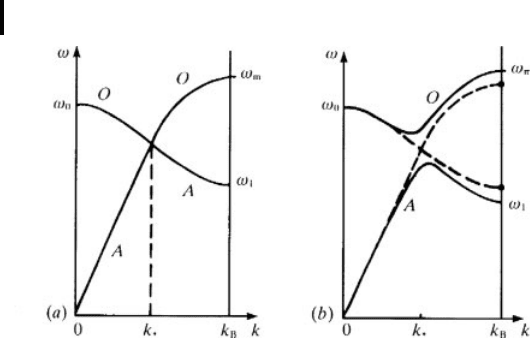
< ω
m
are quite possible. The plots of the disper-
sion laws (3.3.6), (3.3.7) along the d irection [111] will then intersect at a certain point
k
∗
(Fig. 3.3a), so that a crossover situation arises. Formally, following (3.3.4), the
dispersion laws of acoustic (low-frequency) and optical (high-frequency) vibrations
are
ω
2
A
(k)=
1
m
A
1
(k) ,0< k < k
∗
,
1
I
A
2
(k) , k
∗
< k < k
B
,
ω
2
O
(k)=
1
I
A
2
(k) ,0< k < k
∗
,
1
m
A
1
(k) , k
∗
< k < k
B
,
(3.3.9)
As a result of the interaction at the point k = k
∗
, a discontinuous change in the po-
larizations of the vibrations of two b ranches occurs. Actually, it follows from (3.1.7)
at B(k )=0 that the dispersion law mω
2
= A
1
(k) refers to purely translational
vibrations (φ = 0), and the dispersion law Iω
2
= A
2
(k) to the orientational vibra-
tions ( u = 0). The jump-like change in the vibration polarizations and the breaks
appearing in the plots of the dispersion laws of acoustic and optical vibrations are
the result of disregarding the interaction of translational a nd libratio nal vibrations at
Iα
1
(0) > mα
2
(0). The inclusion of even a small value of B
2
in (3.3.4 ) eliminates both
misunderstandings, as intersection point vanishes, the plots in the vicinity of k = k
∗
move apart, the dispersion laws become regular (Fig. 3.3b) and the polarizations trans-
form continuously.
The above-described peculiarities of the vibratio n spectrum are typical for some
molecular crystals mentioned above.
3.4
Two-Dimensional Dipole Lattice
A two-dimensional lattice can be made up of particles adsorbed onto an atomically
smooth face of some crystals. If charged particles (ions) are adsorbed onto a metal
surface each of them manifests itself as an electric dipole perpendicular to the surface.
This is connected with the fact that the electrostatic charge field near the conductor
(metal) plane surface is equivalent to a Coulomb charge field and its mirror reflec-
102
3 Vibrations of Polyatomic Lattices
Fig. 3.3 The “cross situation”: (
a
) intersection of dispersion branches;
(
b
) removal of degeneracy.
tion in the plane surface (the opposite sign charge). Therefore, the adsorbed charged
particles interact as parallel dipoles. When adsorbed particles are dense enough they
are ordered and form a two-dimensional crystal that is the simplest realization of a
2D dipole lattice. The adsorbed particles, however, interact strongly enough with a
substrate, such that this crystal can be regarded as two-dimensional only in terms of
the geometry of its lattice.
Examples of systems whose dynamics under certain approximations are equivalent
to 2D vibrations seem to be of greater interest. Under certain conditions a 2D crystal
forms from electrons on a liquid helium surface at low temperatures. Electrons that
have been (forced) pressed by an electric field to the liquid helium surface behave gen-
erally as a gas (gas of interacting p articles), but at low enough temperatures Wigner
crystallization may occur in the electron gas concerned and a 2D electron crystal ap-
pears. Electrons over the thick layer surface of dielectric helium interact almost like
point charges. Thus, although the electrons on the liquid helium surface create a crys-
tal lattice, the latter may n ot be a dipole. On ly when a thin helium film is formed
on a metal substrate is the electron interaction at large distances similar to the dipole
interaction.
Finally, a 2D crystal may be formed by a system of magnetic bubbles. They can be
obtained in a thin ferromagnetic film whose magnetic anisotropy axis is perpendicular
to the plane of the film. In a strong enough magnetic field H directed along the nor-
mal to the film, a ferromagnetic film is in a single domain state. The magnetization
M coincides in its direction with H. However, if the external field is not very strong,
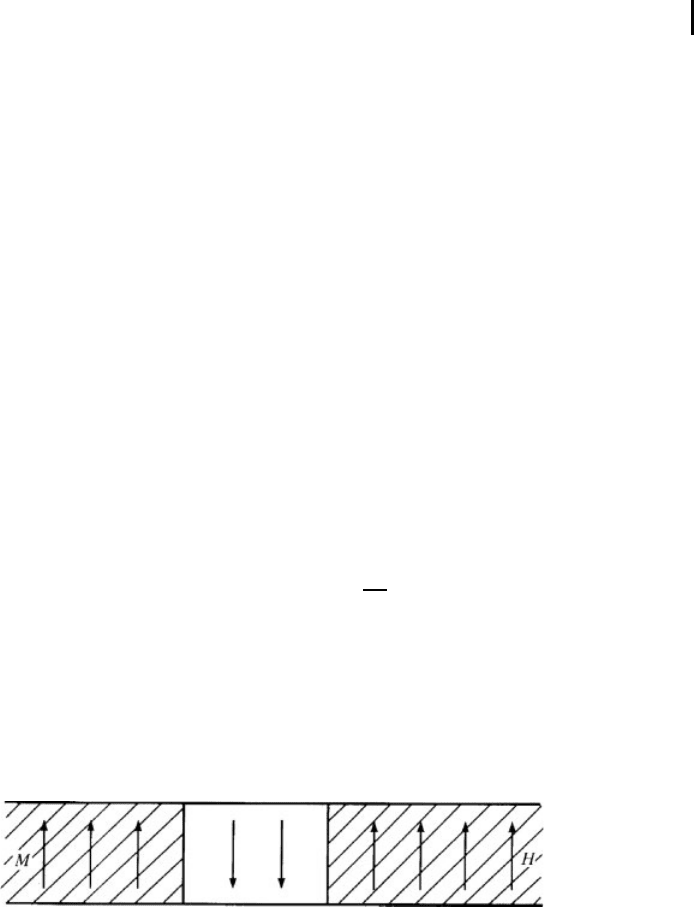
cylindrical “islands” where the magnetization M is directed opposite to the external
magnetic field appear in the film (Fig. 3.4). These are just cylindr ical magnetic do-
mains or bubbles. They are generally observed in films of thickness 10
−4
−10
−3
cm
and have a diameter of the same order or even less. But in any case the bubbles prove
to be macroscopic formations whose dimension is much larger than the thickness of
3.4 Two-Dimensional Dipole Lattice
103
the domain boundary dividing the regions with different orientation of magnetization.
A considerable “surface” energy concentrated at the domain boundary provides a cir-
cular form of the bubble cross section.
The peculiarity of the bubbles is their great mobility and the ability to move easily
along the film. But moving bubbles create around themselves a dynamical magneti-
zation field with certain inertia. As a rule, the inertia of the inhomogeneous magneti-
zation field is attributed, in such cases, to its source, the bubble. As a result it appears
that the bubble may be regarded as some particle in a 2 D crystal with the definite
effective mass m
∗
. It is clear that the bubble is an isolated magnetic dipole in the
background of a uniformly magnetized film (its magnetic moment equals µ = 2MhS,
where h is the film thickness; S is the bubble cross-sectional area). Therefore, it is
affected by the action of both inhomogeneous external magnetic field and the forces
of magnetic dipole interaction with the other bubbles. The dipole interaction results
in a repulsion of the same magnetic dipoles. Therefore, in a film of finite area the
bubbles may form a periodic lattice. If the magnetic properties of a film are isotropic
in its plane, a hexagonal (or trigonal) lattice is stable.
Let the lattice constant a be much larger that the bubble diameter (a
2
S)andthe
plate thickness ( a h). The interaction energy of two bubbles at the points R and R
may then be represented as the dipole–dipole interaction energy V(R − R
),where
V(R)=
µ
2
R
3
. (3.4.1)
It is assumed in (3.4.1) that the bubble magnetic moments µ are strictly perpendicular
to the plane of the film and precession deviations are absent.
Let us consider small translational vibrations
1
of a bubble lattice. We introduce
u
i
(n) , i = 1, 2 as the displacement vector of a bubble located at the point with 2D
number n(n
1
, n
2
) th at numbers unit cells. The eq uilibrium distance between the bub-
ble centers in a static lattice is denoted by a.
Fig. 3.4 Distribution of magnetization in a film with bubbles.
Let the bubbles experience small displacements from the equilibrium lattice points:
R
n
= r(n)+u(n). Then, within the approximation quadratic in u(n) the total inter-
1) Analyzing only the vibrations of the bubble gravity centers we assume that at
the frequencies we are interested in the values and the direction of a magnetic
moment µ remain unchanged, the domain pulsation and precession motion of
its magnetic moment do not e xist, with these motions taking place at higher
frequencies.
104
3 Vibrations of Polyatomic Lattices
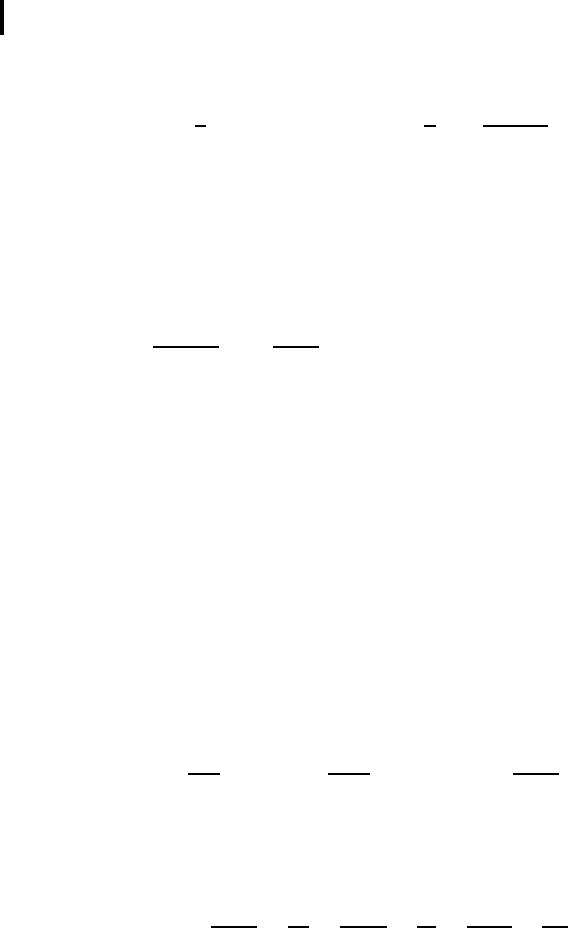
action energy of the bubbles is given by
U =
1
2
∑
R=R
V(R − R
)=U
0
+
1
4
∑
∂
2
V
∂X
i
∂X
k
0
× [u
i
(n) − u
i
(n
)] [u
k
(n) −u
k
(n
)] ,
(3.4.2)
where U
0
is the bubble equilibrium lattice energy.
The simplest version of the pair interaction energy (3.4.1) allows one to describe
consistently the low-frequency vibrations of a dipole lattice. The expression (3.4.2) is
easily reduced to a standard form (2.1.11) by denoting
α
ik
(n)=−
∂
2
V
∂X
i
∂X
k
0
=
3µ
2
r
7
(n)
r
2
(n)δ
ik
−5x
i
(n)x
k
(n)
, n > 0;
α
ik
(0)=
∑
n=0
α
ik
(n) .
(3.4.3)
By calculating the elements of the matrix of atomic force constants (3.4.3), the
problem of harmonic vibrations of the bubble plane lattice is actually solved.
The long-wave dipole lattice vibrations should be described by two-dimensional
equations of elasticity theory of the type (2.8.6), (2.8.7), where elasticity moduli are
calculated using (2.8.5), (2.8.1 1). With the presence of the six-fold symmetry axis
(hexagonal dipole lattice), the 2D symmetrical fourth-rank tensor c
iklm
can be pre-
sented as (i, k = 1, 2)
c
iklm
= Aδ
ik
δ
lm
+ B(δ
il
δ
km
+ δ
im
δ
kl
). (3.4.4)
To calculate A and B we will use (1.8.5). We will convolute over the pair of indices i
and k in (2.8.5) and (3.4.4) and then over k and l. Thus, we get
A =
3µ
2
16
Q, B =
15µ
2
16
Q, Q =
∑
n=0
1
r
3
(n)
. (3.4.5)
In a two-dimensional lattice, the sum involved in (3.4.5) converges. Therefore, it is
easily estimated by replacing the sum with a two-dimensional integral:
Q =
∑
n=0
1
r
3
(n)
∼
1
S
0
dx dy
r
3
∼
1
a
2
∞
a
2πdr
r
2
=
2π
a
3
.
Analogous to (3.4.4), the expression for a 2D tensor of elastic moduli λ
iklm
in an
hexagonal lattice can be written as (i, k = 1, 2):
λ
iklm
= λδ
ik
δ
lm
+ G(δ
il
δ
km
+ δ
im
δ
kl
), (3.4.6)
where G is the shear modulus, λ is the Lamé coefficient of a two-dimensional elastic
medium. We now make use of (2.8.11) replacing V
0
with S
0
, th e 2D lattice unit cell
3.5 Optical Vibrations of a 2D Lattice of Bubbles
105
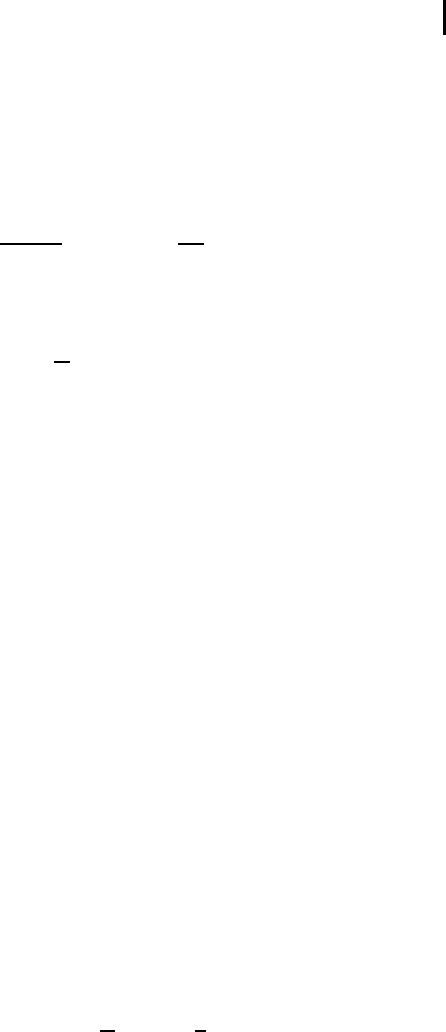
area. We then obtain λS
0
= 2B − A = 9A, GS
0
= A. Thus, the elastic moduli of a
2D dipole lattice are λ = 9A/S
0
∼ 2πµ
2
/a
5
.
Since the two-dimensional dipole lattice has both a total compression modulus and
shift modulus, longitudinal and transverse elastic waves can propagate in it. The
squares of longitudinal, c
2
l
and transverse c
2
t
, wave velocities are determined b y the
formulae known from elasticity theory
c
2
l
=
λ + 2G
m
∗
S
0
; c
2
t
=
G
m
∗
S
0
. (3.4.7)
Irrespective of specific elastic wave velocity values, the ratio of their squares in the
model of a bubble lattice is given by
c
l
c
t
2
= 11. (3.4.8)
The number obtained is due to the choice of the pair interaction energy in the form
of (3.4.1). Therefore, the relation (3.4.8) should be preserved for any plane dipole
lattice of a similar type.
3.5
Optical Vibrations of a 2D Lattice of Bubbles
Using the simplest model we considered in the previous section the low-frequency
(i. e., acoustic) vibrations of a 2D dipole lattice. Generalizing the model one can also
study the optical vibrations of a 2D dipole lattice.
We consider two independent generalizations of the above model. First, for the
bubble lattice, we take into account the magnetic domain pulsations connected with
symmetric extensions and compressions of the region of “inverted” orientation of the
magnetization vector M.
With existing pulsations there appears a new dynamic variable – the bubble radius
– denoted as R. Setting up the equations for the new dynamic variable, we assume as
before that the bubble radius is much larger than the thickness of a domain boundary
dividing the regions with opposite magnetization directions. The bubble inertia will
then be concentrated almost in its cylinder surface and the surface kinetic energy can
be written as (1/2)ηv
2
n
,whereη is the surface effective mass density of the domain
boundary; v
n
is the boundary motion velocity normal to its surface (v
n
= dR/dt). If
the bubbles move translationally with velocity V,thenv
n
= V cos ϕ(0 < ϕ < 2π)
and the kinetic energy of its translational motion is determined by
E
tr
kin
= πRh ηv
2
n
=
π
2
RhV
2
=
1
2
m
∗
V
2
. (3.5.1)
If there are small pulsations under which the boundary moves uniformly at all points
of the bubble surface with velocity v
n
= V, then the kinetic energy is given by
E
pul
kin
= πηhRv
2
n
= πηhRV
2
. (3.5.2)