
Kosevich A.M. The crystal lattice
Подождите немного. Документ загружается.

106
3 Vibrations of Polyatomic Lattices
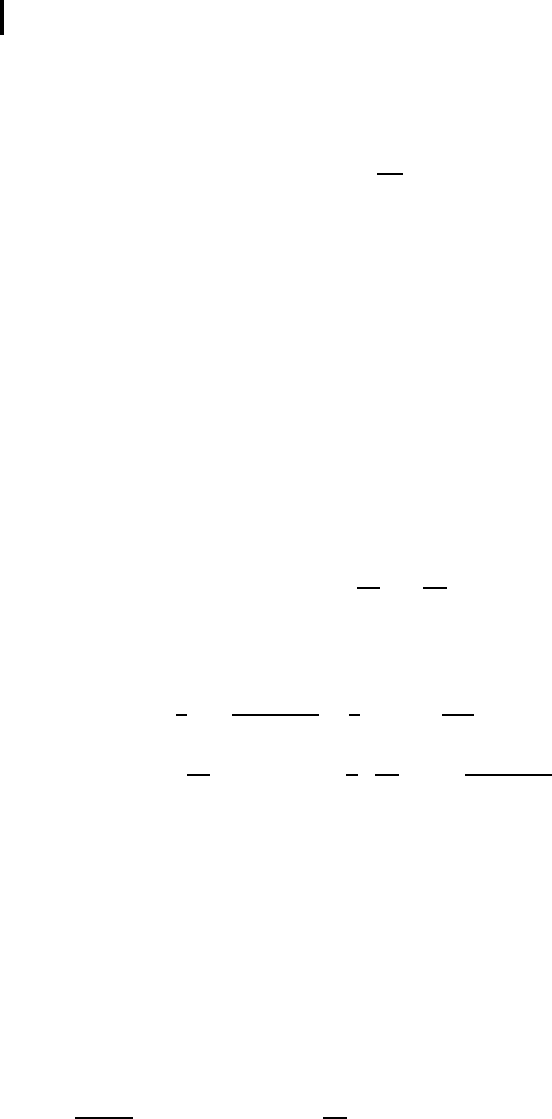
Comparing (3.5.1), (3.5.2) we conclude that the effective mass of symmetric pulsa-
tions is twice as large as the effective mass of translation motion, m
∗
. Therefore, the
kinetic energy of pulsations can be expressed through dR/dt in the form
E
pul
kin
= m
∗
dR
dt
2
.
Since the bubble pulsations change the bubble radius, they are associated with a
certain increase in the potential energy of the system. Under small vibrations the
potential energy of an individual bubble depends quadratically on R − R
0
(R
0
is the
equilibrium bubble radius)
U
pul
= m
∗
ω
2
0
(R − R
0
)
2
, (3.5.3)
where ω
0
is the pulsation eig enfrequency. In a lattice, the equilibrium radius R
0
is
different from the equilibrium radius of an isolated bubble, since the magnetodipole
repulsion in a static lattice simulates a decrease in the equilibrium radiu s of an indi-
vidual bubble.
We introduce ξ = R − R
0
and calculate, in the approximation quadratic in ξ(n),the
change in the magnetic-dipole interaction energy in the bubble lattice. We represent
the pulsating magnetic moment of a bubble at the n-th site as
µ(n)=µ
1 + 2
ξ
R
0
+
ξ
R
0
2
,
where µ is an equilibrium value of the magnetic moment. Then, using (3.4.1), we
write
U
md
=
1
2
∑
n=n
µ(n)µ(n
)
r
3
(n − n
)
=
1
2
Nµ
2
Q +
2µ
2
R
0
Q
∑
ξ(n)
+
µ
R
0
2
Q
∑
ξ
2
(n)+
1
2
2µ
R
0
2
∑
n=n
ξ(n)ξ(n
)
r
3
(n − n
)
,
(3.5.4)
where Q is determined by (3.4.5); N is the number of sites in the lattice.
The first term in (3.5.4) is included in the ground-state energy of the lattice and
does not contribute to the equation of the motion for ξ(n). The second term is re-
sponsible for the renormalization of the equilibrium bubble radius. We do not give
here the calculation s of this renormalization (see Problem 1) , keeping in m ind that the
equilibrium bubble radius in a lattice is different from that of an isolated bubble. The
third term in (3.5.4) contributes to the renormalization of the homogeneous pulsation
frequency and, finally, the fourth term determines the pulsation wave dispersion.
Using (3.5.3), (3.5.4) we introduce in a standard way the equation of motion for
pulsations
2m
∗
d
2
ξ(n)
dt
2
= −
2m
∗
ω
2
0
+ 2Q
µ
R
0
2
ξ(n) −
∑
n=n
β(n − n
)ξ(n
), (3.5.5)
3.5 Optical Vibrations of a 2D Lattice of Bubbles
107
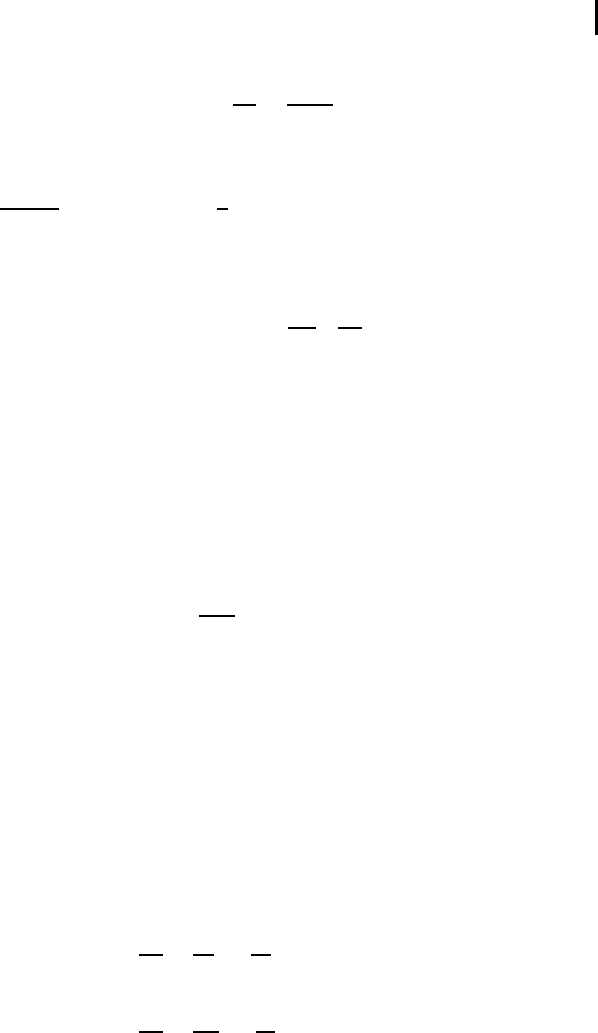
where
β(n)=
2µ
R
0
2
1
r
3
(n)
. (3.5.6)
Transforming (3.5.5), taking into account the definition Q,gives
m
∗
d
2
ξ(n)
dt
2
= −m
∗
ω
2
r
ξ(n)+
1
2
∑
n
β(n − n
)[ξ(n) − ξ(n
)], (3.5.7)
where ω
r
is the renormalized pulsation frequency,
ω
2
r
= ω
2
d
+ ω
2
0
, ω
2
d
=
3Q
m
∗
µ
R
0
2
. (3.5.8)
Finally, the relation (3.5.7) is written for small pulsation vibrations of the bubble
lattice. For this equatio n the relation between the pulsations and th e translational vi-
bration of the lattice concerned was neglected. The equation for small translational vi-
brations was obtained, without taking into account the bubble pulsations. The relation
between translational and pu lsation vibrations is easily allowed for (in the expan sion
(3.5.4) it suffices to include the terms proportional to the bubble displacements), so
the reader is invited to do this (see Problem 2).
The dispersion law for pulsation vibrations is
ω
2
(k)=ω
2
r
−
1
2m
∗
∑
β(n)[1 − e
−ikr (n)
]. (3.5.9)
It is clear that ω
0
= ω
r
= 0. Thus, the pulsation vibrations are the optical vibra-
tions. Furth ermore, it follows from the definition (3.5.6) that β(n ) > 0; hence, the
second term in (3.5.9) leads to a frequency d ecrease with increasing k. Thus, ω = ω
r
is the largest frequency in the spectrum of pulsation vibrations.
Let us analyze the dispersion law (3.5.9) in the long-wavelength limit (ak 1).
We denote
B(k)=
∑
β(n)[e
−ikr (n)
−1], (3.5.10)
and replace the sum over the lattice with the integral in the lattice plane using the polar
coordinates (r, ϕ) associated with the k vector direction
B(k)=
2µ
R
0
2
1
S
0
L/2
0
dr
r
2π
0
(e
−ikr cos ϕ
−1) dϕ
=
2µ
R
0
2
2π
S
0
L/2
0
dr
r
2
[J
0
(kr ) − 1] ,
where S
0
is the unit cell area of a bubble lattice; L is the dimension (diameter) of the
plane lattice; J
0
(x) is the first-order Bessel function (with zero index).
108
3 Vibrations of Polyatomic Lattices
Replacing the integration variable results in
B(k)=
2µ
R
0
2
2πk
S
0
Φ
kL
2
, (3.5.11)
where
Φ(z)=
1
z
[1 − J
0
(z)] + J
1
(z) −
z
0
J
0
(x) dx.
Taking into account the possible values of the quasi-wave vector components
(1.5.3), we conclude that the product kL either equals zero (B(0)=0)orkL > 2π.
But in the second case Φ(kL/2) does not differ in order of magnitude from its limit-
ing value Φ(∞)=−1 and rapidly approaches it with increasing k.
2
Therefore, as we
are interested in the finite interval of small values k (ak 1), we can write at k = 0
B(k)=
2µ
R
0
2
2πk
S
0
Φ (∞)=−
2π
S
0
2µ
R
0
2
k.
Thus, the long-wave dispersion law looks like
ω
2
= ω
2
r
−
π
m
∗
S
0
2µ
R
0
2
k. (3.5.12)
The frequency in (3.5.12) is independent of the direction of the 2D vector k,this
being a result of the symmetry of the hexagonal lattice.
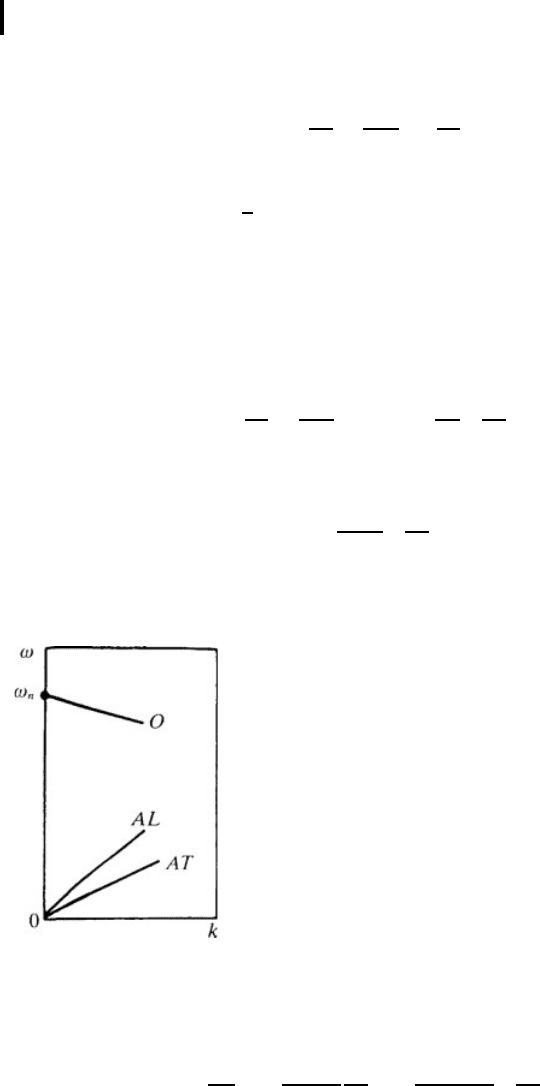
Fig. 3.5 Dispersion laws of the long-wave translational (acoustic) and
pulsation (optical) vibrations of the 2D bubble lattice.
It follows from (3.5.12) that the pulsation waves for ak 1 have nonzero velocity
v = lim
k→0
∂ω
∂k
= −
1
4m
∗
ω
r
∂B
∂k
= −
π
2m
∗
S
0
ω
r
2µ
R
0
2
,
2) The value of Φ(2π) differs from Φ(∞)=−1 by 15 per cent.
3.6 Long-Wave Librational Vibrations of a 2D Dipole Lattice
109
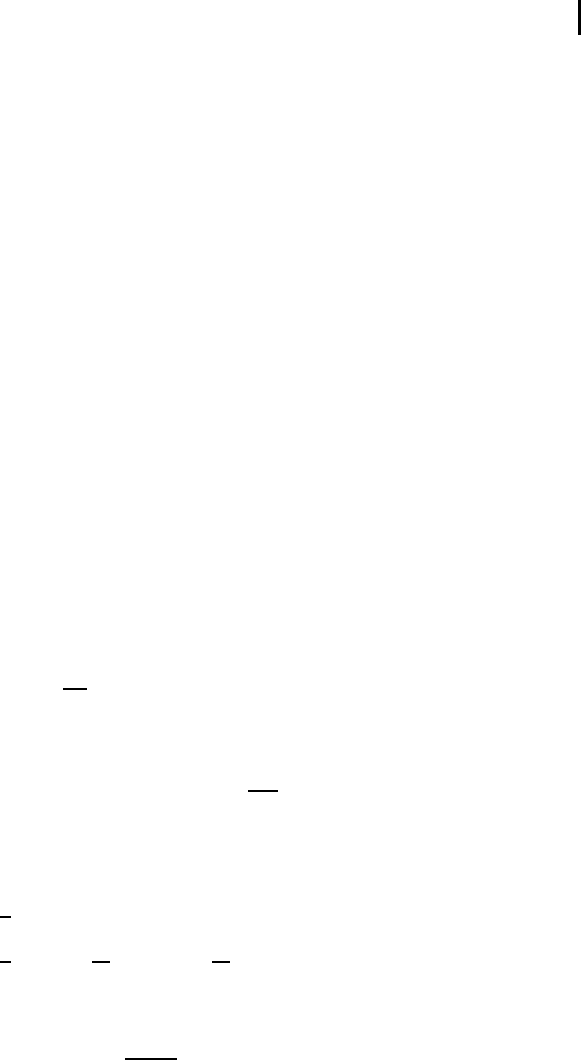
directed opposite to the vector k. The plots of long-wave dispersion laws of transla-
tional and pulsation waves in a bubble lattice are shown schematically in Fig. 3.5.
The dispersion law peculiarities that manifest themselves in a nonanalytic depen-
dence of the frequency on the wave-vector components at k → 0 are due to the mag-
netostatic character of the dipole-interaction forces making up a lattice of bubbles.
3.6
Long-Wave Librational Vibrations of a 2D Dipole Lattice
We now proceed to the second possible generalization of a two-dimensional dipole
lattice model. Assume that the centers of gravity of hard electric dipoles, oriented
in the equilibrium state, perpendicular to the lattice plane (parallel to the z-axis) are
fixed in the sites of a symmetric (triangular or quadratic) lattice. Each dipole can make
librational vibrations and the libration frequency of an isolated dipole is equal to ω
0
.
If the librational vibration angles are small, the change in the z-projection of a
dipole moment is of the o rder of its square projection onto the lattice plane. Thus, let
us denote by d
0
a dipole moment and let eξ be its component in the lattice plane. It
then follows from the condition d
2
= d
2
0
= constant that
d
z
−d
0
= −e
2
ξ
2
x
+ ξ
2
y
/2d
0
eξ.
We calculate the dipole energy of the lattice in the approximatio n quadratic in ξ.
The interaction energy of two dipoles d and d
at the points n and n
is equal to
V(n −n
)=
1
R
5
[R
2
dd
−3(Rd)( Rd
)], R = r(n − n
). (3.6.1)
A scalar product dd
in (3.6.1) for the approximation quadratic in ξ is
d(n)d(n
)=d
2
0
+ e
2
ξ( n)ξ(n
) −
e
2
2d
0
ξ
2
(n)+ξ
2
(n
)
. (3.6.2)
Using (3.6.1), (3.6.2) and keeping in mind that the vector R lies in the lattice plane,
we get, similar to (3.5.4), the following expression for the dipole energy
U =
1
2
∑
V(n −n
)
=
1
2
d
2
0
NQ −
e
2
2
∑
ξ
2
(n)+
e
2
2
∑
D
ik
(n − n
)ξ
i
(n)ξ
k
(n
),
(3.6.3)
where Q is determined, as before, by (3.4.5), and with
D
ik
(n)=
1
R
5
(n)
R
2
(n)δ
ik
−3X
i
(n)X
k
(n)
. (3.6.4)
The third term on the r.h.s. o f (3.6.3) is traditional and the sign of the second term is
unusual. It describes the energy decrease when dipoles deviate from the z-axis. This
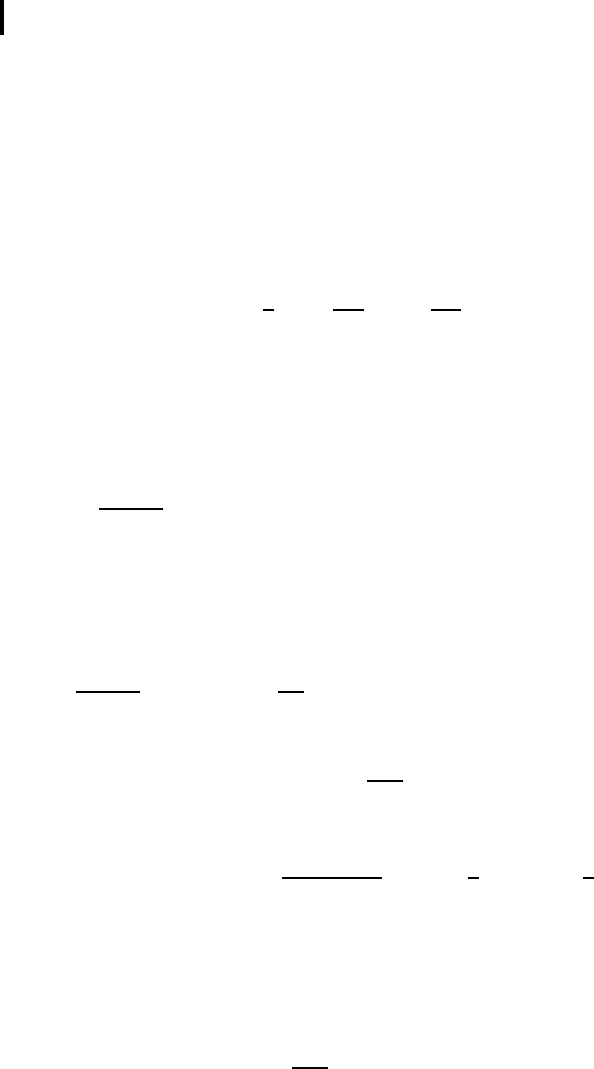
110
3 Vibrations of Polyatomic Lattices
is due to the fact that at a fixed d istance between the centers of two parallel dipoles,
the mutual orientation along the line connecting them is the most advantageous ener-
getically, rather than when they are perpendicular to it. But introducing the frequency
ω
0
, we assume the presence of fo rces keeping the lattice in an equilibrium state with
the dipoles parallel to the z-axis. The dipole interaction acts against these forces.
We now write the kinetic energy of a vibrating dipole. If we consider a dipole as
a symmetric top with moment of inertia I the kinetic energy of its small librational
vibrations is given by
E
kin
=
1
2
m
∗
dξ
x
dt
2
+
dξ
y
dt
2
, (3.6.5)
where m
∗
= e
2
I/d
2
0
α is the effective mass.
The simple form of the kinetic (3.6.5) and potential (3.6.3) energies of the lattice
allows one to write down the equations of collective librational motio n that take into
account the dipole eigenvibrations
m
∗
d
2
ξ
i
(n)
dt
2
= −[m
∗
ω
2
0
−e
2
Q]ξ
i
(n) −
∑
n=n
β
ik
(n − n
)ξ
k
(n
), (3.6.6)
where
β
ik
(n)=e
2
D
ik
(n) , i, k = 1, 2. (3.6.7)
We now represent (3.6.6) in a form analogous to (3.5.7)
d
2
ξ
i
(n)
dt
2
= −ω
2
1
ξ
i
(n)+
1
m
∗
∑
n
β
ik
(n − n
)
ξ
k
(n) − ξ
k
(n
)
, (3.6.8)
where
ω
2
1
= ω
2
0
−
3
2m
∗
e
2
Q. (3.6.9)
In (3.6.8), (3.6.9) we use the relation, obvious for a symmetric lattice,
∑
D
ik
(n)=Qδ
ik
−3
∑
X
i
(n)X
k
(n)
R
5
(n)
=
Q −
3
2
Q
δ
ik
= −
1
2
Qδ
ik
.
It follows from (3.6.9) that the dipole–dipole interaction lowers the frequency of
homogeneous librational vibrations of a two-dimensional dipole lattice. Since the
lattice must be stable with respect to these vib rations it is necessary that ω
2
1
> 0.In
other words, the stability condition for a dipole lattice of the type concerned is given
by the inequality
3
2m
∗
e
2
Q < ω
2
0
, (3.6.10)
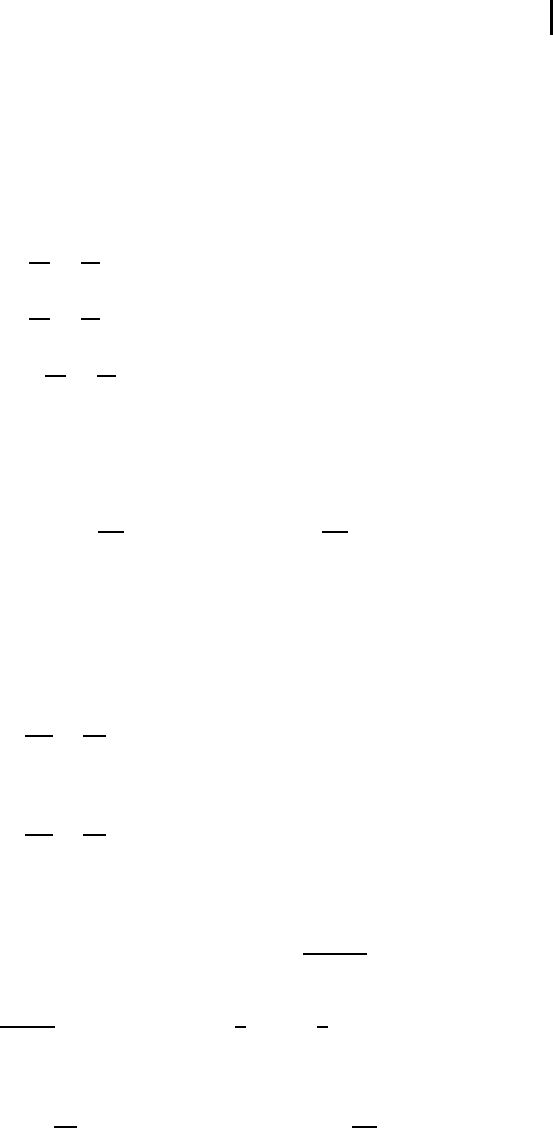
which imposes a restriction on the dipole density (i. e., on the lattice period a)since
Q ∼ 2π/a
3
.
3.6 Long-Wave Librational Vibrations of a 2D Dipole Lattice
111
To analyze the dispersion law of librational vibrations we introduce the tensor func-
tions
B
ij
(k)=
∑
β
ij
(n)
e
−ikr (n)
−1
, (3.6.11)
which in the long-wave approximation can be written in terms of two-dimensional
space integrals. In a symmetric lattice these integrals may be calculated in a specific
form of Cartesian coordinates with the x-axis directed along the vector k
B
xx
(k)=
e
2
S
0
dr
r
2
(1 − cos
2
ϕ)[e
−ikr cos ϕ
−1] dϕ, (3.6.12)
B
yy
(k)=
e
2
S
0
dr
r
2
(1 − 3sin
2
ϕ)[e
−ikr cos ϕ
−1] dϕ, (3.6.13)
B
xy
(k)=−
e
2
S
0
dr
r
2
cos ϕ sin ϕ)[e
−ikr cos ϕ
−1] dϕ.
It is clear that B
xy
(k)=0. Thus, longitudinal vibrations whose dispersion law is
determined by the function B
l
= B
xx
(k) , and the transverse vibrations whose dis-
persion law is given by B
t
= B
yy
(k) are independent. Their dispersion laws are as
follows
ω
2
l
= ω
2
1
+
1
m
∗
B
l
(k) ; ω
2
t
= ω
2
1
+
1
m
∗
B
t
(k) . (3.6.14)
We note that the limiting frequencies (at k = 0) of longitudinal and transverse
optical 2D lattice vibrations are the same. The behavior of the dispersion laws near
the limiting frequency ω
1
is determined by the form of the functions B
l
(k) and B
t
(k) .
Repeating the arguments used for the treatment of the limiting behavior of the func-
tions (3.6.12), (3.6.13) at ak 1 we can write them as
B
l
(k)=
e
2
k
S
0
∞
0
dx
x
2
(1 − 3cos
2
ϕ)(e
−ix cos ϕ
−1) dϕ,
B
t
(k)=
e
2
k
S
0
∞
0
dx
x
2
(1 − 3sin
2
ϕ)(e
−ix cos ϕ
−1) dϕ.
(3.6.15)
It follows from the definition of the Bessel functions J
0
(x) and J
1
(x) that
cos
2
ϕ(e
−ix cos ϕ
−1) dϕ = −
π + 2π
d
2
J
0
(x)
dx
2
= 2π
dJ
1
(x)
dx
− π = 2π
J
0
(x) −
1
2
J
1
(x) −
1
2
.
(3.6.16)
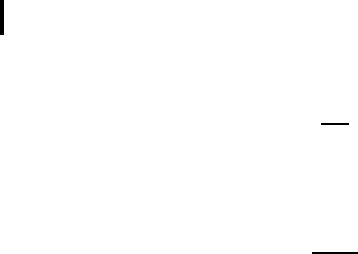
Using this expression one can show that
∞
0
dx
x
2
cos
2
ϕ(e
−ix cos ϕ
−1) dϕ = −
4π
3
. (3.6.17)
112
3 Vibrations of Polyatomic Lattices
Substituting (3.6.17) into (3.6.15) we get
B
l
(k)=2π
e
2
k
S
0
, B
t
(k)=0.
Thus, if we restrict ourselves only to the linear terms of the expansion in powers
of k, the dispersion laws (3.6.14) will take the form
ω
2
l
= ω
2
1
+
2πe
2
m
∗
S
0
k, ω
2
t
= ω
2
1
. (3.6.18)
It is meaningless to write down the next terms of the expansion in powers of k
without taking into account the librational and translational motions of a d ipole lattice.
As in the case of the dispersion law for pulsation vibrations of a bubble lattice
(3.5.12), the nonanalyticity of the dispersion law (3.6.18) considered as a function of k
is connected, for k → 0, with a slow decay of the coefficients β
ik
(n) in an infinite
sum (3.6.11). Even the first derivative of B
ij
(k) with respect to k is determined by the
sum having no absolute convergence. This explains the singularity of this function as
k → 0.
Although the nonanalyticity of the dispersion law (3.6.18) seems to be insignifi-
cant its appearance is important. While discussing the general properties of the dis-
persion law it was noted that similar nonanalyticity is observed only in the points of
k-space where there is degeneracy and where, going over from one branch of the spec-
trum to another, it is possible to preserve the continuity of the group velocity vector
v = ∂ω/∂k. In the given case such a possibility is absent an d one might think that
the dispersion law for small k has been derived incorrectly, and this is really so. We
have neglected the retardation of the electromagnetic interaction and used the static
expression for the energy of the dipole interaction (3.6.1), although we have taken
into account the interaction of very distant pairs of moving dipoles. Taking into ac-
count the finite velocity of electromagnetic wave propagation affects the form of the
dipole pair interaction energy and results in a restricted dispersion law in the region of
small k. This situation is discussed in detail in the next section.
3.7
Longitudinal Vibrations of 2D Electron Crystal
Let us analyze the simplest model for long-wavelength vibrations of a two-dimensi-
onal electron crystal formed due to Wigner crystallization on a liquid helium surface
or any other realization of a 2D electron crystal. We consider a system of electrons
and ions with mass m and M, respectively, with opposite, but equal in absolute value,
charges e. The entire system is neutral, if the number of ions in the volume unit equals
the number of electrons. We disregard the fact th at the ions form a lattice, i. e., we
shall treat them as a liquid. This simple model is called the jelly model. As it is
more convenient to study a purely electron crystal, taking into account m/M 1,
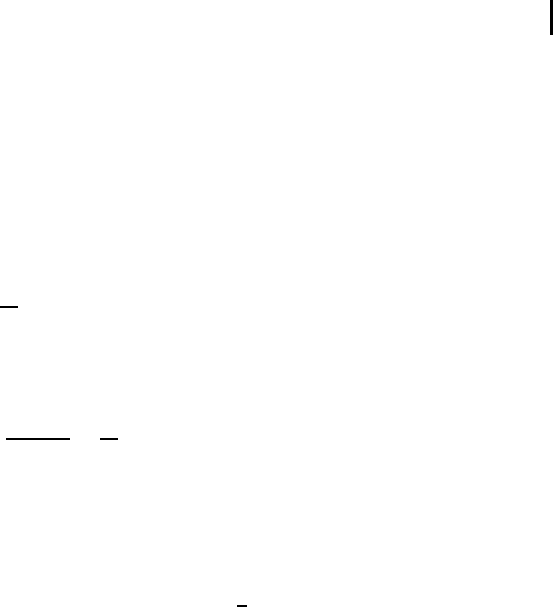
3.7 Longitudinal Vibrations of 2D Electron Crystal
113
we further simplify the jelly model by assuming M = ∞. In this model the con-
tinuous distribution of a positive charge is time independent and coincides with the
equilibrium one that provides stability of an electron crystal.
We suppose that electrons may be displaced only in the crystal plane and denote by
ξ
i
(n) the two-dimensional vector (i = 1,2) o f electron displacement at the site n.
Let ξ a; now, using the symmetry of an electron lattice, we expand the Coulomb
energy of the interaction between electrons and the positive charge of an ion liquid in
powers of ξ:
U = U
0
−
e
2
2
∑
D
ik
(n − n
)
ξ
i
(n) − ξ
i
(n
)
ξ
k
(n) − ξ
k
(n
)
, (3.7.1)
where U
0
is the energy of an equilibrium crystal. The matrix D
ik
is given by (3.6.4).
Using (3.7.1), it is easy to write down the equation of m otion of an electron crystal
d
2
ξ
i
(n)
dt
2
=
1
m
∑
n
β
ik
(n − n
)
ξ
k
(n) − ξ
k
(n
)
, (3.7.2)
with the matrix β
ik
coincident with (3.6.7).
Equation (3.7.2) is different from (3.6.8) only in the fact that ω
0
= 0. Conse-
quently, in the approximation (ak 1) linear in k, the dispersion law for longitudinal
vibrations of an electron crystal can be obtained using (3.6.18)
ω
l
=(2πn
s
e
2
/m)
1/2
√
k, n
s
= 1/S
0
, (3.7.3)
where n
s
is the electron density (the number of electrons per unit crystal area).
It turns out that, essentially, the optical longitudinal vibrations of an electron crystal
have zero limiting frequency (ω(0)=0), i. e., they have a gapless frequency spec-
trum. This is a d irect result of the fact that the electron system is two-dimen sional. The
long-wave dispersion law (3.7.3) coincides with the frequencies of plasma vibrations
of a 2D electron plasma: ω
2
l
= ω
2
pl
(k)=2πn
s
e
2
k /m.
However, if we make an attempt to use the results (3.6.18) to find the frequencies of
long-wave transverse vibrations of an electron crystal, we see that the approximation,
linear in k, that resulted in (3.6.18) is insufficient. When ω
1
= 0, the function B
t
(k)
should be calculated with more accuracy, i. e., taking into account the terms quadratic
in k. To make these calculations, it is necessary to replace the sums (3.6.11) by the
integrals (3.6.12), (3.6.13), i. e., to go over from a discrete to a continuum description
of an electron crystal.
We consider a triangular lattice that has a six-fold symmetry axis and is, thus, elas-
tically isotropic. We put a chosen electron in the center of a circle of radius a and unit
cell area (S
0
= πa
2
). The sums that determine the functions B(k) in the long-wave
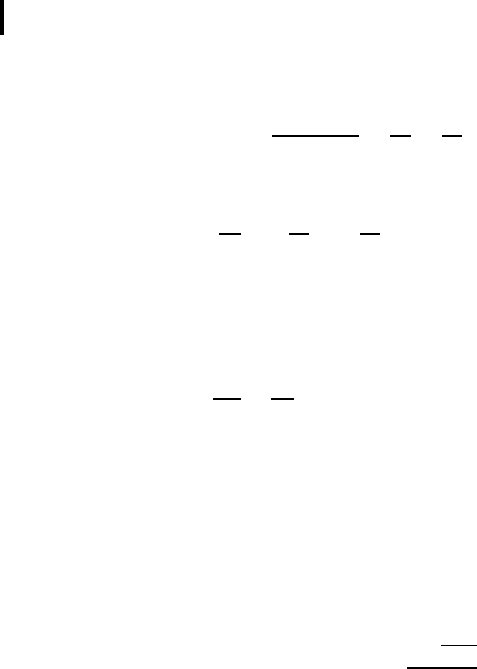
114
3 Vibrations of Polyatomic Lattices
approximation (ak 1) may then be represented, with a good accuracy in the form
B(k)= e
2
∑
n=0
f (r(n), k)
r
3
(n)
=
e
2
S
0
∞
a
dr
r
2
f (r, k) dϕ
=
e
2
S
0
∞
0
dr
r
2
−
a
0
dr
r
2
f (r, k) dϕ.
We make use of this and take the definition (3.6.15) into account, and also the
property of the function B
t
(k) for small k:
B
t
(k)=−
e
2
k
S
0
ak
0
dx
x
(1 − 3sin
2
(ϕ))(e
ix cos ϕ
−1) dϕ. (3.7.4)
We substitute (3.6.1 6) into (3.7.4) retaining in the integral the leading term of the
expansion in powers of x:
B
t
(k)=πe
2
ak
2
/(8S
0
).
We now take the second relation (3.6.14) for ω
1
= 0 and write the dispersion law
for transverse v ibrations of an electron crystal
ω
t
= s
t
k, s
2
t
= 0.125
e
2
√
πn
3
m
. (3.7.5)
So the transverse vibrations of an electron crystal have the character of sound waves
with a large velocity determined by the Coulomb electron interaction
3
(ms
2
t
∼ e
2
/a).
For the realizations of a 2D electron crystal on a helium surface, the limiting period
of the lattice is a ∼ 10
−5
− 10
−4
cm, so that the velocity of a transverse sound may
attain the values s
t
∼ 10
5
−10
6
cm/s.
The presence of transverse sound vibrations in an electron crystal distinguishes it
from an electron liquid (plasma). Therefore, observation of such waves is a direct
proof of the crystallization of a 2D electron system.
We come back, however, to an unusual form of the dispersion relation for longitu-
dinal waves in an electron crystal. The group velocity of longitudinal vibrations with
the dispersion law (3.7.3) tends to infin ity as k → 0. This nonphysical result is due
to neglecting the electromagnetic wave retardation. In describing the electron interac-
tion, we considered only the electrostatic potential energy (3.7.1). When this energy
is calculated, the dominant contribution comes from the terms corresponding to large
distances R(n −n
) when the electromagnetic wave retardation is significant.
3) The exact calculation of 2D lattice sums gives in s
2
t
the numerical multiplier
0.138 that differs from the approximate result (3.7.5) by 10 per cent.
3.7 Longitudinal Vibrations of 2D Electron Crystal
115
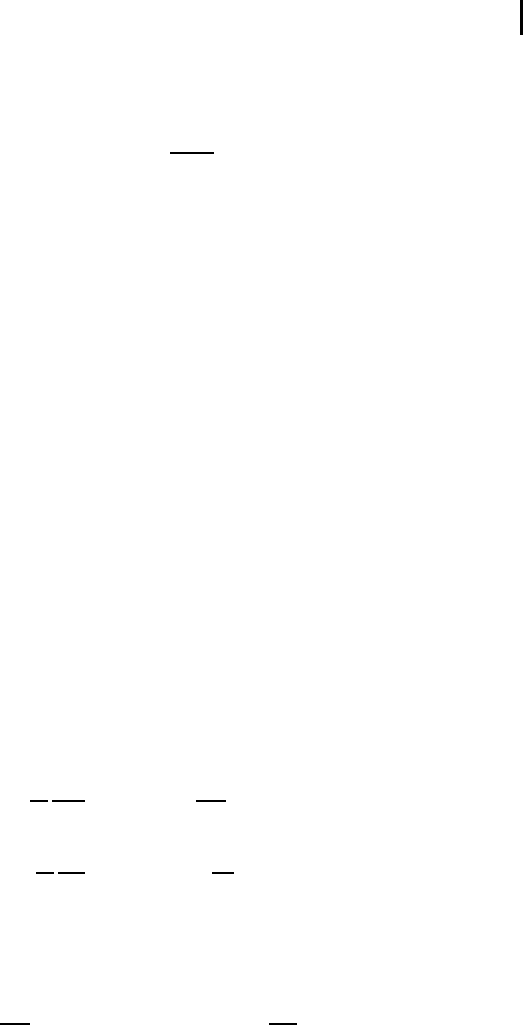
We assu me that the dispersion law (3.6.18) is valid only for those k at which the
group wave velocity is small compared with that of light c, i. e., under the condition
ak
e
2
amc
2
. (3.7.6)
The cond ition (3.7.6) allows, in principle, the existence of a wide interval of wave-
lengths simultaneously satisfying the conditions that the long-wave approximation be
applicable and the dispersion law (3.7.3) be valid.
Although the region of the dispersion law applicability (3.7.3) is rather wide, the re-
sulting nonphysical singularity for k → 0 stimulates us to clarify how this singularity
will vanish in a more consistent calculation. We consider a plane 2D electron crystal
in an unbounded 3D medium with dielectric constant ε = 1 and consider the problem
of vibrations of a 2D electron system from a different point of view. It is known that
the accelerating electric charges radiate electromagnetic waves. In the quasi-static
approximation used above, the radiation is absent. But it is necessary to make sure
that there is also no radiation in the volume with dynamic effects taken into account,
i. e., it is necessary to prove that the electromagnetic wave is localized in space near
a 2D electron crystal. This is possible if the dispersion law of electromagnetic vibra-
tions connected with electron cry stal vibrations is incompatible with the dispersion
law ω = ck,wherec is the light velocity in vacuum (in the medium with ε = 1).
Not taking into account the specific dielectric p roperties of a surrounding medium,
we assume that it provides the electrons move only in the crystal plane (the plane
xOy). We shall describe the electromagnetic field by means of scalar (ϕ) and vec-
tor (A) potentials. The medium with a 2D electron crystal has a specific plane (the
plane z = 0) with trapped but movable electric charges that have surface charge den-
sity ρ
s
= −en
s
∂ξ
k
/∂x
k
(k = 1, 2) and the surface current density j
s
= en
s
∂ξ/∂t.
Therefore, the equations for the potentials ϕ and A, in the long-wave approximation
are
∆ϕ −
1
c
2
∂
2
ϕ
∂t
2
= 4πen
s
∂ξ
k
∂x
k
δ(z), k = 1, 2;
∆A −
1
c
2
∂A
∂t
2
= −4πen
s
∂ξ
∂t
δ(z),
(3.7.7)
where δ(z) is the delta-function, and the dependence of ξ on time and coordinates (x
and y) is found from an obvious equation for the electron motion in the continuum
approximation
m
∂
2
ξ
∂t
2
= eE|
z=0
≡−e
grad ϕ −
∂A
∂t
z=0
, (3.7.8)
where E in the mean electric field. Using the linear approximation the mean magnetic
field acting on the electron may not be taken into account in the Lorentz force.