
Kosevich A.M. The crystal lattice
Подождите немного. Документ загружается.

4.1 Constant-Frequency Surface
127
dispersion law. To image the corresponding geometrical picture, we consider a sym-
metrical enough crystal whose vibration frequencies take maximum values only at the
unit cell vertices of a reciprocal lattice.
Let the k
1
Ok
2
plane in reciprocal space correspond to a certain “good” crystallo-
graphic direction. We denote by b
1
and b
2
the r eciprocal lattice vectors along the
axes k
1
, k
2
and assume that ω = 0 at the point k
1
= k
2
= 0,andω = ω
m
at k
1
=(1/2)b
1
, k
2
=(1/2)b
2
. The points (0, 0), (0, b
2
), (b
1
,0), (b
1
, b
2
) are
then surrounded by the closed isofrequency surfaces “expanding” with increasing ω
(ω ω
m
, and the closed surfaces “compressing” with the frequency increasing
(ω − ω
m
ω
m
) will surround the points ((1/2)b
1
, (1/2)b
2
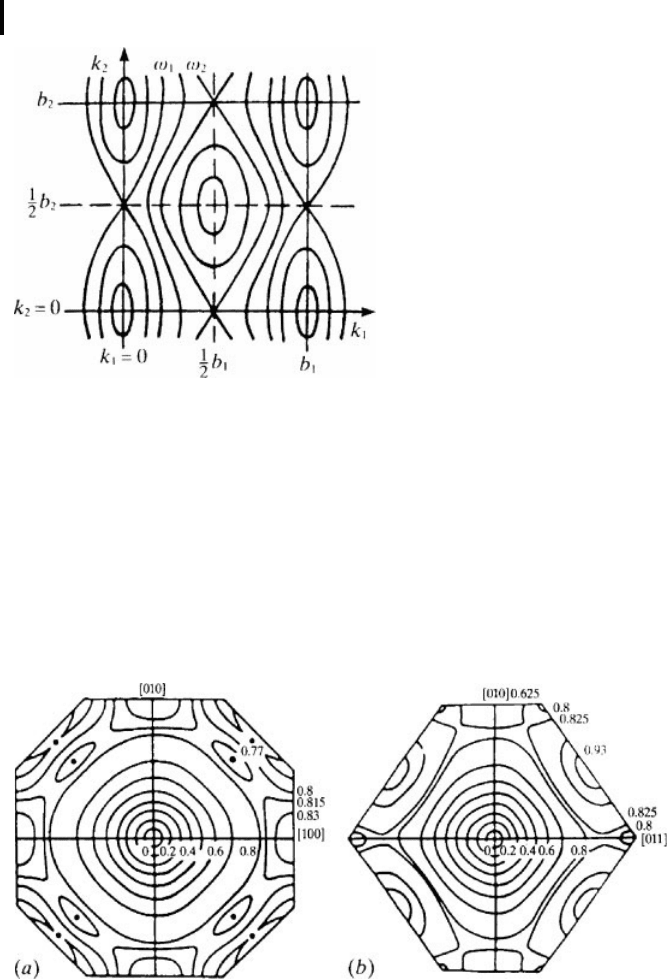
) (Fig. 4.3). The prop-
erties of closed surfaces expanding and compressing with rising ω cannot transform
into each other without changing their topology. In o rder to pass from the surface of
one set to that of another set, it is necessary to “unscrew” the surface. But the closed
surface cannot be unscrewed. Thus, apart from closed isofrequency surfaces there ex-
ist isofrequency surfaces of another geometrical type, e. g., the isofrequency surfaces
ranging within ω
1
< ω < ω
2
(Fig. 4.3). These surfaces passing continuously from
one unit cell of a reciprocal lattice to anothe r one are called open.
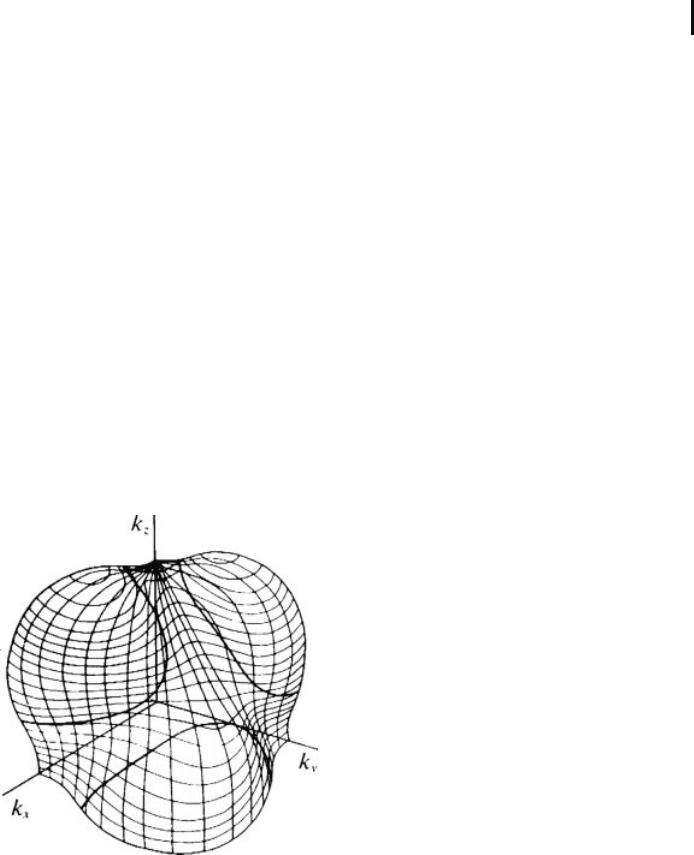
Fig. 4.2 Isofrequency surface for one of the branches of Ge crystal
vibrations.
Generally, points o f the type (0, (1/2) b
2
) or (b
1
, (1/2)b
2
) through which the
isofrequency surfaces are transformed into open ones are the conical points in a 3D
k-space. We can imagine the form of constant-frequency surfaces of real crystal vibra-
tions studying the results of calculations of isofrequency surfaces for a face-centered
cubic lattice of Al (Walker, 1956). Figure 4.4 shows the cross sections of the isofre-
quency surfaces of a longitudinal branch vibration in Al inside the same Brillouin
zone. The fractional numbers near the cross section lines show the value ω/ω
m
for
the branch concerned. The conical points are not singled out, but they are positioned
128
4 Frequency Spectr um and Its Connection with the Green Function
Fig. 4.3 Cross section of isofrequency surfaces of Ge crystal vibrations
through the plane k
z
= 0.
in the frequency range 0.8 < ω/ω
m
< 0.825. Near such points the dispersion law is
written as
ω = ω
k
+ γ
1
k
2
1
+ γ
2
k
2
2
− γ
3
k
2
3
, (4.1.5)
where the constant coefficients γ
1
, γ
2
, γ
3
have the same signs, the vector k is mea-
sured from the conical points, the axis k
3
is directed along the axis of the correspond-
ing cone. The value ω
k
at the conic point is determined by a specific form of the
dynamical matrix A(k) of the crystal.
Fig. 4.4 Cross section of calculated isofrequency surfaces of a longi-
tudinal branch of vibrations of Al (Walker 1956): (
a
) the plane (100);
(
b
) the plane (110).
The equation for isofrequency surfaces resulting from (4.1.5) determines a set
of hyperboloids. If all the coefficients γ
α
are positive when ω < ω
c
, we ob-
tain double-banded hyperboloids, and when ω > ω
c
single-banded ones (Fig. 4.5,
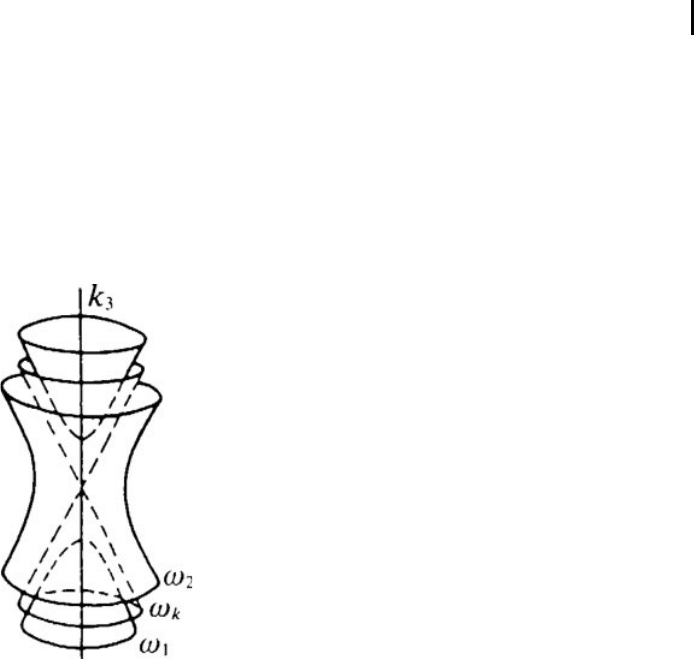
4.2 Frequency Spectrum of Vibrations
129
ω
1
< ω
c
< ω
2
). Similarly, we can trace the specific forms of isofrequency surfaces
of optical branches of crystal vibrations. No matter how complicated the dispersion
law of an optical branch may be, the corresponding frequencies are always placed in
a band of finite width and the edges of this band are the extremum points for the func-
tion ω = ω
α
(k) , α = 4,5.... This means that the dispersion law near the optical
band edges is quadratic, and the iso frequency surfaces are ellipsoids of the type (4.1.4)
where the matrix γ
ij
is positively definite in the vicinity of the maximum frequency,
and it is negatively definite in the vicinity of th e minimum freque ncy.
Fig. 4.5 The form of isofrequency surfaces near the conical point.
Concluding the geometrical analysis of constant-frequency surfaces, we note that
the direction of the wave group velocity is totally dependent on the form of an isofre-
quency surface that passes through the point k. Indeed, the group velocity is deter-
mined by (1.4.10), i. e., by the gradient in k-space of the function ω(k) . The gradient
is directed along the normal to the surface of constant level of the function for which it
is calculated, so that the velocity v(k) is directed along the normal to an isofrequency
surface going through the point k.
4.2
Frequency Spectrum of Vibrations
To explain some properties of crystals, one does not need to have exhaustive informa-
tion on vibrations such as provided by the dispersion law. It suffices to know only the
frequency distribution of the vibrations. In view of this, the vibration density concept
or the frequency distribution function is introduced.
130
4 Frequency Spectr um and Its Connection with the Green Function
Let us use the notation ε = ω
2
. The fraction of vibration s of the α-th branch dn
α
whose frequencies are in the interval (ε, ε + dε) can be written as
dn
α
= Ng
α
(ε)dε , (4.2.1)
where N is the number of unit cells in the crystal
1
. The function g
α
(ε) is called
the density of states. Since for every branch of vibrations, this function is calculated
independently, the index α will be omitted in futu re. Obviously, the following formula
holds
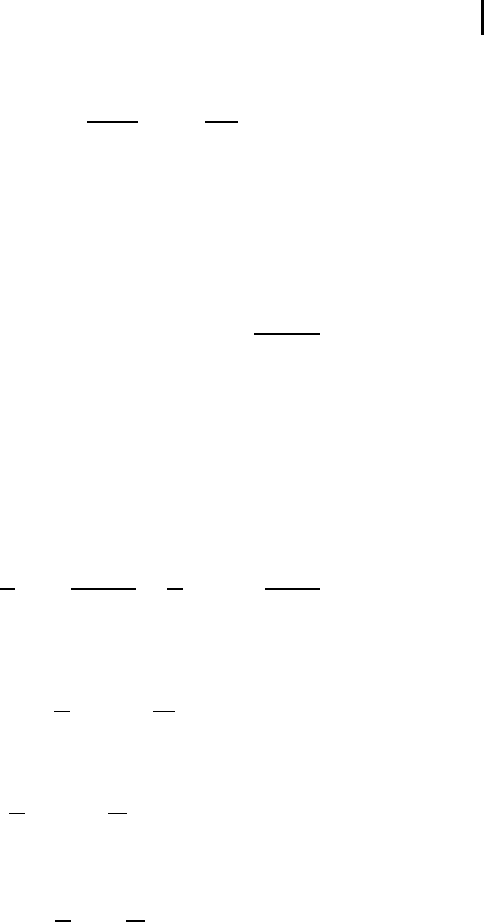
g(ε)=
1
N
∑
δ
ε − ω
2
(k)
, (4.2.2)
where the dependence ω
2
(k) is determined by the crystal dispersio n law, and the
summation is over all physically nonequivalent values of this vector (in one cell of the
reciprocal lattice or in the first Brillouin zone).
We transform (4.2.2) transforming the summation to the integration by the rule
(1.5.4) and, on changing the integration variables, we have
g(ε)=
V
0
(2π)
3
δ
ε − ω
2
(k)
d
3
k =
V
0
(2π)
3
δ
ε − ω
2
dω
2
dS
k
∂ω
2
(k)
∂k
, (4.2.3)
where V
0
is the unit cell volume of the crystal, dS
k
is an element of the surface area
ω
2
(k)=ω
2
= const.
On performing the integration over ω in (4.2.3), we o btain the ultimate fo rmula f or
the density of vibrational states
g(ε)=
V
0
(2π)
3
ω
2
(k)=ε
dS
k
∂ω
2
∂k
, (4.2.4)
where the integration is carried out over the isofrequency surface ω
2
(k)=ε =
constant.
In many cases it is convenient to use the distribution function in frequencies ω,
rather than in squared frequencies ε. If we write the fraction of vibrations whose
frequencies lie in the interval (ω, ω + dω) in the form of dn = ν(ω) dω,thenν(ω)
will determine the frequency spectrum.
The normalization of the function ν(ω) is different from that of the function g(ε),
namely,
ν(ω) dω = N.
A simple relation exists between the functions ν(ω) and g(ε):
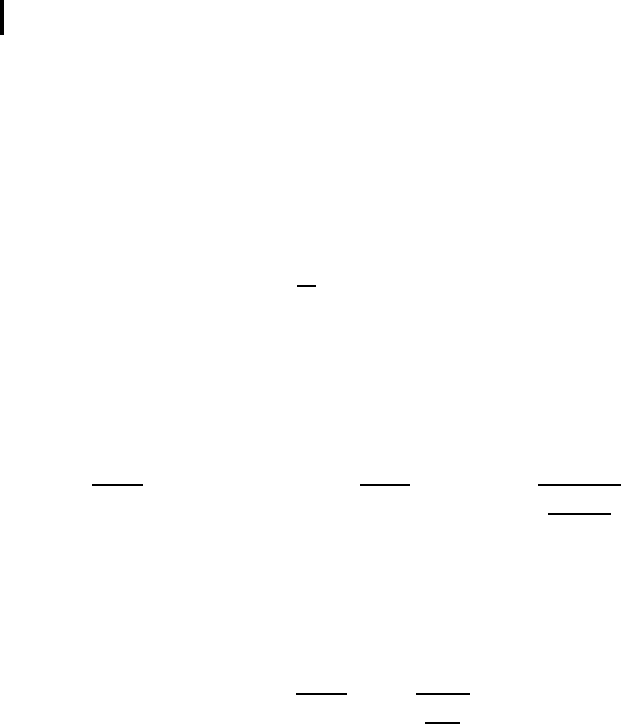
ν(ω)=2Ngωg(ω
2
), (4.2.5)
1) In a monatomic lattice, the number of unit cells coincides with the number of
atoms in the crystal. However, in a polyatomic lattice, this is not so, and to
preserve in (4.2.1) the normalization of distribution function of any branch
g
α
(ε)dε = 1 we will always use N as the number of unit cells in the
crystal.
4.2 Frequency Spectrum of Vibrations
131
and for the functions ν(ω) one can write a formula similar to (4.2.4):
ν(ω)=
V
0
(2π)
3
ω(k)=ω
dS
k
v
, (4.2.6)
where the velocity definition (1.4.10) is taken into account.
If we are not interested in the frequency spectrum, but in the total number of vi-
brations whose frequencies are less that the fixed frequency ω, this number can be
established from
n(ω)=
ω
0
ν(ω) dω = N
ω
2
0
g(ε)dε =
VΩ( ω)
(2π)
3
, (4.2.7)
where Ω(ω) is the volume in k-space inside an isofrequency surface ω(k)=ω.
Apart from (4.2.4) or (4.2.5) that are useful in analytically calculating the frequency
spectrum for a given dispersion law, there are other ways of writing it, which are
instrumental in solving some questions that refer to the vibration spectrum. Thus,
coming back to the initial definition (4.2.2), we consider it from another po int of view.
We use one of the Dirac δ-function definitions δ(x) and write the following chain of
equations:
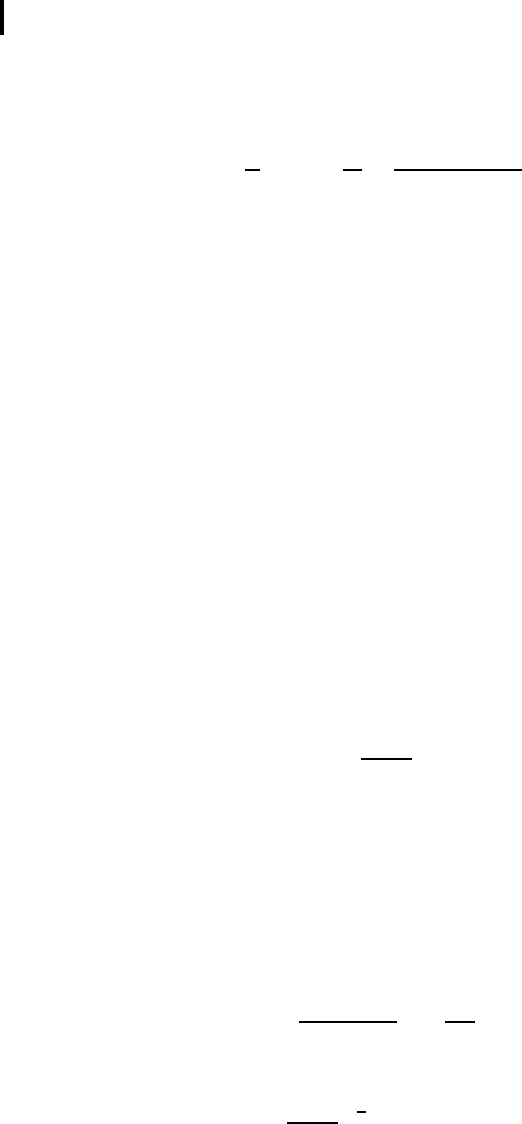
δ(x)=
1
π
lim
γ→+0
γ
x
2
+ γ
2
=
1
π
lim
γ→+0
Im
1
x −iγ
, (4.2.8)
where Im is the symbol for an imaginary part of a corresponding complex number.
Then, we write the relation resulting from (4.2.8) as
δ(x)=
1
π
lim
γ→+0
Im
d
dx
ln(x − iγ), (4.2.9)
and use it to transform (4.2.2):
Ng(ε)=
1
π
lim
γ→+0
Im
d
dε
∑
k
ln
ε − ω
2
(k) −iγ
. (4.2.10)
We rearrange the order of operations in (4.2.10) and write
Ng(ε)=
1
π
lim
γ→+0
d
dε
Im ln D(ε −iγ), (4.2.11)
where
D(ε)=
∏
k
ε − ω
2
(k)
. (4.2.12)
It is easily seen that the d efinition (4.2.12) coincides with that of (1.2.8) in a scalar
model. In the general case,
D(ε)=
∏
k,α
ε − ω
2
α
(k)
, (4.2.13)
132
4 Frequency Spectr um and Its Connection with the Green Function
where the function ω
2
α
(k) describes the dispersion law of the α-th branch of vibrations,
and the formula (4.2.11) then gives the total d ensity of vibrational states of the crystal.
We rewrite the definition of (4.2.9) taking all vibration branches in account:
g(ε)=
1
π
lim
γ→+0
Im
1
N
∑
k,α
1
ε − iγ − ω
2
α
(k)
. (4.2.14)
The last formula plays a major role in establishing the relation between the density of
vibrational states and the Green function.
4.3
Analysis of Vibrational Frequency Distribution
A specific form of the function g() or ν(w) as well as the dispersion law ω(k) is
different for different crystals. We can thus discuss general concepts concerned only
with the behavior of the vibration density near some special points. Such points are
primarily the eigenfrequency band edges.
We begin by analyzing the distribution functions for the acoustic branch of vibra-
tions in the extremely low-frequency region ω ω
m
, where the d ispersion law is the
simplest:
ω = s(κ)k. (4.3.1)
It follows from (4.3.1) that the group velocity of the vibration wave v = ∂ω/∂k is
dependent only on the direction of the vector k (and is independent of its value). In
studying the general properties of the function ν(ω), one can put s = s
0
= constant;
then dS
k
= k
2
dO =(ω
2
/s
2
0
)dO ,wheredO is an element of a solid angle in k -space.
As a result, for the frequency spectrum we have:
ν(ω)=
Vω
2
2π
2
s
3
0
. (4.3.2)
In an anisotropic case (s = s(κ )) the parameter s
3
0
is obtained by certain averaging
of the function s(κ) in all directions of the vector k.
Thus we have shown that in the low-frequency region (ω ω
m
) the function
ν(ω) is proportional to the frequency squared. The latter is a direct consequence of
the linear character of the dependence ω = ω(k) in the low-frequency region.
We write (4.3.2) in a somewhat different form admitting an elementary estimate o f
the order of value of the function ν(ω) at low frequencies, namely
ν(ω)=
Nω
2
2π
2
(s
0
/a)
3
∼ N
ω
2
ω
3
m
.
In this region using (4.2.5) for the function g(ε),wefind
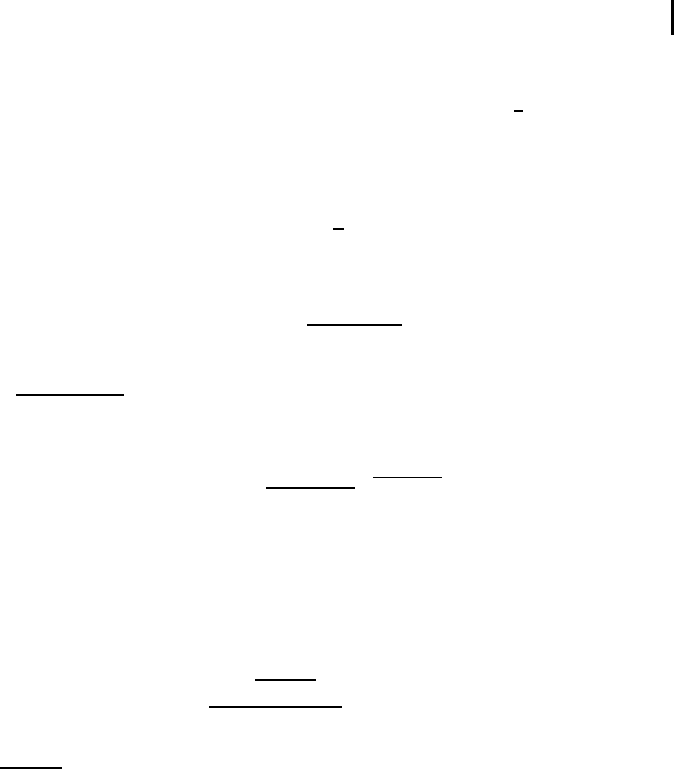
g(ε)=
V
0
2π
2
s
3
0
√
ε, ε ω
2
m
. (4.3.3)
4.3 Analysis of Vibrational Frequency Distr ibution
133
The appearance of a so-called r oot singularity is connected with the fact that the
dispersion law written as ε = ε(k)=ω
2
(k) is quadratic for sma ll k. From (4.3.3)
follows an estimate of the value of the vibration density: g(ε) ∼
√
ε/ω
3
m
.
Near the high-frequency boundary of the continuous spectrum (ω
m
− ω ω
m
),
determining the reference origin for the vector k as for (4.1.4), the dispersion law can
be written as
ω = ω
m
−
1
2
γ
ij
k
i
k
j
, (4.3.4)
and the equation for isofrequency surfaces is
k
2
(κ)=
2(ω
m
− ω)
γ
ik
κ
i
κ
k
.
In the simplest (isotropic) version ω = ω
m
− ( 1/2)γk
2
and then v = −γk =
−
2γ(ω
m
− ω) and also dS
k
= k
2
dO = 2(ω
m
− ω)dO/γ. As a result, for the
frequency spectrum we obtain
ν(ω)=
2V
π
2
(2γ)
2/3
√
ω
m
− ω. (4.3.5)
In the general case, the coefficient before the root in (4.3.5) is obtained by averag-
ing in directions of the vector k. According to the above, the root singularity of the
frequency spectrum near the upper spectrum boundary, described by (4.3.5), is a result
of the quadratic dispersion law (4.3.4).
The density of states g(ε) near the high-frequency band edge of eigenfrequencies
has the form
g(ε)=V
0
ω
2
m
−ε
(2π)
2
(γω
m
)
3/2
, ω
2
m
− ε ω
2
m
. (4.3.6)
Comparing (4.3.3), (4.3.6), we conclude that the density of states g(ε )=constant ×
|ε − ε
∗
|,whereε
∗
determines the position of any one of the boundaries of the con-
tinuous spectrum of squared frequencies.
Apart from the continuous spectrum boundaries, the vicinities of frequencies di-
viding isofrequency surfaces of different topology can also be analyzed. We restrict
ourselves to the case when the “boundary” isofrequency surface ω = ω
c
has a con-
ical point near which the dispersion law is given by (2.1.5). We assume that outside
a small neighborhood of the conical point, all isofrequency surfaces of a thin layer
near ω = ω
c
are regular and the velocity v does not vanish on them. The specific
properties of the density of vibrations that we expect at ω = ω
c
may only be as-
sociated with the contribution of vibrations corresponding to the small conical point
neighborhood. Thus, we draw a pair of planes k
3
= ±K
3
at such a distance from
the conical point where the isofrequency surfaces still have the form of hyperboloids
(Fig. 4.5), and calculate the fraction of vibrational states δn(ω) in the volume δΩ(ω)
limited by these planes and the hyperboloid ω(k)=ω. To simplify calculations we
134
4 Frequency Spectr um and Its Connection with the Green Function
set γ
1
= γ
2
= γ, i. e., we assume the isofrequency surfaces near the conical point to
be rotation hyperboloids. Furthermore, we put γ > 0 and γ
3
> 0.
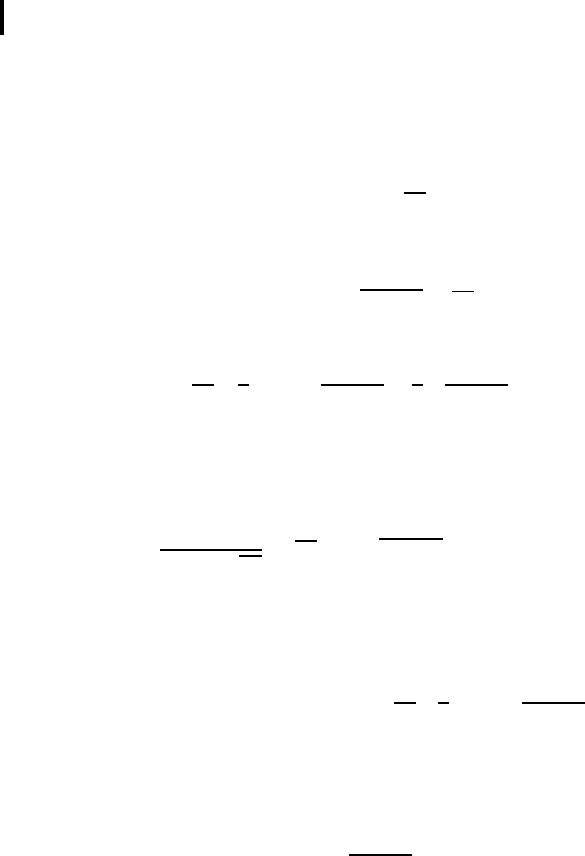
If ω < ω
c
,thevolumeδΩ(ω) is determin ed by
δΩ(ω)=2π
K
3
k
0
3
(k
2
1
+ k
2
2
) dk
3
= 2π
γ
3
γ
K
3
k
0
3
k
2
3
− (k
0
3
)
2
dk
3
,
where the factor 2 takes into account the presence of two hyperboloid cavities and k
0
3
determines the hyperboloid vertex: k
0
3
=
√
ω
c
− ω/
√
γ
3
.
Thus,
δΩ(ω)=2π
γ
3
γ
1
3
K
3
3
+ K
3
ω − ω
c
γ
3
+
2
3
ω
c
−ω
γ
3
3/2
. (4.3.7)
Using (4.3.7) we now take into account (4.2.7) and the definition of the frequency
spectrum function ν(ω) to calculate the contribution to ν(ω) of the states that corre-
spond to the conical point vicinity:
δν(ω)=
V
(2π)
2
γ
√
γ
3
√
γ
3
K
3
−
√
ω
c
−ω
, ω < ω
k
. (4.3.8)
We calculate the same functio n f or ω > ω
c
. Since in this case the isofrequency
surface has the form of a hyperboloid, for one sheet we have
δΩ(ω)=
K
3
−K
3
π(k
2
1
+ k
2
2
) dk
3
= 2π
γ
3
γ
1
3
K
3
3
+ K
3
ω −ω
c
γ
3
.
Consequently, the contribution to the function ν(ω) of a small neighborhood of the
conical point is independent of frequency:
δν(ω)=
V
(2π)
2
γ
K
3
. (4.3.9)
The contribution to the density of vibrations near ω = ω
c
from the vibrational
states that correspond to the points in k-space, lying outside the conical point vicinity
are described by a regular frequency function. Thus, comparing (4.3.9) and (4.3.8),
we see that:
1. the function ν(ω) is a continuous frequency function at the point ω = ω
c
;
2. its plot has a break at this point;
3. its derivative has an infinite jump.
4.3 Analysis of Vibrational Frequency Distr ibution
135
It is characteristic that on approaching the point ω = ω
c
from the side correspond-
ing to closed isofrequency surfaces, the derivative dν/dω becomes infinite and, ap-
proaching the same point from the other side, the derivative remains finite.
The same singularity at the point concerned is typical of the function g(ε):
g(ε)=
g(ε
c
) − A
√
ε
c
− ε + O(ε
c
−ε), ε < ε
c
g(ε
c
)+O(ε
c
−ε), ε > ε
c
,
(4.3.10)
where ε
c
= ω
2
c
is the squared frequency at the critical point, A is a positive constant
value, O(x) is a small qua ntity of the order of x (for small x).
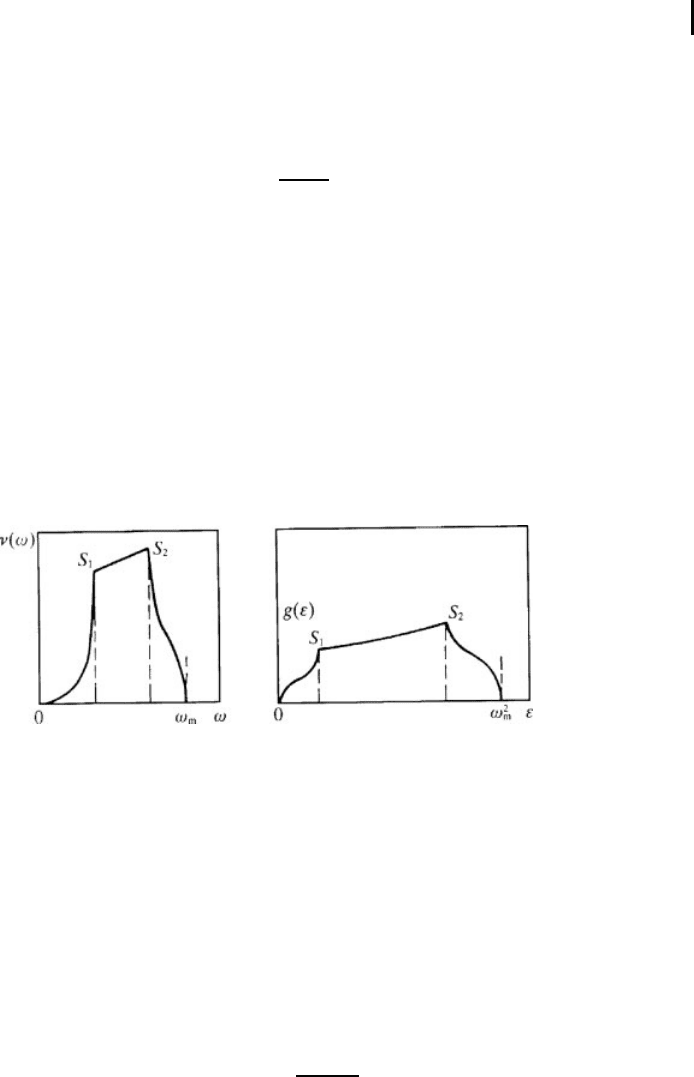
The spectral functions ν(ω) and g(ε) may also have singularities at other points, but
the latter are generally associated with frequencies at which an isofrequency surface
changes its topology. In the frequency range (0, ω
m
) at least two such frequencies ex-
ist. These frequencies separate the “layer” of open isofrequency surfaces from closed
surfaces and, as a rule, they determine the surfaces with conical points. Hence, at
least two critical frequencies can be expected at which the spectral functions possess
singularities as described (Fig. 4.6).
Fig. 4.6 Typical frequency spectrum [the functions ν (ω) and g()] for
the acoustic branch of the dispersion law.
In the vicinity of critical frequencies associated with the conical points, the function
ω(k) is always expressed as (4.1.5), where all the coefficients γ
α
(α = 1, 2, 3) have
the same sign. According to the terminology adopted, these frequencies are called
analytical critical points of type S. We distinguish between the crystal points of type
S
1
when the coefficients are positive and those of type S
2
when γ
α
are negative. The
standard form of the singularities of the functions ν(ω) or g(ε) at the S-type points,
as well as their number inside th e interval (0, ω
m
) is regulated by the van Hove theo-
rem: the frequency spectrum of each crystal branch should involve at least one crystal
point of both types S
1
and S
2
. In the near vicinity of the S
1
-type point the frequency
spectrum has the form
ν(ω)=
ν(ω
c
) − B
1
√
ω
c
− ω + O(ω
c
−ω), ω < ω
c
,
ν(ω
c
)+O(ω
c
−ω), ω > ω
c
,
136
4 Frequency Spectr um and Its Connection with the Green Function
where ω
c
is the critical frequency, and in the vicinity of the S
2
-type point the following
expression is valid
ν(ω)=
ν(ω
c
)+O(ω
c
−ω), ω < ω
c
,
ν(ω
c
) − B
2
√
ω −ω
c
+ O( ω − ω
c
), ω > ω
c
,
where B
1
and B
2
are positive constants. The function g( ω) for each branch of vibra-
tions has at least four singular points: two eigenfrequency band edges and two S-type
critical points. At all these points, the singularity g(ε) implies that on the one hand
the function of each of these points is regular (in particular, it may vanish identically),
and on the other hand it has the form
g(ε)=g(ε
∗
) ± const
|ε − ε
∗
| ,
where ε
∗
denotes the square of the frequency at the corresponding singular point.
Finally, let us discuss the singularities of the optical vibration spectrum. At the
optical vibration frequency band edges the dispersion law is quadratic, leading to the
“root singularity” for either the frequency spectrum ν(ω) or the density of states g(ε )
at both edges of the band of the allowed frequencies. The singularities inside the
optical frequency interval are determined by the van Hove theorems, because due to
these theorems the optical frequency band does not differ from the acoustic one.
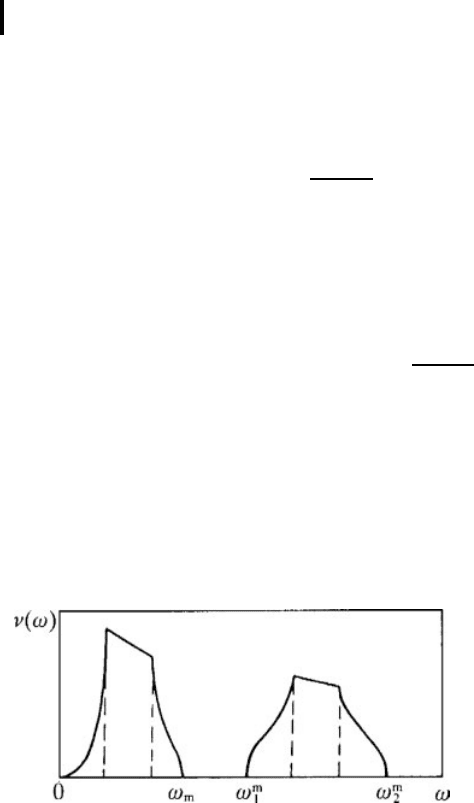
Fig. 4.7 Frequency spectrum functions of the acoustic and optical
branches of the polyatomic lattice.
The total distribution of crystal lattice vibrations involves the densities for sepa-
rate branches. The plot of the total frequency spectrum can be obtained by imposing
(summing) plots such as shown in Fig. 4.7 with different ω, ω
m1
, ω
m2
, and different
positions of the singular points S
1
and S
2
.
4.4
Dependence of Frequency Distribution on Crystal Dimensionality
The singularities of the frequency distribution function are transformed fundamentally
when going from a 3D lattice to a 2D or 1D lattice.