
Krantz W.B. Scaling Analysis in Modeling Transport and Reaction Processes: A Systematic Approach to Model Building and the Art of Approximation
Подождите немного. Документ загружается.

EXAMPLE PROBLEMS 73
R
U = U
0
e
−b
t
z
r
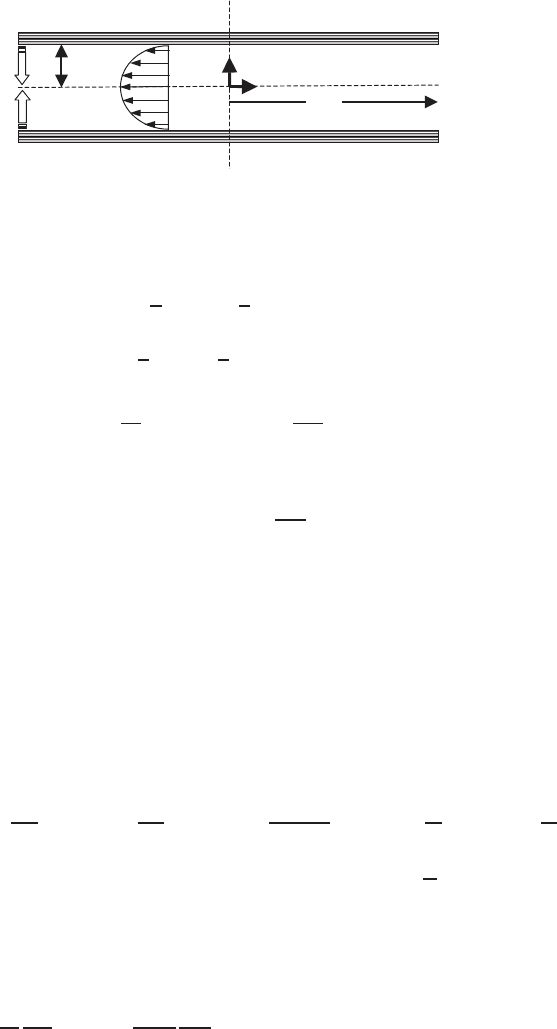
Figure 3.E.2-1 Laminar flow of an incompressible Newtonian liquid that has constant
physical properties between two parallel circular plates that are approaching each other
slowly.
u
r
=0,u
z
=−
1
2
U(t)=−
1
2
U
0
e
−βt
at z =H(t) (3.E.2-5)
u
r
=0,u
z
=
1
2
U(t) =
1
2
U
0
e
−βt
at z =−H(t) (3.E.2-6)
H
−H
u
r
·2πr dz =−
d
dt
(πr
2
H) =−2πr
2
dH
dt
= πr
2
U
0
e
−βt
,u
z
= f
1
(z, t)
at r = R (3.E.2-7)
u
r
= 0,
∂u
z
∂r
= 0atr = 0 (3.E.2-8)
P = P
atm
at r = R (3.E.2-9)
The boundary condition given by equation (3.E.2-7) is a statement that the mass
squeezed out by the plates moving together must flow out the periphery of the
circular plates. The function f
1
merely denotes that to solve these differential
equations, one would need to specify a boundary condition for u
z
at the periphery
of the circular plates. The simplifications justified by scaling analysis will obviate
the need to know f
1
.
Introduce the following scale factors, reference factor, and dimensionless vari-
ables (steps 2, 3, and 4):
u
∗
r
≡
u
r
u
rs
; u
∗
z
≡
u
z
u
zs
; P
∗
≡
P − P
r
P
s
; z
∗
≡
z
z
s
; r
∗
≡
r
r
s
;
t
∗
≡
t
t
s
(3.E.2-10)
Substitute these dimensionless variables into the describing equations and divide
through by the dimensional coefficient of a term that must be retained in each
equation to obtain (steps 5 and 6)
1
r
∗
∂
∂r
∗
(r
∗
u
∗
r
) +
u
zs
r
s
u
rs
z
s
∂u
∗
z
∂z
∗
= 0 (3.E.2-11)
74 APPLICATIONS IN FLUID DYNAMICS
ρz
2
s
μt
s
∂u
∗
r
∂t
∗
+
ρu
rs
z
2
s
μr
s
u
∗
r
∂u
∗
r
∂r
∗
+
ρu
zs
z
s
μ
u
∗
z
∂u
∗
r
∂z
∗
=−
P
s
z
2
s
μu
rs
r
s
∂P
∗
∂r
∗
+
z
2
s
r
2
s
∂
∂r
∗
1
r
∗
∂
∂r
∗
(r
∗
u
∗
r
)
+
∂
2
u
∗
r
∂z
∗2
(3.E.2-12)
ρz
2
s
μt
s
∂u
∗
z
∂t
∗
+
ρu
rs
z
2
s
μr
s
u
∗
r
∂u
∗
z
∂r
∗
+
ρu
zs
z
s
μ
u
∗
z
∂u
∗
z
∂z
∗
=−
P
s
z
s
μu
zs
∂P
∗
∂z
∗
+
z
2
s
r
2
s
∂
∂r
1
r
∗
∂
∂r
∗
r
∗
∂u
∗
z
∂r
∗
+
∂
2
u
∗
z
∂z
∗2
(3.E.2-13)
u
∗
r
= 0,u
∗
z
=−
1
2
U
0
u
zs
e
−βt
s
t
∗
at z
∗
=
H(t)
z
s
(3.E.2-14)
u
∗
r
= 0,u
∗
z
=
1
2
U
0
u
zs
e
−βt
s
t
∗
at z
∗
=−
H(t)
z
s
(3.E.2-15)
H/z
s
−H/z
s
u
∗
r
dz
∗
=
U
0
r
s
2u
rs
z
s
r
∗
e
−βt
s
t
∗
,u
∗
z
= f
∗
1
(z
∗
,t
∗
) at r
∗
=
R
r
s
(3.E.2-16)
u
∗
r
= 0,
∂u
∗
z
∂r
∗
= 0atr
∗
= 0 (3.E.2-17)
P
∗
=
P
atm
− P
r
P
s
at r
∗
=
R
r
s
(3.E.2-18)
The dimensionless group in equation (3.E.2-14) is set equal to 1 to obtain the
axial velocity scale u
zs
. The geometric ratio groups in equations (3.E.2-14) and
(3.E.2-16), when set equal to 1, provide the axial and radial length scales z
s
and
r
s
. Equation (3.E.2-11) then provides the radial velocity scale u
rs
. Since pressure
causes the radial flow, P
s
is obtained by setting the dimensionless group multiply-
ing the pressure term in equation (3.E.2-12) equal to 1. The reference pressure P
r
is obtained from equation (3.E.2-18). Finally, the time scale t
s
is dictated by the
approach velocity of the two parallel plates and is obtained by setting the dimen-
sionless group in the argument of the exponential in equation (3.E.2-14) equal to 1.
This results in the following scale and reference factors (step 7):
u
rs
=
RU
0
2H
; u
zs
=
U
0
2
; P
s
=
μU
0
R
2
2H
3
; P
r
= P
atm
; z
s
= H ;
r
s
= R; t
∗
=
1
β
(3.E.2-19)
Note in this case that several of our scales are time-dependent, owing to the presence
of H in their definition.
The resulting scaled dimensionless describing equations then are given by
1
r
∗
∂
∂r
∗
(r
∗
u
∗
r
) +
∂u
∗
z
∂z
∗
= 0 (3.E.2-20)
EXAMPLE PROBLEMS 75
ρβH
2
μ
∂u
∗
r
∂t
∗
+ Reu
∗
r
∂u
∗
r
∂r
∗
+ Reu
∗
z
∂u
∗
r
∂z
∗
=−
∂P
∗
∂r
∗
+
H
2
R
2
∂
∂r
∗
1
r
∗
∂
∂r
∗
(r
∗
u
∗
r
)
+
∂
2
u
∗
r
∂z
∗2
(3.E.2-21)
ρβH
2
μ
∂u
∗
z
∂t
∗
+ Reu
∗
r
∂u
∗
z
∂r
∗
+ Reu
∗
z
∂u
∗
z
∂z
∗
=−
R
2
H
2
∂P
∗
∂z
∗
+
H
2
R
2
∂
∂r
1
r
∗
∂
∂r
∗
r
∗
∂u
∗
z
∂r
∗
+
∂
2
u
∗
z
∂z
∗2
(3.E.2-22)
u
∗
r
= 0,u
∗
z
=−e
−t
∗
at z
∗
= 1 (3.E.2-23)
u
∗
r
= 0,u
∗
z
=e
−t
∗
at z
∗
=−1 (3.E.2-24)
1
−1
u
∗
r
dz
∗
= r
∗
e
−t
∗
,u
∗
z
= f
∗
1
(z
∗
,t
∗
) at r
∗
= 1 (3.E.2-25)
u
∗
r
= 0,
∂u
∗
z
∂r
∗
= 0atr
∗
= 0 (3.E.2-26)
P
∗
= 0atr
∗
= 1 (3.E.2-27)
where Re≡ρU
0
H/2μ is the Reynolds number. We see that equations (3.E.2-20)
through (3.E.2-27) can be greatly simplified if the following conditions hold (step 8):
Re =
ρU
0
H
2μ
1 ⇒ creeping flow (3.E.2-28)
H
2
R
2
1 ⇒ lubrication flow if Re 1 as well (3.E.2-29)
ρβH
2
μ
1 ⇒ quasi-steady-state flow (3.E.2-30)
All of these conditions are satisfied for sufficiently close approach distances H
between the two plates. Note that our scaling ensured that the dimensionless radial
pressure gradient was
◦
(1); this scaling does not necessarily ensure that the axial
pressure derivative is also
◦
(1). In fact, the condition given by equation (3.E.2-29)
implies that the dimensionless axial pressure gradient in equation (3.E.2-22) is of
the following order:
∂P
∗
∂z
∗
∼
=
H
2
R
2
∂
2
u
∗
z
∂z
∗2
=
◦
H
2
R
2
1 (3.E.2-31)
This implies that the axial pressure gradient is essentially zero for the case of
lubrication flow; this in turn implies that the radial pressure gradient is not a
function of z.
76 APPLICATIONS IN FLUID DYNAMICS
If the conditions given by equations (3.E.2-28) through (3.E.2-30) are satisfied,
equations (3.E.2-20) through (3.E.2-27) simplify to
0 =−
∂P
∗
∂r
∗
+
∂
2
u
∗
r
∂z
∗2
(3.E.2-32)
∂P
∗
∂z
∗
∼
=
0 (3.E.2-33)
u
∗
r
= 0,u
∗
z
=−e
−t
∗
at z
∗
= 1 (3.E.2-34)
u
∗
r
= 0,u
∗
z
= e
−t
∗
at z
∗
=−1 (3.E.2-35)
1
−1
u
∗
r
dz
∗
= r
∗
e
−t
∗
,u
∗
z
= f
∗
1
(z
∗
,t
∗
) at r
∗
= 1 (3.E.2-36)
P
∗
= 0atr
∗
= 1 (3.E.2-37)
Equations (3.E.2-36) and (3.E.2-37) are required to obtain the radial pressure dis-
tribution. This simplified set of describing equations can be solved analytically in
closed form.
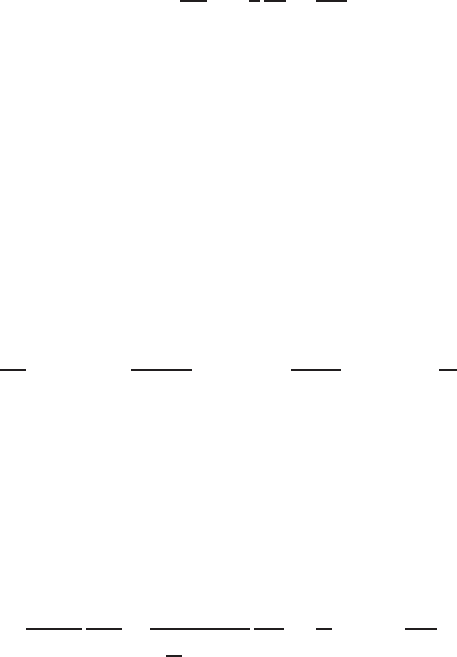
3.E.3 Design of a Hydraulic Ram
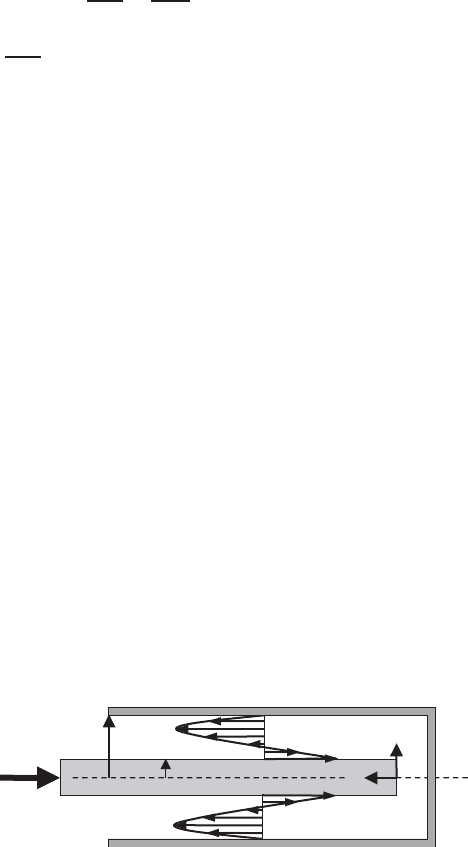
Consider the operation of a hydraulic ram shown in Figure 3.E.3-1. This device
consists of a piston of radius R
1
that is free to slide within a cylinder of inner
radius R
2
containing a viscous oil that can be assumed to be an incompressible
Newtonian liquid with constant physical properties. An applied force causes the
piston to be pushed into the cylinder, which in turn causes a high pressure P
0
to be
generated within the oil confined between the closed end of the cylinder and the
piston head. The difference between this high pressure and the ambient pressure
P
atm
then causes oil to flow in the gap between the piston and the cylinder. The
force that must be applied to push the piston into the cylinder is equal to the sum
of the force exerted by P
0
on the piston head and the drag force caused by the
r
U
0
P
atm
R
2
R
1
P
0
z
Figure 3.E.3-1 Hydraulic ram consisting of a cylindrical piston of radius R
1
that slides
within a cylindrical housing of radius R
2
; the cylindrical housing and piston assembly
contains a viscous oil that can be considered to be an incompressible Newtonian liquid with
constant physical properties; a time-dependent force is applied to the piston, causing it to
move into the cylindrical housing at a constant velocity U
0
; the instantaneous axial velocity
profile in the annular gap is sketched in the figure.
EXAMPLE PROBLEMS 77
oil being pushed through the annular gap. Let us assume that the piston is being
pushed in at a constant velocity U
0
. We ignore any end effects and assume that the
lubrication-flow approximation can be made for the flow in the thin annular gap.
13
We employ scaling analysis to determine when curvature effects in the describing
equations for the flow in the annular gap can be neglected; that is, the conditions
for which the describing equations in cylindrical coordinates reduce to those in
rectangular coordinates.
The describing equations are obtained by simplifying appropriately the equations
of motion in cylindrical coordinates given by equations (C.2-1), (D.2-10), and
(D.2-12) in the Appendices (step 1). In writing these describing equations we
place our coordinate system on the moving piston. In doing so, it appears that the
cylinder is moving in the direction opposite to that of the piston.
0 =−
∂P
∂z
+ μ
1
r
d
dr
r
du
z
dr
(3.E.3-1)
u
z
= 0atr = R
1
(3.E.3-2)
u
z
= U
0
at r = R
2
(3.E.3-3)
P = P
atm
at z = L(t) (3.E.3-4)
where P
atm
is the prevailing atmospheric pressure and L(t) is the wetted length of
the piston; that is, the instantaneous length of the piston that is in contact with the
flowing oil. Note that we retain the partial derivative ∂P/∂z in equation (3.E.3-1)
because the pressure gradient is also a function of time, since the wetted length
increases as the piston is pushed into the cylinder.
Introduce the following scale factors and dimensionless variables (steps 2, 3,
and 4):
u
∗
z
≡
u
z
u
zs
; P
∗
≡
P − P
r
P
s
; r
∗
≡
r − r
r
r
s
; z
∗
≡
z
z
s
(3.E.3-5)
Note that we have introduced a reference factor for the radial coordinate since it
is not naturally referenced to zero within the region wherein the flow is occurring;
that is, within the annular gap. We have also introduced a reference pressure since
the pressure is also not naturally referenced to zero at either end of the annular gap.
Substitute these dimensionless variables into the describing equations and divide
through by the dimensional coefficient of a term that must be retained in each
equation to obtain (steps 5 and 6)
0 =−
P
s
r
2
s
μu
zs
z
s
∂P
∗
∂z
∗
+
1
r
s
r
r
r
∗
+ 1
d
dr
∗
r
s
r
r
r
∗
+ 1
du
∗
z
dr
∗
(3.E.3-6)
13
The lubrication-flow approximation for this flow can also be justified using scaling analysis; this is
considered in practice Problem 3.P.11.

78 APPLICATIONS IN FLUID DYNAMICS
u
∗
z
= 0atr
∗
=
R
1
− r
r
r
s
(3.E.3-7)
u
∗
z
=
U
0
u
zs
at r
∗
=
R
2
− r
r
r
s
(3.E.3-8)
P
∗
=
P
atm
− P
r
P
s
at z
∗
=
L
z
s
(3.E.3-9)
The dimensionless radial coordinate can be bounded between zero and 1 if
we set the dimensionless group in equation (3.E.3-7) equal to zero and that in
equation (3.E.3-8) equal to 1, thereby obtaining r
r
= R
1
and r
s
= R
2
− R
1
.The
velocity scale is obtained by setting the dimensionless group in equation (3.E.3-8)
equal to 1 to obtain u
zs
= U
0
. The axial length scale can be obtained by setting
the dimensionless group in equation (3.E.3-9) equal to 1 to obtain z
s
= L(t).The
dimensionless pressure can be referenced to zero by setting the dimensionless group
in equation (3.E.3-9) equal to zero to obtain P
r
= P
atm
. Finally, since pressure
causes the flow in the axial direction, P
s
can be obtained by setting the dimen-
sionless group in equation (3.E.3-6) equal to 1 to obtain P
s
= μU
0
L/(R
2
− R
1
)
2
(step 7).
The resulting scaled dimensionless describing equations then are given by
0 =−
∂P
∗
∂z
∗
+
1
[(R
2
− R
1
)/R
1
]r
∗
+ 1
d
dr
∗
R
2
− R
1
R
1
r
∗
+ 1
du
∗
z
dr
∗
(3.E.3-10)
u
∗
z
= 0atr
∗
= 0 (3.E.3-11)
u
∗
z
= 1atr
∗
= 1 (3.E.3-12)
P
∗
= 0atz
∗
= 1 (3.E.3-13)
We see that if the dimensionless group (R
2
− R
1
)/R
1
=
◦
(0.01), equation
(3.E.3-10) reduces to (step 8)
0 =−
∂P
∗
∂z
∗
+
d
2
u
∗
z
dr
∗2
(3.E.3-14)
This is the same equation that would apply to steady-state pressure-driven lubri-
cation flow between two parallel flat plates. Hence, we conclude that curvature
effects can be ignored in problems such as that considered here if the following
condition is satisfied:
R
2
− R
1
R
1
1 ⇒ curvature effects can be neglected (3.E.3-15)
A closed-form analytical solution for the axial velocity profile can easily be
obtained for equation (3.E.3-14) subject to the boundary conditions given by
EXAMPLE PROBLEMS 79
equations (3.E.3-11) through (3.E.3-13). The unknown axial pressure gradient in
the solution for the velocity profile can be obtained from the known volumetric
flow rate corresponding to the volume swept out by the piston moving in at a
constant velocity U
0
. The force required to push the piston in at a constant velocity
can be obtained by a force balance on the piston that includes the pressure force
at each end of the piston and the drag force exerted by the flowing oil.
3.E.4 Rotating Disk Flow
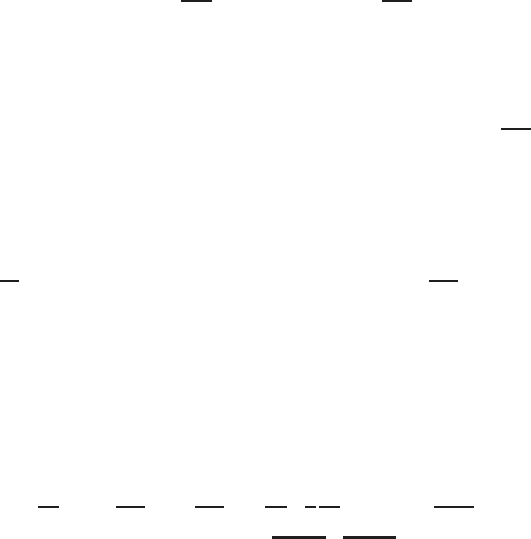
Consider a disk rotating at a constant angular frequency ω (radians per second) in
an infinite fluid having constant physical properties, as shown in Figure 3.E.4-1.
The rotation of the disk causes both an angular fluid velocity and flow in the radial
direction. This in turn causes flow toward the disk in the axial direction. Infinitely
far into the fluid the velocity must be purely axial toward the disk. This flow
geometry is of considerable practical value since the rotating disk is referred to
as a uniformly accessible surface. By this we mean that the heat- or mass-transfer
flux to the surface of a rotating disk is invariant with position along its surface. For
example, this makes the rotating disk an ideal geometry for determining reaction
kinetics in electrochemical systems for which the rotating disk can serve as one
of the electrodes.
14
The rotating disk was first analyzed by von K
´
arm
´
an
15
;amore
z
−U
∞
r
w
q
Figure 3.E.4-1 Flow created by a flat disk rotating at an angular velocity ω (rad/s) in an
unbounded fluid; the rotational motion of the disk draws fluid toward the disk; the axial
velocity infinitely far removed from the disk is U
∞
.
14
The rotating disk electrode apparatus was first exhibited at the Brussels World’s Fair in 1958. The
application of scaling analysis for using the rotating disk to study mass transfer is considered in
Chapter 5.
15
T. von K
´
arm
´
an, Z. Angew. Math. Mech., 1, 244–247 (1921).

80 APPLICATIONS IN FLUID DYNAMICS
complete analysis was done by Cochran
16
; an overview of the analysis and use
of this instrument is given by Levich.
17
This problem can be solved analytically
for laminar flow conditions in the absence of free convection effects. However,
under proper operating conditions, the hydrodynamics take on a boundary-layer
character such that the change in velocity components occurs within a thin region
of influence near the rotating disk. Establishing a thin boundary layer is important
for heat- or mass-transfer characterization using this apparatus since it ensures that
container boundary effects are minimized. We use scaling analysis to ascertain the
conditions for which the boundary layer will be thin.
A surprising aspect of laminar rotating disk flow is that there is no radial pressure
gradient and the radial and angular velocities are directly proportional to the radial
position, whereas the axial velocity depends only on the axial position. Classical
treatments of this flow begin by recognizing these considerations intuitively and
then proceeding to develop the rigorous analytical solution for this flow. However,
these considerations can be ascertained via simple integral mass and momentum
balances. Consider a mass balance on a control volume of arbitrary radius r extend-
ing from the surface of the disk far into the fluid, where there is only an axial
velocity component given by u
z
=−U
∞
. Note that in practice U
∞
is unknown;
however, it can be determined from the solution for the hydrodynamics and a
specified disk rotation rate. A mass balance on this control volume then yields
U
∞
πr
2
= 2πr
∞
0
u
r
dz ⇒ U
∞
=
2
r
∞
0
u
r
dz ⇒ u
r
= rf
1
(z) (3.E.4-1)
If the general form of the radial velocity profile given by equation (3.E.4-1) is sub-
stituted into the continuity equation given by equation (C.2-1), we can conclude
that the axial velocity is independent of r:
1
r
∂
∂r
(ru
r
)+
∂u
z
∂z
=0 ⇒ 2f
1
(z)+
∂u
z
∂z
=0 ⇒ u
z
=−2
z
0
f
1
(˜z) d ˜z =f
2
(z)
(3.E.4-2)
where ˜z denotes a dummy integration variable. Hence, we conclude that u
z
is a
function only of z. We can now prove that there is no radial pressure gradient
by considering an integral z-momentum balance on a control volume of arbitrary
radius r extending from an arbitrary height z into the fluid far from the rotating
disk where u
z
=−U
∞
:
ρU
2
∞
πr
2
−
r
0
ρu
2
z
· 2π ˜rd˜r
z
− P
∞
πr
2
+
r
0
P · 2π ˜rd˜r
z
+
∞
z
τ
rz
· 2πrd˜z
z
−
r
0
τ
zz
· 2π ˜rd˜r
z
= 0 (3.E.4-3)
16
W. G. Cochran, Proc. Cambridge Philos. Soc., 30, 365–375 (1934).
17
V. G. Levich, Physicochemical Hydrodynamics, Prentice-Hall, Englewood Cliffs, NJ 1962, pp. 60–78.
EXAMPLE PROBLEMS 81
where ˜r and ˜z again denote dummy integration variables. When the components
of Newton’s constitutive equation given by equations (D.2-6) and (D.2-9) in the
Appendices are substituted, we obtain
ρU
2
∞
r
2
−
r
0
ρu
2
z
· 2˜rd˜r
z
− P
∞
r
2
+
r
0
P · 2˜rd˜r
z
−
∞
z
μ
∂u
r
∂ ˜z
· 2rd˜z
z
+
r
0
μ
∂u
z
∂z
· 4˜rd˜r
z
= 0
(3.E.4-4)
Substitute the functional forms for u
r
and u
z
into equation (3.E.4-4) to obtain
ρU
2
∞
r
2
− ρf
2
2
r
2
− P
∞
r
2
+ 2
r
0
P ·˜rd˜r
z
+ 2μr
2
f
1
+ 2μ
df
2
dz
r
2
= 0
(3.E.4-5)
Hence, we conclude that
2
r
2
r
0
P ·˜rd˜r =−ρU
2
∞
+ ρf
2
2
+ P
∞
− 2μf
1
− 2μ
df
2
dz
⇒ P = f
3
(z)
(3.E.4-6)
When the functional forms for u
r
,u
z
,andP given by equations (3.E.4-1),
(3.E.4-2), and (3.E.4-6) are substituted into the radial component of the equations
of motion given by equation (D.2-10) in the Appendices, we can conclude that
u
θ
= rf
4
(z);thatis,
ρrf
2
1
−
u
2
θ
r
+ f
2
r
df
1
dz
=−
df
3
dr
=0
+μ
∂
∂r
1
r
∂
∂r
(r
2
f
1
)
=0
+r
d
2
f
1
dz
2
⇒ u
θ
= rf
4
(z)
(3.E.4-7)
Hence, we conclude that for rotating disk laminar flow, u
z
,P,ru
r
,andu
θ
/r are
functions only of the axial coordinate z.
The prior considerations are rigorous for a rotating disk, causing laminar flow in
an infinite fluid. However, in practice the rotating disk is placed in a finite container,
which implies that the velocity might not be purely axial far above the rotating disk,
due to recirculation. When one is using the rotating disk to characterize some heat-
or mass-transfer process, one would like to minimize this finite container effect.
This will be minimized when there is a thin boundary layer adjacent to the rotating
disk across which the radial and angular velocities components decay. Hence, we
use scaling to ascertain the criteria required to assure that this boundary layer is thin.
In view of the considerations for a rotating disk in an infinite fluid, the equations
of motion in cylindrical coordinates given by equations (C.2-1), (D.2-10), (D.2-11),
82 APPLICATIONS IN FLUID DYNAMICS
and (D.2-12) in the Appendices simplify to (step 1)
ρu
r
∂u
r
∂r
− ρ
u
2
θ
r
+ ρu
z
∂u
r
∂z
= μ
∂
2
u
r
∂z
2
(3.E.4-8)
ρu
r
∂u
θ
∂r
+ ρ
u
r
u
θ
r
+ ρu
z
∂u
θ
∂z
= μ
∂
2
u
θ
∂z
2
(3.E.4-9)
ρu
z
du
z
dz
=−
dP
dz
+ μ
d
2
u
z
dz
2
(3.E.4-10)
1
r
∂
∂r
(ru
r
) +
∂u
z
∂z
= 0 (3.E.4-11)
The corresponding boundary conditions are given by
u
r
= 0,u
z
= 0,u
θ
= ωr at z = 0 (3.E.4-12)
u
z
=−U
∞
,u
r
= 0,u
θ
= 0,P= P
∞
as z →∞ (3.E.4-13)
u
r
= 0,u
θ
= 0atr = 0 (3.E.4-14)
Note that equations (3.E.4-8) through (3.E.4-14) are rigorous for a rotating disk in
an unbounded fluid.
Introduce the following dimensionless variables containing appropriate reference
and scale factors (steps 2, 3, and 4):
u
∗
r
≡
u
r
u
rs
; u
∗
z
≡
u
z
u
zs
; u
∗
θ
≡
u
θ
u
θs
; P
∗
≡
P − P
r
P
s
; r
∗
≡
r
r
s
;
z
∗
≡
z
z
s
(3.E.4-15)
Substituting these dimensionless variables into equations (3.E.4-8) through
(3.E.4-14) and dividing through by the dimensional coefficient of one of the prin-
cipal terms in each equation then yields the following dimensionless describing
equations (steps 5 and 6):
ρu
rs
z
2
s
μr
s
u
∗
r
∂u
∗
r
∂r
∗
−
ρu
2
θs
z
2
s
μu
rs
r
s
u
∗2
θ
r
∗
+
ρu
zs
z
s
μ
u
∗
z
∂u
∗
r
∂z
∗
=
∂
2
u
∗
r
∂z
∗2
(3.E.4-16)
ρu
rs
z
2
s
μr
s
u
∗
r
∂u
∗
θ
∂r
∗
+
ρu
rs
z
2
s
μr
s
u
∗
r
u
∗
θ
r
∗
+
ρu
zs
z
s
μ
u
∗
z
∂u
∗
θ
∂z
∗
=
∂
2
u
∗
θ
∂z
∗2
(3.E.4-17)
ρu
zs
z
s
μ
u
∗
z
du
∗
z
dz
∗
=−
P
s
z
s
μu
zs
dP
∗
dz
∗
+
d
2
u
∗
z
dz
∗2
(3.E.4-18)