
Krantz W.B. Scaling Analysis in Modeling Transport and Reaction Processes: A Systematic Approach to Model Building and the Art of Approximation
Подождите немного. Документ загружается.

DIMENSIONAL ANALYSIS CORRELATION 63
Viscous liquid
R
U
t
g
Solid
particle
z
r
d
r
d
z
q
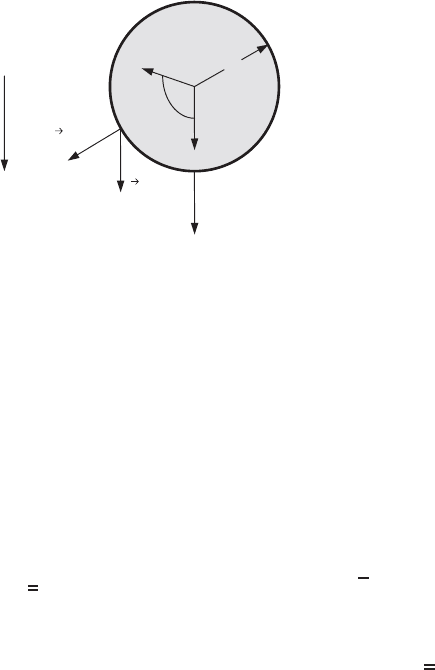
Figure 3.10-1 Solid sphere of radius R falling at its terminal velocity U
t
through a viscous
Newtonian fluid with constant physical properties.
In this first example of the use of scaling analysis for dimensional analysis in
fluid dynamics, we consider developing a correlation for the terminal velocity U
t
of a spherical particle having radius R and density ρ
p
falling due to gravitational
acceleration g through an incompressible Newtonian liquid having density ρ and
viscosity μ as shown in Figure 3.10-1. We begin by writing the equation that in
principle would have to be solved to obtain the terminal velocity. This constitutes
a force balance on the sphere involving form drag due to the pressure, viscous drag
on the sphere boundaries, and a net gravitational force that causes the flow:
−
S
δ
z
·
δ
r
Pδ
− μ(∇u +∇u
†
)
r=R
dS + (ρ
p
− ρ)g
4
3
πR
3
= 0 (3.10-1)
where
δ
i
is the unit vector in the i-direction, S the surface area, δ the identity
tensor, P the dynamic pressure, u the fluid velocity, and † denotes the transpose
of a second-order tensor. The sign convention employed in arriving at equation
(3.10-1) is consistent with defining the force on a fluid particle as described by
equation (A.1-1) in the Appendices. To carry out the integration in equation (3.10-
1), one would have to solve the axisymmetric equations of motion in spherical
coordinates with boundary conditions consisting of no-slip at the sphere surface
and a far-field velocity condition, which are given by
ρ u ·∇u =−∇P +μ∇
2
u (3.10-2)
u = 0atr = R (3.10-3)
u ·
δ
r
=−U
t
cos θ, u ·
δ
θ
=−U
t
sin θ as r →∞ (3.10-4)
where r and θ denote the radial and circumferential coordinates, respectively. Since
there is no need to achieve
◦
(1) scaling in dimensional analysis, it is sufficient
to express the describing differential equations in the generalized vector–tensor
form given by equation (3.10-2), which is the appropriately simplified form of
64 APPLICATIONS IN FLUID DYNAMICS
equation (B.2-3) in the Appendices. Equations (3.10-1) through (3.10-4) constitute
step 1 in the procedure for dimensional analysis outlined in Section 2.4.
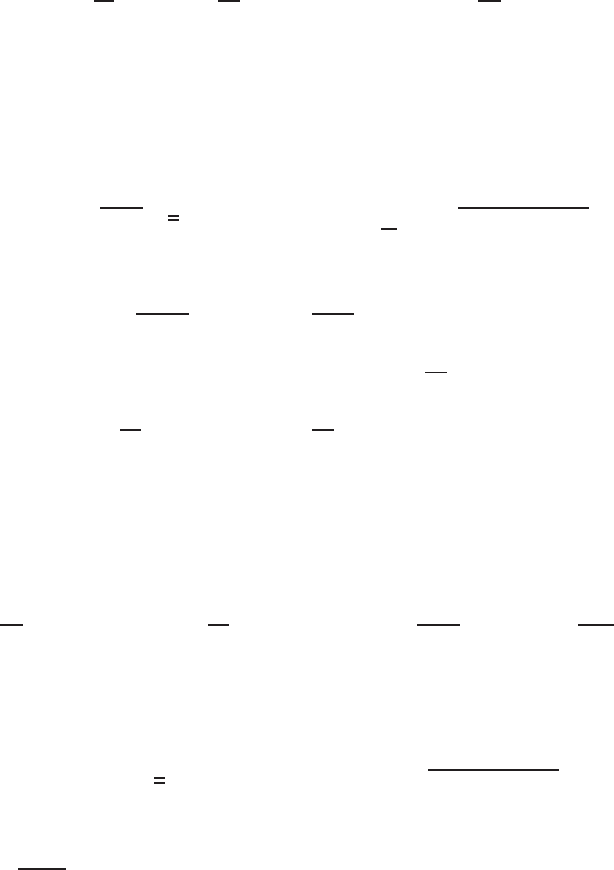
Define the following dimensionless variables (steps 2, 3, and 4):
u
∗
≡
u
u
s
; P
∗
≡
P
P
s
;∇
∗
≡ L
s
∇; S
∗
≡
S
L
2
s
(3.10-5)
where ∗ denotes a dimensionless variable and u
s
,P
s
,andL
s
denote velocity,
pressure, and length scales, respectively, that will be chosen to obtain the mini-
mum parametric representation. Introducing these into equations (3.10-1) through
(3.10-4) and dividing through by the dimensional coefficient of one term in each
equation yields (steps 5 and 6)
−
S
∗
δ
z
·
δ
n
P
s
L
s
μ
s
u
s
P
∗
δ − (∇
∗
u
∗
+∇
∗
u
∗
†
)
r
∗
=
R
L
s
dS
∗
+
4(ρ
p
− ρ)gπR
3
3μu
s
L
s
= 0
(3.10-6)
ρu
s
L
s
μ
u
∗
·∇
∗
u
∗
=−
P
s
L
s
μu
s
∇P
∗
+∇
∗
2
u
∗
(3.10-7)
u
∗
= 0atr
∗
=
R
L
s
(3.10-8)
u
∗
·
δ
r
=−
U
t
u
s
cos θ, u
∗
·
δ
θ
=−
U
t
u
s
sin θ as r
∗
→∞ (3.10-9)
One possible set of scale factors is obtained by setting the following dimen-
sionless groups equal to 1; note that no attempt is made to ensure that any of
the dimensionless variables are
◦
(1) since we are merely seeking to determine the
minimum parametric representation rather than to assess what assumptions might
be made to simplify the describing equations (step 7):
R
L
s
= 1 ⇒ L
s
= R;
U
t
u
s
= 1 ⇒ u
s
= U
t
;
P
s
L
s
μu
s
= 1 ⇒ P
s
=
μU
t
R
(3.10-10)
When these scale factors are substituted into equations (3.10-6) through (3.10-9),
the latter assume the form
−
S
∗
δ
z
·
δ
n
[P
∗
δ − (∇
∗
u
∗
+∇
∗
u
∗
†
)]
r
∗
=1
dS
∗
+
4(ρ
p
− ρ)gπR
2
3μU
t
= 0
(3.10-11)
ρU
t
R
μ
u
∗
·∇
∗
u
∗
=−∇P
∗
+∇
∗
2
u
∗
(3.10-12)
u
∗
= 0atr
∗
= 1 (3.10-13)
u
∗
·
δ
r
=−cos θ, u
∗
·
δ
θ
=−sin θ as r
∗
→∞ (3.10-14)
DIMENSIONAL ANALYSIS CORRELATION 65
Equations (3.10-11) through (3.10-14) represent the minimum parametric rep-
resentation of the describing equations. Hence, the solution to equation (3.10-12)
for the dimensionless velocity u
∗
will depend on r
∗
,θ, and the dimensionless
group ρU
t
R/μ, which is seen to be the Reynolds number. When this solution
is substituted into equation (3.10-11), evaluated at r
∗
= 1 and integrated over the
surface area S
∗
, the resulting solution for the dimensionless terminal velocity can
be correlated in terms of the following two dimensionless groups:
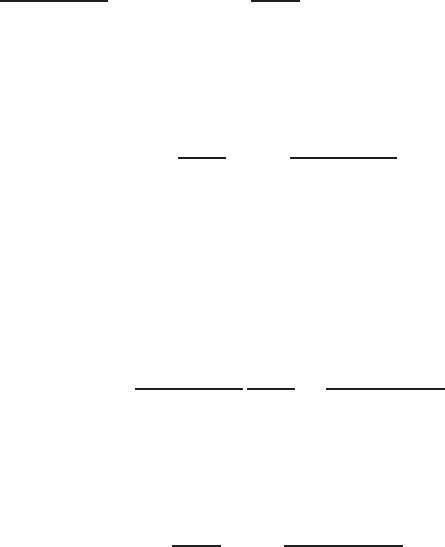
1
≡
(ρ
p
− ρ)gR
2
μU
t
and
2
≡
ρU
t
R
μ
(a Reynolds number) (3.10-15)
Hence, either data or a numerical solution for U
t
can be correlated in terms of
1
and
2
; that is, the correlation for the terminal velocity involves only two
dimensionless parameters and is of the general form
f
1
(
1
,
2
) = 0 ⇒
ρU
t
R
μ
= f
2
(ρ
p
− ρ)gR
2
μU
t
(3.10-16)
The two dimensionless groups appearing in equation (3.10-16) are not optimal
if one is seeking a correlation for U
t
since it appears in both groups; that is,
determining U
t
from known values of the physical properties and sphere radius
would require a trial-and-error solution. By invoking the transformation in step
8 with a = 1andb = 1 in equation (2.4-2), a new dimensionless group
3
not
containing U
t
can be obtained:
3
=
1
×
2
=
(ρ
p
− ρ)gR
2
μU
t
ρU
t
R
μ
=
(ρ
p
− ρ)ρgR
3
μ
2
(3.10-17)
Hence, data or numerical results for U
t
can be correlated in terms of
3
and either
1
or
2
; that is, our correlation for the terminal velocity can be expressed in the
general form
f
3
(
2
,
3
) = 0 ⇒
ρU
t
R
μ
= f
4
(ρ
p
− ρ)ρgR
3
μ
2
(3.10-18)
It is instructive to rework this problem in dimensional analysis using the Pi
theorem approach. A naive application of the Pi theorem with n = 6 quantities
and m = 3 units (mass, length, and time) to be considered in the dimensional
analysis indicates that the correlation for U
t
requires n − m = 3 rather than two
dimensionless groups. Note that if force is also considered as a unit, n = 7, but
then m = 4 because the dimensional constant g
c
in Newton’s law of motion must
also be included since this law interrelates force, mass, length, and time units;
hence, the Pi theorem would still predict three dimensionless groups rather than
two. Hence, it would appear that the Pi theorem gives a less general result than
does the scaling approach to dimensional analysis. To obtain the most general
result from the Pi theorem, one must recognize that the gravitational acceleration
g appears as the product g(ρ
p
− ρ), and hence n is really only 5; hence, with

66 APPLICATIONS IN FLUID DYNAMICS
m = 3 the Pi theorem will also predict two dimensionless groups. In contrast, the
scaling approach naturally generates the grouping g(ρ
p
− ρ) and does not require
addressing the subtleties associated with choosing the correct number of units and
dimensional constants.
Standard references
11
suggest that U
t
can be correlated in terms of
1
alone;
that is,
U
t
=
2R
2
g(ρ
p
− ρ)
9μ
⇒
1
=
(ρ
p
− ρ)gR
2
μU
t
=
9
2
(3.10-19)
However, this is for the special case of creeping or very low Reynolds number flow
for which the inertia terms can be neglected.
12
Hence,
2
(or equivalently,
3
)
no longer appears in the correlation. The correlation given by equation (3.10-19)
can be obtained (to within a multiplicative constant) by invoking the formalism
in step 9 in the systematic scaling analysis method for dimensional analysis; that
is, equation (3.10-16) can be expanded in a Taylor series in the parameter
2
,the
Reynolds number, which is a small parameter for creeping flow:
f
1
(
1
,
2
) = f
2
=0
+
∂f
∂
2
2
=0
2
+
◦
(
2
2
) (3.10-20)
Truncating the expansion in equation (3.10-20) at the first term implies that the
terminal velocity U
t
can be correlated in terms of only the dimensionless group
1
. Note that this same result could have been obtained by making the creeping-
flow approximation in equation (3.10-2), in which case the Reynolds number would
not have appeared as a dimensionless group.
A correlation in terms of just one group for the special case of creeping flow can
also be obtained from the Pi theorem; however, it requires some subtle reasoning
to achieve this result. In using the Pi theorem for creeping flow, as stated earlier,
one must recognize that the quantities g, ρ
p
,andρ appear only as the product
g(ρ
p
− ρ) and not individually. One must also be aware that creeping flow con-
stitutes a problem in statics since there is no acceleration of the fluid. This implies
that force must be introduced as a unit in addition to mass, length, and time. How-
ever, for problems in statics, one does not introduce the dimensional constant g
c
since Newton’s law of motion is not involved; that is, there is no fundamental
relationship between force, mass, length, and time units. These considerations then
infer that n = 4andm = 4, thereby suggesting zero dimensionless groups. How-
ever, n = m is a degenerate case of the Pi theorem that can be shown to imply
one dimensionless group in this case. Again one sees that scaling analysis obviates
the need to understand these subtle concepts in achieving the minimum number of
dimensionless parameters via the Pi theorem approach.
11
See Bird et al., Transport Phenomena, 2nd ed. p. 186.
12
See Section 3.3 for determining the conditions required for creeping flow.
SUMMARY 67
3.11 SUMMARY
The example in Section 3.2 provided an introduction to several features of scaling
analysis. In this problem, scaling was used to assess under what conditions the
flow could be assumed to be caused either by the applied pressure or by the upper
moving boundary. It also introduced region of influence scaling by determining the
thickness of the zone wherein the effects of the upper moving plate could never
be ignored when predicting certain quantities; that is, thin boundary-layer regions
might be safely ignored when predicting integral quantities such as the volumetric
flow rate or average velocity but must be considered when predicting local quanti-
ties such as the drag at the upper moving plate. This example provided a means for
estimating the error incurred when the assumptions suggested by scaling analysis
are invoked since an analytical solution was available for this flow. Demanding
that a quantity be one order of magnitude smaller in order to ignore some term
in the describing equations typically results in an error of 40 to 50%; demanding
two orders of magnitude reduces the error to less than 10%. However, the error
that is encountered also depends on the quantity being considered; for example,
point quantities within a region of influence might incur very large errors even
when the relevant dimensionless group is several orders of magnitude less than 1.
Finally, this example illustrated the forgiving nature of scaling; that is, if an incor-
rect assumption is made in determining one or more of the scales, a contradiction
will emerge in the final dimensionless describing equations. This usually takes the
form of having one term much larger than any of the others, thus implying that
there is no term to balance it.
In Section 3.3 we introduced the creeping- and lubrication-flow approximations.
The former requires that the Reynolds number be small, whereas the latter requires
that in addition, some aspect ratio be small. This example illustrated that the dimen-
sionless groups that emerge from scaling analysis have a physical interpretation in
that they provide a measure of relative effects. For example, the Reynolds number
is seen to be a measure of the ratio of the convection of momentum to the principal
viscous stress. In this example it was necessary to prescribe unspecified downstream
boundary conditions, due to the elliptic nature of the describing equations. Scal-
ing provided a means for assessing when these troublesome terms can be ignored;
that is, in practice these downstream conditions might not be known, which would
preclude obtaining a solution to the describing equations. Finally, this example
introduced the concept of local scaling, whereby one considers the flow at some
arbitrary distance in the principal direction of flow that is considered to be constant
during the scaling analysis.
Hydrodynamic boundary-layer theory, which is a special case of region of influ-
ence scaling, was considered in Section 3.4. The need for considering a region of
influence arose naturally in scaling this problem. Indeed, when the problem was
scaled without introducing any small transverse length scale over which the depen-
dent variables experienced a characteristic change, a contradiction resulted in that
the viscous terms dropped out of the dimensionless describing equations. A proper
scaling analysis that introduces a region of influence or boundary layer provides
68 APPLICATIONS IN FLUID DYNAMICS
a straightforward way to resolve this classical problem known as d’Alembert’s
paradox. This example also involved local scaling in which one of the scales is
the local axial distance in the direction of flow, which is considered to be a con-
stant in the change of variables involved in scaling analysis. We found that the
boundary-layer approximation is reasonable when the Reynolds number based on
the local axial length scale becomes large (i.e., Re ≡ Lρ U
∞
/μ 1). However, it
is clear that the boundary-layer approximation must break down in the vicinity of
the leading edge where L becomes small. This limitation of boundary-layer theory,
which emerges from scaling analysis, is not mentioned in some transport and fluid
mechanics textbooks.
In Section 3.5, scaling analysis was applied to an unsteady-state flow problem
in order to ascertain when the quasi-steady-state approximation can be invoked. In
this problem we found that there were several possible time scales, depending on
the conditions being considered. If the transient effects associated with initiating
this flow were important, the appropriate time scale was the observation time, the
particular time from the start of the process at which the flow was being observed.
This particular flow was still time-dependent even after the transient flow effects
died out, owing to the periodic oscillation of the lower plate. Scaling analysis led
to the condition required to assume quasi-steady-state, whereby the unsteady-state
term could be ignored in the describing equations. However, the flow was still
unsteady-state since the time dependence entered implicitly through the boundary
conditions. If the time scale for the viscous penetration of vorticity was much
longer than the time scale for the oscillating plate motion, the effects of the latter
on the flow were confined to a region of influence near the oscillating plate.
Scaling analysis was used in Section 3.6 to determine when end and sidewall
effects could be ignored. When the appropriate aspect ratio is sufficiently small,
the corresponding sidewall or end effects can be ignored when determining the
maximum velocity or integral quantities, such as the average flow rate. However,
there is always some region of influence that can be assessed by scaling wherein
one cannot ignore the effect of the lateral boundaries on quantities such as the local
velocity or drag at the boundary.
In Section 3.7 we considered free surface flows, flows for which the location
of some interface between adjacent phases is unknown initially and must be deter-
mined by solving the describing equations. The latter require an additional equation,
referred to as the kinematic surface condition, to relate the location of the free
surface to the local velocity components; this is obtained from an integral mass
balance. This was the first problem we considered that required introducing a scale
factor for a derivative: the time derivative of the film thickness. This was nec-
essary because this derivative did not scale with the characteristic length scale
divided by the characteristic time scale. If one did not recognize this, the forgiving
nature of scaling would have led to a contradiction in the dimensionless describing
equations. Scaling analysis indicated that the curvature effects could be ignored if
the quasi-parallel-flow approximation was applicable; this is the spatial analog to
the quasi-steady-state approximation considered in Section 3.5, whereby the effects
SUMMARY 69
of the nonconstant film thickness enter only through the boundary conditions. How-
ever, scaling analysis indicated that the quasi-parallel-flow approximation always
breaks down sufficiently close to the leading edge of the flow. This was the first
problem in which it was necessary to introduce a reference factor, since in this
case the pressure was not naturally referenced to zero.
Porous media flows were considered in Section 3.8 for which the flow was
described by the Darcy flow equation incorporating the Brinkman term to allow
satisfying the no-slip condition at the solid boundaries. Scaling analysis was used
to determine the conditions for which the effect of the bounding walls on the flow
through the porous media could be ignored. Scaling again indicated that there was
a region of influence wherein the effect of the bounding walls could not be ignored
on quantities such as the local velocity or drag on these boundaries.
In Section 3.9, scaling was applied to a compressible flow for which an equation
of state is required to relate the density to the state variables, in this case the
nonconstant pressure. This problem also required introducing a separate scale for a
derivative, the radial pressure gradient. However, if one did not recognize this, the
forgiving nature of scaling would have led to a contradiction in the dimensionless
describing equations. This is explored further in Practice Problem 3.P.31. Scaling
indicated that this flow could be assumed to be incompressible if the dimensionless
group known as the Mach number was much less than 1; the Mach number is the
ratio of the velocity of the fluid divided by the speed of sound in the medium. The
effects of compressibility were explored in this problem by expanding the density
in a Taylor series about some mean value characteristic of the flow. This same
technique can be used in conjunction with scaling to explore the effects of other
nonconstant physical and transport properties, such as surface tension and viscosity.
This is considered in more depth in Chapter 4 when we consider the application of
scaling to heat transfer and allow for the variation of the viscosity with temperature.
Scaling was applied to dimensional analysis in Section 3.10. The critical dif-
ference between
◦
(1) scaling and dimensional analysis is that in the latter there
is no attempt to define dimensional variables that are bounded of
◦
(1). The goal
in dimensional analysis is to arrive at the minimum parametric representation of
the problem; that is, to obtain a set of dimensionless describing equations in terms
of the minimum number of dimensionless parameters. Whereas
◦
(1) scaling leads
to a unique set of dimensionless groups for a prescribed set of physical variables
and system parameters, dimensional analysis does not. However, any one set of
dimensionless groups can be converted into any other set of dimensionless groups
by defining new dimensionless groups that are obtained by multiplying products
of the original groups raised to appropriate positive or negative powers. In some
cases it is advantageous to use this property of dimensional analysis to isolate one
or more dimensional quantities into a particular dimensionless group; for example,
by isolating all the quantities that are varied in an experiment into one dimen-
sionless group, the dependence of the phenomenon being studied on this particular
group can be determined since all the other dimensionless groups will be con-
stant. Isolating certain dimensional quantities into one group is also advantageous
when developing correlations for experimental data since it allows determining
70 APPLICATIONS IN FLUID DYNAMICS
that particular dimensional quantity directly rather than by means of a trial-and-
error procedure. The systematic scaling procedure offers several advantages relative
to the Pi theorem approach for dimensional analysis. The problem considered in
Section 3.10 demonstrated that scaling analysis led to the minimum parametric rep-
resentation directly, whereas obtaining it using the Pi theorem required considerable
intuitive knowledge. The scaling procedure naturally groups variables that always
appear in some combination, whereas the Pi theorem requires that one somehow
recognize this intuitively. Scaling also obviates the need to know which dimen-
sional variables need to be considered as primary and secondary quantities and
when dimensional constants need to be introduced into the dimensional analysis.
3.E EXAMPLE PROBLEMS
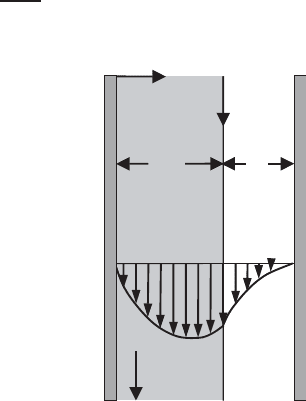
3.E.1 Gravity-Driven Laminar Film Flow down a Vertical Wall
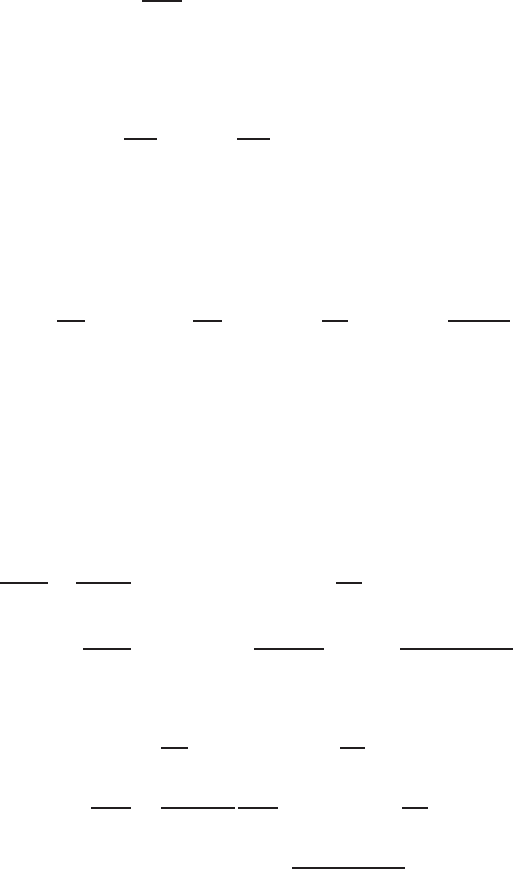
A film of an incompressible viscous Newtonian liquid that has constant physi-
cal properties is in fully developed laminar flow down a vertical wall, due to
a gravitational body force in the presence of an insoluble gas phase as shown
in Figure 3.E.1-1. Scaling analysis will be used to determine when the effect of
the drag exerted by the gas phase on the velocity profile in the liquid film can
be neglected.
The describing equations obtained by appropriately simplifying equation
(D.1-10) in the Appendices (step 1)
μ
1
d
2
u
x
dy
2
+ ρ
1
g = 0for0≤ y ≤ h
1
(3.E.1-1)
x
Gas
g
Liquid
y
h
1
h
2
Figure 3.E.1-1 Fully developed laminar flow of an incompressible viscous Newtonian
liquid film with constant physical properties down a vertical wall under the influence of
gravity in the presence of a viscous gas phase.
EXAMPLE PROBLEMS 71
d
2
u
x
dy
2
= 0forh
1
≤ y ≤ h
1
+ h
2
(3.E.1-2)
u
x
= 0aty = 0 (3.E.1-3)
u
x
|
h
−
1
= u
x
|
h
+
1
at y = h
1
(3.E.1-4)
μ
1
du
x
dy
h
−
1
= μ
2
du
x
dy
h
+
1
at y = h
1
(3.E.1-5)
u
x
= 0aty = h
1
+ h
2
(3.E.1-6)
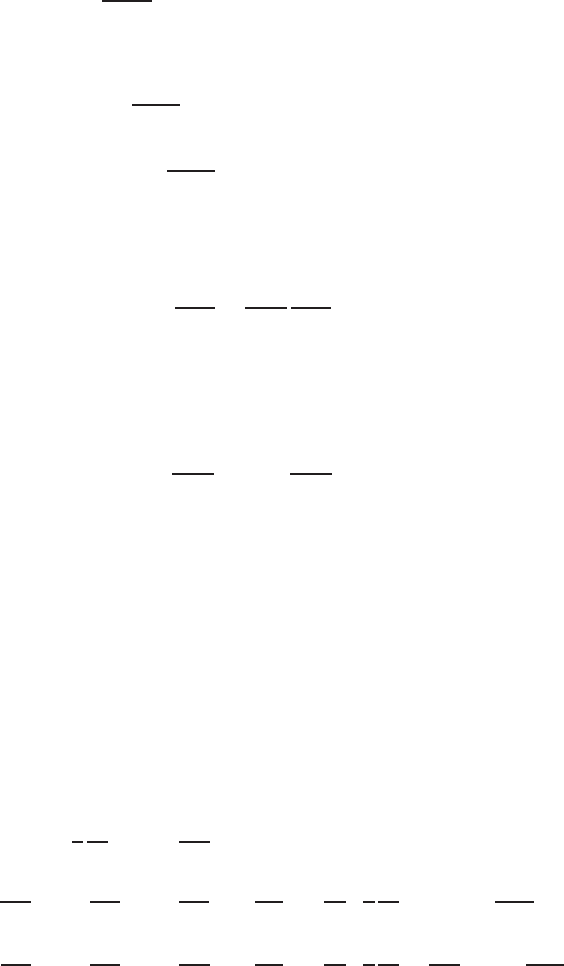
Introduce the following scale factors, reference factor, and dimensionless variables
(steps 2, 3, and 4):
u
∗
x1
≡
u
x1
u
s1
; u
∗
x2
≡
u
x2
u
s2
; y
∗
1
≡
y
y
s1
; y
∗
2
≡
y −y
r2
y
s2
(3.E.1-7)
where y
s1
is the length scale in the liquid film and y
r2
and y
s2
are the reference and
length scales in the gas phase; these are introduced to ensure that we can achieve
◦
(1) scaling for the spatial coordinates in both phases. A reference length scale
is needed in the gas phase because y is not naturally referenced to zero in this
phase. Substitute these dimensionless variables into the describing equations and
divide through by the dimensional coefficient of a term that must be retained in
each equation (steps 5 and 6):
d
2
u
∗
x1
dy
∗2
1
+
ρ
1
gy
2
s1
μ
1
u
s1
= 0for0≤ y
∗
1
≤
h
1
y
s1
(3.E.1-8)
d
2
u
∗
x2
dy
∗2
2
= 0for
h
1
− y
r2
y
s2
≤ y
∗
2
≤
h
1
+ h
2
− y
r2
y
s2
(3.E.1-9)
u
∗
x1
= 0aty
∗
1
= 0 (3.E.1-10)
u
∗
x1
=
u
s2
u
s1
u
∗
x2
at y
∗
1
=
h
1
y
s1
(3.E.1-11)
du
∗
x1
dy
∗
1
=
μ
2
u
s2
y
s1
μ
1
u
s1
y
s2
du
∗
x2
dy
∗
2
at y
∗
1
=
h
1
y
s1
(3.E.1-12)
u
∗
x2
= 0aty
∗
2
=
h
1
+ h
2
− y
r2
y
s2
(3.E.1-13)
Since gravity causes the flow in the liquid film, the dimensionless group in
equation (3.E.1-8) provides u
s1
. Since the drag at the interface causes the flow in
the gas phase, the dimensionless group in equation (3.E.1-11) gives u
s2
. We bound
the dimensionless spatial variables in the liquid and gas phases to be
◦
(1) by setting
the dimensionless geometric ratio groups in equations (3.E.1-8) and (3.E.1-9) equal
to zero (for determining y
r2
) or 1 (for determining y
s1
and y
s2
). This results in the
72 APPLICATIONS IN FLUID DYNAMICS
following scale and reference factors (step 7):
u
s1
= u
s2
=
ρ
1
gh
2
1
μ
1
; y
s1
= h
1
; y
s2
= h
2
; y
r2
= h
1
(3.E.1-14)
The resulting scaled dimensionless describing equations then are given by
d
2
u
∗
x1
dy
∗2
1
+ 1 = 0for0≤ y
∗
1
≤ 1 (3.E.1-15)
d
2
u
∗
x2
dy
∗2
2
= 0for0≤ y
∗
2
≤ 1 (3.E.1-16)
u
∗
x1
= 0aty
∗
1
= 0 (3.E.1-17)
u
∗
x1
= u
∗
x2
at y
∗
1
= 1 (3.E.1-18)
du
∗
x1
dy
∗
1
=
μ
2
h
1
μ
1
h
2
du
∗
x2
dy
∗
2
at y
∗
1
= 1 (3.E.1-19)
u
∗
x
2
= 0aty
∗
2
= 1 (3.E.1-20)
We see that the effect of the gas phase drag on the liquid film will be negligible if
the following condition is satisfied (step 8):
μ
2
h
1
μ
1
h
2
1 ⇒
μ
2
h
1
μ
1
h
2
=
◦
(0.01) (3.E.1-21)
3.E.2 Flow Between Two Approaching Parallel Circular Flat Plates
Consider the unsteady-state laminar flow of an incompressible Newtonian liquid
having constant physical properties between two parallel circular flat plates that
slowly approach each other with an axial velocity given by
U = U
0
e
−βt
(3.E.2-1)
where U
0
is the initial axial velocity and β is a time constant; a schematic of
this flow is shown in Figure 3.E.2-1. We use scaling to simplify the describing
equations for this relatively complex flow.
The describing equations are obtained by appropriately simplifying equations
(C.2-1), (D.2-10), and (D.2-12) in the Appendices (step 1):
1
r
∂
∂r
(ru
r
) +
∂u
z
∂z
= 0 (3.E.2-2)
ρ
∂u
r
∂t
+ ρu
r
∂u
r
∂r
+ ρu
z
∂u
r
∂z
=−
∂P
∂r
+ μ
∂
∂r
1
r
∂
∂r
(ru
r
)
+ μ
∂
2
u
r
∂z
2
(3.E.2-3)
ρ
∂u
z
∂t
+ ρu
r
∂u
z
∂r
+ ρu
z
∂u
z
∂z
=−
∂P
∂z
+ μ
∂
∂r
1
r
∂
∂r
r
∂u
z
∂r
+ μ
∂
2
u
z
∂z
2
(3.E.2-4)