
Krantz W.B. Scaling Analysis in Modeling Transport and Reaction Processes: A Systematic Approach to Model Building and the Art of Approximation
Подождите немного. Документ загружается.

EXAMPLE PROBLEMS 83
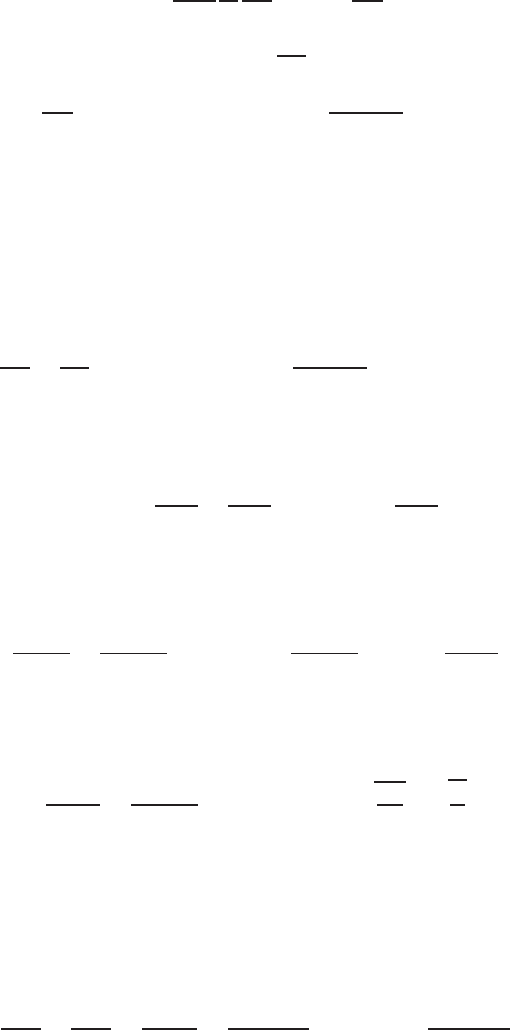
u
rs
z
s
u
zs
r
s
1
r
∗
∂
∂r
∗
(r
∗
u
∗
r
) +
∂u
∗
z
∂z
∗
= 0 (3.E.4-19)
u
∗
r
= 0,u
∗
z
= 0,u
∗
θ
=
ωr
s
u
θs
r
∗
at z
∗
= 0 (3.E.4-20)
u
∗
z
=−
U
∞
u
zs
,u
∗
r
= 0,u
∗
θ
= 0,P
∗
=
P
∞
− P
r
P
s
as z
∗
→∞ (3.E.4-21)
u
∗
r
= 0,u
∗
θ
= 0atr
∗
= 0 (3.E.4-22)
We now apply step 7 to achieve
◦
(1) scaling. Since we seek to describe the flow
at any arbitrary position along the disk, we set r
s
= R, the local radial coordinate;
that is, we are considering a local scaling analysis. The appropriate dimension-
less groups in equations (3.E.4-20) and (3.E.4-21) suggest the following scale and
reference factors:
u
θs
ωr
s
=
u
θs
ωR
= 1 ⇒ u
θs
= ωR;
P
∞
− P
r
P
s
= 0 ⇒ P
r
= P
∞
(3.E.4-23)
Since this is a developing flow, the continuity equation given by (3.E.4-19) implies
that
u
rs
z
s
u
zs
r
s
=
u
rs
z
s
u
zs
R
= 1 ⇒ u
zs
=
u
rs
z
s
R
(3.E.4-24)
The scale for u
r
is obtained from equation (3.E.4-16) since the inertia and viscous
terms must balance:
ρu
2
θs
z
2
s
μu
rs
r
s
=
ρRω
2
z
2
s
μu
rs
= 1 ⇒ u
rs
=
ρRω
2
z
2
s
μ
⇒ u
zs
=
ρω
2
z
3
s
μ
(3.E.4-25)
Similarly, the inertia and viscous terms in equation (3.E.4-18) must balance, which
provides the axial length scale:
ρu
zs
z
s
μ
=
ρ
2
ω
2
z
4
s
μ
2
= 1 ⇒ z
s
≡ δ
m
=
μ
ρω
=
ν
ω
(3.E.4-26)
where ν is the kinematic viscosity. The axial length scale z
s
has been identified with
the momentum boundary-layer thickness δ
m
, the region of influence within which
the fluid is affected by the rotating disk. Note that in contrast to most boundary-
layer problems in fluid dynamics, δ
m
is constant over the entire surface of the
rotating disk. Finally, the pressure scale is also obtained from equation (3.E.4-18):
P
s
z
s
μu
zs
=
P
s
R
μu
rs
=
P
s
R
ρω
2
δ
3
m
=
P
s
R
ρω
1/2
ν
3/2
= 1 ⇒ P
s
=
ρω
1/2
ν
3/2
R
(3.E.4-27)
84 APPLICATIONS IN FLUID DYNAMICS
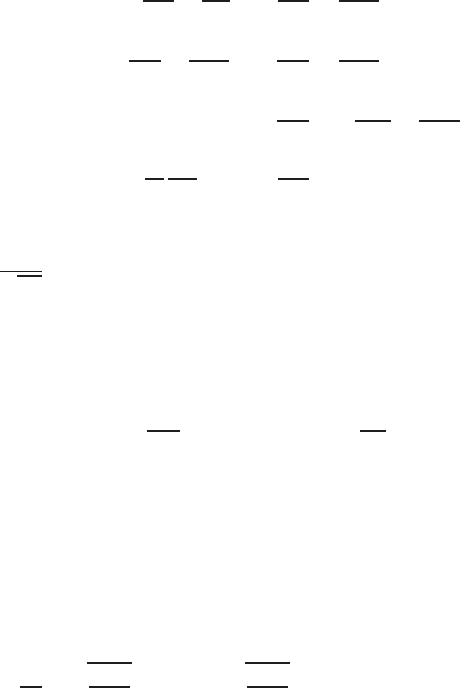
Substitution of the scale and reference factors then yields the following set of
dimensionless describing equations:
u
∗
r
∂u
∗
r
∂r
∗
−
u
∗2
θ
r
∗
+ u
∗
z
∂u
∗
r
∂z
∗
=
∂
2
u
∗
r
∂z
∗2
(3.E.4-28)
u
∗
r
∂u
∗
θ
∂r
∗
+
u
∗
r
u
∗
θ
r
∗
+ u
∗
z
∂u
∗
θ
∂z
∗
=
∂
2
u
∗
θ
∂z
∗2
(3.E.4-29)
u
∗
z
du
∗
z
dz
∗
=−
dP
∗
dz
∗
+
d
2
u
∗
z
dz
∗2
(3.E.4-30)
1
r
∗
∂
∂r
∗
(r
∗
u
∗
r
) +
∂u
∗
z
∂z
∗
= 0 (3.E.4-31)
u
∗
r
= 0,u
∗
z
= 0,u
∗
θ
= r
∗
at z
∗
= 0 (3.E.4-32)
u
∗
z
=−
U
∞
√
ων
,u
∗
r
=, 0,u
∗
θ
= 0,P
∗
= 0asz
∗
→∞ (3.E.4-33)
u
∗
r
= 0,u
∗
θ
= 0atr
∗
= 0 (3.E.4-34)
Equations (3.E.4-28) through (3.E.4-34) have been solved via a series-expansion
method (see footnote 17). The resulting series can be truncated at the first term if
δ
m
1 corresponding to a very thin momentum boundary layer. The resulting solu-
tion indicates that δ
m
= 3.6
√
ν/ω and U
∞
= 0.88447
√
νω. These agree to within
a constant of
◦
(1) with the estimates obtained for δ
m
given by equation (3.E.4-26)
and for U
∞
obtained by setting the dimensionless group in equation (3.E.4-33)
equal to 1. Note that scaling has provided reliable estimates of both the momentum
boundary-layer thickness δ
m
and the far-field axial velocity U
∞
without the need
to actually solve the describing equations.
To assume that the rotating disk is effectively in an unbounded fluid, it is nec-
essary for the boundary layer to be very thin; that is, the following criterion must
be satisfied (step 8):
δ
m
H
=
ν
ωH
2
1or
ν
ωH
2
=
◦
(0.01) (3.E.4-35)
where H denotes the distance of the rotating disk from the nearest parallel bound-
ary. This condition will be satisfied when the kinematic viscosity is low, the angular
rotation rate is high, or the boundary is far removed from the rotating disk.
3.E.5 Entry Region Flow Between Parallel Plates
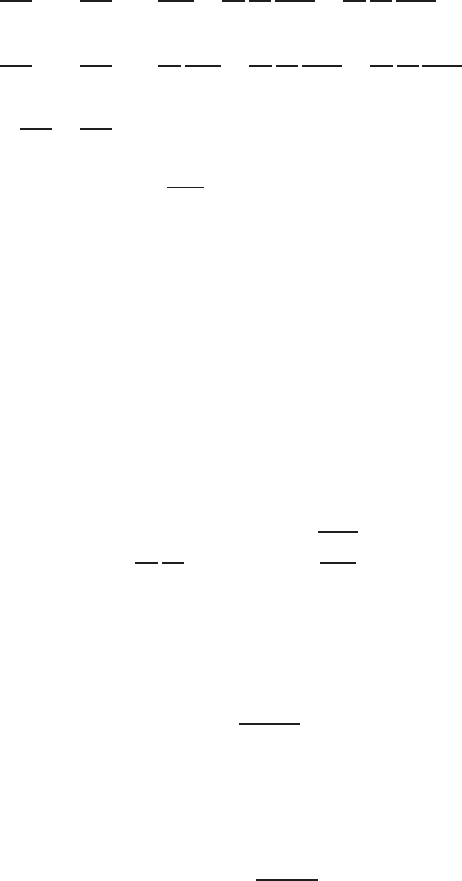
Figure 3.E.5-1 shows a schematic of pressure-driven steady-state laminar entry-
region flow of an incompressible Newtonian fluid with constant physical properties
between two parallel flat plates spaced a distance 2H apart. The constant flow
velocity at the entrance is U
0
. This is assumed to be a high Reynolds number
laminar flow for which the inertia or convection terms cannot be ignored in the entry
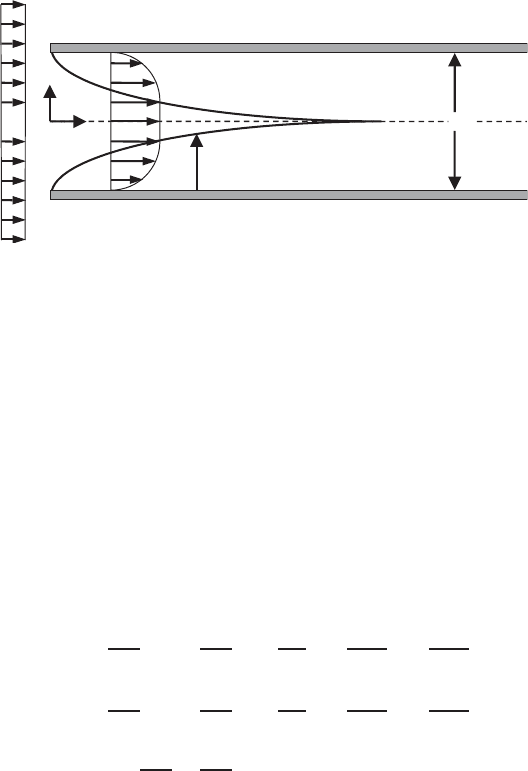
EXAMPLE PROBLEMS 85
y
2H
x
U
0
d
m
(x)
Figure 3.E.5-1 High Reynolds number steady-state pressure-driven entry region flow of
an incompressible Newtonian fluid with constant physical properties between two parallel
flat plates spaced a distance 2H apart.
region. We will use scaling to estimate the entry length required to achieve fully
developed laminar flow. Note that this flow differs somewhat from the boundary-
layer flow considered in Section 3.4 in that this is a confined boundary-layer flow.
Hence, owing to the deceleration of the flow within the boundary layer at the walls,
the uniform or plug flow in the center must accelerate. Moreover, in contrast to the
boundary-layer flow considered in Section 3.4 that was caused by the velocity of
the flow external to the boundary layer, the flow in the present example is caused
by an applied pressure gradient.
The describing equations are obtained by simplifying equations (C.1-1),
(D.1-10), and (D.1-11) in the Appendices appropriately (step 1):
ρu
x
∂u
x
∂x
+ ρu
y
∂u
x
∂y
=−
∂P
∂x
+ μ
∂
2
u
x
∂x
2
+ μ
∂
2
u
x
∂y
2
(3.E.5-1)
ρu
x
∂u
y
∂x
+ ρu
y
∂u
y
∂y
=−
∂P
∂y
+ μ
∂
2
u
y
∂x
2
+ μ
∂
2
u
y
∂y
2
(3.E.5-2)
∂u
x
∂x
+
∂u
y
∂y
= 0 (3.E.5-3)
u
x
= U
0
,u
y
= 0,P= P
0
at x = 0 (3.E.5-4)
u
x
= f
1
(y), u
y
= f
2
(y) at x = L (3.E.5-5)
u
x
= 0,u
y
= 0aty =±H (3.E.5-6)
u
x
= f
3
(x), u
y
= f
4
(x) at y =±(H − δ
m
) (3.E.5-7)
where f
1
(y) and f
2
(y) are unspecified functions of y and f
3
(x) and f
4
(x) are
unspecified functions of x that in principle would have to be known in order to
integrate the set of differential equations above. Note that we have introduced a
region of influence δ
m
(x) within which the effect of the viscous shear induced by
the presence of each wall is confined. The rationale for introducing this region of
86 APPLICATIONS IN FLUID DYNAMICS
influence or hydrodynamic boundary-layer thickness was discussed in Section 3.4.
The set of equations above also introduces the pressure P
0
that would have to be
specified at the entry region in order to integrate the system of equations above.
Introduce the following scale factors, reference factors, and dimensionless vari-
ables (steps 2, 3, and 4):
u
∗
x
≡
u
x
u
xs
; u
∗
y
≡
u
y
u
ys
; P
∗
≡
P
P
s
; x
∗
≡
x
x
s
; y
∗
≡
y −y
r
y
s
(3.E.5-8)
We have introduced a reference factor y
r
in the definition of y
∗
to force this dimen-
sionless variable to zero at the wall. Note that the symmetry of this problem permits
considering only the region −H ≤ y ≤ 0. Substituting these dimensionless variables
into equations (3.E.5-1) through (3.E.5-7) and dividing through by the dimensional
coefficient of one of the principal terms in each equation then yields the following
equations that describe the flow in the region −H ≤ y ≤ 0 (steps 5 and 6):
u
∗
x
∂u
∗
x
∂x
∗
+
u
ys
x
s
u
xs
y
s
u
∗
y
∂u
∗
x
∂y
∗
=−
P
s
ρu
2
xs
∂P
∗
∂x
∗
+
μ
ρu
xs
x
s
∂
2
u
∗
x
∂x
∗2
+
μx
s
ρu
xs
y
2
s
∂
2
u
∗
x
∂y
∗2
(3.E.5-9)
u
∗
x
∂u
∗
y
∂x
∗
+
u
ys
x
s
u
xs
y
s
u
∗
y
∂u
∗
y
∂y
∗
=−
P
s
x
s
ρu
xs
u
ys
y
s
∂P
∗
∂y
∗
+
μ
ρu
xs
x
s
∂
2
u
∗
y
∂x
∗2
+
μx
s
ρu
xs
y
2
s
∂
2
u
∗
y
∂y
∗2
(3.E.5-10)
∂u
∗
x
∂x
∗
+
u
ys
x
s
u
xs
y
s
∂u
∗
y
∂y
∗
= 0 (3.E.5-11)
u
∗
x
=
U
0
u
xs
,u
∗
y
= 0,P
∗
=
P
0
P
s
at x
∗
= 0 (3.E.5-12)
u
∗
x
= f
∗
1
(y
∗
), u
∗
y
= f
∗
2
(y
∗
) at x
∗
=
L
x
s
(3.E.5-13)
u
∗
x
= 0,u
∗
y
= 0aty
∗
=−
H − y
r
y
s
(3.E.5-14)
u
∗
x
= f
∗
3
(x
∗
), u
∗
y
= f
∗
4
(x
∗
) at y
∗
=−
H − δ
m
− y
r
y
s
(3.E.5-15)
We now apply step 7 to bound the variables to be
◦
(1). We can bound y
∗
to be
between 0 and 1 by setting the dimensionless groups in equations (3.E.5-14) and
(3.E.5-15) equal to zero and 1, respectively, to obtain y
r
= H and y
s
= δ
m
.The
axial length scale can be bounded to be between 0 and 1 by setting the dimen-
sionless group in equation (3.E.5-13) equal to 1, thereby obtaining x
s
= L.The
axial velocity can be bounded to be between 0 and 1 by setting the dimensionless
group in equation (3.E.5-12) equal to 1, thereby obtaining u
xs
= U
0
. Since this is a
developing flow, both terms in the dimensionless continuity equation should be of
the same order; hence, we require that the dimensionless group in equation (3.E.5-
11) be equal to 1, thereby obtaining u
ys
= U
0
δ
m
/L. Since this is a pressure-driven
EXAMPLE PROBLEMS 87
high Reynolds number flow, the dimensionless pressure term should be of the same
order as the inertia terms; hence, we require that dimensionless group multiplying
the pressure term in equation (3.E.5-9) be equal to 1, thereby obtaining P
s
= ρU
2
0
.
The resulting scaled dimensionless describing equations are given by
u
∗
x
∂u
∗
x
∂x
∗
+ u
∗
y
∂u
∗
x
∂y
∗
=−
∂P
∗
∂x
∗
+
1
Re
δ
m
L
∂
2
u
∗
x
∂x
∗2
+
1
Re
L
δ
m
∂
2
u
∗
x
∂y
∗2
(3.E.5-16)
u
∗
x
∂u
∗
y
∂x
∗
+ u
∗
y
∂u
∗
y
∂y
∗
=−
L
2
δ
2
m
∂P
∗
∂y
∗
+
1
Re
δ
m
L
∂
2
u
∗
y
∂x
∗2
+
1
Re
L
δ
m
∂
2
u
∗
y
∂y
∗2
(3.E.5-17)
∂u
∗
x
∂x
∗
+
∂u
∗
y
∂y
∗
= 0 (3.E.5-18)
u
∗
x
= 1,u
∗
y
= 0,P
∗
=
P
0
ρU
2
0
at x
∗
= 0 (3.E.5-19)
u
∗
x
= f
∗
1
(y
∗
), u
∗
y
= f
∗
2
(y
∗
) at x
∗
= 1 (3.E.5-20)
u
∗
x
= 0,u
∗
y
= 0aty
∗
= 0 (3.E.5-21)
u
∗
x
= f
∗
3
(x
∗
), u
∗
y
= f
∗
4
(x
∗
) at y
∗
= 1 (3.E.5-22)
where Re ≡ δ
m
ρU
0
/μ is the Reynolds number. The principal viscous term in
equation (3.E.5-16) must be of the same size as the pressure and inertia terms
within the region of influence (hydrodynamic boundary layer) if we are to sat-
isfy the boundary conditions given by equations (3.E.5-21) and (3.E.5-22). Hence,
we require that the dimensionless group multiplying the principal viscous term in
equation (3.E.5-16) be equal to 1, which provides an estimate of the boundary-layer
thickness δ
m
(x
∗
):
1
Re
L
δ
m
= 1 ⇒ δ
m
=
μL
ρU
0
(3.E.5-23)
When the boundary layer thickness δ
m
= H , the flow is fully developed. Hence,
we can use equation (3.E.5-23) evaluated at δ
m
= H to obtain an estimate of the
entrance length L
e
:
L
e
∼
=
ρU
0
H
2
μ
(3.E.5-24)
This agrees to within a multiplicative constant of order 1 with the entrance length
required to achieve fully developed flow obtained from solving the boundary-layer
equations that yields
18
L
e
= 0.16
ρU
0
H
2
μ
(3.E.5-25)
18
See H. Schlichting, Boundary Layer Theory, 4th ed., McGraw-Hill, New York, 1980, p. 168.

88 APPLICATIONS IN FLUID DYNAMICS
Whereas for this well-studied flow, an equation is available to predict the entrance
length that obviates the need to use scaling analysis, the latter provides an invaluable
tool for estimating the entry region for flows for which no such results are available.
Equations (3.E.5-16) through (3.E.5-23) can be greatly simplified if δ
2
m
/L
2
=
◦
(0.01) (step 8). This permits ignoring the axial diffusion of vorticity term in
equation (3.E.5-16), thereby obviating the need to satisfy any downstream boundary
condition. Moreover, in view of equation (3.E.5-17), this condition implies that the
dimensionless derivative ∂P
∗
/∂y
∗
is very small. Note that we have not scaled the
dimensionless derivative ∂P
∗
/∂y
∗
in equation (3.E.5-17) to be
◦
(1) since there is
no reason for this derivative to scale as P
s
/y
s
. However, since we have scaled
u
∗
x
∂u
∗
y
/∂x
∗
to be of order
◦
(1), equation (3.E.5-17) implies that ∂P
∗
/∂y
∗
is of
◦
(δ
2
m
/L
2
) and hence that it is very small. This decouples the solution of equation
(3.E.5-16) from equation (3.E.5-17) and implies that the dimensionless describing
equations for the entry-region flow problem can be reduced to
u
∗
x
∂u
∗
x
∂x
∗
+ u
∗
y
∂u
∗
x
∂y
∗
=−
dP
∗
dx
∗
+
∂
2
u
∗
x
∂y
∗2
(3.E.5-26)
∂u
∗
x
∂x
∗
+
∂u
∗
y
∂y
∗
= 0 (3.E.5-27)
u
∗
x
= 1,u
∗
y
= 0,P
∗
=
P
0
ρU
2
0
at x
∗
= 0 (3.E.5-28)
u
∗
x
= 0,u
∗
y
= 0aty
∗
= 0 (3.E.5-29)
u
∗
x
= f
∗
3
(x
∗
) at y
∗
= 1 (3.E.5-30)
To solve equations (3.E.5-26) through (3.E.5-30), it is necessary to know the unspe-
cified function f
∗
3
(x
∗
) in equation (3.E.5-30). This is obtained by solving the ideal
flow (inviscid) flow equations
19
outside the boundary-layer region for which vis-
cous effects can be ignored, due to the high Reynolds number. In doing this, one
carries out integral mass and momentum balances that account for the acceler-
ation of the flow due to the thinning of the inviscid core region that is caused
by the growing boundary layer at each wall. These equations can then be solved
analytically to determine the unspecified function f
∗
3
(x
∗
) in equation (3.E.5-30).
Equations (3.E.5-26) and (3.E.5-27) can then be solved numerically. The resulting
solution will yield the entrance length given by equation (3.E.5-25).
3.E.6 Rotating Flow in an Annulus with End Effects
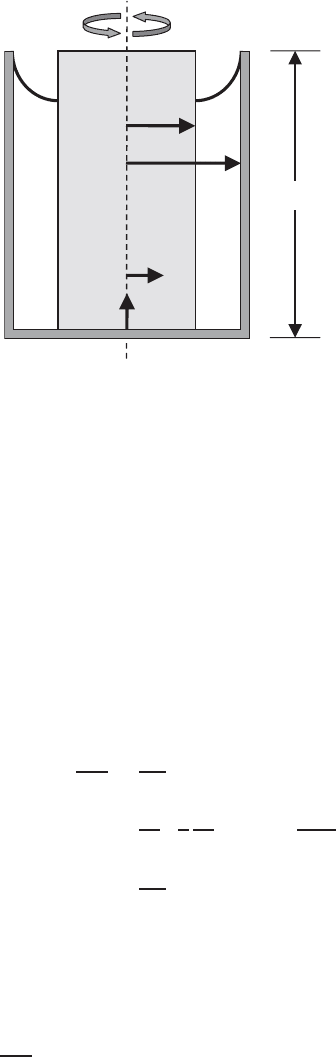
Consider the steady-state flow of an incompressible Newtonian liquid with con-
stant physical properties in the annular region between two concentric cylinders
of length L, shown in Figure 3.E.6-1. The inner cylinder has radius R
1
and is
19
The ideal or inviscid flow equations correspond to an infinite Reynolds number, which implies no
viscous effects whatsoever; in the case of hydrodynamic boundary-layer flows, the flow region outside
the boundary layer is described by the ideal flow equations.
EXAMPLE PROBLEMS 89
L
r
z
x
w
R
1
R
2
Figure 3.E.6-1 Steady-state incompressible laminar flow of a Newtonian liquid with con-
stant physical properties in the annular region between a stationary inner and a rotating outer
cylinder.
stationary. The outer cylinder has radius R
2
and rotates at a constant angular veloc-
ity ω (radians per second). The flow is caused primarily by the rotation of the outer
cylinder. However, the bottom of the outer cylinder is also rotating and dragging
the adjacent liquid with it, causing an end effect. We neglect any effect of the
small gap between the bottom of the stationary inner cylinder and the rotating
outer cylinder. We use scaling analysis to derive criteria for ignoring the end effect
on the primary rotational flow in the annulus.
The describing equations for this flow are obtained by appropriately simplifying
the equations of motion in cylindrical coordinates given by equations (D.2-10)
through (D.2-12) in the Appendices (step 1):
ρu
2
θ
r
=
∂P
∂r
(3.E.6-1)
0 =
∂
∂r
1
r
∂
∂r
(ru
θ
)
+
∂
2
u
θ
∂z
2
(3.E.6-2)
0 =
∂P
∂z
+ ρg (3.E.6-3)
u
θ
= 0atr = R
1
(3.E.6-4)
u
θ
= ωR
2
at r = R
2
(3.E.6-5)
u
θ
= ωr at z = 0 (3.E.6-6)
∂u
θ
∂z
= 0atz = f
1
(r) (3.E.6-7)

90 APPLICATIONS IN FLUID DYNAMICS
The boundary condition given by equation (3.E.6-7) allows for the fact that the
rotation causes a centrifugal pressure force that increases with the radius. At any
point in the liquid the centrifugal pressure has to be balanced by the hydrostatic
pressure. Hence, the liquid depth will increase with increasing radius. The location
of this interface can be determined from the solution to the pressure profile. The
function f
1
(r) must satisfy the integral conservation of mass for an incompressible
liquid given by
R
2
R
1
2πrf
1
(r) dr = π(R
2
2
− R
2
1
)L
0
(3.E.6-8)
where L
0
is the liquid depth in the absence of any rotation.
Introduce the following scale factors, reference factor, and dimensionless vari-
ables (steps 2, 3, and 4):
u
∗
θ
≡
u
θ
u
s
; P
∗
≡
P
P
s
; r
∗
≡
r − r
r
r
s
; z
∗
≡
z
z
s
(3.E.6-9)
We have introduced a reference factor for the dimensionless radial coordinate since
r is not naturally referenced to zero within the region where flow is occurring.
Substitute these dimensionless variables into the describing equations and divide
through by the dimensional coefficient of a term that must be retained (steps 5 and 6):
u
∗2
θ
r
∗
+ r
r
/r
s
=
P
s
ρu
2
s
∂P
∗
∂r
∗
(3.E.6-10)
0 =
∂
∂r
∗
1
r
∗
+ r
r
/r
s
∂
∂r
∗
r
∗
+
r
r
r
s
u
∗
θ
+
r
2
s
z
2
s
∂
2
u
∗
θ
∂z
∗2
(3.E.6-11)
0 =
P
s
ρgz
s
∂P
∗
∂z
∗
+ 1 (3.E.6-12)
u
∗
θ
= 0atr
∗
=
R
1
− r
r
r
s
(3.E.6-13)
u
∗
θ
=
ωR
2
u
s
at r
∗
=
R
2
− r
r
r
s
(3.E.6-14)
u
∗
θ
=
ωr
s
r
∗
+ r
r
/r
s
u
s
at z
∗
= 0 (3.E.6-15)
∂u
∗
θ
∂z
∗
= 0atz
∗
= f
∗
1
(r
∗
) (3.E.6-16)
R
2
−r
r
r
s
R
1
−r
r
r
s
2
r
∗
+
r
r
r
s
f
∗
1
r
∗
dr
∗
=
R
2
2
− R
2
1
L
0
r
2
s
z
s
(3.E.6-17)
We now apply step 7 to bound the variables to be
◦
(1). We can bound r
∗
to
be between zero and 1 by setting the dimensionless group in equation (3.E.6-13)
equal to zero and that in equation (3.E.6-14) equal to 1, thereby obtaining r
r
= R
1
EXAMPLE PROBLEMS 91
and r
s
= R
2
− R
1
. Our dimensionless axial coordinate can be bounded between
zero and 1 by setting the dimensionless group L
0
/z
s
that appears in equation
(3.E.6-17) equal to 1, thereby obtaining z
s
= L
0
. Our velocity scale is obtained
from the dimensionless group in equation (3.E.6-14) to obtain u
s
= ωR
2
. Finally,
our pressure scale is obtained from the dimensionless group in equation (3.E.6-10)
to obtain P
s
= ρω
2
R
2
2
. When these scale and reference factors are substituted in
equations (3.E.6-10) through (3.E.6-17), we obtain the following set of dimension-
less describing equations:
u
∗2
θ
r
∗
+ R
1
/(R
2
− R
1
)
=
∂P
∗
∂r
∗
(3.E.6-18)
0 =
∂
∂r
∗
1
r
∗
+ R
1
/(R
2
− R
1
)
∂
∂r
∗
r
∗
+
R
1
R
2
− R
1
u
∗
θ
+
(R
2
− R
1
)
2
L
2
0
∂
2
u
∗
θ
∂z
∗2
(3.E.6-19)
0 =
ω
2
R
2
2
gL
∂P
∗
∂z
∗
+ 1 (3.E.6-20)
u
∗
θ
= 0atr
∗
= 0 (3.E.6-21)
u
∗
θ
= 1atr
∗
= 1 (3.E.6-22)
u
∗
θ
=
R
2
− R
1
R
2
r
∗
+
R
1
R
2
− R
1
at z
∗
= 0 (3.E.6-23)
∂u
∗
θ
∂z
∗
= 0atz
∗
= f
∗
1
(r
∗
) (3.E.6-24)
1
0
2
r
∗
+
R
1
R
2
− R
1
f
∗
1
r
∗
dr
∗
=
R
2
+ R
1
R
2
− R
1
(3.E.6-25)
We see that if the dimensionless group (R
2
− R
1
)
2
/L
2
0
=
◦
(0.01) the end effect
can be ignored in equation (3.E.6-19) (step 8). The resulting simplified set of
describing equations can be solved analytically.
20
A further simplification is possi-
ble if the group (R
2
− R
1
)/R
1
=
◦
(0.01), in which case the describing equations
reduce to
0 =
∂P
∗
∂r
∗
(3.E.6-26)
0 =
d
2
u
∗
θ
dr
∗2
(3.E.6-27)
0 =
ω
2
R
2
2
gL
0
∂P
∗
∂z
∗
+ 1 (3.E.6-28)
20
This simplified set of describing equations has been solved in Bird et al., Transport Phenomena, 2nd
ed., pp. 93–95; however, no attempt is made to justify when these simplified equations are applicable.
92 APPLICATIONS IN FLUID DYNAMICS
u
∗
θ
= 0atr
∗
= 0 (3.E.6-29)
u
∗
θ
= 1atr
∗
= 1 (3.E.6-30)
1
0
f
∗
1
r
∗
dr
∗
= 1 (3.E.6-31)
This simplified set of describing equations also admits an analytical solution.
The integral mass-balance condition is retained in the form given by equation
(3.E.6-31), which permits obtaining the liquid depth profile in the annular region.
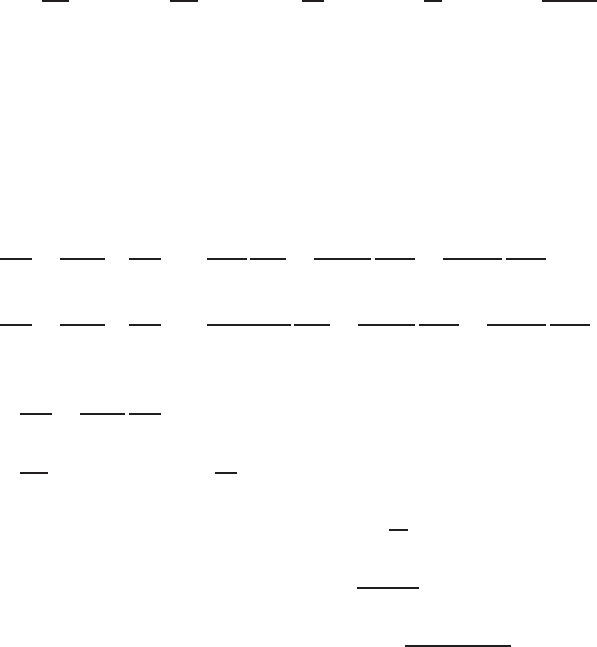
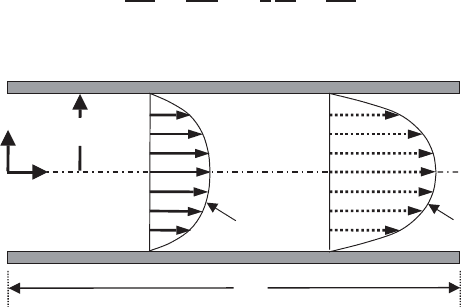
3.E.7 Impulsively Initiated Pressure-Driven Laminar Tube Flow
Consider an incompressible Newtonian liquid with constant physical properties
contained in a semi-infinitely long cylindrical tube having radius R. Initially, the
liquid in the tube is at rest. At time t = 0, a constant pressure drop P ≡ P
0
− P
L
is applied across some length L of the tube to initiate continuous flow, as shown
in Figure 3.E.7-1. We will ignore any entrance effects, in which case this is an
interesting example of an unsteady-state fully developed flow. Figure 3.E.7-1 shows
the axial velocity profiles at times t
1
and t
2
,wheret
2
>t
1
. If the entrance effects are
neglected, the velocity profile at any time applies along the entire length of the tube.
The unsteady-state acceleration of the flow is suggested by the increased area under
the velocity profile at t
2
relative to t
1
. We use scaling analysis to determine the
criterion for assuming that this impulsively initiated flow has achieved steady-state
conditions.
The describing equations for this flow are obtained by appropriately simpli-
fying the unsteady-state equations of motion in cylindrical coordinates given by
equation (D.2-12) in the Appendices to obtain (step 1)
ρ
∂u
z
∂t
=
P
L
+ μ
1
r
∂
∂r
r
∂u
z
∂r
(3.E.7-1)
r
z
R
L
P
0
P
L
u
z
(r, t
1
) u
z
(r, t
2
)
Figure 3.E.7-1 Laminar flow of an incompressible Newtonian liquid with constant physical
properties in a circular tube of radius R due to an impulsively applied pressure difference
P ≡ P
0
− P
L
, showing the axial velocity profiles at times t
1
and t
2
,wheret
2
>t
1
.