
Krantz W.B. Scaling Analysis in Modeling Transport and Reaction Processes: A Systematic Approach to Model Building and the Art of Approximation
Подождите немного. Документ загружается.

EXAMPLE PROBLEMS 103
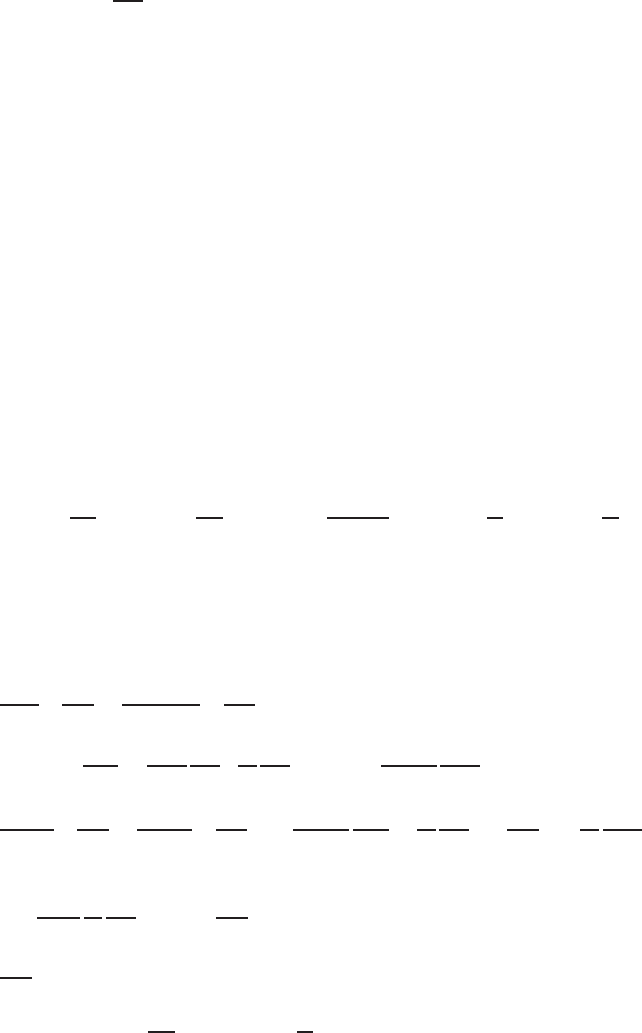
∂u
z
∂r
= 0,u
r
= 0atr = 0 (3.E.10-4)
u
z
= 0,u
r
=−U
0
at r = R (3.E.10-5)
u
z
= 0,u
r
= 0atz = 0 (3.E.10-6)
u
z
= f
1
(r), u
r
= f
2
(r), P = P
atm
at z = L (3.E.10-7)
2πRzU
0
=
R
0
u
z
2πrdr (3.E.10-8)
where f
1
(r) and f
2
(r) are undetermined functions that are required for complete-
ness in specifying the boundary conditions. The fact that these functions are gener-
ally unknown in practice significantly complicates solving the full set of describing
equations. Equation (3.E.10-5) accounts for the fact that permeation through the
walls of the hollow-fiber membrane results in a nonzero radial velocity component.
This permeation also causes this to be a developing flow. Equation (3.E.10-8) is a
statement that for an incompressible liquid the total permeation over a length z of
the fiber wall is equal to the volumetric flow rate at that axial position. This serves
as an auxiliary condition to determine the unspecified axial pressure gradient.
Define the following scale factors, reference factor, and dimensionless variables
(steps 2, 3, and 4):
u
∗
z
≡
u
z
u
zs
; u
∗
r
≡
u
r
u
rs
; P
∗
≡
P − P
r
P
s
; r
∗
≡
r
r
s
; z
∗
≡
z
z
s
(3.E.10-9)
Introduce these dimensionless variables into equations (3.E.10-1) through
(3.E.10-8) and divide each equation through by the dimensional coefficient of a
term that must be retained to obtain (steps 5 and 6)
ρu
2
rs
P
s
u
∗
r
∂u
∗
r
∂r
∗
+
ρu
zs
u
rs
r
s
P
s
z
s
u
∗
z
∂u
∗
r
∂z
∗
=−
∂P
∗
∂r
∗
+
μu
rs
P
s
r
s
∂
∂r
∗
1
r
∗
∂
∂r
∗
(r
∗
u
∗
r
)
+
μu
rs
r
s
P
s
z
2
s
∂
2
u
∗
r
∂z
∗2
(3.E.10-10)
ρu
zs
r
s
μ
u
∗
r
∂u
∗
z
∂r
∗
+
ρu
zs
r
2
s
μz
s
u
∗
z
∂u
∗
z
∂z
∗
=−
P
s
r
2
s
μu
zs
z
s
∂P
∗
∂z
∗
+
1
r
∗
∂
∂r
∗
r
∗
∂u
∗
z
∂r
∗
+
r
2
s
z
2
s
∂
2
u
∗
z
∂z
∗2
(3.E.10-11)
u
rs
z
s
u
zs
r
s
1
r
∗
∂
∂r
∗
(r
∗
u
∗
r
) +
∂u
∗
z
∂z
∗
= 0 (3.E.10-12)
∂u
∗
z
∂r
∗
= 0,u
∗
r
= 0atr
∗
= 0 (3.E.10-13)
u
∗
z
= 0,u
∗
r
=−
U
0
u
rs
at r
∗
=
R
r
s
(3.E.10-14)
104 APPLICATIONS IN FLUID DYNAMICS
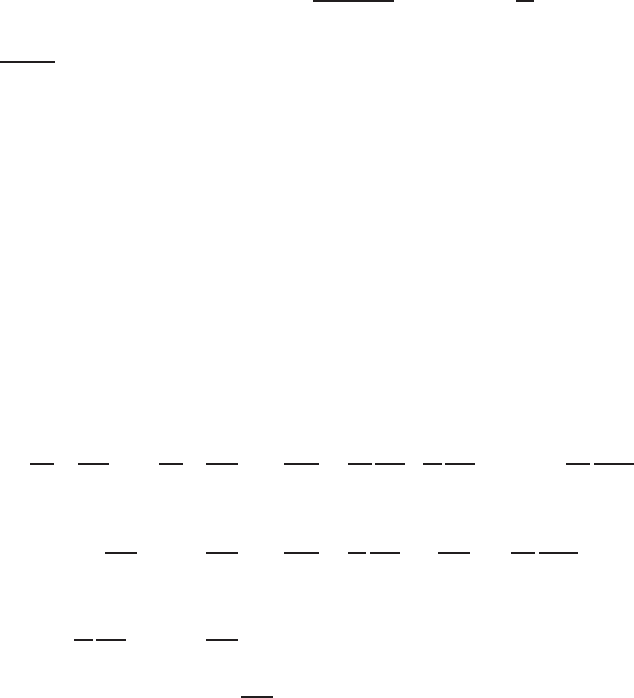
u
∗
z
= 0,u
∗
r
= 0atz
∗
= 0 (3.E.10-15)
u
∗
z
= f
∗
1
(r
∗
), u
∗
r
= f
∗
2
(r
∗
), P
∗
=
P
atm
− P
r
P
s
at z
∗
=
L
z
s
(3.E.10-16)
U
0
Rz
s
u
zs
r
2
s
z
∗
=
R/r
s
0
u
∗
z
r
∗
dr
∗
(3.E.10-17)
The dimensionless geometric ratios in equations (3.E.10-14) and (3.E.10-16)
can be set equal to 1, thereby determining the length scales r
s
= R and z
s
= L
(step 7). Since the permeation through the hollow-fiber membrane wall causes the
radial flow, we set the dimensionless group containing U
0
in equation (3.E.10-14)
equal to 1, thereby obtaining u
rs
= U
0
. Since this is a developing flow, setting the
dimensionless group equal to 1 in equation (3.E.10-12) gives u
zs
= LU
0
/R.Since
the axial flow is caused by the axial pressure gradient, we set the dimensionless
group containing P
s
in equation (3.E.10-11) equal to 1, thereby obtaining P
s
=
μU
0
L
2
/R
3
. Finally, our dimensionless pressure will be bounded between zero
and 1 if we set the dimensionless group in equation (3.E.10-16) equal to zero,
which gives P
r
= P
atm
. When these values for the scale and reference factors are
substituted into equations (3.E.10-10) through (3.E.10-17), we obtain the following
minimum parametric representation of the describing equations:
Re
R
2
L
2
u
∗
r
∂u
∗
r
∂r
∗
+ Re
R
2
L
2
u
∗
z
∂u
∗
r
∂z
∗
=−
∂P
∗
∂r
∗
+
R
2
L
2
∂
∂r
∗
1
r
∗
∂
∂r
∗
(r
∗
u
∗
r
)
+
R
4
L
4
∂
2
u
∗
r
∂z
∗2
(3.E.10-18)
Reu
∗
r
∂u
∗
z
∂r
∗
+ Reu
∗
z
∂u
∗
z
∂z
∗
=−
∂P
∗
∂z
∗
+
1
r
∗
∂
∂r
∗
r
∗
∂u
∗
z
∂r
∗
+
R
2
L
2
∂
2
u
∗
z
∂z
∗2
(3.E.10-19)
1
r
∗
∂
∂r
∗
(r
∗
u
∗
r
) +
∂u
∗
z
∂z
∗
= 0 (3.E.10-20)
∂u
∗
z
∂r
∗
= 0,u
∗
r
= 0atr
∗
= 0 (3.E.10-21)
u
∗
z
= 0,u
∗
r
=−1atr
∗
= 1 (3.E.10-22)
u
∗
z
= 0,u
∗
r
= 0atz
∗
= 0 (3.E.10-23)
u
∗
z
= f
∗
1
(r
∗
), u
∗
r
= f
∗
2
(r
∗
), P
∗
= 0atz
∗
= 1 (3.E.10-24)
z
∗
=
1
0
u
∗
z
r
∗
dr
∗
(3.E.10-25)
The fact that equation (3.E.10-25) does not contain any dimensionless groups is
an indication that we have scaled the describing equations properly. That is, the
scaling has normalized the integral mass balance in this equation to be
◦
(1), as it
should be, since the two terms in this equation must balance each other.
EXAMPLE PROBLEMS 105
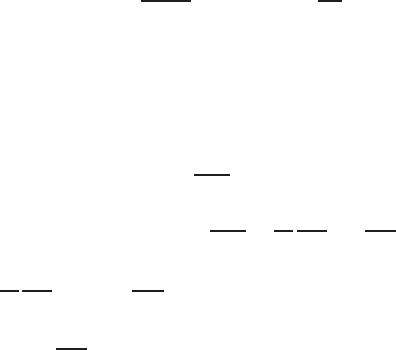
Inspection of equations (3.E.9-18) through (3.E.10-25) indicates that consider-
able simplification is possible if the following conditions apply (step 8):
Re ≡
ρU
0
R
μ
1and
R
2
L
2
1 (3.E.10-26)
We recognize these conditions to be those for assuming lubrication flow that was
considered in Section 3.3. However, for this flow the Reynolds number charac-
terizes the ratio of the radial convection to viscous force. If the conditions above
apply, our describing equations simplify to
0 =
∂P
∗
∂r
∗
(3.E.10-27)
0 =−
dP
∗
dz
∗
+
1
r
∗
∂
∂r
∗
r
∗
∂u
∗
z
∂r
∗
(3.E.10-28)
1
r
∗
∂
∂r
∗
(r
∗
u
∗
r
) +
∂u
∗
z
∂z
∗
= 0 (3.E.10-29)
∂u
∗
z
∂r
∗
= 0atr
∗
= 0 (3.E.10-30)
u
∗
z
= 0,u
∗
r
=−1atr
∗
= 1 (3.E.10-31)
u
∗
z
= 0atz
∗
= 0 (3.E.10-32)
P
∗
= 0atz
∗
= 1 (3.E.10-33)
z
∗
=
1
0
u
∗
z
r
∗
dr
∗
(3.E.10-34)
Equation (3.E.10-27) implies that P
∗
= P
∗
(z
∗
), which permits integrating equa-
tion (3.E.10-28) directly to obtain the axial velocity profile in terms of the unspec-
ified axial pressure gradient. The latter can be obtained by substituting the axial
velocity profile into equation (3.E.10-34). The corresponding radial velocity pro-
file can be obtained from equation (3.E.10-29). The resulting solutions for the
dimensionless velocity and pressure profiles are given by
u
∗
z
= 4z
∗
(1 − r
∗2
); u
∗
r
= r
∗
(r
∗2
− 2); P
∗
= 8(1 − z
∗2
) (3.E.10-35)
3.E.11 Falling Head Method for Determining Soil Permeability
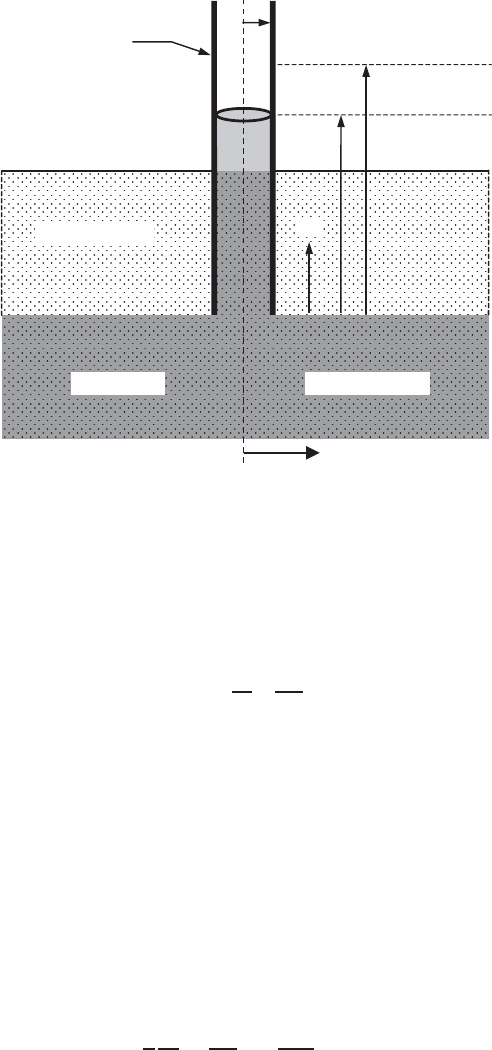
The falling head method is used to determine the permeability of soils. This test,
shown in Figure 3.E.11-1, involves driving a pipe of radius R into the soil until
it penetrates the water table, assumed here to be at the end of the tube. The pipe
is filled with water to a height L
0
and the time t
d
required to drain it to a height
L
d
is measured. We use the scaling method for dimensional analysis to develop a
correlation for the draining time.
Step 1, the scaling procedure for dimensional analysis, involves writing the
appropriate describing equations to determine the quantity of interest. The draining
106 APPLICATIONS IN FLUID DYNAMICS
r
Wet porous soil
Water table
Cylindrical
tube
L
d
L
0
Ground surface
R
Dry porous soil
z
Figure 3.E.11-1 Falling head apparatus for measuring the permeability of soils; a cylin-
drical tube of radius R is pushed to the depth of the water table, which is defined to be at
z = 0, and filled to an initial depth of L
0
with water; the instantaneous water depth in the
tube L(t) decreases due to permeation into the soil.
time t
d
is related to the axial velocity u
z
and Darcy’s law via an instantaneous
mass balance on the water in the tube:
L
0
− L
d
=−
t
d
0
u
z
z=0
dt =
t
d
0
k
p
μ
dP
dz
+ ρg
z=0
dt, 0 ≤ r ≤ R
(3.E.11-1)
where k
p
is the permeability, μ the viscosity, ρ the density, and g the gravitational
acceleration. Note that we have ignored the effect of the Brinkman term for flow
through the porous medium based on the assumption that k
p
/R
2
1, as discussed
in Section 3.8. To evaluate the integral above it would be necessary to solve for the
pressure distribution in the porous medium. This is obtained in turn by solving the
Darcy flow equations in the porous medium subject to the appropriate boundary
conditions. The incompressible continuity equation given by equation (C.2-1) in the
Appendices in combination with Darcy’s law for flow through porous media given
by equation (E.2-3) in the Appendices implies that the pressure P is obtained from a
solution to the axisymmetric form of Laplace’s equation in cylindrical coordinates:
1
r
∂
∂r
r
∂P
∂r
+
∂
2
P
∂z
2
= 0 (3.E.11-2)
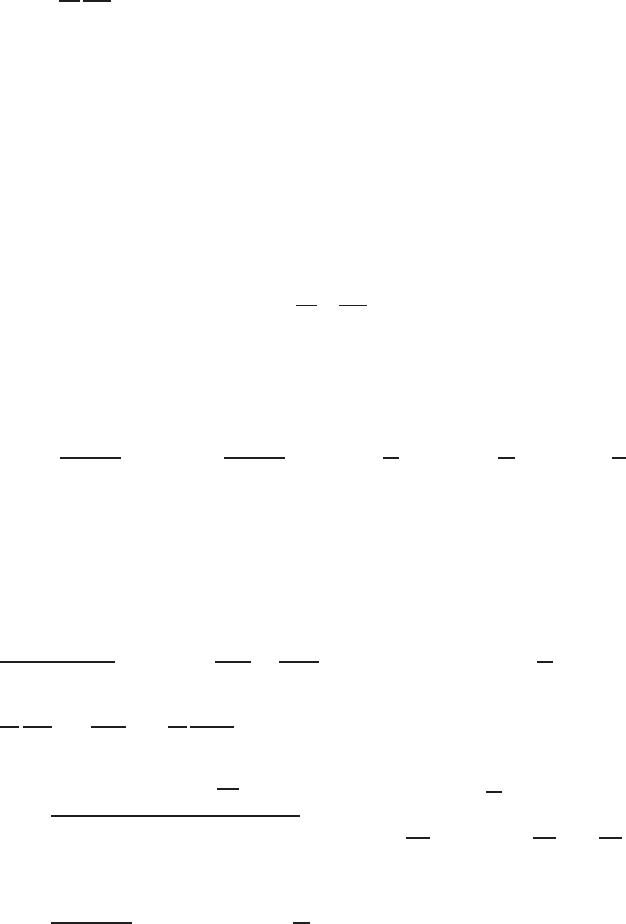
EXAMPLE PROBLEMS 107
The pressure is subject to the following boundary conditions:
P = P
atm
+ ρgL(t) at z = 0, 0 ≤ r ≤ R, L
d
≤ L(t) ≤ L
0
(3.E.11-3)
P = P
atm
at z = 0,R≤ r<∞ (3.E.11-4)
u
z
=−
k
p
μ
∂P
∂z
= 0asz →−∞, 0 ≤ r<∞ (3.E.11-5)
P = P
atm
− ρgz as r →∞, −∞ <z≤ 0 (3.E.11-6)
Note that in specifying the boundary conditions for this partial differential equation,
one must also specify the domain of any other variables that are not specified in
the particular boundary condition; in some cases, such as for the domain of the
boundary condition given by equation (3.E.11-3), this introduces additional param-
eters into the dimensional analysis. The boundary conditions given by equation
(3.E.11-3) involve the instantaneous liquid depth L(t) in the tube. This can be
obtained from a mass balance for the amount of liquid flowing from the tube up
to the instantaneous time t and is given by
L
0
− L =−
t
0
u
z
z=0
dt =
t
0
k
p
μ
dP
dz
+ ρg
z=0
dt 0 ≤ r ≤ R
(3.E.11-7)
Define the following scale and reference factors and corresponding dimension-
less variables (steps 2, 3, and 4):
P
∗
≡
P − P
r
P
s
; L
∗
≡
L − L
r
L
s
; r
∗
≡
r
r
s
; z
∗
≡
z
z
s
; t
∗
≡
t
t
s
(3.E.11-8)
Substitute these dimensionless variables into equations (3.E.11-1) through (3.E.11-7)
and divide each equation by the dimensional coefficient of one of its terms (steps 5 and
6). Since this is dimensional analysis rather than
◦
(1) scaling, we can divide through
by the dimensional coefficient of any arbitrary term in each equation:
μz
s
(L
0
− L
d
)
k
p
P
s
t
s
=
t
d
/t
s
0
dP
∗
dz
∗
+
ρgz
s
P
s
z
∗
=0
dt
∗
, 0 ≤ r
∗
≤
R
r
s
(3.E.11-9)
1
r
∗
∂
∂r
∗
r
∗
∂P
∗
∂r
∗
+
r
2
s
z
2
s
∂
2
P
∗
∂z
∗2
= 0 (3.E.11-10)
P
∗
=
P
atm
+ ρgL
s
L
∗
+
L
r
L
s
− P
r
P
s
at z = 0
⎧
⎪
⎨
⎪
⎩
0 ≤ r
∗
≤
R
r
s
L
d
L
s
≤ L
∗
1 +
L
r
L
s
≤
L
0
L
s
(3.E.11-11)
P
∗
=
P
atm
− P
r
P
s
at z
∗
= 0,
R
r
s
≤ r
∗
< ∞ (3.E.11-12)
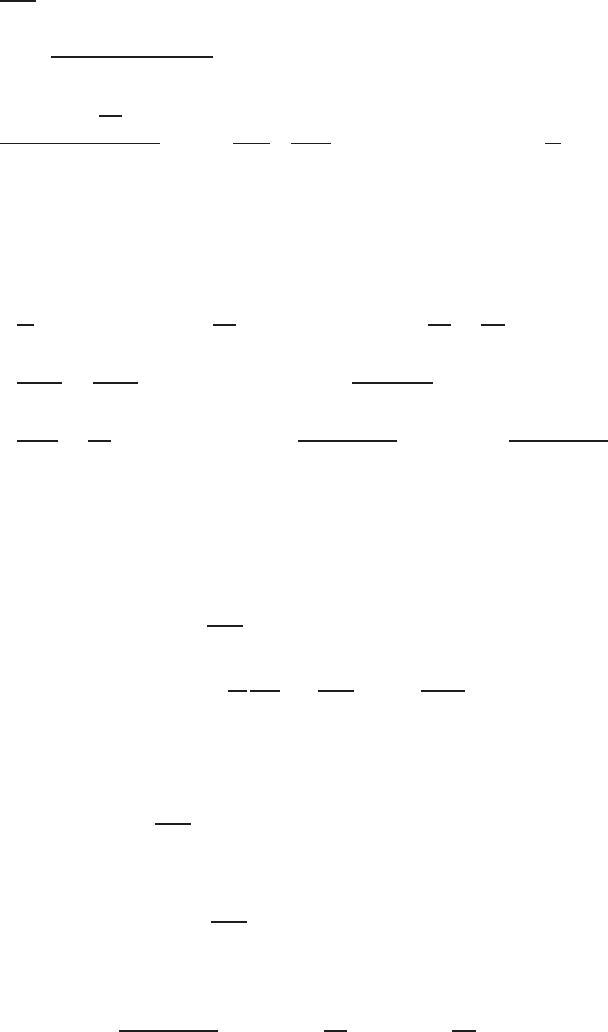
108 APPLICATIONS IN FLUID DYNAMICS
∂P
∗
∂z
∗
= 0asz
∗
→−∞, 0 ≤ r
∗
< ∞ (3.E.11-13)
P
∗
=
P
atm
− ρgz
s
z
∗
− P
r
P
s
as r
∗
→∞, −∞ <z
∗
≤ 0 (3.E.11-14)
μz
s
L
0
1−
L
s
L
0
L
∗
k
p
P
s
t
s
=
t
∗
0
dP
∗
dz
∗
+
ρgz
s
P
s
z=0
dt
∗
, 0 ≤ r
∗
≤
R
r
s
(3.E.11-15)
We are free to choose which groups we set equal to zero or 1 in order to determine
our scale and reference factors since we are not concerned about scaling our variables
to be of order one. Hence, let us arbitrarily make the following choices (step 7):
R
r
s
= 1 ⇒ r
s
= R;
L
0
L
s
= 1 ⇒ L
s
= L
0
;
L
r
L
0
=
L
d
L
0
⇒ L
r
= L
d
,
ρgL
s
P
s
=
ρgL
0
P
s
= 1 ⇒ P
s
= ρgL
0
;
P
atm
− P
r
P
s
= 0 ⇒ P
r
= P
atm
;
ρgz
s
P
s
=
z
s
L
0
= 1 ⇒ z
s
= L
0
;
k
p
ρgt
s
μ(L
0
− L
d
)
= 1 ⇒ t
s
=
μ(L
0
− L
d
)
k
p
ρg
(3.E.11-16)
When these scale and reference factors are substituted into the equations (3.E.11-9)
through (3.E.10.15), we obtain the following minimum parametric representation
of the dimensionless describing equations:
1 =
1
0
dP
∗
dz
∗
+ 1
z
∗
=0
dt
∗
, 0 ≤ r
∗
≤ 1 (3.E.11-17)
1
r
∗
∂
∂r
∗
r
∗
∂P
∗
∂r
∗
+
2
∂
2
P
∗
∂z
∗2
= 0 (3.E.11-18)
P
∗
= 1atz
∗
= 0, 0 ≤ r
∗
≤ 1, 0 ≤ L
∗
≤ 1 −
3
(3.E.11-19)
P
∗
= 0atz
∗
= 0, 1 ≤ r
∗
< ∞ (3.E.11-20)
∂P
∗
∂z
∗
= 0asz
∗
→−∞, 0 ≤ r
∗
< ∞ (3.E.11-21)
P
∗
= 1asr
∗
→∞, −∞ <z
∗
≤ 0 (3.E.11-22)
1 − L
∗
=
t
∗
0
dP
∗
dz
∗
+ 1
z=0
dt
∗
, 0 ≤ r
∗
≤ 1 (3.E.11-23)
where the following dimensionless groups have been defined:
1
≡
k
p
ρgt
d
μ(L
0
− L
d
)
;
2
≡
R
L
0
;
3
≡
L
d
L
0
(3.E.11-24)

EXAMPLE PROBLEMS 109
A solution to equation (3.E.11-18) subject to the boundary conditions given
by equations (3.E.11-19) through (3.E.11-23) will yield the dimensionless pressure
P
∗
as a function of r
∗
,z
∗
,andt
∗
and the dimensionless groups
2
and
3
.
When the axial pressure gradient is evaluated at exit of the tube, where it is not a
function of r
∗
, and substituted into equation (3.E.11-17), the resulting solution for
the dimensionless draining time
1
will be a function only of the dimensionless
groups
2
and
3
; that is, the minimum parametric representation is given by a
general correlation of the form
1
≡
k
p
ρgt
s
μ(L
0
− L
d
)
= f
1
(
2
,
3
) = f
R
L
0
,
L
d
L
0
(3.E.11-25)
where f
1
(
2
,
3
) denotes some unspecified function of the dimensionless groups
2
and
3
that would have to be determined empirically. Note that a naive appli-
cation of the Pi theorem for eight quantities in three units (i.e., n = 8andm = 3)
would have suggested that five (m − n = 5) rather than three dimensionless groups
were necessary to correlate the draining time. For the Pi theorem to yield the min-
imum parametric representation, it is necessary to recognize that the grouping
k
p
ρg/μ can be considered as a single quantity, in which case only two units need
to be considered.
It would be necessary to take a considerable number of data to establish the
correlation indicated in equation (3.E.11-25). We show here how a general cor-
relation for the draining time can be established from very limited data for a
specific tube, using water in a particular soil. The following empirical correla-
tion has been obtained using water and a 5-cm-radius pipe for a soil having a
permeability k
p
= 5.9×10
−6
cm
223
:
t
d
= 4.94 ln
L
0
L
d
(3.E.11-26)
This empirical result is a special case of equation (3.E.11-25) and can be used
to determine the functional form of a more general correlation for the draining
time that can be used for different tubes, fluids, and soils. This can be seen more
easily by using step 8 of the scaling procedure for dimensional analysis outlined
in Section 2.4 in order to eliminate both L
0
and L
d
from the dimensionless group
that contains the draining time t
d
. This involves generating a new dimensionless
group formed from the original set of groups by means of the operation
4
≡
1
2
=
t
d
k
p
ρg
μR
(
1 − L
d
/L
0
)
= f
2
(
2
,
3
) (3.E.11-27)
where f
2
(
2
,
3
) denotes an unspecified function of the dimensionless groups
2
and
3
that would have to be determined empirically. Equation (3.E.11-27) can
23
R. J. Ray, A Rayleigh free convection compliant ice front model for sorted patterned ground, M.S.
thesis, University of Colorado, Boulder, Co, 1981.
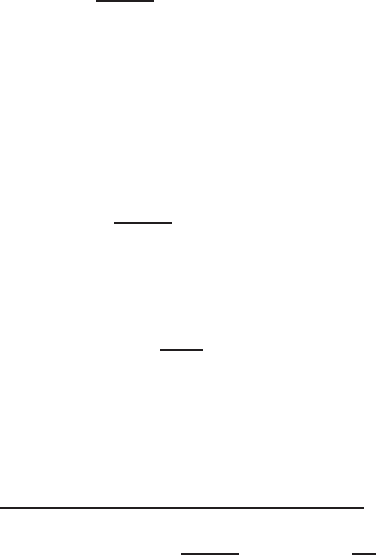
110 APPLICATIONS IN FLUID DYNAMICS
be recast into the following form using step 11:
t
d
k
p
ρg
μR
≡
5
= f
3
(
2
,
3
) (3.E.11-28)
where f
3
(
2
,
3
) denotes an unspecified function of the dimensionless groups
2
and
3
that would have to be determined empirically. In general, the radius R
of the tubes used to determine soil permeability is much less than the initial fill
height L
0
.IfR L
0
,then
2
1 and we can use the procedure in step 9 of the
scaling analysis procedure for dimensional analysis to eliminate group
2
from the
correlation; hence,
t
d
k
p
ρg
μR
≡
5
= f
4
(
3
) (3.E.11-29)
where f
4
(
3
) is an unspecified function of
3
only. A comparison of equa-
tion (3.E.11-29) with equation (3.E.11-26) implies the following:
t
d
=
5
μR
k
p
ρg
=−4.94 ln
3
(3.E.11-30)
A generalized correlation relating soil permeability k
p
and draining time t
d
can be
obtained by substituting values for the quantities in equation (3.E.11-30) to obtain
the following correlation:
5
=−
4.94(5.9×10
−6
cm
2
)
1g/cm
3
980 cm/s
2
(
0.01 g/cm · s
)
(5cm)
ln
3
⇒
5
=−0.572 ln
3
⇒
t
d
k
p
ρg
μR
=−0.572 ln
L
0
L
d
(3.E.11-31)
In this case, using the scaling analysis approach for dimensional analysis in com-
bination with data for a specific falling head test gives the functional form of a
generalized correlation that relates the measured draining time t
d
to the soil perme-
ability k
p
and relevant physical properties and process parameters. The generalized
correlation given by equation (3.E.11-31) applies for any falling head test, irrespec-
tive of the fluid, pipe size, and soil, provided that the dimensionless group
2
1.
3.P PRACTICE PROBLEMS
3.P.1 Alternative Scales for Laminar Flow Between Stationary and Moving
Parallel Plates
Consider the steady-state fully developed laminar flow of an incompressible vis-
cous Newtonian fluid with constant physical properties between two infinitely wide
parallel flat plates due to both an applied axial pressure gradient and to the upper
plate moving at a constant velocity U
0
as shown in Figure 3.2-1. In Section 3.2
we introduce scales for the velocity and y-coordinate to determine the criterion
necessary to ignore the effect of the motion of the upper plate.
PRACTICE PROBLEMS 111
(a) Rescale this problem by introducing an additional scale for the second
derivative as well as the velocity and y-coordinate; you will find that there
is no dimensionless group to determine the velocity scale; however, this can
be determined by integrating the scale for the second derivative.
(b) Rescale this problem by introducing an additional scale for the first deriva-
tive as well as the velocity and y-coordinate. Again you will find that there
is no dimensionless group to determine the velocity scale; however, this can
be determined by integrating the scale for the first derivative.
3.P.2 Laminar Flow Between Stationary and Moving Parallel Plates
Consider the steady-state fully developed laminar flow of an incompressible vis-
cous Newtonian fluid with constant physical properties between two infinitely wide
parallel flat plates due to both an applied axial pressure gradient and to the upper
plate moving at a constant velocity U
0
, as shown in Figure 3.2-1. In Section 3.2
we scaled this flow to determine the criterion necessary to ignore the effect of the
motion of the upper plate. We found that the motion of the upper plate would not
affect quantities such as the average velocity, volumetric flow rate, or drag at the
stationary plate if equation (3.2-19) were satisfied. However, there was a region of
influence next to the upper plate within which the motion of the plate could never
be ignored. In this problem we explore complementary flow conditions for which
the flow is caused primarily by the motion of the upper plate.
(a) Determine the criterion necessary to neglect the effect of the applied pressure
on quantities such as the average velocity or volumetric flow rate.
(b) Determine if there is a region of influence within which the effect of the
pressure on the flow can never be ignored in determining point quantities
such as the local velocity or drag at the wall.
(c) Solve the simplified describing equations for the velocity profile for condi-
tions such that the criterion you derived in part (a) is satisfied.
3.P.3 Gravity and Pressure-Driven Laminar Flow in a Vertical Tube
Consider the steady-state fully developed laminar flow of a Newtonian liquid with
constant physical properties in a vertical tube of radius R that is subject to both
gravity and a constant axial pressure gradient, as shown in Figure 3.P.3-1.
(a) Write the appropriate form of the simplified equations of motion for this
flow.
(b) Write the boundary conditions required for the differential equations above.
(c) Scale the describing equations to determine the criterion for ignoring the
effect of the applied pressure gradient on the velocity profile.
(d) Solve the resulting simplified describing equations to obtain the velocity
profile.
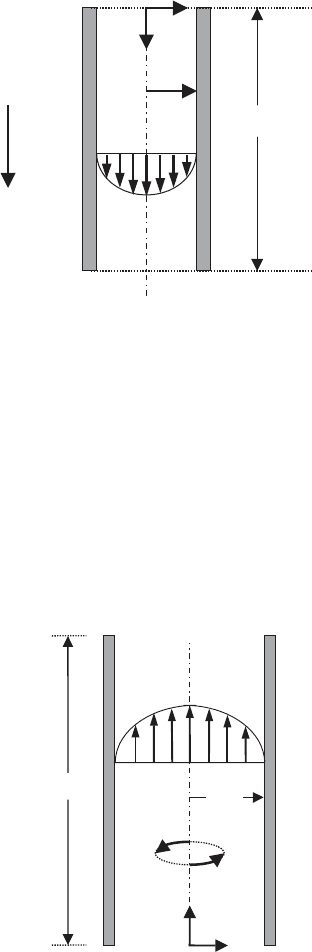
112 APPLICATIONS IN FLUID DYNAMICS
R
g
z
r
P
0
P
L
L
Figure 3.P.3-1 Steady-state fully developed laminar flow of a Newtonian liquid with con-
stant physical properties in a vertical tube of radius R and length L subject to both gravity
and a constant axial pressure gradient (P
0
− P
L
)/L.
3.P.4 Axial Flow in a Rotating Tube
Consider the steady-state fully developed laminar flow of an incompressible
Newtonian liquid with constant physical properties in a vertical cylindrical tube
of radius R and length L subject to a constant axial pressure gradient (P
0
− P
L
)/L
and a constant angular rotation about its axis of symmetry at ω radians per second,
as shown in Figure 3.P.4-1.
L
R
P
L
P
0
z
w
r
Figure 3.P.4-1 Steady-state fully developed laminar flow of an incompressible Newtonian
liquid with constant physical properties in a vertical cylindrical tube of radius R and length
L subject to a constant axial pressure gradient (P
0
− P
L
)/L and a constant angular rotation
at ω radians per second.