
Krantz W.B. Scaling Analysis in Modeling Transport and Reaction Processes: A Systematic Approach to Model Building and the Art of Approximation
Подождите немного. Документ загружается.

PRACTICE PROBLEMS 113
(a) Write the appropriate form of the simplified equations of motion for this
flow.
(b) Write the boundary conditions required for the above differential equations.
(c) Scale the describing equations to determine the dimensionless criteria for
ignoring the effect of the gravitational body force on the flow.
(d) Develop a dimensionless criterion for assuming that the radial pressure gra-
dient is much less than the axial pressure gradient.
(e) Develop a dimensionless criterion for assuming that the circumferential
velocity is much less than the axial velocity.
3.P.5 Laminar Flow Between Converging Flat Plates
In Section 3.3 we developed the criteria for invoking the lubrication-flow approxi-
mation for laminar flow between two converging flat plates. However, these criteria
break down near the upstream region of this flow. Use scaling analysis to determine
the thickness of the region of influence in which the lubrication-flow approximation
breaks down.
3.P.6 Laminar Flow Between Diverging Flat Plates
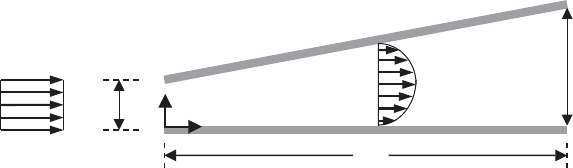
Consider the pressure-driven steady-state one-dimensional laminar plug flow of
an incompressible Newtonian fluid with constant physical properties and constant
velocity U
0
impinging on two nonparallel infinitely wide diverging flat plates as
shown in Figure 3.P.6-1.
(a) Write the appropriate form of the simplified equations of motion for this
flow.
(b) Write the boundary conditions required for the differential equations above.
(c) Scale the describing equations to determine the dimensionless criteria for
making the lubrication-flow approximation.
(d) Solve the resulting describing equations appropriate to lubrication flow for
the x-andy-component velocity profiles.
x
U
0
H
0
H
L
y
L
Figure 3.P.6-1 Steady-state developing laminar flow of an incompressible Newtonian fluid
with constant physical properties between two infinitely wide diverging flat plates; only the
local axial velocity profile is shown.
114 APPLICATIONS IN FLUID DYNAMICS
R
L
R
0
z
r
L
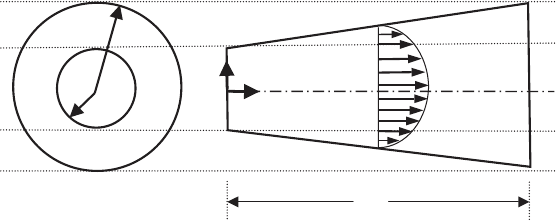
Figure 3.P.7-1 Pressure-driven steady-state laminar flow of an incompressible Newtonian
fluid with constant physical properties through a diverging nozzle of length L and a circular
cross-section with radii R
0
and R
L
.
3.P.7 Laminar Flow in a Diverging Nozzle
Consider the pressure-driven steady-state laminar flow of an incompressible New-
tonian fluid with constant physical properties through a diverging nozzle of length
L and a circular cross section as shown in Figure 3.P.7-1. Assume plug flow at
z = 0 with a constant velocity U
0
.
(a) Write the appropriate form of the equations of motion.
(b) Write the boundary conditions that are necessary to solve the describing
equations.
(c) Scale the describing equations to determine the criteria necessary to assume
lubrication flow.
(d) Solve the resulting simplified lubrication-flow equations for the z-and
r-velocity and axial pressure profiles. Note that the unspecified axial pres-
sure gradient can be shown to be a constant and can be obtained from an
integral mass balance and the known inlet velocity.
3.P.8 Steady-State Flow Between Parallel Circular Disks
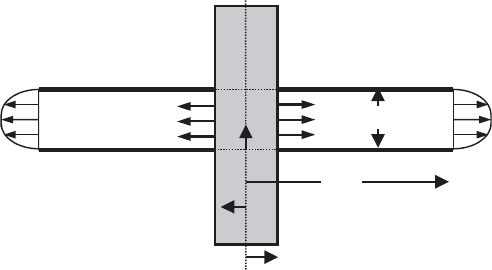
Two parallel disks of outer radius R
2
are separated by a distance H as shown in
Figure 3.P.8-1. An incompressible Newtonian liquid with constant physical prop-
erties is injected through a porous tube of radius R
1
located concentric with the
axis of symmetry of the two disks.
(a) If the liquid is injected at a constant volumetric flow rate Q, write the
appropriate form of the equations of motion.
(b) Write the boundary conditions required to solve the equations of motion.
(c) Scale the describing equations to determine the criteria necessary to assume
lubrication flow.
PRACTICE PROBLEMS 115
z
r
R
2
R
1
H
Figure 3.P.8-1 Steady-state radial flow of an incompressible Newtonian liquid with con-
stant physical properties between two parallel disks of radius R
2
separated by a distance H
due to injection of liquid at a volumetric flow rate Q through a porous tube of radius R
1
.
(d) Solve the lubrication-flow equations to obtain the velocity profile as a func-
tion of r and z.
(e) Determine the pressure drop P
1
− P
2
necessary to inject this liquid at the
constant volumetric flow rate Q.
3.P.9 Unsteady-State Flow Between Parallel Circular Disks
Consider the radial flow of an incompressible Newtonian liquid with constant phys-
ical properties between two parallel disks as shown in Figure 3.P.8-1. Assume
that the liquid injection through the porous cylindrical tube is time-dependent and
described by
Q = Q
0
e
−αt
, where Q
0
and α are constants (3.P.9-1)
(a) Write the boundary conditions required to solve the equations of motion.
(b) Scale the describing equations to determine the criterion necessary to assume
that the flow is quasi-steady-state.
(c) Solve the quasi-steady-state lubrication-flow equations to obtain the velocity
profile as a function of r, z,andt.
3.P.10 Steady-State Flow Between Spinning Parallel Circular Disks
Consider the steady-state radial flow of an incompressible Newtonian liquid with
constant physical properties between two parallel disks, as shown in Figure 3.P.8-1.
The radial flow is caused by liquid injection through the porous cylindrical tube
at a constant volumetric flow rate Q. Assume now that both disks are spun at a
constant angular velocity ω (radians per second).
116 APPLICATIONS IN FLUID DYNAMICS
(a) Write the appropriate form of the unsteady-state equations of motion assum-
ing that the lubrication-flow approximation is applicable.
(b) Write the boundary conditions required to solve the equations of motion.
(c) Scale the describing equations to determine the criterion necessary to ignore
the effect of the rotating disks on the pressure profile.
3.P.11 Lubrication-Flow Approximation for a Hydraulic Ram
In Example Problem 3.E.3 we considered lubrication flow in a hydraulic ram as
shown in Figure 3.E.3-1 and used scaling to determine the criterion that must be
satisfied in order to ignore curvature effects on the flow. However, we did not
justify the lubrication-flow approximation that was made.
(a) Write the appropriate form of the equations of motion; however, do not
make the lubrication-flow simplifications.
(b) Write the boundary conditions required to solve the equations of motion.
(c) Scale the describing equations to determine the criteria necessary to justify
the lubrication-flow approximation.
3.P.12 Flow in a Rotating Disk Viscometer
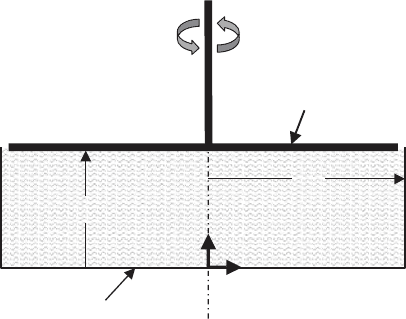
Consider an incompressible Newtonian liquid with constant physical properties that
fills a cylindrical container of radius R to a depth H . A circular plate contacts the
liquid at its upper surface but does not contact the sidewalls of the container, as
shown in Figure 3.P.12-1. By rotating the upper circular plate it is possible to
obtain the viscosity of the liquid by measuring the torque, which is the force times
the radial distance from the axis of rotation, on the upper plate. Operation of this
instrument involves accelerating the upper plate from rest to a constant angular
rotation rate of ω radians per second.
(a) Write the appropriate simplified form of the equations of motion for this
unsteady-state fully developed flow; do not ignore the edge effects due to
the presence of the sidewall of the container.
(b) Write the initial and boundary conditions required to solve the equations of
motion.
(c) Scale the describing equations to determine a criterion for when steady-state
flow conditions can be assumed.
(d) Scale the describing equations to determine a criterion for when the effects
of the sidewall of the cylindrical container on the flow can be neglected.
(e) Solve the steady-state describing equations in the absence of sidewall effects
for the angular velocity u
θ
as a function of z and r.
(f) Use the velocity profile that you obtained in part (e) to obtain an equation
for the torque exerted on the upper rotating plate by the liquid.
PRACTICE PROBLEMS 117
No contact between rotating
circular plate and sidewall
of cylindrical container
Rotating horizontal
circular plate
Viscous Newtonian liquid with
constant physical properties
H
R
z
w
r
Figure 3.P.12-1 Flow of a viscous Newtonian liquid with constant physical properties in
a rotating disk viscometer.
3.P.13 Flow in an Oscillating Disk Viscometer
Consider the viscometer shown in Figure 3.P.12-1, which is filled entirely with
an incompressible Newtonian liquid with constant physical properties. Another
way to operate this viscometer is to oscillate rather than rotate the upper circular
plate. Assume that the upper plate is oscillated continuously at an angular rate
of ω
0
sin 2πft radians per second, where ω
0
is the amplitude of the oscillation in
radians per second and f is the frequency of the oscillation in cycles per second.
(a) Write the appropriate simplified form of the equations of motion for this
unsteady-state, fully developed flow for which edge effects due to the side-
wall can be ignored.
(b) Write the initial and boundary conditions required to solve the equations of
motion.
(c) Scale the describing equations to determine a criterion for when quasi-
steady-state flow conditions can be assumed.
(d) Consider the describing equations for the special case of very high fre-
quency oscillations for which the effects of the oscillating upper circular
plate are confined to a thin boundary layer near the upper plate. Use scal-
ing to obtain an equation that can be used to estimate the thickness of the
viscous boundary layer at the upper oscillating circular plate.
(e) Based on your scaling in part (d), develop a criterion for ignoring the effect
of the bottom surface of the container on the oscillating flow.
3.P.14 Falling Needle Viscometer
The falling needle viscometer is useful for obtaining viscosity measurements when
only small quantities of the liquid are available for measurement purposes. The
118 APPLICATIONS IN FLUID DYNAMICS
viscosity is obtained using this viscometer by measuring the time it takes for a
long cylindrical needle that is falling at its terminal velocity to pass between two
known reference planes. This viscometer can be modeled quite well by considering
the hydrodynamics to be steady-state fully developed laminar flow in the annular
region between two cylinders, the inner of which is moving downward at a constant
velocity U
0
and the outer of which is stationary; that is, end effects are ignored.
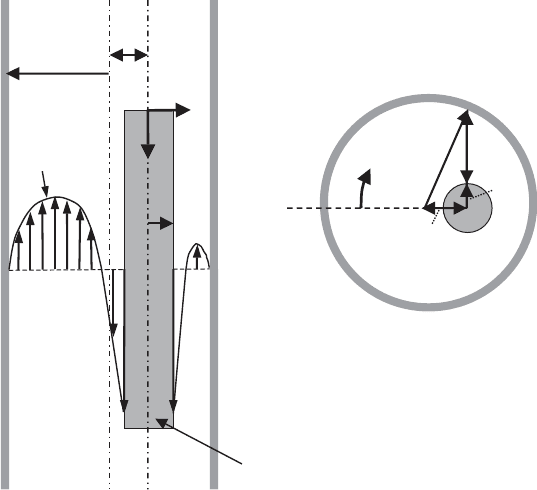
Unfortunately, it is difficult to drop the needle exactly along the centerline of the
outer cylinder. Hence, in general, the cylinders are not concentric, as shown in
Figure 3.P.14-1. We seek to simplify the describing equations to permit a tractable
solution.
24
It is convenient to use a moving cylindrical coordinate system located
with its axis concentric with that of the falling cylinder.
(a) Consider the steady-state fully developed flow of an incompressible Newto-
nian liquid with constant physical properties in the annular region between
two cylindrical tubes whose centers are displaced by a distance ε, as shown
in Figure 3.P.14-1. Recall that this flow is driven by the moving boundary of
Side view
w(q)
Cross-sectional view
Needle of radius R
1
and length L falling at
a constant velocity U
0
z
e
q
e
r
R
2
R
1
R
2
R
1
U
0
Velocity
profile in
stationary
coordinate
system
Figure 3.P.14-1 Falling needle viscometer showing a small inner cylinder having radius
R
1
being dropped at a constant velocity U
0
a distance ε off-center in a cylindrical tube of
radius R
2
.
24
This effect has been analyzed by D. B. Thiessen and W. B. Krantz, Rev. Sci. Instrum., 63(9),
4200–4204 (1992).
PRACTICE PROBLEMS 119
the inner cylinder (the needle), which is falling at its terminal velocity dic-
tated by a balance between the gravity force on its volume and the drag
force on its surface area. Show that the appropriate form of the equations of
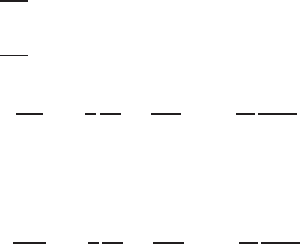
motion in cylindrical coordinates is given by
0 =
∂P
∂r
(3.P.14-1)
0 =
∂P
∂θ
(3.P.14-2)
0 =−
∂P
∂z
+ μ
1
r
∂
∂r
r
∂u
z
∂r
+ μ
1
r
2
∂
2
u
z
∂θ
2
+ ρg (3.P.14-3)
(b) Show that equation (3.P.14-3) simplifies to
0 =−
P
L
+ μ
1
r
∂
∂r
r
∂u
z
∂r
+ μ
1
r
2
∂
2
u
z
∂θ
2
+ ρg (3.P.14-4)
where P ≡ P
L
− P
0
is the pressure drop across the length of the falling
needle for which P
0
is the pressure at z = 0andP
L
is the pressure at z = L.
(c) Write the appropriate boundary conditions required to solve the simplified
equations of motion. Since the axial pressure drop across the length of the
needle P is unknown, an auxiliary condition is needed. This is determined
from a force balance across the falling needle that involves the gravitational,
viscous drag, and pressure forces. It will be helpful in specifying the no-slip
condition at the outer cylinder to recall the law of cosines, which permits
relating the local gap thickness w(θ) to the radii of the inner and outer
cylinders, needle displacement ε, and local angular coordinate θ in the form
w(θ) = ε cos θ − R
1
+ (R
2
2
− ε
2
sin
2
θ)
1/2
∼
=
ε cos θ
+ (R
2
− R
1
) if ε R
2
(3.P.14-5)
(d) Scale the describing equations to determine the criterion for assuming that
the derivatives of the axial velocity in the circumferential direction can be
ignored. Discuss the physical implications of this criterion.
(e)UsescalingtoobtainanestimateofP , the pressure driving force that
causes flow in the annular gap between the inner cylindrical needle and the
outer stationary tube wall.
(f) Use scaling and the result you obtained in part (e) for P to obtain an
estimate of the velocity U
0
of the falling needle.
3.P.15 Leading-Edge Considerations for Laminar Boundary-Layer Flow
In Section 3.4 we consider laminar boundary-layer flow over a semi-infinite flat
plate and determined that the hydrodynamic boundary-layer approximation can
120 APPLICATIONS IN FLUID DYNAMICS
be made when the criterion given by equation (3.4-38) is satisfied. However, as
discussed in Section 3.4, the hydrodynamic boundary-layer approximation always
breaks down near the leading edge of the plate. Use scaling analysis to estimate the
region of influence wherein the criterion given by equation (3.4-38) is no longer
satisfied.
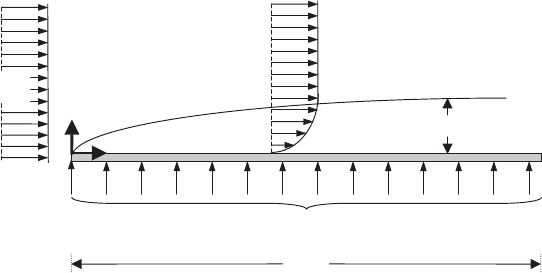
3.P.16 Laminar Boundary-Layer Flow with Blowing
Consider a uniform plug flow of an incompressible viscous Newtonian liquid with
constant physical properties and velocity U
∞
intercepting a stationary semi-infinite
infinitely wide horizontal flat plate such as that considered in Section 3.4. Assume
that the horizontal flat plate is porous such that there is a constant blowing velocity
V
0
along its length, as shown in Figure 3.P.16-1. Blowing is used to increase heat
and mass transfer in boundary-layer flows since it causes the local Reynolds number
to increase, which in turn can cause a transition to turbulent boundary-layer flow.
(a) Use scaling to determine the condition for which the blowing effect on the
boundary-layer flow can be neglected.
(b) Provide a physical interpretation of the condition on the dimensionless group
that you obtained in part (a).
V
0
d
m
(x)
x
y
L
U
∞
Figure 3.P.16-1 Uniform plug flow with velocity U
∞
of an incompressible viscous New-
tonian fluid with constant physical properties intercepting a stationary semi-infinite infinitely
wide horizontal porous flat plate along which there is a blowing velocity V
0
; the blowing
causes the boundary-layer thickness, δ
m
, to increase.
3.P.17 Laminar Boundary-Layer Flow with Suction
Consider a uniform plug flow of an incompressible viscous Newtonian liquid
with constant physical properties and velocity U
∞
intercepting a stationary semi-
infinitely long infinitely wide horizontal flat plate such as that considered in Sec-
tion 3.4. Assume that the horizontal flat plate is porous so that a constant suction
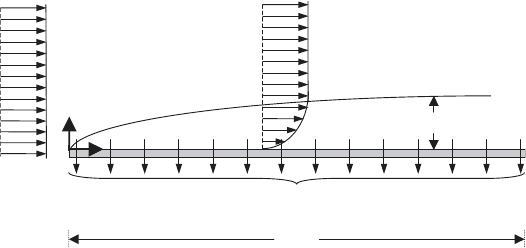
PRACTICE PROBLEMS 121
V
0
d
m
(x)
U
∞
y
x
L
Figure 3.P.17-1 Uniform plug flow with velocity U
∞
of an incompressible viscous New-
tonian fluid with constant physical properties intercepting a stationary semi-infinitely long
infinitely wide horizontal porous flat plate along which there is a suction velocity V
0
;the
suction causes the boundary-layer thickness, δ
m
, to decrease.
velocity V
0
can be applied along its length, as shown in Figure 3.P.17-1. Suction
is used to decrease the boundary-layer thickness to decrease the local Reynolds
number and thereby delay the transition to turbulence. It is also used to increase
heat and mass transfer in the laminar boundary-layer flow regime by decreasing the
thickness of the boundary-layer region, which provides the controlling resistance
to conduction or diffusion.
(a) Write the appropriate forms of the equations of motion applicable to this
boundary-layer flow; it is not necessary here to justify the form of these
equations by scaling.
(b) Write the boundary conditions required to solve the equations of motion.
(c) We might anticipate that with boundary-layer suction such as we have in
this problem, the boundary-layer thickness might ultimately become con-
stant rather than grow without bound as it does for a boundary layer on a
semi-infinitely long flat plate without suction or with blowing. Use scaling
analysis to determine the criterion for obtaining a constant boundary-layer
thickness; express your answer in terms of a dimensionless group that must
be very small.
(d) For the constant boundary-layer condition obtained in part (c), determine
the x-andy-velocity component profiles.
3.P.18 Entry-Region Laminar Flow in a Cylindrical Tube
Figure 3.P.18-1 shows a schematic of pressure-driven steady-state laminar entry-
region flow of a viscous Newtonian fluid with constant physical properties in a
cylindrical tube of radius R. The flow velocity at the entrance is assumed to be a
constant U
0
. This is assumed to be a high Reynolds number flow for which the
inertia terms cannot be ignored in the entry region. Hence, in the entry region the
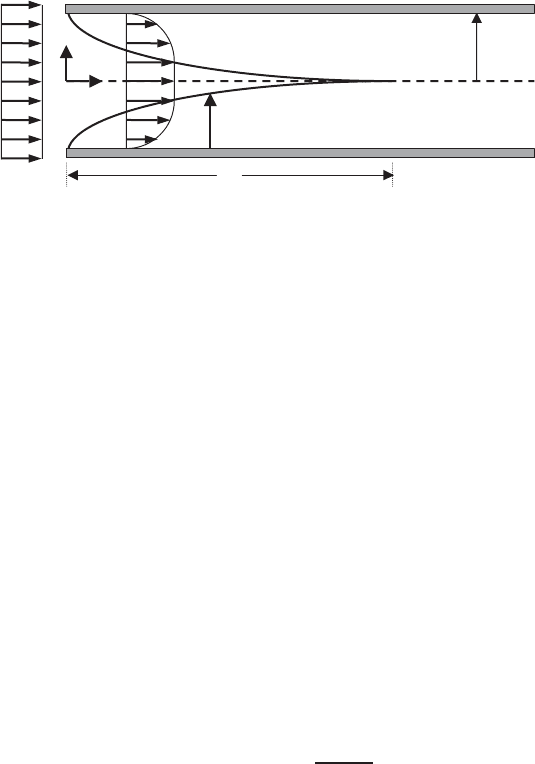
122 APPLICATIONS IN FLUID DYNAMICS
r
U
0
R
z
L
e
d
m
(z)
Figure 3.P.18-1 High Reynolds number steady-state pressure-driven entry-region laminar
flow of a viscous Newtonian fluid with constant physical properties in a cylindrical tube of
radius R, showing the developing boundary layer δ
m
(z) and entrance length L
e
required for
the initial uniform flow U
0
to rearrange so as to become fully developed
action of viscosity will be confined to a region of influence near the tube wall
denoted by the boundary-layer thickness δ
m
(z). The latter will increase axially;
when it reaches the center of the tube, the flow is fully developed. Note that since
this is a confined flow, the fluid in the center of the tube must accelerate as the
boundary layer grows.
(a) Write the appropriate simplified form of the equations of motion for this
steady-state, developing flow.
(b) Write the boundary conditions required to solve the equations of motion.
(c) Scale the describing equations to determine the conditions required to invoke
the hydrodynamic boundary-layer approximation; that is, for which the cou-
pling between the axial and radial components of the equations of motion
can be ignored and for which the axial diffusion of vorticity can be ignored.
(d) Use your scaling analysis to estimate the axial distance required to attain
fully developed flow; reconcile your result with that obtained from the
approximate analytical solution of Langhaar given by
25
L
e
= 0.227
R
2
ρU
0
μ
(3.P.18-1)
3.P.19 Pressure-Driven Flow in an Oscillating Tube
Consider the unsteady-state laminar flow of an incompressible Newtonian fluid
with constant physical properties through a horizontal cylindrical tube of radius R
whose length L is sufficiently long to ensure that entrance and exit effects can be
ignored; that is, the tube can be assumed to be essentially infinitely long. Initially,
there is no flow. At time t = 0 a constant pressure gradient (P
0
− P
L
)/L = P /L
is impressed across this tube. Simultaneously, the wall of this tube is oscillated at
a velocity u
z
= U
0
cos ωt,whereω is the angular frequency of the oscillation in
radians per second. A schematic of this flow problem is shown in Figure 3.P.19-1.
25
H. L. Langhaar, Trans. ASME, 64, A55 (1942).