
Krantz W.B. Scaling Analysis in Modeling Transport and Reaction Processes: A Systematic Approach to Model Building and the Art of Approximation
Подождите немного. Документ загружается.

PRACTICE PROBLEMS 123
P
0
P
L
t
1
t
2
r
z
R
L
u
z
= U
0
cos wt
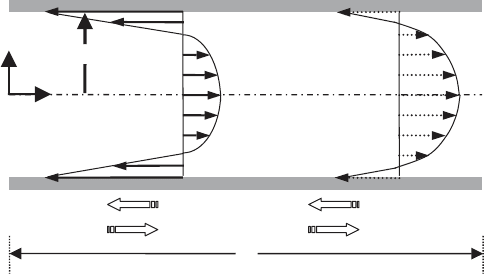
Figure 3.P.19-1 Unsteady-state laminar flow of an incompressible Newtonian liquid with
constant physical properties in a circular tube of radius R due to an impulsively applied pres-
sure difference P ≡ P
0
−P
L
and oscillation of the tube wall described by u
z
= U
0
cos ωt;
the axial velocity profiles are shown at times t
1
and t
2
,wheret
2
>t
1
.
(a) Write the appropriate form of the equations of motion for this unsteady-state
flow.
(b) Write the initial and boundary conditions required to solve the equations of
motion.
(c) Determine the appropriate velocity scale for conditions such that the flow
is mainly caused primarily by the applied pressure gradient.
(d) Determine the appropriate velocity scale for conditions such that the flow
is caused primarily by the oscillating pipe wall.
(e) Scale the describing equations to determine when the effect of the wall
oscillation can be neglected.
(f) Scale the describing equations to determine when this can be considered
to be a quasi-steady-state creeping flow. Be careful to consider both time
effects: i.e., the transients following startup and the periodic oscillations.
(g) Solve for the velocity profile u
z
(r, t) for the special case of quasi-steady-state
creeping flow.
3.P.20 Countercurrent Liquid–Gas Flow in a Cylindrical Tube
Consider the steady-state fully developed laminar flow of a nonvolatile Newtonian
liquid film of thickness H with constant physical properties at the inner wall of
a vertical cylindrical tube of radius R and length L due to gravity, pressure, and
interfacial drag arising from the fully developed upward pressure-induced flow of
a gas having constant physical properties in the center of the tube, as shown in
Figure 3.P.20-1.
(a) Write the appropriately simplified continuity and equations of motion for
both the liquid and gas phases for this flow.
124 APPLICATIONS IN FLUID DYNAMICS
g
P
L
P
0
Liquid
Gas
R
z
r
H
L
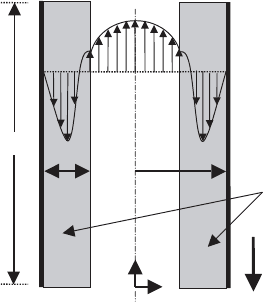
Figure 3.P.20-1 Steady-state fully developed laminar flow of a nonvolatile Newtonian
liquid film of thickness H with constant physical properties at the inner wall of a vertical
cylindrical tube of radius R and length L due to gravity, pressure, and interfacial drag arising
from the upward fully developed pressure-induced flow of a gas with constant physical
properties in the center of the tube.
(b) Write the boundary conditions required to solve the differential equations
you obtained in part (a).
(c) Determine the appropriate velocity scale in the liquid film when this flow
is caused primarily by the gravitational body force.
(d) Determine the appropriate velocity scale in the gas phase when this flow is
caused primarily by the applied pressure.
(e) Use scaling to determine the criterion for when the effect of the gas flow
on the liquid film flow can be ignored.
(f) Use scaling to determine the criterion for when the effect of the gravitational
body force on the gas flow can be ignored.
(g) For the conditions considered in part (d), determine the criterion for ignoring
curvature effects in the describing equations; that is, for when the describing
equations in cylindrical coordinates reduce to the corresponding equations
in rectangular coordinates.
(h) Determine the appropriate velocity scale in the liquid film when this flow
is caused primarily by the drag exerted on it by the upward gas flow.
(i) Use scaling to determine the criterion for when the effect of gravity on the
liquid film flow can be ignored.
(j) This flow is an idealization of that within a single packing element such as
a Raschig ring in countercurrent liquid–gas contacting in a packed column.
Flooding in a packed column begins when the upward gas flow causes a
net amount of liquid to be carried upward to the top of the column. Use
the results from your scaling analysis to determine the pressure gradient
required to initiate flooding.
PRACTICE PROBLEMS 125
3.P.21 Stratified Flow of Two Immiscible Liquid Layers
Consider the steady-state fully developed flow of two immiscible Newtonian liq-
uids with constant physical properties between two stationary parallel impermeable
flat plates, as shown in Figure 3.P.21-1. These fluids have densities ρ
1
and ρ
2
,vis-
cosities μ
1
and μ
2
, and thicknesses H
1
and H
2
, respectively. A high pressure P
0
is applied at x = 0 and a low pressure P
L
is applied at x = L. Liquid 1 flows
symmetrically about the center plane between the two flat plates, whereas liquid 2
is confined to a layer having thickness H
2
− H
1
adjacent to each of the two flat
plates. The velocities in liquids 1 and 2 are denoted by u
1
and u
2
, respectively.
For the scaling analysis in this problem, introduce the following dimensionless
variables in terms of undefined scale and reference factors:
u
∗
1
≡
u
1
− u
1r
u
1s
; u
∗
2
≡
u
2
u
2s
; y
∗
1
≡
y
y
1s
; y
∗
2
≡
y −y
2r
y
2s
(3.P.21-1)
(a) Write the appropriate form of the simplified continuity and equations of
motion along with the necessary boundary conditions for this flow; gravita-
tional body forces may be neglected in your analysis.
(b) Explain why a reference factor is needed for the velocity in liquid 1 and
why a reference factor is needed for the spatial coordinate in liquid 2.
(c) Determine the scale and reference factors in the dimensionless variables
defined above for the case where the flow in both liquids is caused by the
applied pressure P ≡ P
0
− P
L
. Indicate why you set various dimensionless
groups equal to zero or 1.
(d) What is the criterion for ignoring the effect of liquid 1 on the flow of liquid
2 for the conditions in part (c)?
(e) Determine the scale and reference factors in the dimensionless variables
defined above for the case where the flow in liquid 1 is caused by the applied
pressure P ≡ P
0
− P
L
, whereas the flow in liquid 2 is caused primarily
by the drag force exerted by liquid 1 at the interface. Indicate why you set
various dimensionless groups equal to zero or 1.
x
y
H
2
H
1
Liquid 1
P
0
Liquid 2
Liquid 2
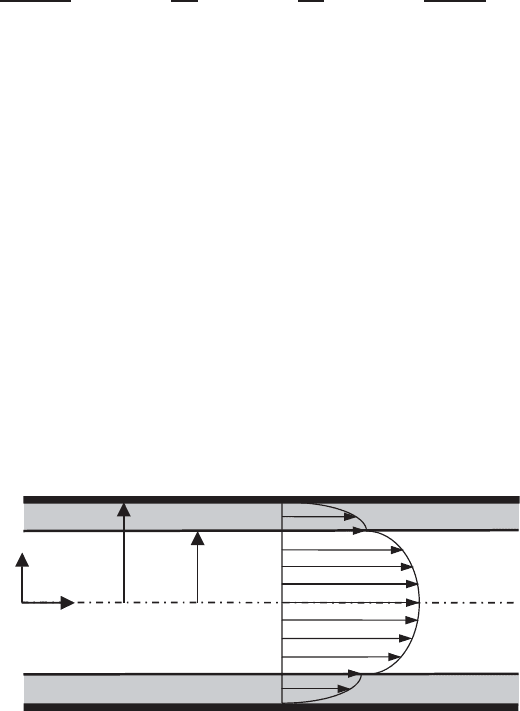
Figure 3.P.21-1 Steady-state fully developed flow of two immiscible Newtonian liquids
with constant physical properties between two stationary parallel impermeable flat plates.

126 APPLICATIONS IN FLUID DYNAMICS
(f) What is the criterion for determining whether the scaling in part (c) or in
part (e) is appropriate for the describing equations?
(g) Use the results of your scaling analysis in part (e) to estimate the velocity
gradients in both liquids 1 and 2; that is, develop appropriate scales for the
velocity gradients in each liquid.
(h) For the scaling analysis done in part (e), determine the dimensionless groups
that are necessary to correlate the total rate of entropy production
˙
S,which
is given by
˙
S =−
H
1
0
μ
1
T
du
x
d
y
2
WLdy −
H
2
H
1
μ
2
T
du
x
d
y
2
WLdy (3.P.21-2)
where T is the absolute temperature and W and L denote the width and
length, respectively, of the two flat plates.
(i) One means for reducing the viscous drag at the walls experienced in pumping
viscous liquids such as petroleum is to inject a less viscous immiscible liquid
such as water, which will form a layer at the wall. However, for this idea
to work, we have to establish that the less viscous liquid (e.g., water) rather
than the more viscous liquid (e.g., petroleum) will go to the wall region.
This question can be answered by invoking the principle that continuous
steady-state processes seek a state of minimum entropy production. Use this
principle along with the results of your scaling analysis in part (e) to deter-
mine whether the viscous or the less viscous liquid will go to the wall region.
3.P.22 Laminar Cylindrical Jet Flow
In Example Problem 3.E.8 we considered a jet of an incompressible Newtonian
liquid with constant physical properties issuing from a circular orifice with an
initial velocity U
0
and falling vertically under the influence of gravity in an inviscid
gas as shown in Figure 3.E.8-1. We scaled the describing equations to explore the
conditions for which quasi-parallel flow can be assumed; that is, when the axial
velocity profile can be assumed to depend only on the axial coordinate. In scaling
the describing equations we introduced a scale for the radial derivative of the axial
velocity since we did not anticipate that this derivative would scale as the ratio
of the characteristic axial velocity scale divided by the characteristic radial length
scale. We anticipated the need to scale this derivative with its own scale since the
axial velocity does not change significantly across the jet. It was stated that if we
had scaled this radial derivative with the ratio of the characteristic axial velocity
scale to the characteristic radial length scale, the forgiving nature of scaling would
have indicated a contradiction. To better understand what is meant by this, let us
assume (incorrectly!) that the radial derivative of the axial velocity scales as the
axial velocity scale u
zs
divided by the radial length scale r
s
. Show that this leads to
an inconsistency in the resulting dimensionless equations in that the dimensionless
group multiplying one term in the describing equations becomes very large, whereas
PRACTICE PROBLEMS 127
the others terms are of
◦
(1); this implies that there is no term to balance this very
large term.
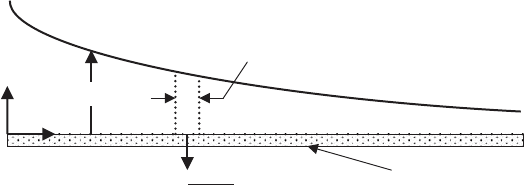
3.P.23 Free Surface Flow Down a Plate with Condensation
Consider the steady-state incompressible laminar film flow of a Newtonian liquid
having constant physical properties down an infinitely wide plane surface inclined
at an angle θ to the horizontal as shown in Figure 3.P.23-1. At the interface between
the liquid film and the ambient gas phase, a constant amount of liquid
˜
W
m
is added
to the film flow per unit area of free surface. For example, this might occur due to
condensation occurring at the liquid–gas interface.
(a) Write the appropriate forms of the steady-state equations of motion assuming
that the ambient gas phase exerts negligible drag on the liquid film.
26
(b) Write the boundary conditions required to solve the equations of motion;
note that the continuity of surface normal stresses and tangential stress bal-
ance must account for the surface-curvature effects.
27
(c) Derive the kinematic surface condition for this flow; note that the mass
addition at the interface must be taken into consideration.
(d) Scale the describing equations to determine the conditions required to make
the lubrication-flow approximation and to ignore the surface-curvature effects.
x
y
h(x)
Δx
mass
area
·time
W
m
∼
Liquid
Gas
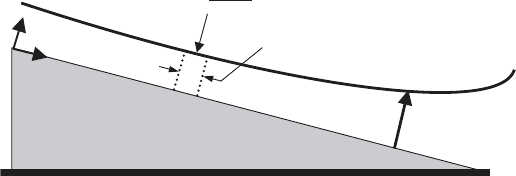
Figure 3.P.23-1 Steady-state incompressible laminar film flow of a Newtonian liquid with
constant physical properties down an infinitely wide plane surface inclined at an angle θ to
the horizontal. Mass addition at the free surface of
˜
W
m
units of mass per unit area per unit
time causes the local film thickness η to increase as a function of axial distance x.
3.P.24 Free Surface Flow Over a Horizontal Filter
A filter in a large industrial plant operates by letting a solution flow across a large
sheet of filter paper as shown in Figure 3.P.24-1. Assume steady-state developing
incompressible laminar flow of a Newtonian liquid with constant physical properties
26
Scaling was used to determine the criterion for making this assumption in Example Problem 3.E.1.
27
See the example in Section 3.7 as a guide to scaling this problem.
128 APPLICATIONS IN FLUID DYNAMICS
Filter
Liquid
Gas
y
x
h(x)
Δx
mass
area
·time
W
m
∼
Figure 3.P.24-1 Gravitationally induced steady-state laminar flow of an incompressible
Newtonian liquid with constant physical properties across a filter through which the mass
flow rate per unit area is
˜
W
m
.
that is driven by a constant hydrostatic pressure gradient due to a variable film
thickness in the x-direction. Assume also that mass is removed from this flow
at the filter boundary at a constant rate of
˜
W
m
units of mass per unit area per
unit time.
(a) Write the appropriate forms of the steady-state equations of motion assuming
that the ambient gas phase exerts negligible drag on the liquid film (see
footnote 26).
(b) Write the boundary conditions required to solve the equations of motion;
note that the continuity of surface normal stresses and tangential stress bal-
ance must account for the surface-curvature effects (see footnote 27).
(c) Derive the kinematic surface condition for this flow; note that the mass loss
through the filter must be taken into consideration.
(d) Scale the describing equations to determine the condition(s) required to
make the lubrication-flow approximation and to ignore the surface-curvature
effects.
(e) Solve the simplified equations of motion that you obtained in part (d) to
obtain the axial velocity profile in terms of the unknown hydrostatic pressure
gradient.
(f) Determine the unknown hydrostatic pressure gradient given that the volu-
metric flow rate Q is specified.
(g) Determine the component of the velocity normal to the filter.
3.P.25 Curtain-Coating Flow
The process of curtain coating is shown in Figure 3.P.25-1. This process is used,
for example, to apply protective polymer coatings at high speed to continuous
steel or tin-plate strip. The curtain flow emanates from a slot at x = 0, at which
point it has a velocity U
0
. The solid guides at z =±W/2 maintain the film at a
constant thickness in the z-direction. However, since the film accelerates due to the
gravitational body force, it thins in the y-direction, as shown in the side view in
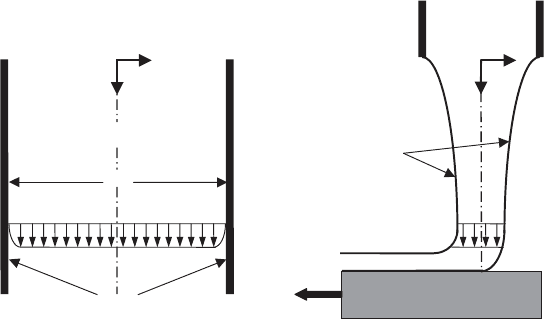
PRACTICE PROBLEMS 129
z
W
x
Solid guides maintain film at
constant width in z-direction
obj
obj
ect to be coated
ecttobecoated
y
x
FRONT VIEW SIDE VIEW
Liquid/gas interface
defined by y = h(x)
Liquid
Liquid
Figure 3.P.25-1 Gravitationally induced steady-state laminar curtain-coating flow of an
incompressible Newtonian liquid with constant physical properties emanating from a rect-
angular slot with an initial velocity of U
0
; front view shows solid guides that maintain the
film at constant width; the axial velocity profile is shown in both views.
Figure 3.P.25-1. The liquid–gas interface is defined by y = η(x),whereη decreases
with increasing x due to the increase in the x-velocity component. The object to
be coated can be ignored entirely in this analysis since we are concerned only with
the falling curtain flow. We assume steady-state laminar flow of an incompressible
Newtonian liquid with constant physical properties and ignore edge effects at the
sidewalls. Note that the applicability of all these assumptions could be determined
using scaling analysis. We use scaling analysis to explore the conditions for which
quasi-parallel flow can be assumed. We then test the applicability of our scaling
analysis results using data from the curtain-coating process.
(a) Write the appropriate form of the three-dimensional equations of motion for
this flow assuming that the ambient gas phase exerts a negligible drag on
the liquid film (see footnote 26).
(b) Write the appropriate boundary conditions for this flow assuming that the
surface-tension effects associated with the curvature can be ignored.
28
How-
ever, do not ignore the effects of curvature in specifying the tangential and
normal stress boundary conditions at the free surface. In deriving the tan-
gential and normal stress boundary conditions at the liquid–gas interface,
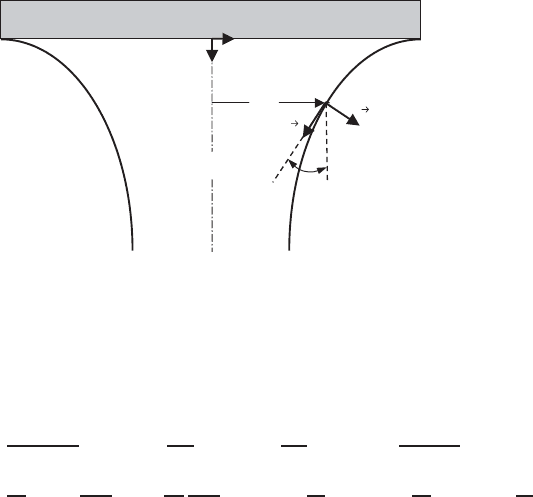
use the convection for θ and the normal and tangential unit vectors, n and
t, respectively, shown in Figure 3.P.25-2.
(c) Write the appropriate form of the kinematic surface condition for this flow.
28
Note that scaling analysis could be used to determine when surface-tension and curvature effects can
be neglected; the latter were considered in Section 3.7.
130 APPLICATIONS IN FLUID DYNAMICS
y
x
Gas
Liquid
Slot
h(x)
q
t
n
Figure 3.P.25-2 Enlarged view of the x–y plane for curtain flow, showing normal and
tangential unit vectors, n and
t, respectively, at the liquid–gas interface.
(d) Introduce the following dimensionless variables involving unspecified scale
and reference factors into the describing equations:
u
∗
x
≡
u
x
− u
xr
u
xs
; u
∗
y
≡
u
y
u
ys
; u
∗
z
≡
u
z
u
zs
; P
∗
≡
P − P
r
P
s
;
η
∗
≡
η
η
s
;
∂u
x
∂y
∗
≡
1
β
s
∂u
x
∂y
; x
∗
≡
x
x
s
; y
∗
≡
y
y
s
; z
∗
≡
z
z
s
(3.P.25-1)
Note that ∂u
x
/∂y does not scale with u
xs
/y
s
since u
x
does not undergo
a characteristic change of u
xs
over the distance y
s
. The proper scale for
β
s
is obtained from the tangential stress boundary condition. Note that this
scaling for ∂u
x
/∂y implies that ∂
2
u
x
/∂y
2
scales with β
s
/y
s
.Usex
s
= L,
where L is some arbitrary but constant downstream distance. Your pressure
scale P
s
will come from balancing the pressure term with the convection
terms in the y-component of the equations of motion. This follows from the
fact that the pressure gradient arises from the acceleration of the flow.
(e) Simplify the tangential and normal stress boundary conditions appropriate
to the assumption of small curvature; that is, for dη/dx 1.
(f) Assume small curvature and use your scaling analysis in part (d) to deter-
mine the criteria for assuming that this is a quasi-parallel flow; that is, a
flow that can be described by considering only the changes of the x-velocity
component in the x-direction.
(g) Show that the solution to the simplified set of equations appropriate to the
quasi-parallel-flow approximation is given by
u
2
x
= U
2
0
+ 2xg (3.P.25-2)
(h) Table 3.P.25-1 summarizes several data sets for a series of curtain flows for
which the fall velocity u
x
in cm/s at a position below the slot of x = 5cmis
PRACTICE PROBLEMS 131
TABLE 3.P.25-1 Data Sets for Curtain Flow
Data Viscosity Slot Width Mean Velocity at Measured Velocity at
Set (poise) (mm) Slot Exit (cm/s) x = 5cm(cm/s)
11.2 0.6 18 96
2 1.5 0.6 56 110
3 1.95 0.2 38 100
4 2.0 0.2 47 109
52.6 0.6 18 97
62.7 0.3 33 93
72.8 0.3 13 87
8 3.45 0.6 6 86
9 3.7 1.5 5 86
10 5.3 1.5 12 85
11 9.9 0.6 8 75
reported as a function of the liquid viscosity in poise (g/cm ·s), the slot width
in mm, and the mean velocity U
0
in cm/s at the exit of the slot. Compare
the fall velocities predicted by the quasi-parallel-flow approximation in part
(g) with the measured fall velocities and also assess the validity of the quasi-
parallel-flow approximation. Discuss any significant deviations between the
experimental and model results.
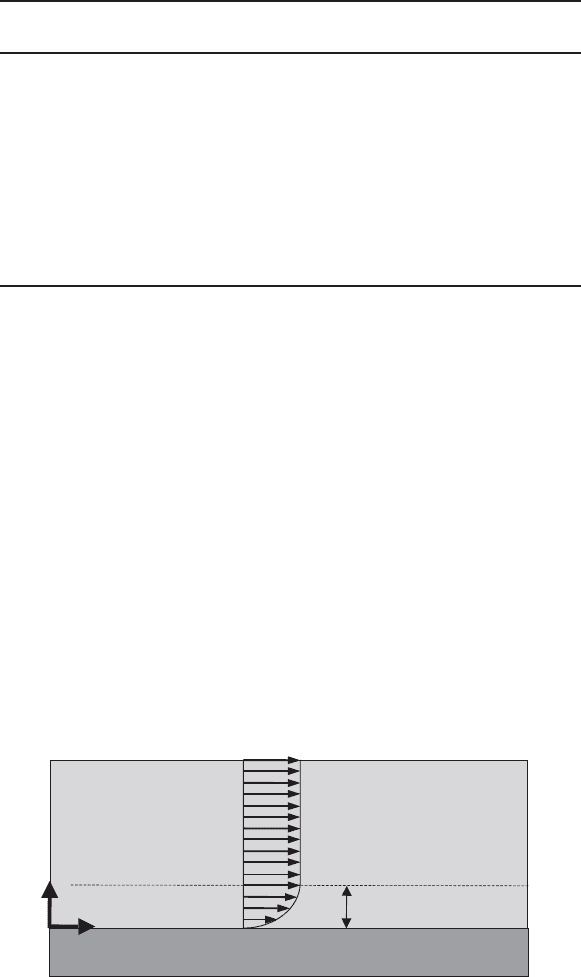
3.P.26 Flow in a Semi-infinite Porous Medium Bounded by a Flat Plate
Consider the steady-state fully developed pressure-driven flow of an incompressible
Newtonian liquid through a liquid-saturated semi-infinite porous medium that is
bounded by a horizontal flat plate as shown in Figure 3.P.26-1.
(a) Write the appropriate form of the equations of motion applicable to porous
media for this flow.
(b) Write the boundary conditions required to solve the equations of motion.
Solid plate
P
0
P
L
x
Porous media
d
p
y
Figure 3.P.26-1 Steady-state fully developed flow of an incompressible Newtonian fluid
with constant physical properties through a semi-infinite porous medium bounded by a
horizontal flat plate due to an applied pressure gradient (P
0
− P
L
)/L.
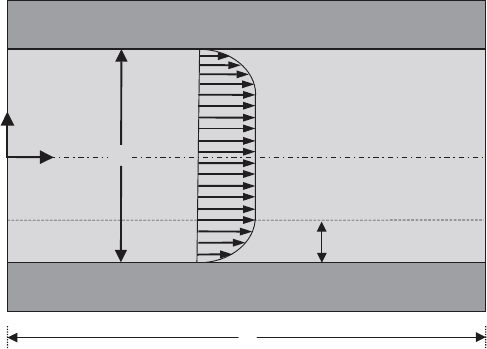
132 APPLICATIONS IN FLUID DYNAMICS
(c) Solve the equations you derived in parts (a) and (b) for the velocity profile.
(d) Scale the describing equations for this flow to determine the criterion for
ignoring the effect of the flat plate on the velocity profile.
(e) Determine the thickness of the region of influence δ
p
within which the effect
of the flat plate on the velocity profile cannot be ignored.
(f) Solve the simplified form of the equations of motion for the velocity profile
assuming that the effect of the flat plate can be ignored.
(g) Show how the solution for the velocity profile that you derived in part
(c) reduces to the result that you obtained in part (f).
3.P.27 Porous Media Flow Between Parallel Flat Plates
Consider the steady-state fully developed pressure-driven flow of an incompressible
Newtonian liquid through a liquid-saturated semi-infinite porous medium that is
bounded by horizontal parallel flat plates as shown in Figure 3.P.27-1.
(a) Write the appropriate form of the equations of motion applicable to porous
media for this flow.
(b) Write the boundary conditions required to solve the equations of motion.
(c) Solve the equations you derived in parts (a) and (b) for the velocity profile.
(d) Scale the describing equations for this flow to determine the criterion for
ignoring the effect of the solid boundaries on the velocity profile.
(e) Determine the thickness of the region of influence δ
p
within which the effect
of the solid boundaries on the velocity profile cannot be ignored.
y
x
Solid plate
Porous media
Solid plate
H
L
P
0
P
L
d
p
Figure 3.P.27-1 Steady-state fully developed flow of an incompressible Newtonian fluid
with constant physical properties through a porous medium bounded by horizontal parallel
flat plates due to an applied pressure gradient (P
0
− P
L
)/L.