
Krantz W.B. Scaling Analysis in Modeling Transport and Reaction Processes: A Systematic Approach to Model Building and the Art of Approximation
Подождите немного. Документ загружается.

PRACTICE PROBLEMS 133
(f) Solve the simplified form of the equations of motion for the velocity profile
assuming that the effect of the solid boundaries can be ignored.
(g) Show how the solution for the velocity profile that you derived in part
(c) reduces to the result that you obtained in part (f).
3.P.28 Gravity-Driven Film Flow over a Saturated Porous Medium
In Example Problem 3.E.9 we considered the steady-state fully developed flow of
an incompressible Newtonian liquid film over an inclined liquid-saturated porous
medium due to a gravitationally induced body force as shown in Figure 3.E.9-1.
We used scaling analysis to determine when the flow through the porous media has
a negligible effect on the flow of the liquid film. We introduced one set of scales for
the velocity and the length variables in the liquid film and another set of scales for
velocity and length variables in the porous medium. We stated that if we had not
done this, we would have arrived at a contradiction in our scaled equations. How-
ever, the forgiving nature of scaling would then indicate that we had not scaled some
quantity so that it was
◦
(1). To understand better what is meant by the forgiving
nature of scaling, rework this problem while assuming (incorrectly!) that the veloc-
ity and the length scales are the same in both the liquid film and the porous medium.
3.P.29 Radial Flow from a Porous Cylindrical Tube
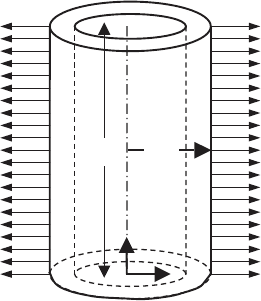
Consider the steady-state laminar flow of a Newtonian liquid with constant physical
properties that is caused by fluid emanating radially at a uniform volumetric flow
rate Q from a cylindrical tube having length L, outer radius R, and porous walls
that is immersed in an infinite pool of the same liquid as shown in Figure 3.P.29-1.
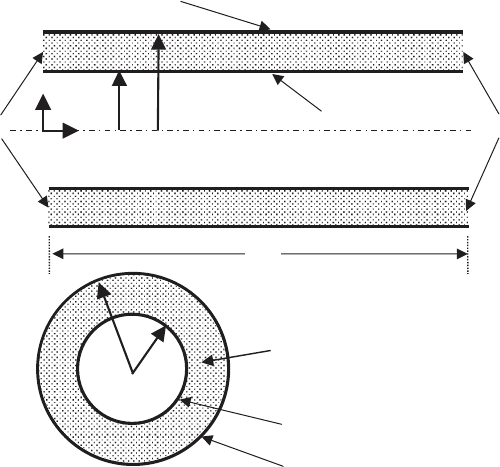
R
L
z
r
Figure 3.P.29-1 Steady-state laminar flow of a Newtonian liquid with constant physical
properties that is caused by fluid emanating radially at a uniform volumetric flow rate Q
from a cylindrical tube of length L, outer radius R, and porous walls that is immersed in
an infinite pool of the same liquid; the radial velocity profile at the surface of the cylinder
is shown at which the pressure is P
R
; the pressure far removed from the cylinder is P
∞
.
134 APPLICATIONS IN FLUID DYNAMICS
(a) Write the appropriate form of the simplified equations of motion for the flow
exterior to the cylinder, allowing for the fact that the finite length of the
cylinder implies that there will be end effects; note that this flow is caused
by the pressure gradient P
R
− P
∞
generated between the outer surface of
the porous cylindrical tube and infinity.
(b) Write the boundary conditions required for the differential equations above.
(c) Scale the describing equations to determine the criteria for ignoring the end
effects on the radial velocity profile; note that the radial velocity scale is
determined from the known volumetric flow rate.
(d) Solve the resulting simplified describing equations to obtain the radial veloc-
ity profile in the liquid exterior to the cylinder.
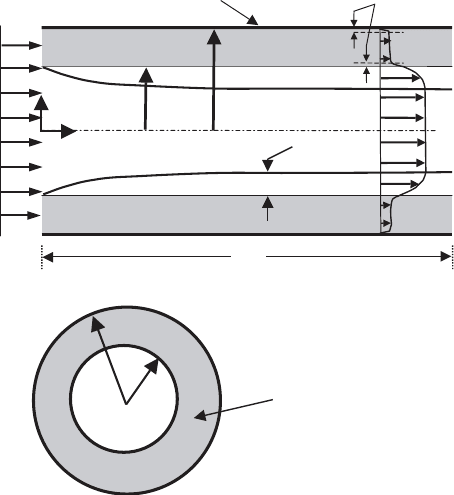
3.P.30 Entry-Region Flow in a Tube with a Porous Annulus
In this problem we explore the idea that one might be able to decrease the entry
region length for steady-state laminar pipe flow by lining the wall of the pipe
with an annular region of porous medium, as shown in Figure 3.P.30-1. The outer
impermeable wall of the pipe is at R
2
. The porous medium is confined in the annular
region defined by radii R
1
and R
2
,whereR
1
<R
2
. Assume that fluid enters the pipe
in plug flow; that is, u
z
= U
0
at z = 0for0 r R
2
. The flow within the pipe,
including the porous annular region, is caused by an applied pressure difference
over the length of the pipe L; the downstream pressure is known and denoted by
P
L
; however, the upstream pressure is not specified. This fluid may be assumed to
be Newtonian and to have constant physical properties. The pipe is assumed to be
horizontal such that gravitational body forces can be ignored.
(a) Write the appropriately simplified continuity and equations of motion for
the flow within the pipe; in writing these equations, denote the velocity
components as u
z
,u
r
,andu
θ
.
(b) Write the appropriately simplified continuity and equations of motion for
the flow within the porous pipe wall; in writing these equations, denote the
velocity components as u
z
, u
r
,andu
θ
.
(c) Write the boundary conditions required to solve the differential equations
you obtained in part (a).
(d) Write the boundary conditions required to solve the differential equations
you obtained in part (b). Assume that the radial velocity profile within
the porous medium becomes pluglike within a region of influence that has
an unspecified thickness δ
p
whose value will be estimated in the scaling
process; that is, assume that the flow within the porous medium departs
from being pluglike only very near the boundaries at r = R
1
and r = R
2
.
(e) Determine the scale and reference factors for the flow in the pipe; estimate
the thickness of the boundary layer or region of influence δ
m
.
PRACTICE PROBLEMS 135
r
SIDE VIEW
SIDE VIEW
Impermeable outer wall
R
2
R
1
z
d
m
d
p
Porous media
Porous media
U
0
P
0
P
L
L
END VIEW
END VIEW
Porous media
R
2
R
1
Figure 3.P.30-1 Side and end views of entry-region flow of an incompressible Newtonian
fluid with constant physical properties in a pipe consisting of an open region of radius R
1
and an annular region of porous medium between R
1
and R
2
.
(f) Determine the scale and reference factors for the flow within the porous
medium; in particular, estimate the thickness of the region of influence δ
p
.
(g) What is the criterion for ignoring the effect of the porous medium on flow
in the pipe?
(h) What are the criteria for ignoring the effect of the curvature on the equations
of motion for flow in both the nonporous and porous regions of the pipe?
(i) Assess the merits of using this outer annular region of the porous medium
to reduce the entrance length required to achieve fully developed laminar
flow in the pipe.
3.P.31 Steady-State Laminar Flow of a Compressible Gas
In Section 3.9 we considered the steady-state laminar flow of a compressible gas
in a cylindrical tube as shown in Figure 3.9-1. We scaled the describing equations
to determine the criterion for assuming that this flow was incompressible. This
criterion was that the Mach number for the flow must be much less than 1. In
scaling the describing equations we introduced a scale for the radial derivative of
the pressure since we did not anticipate that this derivative would scale in the same
136 APPLICATIONS IN FLUID DYNAMICS
way as the axial pressure gradient. We raised the question as to how one knows
whether to scale a derivative as the ratio of some dependent variable scale divided
by some independent variable scale or to introduce a separate scale for the entire
derivative. We indicated that the answer to this rhetorical question was contained
in the forgiving nature of scaling. To better understand what is meant by this, let
us assume (incorrectly!) that the radial pressure derivative scales as the pressure
scale P
s
divided by the radial length scale r
s
. Show that this leads to inconsistency
in the resulting dimensionless equations in that one term becomes much greater
than 1, with no other terms balancing it.
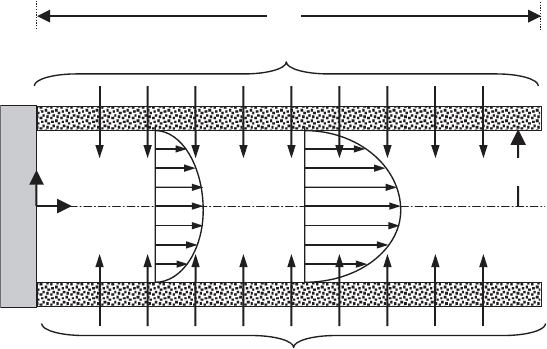
3.P.32 Velocity Profile Distortion Effects Due to Fluid Injection and
Withdrawal
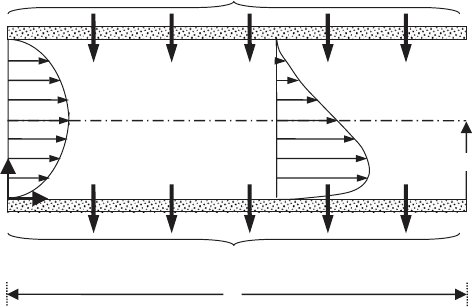
Flow-field-flow fractionation is a technique for separating small particles such as
proteins and viruses from a carrier fluid such as water by combining a longitudinal
laminar flow with a transverse flow. The latter can be imposed by making the
closely spaced parallel lateral walls of the horizontal flow channel consist of two
permeable membranes. Inflow and outflow at a constant velocity V
0
of the same
carrier fluid (without any particles) occurs through the upper and lower mem-
branes, respectively, as shown in Figure 3.P.32-1. This drives the particles, which
are injected as a pulse in the axially flowing fluid, toward the lower membrane and
thereby provides a means of separating them. Field-flow fractionation is consid-
ered in more detail in Chapter 5 when scaling is applied to mass transfer. In this
problem we are concerned with developing a criterion for determining when the
longitudinal velocity profile can be assumed to be unaffected by the transverse flow.
x
H
L
y
V
0
V
0
Figure 3.P.32-1 Flow-field-flow fractionation showing transverse injection of a fluid with
a velocity V
0
into a longitudinal flow of the same fluid that is assumed to be initially in
fully developed laminar flow; the distortion of the velocity profile that can occur due to
transverse injection is shown schematically.

PRACTICE PROBLEMS 137
The entering carrier fluid can be assumed to be a Newtonian fluid with constant
physical properties and to have a velocity profile given by
u
x
= 2U
2y
H
−
y
2
H
2
(3.P.32-1)
where
U is the average axial velocity.
(a) Write the appropriate form of the equations of motion that describe this
flow.
(b) Write the boundary conditions that would be necessary to solve the equations
of motion.
(c) Determine the criterion necessary to ignore the effect of the permeation
through the upper and lower membrane boundaries on the solution for the
x-component of the velocity if the latter is to be used to determine quantities
such as the volumetric flow rate or average velocity.
(d) If one is interested in determining quantities in the vicinity of the mem-
brane, such as the drag on its surface, one cannot ignore the effect of the
permeation on the flow in this wall region (i.e., since the nonzero perme-
ation velocity can have a significant influence on the small axial velocity
near the membrane surface). Use scaling to determine the thickness of the
region of influence near the lower membrane boundary wherein the effects
of the permeation can never be ignored.
3.P.33 Flow Between Parallel Impermeable and Permeable Flat Plates
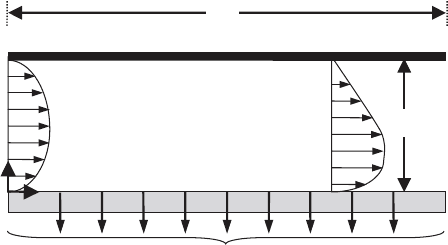
Consider the steady-state laminar flow of a Newtonian fluid with constant physical
properties through a horizontal channel due to a pressure driving force P
0
− P
L
applied over the length L as shown in Figure 3.P.33-1. The upper surface of this
channel at y = H consists of an impermeable solid plate. The lower surface of this
channel at y = 0 consists of a permeable membrane; the permeation velocity V
0
through this membrane is given by
V
0
= k
m
[P(x)−P
atm
] (3.P.33-1)
where k
m
is the permeability of the membrane, P(x)− P
atm
is the pressure drop
across the membrane in which P(x) is the local pressure on the high-pressure side
of the membrane at y = 0, and P
atm
is the constant pressure on the low-pressure
side of the membrane, which is assumed to be atmospheric pressure. Note that, in
general, P
L
− P
atm
> 0, to ensure that permeation occurs over the entire length L
of the membrane. Ignore body forces and lateral edge effects (i.e., those in the z-
direction perpendicular to the plane of Figure 3.P.33-1). Also assume that the flow
is fully developed when it enters this membrane module at x = 0; note, however,
that we are not given any information on the average or maximum velocity of the
velocity profile at x = 0.
138 APPLICATIONS IN FLUID DYNAMICS
Impermeable solid plate
H
P
0
P
L
y
x
L
V
0
Permeable membrane
P
atm
(atmospheric pressure)
Figure 3.P.33-1 Steady-state laminar flow of a Newtonian fluid with constant physical
properties through a horizontal channel due to a pressure driving force P
0
− P
L
applied
over the length L; the upper surface at y = H consists of an impermeable solid plate; the
lower surface at y = 0 consists of a permeable membrane through which permeation occurs
at a constant velocity V
0
.
(a) Write the appropriate form of the equations of motion that describe this
flow.
(b) Write the boundary conditions that would be necessary to solve the equations
of motion.
(c) Determine the criterion for ignoring the axial diffusion of vorticity (mo-
mentum).
(d) Determine the criteria necessary to assume that this flow is essentially fully
developed within the region 0 x L.
(e) For the simplifying assumptions appropriate to parts (c) and (d), determine
the solution for the dimensionless pressure and axial velocity profiles.
(f) For the simplifying assumptions appropriate to parts (c) and (d), derive an
equation for determining the y-component of the velocity; it is not necessary
to solve this equation.
(g) In part (e) you determined the solution for the dimensionless pressure profile
P(x). In fact, the pressure will have a slight dependence on y as well. For
the simplifying assumptions appropriate to parts (c) and (d), determine the
equations necessary to obtain the complete dimensionless pressure profile
P(x,y); that is, including the y-dependence as well. It is sufficient to express
your result for the pressure profile in terms of the two velocity components
u
x
and u
y
.
(h) Determine the criterion necessary to ignore the effect of the permeation
through the membrane on the solution for the x-component of the velocity
if the latter is to be used to determine quantities such as the volumetric flow
rate or average velocity.
PRACTICE PROBLEMS 139
(i) If one is interested in determining quantities in the vicinity of the membrane,
such as the drag on its surface, one cannot ignore the effect of the permeation
on the flow in this wall region (i.e., since the nonzero permeation velocity can
have a significant influence on the small axial velocity near the membrane
surface). Use scaling to determine the thickness of the region of influence
wherein the effects of the permeation can never be ignored.
3.P.34 Flow in an Annulus with Fluid Injection and Withdrawal
Consider the steady-state fully developed flow of an incompressible Newtonian
fluid with constant physical properties in the annular region between radii R
1
and
R
2
, as shown in Figure 3.P.34-1. The flow in the axial direction is caused by a
constant-pressure driving force given by P ≡ P
0
− P
L
applied across the length
L. Both the inner wall at R
1
and the outer wall at R
2
are permeable membranes.
Fluid is injected at a constant radial velocity V
0
into the annular region through
the inner wall at R
1
and withdrawn at some constant unspecified velocity (not
necessarily equal to V
0
) from the annular region through the outer wall at R
2
.
z
r
Injection of fluid at inner wall
at constant velocity V
0
P
L
P
0
SIDE VIEW
Withdrawal of fluid at outer wall
R
2
R
1
END VIEW
Axial and radial flow in
this annular region
Inner wall at R
1
Outer wall at R
2
L
Figure 3.P.34-1 Steady-state fully developed laminar flow of a Newtonian fluid with con-
stant physical properties through an annulus due to a pressure driving force P
0
−P
L
applied
over the length L; fluid injection occurs at constant velocity V
0
through the inner permeable
wall at r = R
1
and fluid withdrawal occurs at a constant unspecified velocity at the outer
permeable wall at r = R
2
.
140 APPLICATIONS IN FLUID DYNAMICS
This injection and withdrawal of fluid is done under conditions that maintain fully
developed flow throughout the annulus.
(a) Simplify the continuity equation in cylindrical coordinates.
(b) What are the implications of the continuity equation for the case of fully
developed flow for the axial component of velocity? Explore these math-
ematically by integrating the appropriate term in the continuity equation
that contains the axial velocity. Be careful in considering the integration
constant(s) you obtain in your partial integration.
(c) What are the implications of the continuity equation for the case of fully
developed flow for the radial component of velocity? Explore these mathe-
matically by integrating the appropriate term in the continuity equation that
contains the radial velocity. Apply an appropriate boundary condition to this
first-order differential equation for the axial velocity and obtain a equation
for the radial velocity profile. Note in curvilinear coordinates that fully
developed flow does not necessarily mean that the radial velocity component
does not change in the radial direction, however, it does imply something
about the radial variation of the radial velocity.
(d) Simplify the axial component of the equations of motion in cylindrical coor-
dinates for this flow. Note that the axial pressure gradient is constant, as
indicated in the problem statement.
(e) Write the appropriate boundary conditions needed to solve the differential
equation that you derived in part (d).
(f) Simplify the radial component of the equations of motion in cylindrical
coordinates for this flow; you may ignore the small effect of the gravitational
body force.
(g) Scale the differential equations and boundary conditions that you derived
for this flow in parts (d) and (e). Your answer should include specifying
the scale and reference factors needed to ensure that your dependent and
independent variables are bounded of order one.
(h) Use your scaling analysis in part (g) to determine the criterion for ignoring
the effect of the fluid injection and withdrawal at the walls on the solution
for the axial velocity.
(i) Use your scaling analysis in part (g) to determine the criterion for assuming
that the inner wall is essentially at r = 0.
(j) Use your scaling analysis in part (g) to determine the criterion for ignoring
the curvature effects. That is, what is the criterion for assuming that this is
essentially the same as flow between two parallel flat plates at which there
is injection at the lower plate and withdrawal at the upper plate?
(k) Solve the differential equation that you derived in part (f) to obtain an
analytical solution for the pressure profile as a function of r and z;in
carrying out this integration, do not forget that ∂P/∂z =−P /L since it
will help you determine the integration “constant” that you obtain in your
radial integration.
PRACTICE PROBLEMS 141
(l) Solve the differential equation and appropriate boundary conditions that
you derived in parts (d) and (e) to obtain an analytical solution for the axial
velocity profile as a function of r.
3.P.35 Flow Between Parallel Permeable Membranes
Consider the parallel permeable membranes shown in Figure 3.P.35-1, which are
open at the downstream end at x = L to atmospheric pressure P
atm
, but closed at
the upstream end at x = 0. All along the semipermeable walls of the parallel mem-
branes, an incompressible Newtonian liquid with constant physical properties flows
in at a constant velocity V
0
. The fluid that flows in through the semipermeable walls
ultimately exits to the atmosphere from the open end of the parallel membranes.
(a) Write the appropriate form of the equations of motion for this flow.
(b) Write the boundary conditions that are required to solve the equations of
motion.
(c) Scale the describing equations to determine the criteria for making the
lubrication-flow approximation.
(d) Solve for the axial velocity profile as a function of y and x; be certain that
you express your answer entirely in terms of known quantities; that is, you
must eliminate the pressure gradient from the equation that you obtain for
the axial velocity profile.
(e) Solve for the pressure profile at any axial position along the flow.
x
y
P
at
m
V
0
L
H
V
0
Figure 3.P.35-1 Steady-state laminar flow of an incompressible Newtonian liquid with
constant physical properties between parallel permeable membranes owing to a constant
radial velocity V
0
through the permeable wall at y =±H ; the end between the parallel
membranes at x = 0 is closed and impermeable; the end at x = L is open to atmospheric
pressure P
atm
.
142 APPLICATIONS IN FLUID DYNAMICS
(f) Solve the simplified describing equations that you obtained in part (c) for
the y-component of velocity as a function of y and x.
3.P.36 Dimensional Analysis for Flow Around a Falling Sphere
In Section 3.10 we used the scaling approach for dimensional analysis to develop a
correlation for the terminal velocity U
t
of a spherical particle having radius R and
density ρ
p
falling, owing to gravitational acceleration g through an incompressible
Newtonian liquid having density ρ and viscosity μ, as shown in Figure 3.10-1.
(a) Use the scaling analysis approach to dimensional analysis to develop a
correlation for the viscous drag force on the spherical particle.
(b) Consider how the correlation that you developed in part (a) simplifies for
the special case of creeping flow.
3.P.37 Dimensional Analysis for Impulsively Initiated Laminar Tube Flow
In Example Problem 3.E.7 we considered the impulsively initiated laminar flow of
an incompressible Newtonian fluid with constant physical properties in a cylindrical
tube, as shown in Figure 3.E.7-1.
(a) Use the scaling approach to dimensional analysis to determine the dimen-
sionless groups needed to correlate the instantaneous local velocity u
z
(r, t).
Isolate u
z
into just one dimensionless group.
(b) Use the scaling approach to dimensional analysis to determine the dimen-
sionless groups needed to correlate the instantaneous viscous drag force on
the wall. Be certain to write all the equations you would solve in order to
obtain the viscous drag force. Isolate u
z
into just one dimensionless group.
(c) How would the dimensional analysis in parts (a) and (b) simplify for the
special case of fully developed flow?
3.P.38 Dimensional Analysis for Flow in an Oscillating Tube
In Practice Problem 3.P.19 we considered the unsteady-state flow of an incom-
pressible Newtonian fluid with constant physical properties through a horizontal
cylindrical tube of radius R and length L due to both an axial pressure gradient
and an oscillating wall, as shown in Figure 3.P.19-1. Consider the special case of
unsteady-state flow in this tube that is caused only by tube wall that is oscillated
at a velocity u
z
= U
0
cos ωt,whereω is the angular frequency of the oscillation in
radians per second.
(a) Use the scaling approach to dimensional analysis to determine the dimen-
sionless groups needed to correlate the instantaneous local velocity u
z
(z, t);
isolate u
z
into one dimensionless group, t into another, and the viscosity
into a third dimensionless group; note that there may be more than three
dimensionless groups.