
Krantz W.B. Scaling Analysis in Modeling Transport and Reaction Processes: A Systematic Approach to Model Building and the Art of Approximation
Подождите немного. Документ загружается.

PRACTICE PROBLEMS 143
(b) How would the dimensional analysis in part (a) simplify for quasi-steady-
state creeping flow?
3.P.39 Dimensional Analysis for Curtain-Coating Flow
In Practice Problem 3.P.25 we consider the steady-state laminar curtain-coating
flow of an incompressible Newtonian liquid with constant physical properties as
shown in Figure 3.P.25-1. This problem involved the use of scaling analysis to
simplify the describing equations appropriate to a quasi-parallel flow. In part (h) of
this problem the analytical solution for the axial velocity u
x
at 5 cm down from
the entrance slot was compared with experimental measurements. We suspect that
the result for the axial velocity that we obtained in part (g) of this problem will
display considerably more error as the viscous terms that we ignored in our scaling
analysis become more important. Assume that the pressure terms in the equations of
motion can be ignored and use dimensional analysis to arrive at the dimensionless
groups needed to correlate the axial velocity u
x
at any point x = L below the slot.
Assume that the axial velocity that you are correlating represents an average value
of u
x
across the cross-section at any point x = L.
3.P.40 Dimensional Analysis for Flow Between Parallel Membranes
Consider the steady-state fully developed laminar flow of an incompressible New-
tonian fluid with constant physical properties between two unbounded perme-
able membranes separated by a distance 2H due to a pressure driving force
P ≡ P
0
− P
L
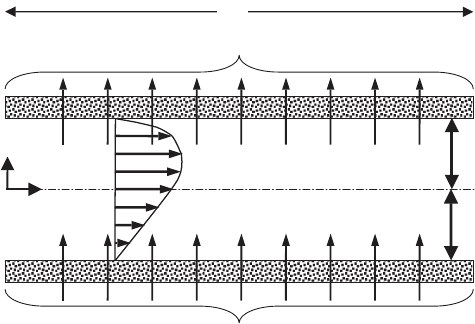
applied over a distance L, as shown in Figure 3.P.40-1. The same
x
y
P
L
L
P
0
V
−H
V
+H
+H
−H
Figure 3.P.40-1 Steady-state fully developed laminar flow of an incompressible Newtonian
fluid with constant physical properties through a horizontal channel due to a pressure driving
force P
0
− P
L
applied over the length L; injection of this same fluid occurs through the
membrane boundary at y =−H at a constant permeation rate of V
−H
; withdrawal of fluid
occurs at the upper membrane boundary at y =+H at a constant permeation rate of V
+H
.
144 APPLICATIONS IN FLUID DYNAMICS
fluid is simultaneously injected at the lower plate at a velocity V
−H
while uniform
suction occurs at the upper plate to remove fluid at the velocity V
+H
.
(a) Use the continuity equation to show that V
−H
= V
+H
= V , a constant.
(b) Use dimensional analysis to develop a correlation for the total drag force
exerted in the +z-direction by the flowing fluid on the upper and lower
plates.
(c) Use your dimensional analysis result to determine how much the total drag
force will increase if the applied pressure force P is doubled.
(d) Use dimensional analysis to develop a correlation for the volumetric flow
rate Q.
(e) Use your dimensional analysis results in parts (b) and (d) to determine how
much the total drag force will increase if the volumetric flow rate is doubled.
3.P.41 Dimensional Analysis for Flow in a Hollow-Fiber Membrane
In Example Problem 3.E.10, we consider the steady-state flow of an incompressible
Newtonian fluid with constant physical properties in a hollow-fiber membrane, one
end of which is closed and the other open to the atmosphere, which is caused
by permeation through the wall at a constant velocity V
0
, as shown in Figure
3.E.10-1. This problem involved the use of scaling analysis to assess the criteria for
assuming that this is a lubrication flow. Assume now that we wish to correlate the
drag force on the hollow-fiber wall for the general case when the lubrication-flow
approximation cannot be made. Use dimensional analysis to infer the appropriate
dimensionless groups to correlate the dimensional drag force. Express your answer
in terms of the standard dimensionless groups used to correlate drag phenomena
of this type; that is, in terms of an appropriately defined friction factor, Reynolds
number, and aspect ratio.

4 Applications in Heat Transfer
If we assume that the ice is thin enough so that the temperature gradient can be
considered as uniform from the upper to the lower surface, we can derive
at once a very simple solution....
1
4.1 INTRODUCTION
The quotation cited above appeared in the classic text Heat Conduction with
Engineering and Geological Applications, which still serves as a basic reference
book in this field of research. In particular, this statement was made in connection
with justifying when the unsteady-state freezing of water-saturated soil could be
assumed to be quasi-steady-state. However, an appropriate rejoinder to the quote
above would be: “How thin is thin?” The solution to the quasi-state-state prob-
lem indeed is “very simple”. However, leaping to the conclusion that “the ice is
thin enough” is intuitive. Alternatively, scaling analysis can be used to develop a
quantitative criterion for assessing the applicability of the quasi-steady-state approx-
imation. This is considered in Section 4.7 for this freezing problem involving heat
transfer with phase change.
In this chapter we consider the application of scaling analysis to heat transfer.
The organization of this chapter is the same as that used in Chapter 3. To understand
fully the material in this chapter, it is necessary first to read Chapters 1 and 2.
However, since some readers might be interested primarily in heat transfer rather
than fluid dynamics, the first few examples are developed in the same detail as was
done in Chapter 3; that is, it will be possible to understand how to apply scaling
analysis to heat transfer without necessarily thoroughly understanding the material
in Chapter 3. However, it will clearly be necessary to understand some aspects
of fluid dynamics when convective heat transfer is considered. Note that in this
chapter we again use the ordering symbols
◦
(1) and
◦
(1) introduced in Chapter 2.
1
L. R. Ingersoll, O. J. Zobel, and A. C. Ingersoll, Heat Conduction with Engineering and Geological
Applications, McGraw-Hill, New York, 1948, p. 197.
Scaling Analysis in Modeling Transport and Reaction Processes: A Systematic Approach
to Model Building and the Art of Approximation, By William B. Krantz
Copyright © 2007 John Wiley & Sons, Inc.
145
146 APPLICATIONS IN HEAT TRANSFER
Recall that the symbol
◦
(1) implies that the magnitude of the quantity can range
between 0 and more-or-less 1, whereas the symbol
◦
(1) implies that the magnitude
of the quantity is more-or-less 1 but not much less than 1.
Some of the scaling considerations in this chapter are similar to those encoun-
tered in scaling fluid dynamics problems: for example, quasi-steady-state and
boundary-layer phenomena. However, in this chapter we apply scaling analysis
to determine when other simplified models can be used, such as film theory and
penetration theory for conductive heat transfer; there are no analogs to these approx-
imations in fluid dynamics. The same disclaimer applies to this chapter as was
stated for Chapter 3: namely, that no attempt will be made here to provide a
detailed derivation of the describing equations that are used in the scaling analysis.
Hence, the material in this chapter provides a useful supplement for a foundation
course in heat transfer. The reader is referred to the appendices that summarize
the energy equation in generalized vector–tensor notation as well as in rectangular,
cylindrical, and spherical coordinates. These equations serve as the starting point
for each example problem.
We begin by considering the use of
◦
(1) scaling to simplify pure heat-conduction
problems. Scaling analysis is then used to justify simplifications made in heat
transfer, such as the penetration-theory and film-theory approximations, low Biot
number heat transfer, conduction- and heat-generation-dominated convective heat
transfer, low Peclet number convective heat transfer (the analog to the creeping-
flow approximation in fluid dynamics) and high Peclet number convective heat
transfer (the analog to high Reynolds number or boundary-layer flows). We then
apply
◦
(1) scaling to heat transfer with phase change, which introduces scaling of
moving boundary problems. Applying scaling analysis to heat transfer now permits
us to determine when the variation of physical and/or transport properties with tem-
perature needs to be considered in developing models. Finally, the scaling analysis
approach is applied to dimensional analysis for heat-transfer problems. Additional
worked example and practice problems are included at the end of the chapter.
4.2 STEADY-STATE HEAT TRANSFER WITH END EFFECTS
This first example illustrates the application of the
◦
(1) scaling analysis procedure
to a steady-state conductive heat-transfer problem for which an exact analytical
solution is available. If the describing equations can be solved analytically, there
is no need to apply scaling analysis to explore how the problem can be simplified.
However, this problem is instructive in that the solution to the simplified equations
obtained via scaling can be compared with the analytical solution to the unsimplified
describing equations to assess the error incurred as a function of the magnitude
of the dimensionless group, which needs to be small to justify the approximation.
It will also illustrate region-of-influence scaling whereby we seek to determine
the thickness of a region wherein some important effect is concentrated. Region-
of-influence scaling is particularly important since it forms the basis of thermal
boundary-layer theory and penetration theory.
STEADY-STATE HEAT TRANSFER WITH END EFFECTS 147
W
y
x
Conducting solid
T = T
1
T = T
1
T = T
2
T = T
1
H
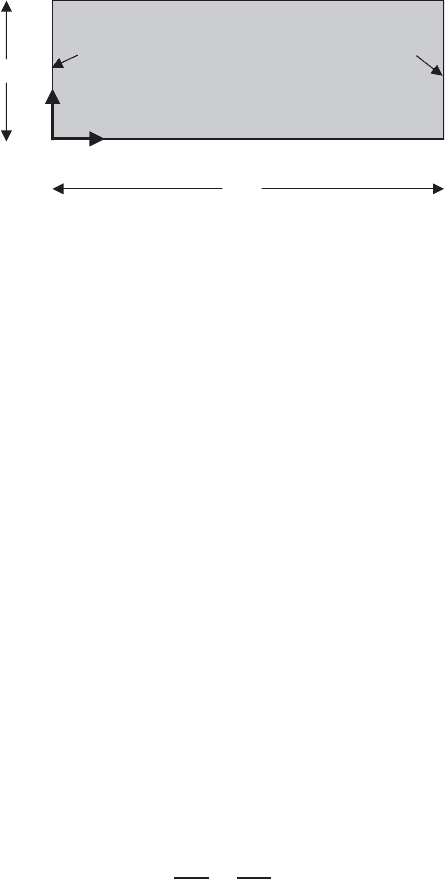
Figure 4.2-1 Steady-state two-dimensional heat conduction in a homogeneous solid with
constant physical properties, width W , and height H such that W>H; the faces at x = 0,
x = W ,andy = 0 are held at a constant temperature T
1
, whereas the face at y = H is held
at a constant temperature T
2
.
Consider steady-state heat conduction in a homogeneous solid having constant
physical properties that has width W in the x-direction, height H in the y-direction,
and is infinitely thick in the z-direction, as shown in Figure 4.2-1; the geometry is
such that W>H. The planar faces at x = 0, x = W ,andy = 0 are held at a con-
stant temperature T
1
, whereas the planar face at y = H is maintained at a constant
temperature T
2
. We anticipate that if W H , we might be able to ignore the
heat conduction in the x-direction. However, the question arises as to how much
larger W has to be relative to H to ignore the lateral heat conduction. Another
question is: How much error do we encounter if we ignore the lateral heat con-
duction? We employ scaling analysis to determine the criterion for when we can
assume that this can be approximated as one-dimensional heat conduction in the
y-direction; that is, we seek to determine when the lateral heat transfer or end
effects can be neglected. We invoke the stepwise
◦
(1) scaling analysis procedure
outlined in Chapter 2. In this first example of
◦
(1) scaling analysis applied to heat
transfer, we show all the steps in detail and provide a discussion of the rationale
for each step.
Step 1 involves writing the describing equations, in this case the thermal energy
equation appropriately simplified for this problem statement and its boundary
conditions. Equation F.1-2 in the Appendices simplifies to the following for the
conditions specified for this heat-transfer problem:
∂
2
T
∂x
2
+
∂
2
T
∂y
2
= 0 (4.2-1)
T = T
1
at x = 0 (4.2-2)
T = T
1
at x = W (4.2-3)
T = T
1
at y = 0 (4.2-4)
T = T
2
at y = H (4.2-5)
148 APPLICATIONS IN HEAT TRANSFER
These boundary conditions constitute the temperatures prescribed at the four
boundaries.
Step 2 involves introducing arbitrary scale factors for each dependent and inde-
pendent variable. Step 3 requires introducing a reference factor for the temperature
since it is not naturally referenced to zero at any of the boundaries. Step 4 involves
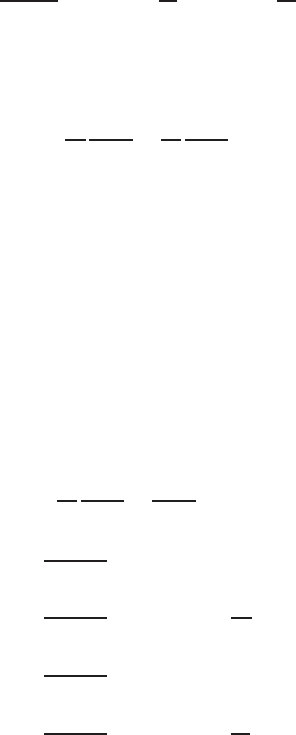
defining the following dimensionless variables:
T
∗
≡
T − T
r
T
s
; x
∗
≡
x
x
s
; y
∗
≡
y
y
s
(4.2-6)
In step 5 these dimensionless variables are substituted into the describing equa-
tions (4.2-1) through (4.2-5):
1
x
2
s
∂
2
T
∗
∂x
∗2
+
1
y
2
s
∂
2
T
∗
∂y
∗2
= 0 (4.2-7)
T
s
T
∗
+ T
r
= T
1
at x
s
x
∗
= 0 (4.2-8)
T
s
T
∗
+ T
r
= T
1
at x
s
x
∗
= W (4.2-9)
T
s
T
∗
+ T
r
= T
1
at y
s
y
∗
= 0 (4.2-10)
T
s
T
∗
+ T
r
= T
2
at y
s
y
∗
= H (4.2-11)
Step 6 involves dividing through by the dimensional coefficient of the conduction
term in the y-direction in equation (4.2-7) since this term must be retained to
account for the principal direction for heat transfer. In the four boundary conditions
we divide through by the dimensional coefficient of the dimensionless dependent
variable, which yields
y
2
s
x
2
s
∂
2
T
∗
∂x
∗2
+
∂
2
T
∗
∂y
∗2
= 0 (4.2-12)
T
∗
=
T
1
− T
r
T
s
at x
∗
= 0 (4.2-13)
T
∗
=
T
1
− T
r
T
s
at x
∗
=
W
x
s
(4.2-14)
T
∗
=
T
1
− T
r
T
s
at y
∗
= 0 (4.2-15)
T
∗
=
T
2
− T
r
T
s
at y
∗
=
H
y
s
(4.2-16)
Step 7 involves determining the scale and reference factors to ensure that the
dimensionless variables are
◦
(1); that is, that they are bounded between zero and
more-or-less 1. This can be achieved by setting the dimensionless groups containing
the reference temperature and temperature scale in equations (4.2-13), (4.2-14),
or (4.2-15) equal to zero and in equation (4.2-16) equal to 1; that is,
STEADY-STATE HEAT TRANSFER WITH END EFFECTS 149
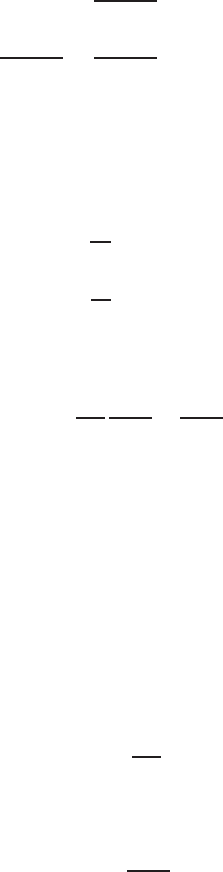
T
1
− T
r
T
s
= 0 ⇒ T
r
= T
1
(4.2-17)
T
2
− T
r
T
s
=
T
2
− T
1
T
s
= 1 ⇒ T
s
= T
2
− T
1
(4.2-18)
Since our region of interest spans the solid between the four planar faces, the
dimensionless spatial variables can be bounded between zero and 1 by setting the
dimensionless groups containing x
s
and y
s
in equations (4.2-14) and (4.2-16) equal
to 1; that is,
W
x
s
= 1 ⇒ x
s
= W (4.2-19)
H
y
s
= 1 ⇒ y
s
= H (4.2-20)
Our dimensionless equations now become
H
2
W
2
∂
2
T
∗
∂x
∗2
+
∂
2
T
∗
∂y
∗2
= 0 (4.2-21)
T
∗
= 0atx
∗
= 0 (4.2-22)
T
∗
= 0atx
∗
= 1 (4.2-23)
T
∗
= 0aty
∗
= 0 (4.2-24)
T
∗
= 1aty
∗
= 1 (4.2-25)
Step 8 then involves using our scaled dimensionless describing equations to assess
the conditions for which we can ignore lateral (x-direction) heat conduction.
Equation (4.2-21) indicates that the lateral heat-conduction term will drop out of
the describing equations if the following condition holds:
H
2
W
2
1 (4.2-26)
If the condition above is satisfied, equation (4.2-21) reduces to
∂
2
T
∗
∂y
∗2
= 0 (4.2-27)
for which the solution is given by
T
∗
= y
∗
(4.2-28)
Note that the criterion that has emerged from our scaling analysis for ignoring the
effect of lateral heat conduction is in terms of a dimensionless group. The physical
150 APPLICATIONS IN HEAT TRANSFER
significance of this dimensionless group is that it is the ratio of the magnitude of
the lateral to vertical (x-toy-direction) heat conduction. The dimensionless groups
that emerge from scaling analysis will always have a physical significance that can
be determined by examining how a particular group was formed: in this case, by
dividing the coefficient of the lateral heat-conduction term by that for the vertical
heat-conduction term.
To gain a better feeling for the error incurred when scaling approximations
are made, it is instructive to compare the approximate solution for small values
of H
2
/W
2
given by equation (4.2-28) to the exact analytical solution to
equation (4.2-21) that is given by
2
T
∗
=
2
π
∞
n=1
(−1)
n+1
n
sin nπx
∗
sinh(nπy
∗
H/W)
sinh(nπH /W )
(4.2-29)
Note that if the dimensionless group H/W 1, equation (4.2-29) can be expanded
in a Taylor series; the first nonzero term in this expansion is the approximate solu-
tion given by equation (4.2-28). Equation (4.2-28) predicts that the dimensionless
temperature is constant along any horizontal plane corresponding to some specified
value of y
∗
. The exact solution given by equation (4.2-29) predicts that the temper-
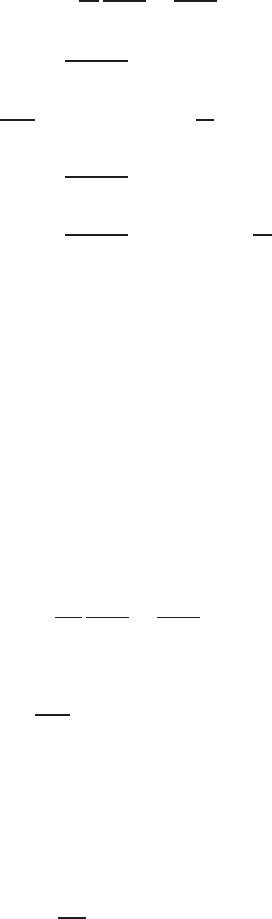
ature along any horizontal plane varies with the lateral location. Figure 4.2-2 plots
the error that is incurred when equation (4.2-28) is used to predict the dimension-
less temperature at y
∗
= 0.5(i.e.,T
∗
= 0.5) as a function of the lateral location
x
∗
for H
2
/W
2
= 0.01 (H/W = 0.1) and H
2
/W
2
= 0.1(H/W = 0.316); that is,
0
10
20
30
40
50
60
70
80
90
100
0 0.1 0.2 0.3 0.4 0.5
x/W
Percent Error in T* at y/H = 0.5
H/W = 0.1
H/W = 0.316
Figure 4.2-2 Percentage error in the dimensionless temperature at y
∗
= 0.5 that is incurred
when the effect of lateral conduction is ignored as a function of the dimensionless lateral
position x
∗
for H/W = 0.1(H
2
/W
2
= 0.01) and H/W = 0.316 (H
2
/W
2
= 0.1).
2
F. P. Incropera and D. P. DeWitt, Fundamentals of Heat and Mass Transfer, Wiley, New York, 1996,
pp. 163–167.

STEADY-STATE HEAT TRANSFER WITH END EFFECTS 151
the error incurred when lateral conduction is ignored.
3
Figure 4.2-2 is plotted
only for 0 <x
∗
≤ 0.5 since the temperature profile is symmetrical about the plane
defined by x
∗
= 0.5. This figure indicates that for H
2
/W
2
= 0.01 the error is less
than 10% across 80% of the total width of the solid. In contrast, for H
2
/W
2
= 0.1,
the error is less than 10% across only 50% of the total width of the solid. This
is to be expected since ignoring lateral conduction becomes a progressively better
approximation as the dimensionless group H
2
/W
2
decreases. These errors are typ-
ical of what one can anticipate for the approximations that emanate from scaling
analysis. Since the dimensionless variables are scaled to be of order one, neglecting
a term that is multiplied by a dimensionless group that is
◦
(0.1) or
◦
(0.01) should
result in errors of approximately 10% and 1%, respectively.
The preceding analysis indicates that the error encountered in making some
assumption depends not only on the magnitude of the dimensionless group that
emanates from the scaling analysis, but also on the particular quantity that is being
predicted. For example, ignoring the lateral conduction in the present problem
yields accurate predictions for the temperature at the center of the solid even when
H
2
/W
2
is as large as 0.1. However, the prediction for the dimensionless temper-
ature is considerably in error at x
∗
= 0.05 even when H
2
/W
2
is as small as 0.01.
Indeed, the error in the temperature predicted that is incurred when lateral heat con-
duction is neglected increases without bound at points progressively closer to the
lateral boundaries. Moreover, the thickness of this wall region wherein lateral con-
duction is important is directly proportional to the value of H/W. Clearly, it would
be of value to be able to estimate the thickness of this wall region wherein two-
dimensional conductive heat transfer must be considered. This can be done using
region-of-influence scaling, whereby we seek to determine the thickness of a region
within which some effect is important; in this case, the thickness of the region near
the lateral boundaries wherein lateral heat-conduction effects are significant.
To carry out region-of-influence scaling, the unspecified length scale factor in
fact becomes the thickness of the region of influence, which we denote by the
symbol δ
t
to emphasize its particular physical significance. By this we mean that
the relevant dependent variable, in this case ∂T
∗
/∂x
∗
,is
◦
(1) within this region.
Let us rescale this problem to determine the magnitude of δ
t
. It is sufficient here
to consider only one of the lateral boundaries, due to the symmetry of the heat-
transfer geometry. Equations (4.2-1), (4.2-2), (4.2-4), and (4.2-5) remain the same;
however, equation (4.2-3) needs to be replaced by a boundary condition appropriate
to the wall region, which is given by
∂T
∂x
= 0atx = δ
t
(4.2-30)
This boundary condition merely states that the lateral variation in temperature
is confined to the wall region or region of influence whose thickness δ
t
will be
determined via scaling analysis.
3
The infinite series in equation (4.2-29) converges rather slowly; hence, 50 terms in this series were
retained in determining the dimensionless temperature predicted by this exact solution.
152 APPLICATIONS IN HEAT TRANSFER
If the dimensionless variables defined by equations (4.2-6) are substituted into
equations (4.2-1), (4.2-2), (4.2-4), (4.2-5), and (4.2-30) and step 6 in the scal-
ing analysis procedure is applied, the following set of dimensionless describing
equations is obtained:
y
2
s
x
2
s
∂
2
T
∗
∂x
∗2
+
∂
2
T
∗
∂y
∗2
= 0 (4.2-31)
T
∗
=
T
1
− T
r
T
s
at x
∗
= 0 (4.2-32)
∂T
∗
∂x
∗
= 0atx
∗
=
δ
t
x
s
(4.2-33)
T
∗
=
T
1
− T
r
T
s
at y
∗
= 0 (4.2-34)
T
∗
=
T
2
− T
r
T
s
at y
∗
=
H
y
s
(4.2-35)
Applying
◦
(1) scaling then results in the following for the scale and reference
factors:
T
r
= T
1
; T
s
= T
2
− T
1
; x
s
= δ
t
; y
s
= H (4.2-36)
These scale factors differ from those obtained initially in that the lateral length
scale is now the thickness of the region of influence near the lateral boundary
rather than being the entire width of the solid. This is a reasonable result since the
temperature goes through a characteristic change T
2
− T
1
over the distance δ
t
near
the lateral boundary rather than over the entire half-width of the solid.
If the scale and reference factors indicated in equations (4.2-36) are introduced
into equations (4.2-31) through (4.2-35), we obtain the following set of dimension-
less describing equations:
H
2
δ
2
t
∂
2
T
∗
∂x
∗2
+
∂
2
T
∗
∂y
∗2
= 0 (4.2-37)
T
∗
= 0atx
∗
= 0 (4.2-38)
∂T
∗
∂x
∗
= 0atx
∗
= 1 (4.2-39)
T
∗
= 0aty
∗
= 0 (4.2-40)
T
∗
= 1aty
∗
= 1 (4.2-41)
If lateral heat conduction is important within the region of influence, both terms in
equation (4.2-37) must be
◦
(1). This implies that
H
2
δ
2
t
= 1 ⇒ δ
t
= H (4.2-42)