
Krantz W.B. Scaling Analysis in Modeling Transport and Reaction Processes: A Systematic Approach to Model Building and the Art of Approximation
Подождите немного. Документ загружается.

IMPLICATIONS OF SCALING ANALYSIS FOR REACTOR DESIGN 383
applicable, the absorption rate per unit volume of reactor is given by
N
A
a
∼
=
R
A
φa (6.11-4)
where the reaction rate is determined using ˆc
A
∼
=
c
◦
A
and the local value of ˆc
B
.
Equation (6.11-4) implies that the total absorption rate per unit volume for the
kinetic domain of the slow reaction regime is:
•
Independent of the interfacial area (note that the product φa is the liquid-phase
holdup since the interfacial area cancels in the product)
•
Proportional to the liquid-phase holdup φa
•
Independent of the mass-transfer coefficient k
•
L0
that characterizes the transport
between the microscale and macroscale elements
•
Proportional to the reaction rate per unit volume R
A
•
Influenced by the overall driving force for the limiting reactant c
◦
A
only insofar
as it enters through the reaction rate R
A
•
Dependent on the concentration of the nonlimiting reactant ˆc
B
insofar as it
enters through the reaction rate R
A
These considerations indicate that appropriate contactors for mass transfer with
chemical reaction operating in the kinetic domain of the slow reaction regime are
stirred tank reactors that provide large liquid holdups (i.e., large values of φa)and
for which the large-scale mixing that reduces the driving force has no effect on the
total absorption rate per unit volume (i.e., c
◦
A
is a constant not affected by mixing).
On the other hand, contactors such as packed columns are not appropriate since
they have low liquid holdups and a large interfacial area. These considerations
also indicate that changing the hydrodynamics to increase the Reynolds number,
which will increase the interfacial area a and the mass-transfer coefficient k
•
L0
, will
have no effect on the total absorption rate per unit volume in the kinetic domain.
The fact that the kinetic domain of the slow reaction regime is independent of the
interfacial area is advantageous in the use of laboratory absorbers to determine the
kinetics of a reaction; that is, one can employ a packed column whose interfacial
area is unknown in order to determine the unknown kinetics of a reaction.
Consider now the diffusional domain of the slow reaction regime. For this
domain the chemical reaction is very slow on the microscale but fast on the
macroscale. Again the mass-transfer coefficient for transfer from the microscale
to the macroscale is the same as for mass transfer in the absence of chemical
reaction. On the macroscale the diffusional domain of the slow reaction regime
means that the reaction is sufficiently fast to maintain the local bulk concentra-
tion of the component A, the limiting reactant, at nearly zero for the assumed
irreversible reaction. Hence, equation (6.8-3) implies that the absorption rate per
unit volume of reactor is given by
N
A
a
∼
=
k
•
L0
ac
◦
A
(6.11-5)

384 APPLICATIONS IN MASS TRANSFER WITH CHEMICAL REACTION
Equation (6.11-5) implies that the total absorption rate per unit volume for the
diffusional domain of the slow reaction regime is:
•
Proportional to a, the interfacial area per unit volume
•
Independent of the liquid-phase holdup φa
•
Proportional to the mass-transfer coefficient k
•
L0
that characterizes the transport
between the microscale and macroscale elements
•
Independent of the reaction rate per unit volume R
A
•
Proportional to the overall driving force c
◦
A
−ˆc
A
•
Independent of the concentration of the nonlimiting reactant component B
These considerations indicate that appropriate contactors for mass transfer with
chemical reaction operating in the diffusional domain of the slow reaction regime
are packed columns that provide large interfacial area, good hydrodynamics, and
maintain large overall driving forces. Contactors such as stirred tanks are not appro-
priate since they have low interfacial area and promote large-scale mixing that
reduces the overall driving force for mass transfer.
Now let us consider the intermediate reaction regime for which both diffusion
and reaction on the microscale are of equal importance. The reaction is sufficiently
fast to steepen the concentration profile significantly near the gas–liquid interface
on the microscale, but not large enough necessarily to reduce the bulk concentration
to its reaction equilibrium value of zero for an irreversible reaction. We use the
results of our scaling analysis for the intermediate reaction regime to obtain an
estimate of N
A
a, the total absorption rate per unit volume of reactor; that is,
N
A
∼
=
−D
AS
∂c
A
∂y
⇒ N
∗
A
∼
=
−
D
AS
c
As
N
As
y
As
∂c
∗
A
∂y
∗
A
=−
D
AS
(c
◦
A
−ˆc
A
)
N
As
δ
m
∂c
∗
A
∂y
∗
A
=−
k
•
L0
(c
◦
A
−ˆc
A
)
N
As
∂c
∗
A
∂y
∗
A
(6.11-6)
where we have used equation (6.11-2) to introduce k
•
L0
, the mass-transfer coefficient
for purely physical absorption. To bound N
∗
A
to be
◦
(1), we set k
•
L0
(c
◦
A
−ˆc
A
)/
N
As
= 1 ⇒ N
As
= k
•
L0
(c
◦
A
−ˆc
A
). Hence, we obtain the following estimate for
the mass-transfer rate per unit volume:
N
A
a
∼
=
k
•
L0
a(c
◦
A
−ˆc
A
) for the intermediate reaction regime (6.11-7)
Although equation (6.11-7) is identical in form to equation (6.11-1) for purely
physical absorption, the driving force in the former is much larger. This follows
from the reduction in ˆc
A
due to the chemical reaction on the microscale that is
implied by equation (6.5-2). Equation (6.11-7) implies that the total absorption
rate per unit volume for the intermediate reaction regime is:
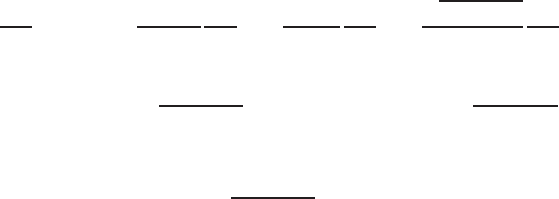
•
Proportional to a, the interfacial area per unit volume
IMPLICATIONS OF SCALING ANALYSIS FOR REACTOR DESIGN 385
•
Independent of the liquid-phase holdup φa
•
Proportional to the mass-transfer coefficient k
•
L0
•
Dependent on the reaction rate per unit volume R
A
insofar as it reduces ˆc
A
•
Proportional to the overall driving force c
◦
A
−ˆc
A
•
Dependent on the concentration of the nonlimiting reactant component B
insofar as it influences the reaction rate per unit volume R
A
These considerations indicate that appropriate contactors for mass transfer with
chemical reaction operating in the intermediate reaction regime are packed columns
that provide large interfacial area, good hydrodynamics, and maintain a large driv-
ing force. Contactors such as stirred tanks are not appropriate since they have small
interfacial area and a reduced driving force.
Consider now the fast reaction regime that maintains the bulk liquid at the
reaction equilibrium concentration within a distance that is less than the thickness
δ
m
, which is determined by the hydrodynamics. In this case we use the results of
our scaling analysis for the fast reaction regime to obtain an estimate of N
A
a:
N
A
∼
=
−D
AS
∂c
A
∂y
⇒ N
∗
A
∼
=
−
D
AS
c
As
N
As
y
As
∂c
∗
A
∂y
∗
A
=−
D
AS
c
◦
A
N
As
δ
r
∂c
∗
A
∂y
∗
A
=−
D
AS
c
◦
A
R
m
A
N
As
∂c
∗
A
∂y
∗
A
(6.11-8)
To bound N
∗
A
to be
◦
(1), we set
D
AS
c
◦
A
R
m
A
/N
As
= 1 to obtain N
As
=
D
AS
c
◦
A
R
m
A
.
Hence, we obtain the following estimate for the mass-transfer rate per unit
volume:
N
A
a = a
D
AS
c
◦
A
R
m
A
(6.11-9)
Equation (6.11-9) implies that the total absorption rate per unit volume for the fast
reaction regime is:
•
Proportional to a, the interfacial area per unit volume
•
Independent of the liquid-phase holdup φa
•
Independent of the mass-transfer coefficient k
•
L0
•
Proportional to the reaction rate per unit volume R
A
•
Proportional to the overall driving force c
◦
A
both explicitly and implicitly
through the reaction rate R
m
A
•
Dependent on the nonlimiting reactant concentration through the reaction
rate R
m
A
The fast reaction regime is distinguished from the other reaction regimes because
the hydrodynamics affect the total absorption rate only through a, the interfacial
area per unit volume. In general, changing the hydrodynamics (i.e., the Reynolds
number) can affect the interfacial area, mass-transfer coefficient, and liquid holdup.

386 APPLICATIONS IN MASS TRANSFER WITH CHEMICAL REACTION
If changing the hydrodynamics does not affect the total absorption rate per unit
volume, it indicates that the device is operating in the fast reaction regime. The
characteristics of the fast reaction regime imply that laboratory contactors for which
the interfacial area per unit volume is known, such as wetted-wall columns, liq-
uid jets, or falling film sphere absorbers, can be used to determine the reaction
kinetics.
Consider now the inner domain of the instantaneous reaction regime. For this
case we also use the results of our scaling analysis to obtain an estimate of N
A
a:
N
A
∼
=
−D
AS
∂c
A
∂y
⇒ N
∗
A
∼
=
−
D
AS
c
As
N
As
y
As
∂c
∗
A
∂y
∗
A
=−
D
AS
c
◦
A
N
As
L
∂c
∗
A
∂y
∗
A
=−
k
•
L0
N
As
ˆc
B
κ
D
BS
D
AS
∂c
∗
A
∂y
∗
A
(6.11-10)
where we have made the substitution L = (κD
AS
c
◦
A
/ ˆc
B
)
√
t
o
/D
BS
andusedequa-
tion (6.3-29) to identify
√
D
AS
/t
o
, with k
•
L0
the mass-transfer coefficient obtained
for unsteady-state physical absorption. To bound N
∗
A
to be
◦
(1), we set (k
•
L0
ˆc
B
/
N
As
κ)
√
D
BS
/D
As
= 1 to obtain N
As
= (k
•
L0
ˆc
B
/κ)
√
D
BS
/D
As
. Hence, we obtain
the following estimate for the mass-transfer rate per unit volume:
N
A
a =
k
•
L0
a ˆc
B
κ
D
BS
D
AS
(6.11-11)
Equation (6.11-11) implies that the total absorption rate per unit volume for the
inner domain of the instantaneous reaction regime is:
•
Proportional to a, the interfacial area per unit volume
•
Independent of the liquid-phase holdup φa
•
Proportional to the mass-transfer coefficient k
•
L0
•
Independent of the reaction rate per unit volume R
A
•
Independent on the concentration of the absorbing component
•
Proportional to ˆc
B
, the driving force of the liquid-phase reactant
Contactors such as packed columns that provide large interfacial area, good hydro-
dynamics, and maintain a large driving force are appropriate for mass transfer
with chemical reaction operating in the inner domain of the instantaneous reaction
regime. In contrast, contactors such as stirred tanks are not appropriate.
We did not apply scaling analysis to the surface reaction domain of the instanta-
neous reaction regime since the mass transfer becomes controlled by the gas phase
rather than by the liquid phase. Since the resistance to mass transfer in the liquid
phase is negligible and the reaction is instantaneous, the interfacial concentration
of the absorbing component is zero. Since the liquid-phase reactant is assumed to
be nonvolatile, the gas-phase mass transfer will not involve any chemical reaction.

MASS-TRANSFER COEFFICIENTS FOR REACTING SYSTEMS 387
Hence, the mass-transfer rate per unit volume is determined directly from the
gas-phase mass-transfer coefficient k
•
G0
and is given by
N
A
a = k
•
G0
ap
A
(6.11-12)
in which
p
A
is the partial pressure of the absorbing component A in the gas phase.
Equation (6.11-12) implies that the total absorption rate per unit volume for the
surface domain of the instantaneous reaction regime is:
•
Proportional to a, the interfacial area per unit volume
•
Independent of the liquid-phase holdup φa
•
Proportional to the gas-phase mass-transfer coefficient k
•
G0
•
Independent of the reaction rate per unit volume R
A
•
Proportional to the gas-phase concentration of the absorbing component
•
Independent of the concentration of the liquid-phase reactant
Appropriate contactors are those that provide a large interfacial area such as packed
columns.
In this section we have shown that scaling analysis provides valuable insight into
selecting the proper contacting equipment and operating conditions for mass trans-
fer with chemical reaction. In particular, scaling analysis permitted us to develop a
set of design precepts for each operating regime without the need for solving any
of the describing equations.
6.12 MASS-TRANSFER COEFFICIENTS FOR REACTING SYSTEMS
The performance of contacting devices for mass transfer is characterized by correla-
tions for the dimensionless mass-transfer coefficient, that is, the Sherwood number
or Nusselt number for mass transfer. In microscale–macroscale modeling this mass-
transfer coefficient characterizes the transfer between the micro- and macroscales.
We have established that in the slow reaction regime the same mass-transfer coeffi-
cient for the particular contacting geometry applies to both mass transfer with and
without chemical reaction. However, for the intermediate, fast, and instantaneous
reaction regimes the mass-transfer coefficient will be increased from that for purely
physical absorption. In this section we demonstrate how the approximations sug-
gested by scaling analysis can be used to determine the mass-transfer coefficient
under reaction conditions that influence it.
Since the concentration profiles in the microscale element are influenced by the
chemical reaction, the mass-transfer coefficient will be greater than that for purely
physical absorption. Unfortunately, it is not possible to obtain a general solution
for the mass-transfer coefficient for the intermediate reaction regime. However,
we can invoke the steady-state approximation, for which the criterion is given by
equation (6.3-22), to obtain a solution for the mass-transfer coefficient for speci-
fied reaction kinetics. Let us consider the special case of a zeroth-order irreversible

388 APPLICATIONS IN MASS TRANSFER WITH CHEMICAL REACTION
reaction for which R
A
=−k
0
. When the criterion for the applicability of the inter-
mediate reaction regime given by equation (6.5-1) is satisfied, our dimensionless
describing equations corresponding to a film theory model for the microscale ele-
ment reduce to the following for this special case:
0 =
d
2
c
∗
A
dy
∗2
−
k
0
δ
2
m
D
AS
c
◦
A
=
d
2
c
∗
A
dy
∗2
−
r
(6.12-1)
c
∗
A
= 1aty
∗
= 0 (6.12-2)
c
∗
A
= 0aty
∗
= 1 (6.12-3)
where
r
≡ k
0
δ
2
m
/D
AS
c
◦
A
. The corresponding solution for the mass-transfer flux is
given by
N
A
= k
•
L0
c
◦
A
1 +
r
2
(6.12-4)
where k
•
L0
has been introduced via the substitution D
AS
/δ
m
= k
•
L0
. The correspond-
ing mass-transfer coefficient characterizing the intermediate reaction regime then
is given by
k
•
L
= k
•
L0
1 +
r
2
(6.12-5)
Hence, the mass-transfer coefficient for a zeroth-order reaction in the intermediate
reaction regime can be obtained directly from that for purely physical absorption
using equation (6.12-5). Note that in the limit of
r
→ 0 corresponding to no
chemical reaction, k
•
L
reduces to k
•
L0
. Film theory can be used to develop similar
relationships between the mass-transfer coefficients in the presence and absence of
chemical reaction for other kinetic expressions.
In the case of the fast reaction regime it is possible to obtain a general equation
for the mass-transfer coefficient if steady-state can be assumed: that is, if the
criterion given by equation (6.3-22) is satisfied. For the fast reaction regime, y
s
=
δ
r
and ˆc
A
= 0 for an irreversible reaction; this implies that equations (6.3-14) and
(6.3-15) assume the form
c
◦
A
R
m
A
t
o
∂c
∗
A
∂t
∗
=
∂
2
c
∗
A
∂y
∗2
+ R
∗
A
(6.12-6)
D
AS
c
◦
A
D
BS
R
m
A
t
o
∂c
∗
B
∂t
∗
=
∂
2
c
∗
B
∂y
∗2
B
+ R
∗
A
(6.12-7)
For all but the shortest contact times, c
◦
A
/R
m
A
t
o
1andD
AS
c
◦
A
/D
BS
R
m
A
t
o
1,
due to the large value of R
m
A
for the fast reaction regime. Hence, the unsteady-state
term can be ignored and equations (6.12-6) and (6.12-7) simplify to
0 =
d
2
c
∗
A
dy
∗2
A
+ R
∗
A
(6.12-8)
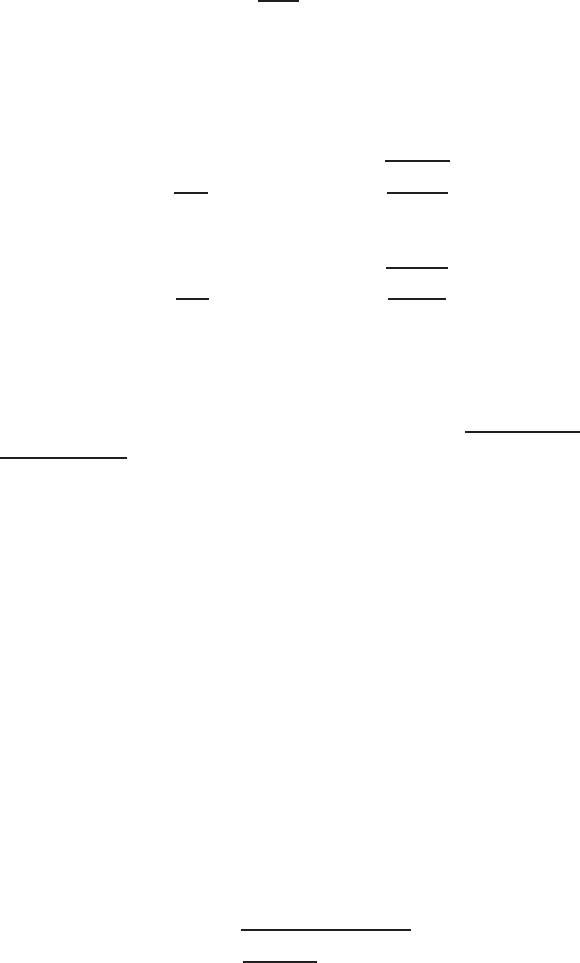
MASS-TRANSFER COEFFICIENTS FOR REACTING SYSTEMS 389
0 =
d
2
c
∗
B
dy
∗2
B
+ R
∗
A
(6.12-9)
The boundary conditions on these simplified describing equations for the microscale
element are the following:
c
∗
A
= 1aty
∗
A
= 0
c
∗
B
= 0and
dc
∗
B
dy
∗
= 0aty
∗
B
=
δ
2
m
κR
m
A
D
BS
ˆc
B
(6.12-10)
c
∗
A
= 0and
dc
∗
A
dy
∗
= 0aty
∗
A
=
δ
2
m
R
m
A
D
AS
c
◦
A
c
∗
B
= 1aty
∗
B
= 0
(6.12-11)
Note that when the concentration of a reactant is reduced to zero, there is no
further diffusion of this reactant, thereby implying that its concentration gradient
is zero as well. If the reaction time is very fast, that is, if
δ
2
m
R
m
A
/D
AS
c
◦
A
1
and
δ
2
m
κR
m
A
/D
BS
ˆc
B
1, the boundary conditions containing these dimensionless
groups can be applied at infinity. Equation (6.12-8) can be integrated subject to
the appropriate boundary conditions given in equations (6.12-10) and (6.12-11)
by defining ϕ ≡ dc
∗
A
/dy
∗
and substituting dy
∗
≡ dc
∗
A
/ϕ to obtain the following
general solution for the mass-transfer flux of component A from the microscale to
macroscale in the fast reaction regime:
N
A
=−
2D
AS
R
m
A
c
◦
A
1
0
R
∗
A
dc
∗
A
1/2
(6.12-12)
The corresponding mass-transfer flux of component B can be obtained by integrat-
ing equation (6.12-9) in a similar manner or by recognizing that the stoichiometry
of the chemical reaction implies
N
B
=−κN
A
(6.12-13)
Since we have established that the mass transfer is not affected by the hydrody-
namics in the fast reaction regime, N
A
is not a function of k
•
L0
. The corresponding
mass-transfer coefficient characterizing the fast reaction regime then is given by
k
•
L
=−
2D
AS
R
m
A
c
◦
A
1
0
R
∗
A
dc
∗
A
(6.12-14)
It is possible to obtain a solution for the mass-transfer coefficient for the inner
domain of the instantaneous reaction regime if steady-state can be assumed; that

390 APPLICATIONS IN MASS TRANSFER WITH CHEMICAL REACTION
is, if a film theory model is used. In this case the describing equations given by
equations (6.7-3) through (6.7-10) simplify to
10
0 =
d
2
c
A
dy
2
(6.12-15)
0 =
d
2
c
B
dy
2
(6.12-16)
c
A
= c
◦
A
at y = 0 (6.12-17)
c
A
= 0,c
B
= 0aty = L (6.12-18)
c
B
=ˆc
B
at y = δ
m
(6.12-19)
D
AS
∂c
A
∂y
=−
D
BS
κ
∂c
B
∂y
at y = L (6.12-20)
The solution to these equations is straightforward and leads to the following
equation for the mass-transfer flux:
N
A
= k
•
L0
c
◦
A
+
D
BS
ˆc
B
D
AS
κ
(6.12-21)
The corresponding mass-transfer coefficient characterizing the inner domain of the
instantaneous reaction regime is then given by
k
L
= k
•
L0
1 +
D
BS
ˆc
B
D
AS
κc
◦
A
(6.12-22)
Hence, the mass-transfer coefficient for the inner domain of the instantaneous reac-
tion regime can be obtained directly from that for purely physical absorption using
equation (6.12-22).
The three examples considered in this section are representative of how scaling
analysis can be applied to developing models that can be used to obtain mass-
transfer coefficients for the design of contacting devices involving mass transfer
with chemical reaction. Other models can be developed based on different reaction
kinetics and approximations, some of which are explored in the practice problems
at the end of the chapter.
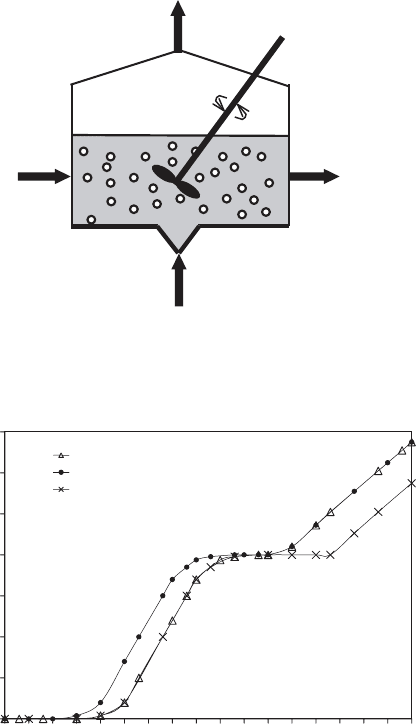
6.13 DESIGN OF A CONTINUOUS STIRRED TANK REACTOR
In this section we apply microscale–macroscale scaling analysis to interpret per-
formance data for a continuous stirred tank reactor (CSTR). This CSTR is used
to absorb component A from a gas that is bubbled continuously into a liquid that
flows into and out of it as shown in Figure 6.13-1. The incoming and outgoing
10
Scaling analysis can be used to develop the criteria for assuming steady-state for the inner domain of
the instantaneous reaction regime; this is considered in Practice Problem 6.P.17.
DESIGN OF A CONTINUOUS STIRRED TANK REACTOR 391
Gas out
Gas in
Liquid in
c
A1
= 0
Liquid ou
t
c
A2
> 0
Figure 6.13-1 Continuous stirred tank reactor for chemisorption of a soluble component
from a gas that is bubbled through a liquid.
−3
−2
−1
0
1
2
3
4
−10−9 −8 −7 −6 −5 −4 −3 −2 −1
0123 4567
Curve A
Curve B
Curve C
Log k
1
Log x
Figure 6.13-2 Log of the ratio of the total absorption rate divided by the maximum physical
absorption rate (χ ) as a function of the log of the first-order reaction rate constant k
1
for
the three sets of system parameter values given in Table 6.13-1.
liquid streams have compositions c
A1
= 0andc
A2
≥ 0, respectively. The CSTR
is assumed to be perfectly mixed so that all the liquid in it has the same com-
position as the exiting stream. Its total volume is V
T
; the volumetric flow rate of
the liquid is Q
L
; and the interfacial area per unit volume of the CSTR is a.The
solute is assumed to be chemisorbed via a first-order irreversible reaction given by
R
A
= k
1
c
A
. Figure 6.13-2 shows performance data in the form of a log-log plot of
χ ≡ N
A
aV
T
/N
m
A
aV
T
, the ratio of the total absorption rate (moles/time) relative to
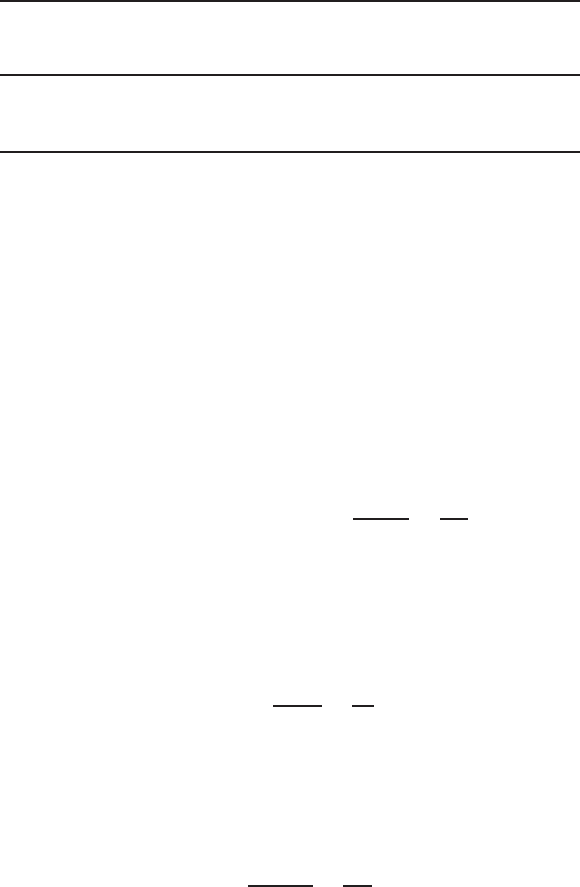
392 APPLICATIONS IN MASS TRANSFER WITH CHEMICAL REACTION
TABLE 6.13-1 Operating Conditions for the Three CSTR Absorber
Performance Curves Shown in Figure 6.13-2
Mass-Transfer Coefficient Contact Interfacial Area
for Physical Absorption Time per Unit Volume
Curve D
AS
(cm
2
/s)k
•
L0
(cm/s)t
o
(s)a(cm
2
/cm
3
)
A5×10
−5
0.04 250 1.0
B5× 10
−5
0.04 2500 0.1
C5× 10
−5
0.4 250 0.1
its maximum value for purely physical absorption, as a function of the reaction rate
constant k
1
for the three sets of operating conditions defined in Table 6.13-1. We
use the results of our scaling analysis for the microscale and macroscale elements
to explain the shape and characteristics of these curves.
Note that the quasi-stationary hypothesis is rigorous for a CSTR since there is no
accumulation for steady-state operation. Moreover, for a CSTR, φa = 1, since there
are no packing elements to occupy volume and the microscale elements (bubbles)
are assumed to be mathematical points on the macroscale.
We first need to determine the maximum possible total absorption rate for purely
physical absorption. The mass-transfer rate per unit volume, N
A
a, can be deter-
mined from a material balance on the transferring component over the entire volume
of the CSTR:
Q
L
(c
A2
− c
A1
) = N
A
aV
T
⇒ N
A
a =
Q
L
c
A2
V
T
=
c
A2
t
o
(6.13-1)
where t
o
is the contact or residence time of the liquid in the CSTR.
11
The maxi-
mum possible value of the mass-transfer rate per unit volume for purely physical
absorption denoted here by N
m
A
a corresponds to the exiting liquid having the ther-
modynamic equilibrium concentration c
◦
A
; hence,
N
m
A
a =
Q
L
c
◦
A
V
T
=
c
◦
A
t
o
(6.13-2)
Let us first consider the flat portion of all three curves at the lowest values
of k
1
for which the mass transfer must be occurring via physical absorption in
the absence of any reaction. The relative absorption ratio in the purely physical
absorption regime is given by
χ =
N
A
aV
T
N
m
A
aV
T
=
c
A2
c
◦
A
(6.13-3)
11
Note that the control volume here is the total volume of the CSTR rather than the differential slice
used in the macroscale balance that led to equations (6.8-1) and (6.8-2). There is an accumulation term
(in a convected coordinate system) in the latter that balances the mass transfer from the microscale to
the macroscale. However, in the former there is no accumulation term since the mass transfer from the
microscale to the macroscale element balances the reaction term.