
Krantz W.B. Scaling Analysis in Modeling Transport and Reaction Processes: A Systematic Approach to Model Building and the Art of Approximation
Подождите немного. Документ загружается.


DESIGN OF A CONTINUOUS STIRRED TANK REACTOR 393
Figure 6.13-2 indicates that χ
∼
=
1 × 10
−3
(log χ =−3) for k
1
< 1 × 10
−8
s
−1
(log k
1
=−8) for curve B and for k
1
< 1 × 10
−7
s
−1
(log k
1
=−7) for curves
A and C, implying that the liquid exiting this CSTR is far from thermodynamic
equilibrium.
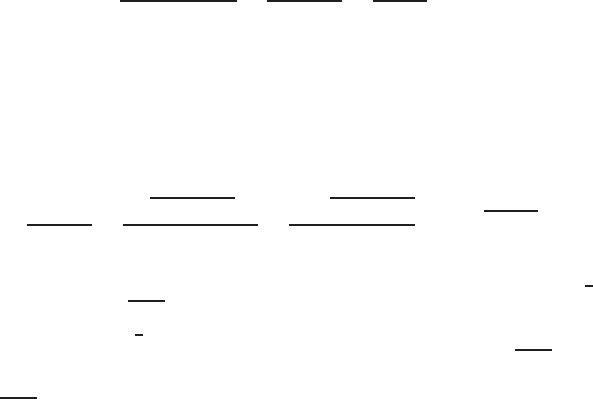
The criterion for purely physical absorption is given by equation (6.8-17), which
assumes the following form for first-order kinetics:
R
m
A
φ
k
•
L0
c
◦
A
=
k
1
c
◦
A
φ
k
•
L0
c
◦
A
=
k
1
k
•
L0
a
∼
=
0 (6.13-4)
Table 6.13-1 indicates that the product k
•
L0
a is an order of magnitude smaller for
curve B than for curves A and C. Hence, the criterion given by equation (6.13-4)
explains why curve B begins deviating from purely physical absorption at a value of
k
1
(
∼
=
1 × 10
−8
) one order of magnitude smaller than for curves A and C
(
∼
=
10
−7
).
Once the criterion given by equation (6.13-4) is no longer satisfied, χ begins to
increase, owing to a transition to the kinetic domain of the slow reaction regime
for which the transfer from the microscale to the macroscale is sufficiently fast so
that ˆc
A
∼
=
c
◦
A
; hence, equation (6.11-4) implies the following for χ:
χ ≡
N
A
aV
T
N
m
A
aV
T
=
R
A
φaV
T
Q
L
c
◦
A
=
k
1
V
T
Q
L
= k
1
t
o
(6.13-5)
where we have used the fact that φa = 1 for a CSTR. It follows that a log-log plot
of χ versus k
1
should be linear with a slope of +1 and an intercept of log t
o
when
k
1
= 1(log k
1
= 0). Figure 6.13-2 indicates that the slopes of all three curves are
+1 in the linear region (on a log-log plot), but that curve B has an intercept of 3.4
at k
1
= 1, corresponding to t
o
= 2500, whereas curves A and C have an intercept
of 2.4 at k
1
= 1, corresponding to t
o
= 250.
As k
1
increases there will be a transition from the kinetic to the diffusional
domain of the slow reaction regime for which ˆc
A
= c
Ar
= 0 for the assumed irre-
versible kinetics. The criterion for this transition based on our scaling analysis is
given by equation (6.10-1) and becomes the following for this example:
R
m
A
φ
k
•
L0
c
◦
A
=
k
1
k
•
L0
a
1 (6.13-6)
where we have again used the fact that φa = 1. Table 6.13-1 indicates that the
product k
•
L0
a is an order of magnitude smaller for curve B than for curves A and
C. Hence, the criterion given by equation (6.13-6) explains why curve B enters the
diffusional domain at a value of k
1
(
∼
=
1 × 10
−1
) one order of magnitude smaller
than for curves A and C (
∼
=
1). In the diffusional domain of the slow reaction regime
equation (6.11-5) implies the following for χ:
χ ≡
N
A
aV
T
N
m
A
aV
T
=
k
•
L0
ac
◦
A
V
T
Q
L
c
◦
A
= k
•
L0
at
o
(6.13-7)
394 APPLICATIONS IN MASS TRANSFER WITH CHEMICAL REACTION
Equation (6.13-7) explains why χ is independent of k
1
andequalto10(logχ = 1)
for all three curves in the diffusional domain of the slow reaction regime; that is,
k
•
L0
at
o
= 10 for all three curves.
Eventually, k
1
will become sufficiently large, so that the chemical reaction can
occur on the microscale; that is, there will be a transition to the fast reaction regime
for which ˆc
A
= c
Ar
= 0 for the assumed irreversible kinetics. The criterion for this
transition given by equation (6.6-1) becomes the following for this example:
R
m
A
δ
2
m
D
AS
(c
◦
A
−ˆc
A
)
=
k
1
c
◦
A
D
AS
k
•
2
L0
c
◦
A
=
k
1
D
AS
k
•
2
L0
1 (6.13-8)
Table 6.13-1 indicates that the quotient D
AB
/k
•
2
L0
is two orders of magnitude larger
for curves A and B than for curve C. Hence, the criterion given by equation (6.13-8)
explains why curves A and B enter the fast reaction regime at a value of k
1
(
∼
=
10)
two orders of magnitude smaller than for curve C (
∼
=
10
3
). In the fast reaction
regime, equation (6.11-9) implies the following for χ :
χ ≡
N
A
aV
T
N
m
A
aV
T
=
a
D
AS
c
◦
A
R
m
A
V
T
Q
L
c
◦
A
=
at
o
D
AS
c
◦
A
R
m
A
c
◦
A
= at
o
D
AS
k
1
(6.13-9)
It follows that a log-log plot of χ versus k
1
should be linear with a slope of +
1
2
and
an intercept of at
o
√
D
AS
when k
1
= 1. Figure 6.13-2 indicates that the slopes of
all three curves are +
1
2
in the linear region (on a log-log plot), but that curve C has
an intercept of −0.75 at k
1
= 1(log k
1
= 0), corresponding to at
o
√
D
AS
= 0.177,
whereas curves A and B have an intercept of 0.25 at k
1
= 1, corresponding to
at
o
√
D
AS
= 1.77.
This example demonstrates that systematic scaling analysis can provide con-
siderable insight into interpreting performance data for chemisorption as well as
other contacting devices that involve transport phenomena. Indeed, we were able
to obtain quantitative estimates of where the various reaction regimes apply as
well as the reaction rates in each of these regimes without the need to solve any
differential equations.
6.14 DESIGN OF A PACKED COLUMN ABSORBER
In this section we apply the results of our microscale–macroscale scaling analysis
in order to design a packed gas-absorption column. This contacting device, shown
schematically in Figure 6.14-1, involves the use of small packing elements such
as spheres, hollow cylinders, saddle-shaped particles, and other specially designed
structures to provide a large contact area between the liquid and gas streams. The
liquid flows over the packing elements cocurrently or countercurrently relative to
an upward-flowing gas stream from which it absorbs some soluble component. In
this example a solute A is to be removed from a nonabsorbing gas by cocurrent
absorption in a liquid solvent S.ThesolventS contains an active component B
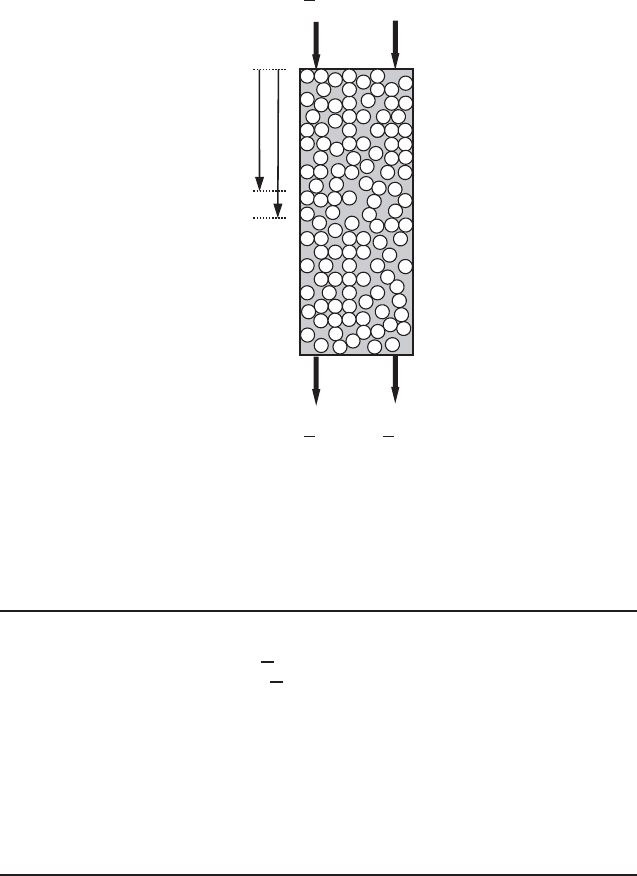
DESIGN OF A PACKED COLUMN ABSORBER 395
z
Gas in
Gas out
z
+Δz
p
A2
c
A2
p
A1
c
A1
ˆ
Liquid in
Liquid out
Figure 6.14-1 Packed column for absorbing a solute A from a nonabsorbing gas by cocur-
rent absorption in a liquid solvent S that contains an active component B which reacts with
A by a first-order irreversible reaction.
TABLE 6.14-1 Performance Data for a Packed Gas-Absorption Column
Gas molar flow rate, W
G
0.3mol/s
Solute concentration in inlet liquid, ˆc
A1
0
Solute partial pressure in inlet gas,
p
A1
1.0 ×10
4
Pa
Solute partial pressure in outlet gas,
p
A2
5Pa
Reaction-rate constant, k
1
1.0 ×10
3
s
−1
Liquid holdup, φ 1 ×10
−3
m
3
/m
2
Interfacial area per unit volume, a 10 m
2
/m
3
Liquid-phase mass-transfer coefficient for physical absorption, k
•
L0
1.0 ×10
−4
m/s
Effective diffusivity of solute in liquid, D
AS
1.2 ×10
−9
m
2
/s
Henry’s law constant, H 70 Pa · m
3
/mol
Column pressure, P 1 × 10
5
Pa
Column cross-sectional area, S
c
0.07 m
2
that reacts with component A, which is assumed to be the limiting reactant, by
a first-order irreversible reaction. Performance data for this absorber are given in
Table 6.14-1.
Let us first determine the ratio of the characteristic diffusion time to that for
chemical reaction to assess the reaction regime in which this chemisorption

396 APPLICATIONS IN MASS TRANSFER WITH CHEMICAL REACTION
process occurs:
R
m
A
δ
2
m
D
AS
(c
◦
A
−ˆc
A
)
=
k
1
c
◦
A
D
AS
k
•
2
L0
(c
◦
A
− 0)
=
(1.0 × 10
3
s
−1
)
1.2 × 10
−9
m
2
/s
1.0 ×10
−4
m/s
2
=120
(6.14-1)
In evaluating the above, we have estimated the diffusion penetration thickness on
the microscale using film theory; that is, δ
m
= D
AS
/k
•
L0
. The criterion given by
equation (6.6-1) then indicates that this chemisorption occurs in the fast reaction
regime, for which ˆc
A
= c
Ar
= 0 for the assumed irreversible reaction and the mass-
transfer flux is given by equation (6.12-12); that is,
N
A
=−
2D
AS
R
m
A
c
◦
A
1
0
R
∗
A
dc
∗
A
1/2
=−(D
AS
k
1
)
1/2
c
◦
A
(6.14-2)
For the fast reaction regime the mass-transfer coefficient for transfer from the
microscale to the macroscale is greater than that for purely physical absorption and
can be determined via equation (6.12-14):
k
•
L
=−
2D
AS
R
m
A
c
◦
A
1
0
R
∗
A
dc
∗
A
1/2
c
◦
A
= (D
AS
k
1
)
1/2
=
&
1.2 × 10
−9
m
2
/s
(1.0 ×10
3
s
−1
)
'
1/2
= 1.1 × 10
−3
m/s
(6.14-3)
We see that the mass-transfer coefficient for chemisorption in the fast reaction
regime is an order of magnitude larger than that for purely physical absorption.
Now let us determine the height of the absorption column required to achieve
the given change in the gas-phase composition. Note that no data are given for
the change in the liquid-phase composition. This is because this reaction occurs
in the fast reaction regime, which keeps the bulk concentration of component A on
the macroscale equal to the reaction equilibrium concentration, which is zero for
the assumed irreversible kinetics. Under fast reaction conditions, a material balance
in the liquid phase on the transferring component provides no information what-
soever. One could determine the column height from a knowledge of the increase
in concentration of the product of the chemisorption reaction in the liquid phase.
However, no information is provided on this component. Hence, to determine the
column height, we will carry out a material balance on the transferring compo-
nent in the gas phase. A species balance on component A in the gas phase for
a macroscale element consisting of a differential length z in a fixed coordinate
system yields
N
A
aS
c
z =
W
G
p
A
P
z
−
W
G
p
A
P
z+z
k
•
L
aS
c
c
◦
A
=
k
•
L
aS
c
p
A
H
=−
W
G
P
d
p
A
dz
(6.14-4)

SUMMARY 397
where W
G
is the molar flow rate of the gas. Integrating equation (6.14-4) over the
length of the column then yields the following for the absorption column height
required:
L =−
W
G
H
Pk
•
L
aS
c
ln
p
A1
p
A2
=−
(
0.3mol/s
)
70 Pa ·m
2
/mol
(1 × 10
5
Pa)
1.1 ×10
−3
m/s
10 m
2
/m
3
(0.07 m
2
)
ln
5
1 × 10
4
= 2.1m
(6.14-5)
Note that the liquid-phase concentration does not enter into either equation (6.14-
2) for the mass-transfer flux or equation (6.14-5) for the column height. This is
because the chemisorption is in the fast reaction regime that maintains the liquid at
the reaction equilibrium concentration. One implication of this is that the column
height required, determined by equation (6.14-5), would not change if we were
to employ countercurrent rather than cocurrent flow. However, under fast reaction
conditions one would choose cocurrent flow because of the reduced pressure drop
requirement. Moreover, flooding of the packed column owing to the gas holding
up the liquid in countercurrent flow is avoided in cocurrent flow. Hence, we see
that scaling the describing equations to determine the reaction regime is pivotal in
choosing both the contacting device and the flow configuration.
Now let us consider how we can use the results of our scaling analysis to improve
the performance of this packed absorption column. In doing this we refer to the
design precepts developed in Section 6.11. Consider first an increase in the liquid
flow rate. This will improve the performance of this packed column operating in the
fast reaction regime only if it increases a, the interfacial area per unit volume; this
increase will not be significant. However, a larger increase in a could be achieved
by changing the type or size of packing elements. Decreasing the gas flow rate
will decrease the required column height since less of the transferring solute will
enter the column. This will also cause an increase in the bubble size and therefore
a decrease in a; this will cause a small decrease in the mass-transfer rate per unit
volume. Increasing P , the operating pressure, or decreasing the temperature in the
column will improve the performance by increasing the thermodynamic equilibrium
solubility of the transferring solute. Increasing k
1
, the reaction-rate constant, will
also improve the performance significantly. This could be done by increasing the
operating temperature or employing a different reacting component in the liquid.
Hence, changing the temperature could either increase or decrease the performance,
depending on whether its influence on the equilibrium solubility or the reaction-rate
constant dominates.
6.15 SUMMARY
In this chapter we focused on the complications that are encountered in pro-
cesses involving chemical reaction that often have mass transfer occurring on
398 APPLICATIONS IN MASS TRANSFER WITH CHEMICAL REACTION
two markedly different length scales. In particular, we considered chemisorption
whereby the solubility of a transferring solute is enhanced by chemical reaction.
The microscale–macroscale modeling methodology developed in this chapter for
mass transfer with chemical reaction can be applied equally well to other processes
involving momentum, heat, or mass transfer occurring on multiple scales, such as
phase-transition phenomena, heat transfer in dispersed phase systems, and others.
In Section 6.2 we provided an example illustrating microscale and macroscale
elements. An important consideration is that for mass transfer with chemical reac-
tions the microscale element becomes a homogeneous point source or sink term in
the macroscale balance.
Scaling analysis was applied to the microscale species-balance equations for
mass transfer in Section 6.3. Scaling led to three time scales associated with the
diffusion, reaction, and contact times. When the ratio of the diffusion to contact
time was very small, steady-state mass transfer can be assumed for the microscale
element for which film theory models are applicable. When this ratio is large,
the mass transfer is inherently unsteady-state, for which penetration theory models
can be used. For purely diffusive mass transfer a film theory model interrelated
the mass-transfer coefficient and the microscale fluid layer thickness, whereas a
penetration theory model interrelated it to the contact time.
Scaling analysis was used in Section 6.4 to develop a criterion for the slow
reaction regime for which the ratio of the diffusion to the reaction time was very
small for the microscale element. Since the chemical reaction does not occur in
the microscale element, the mass-transfer coefficient for the slow reaction regime
is the same as for purely physical absorption.
In Section 6.5, scaling analysis was used to identify a criterion for the inter-
mediate reaction regime for which the diffusion and reaction times are of equal
magnitude. For this reaction regime the chemical reaction occurs on the microscale,
which implies that the mass-transfer coefficient is greater than that for purely phys-
ical absorption.
In Section 6.6, scaling analysis was used to develop the criterion for the fast
reaction regime for which the reaction time is sufficiently fast to maintain the
bulk liquid at the reaction equilibrium concentration. In the fast reaction regime a
reaction boundary layer or region of influence exists within the microscale liquid
layer, within which the concentration of the absorbing component undergoes a
characteristic change.
In Section 6.7 we considered the criterion for the instantaneous reaction regime
for which the reaction is so fast that the reacting components cannot co-exist at
any point within the microscale element. This regime implies that the nonvolatile
liquid-phase reactant becomes rate-limiting, owing to its depletion in the microscale
liquid layer. The inner domain of the instantaneous reaction regime corresponds
to a reaction plane within the liquid layer of the microscale element at which the
concentrations of the reacting components are reduced to zero. The surface domain
of the instantaneous reaction regime corresponds to the reaction plane being at the
gas–liquid interface, for which the mass transfer becomes gas-phase controlled.
PRACTICE PROBLEMS 399
The describing equations for the macroscale element for which the transfer
from the microscale element appears as a homogeneous source term were scaled in
Section 6.8. This macroscale element is relevant only for the slow or intermediate
reaction regimes, for which the reaction is not sufficiently fast to maintain the bulk
liquid at the reaction equilibrium concentration. Scaling led to three time scales
associated with the mass transfer from the microscale, reaction, and macroscale
contact times.
In Section 6.9 we considered the kinetic domain of the slow reaction regime. In
this domain the mass transfer from the microscale is sufficiently fast to maintain
the bulk liquid at the thermodynamic equilibrium concentration.
In Section 6.10 we considered the diffusional domain of the slow reaction
regime. In this domain the chemical reaction is sufficiently fast on the macroscale
to maintain the bulk liquid at the reaction equilibrium concentration.
The results of scaling analysis for the various reaction regimes were used in
Section 6.11 to develop a set of precepts for the design of contacting equipment for
mass transfer with chemical reaction. The power of scaling analysis was particularly
apparent in this section since it provided invaluable information for choosing and
operating mass-transfer contacting devices without the need for developing any
models or solving any differential equations.
The mass-transfer coefficients correlated in the literature can be used to design
contacting devices only for the slow reaction regime. For faster kinetics, microscale
models need to be developed to determine the mass-transfer coefficients. In Section
6.12, film theory was used to demonstrate how a model can be developed for
the mass-transfer coefficients in the intermediate, fast, and instantaneous reaction
regimes.
The results of scaling analysis were used in Section 6.13 to design a mass trans-
fer process involving a first-order irreversible reaction in a CSTR. In particular,
it was used to interpret performance data for the increase in rate of chemisorp-
tion as a function of the reaction-rate constant. Nearly all features of the com-
plex performance curves for three representative sets of operating conditions were
explained using the scaling analysis results without the need to solve any differential
equations.
In Section 6.14, the results of scaling analysis were used to design a continu-
ous packed gas-absorption column. Scaling permitted determining how the various
process parameters affected the performance of this device. Again, emphasis was
placed on how much information could be obtained from scaling analysis without
the need for developing and solving complex models.
6.P PRACTICE PROBLEMS
6.P.1 Criterion for Ignoring the Gas-Phase Resistance to Mass Transfer
Throughout this chapter, with the exception of the surface domain of the instanta-
neous reaction regime, we have assumed that the resistance offered to mass transfer

400 APPLICATIONS IN MASS TRANSFER WITH CHEMICAL REACTION
by the gas phase was negligible in comparison to that of the liquid phase. Assume
that the gas-phase mass transfer rate per unit volume N
A
a is described by
N
A
a = k
•
G0
ap
A
(6.P.1-1)
in which k
•
G0
is the gas-phase mass-transfer coefficient, a the interfacial area per
unit volume of contacting device, and
p
A
the partial pressure of the absorbing
component A in the gas phase. The thermodynamic equilibrium liquid-phase com-
position c
◦
A
is related to the partial pressure p
A
by Henry’s law given by p
A
= Hc
◦
A
,
where H is the Henry’s law constant. Use scaling analysis to develop a criterion
for ignoring the gas-phase relative to the liquid-phase mass transfer.
6.P.2 Penetration Theory Model for a Slow Reaction Regime
In Section 6.3 we scaled the definition of the mass-transfer flux for purely physical
unsteady-state absorption and obtained equation (6.3-29) that interrelates the mass-
transfer coefficient and the contact time. In principle, scaling analysis can provide
only an order-of-magnitude estimate of any quantity such as the mass-transfer
coefficient.
(a) Develop a penetration theory model to obtain a rigorous solution for the
interrelationship between the mass-transfer coefficient and the contact time
for unsteady-state purely physical absorption.
(b) Compare the result you obtained in part (a) with that obtained via scaling
analysis.
6.P.3 Correlation for a Liquid-Phase Mass-Transfer Coefficient
Sherwood and Holloway provide the following correlation for the liquid-phase
mass-transfer coefficient for packed gas-absorption columns k
•
L0
(having dimen-
sions of L
3
/t)
12
:
k
•
L0
a
D
AS
=
ςU
0
μ
1−n
μ
ρD
AS
0.5
(6.P.3-1)
where a is the interfacial area per volume of contacting device, D
AS
the effective
binary diffusion coefficient, U
0
the superficial velocity of the liquid flow, μ the
shear viscosity of the liquid, ρ the mass density of the liquid, and ς and n are
dimensional (M/L
2
) and dimensionless constants, respectively, that depend on the
type and size of the packing elements.
(a) Compare the estimate that we obtained from scaling analysis using the film
theory model given by equation (6.3-25) with the correlation of Sherwood
and Holloway.
12
T. K. Sherwood and F. A. L. Holloway, Trans. A.I.Ch.E., 36, 21, 39, 181 (1940).

PRACTICE PROBLEMS 401
(b) Compare the estimate that we obtained from scaling analysis using the
penetration theory model given by equation (6.3-29) with the correlation
of Sherwood and Holloway.
6.P.4 Slow Reaction Regime for Nondilute Solutions
Throughout this chapter we have assumed dilute solutions of the absorbing com-
ponent so that the convective contribution to Fick’s law could be ignored. Assume
now that the solutions are sufficiently concentrated that the convective term in
Fick’s law cannot be neglected; that is,
N
A
=−D
AS
c
∂x
A
∂z
+ c
A
ˆu = N
A
=−D
AS
c
∂x
A
∂z
+ x
A
(N
A
+ N
B
+ N
S
) (6.P.4-1)
in which ˆu is the molar-average velocity and x
A
is the mole fraction of the absorbing
component A.
(a) Scale the microscale element to determine the criterion for the applicability
of the slow reaction regime; assume that the liquid-phase component S is
nonvolatile, which implies unimolecular diffusion of component A in the
microscale element.
(b) Determine the criteria for ignoring the convective term in Fick’s law.
6.P.5 Microscale Element Scaling for a Reversible Unimolecular Reaction
In Section 6.3 we scaled the describing equations for the microscale element for
an irreversible bimolecular first-order reaction. Now let us consider the situation
where solute A is chemisorbed in the liquid S via a reversible unimolecular reaction
given by R
A
= k
1
(c
A
− c
◦
Ar
),wherec
◦
Ar
is the reaction equilibrium concentration;
that is, the concentration that is achieved when the reaction goes to completion.
(a) Scale the describing equations for the microscale element to determine the
relevant time scales.
(b) Determine the criterion for the slow reaction regime.
(c) Determine the criterion for the intermediate reaction regime.
(d) Determine the criterion for the fast reaction regime.
(e) Determine the criterion for the instantaneous reaction regime.
(f) Determine the criterion for steady-state mass transfer on the microscale.
(g) Estimate the thickness of the region of influence for very short contact times.
6.P.6 Microscale Element Scaling for an Irreversible nth-Order Reaction
In Section 6.3 we scaled the describing equations for the microscale element for
an irreversible bimolecular first-order reaction. Now let us consider the situation
402 APPLICATIONS IN MASS TRANSFER WITH CHEMICAL REACTION
where solute A is chemisorbed in the liquid S via an irreversible nth-order reaction
given by R
A
= k
n
c
n
A
.
(a) Scale the describing equations for the microscale element to determine the
relevant time scales.
(b) Determine the criterion for the slow reaction regime.
(c) Determine the criterion for the intermediate reaction regime.
(d) Determine the criterion for the fast reaction regime.
(e) Determine the criterion for the instantaneous reaction regime.
(f) Determine the criterion for quasi-steady-state.
(g) Estimate the thickness of the region of influence for very short contact times.
6.P.7 Applicability of the Quasi-stationary Hypothesis for Physical
Absorption
In Section 6.8 we considered the quasi-stationary hypothesis whereby the accu-
mulation term in the macroscopic balance is assumed to be very small. We then
invoked this assumption to explore the implications of a very slow and very fast
reaction time relative to the time scale for interphase mass transfer. This led to
identifying the kinetic and diffusional domains of the slow reaction regime. Con-
sider the applicability of the quasi-stationary hypothesis for the macroscale balance
given by equation (6.8-11) for purely physical absorption for which there is no
chemical reaction. Discuss any anomalies that result from the application of the
quasi-stationary hypothesis and their implications for the applicability of the quasi-
stationary hypothesis.
6.P.8 Effect of Axial Dispersion in the Macroscale Balance for a Packed
Absorption Column
In carrying out the macroscale balance in Section 6.8, we did not include the term
associated with axial dispersion of species. In this problem we include this term in
the macroscale balance for a packed gas-absorption column to develop a criterion
for when it can be neglected. We assume that the axial dispersion is characterized by
a constant dispersion coefficient D
L
that accounts for both axial diffusion due to the
concentration gradients and dispersion due to the presence of the packing elements.
(a) Use scaling analysis to develop a criterion for ignoring the axial dispersion
term. Scaling the macroscale balance equation for the packed absorption
column is facilitated by recasting it in a fixed coordinate rather than a
convected coordinate system.
(b) In Chapter 6 we found that the axial diffusion term could not be ignored
within a region of influence whose thickness we estimated using scaling
analysis. Use scaling analysis to estimate the thickness of the region of
influence wherein the axial dispersion term cannot be ignored.