
Krantz W.B. Scaling Analysis in Modeling Transport and Reaction Processes: A Systematic Approach to Model Building and the Art of Approximation
Подождите немного. Документ загружается.

PRACTICE PROBLEMS 403
6.P.9 Intermediate Domain of a Slow Reaction Regime
In the slow reaction regime we considered two limiting cases, corresponding to the
kinetic and diffusional domains that applied when the reaction rate was very slow
and very fast, respectively, in comparison to the mass transfer from the microscale
to the macroscale. There must also be an intermediate domain between these two
limiting cases for which the characteristic times for reaction and mass transfer from
the microscale to the macroscale are comparable.
(a) Determine the criterion for applicability of this intermediate domain of the
slow reaction regime.
(b) Discuss the implications of this intermediate domain of the slow reaction
regime for reactor design; that is, indicate how the various process param-
eters will affect the performance in this domain.
(c) Contrast the equation that you obtained for the mass-transfer rate per unit
volume for the intermediate reaction domain with those that were obtained
for the kinetic and diffusional domains of the slow reaction regime.
6.P.10 Macroscale Element Scaling for a Reversible Unimolecular Reaction
Consider the describing equations for the macroscale element for the reversible
unimolecular reaction described in Practice Problem 6.P.5 for the special case of
the slow reaction regime.
(a) Determine the criterion for the applicability of the quasi-stationary hypo-
thesis.
(b) Determine the criterion for the kinetic domain.
(c) Determine the criterion for the intermediate domain. Note: See Practice
Problem 6.P.9 regarding the intermediate domain of the slow reaction
regime.
(d) Determine the criterion for the diffusional domain.
6.P.11 Macroscale Element Scaling for an Irreversible nth-Order Reaction
Consider the describing equations for the macroscale element for the irreversible
nth-order reaction unimolecular reaction described in Practice Problem 6.P.6 for
the special case of the slow reaction regime.
(a) Determine the criterion for the applicability of the quasi-stationary hypo-
thesis.
(b) Determine the criterion for the kinetic domain.
(c) Determine the criterion for the intermediate domain. Note: See Practice Prob-
lem 6.P.9 regarding the intermediate domain of the slow reaction regime.
(d) Determine the criterion for the diffusional domain.
404 APPLICATIONS IN MASS TRANSFER WITH CHEMICAL REACTION
6.P.12 Implications of the Intermediate Reaction Regime for a Microscale
Element on the Macroscale Balance
The slow reaction regime differs from the fast reaction regime in that the mass-
transfer coefficient is the same as that for physical absorption in the former.
Moreover, in the fast reaction regime the reaction is fast enough to maintain
the bulk fluid at the reaction equilibrium concentration. Consider now the inter-
mediate reaction regime for the microscale element. The reaction is sufficiently
fast so that the mass-transfer coefficient is greater than that for purely physical
absorption. However, it is not necessarily fast enough to maintain the bulk fluid
at the reaction equilibrium concentration. In this problem we consider the impli-
cations of the intermediate reaction regime for the macroscale element describing
equations.
(a) Scale the describing equations for the macroscale element for which the
mass-transfer term corresponds to the intermediate reaction regime; in par-
ticular, identify the three time scales appropriate to this scaling.
(b) Consider the applicability of the kinetic domain; if this domain is possible,
develop a criterion for its occurrence and contrast the criteria for this domain
for the slow and intermediate reaction regimes.
(c) Consider the applicability of the diffusional domain; if this domain is pos-
sible, develop a criterion for its occurrence and contrast the criteria for this
domain for the slow and intermediate reaction regimes.
(d) Based on your results in parts (b) and (c), discuss critically how the slow
and intermediate reaction regimes differ on both the micro- and macroscales.
6.P.13 Comparison of the Fast Reaction Regime and the
Diffusional Domain of the Intermediate Reaction Regime
Consider the intermediate reaction regime for which the reaction is not necessarily
fast enough to maintain the bulk fluid at the reaction equilibrium concentration.
In addition, the mass-transfer coefficient is not equal to that for purely physi-
cal absorption. When the macroscale balance is considered for the intermediate
reaction regime, it is possible that it will admit both a kinetic and a diffusional
domain for conditions similar to those determined by scaling for the slow reac-
tion regime. If the intermediate reaction regime admits a diffusional domain, it
would imply that the bulk fluid concentration is equal to the reaction equilib-
rium concentration. Hence, for both the fast reaction regime and the diffusional
domain of the intermediate reaction regime, the mass-transfer coefficient is not
that for purely physical absorption and the bulk-fluid concentration is the reac-
tion equilibrium concentration. Superficially, these two reaction regimes appear
to be the same when, in fact, they are not. Discuss critically how the diffu-
sional domain of the intermediate reaction regime differs from the fast reaction
regime.

PRACTICE PROBLEMS 405
6.P.14 Discriminating Between the Fast Reaction Regime and the Kinetic
Domain of the Slow Reaction Regime
In Section 6.11 we found for both the fast reaction regime and the kinetic domain of
the slow reaction regime that the mass-transfer rate per unit volume of reactor was
independent of the mass-transfer coefficient for physical absorption k
•
L0
,whichis
strongly dependent on the hydrodynamics. Moreover, in Section 6.11 we stated that
if one observes that the contactor performance is independent of the hydrodynamics,
it indicates that the chemisorption is occurring in the fast reaction regime. Critically
assess the validity of the latter statement based on the design precepts for the two
reaction regimes discussed in Section 6.11; that is, it would appear that if neither of
these two reaction regimes depends on k
•
L0
, which depends on the hydrodynamics,
how in fact can we make the claim that if the contactor performance is independent
of the hydrodynamics, it is operating in the fast reaction regime?
6.P.15 Transition Between the Inner and Surface Domains in the
Instantaneous Reaction Regime for Gas Absorption
The instantaneous reaction regime for gas absorption with a bimolecular reaction
implies that the chemical reaction is so fast that the two reactants cannot coex-
ist. Hence, the instantaneous reaction is confined to a plane that separates two
regions, in each of which only one of the reactants is diffusing. In the inner reac-
tion domain of the instantaneous reaction regime, this reaction plane is in the liquid
phase, whereas in the surface domain it is at the interface between the gas and liq-
uid phases. In contactors such as packed columns, the reaction regime can change
along the length of the column due to changes in the concentrations that affect the
reaction rate. In this problem we explore both the criterion and its implications for
chemisorption in a packed gas absorption column. We assume that the gas-phase
partial pressure of the absorbing component is
p
A
and that the absorption equilib-
rium at the gas–liquid interface is defined by
p
A
= H c
◦
A
,whereH is a constant.
(a) Use the results of our scaling analyses for the inner and surface domains
of the instantaneous reaction regime to develop a criterion for the transition
between these two domains. Note that for the inner reaction domain the
mass-transfer rate per unit volume in the gas phase must be equal to that in
the liquid phase.
(b) Assume that the gas and liquid flow cocurrently down a packed gas absorp-
tion column operation in the instantaneous reaction regime. If a transition
between the inner and surface domains occurs in this column, indicate where
each domain will occur relative to the top of the column.
6.P.16 Fast Reaction Regime for an nth-Order Reaction
Consider the fast reaction regime for the special case of an nth-order reversible
reaction given by R
A
= k
n
(c
A
− c
◦
Ar
)
n
,inwhichc
◦
Ar
is the reaction equilibrium
concentration of the absorbing component.
406 APPLICATIONS IN MASS TRANSFER WITH CHEMICAL REACTION
(a) Integrate equation (6.12-12) for this nth-order reaction to determine the con-
centration profile for the microscale element.
(b) Use the result of part (a) to derive an equation for the thickness of the region
required for the concentration to decrease from its maximum value of c
◦
A
to
its minimum value for the fast reaction regime of c
◦
Ar
.
(c) For n<1 the thickness you calculated in part (b) is finite, whereas for
n>1, it is infinite; reconcile this with the result of scaling analysis for the
thickness of the region of influence for the fast reaction regime given by
equation (6.6-2), which predicts a finite thickness for any value of n. Hint:
Use your result from part (a) in a film theory model to estimate the effective
thickness.
6.P.17 Steady-State Approximation for the Inner Domain
of the Instantaneous Reaction Regime
Use scaling analysis to develop criteria for assuming steady-state for the inner
domain of the instantaneous reaction regime; that is, develop criteria for using a
film theory model to describe this reaction regime.
6.P.18 Improved Model for the Inner Domain of the Instantaneous
Reaction Regime
The steady-state approximation will apply for the inner domain of the instantaneous
reaction regime only for very long contact times for which the diffusive penetration
of the liquid-phase reactant extends from the reaction plane to the outer edge of the
microscale element. An improved model for this reaction regime can be developed
by recognizing that the reaction plane will be very close to the gas–liquid interface
if the contact time is not too long. Hence, quasi-steady-state conditions can be
assumed for the region in which the absorbing component is diffusing, whereas the
unsteady-state term is retained in the region in which the liquid-phase reactant is
diffusing.
(a) Use scaling analysis to develop the criterion for assuming quasi-steady-
state conditions in the region wherein the absorbing component is dif-
fusing.
(b) Develop an analytical solution for the mass-transfer flux and mass-transfer
coefficient, assuming quasi-steady-state in the region where the absorbing
component is diffusing but unsteady-state in the region where the liquid-
phase reactant is diffusing. Note that the differential equation in the unsteady-
state region can be solved using either the method of combination of vari-
ables or Laplace transforms.
(c) Compare the result you obtained in part (b) for the mass-transfer coeffi-
cient to that obtained for the steady-state film theory model developed in
Section 6.12.
PRACTICE PROBLEMS 407
6.P.19 Model for the Mass-Transfer Coefficient for a First-Order
Reversible Reaction in the Intermediate Reaction Regime
In Section 6.12 we developed a film theory model to obtain an equation for the
mass-transfer coefficient for a zeroth-order reaction. Develop a film theory model
for the mass-transfer coefficient appropriate to a first-order reversible reaction given
by R
A
= k
n
(c
A
− c
◦
Ar
),inwhichc
◦
Ar
is the reaction equilibrium concentration of
the absorbing component.
6.P.20 Model for the Mass-Transfer Coefficient for a First-Order
Reversible Reaction in the Fast Reaction Regime
In Section 6.12 we developed a film theory model to obtain an integral equation for
the mass-transfer coefficient for the fast reaction regime with unspecified reaction
kinetics.
(a) Develop a film theory model for the mass-transfer coefficient appropriate to
a first-order reversible reaction for which R
A
= k
n
(c
A
− c
◦
Ar
),inwhichc
◦
Ar
is the reaction equilibrium concentration of the absorbing component.
(b) Compare the result you obtained in part (a) with that given by equation
(6.12-14); in particular, discuss any anomalies that are observed when you
make this comparison.
6.P.21 Macroscale Element Scaling for a Zeroth-Order Reversible Reaction
In Section 6.12 we developed an equation for the mass-transfer coefficient for
an irreversible zeroth-order reaction in the intermediate reaction regime. In this
problem we will consider the slow reaction regime for a zeroth-order reversible
reaction for which the reaction rate per unit volume R
A
is given by
R
A
= k
0
ξ
ξ = 0forˆc
A
≤ c
◦
Ar
ξ = 1forˆc
A
>c
◦
Ar
(6.P.21-1)
(a) Scale the macroscale element for the slow reaction regime for this reversible
zeroth-order reaction and determine the criterion for the kinetic domain.
(b) Derive an equation for the mass-transfer rate per unit volume N
A
a for the
kinetic domain.
(c) Compare the design precepts for the kinetic domain for the special case of
the reversible zeroth-order reaction to those implied by equation (6.11-4)
for unspecified irreversible reaction kinetics.
(d) Scale the macroscale element for the slow reaction regime for this reversible
zeroth-order reaction and determine the criterion for the diffusional domain.
(e) Derive an equation for the mass-transfer rate per unit volume N
A
a for the
diffusional domain.
408 APPLICATIONS IN MASS TRANSFER WITH CHEMICAL REACTION
(f) Compare the design precepts for the diffusional domain for the special case
of the reversible zeroth-order reaction to those implied by equation (6.11-5)
for unspecified irreversible reaction kinetics.
(g) Discuss whether an intermediate domain of the slow reaction regime is
possible for a zeroth-order reversible reaction.
(h) Discuss the nature of the transition between the kinetic and diffusional
domains of the slow reaction regime for a gas-absorption column employing
chemisorption with a zeroth-order reversible reaction.
6.P.22 Design of a CSTR for an nth-Order Reversible Reaction Operating
in the Slow Reaction Regime
In Section 6.13 we considered the design of a CSTR for a first-order irreversible
reaction. In this problem we consider the design of a CSTR such as that shown in
Figure 6.13-1 for the special case of an nth-order reversible reaction operating in
the slow reaction regime for which the reaction rate per unit volume is given by
R
A
= k
n
(c
A
− c
◦
Ar
)
n
.
(a) Derive an equation for the total absorption rate N
A
aV
T
if the chemisorption
occurs in the kinetic regime of the slow reaction regime.
(b) Derive an equation for the total absorption rate N
A
aV
T
if the chemisorption
occurs in the diffusional regime of the slow reaction regime.
(c) Discuss the relative merits of using a CSTR if the chemisorption occurs in
the slow reaction regime.
6.P.23 Determining Kinetic Parameters for a CSTR
In Section 6.13 we considered how the results of our scaling analyses could be
used to interpret performance data for chemisorption through a first-order irre-
versible reaction in a CSTR. In this problem we explore how performance data
for chemisorption in a CSTR can be used to determine the kinetic parameters.
We assume that the chemisorption occurs via a first-order irreversible reaction for
which the reaction rate constant is k
1
. Moreover, we assume that the CSTR liquid
volume V
T
, diffusion coefficient D
AS
, thermodynamic equilibrium concentration
c
◦
A
, and inlet liquid concentration c
A1
are known. Let us assume that we can vary
both the contact time t
o
by changing the volumetric flow rate Q
L
, and the mixing
speed; the latter will change both k
•
L0
and a. Of course, a change in either the con-
tact time or mixing speed will change the outlet liquid concentration c
A2
,whichwe
assume can be measured. We wish to design a series of experiments to determine
the reaction regime and the following design parameters for the CSTR: k
1
,the
reaction rate constant; k
•
L0
, the mass-transfer coefficient for physical absorption;
and a, the interfacial area per unit volume of contacting device.
(a) Assume that we increase the contact time t
o
and find that χ = N
A
/N
m
A
> 1
and increases linearly with t
o
. This can occur for the kinetic and diffusional
PRACTICE PROBLEMS 409
domains of the slow reaction regime as well as for the fast reaction regime.
If we hold the contact time constant, what additional experiment(s) can be
done by changing the process parameters under our control to determine if
the chemisorption is occurring in the kinetic domain?
(b) Assume in part (a) that we establish that the chemisorption is in the kinetic
domain. What information associated with the kinetic parameters can we
determine from a measurement of the outlet liquid concentration c
A2
?
(c) What is the particular advantage of operating in the kinetic domain for
characterizing the reaction kinetics?
6.P.24 Determining the Interfacial Area per Unit Volume for a CSTR
In designing a CSTR for chemisorption, one would like to know k
•
L0
, the mass-
transfer coefficient for purely physical absorption, and a, the interfacial area per unit
volume of contacting device, as functions of the mixing speed or equivalently, the
Reynolds number based on the impeller diameter. In this problem we consider how
experiments might be designed for a CSTR that will permit determining both of
these parameters. We assume that the CSTR liquid volume V
T
, diffusion coefficient
D
AS
, thermodynamic equilibrium concentration c
◦
A
, and inlet liquid concentration
c
A1
are known and that the liquid volumetric flow rate Q
L
and outlet liquid con-
centration c
A2
can be measured. We assume that we have the option of operating
in either purely physical absorption or chemisorption by adding an excess of an
appropriate liquid-phase reactant for which the first-order irreversible reaction rate
constant is k
1
.
(a) Assume that we have done a series of experiments for physical absorption
in which we have measured the outlet liquid concentration c
A2
as we pro-
gressively increased the mixing speed. What can these data tell us about the
parameters k
•
L0
and a?
(b) Assume now that we have the parameters obtained in part (a) and that we
add the liquid-phase reactant so that chemisorption occurs. What types of
experiments could we carry out to determine definitively in which reaction
regime the chemisorption occurs?
(c) Assume that we determine that the chemisorption is occurring in the fast
reaction regime. What can data from a series of experiments in which we
measure the outlet liquid concentration c
A2
as a function of mixing speed
tell us about the parameters k
•
L0
and a?
6.P.25 Design of a CSTR for a Zeroth-Order Irreversible Reaction
Consider a perfectly mixed CSTR that is used to absorb a pure gas by means of
a zeroth-order irreversible reaction operating in the batch mode. By this we mean
that the gas consisting of pure component A flows into and out of the CSTR,
which contains a fixed amount of liquid that is contained in it; there is no inflow
or outflow of the liquid. We assume that the liquid is initially pure component B.

410 APPLICATIONS IN MASS TRANSFER WITH CHEMICAL REACTION
TABLE 6.P.25-1 Design Parameters and Physical Properties for a Batch CSTR
Chemisorption Process Employing a Zeroth-Order Irreversible Reaction
Zeroth-order reaction-rate constant, k
0
3.0 ×10
−6
gmol/cm
3
· s
Diffusion coefficient, D
AB
3.0 ×10
−6
gmol/cm
3
· s
Molar density of bulk liquid, c 0.06 gmol/cm
3
Henry’s law constant relating gas and liquid mole fractions,
y
A
and x
A
, respectively
y
A
= 100x
A
Mass-transfer coefficient for physical absorption, k
•
L0
6.0 ×10
−4
gmol/cm
2
·s
Liquid-phase holdup, φ 2cm
3
/cm
2
Interfacial area per unit volume, a 0.5cm
2
/cm
3
Gas bubble radius, R 0.15 cm
The concentration of component A in the liquid will increase in time, owing to
the chemisorption. Table 6.P.25-1 summarizes the design parameters and physical
properties for this batch chemisorption process. Assume constant physical prop-
erties and that the gas bubbles do not change significantly in size, due to the
chemisorption process. Note in working this problem that it is possible to answer
all parts using the results of the scaling analyses done in Chapter 6.
(a) Estimate the thickness δ
m
of the liquid film surrounding each gas bubble.
(b) Use an appropriate criterion emanating from scaling analysis to determine if
it is reasonable to ignore curvature effects when modeling the mass transfer
from the microscale element.
(c) Determine the maximum possible concentration in the liquid.
(d) Determine if this chemisorption process takes place in the slow, fast, or
instantaneous reaction regime; if it occurs in the slow reaction regime, deter-
mine if it is in the kinetic, intermediate (see Practice Problem 6.P.9), or
diffusional reaction domain of the slow reaction regime.
(e) Determine the mass-transfer rate per unit volume N
A
a at the initiation of
this chemisorption process.
(f) Determine the mass-transfer rate per unit volume N
A
a applicable at very
long contact times.
(g) Suggest how the performance of this chemisorption process could be im-
proved; that is, how can the mass-transfer rate per unit volume be increased?
6.P.26 Use of a Packed Column Absorber to Determine Reaction Order
A packed absorption column can be used to determine the reaction order for a chem-
ical reaction for which the kinetics are unknown under some conditions. Note that a,
the interfacial area per unit volume, is usually unknown for packed columns. Care-
fully consider the properties of each reaction regime and recommend the regime
most appropriate for determining the reaction order from the usual quantities mea-
sured for packed absorption column performance (inlet and outlet concentrations
and flow rates).
PRACTICE PROBLEMS 411
6.P.27 Cocurrent Versus Countercurrent Flow in a Packed Gas-Absorption
Column
A packed gas-absorption column can operate with both streams flowing either in
parallel (cocurrent) or antiparallel (countercurrent) directions. In this problem we
consider the merits of each flow configuration relative to the reaction regime.
(a) In which reaction regimes will the amount of the soluble gas-phase
component that is absorbed into the liquid be independent of the flow con-
figuration?
(b) Which flow configuration would be preferred for the reaction regimes you
identified in part (a)? Indicate the reason(s) for your answer.
(c) Which flow configuration would be preferred for those reaction regimes
that do depend on the contacting scheme? Indicate the reason(s) for your
answer.
6.P.28 Design of a Packed Column Absorber for an nth-Order Irreversible
Reaction
In Section 6.14 we considered the design of a packed column absorber for a first-
order irreversible reaction. In this problem we consider the more general case of an
nth-order irreversible reaction for which R
A
= k
1
c
n
A
. Assume that the data given
in Table 6.14-1 apply for the nth-order reaction as well.
(a) Determine the reaction regime in which this chemisorption process takes
place.
(b) Derive an equation for the mass-transfer flux at any point within the micro-
scale element.
(c) Determine the concentration distribution of component A at any point within
the microscale element.
(d) Consider the implications for your results in parts (b) and (c) for the spe-
cial case of n = 1; explain any anomalies you observe for this special
case.
(e) Derive an equation for the mass-transfer coefficient for an nth-order irre-
versible reaction.
(f) Derive an equation for the column height for an nth-order irreversible reac-
tion.
(g) Discuss any differences in the effects that the various parameters will have
on the mass-transfer rate per unit volume for n>1versusn = 1.
6.P.29 Design of a Packed Gas-Absorption Column for a First-Order
Irreversible Reaction
Consider a packed gas-absorption column such as that shown in Figure 6.2-1 in
which an initially pure liquid stream consisting of component S that enters at the top
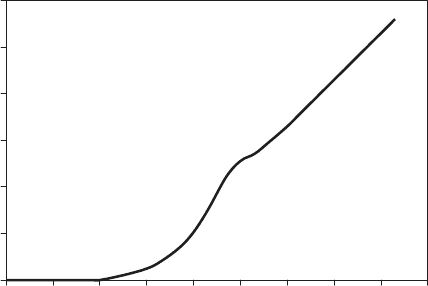
412 APPLICATIONS IN MASS TRANSFER WITH CHEMICAL REACTION
0
0.5
1
1.5
2
2.5
3
−5 −4 −3 −2 −1
0123 4
Log k
1
(s
−1
)
Log x
Figure 6.P.29-1 Performance data for a packed gas-absorption column plotted as log χ
versus log k
1
,whereχ is the ratio of the total absorption rate to the maximum possible rate
for physical absorption and k
1
is the reaction-rate constant for the first-order irreversible
chemisorption reaction.
is used to absorb a component A from a gas stream that enters at the bottom. Compo-
nent A can be chemisorbed in liquid S by means of a first-order irreversible reaction
whose reaction rate per unit volume R
A
is given by R
A
= k
1
c
A
. The following
information is available for this chemisorption process: mass-transfer coefficient
k
•
L0
= 0.01 cm/s; effective binary diffusion coefficient D
AS
= 5.5 × 10
−5
cm
2
/s;
and liquid-phase (macroscale) contact time t
o
= 500 s. Figure 6.P.29-1 shows per-
formance data for this chemisorption process as a plot of χ, the ratio of the total
absorption rate to the maximum possible rate for physical absorption, as a function
of k
1
, the first-order reaction rate constant. The total absorption rate is defined as
W =
V
T
0
N
A
adV (6.P.29-1)
where V and V
T
denote the volume and total volume of the column, respectively.
(a) Develop a general equation for χ in terms of the mass-transfer rate per unit
volume N
A
a, the contact time t
o
, and any relevant concentration(s).
(b) Explain the shape of the line for the performance data in Figure 6.P.29-1 in
terms of the various reaction regimes and domains; that is, identify which
regime or domain applies to each part of this line. When invoking the
scaling analysis criteria for the various regimes and domains, use one order
of magnitude in your ordering arguments. Note: Do not forget to consider
the intermediate regime and the intermediate domain of the slow reaction
regime (see Practice Problem 6.P.9).