
Kusse B.R., Westwig E.A. Mathematical Physics: Applied Mathematics for Scientists and Engineers
Подождите немного. Документ загружается.

96
INTRODUCTION
TO
TENSORS
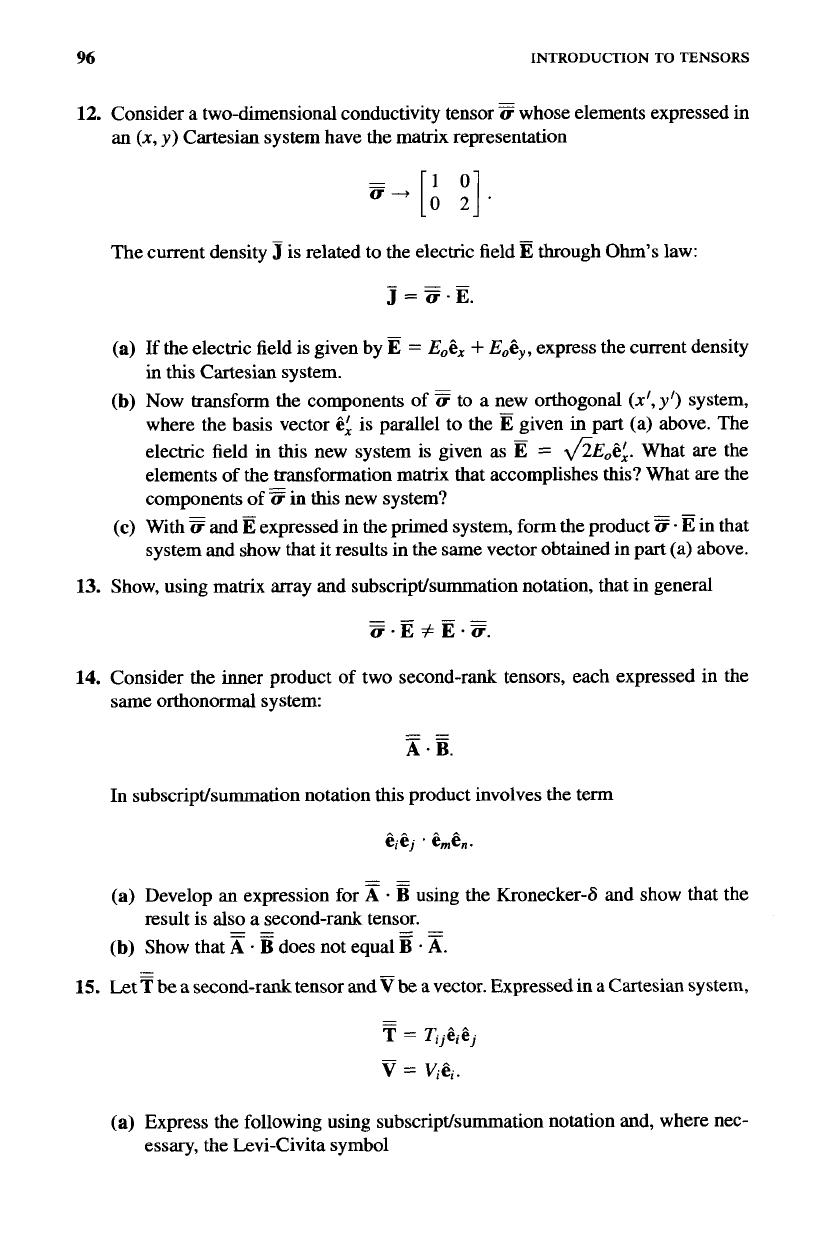
12.
Consider a two-dimensional conductivity tensor
whose elements expressed in
an
(x,
y)
Cartesian system have the matrix representation
The current density
J
is related to the electric field
E
through
Ohm’s
law:
(a)
If
the electric field is given by
E
=
&ex
+
EoeY,
express the current density
in this Cartesian system.
(b)
Now transform
the
components of
a
to a new orthogonal
(x’,y’)
system,
where the basis vector
i?:
is parallel to the
E
given
in
part
(a) above. The
electric field in
this
new system is given as
E
=
&E,,eL:.
What are the
elements of
the
transformation matrix that accomplishes
this?
What are the
components
of
Z
in
this
new system?
(c)
With
a
and
E
expressed in the primed system, form the product
Ti.
E
in that
system and show that it results in
the
same vector obtained in part (a) above.
_-
13.
Show, using matrix array and subscript/summation notation, that in general
Z.E#E.Z.
14.
Consider the inner product of two second-rank tensors, each expressed in the
same orthonormal system:
--
-
A-B.
In subscripthmmation notation
this
product involves the term
--
--
(a)
Develop an expression for
A
*
B
using the Kronecker-6 and show that the
result is also a second-rank tensor.
(b)
Show that
A
.
B
does not equal
B
.
A.
--
--
-_
--
15.
Let
r
be
a
second-rank tensor andv
be
a
vector. Expressed in a Cartesian system,
-
-
T
==
T..@.e.
‘J
I
I
v
=
vici.
(a)
Express the following using subscript/summation notation and, where nec-
essary, the Levi-Civita symbol
EXERCISES
97
--
i.
V.
T.
ii.
T
.
8.
iii.
(V
.
T)
x
V.
iv.
(V
.
T)
x
(1.
v).
v.
(V
.
T)
.
(T
.
V).
(V
.
T)
=
0
for any
V?
T)
=
0
for any
v?
(b)
What values for the elements of
r,
other than
Ti,
=
0,
will result in
V
X
(c)
What values for the elements of
T,
other
than
Tij
=
0,
will result in
V. (V.
--
-
-
16.
Use subscriptlsummation notation
to
show that the expressions
(T.C)XD
and
T.
CxD
=(
1
are not necessarily equal
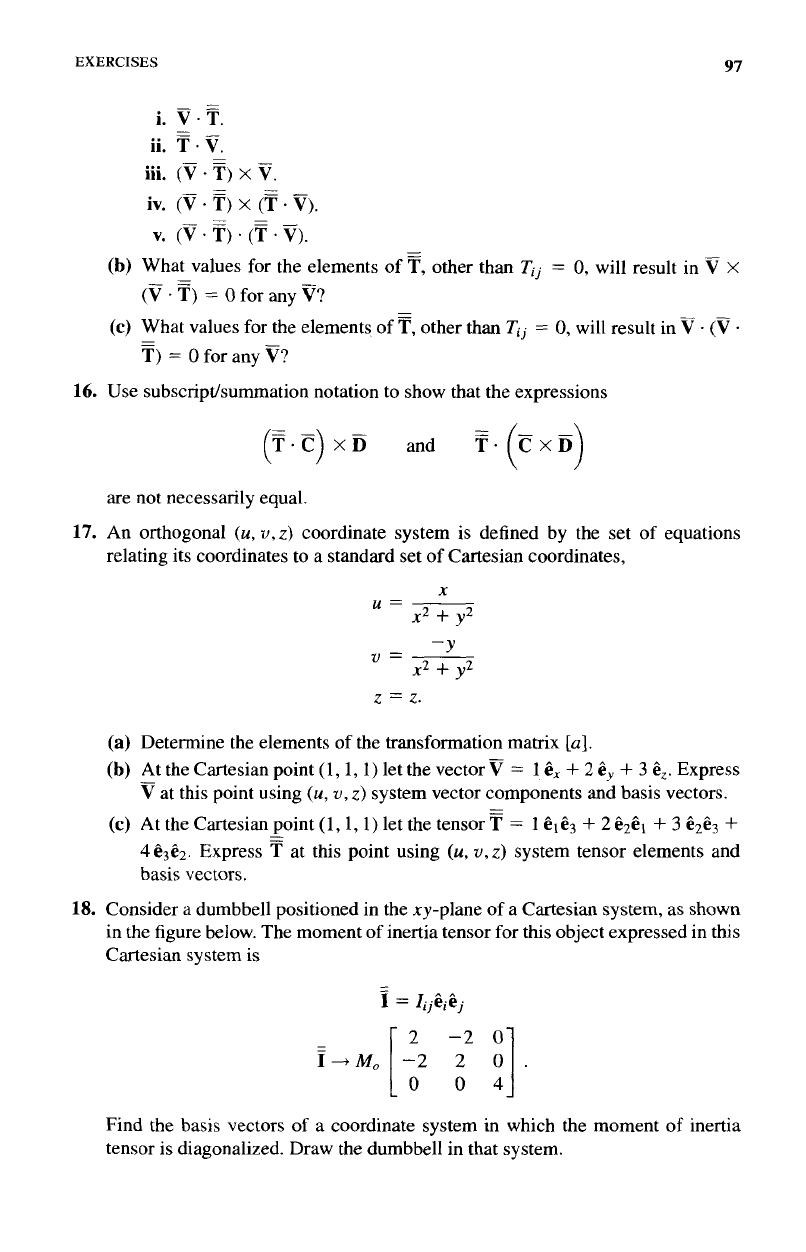
17.
An orthogonal
(u,
v,z)
coordinate system
is
defined by the set of equations
relating its coordinates to a standard set of Cartesian coordinates,
X
(a)
Determine the elements of the transformation matrix
[a].
(b)
-
At the Cartesian point
(1,1,1)
let the vector
v
=
1
8,
+
2
(c)
At the Cartesian point
(1,1,1)
let the tensor
+
3
Sz.
Express
V
at this point using
(u,
u,
z)
system vector components and basis vectors.
=
1
6183
+
2
&2C1
+
3
6263
+
46362.
Express
T
at this point using
(u,
v,z)
system tensor elements and
basis vectors.
18.
Consider
a
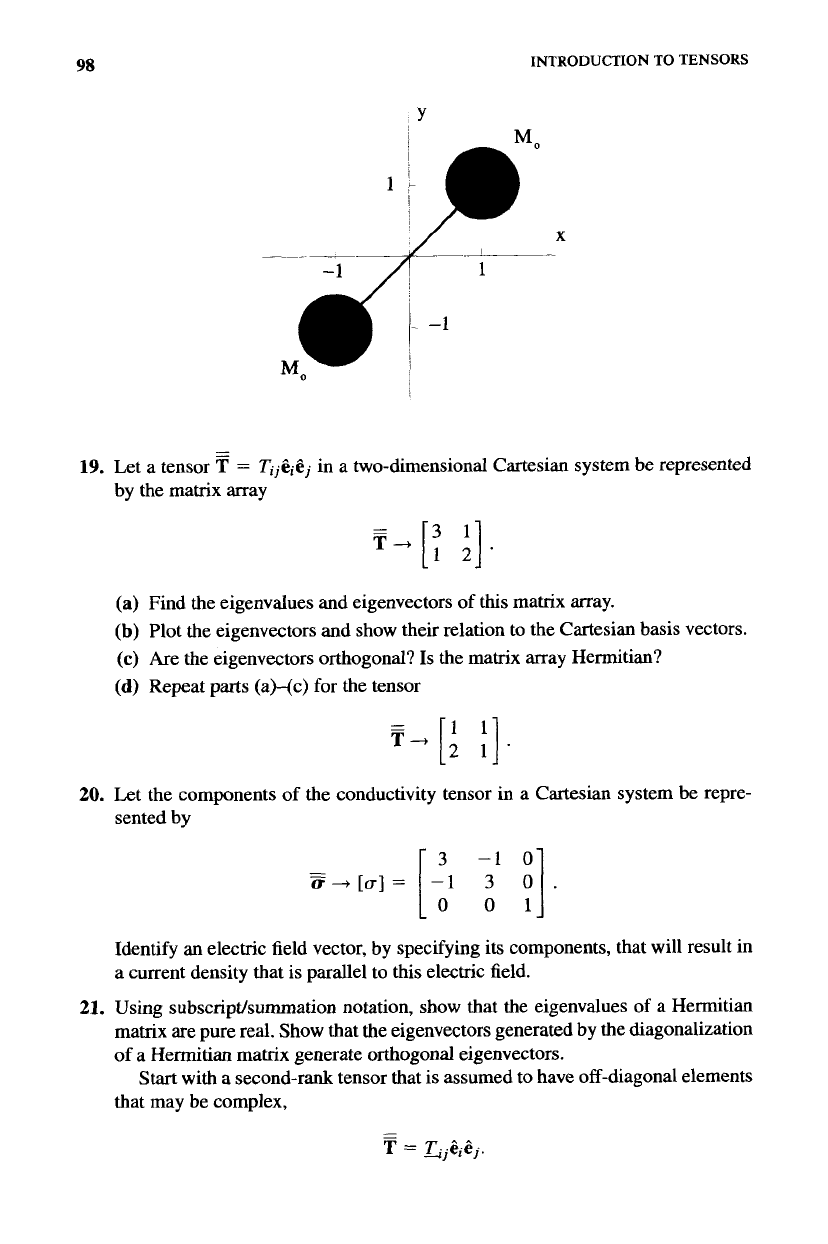
dumbbell positioned in the xy-plane of a Cartesian system, as shown
in the figure below. The moment
of
inertia tensor for this object expressed in this
Cartesian system is
-
- -
1
=
I.
.&&
'1
1
J
-2
0
144,
[;2
;
(I].
Find the basis vectors
of
a coordinate system in which the moment
of
inertia
tensor is diagonalized. Draw the dumbbell in that system.
98
INTRODUCTION TO TENSORS
1
-l
/
Y
M
1
-
-1
-
19.
Let a tensor
T
=
Ti,i$6,
in a two-dimensional Cartesian system be represented
by the matrix array
(a)
Find the eigenvalues and eigenvectors
of
this matrix array.
(b)
Plot the eigenvectors and show their relation to the Cartesian basis vectors.
(c)
Are the eigenvectors orthogonal?
Is
the
matrix array Hermitian?
(d)
Repeat parts (a)-(c) for the tensor
20.
Let the components of the conductivity tensor in a Cartesian system be repre-
sented by
-1
0
-
iT;-[r]=
;
;I.
Identify
an
electric field vector, by specifying its components, that will result in
a current density that is parallel to this electric field.
21.
Using subscript/summation notation,
show
that the eigenvalues
of
a Hermitian
matrix are pure real. Show that the eigenvectors generated by the diagonalization
of
a Hermitian matrix generate orthogonal eigenvectors.
Start
with a second-rank tensor that is assumed to have off-diagonal elements
that may be complex,
-
-
T
=
T.
.$.@.
-4J
I
J'
EXERCISES
99
Let the eigenvalues
of
the matrix representation
of
this tensor be
Ai
and the
eigenvectors associated with these eigenvalues be
@I
=
%jCj
so
that
z.jgnj
=
An&i.
Notice that although the
n
subscript is repeated on the
RHS
it is not summed over
because it appears on the LHS, where it is clearly not summed over.
Now
form
the quantities
&zjsj
and
c&&ju-j
and subtract one from the other. Apply the
Hermitian condition and see what it implies.
22.
Is
the dot product between two pseudovectors a scalar or a pseudoscalar? Give
an example from classical mechanics
of
such
an
operation.
23.
Show that the elements
of
the Kronecker delta
6;j
transform like elements
of
a
tensor, not a pseudotensor.
THE
DIRAC
6-FUNCTION
The Dirac 6-function is a strange, but useful function which has many applications in
science, engineering, and mathematics. The &function was proposed in
1930
by Paul
Dirac in the development of the mathematical formalism of quantum mechanics. He
required a function whlch was zero everywhere, except at a single point, where it was
discontinuous and behaved like
an
infinitely high, infinitely narrow spike of unit area.
Mathematicians were quick to point out that, strictly speaking, there is
no
function
which has these properties. But Dirac supposed there was, and proceeded to use it
so
successfully that a new branch of mathematics was developed in order to justify
its use.
This
area of mathematics is called the theory of
generalizedfunctions
and
develops, in complete detail, the foundation for the Dirac 6-function.
This
rigorous
treatment is necessary to justify the use of these discontinuous functions, but for the
physicist
the
simpler physical interpretations are just
as
important. We will take both
approaches
in
this chapter.
5.1
EXAMPLES OF
SINGULAR FUNCTIONS IN PHYSICS
Physical situations are usually described using equations and operations on contin-
uous functions. Sometimes, however, it is useful to consider discontinuous ided-
izations, such as the mass density of a point mass, or the force of an infinitely fast
mechanical impulse. The functions that describe these ideas are obviously extremely
discontinuous, because they and all their derivatives must diverge. For
this
reason
they are often called
singular
functions. The Dirac 6-function was developed
to
de-
scribe functions that involve these types of discontinuities and provide a method for
handling them in equations which normally involve only continuous functions.
100
EXAMPLES
OF
SINGULAR FUNCTIONS IN PHYSICS
I
101
Force
Area
=-A(
m,v)
time
Figure
5.1
Force and Change
in
Momentum
5.1.1
The
Ideal
Impulse
Often a student's first encounter with the 6-function is the "ideal" impulse. In me-
chanics, an impulse is a force which acts on
an
object over a finite period of time.
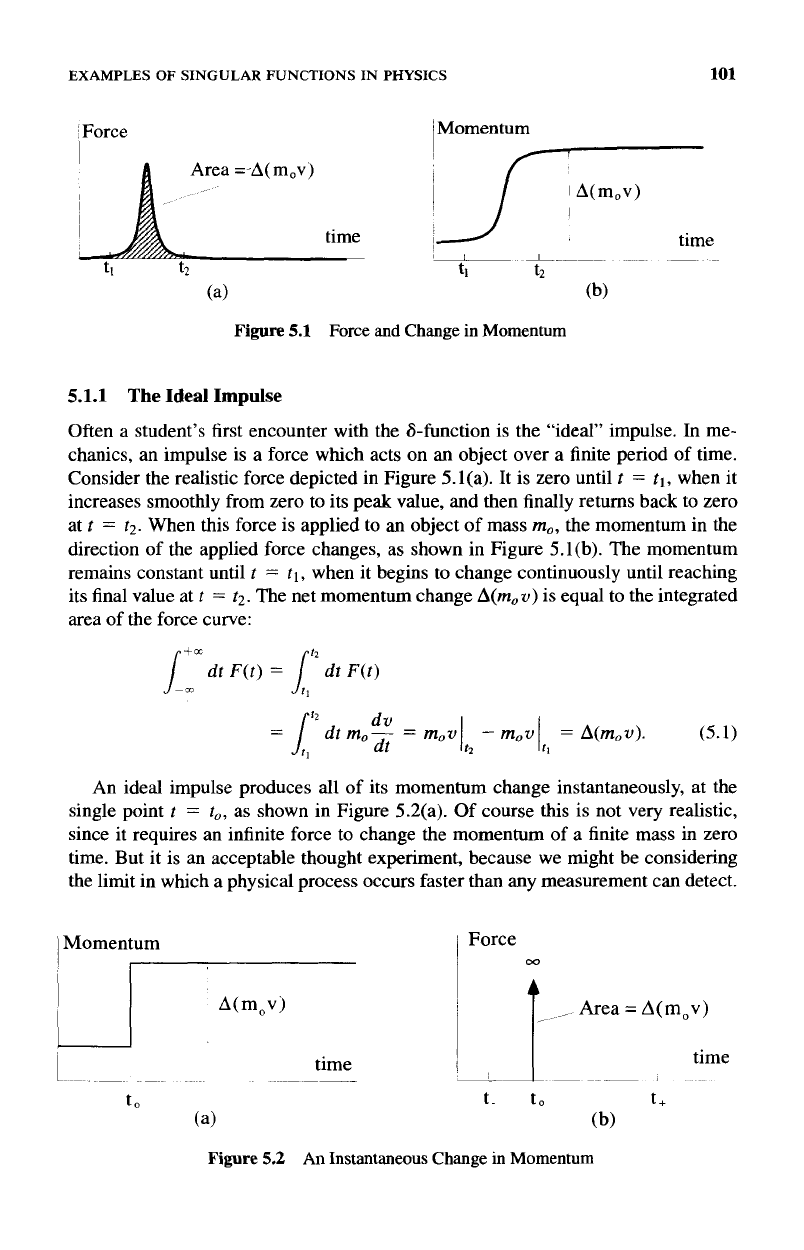
Consider the realistic force depicted in Figure 5.l(a). It is zero until
t
=
t1,
when it
increases smoothly from zero to its peak value, and then finally returns back to zero
at
t
=
t2.
When this force is applied to
an
object of mass
m,,
the momentum in the
direction
of
the applied force changes, as shown in Figure
5.l(b).
The momentum
remains constant until
t
=
21,
when it begins to change continuously until reaching
its final value at
t
=
tz.
The net momentum change
A(rn,v)
is equal to the integrated
area of the force curve:
1;
dt
F(t)
=
[
dt
F(t)
An
ideal impulse produces all of its momentum change instantaneously, at the
single point
t
=
to,
as shown in Figure 5.2(a). Of course this is not very realistic,
since it requires an infinite force to change the momentum of
a
finite mass in zero
time. But it is an acceptable thought experiment, because we might be considering
the limit in which a physical process occurs faster than any measurement can detect.
time
~
Force
O0
,
Area=A(m,v)
1,
Figure
5.2
An
Instantaneous Change
in
Momentum
102
THE
DIRAC &-FUNCTION
The force of an ideal impulse cannot
be
graphed as a function of time in the normal
sense. The force exists for only a single instant, and
so
is zero everywhere, except at
t
=
to,
when it is infinite. But
this
is
not just any infinity. Since the total momentum
change must
be
A(mo
u),
the force must diverge
so
that
its
integral area obeys (for all
t-
<
t+)
t-
<
to
<
t+
otherwise
[
dt
F(t)
=
(5.2)
In other words, any integral which includes the point
to
gives a momentum change
of
A(mov).
On the other hand, integrals which exclude
to
must give no momentum
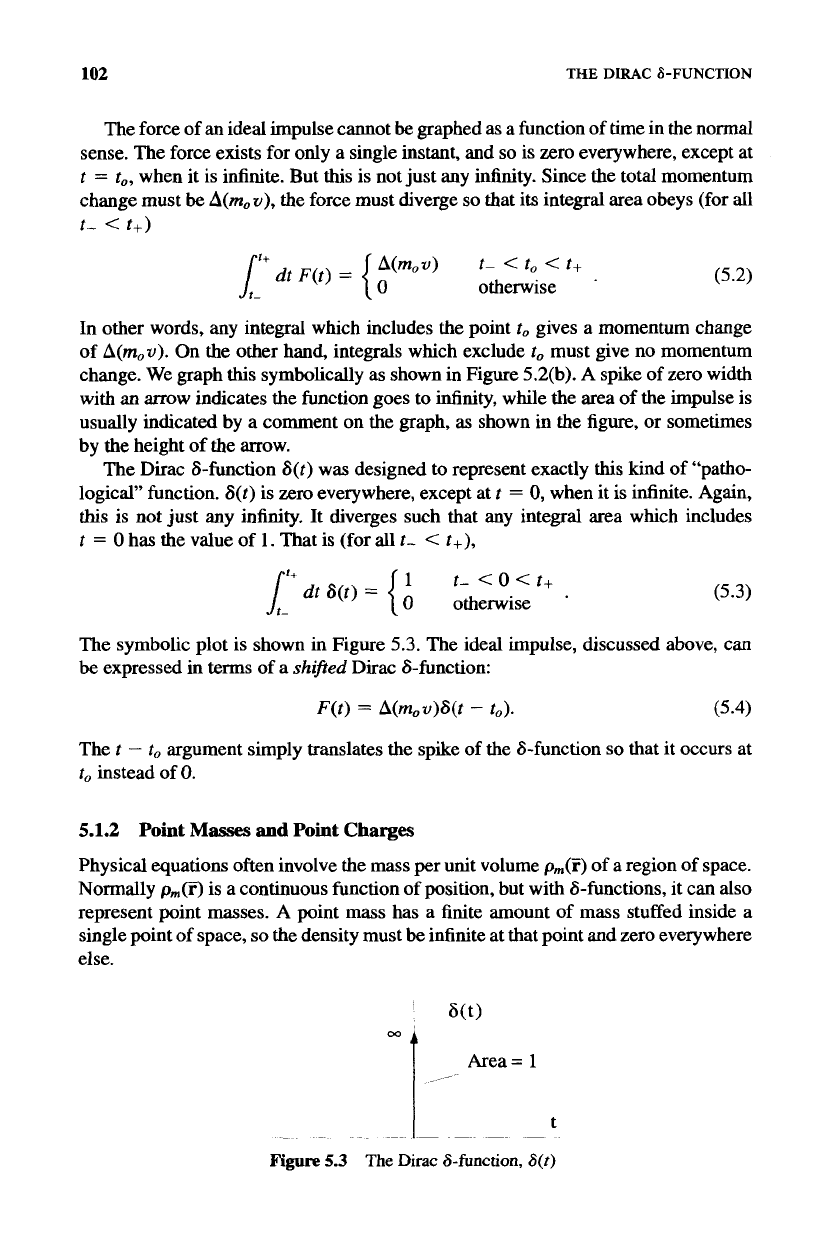
change. We graph
this
symbolically as shown in Figure 5.2(b). A spike of zero width
with
an
arrow indicates the function goes to infinity, while the area
of
the impulse is
usually indicated by a comment on the graph,
as
shown in
the
figure, or sometimes
by the height
of
the arrow.
The Dirac 8-function
8(t)
was designed to represent exactly
this
kind
of "patho-
logical" function.
8(t)
is zero everywhere, except at
t
=
0,
when it is infinite. Again,
this
is not just any infinity. It diverges such that any integral area which includes
t
=
0
has the value of
1.
That
is
(for
all
t-
<
t+),
1
t-<O<t+
otherwise
'
(5.3)
The symbolic plot is shown in Figure
5.3.
The ideal impulse, discussed above,
can
be
expressed
in
terms of a
shrjkd
Dirac 8-function:
(5.4)
F(t)
=
A(mov)8(t
-
to).
The
t
-
to
argument simply translates
the
spike of the &function
so
that it occurs at
to
instead
of
0.
5.1.2
Point
Masses
and
Point
Charges
Physical equations often involve the mass per unit volume
p&)
of a region of space.
Normally
pm0
is a continuous function of position, but with 8-functions,
it
can
also
represent point masses. A point mass has a finite amount of mass stuffed inside a
single point of space,
so
the density must be infinite at that point and zero everywhere
else.
TWO
DEFINITIONS
OF
a(?)
103
Figure
5.4
A
Single
Point
Mass
at
the
Origin
Integrating the mass density over a volume
V
gives the total mass enclosed:
d7
p,(F)
=
total mass inside
V.
(5.5)
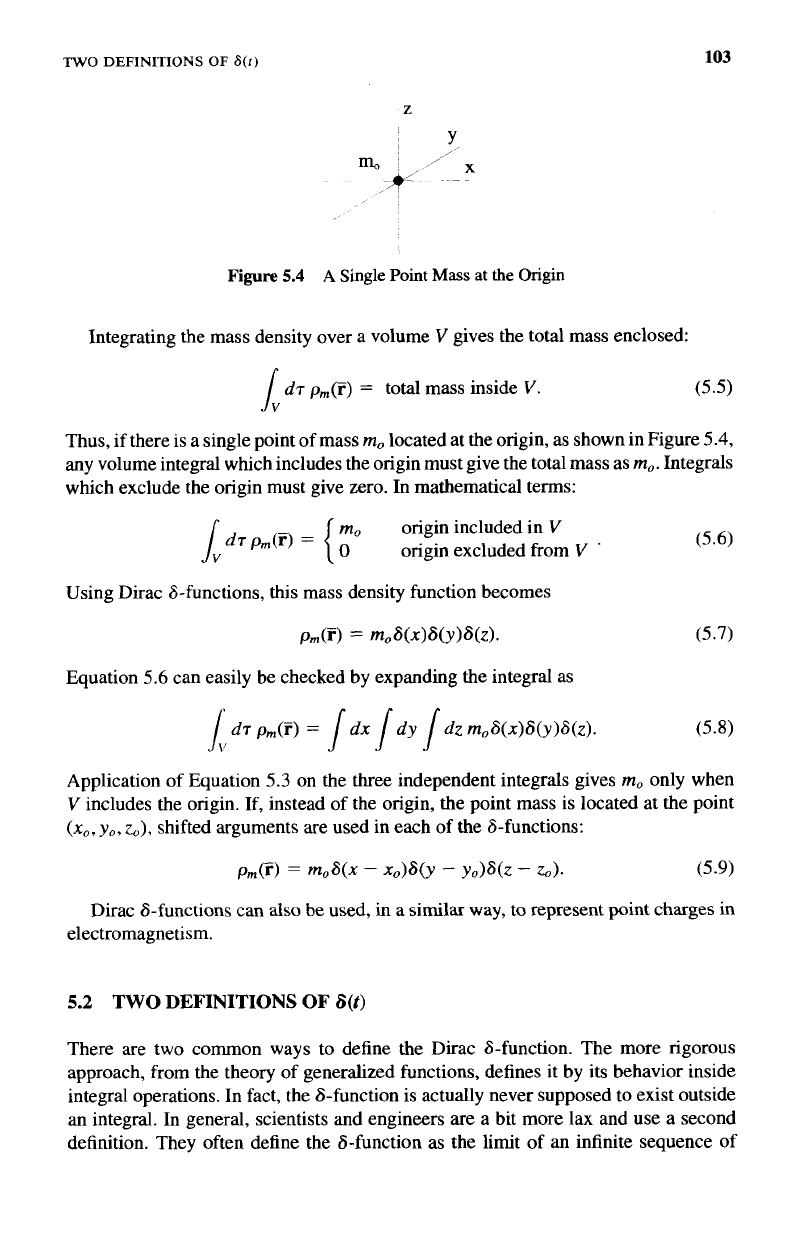
Thus, if there is a single point of mass
m,
located at the origin, as shown in Figure
5.4,
any volume integral which includes the origin must give the total mass as
m,.
Integrals
which exclude the origin must give zero. In mathematical terms:
(5.6)
origin included in
V
origin excluded from
V
.
ld7pm(F)
=
mo
0
{
Using Dirac &functions, this mass density function becomes
(5.7)
Equation
5.6
can easily be checked by expanding the integral as
Application of Equation
5.3
on the three independent integrals gives
m,
only when
V
includes the origin. If, instead of the origin, the point mass is located at the point
(x,,
yo,
z,),
shifted arguments are used in each
of
the &functions:
p,(F)
=
m,Wx
-
x&%y
-
Y,)~(z
-
GI.
(5.9)
Dirac 6-functions can
also
be
used, in a
similar
way, to represent point charges
in
electromagnetism.
5.2
TWO
DEFINITIONS
OF
S(t)
There are two common ways to define the Dirac &function. The more rigorous
approach, from the theory of generalized functions, defines it by its behavior inside
integral operations. In fact, the &function is actually never supposed to exist outside
an integral. In general, scientists and engineers are a bit more lax and use a second
definition. They often define the &function as the limit of
an
infinite sequence
of
104
THE
DIRAC
&FUNCTION
-112n 112n
Figure
5.5
The
Square Sequence Function
continuous functions.
Also,
as
demonstrated
in
the two examples
of
the previous
section, they frequently manipulate the &function outside of integrals. Usually, there
are no problems with
this
less rigorous approach. However, there are some cases,
such as the oscillatory sequence functions described at the end of this section, where
the more careful integral approach becomes essential.
5.2.1
The &function can be viewed
as
the limit
of
a sequence of functions. In other words,
S(t)
as
the Limit
of
a
Sequence
of
Functions
8(t)
=
lim&(t), (5.10)
n-m
where
&(t)
is finite for
all
values oft.
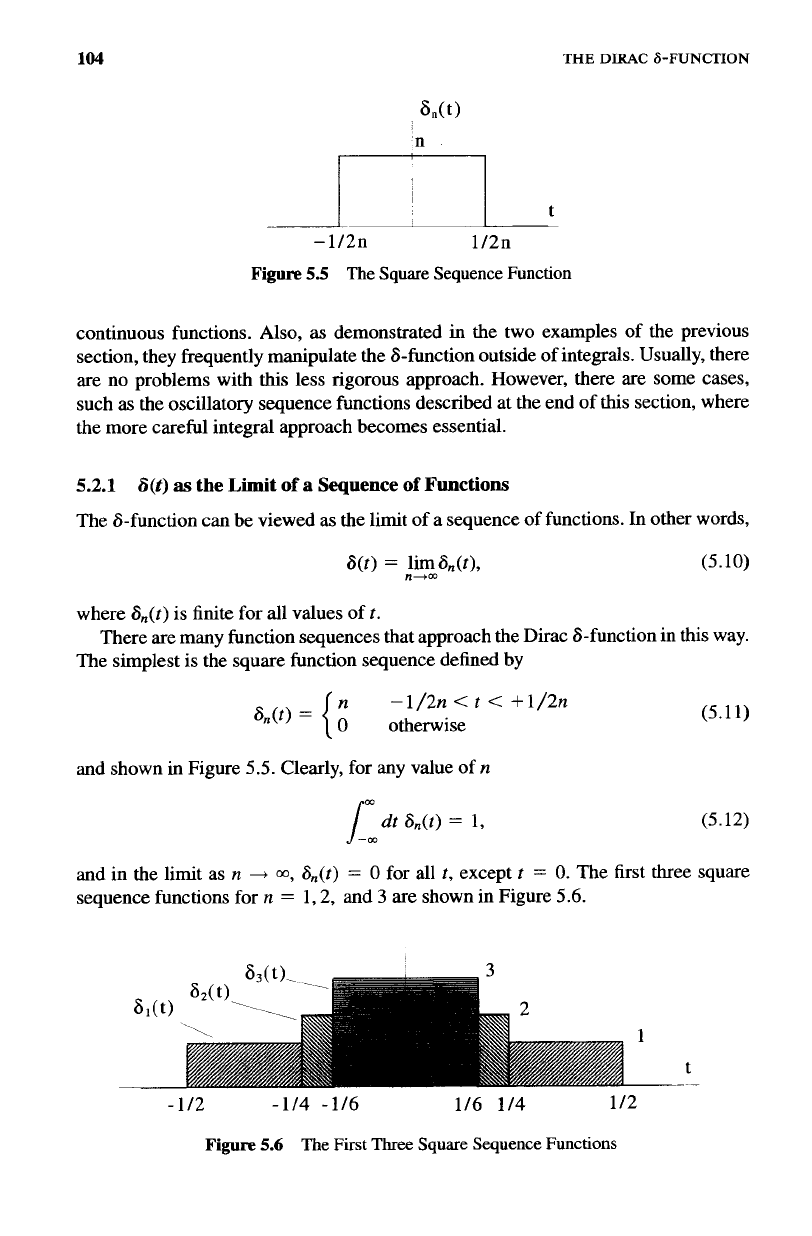
The simplest is the square function sequence defined by
There are many function sequences that approach the Dirac &function in this way.
and shown in Figure 5.5. Clearly, for any value
of
n
1:dt
&(t)
=
1,
(5.11)
(5.12)
and in the limit as n
+
m,
&(t)
=
0
for
all
f,
except
t
=
0.
The first three square
sequence functions for
n
=
1,2, and
3
are shown in Figure 5.6.
-
112
-114
-116 116 114 112
Figure
5.6
The
First
Three
Square
Sequence
Functions
TWO
DEFINITIONS
OF
s(t)
105
Figure
5.7
The Resonance Sequence Function
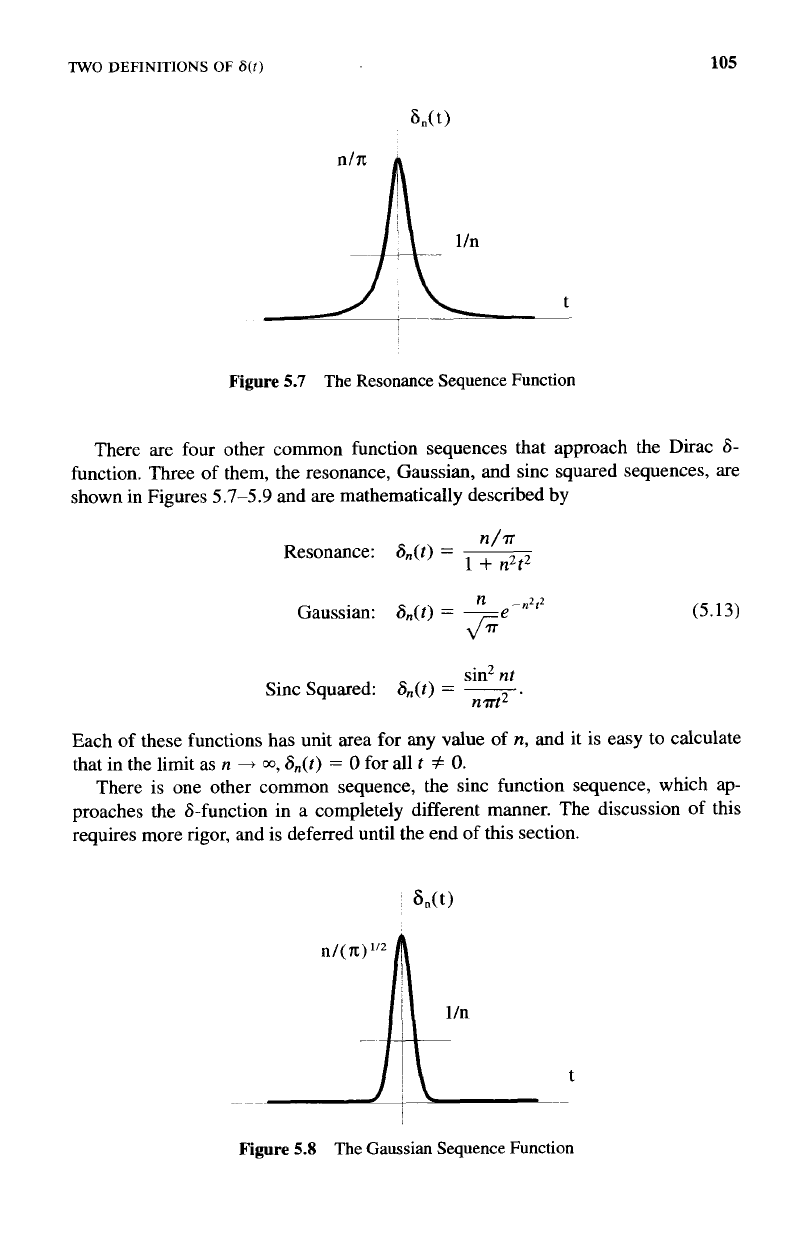
There are four other common function sequences that approach the Dirac
6-
function. Three of them, the resonance, Gaussian, and sinc squared sequences, are
shown in Figures
5.7-5.9
and are mathematically described by
n/.rr
Resonance:
&(t)
=
~
1
+
n2t2
n
22
Gaussian:
&(t)
=
-e-n
fi
(5.13)
sin2 nt
nn-t2
Sinc Squared:
&(t)
=
-.
Each of these functions has unit area for any value of
n,
and it is easy to calculate
that in the limit as
n
+
00,
6,(t)
=
0
for all
t
#
0.
There is one other common sequence,
the
sinc function sequence, which ap-
proaches the &function in a completely different manner. The discussion
of
this
requires more rigor, and is deferred until the end of this section.
Figure
5.8
The Gaussian Sequence Function