
Kusse B.R., Westwig E.A. Mathematical Physics: Applied Mathematics for Scientists and Engineers
Подождите немного. Документ загружается.

66
CURVILINEAR
COORDINATE
SYSTEMS
-
dd
dY
Lop
=
-"[yz
-
z-]&
-in
z-
-x-
ey
[
ax
dz
-in
x-
-
y-
e,.
[
;
:XIA
23.
The derivation of the curvilinear divergence in
this
chapter is somewhat sloppy,
because it treats the scale factors
as
constants along each surface
of
the volume.
Derive the same expression for the divergence following the more rigorous
method demonstrated
in
Appendix
B
for the curvilinear curl.
INTRODUCTION TO TENSORS
Tensors pervade all the branches of physics. In mechanics, the moment
of
inertia
tensor is used to describe the rotation of rigid bodies, and the stress-strain tensor
describes the deformation of elastic
bodies.
In
electromagnetism, the conductivity
tensor extends Ohm’s law to handle current flow in nonisotropic media, and Maxwell’s
stress tensor is the most elegant way to deal with electromagnetic forces. The metric
tensor of relativistic mechanics describes the strange geometry of space and time.
This
chapter presents
an
introduction to tensors and their manipulations, first
strictly in Cartesian coordinates and then in generalized curvilinear coordinates. We
will limit the material in this chapter
to
orthonormal coordinate systems. Tensors
in nonorthonormal systems are discussed later, in Chapter
14.
At the end of the
chapter, we introduce the so-called ‘‘pseudo’’-objects, which arise when we consider
transformations between right- and left-handed coordinate systems.
4.1
THE
CONDUCTIVITY
TENSOR
AND
OHM’S
LAW
The need for tensors can easily be demonstrated by considering
Ohm’s
law. In an
ideal resistor, Ohm’s law relates the current to the voltage in the linear expression
V
I=-
R’
(4.1)
In this equation,
Z
is the current through the resistor, and
V
is the voltage applied
across it. Using
MKS
units,
Z
is measured in amperes,
V
in volts, and
R
in
ohms.
67
68
INTRODUCTION TO TENSORS
Equation 4.1 describes the current flow through a discrete element.
To
apply Ohm’s
law to a distributed medium, such as a crystalline solid, an alternative form of
this
equation is used:
5
=
UE.
(4.2)
Here
5
is the current density,
E
is the electric field, and
u
is the material’s
conductivity.
In
MKS units,
5
is measured in amperes per meter squared,
E
in
volts per meter, and
u
in inverse ohm-meters.
Equation 4.2 describes
a
very simple physical relationship between the current
density and the electric field, because the conductivity has been expressed as a scalar.
With a scalar conductivity, the amount of current flow is governed solely by the
magnitudes of
(+
and
E,
while the direction of the flow is always parallel to
E.
But in
some materials,
this
is not always the case. Many crystalline solids allow current to
flow more easily in one direction than another. These
nonisotropic
materials must have
different conductivities in different directions.
In
addition, these crystals can even
experience current flow perpendicular to
an
applied electric field. Clearly Equation
4.2, with a scalar conductivity, will not handle these situations.
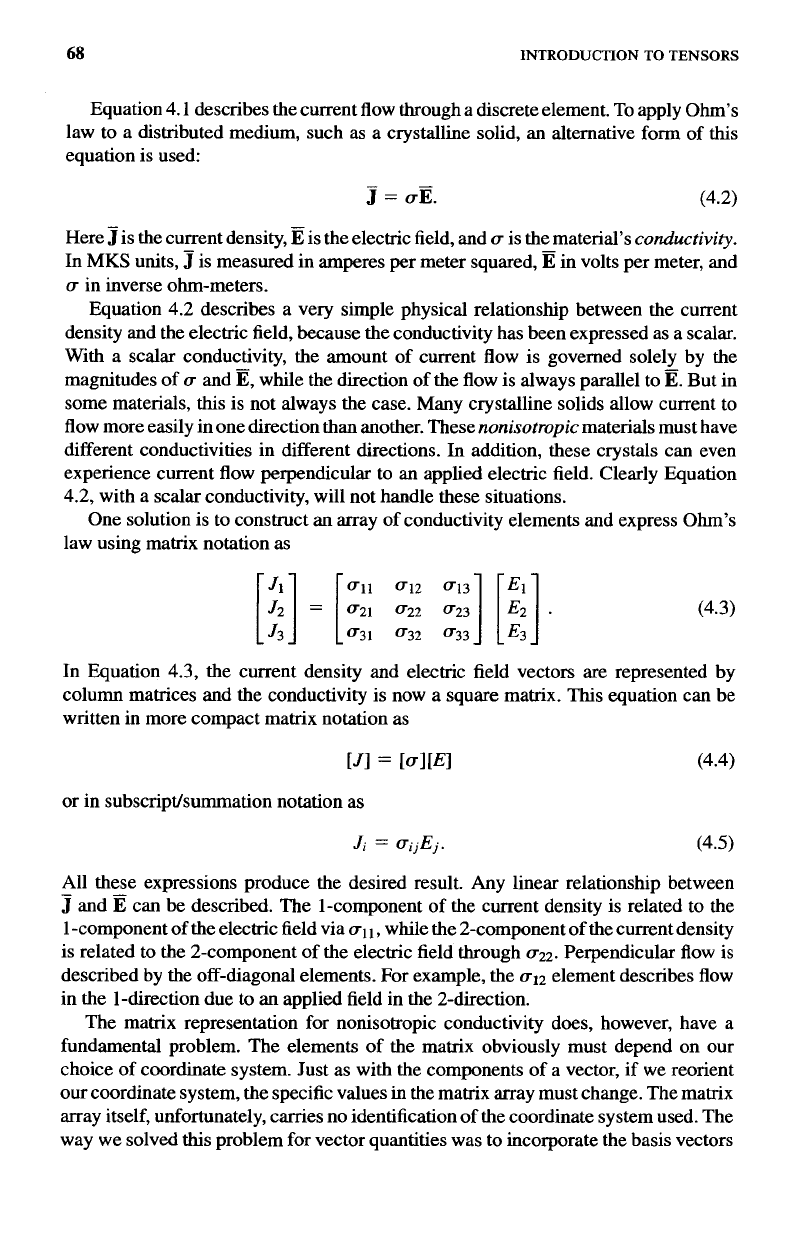
One solution is to construct an array of conductivity elements and express
Ohm’s
law using matrix notation as
u11 u12 (+13
[
=
[
;::
Uz2
Uz3]
[
.
(4.3)
u32
a33
In Equation 4.3, the current density and electric field vectors are represented by
column matrices and the conductivity
is
now a square matrix.
This
equation can be
written in more compact matrix notation as
or
in subscriptlsummation notation
as
All these expressions produce the desired result. Any linear relationship between
3
and
E
can be described. The 1-component of the current density is related to the
1
-component of the electric field via
u1
1,
while the 2-component of the current density
is related to
the
2-component of the electric field through
u22.
Perpendicular flow is
described by the off-diagonal elements. For example, the
u12
element describes flow
in the 1-direction due to an applied field in the 2-direction.
The matrix representation for nonisotropic conductivity does, however, have a
fundamental problem. The elements of the matrix obviously must depend on our
choice of coordinate system. Just as with the components of a vector, if we reorient
our
coordinate system, the specific values in the matrix array must change. The matrix
array itself, unfortunately, carries no identification of the coordinate system used. The
way we solved
this
problem for vector quantities was
to
incorporate the basis vectors
THE
CONDUCTIVITY
TENSOR
AND
OHM’S
LAW
69
directly into the notation. That same approach can be used to improve the notation for
the nonisotropic conductivity. We define a new object, called the conductivity tensor,
which we write as
??.
This
tensor includes both the elements of the conductivity
matrix array and the basis vectors of the coordinate system in which these elements
are valid. Because this notation is motivated by the similar notation we have been
using for vectors, we begin with a quick review.
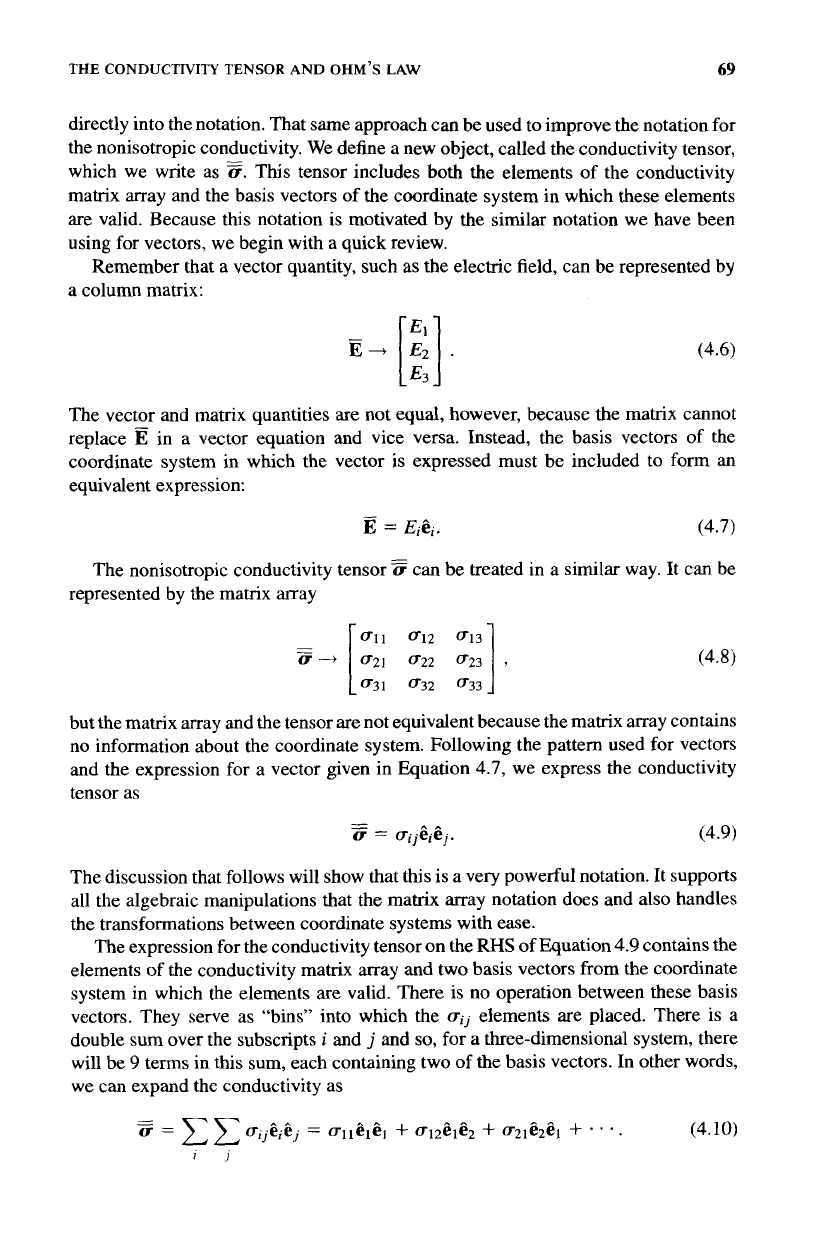
Remember that a vector quantity, such as the electric field, can be represented by
a column matrix:
The vector and matrix quantities are not equal, however, because the matrix cannot
replace
E
in a vector equation and vice versa. Instead, the basis vectors of the
coordinate system in which the vector
is
expressed must be included to form an
equivalent expression:
-
E
=
Eii?;.
(4.7)
The nonisotropic conductivity tensor
can be treated in a similar way. It can be
represented by the matrix array
but the matrix array and the tensor
are
not equivalent because the matrix array contains
no information about the coordinate system. Following the pattern used for vectors
and the expression for
a
vector given in Equation 4.7, we express the conductivity
tensor as
(4.9)
The discussion that follows will show that this is a very powerful notation. It supports
all the algebraic manipulations that the matrix array notation does and also handles
the transformations between coordinate systems with ease.
The expression for the conductivity tensor on the
RHS
of Equation
4.9
contains the
elements of the conductivity matrix array and two basis vectors from the coordinate
system in which the elements are valid. There is no operation between these basis
vectors. They serve as “bins” into which the
aij
elements are placed. There
is
a
double sum over the subscripts
i
and
j
and
so,
for a three-dimensional system, there
will be 9 terms in this sum, each containing two
of
the basis vectors. In other words,
we can expand the conductivity as
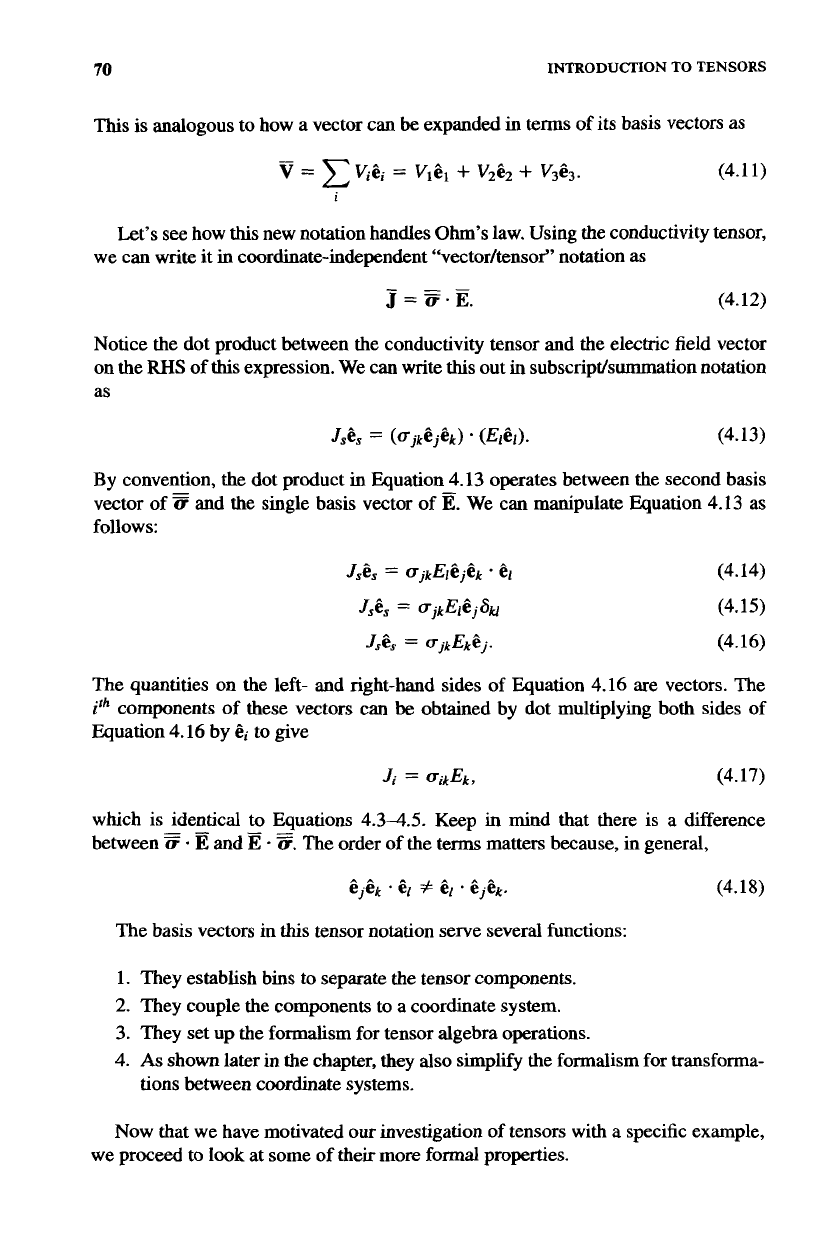
70 INTRODUCTION
TO
TENSORS
This
is analogous to how a vector can
be
expanded in terms
of
its basis vectors as
-
v
=
XVi&
=
V1&
+
v,e,
+
v3g.
(4.1
1)
I
Let’s
see
how
this
new notation handles
Ohm’s
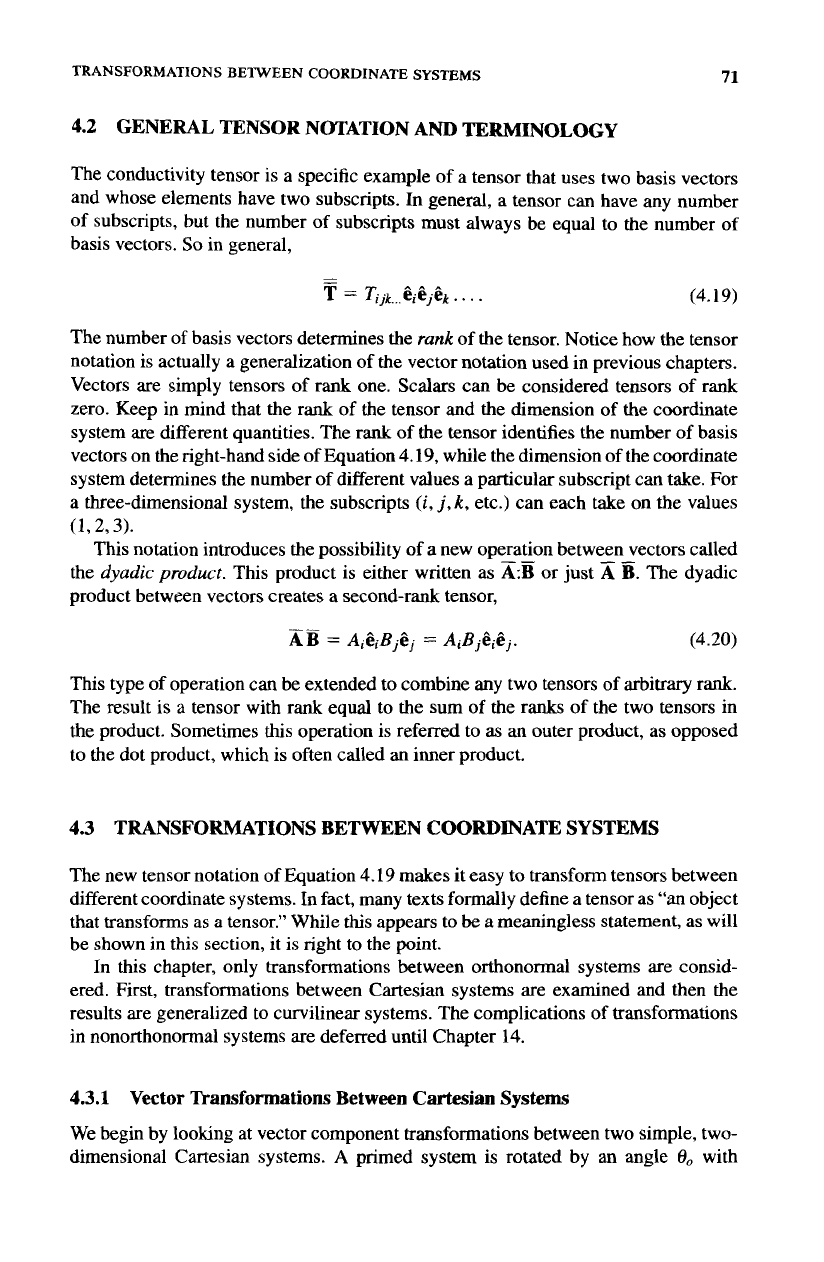
law. Using the conductivity tensor,
we can write it in coordinate-independent “vectorltensor” notation as
-
_-
J=ZF-E.
(4.12)
Notice the dot product between the conductivity tensor and the electric field vector
on the
RHS
of
this
expression. We can write
this
out
in
subscript/summation notation
as
By convention, the dot product in Equation 4.13 operates between the second basis
vector of and the single basis vector
of
E.
We can manipulate Equation 4.13 as
follows:
(4.14)
(4.15)
(4.16)
The quantities on the left- and right-hand sides of Equation 4.16 are vectors. The
ith
components
of
these vectors can
be
obtained by dot multiplying both sides of
Equation 4.16
by
4
to give
which is identical to Equations 4.3-4.5. Keep
in
mind that there
is
a difference
between
.
and
E
-
??,
The order of the
terms
matters because, in general,
$j&
*
#
61
* ej&.
(4.18)
The basis vectors in
this
tensor notation serve several functions:
1.
They establish bins to separate the tensor components.
2. They couple the components to a coordinate system.
3. They set
up
the formalism for tensor algebra operations.
4.
As
shown later in the chapter, they also simpllfy the formalism for transforma-
tions between coordinate systems.
Now
that we have motivated
our
investigation
of
tensors with a specific example,
we proceed
to
look at some
of
their more formal properties.
71
TRANSFORMATIONS
BETWEEN
COORDINATE
SYSTEMS
4.2
GENERAL TENSOR NOTATION
AND
TERMINOLOGY
The conductivity tensor is a specific example
of
a tensor that uses two basis vectors
and whose elements have two subscripts. In general, a tensor can have any number
of subscripts, but the number
of
subscripts must always be equal to the number of
basis vectors.
So
in general,
(4.19)
The number
of
basis vectors determines the
rank
of the tensor. Notice how the tensor
notation is actually
a
generalization of the vector notation used
in
previous chapters.
Vectors are simply tensors of
rank
one. Scalars can be considered tensors of
rank
zero. Keep in mind that the rank of the tensor and the dimension of the coordinate
system are different quantities. The rank of
the
tensor identifies the number
of
basis
vectors on the right-hand side
of
Equation
4.19,
while the dimension of the coordinate
system determines the number of different values a particular subscript can take. For
a three-dimensional system, the subscripts
(i,
j,
k,
etc.) can each take on the values
(1,233).
This notation introduces the possibility of a new operation between vectors called
the
dyadic
product.
This product is either written as
K:E
or
just
A
B.
The dyadic
product between vectors creates a second-rank tensor,
(4.20)
This type
of
operation can be extended to combine any two tensors
of
arbitrary rank.
The result is a tensor with
rank
equal to the sum of the
ranks
of the two tensors in
the product. Sometimes
this
operation is referred
to
as
an outer product, as opposed
to the dot product, which is often called an
inner
product.
4.3
TRANSFORMATIONS BETWEEN COORDINATE
SYSTEMS
The new tensor notation
of
Equation
4.19
makes
it
easy to transform tensors between
different coordinate systems. In fact, many texts formally define a tensor as
“an
object
that transforms
as
a tensor.” While
this
appears to
be
a meaningless statement,
as
will
be shown in this section, it is right to the point.
In this chapter, only transformations between orthonormal systems are consid-
ered. First, transformations between Cartesian systems are examined and then the
results are generalized to curvilinear systems. The complications of transformations
in nonorthonormal systems are deferred until Chapter
14.
4.3.1
Vector
Transformations Between Cartesian
Systems
We begin by looking at vector component transformations between two simple, two-
dimensional Cartesian systems.
A
primed system is rotated by
an
angle
@,
with
12
INTRODUCTION
TO
TENSORS
Figure
4.1
Rotated Systems
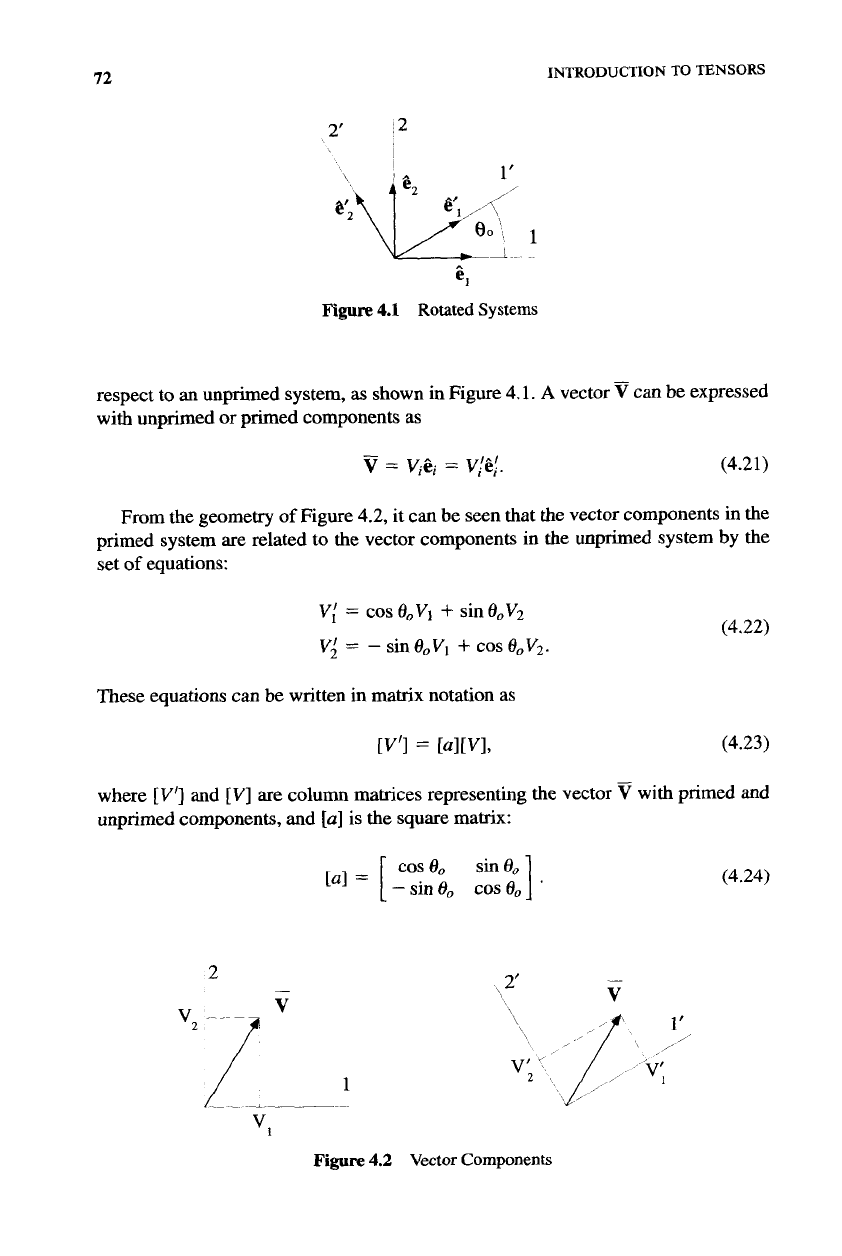
respect to an unprimed system,
as
shown in Figure
4.1.
A
vector
v
can be expressed
with unprimed
or
primed components
as
From the geometry
of
Figure 4.2, it can be seen that the vector components in the
primed system are related to the vector components
in
the unprimed system
by
the
set
of
equations:
V:
=
cos
0,V,
+
sin
OoV,
v;
=
-
sineov,
+
cos
eov,.
These equations can be written
in
matrix notation as
rv‘1
=
ral[Vl,
(4.22)
(4.23)
where
[V’]
and
[VJ
are column matrices representing the vector
v
with primed and
unprimed components, and
[a]
is
the square matrix:
(4.24)
Figure
4.2
Vector Components
TRANSFORMATIONS BETWEEN COORDINATE SYSTEMS
73
4.3.2
The
Transformation
Matrix
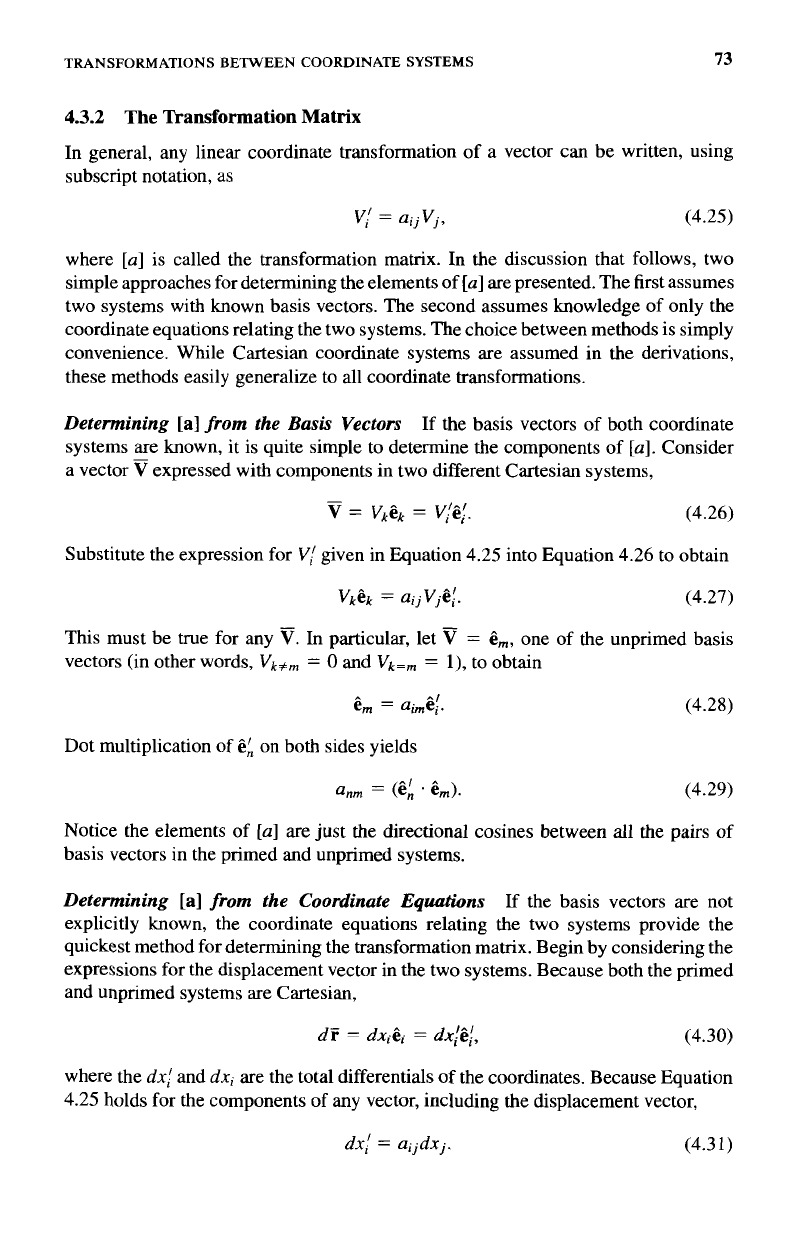
In general, any linear coordinate transformation of a vector can be written, using
subscript notation, as
where
[a]
is called the transformation matrix. In the discussion that follows, two
simple approaches for determining the elements
of
[a]
are presented. The first assumes
two systems with known basis vectors. The second assumes knowledge of only the
coordinate equations relating the two systems. The choice between methods is simply
convenience. While Cartesian coordinate systems are assumed in the derivations,
these methods easily generalize to all coordinate transformations.
Determining
[a]
from the
Basis
Vectors
If the basis vectors
of
both coordinate
systems are known, it is quite simple to determine the components of
[a].
Consider
a vector expressed with components in two different Cartesian systems,
Substitute the expression for
V:
given in Equation 4.25 into Equation 4.26 to obtain
vk6k
=
aijvjs,!.
(4.27)
=
km,
one
of
the unprimed basis This must be true
for
any
v.
In particular, let
vectors (in other words,
Vk+-m
=
0
and
Vk=m
=
l),
to obtain
&,
=
a.
rm
&!.
1
(4.28)
Dot multiplication of
2:
on both sides yields
Unm
=
(6;
*
C,).
(4.29)
Notice the elements
of
[a]
are just the directional cosines between all the pairs
of
basis vectors in the primed and unprimed systems.
Determining
[a]
from the Coordinate
Eqclations
If the basis vectors are not
explicitly known, the coordinate equations relating the two systems provide the
quickest method for determining the transformation matrix. Begin by considering the
expressions for the displacement vector in the two systems. Because both the primed
and unprimed systems are Cartesian,
dF
=
dX.6.
=
d
x,e,,
'A'
(4.30)
where the
dxl
and
dxi
are the total differentials
of
the coordinates. Because Equation
4.25 holds for the components
of
any vector, including the displacement vector,
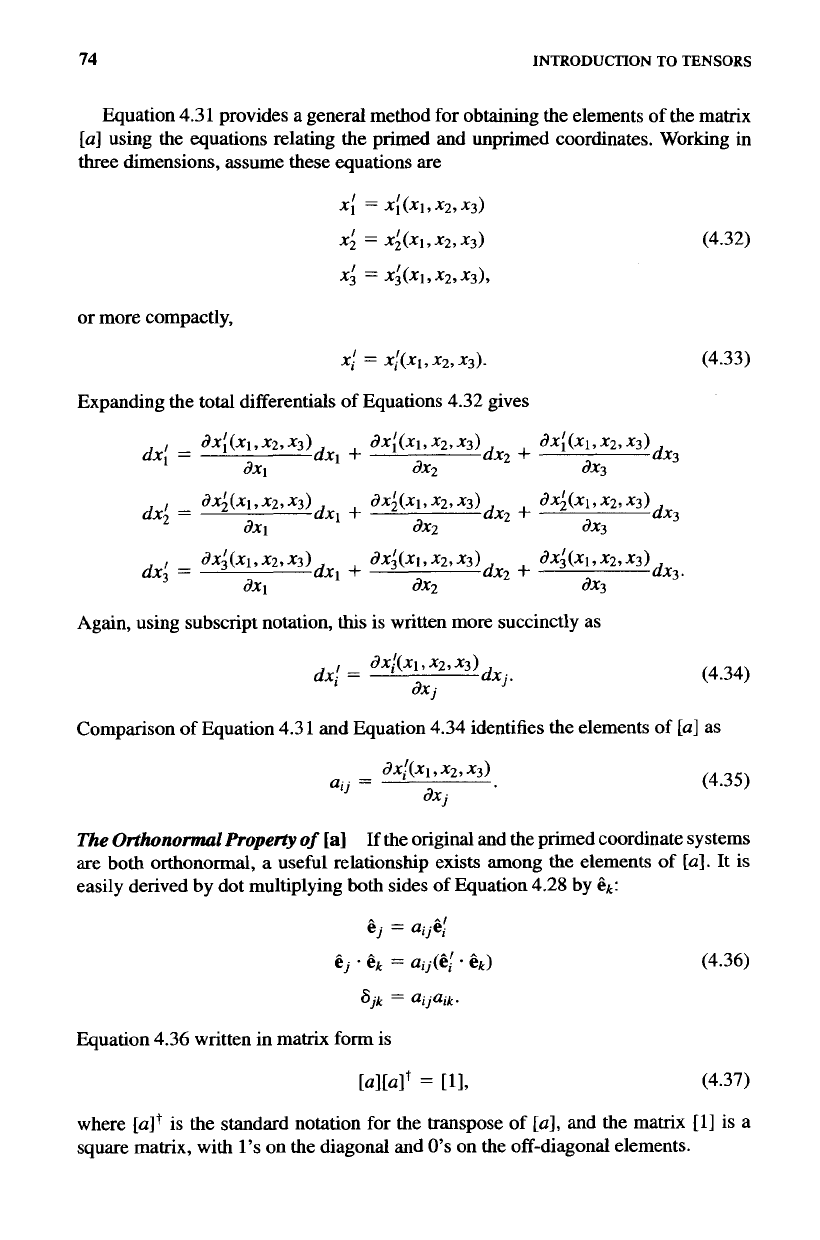
dx:
=
aijdx,.
(4.3
1)
74
INTRODUCTION TO TENSORS
Equation
4.3
1
provides a general method
for
obtaining the elements
of
the matrix
[a]
using the equations relating the primed and unprimed coordinates. Working in
three dimensions, assume these equations are
or
more compactly,
xi'
=
x;(xI,
x2.
x3).
Expanding the total differentials
of
Equations
4.32
gives
Again, using subscript notation,
this
is written more succinctly as
dxf
=
dxj.
dX,'(Xl,
x2.
x3)
an
j
(4.32)
(4.33)
(4.34)
Comparison of Equation
4.3
1
and Equation
4.34
identifies the elements
of
[a]
as
(4.35)
The
OrthonormalProperty
of
[a]
If
the original and the primed coordinate systems
are both orthonormal,
a
useful relationship exists among the elements of
[a].
It
is
easily derived by dot multiplying both sides
of
Equation
4.28
by
&:
(4.36)
Equation
4.36
written in matrix
form
is
=
ill,
(4.37)
where
[a]'
is the standard notation
for
the transpose
of
[a],
and the matrix
[l]
is a
square matrix, with
1's
on the diagonal and
0's
on
the off-diagonal elements.
TRANSFORMATIONS BETWEEN COORDINATE SYSTEMS
75
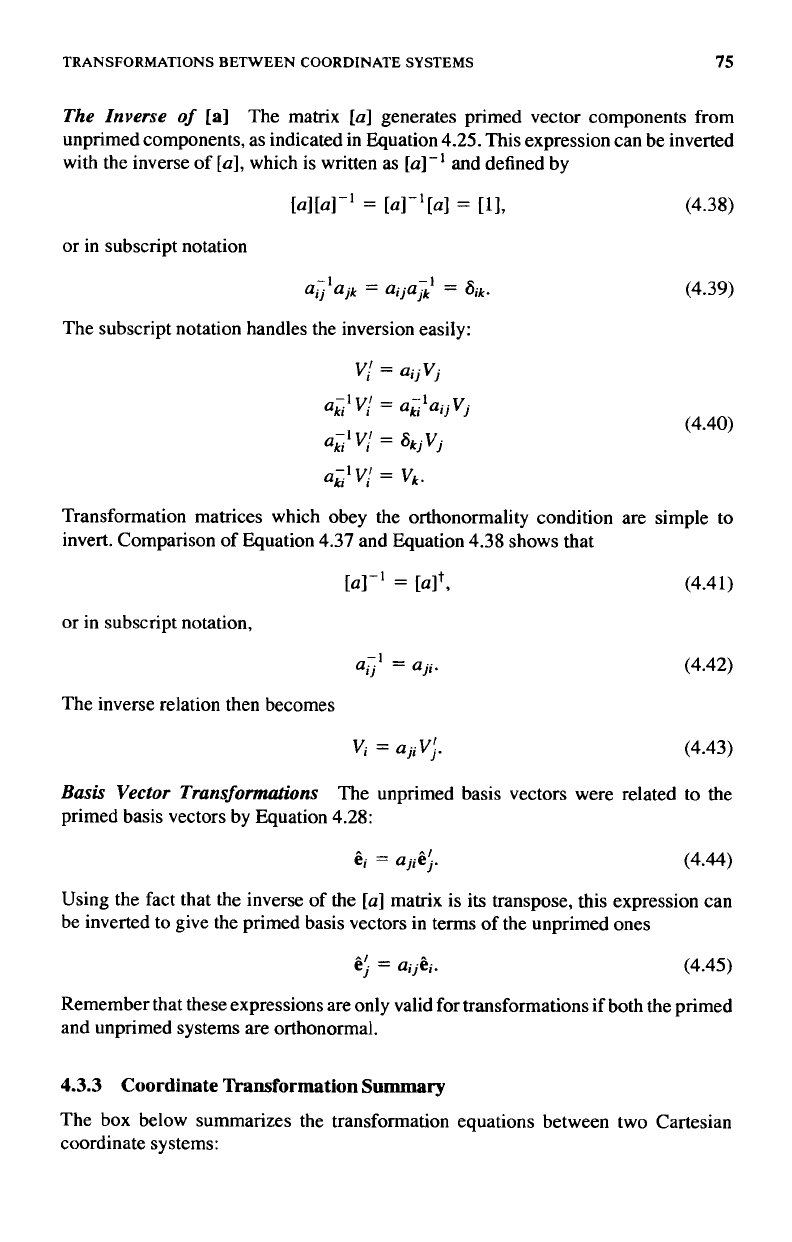
The Inverse of
[a]
The matrix
[a]
generates primed vector components from
unprimed components, as indicated in Equation
4.25.
This expression can be inverted
with the inverse of
[a],
which is written
as
[a]-'
and defined by
or
in subscript notation
aI'ajk
=
a..aT'
=
6.
'J
lJ Jk lk.
The subscript notation handles the inversion easily:
V!
=
a..V.
I
1J
J
a,'V!
=
a-'a..V.
I
ki
'J
J
-
aki'V;
=
6kjvj
(4.39)
(4.40)
Transformation matrices which obey the orthonormality condition are simple to
invert. Comparison
of
Equation
4.37
and Equation
4.38
shows that
[a]-'
=
[a]',
(4.41)
or
in subscript notation,
al<'
=
aji.
(4.42)
The inverse relation then becomes
v.
=
a
Jl
..v!
I'
(4.43)
Busis
Vector Transformations
The unprimed basis vectors were related to the
primed basis vectors by Equation
4.28:
(4.44)
@.
=
1
Jl
j'
Using the fact that the inverse of the
[a]
matrix is its transpose, this expression can
be inverted to give the primed basis vectors in terms of the unprimed ones
@!
J
=
a..@.
'J
1.
(4.45)
Remember that these expressions are only valid
for
transformations if both the primed
and unprimed systems are orthonormal.
4.3.3
Coordinate Transformation Summary
The box below summarizes the transformation equations between two Cartesian
coordinate systems: