
Kusse B.R., Westwig E.A. Mathematical Physics: Applied Mathematics for Scientists and Engineers
Подождите немного. Документ загружается.

106
THE
DIRAC
&FUNCTION
L..
t
nln
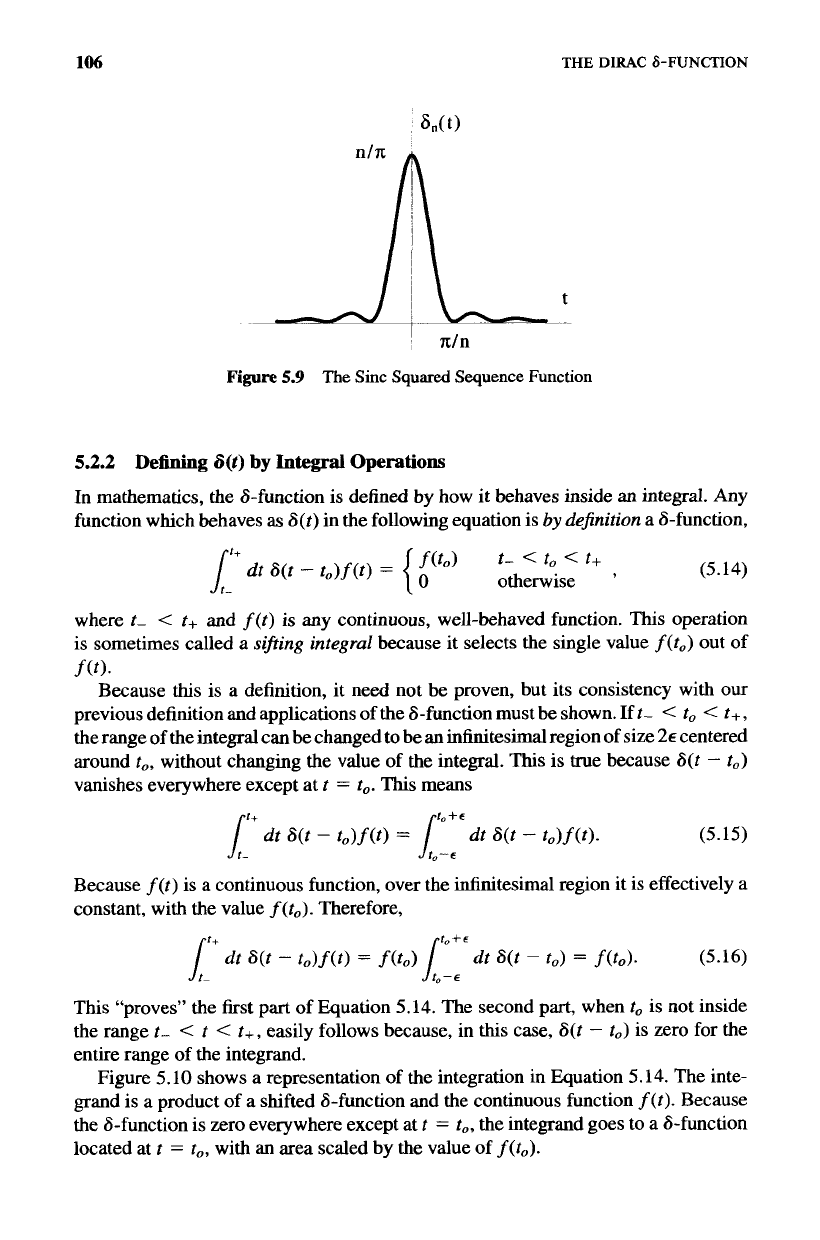
Figure
5.9
The Sinc
Squared
Sequence Function
5.2.2
Defining
S(t)
by
Integral
Operations
In mathematics, the 6-function is defined by how it behaves inside an integral. Any
function which behaves
as
6(t)
in the following equation is
by
dejnition
a 6-function,
t-
<
to
<
t+
otherwise
’
L-“
dt
6(t
-
to)f(t)
=
(5.14)
where
t-
<
t+
and
f
(t)
is
any continuous, well-behaved function. This operation
is sometimes called a
sifiing integral
because it selects the single value
f(to)
out of
Because
this
is a definition, it need not be proven, but its consistency with
our
previous definition and applications
of
the
6-function must be shown.
If
t-
<
to
<
t+
,
the range of the integral can be changed
to
be an infinitesimal region of size
2~
centered
around
to,
without changing the value
of
the integral.
This
is true because
6(t
-
to)
vanishes everywhere except at
t
=
to.
This
means
L-‘+
dt
6(t
-
to)f(t)
=
s,-,
dt
60
-
to)f(t>-
(5.15)
Because
f(t)
is a continuous function, over the infinitesimal region it is effectively a
constant, with the value
f(to).
Therefore,
f
(0.
f0+E
to+€
dt
S(t
-
to)
=
f(to).
(5.16)
This “proves” the first part
of
Equation 5.14. The second part, when
to
is not inside
the range
t-
<
t
<
t+,
easily follows because, in
this
case,
6(t
-
to)
is zero for the
entire range
of
the integrand.
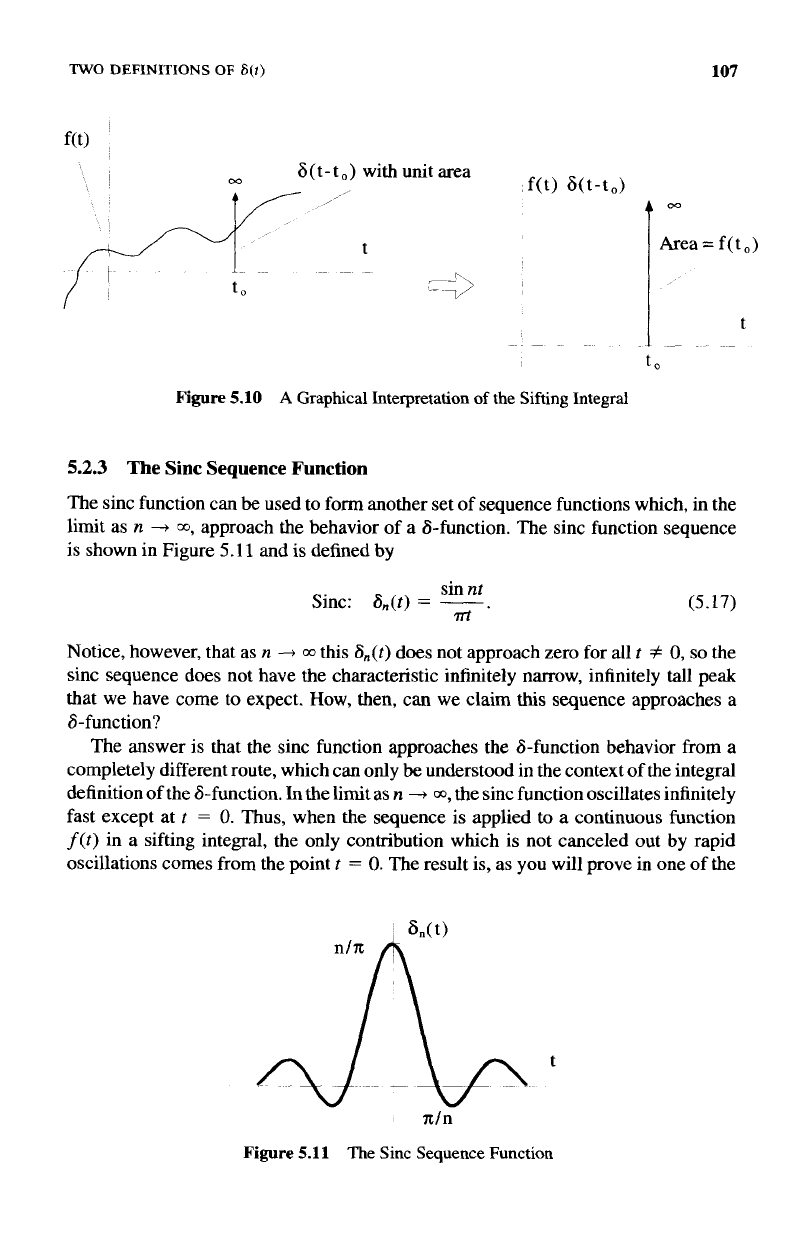
Figure
5.10
shows a representation of the integration in Equation 5.14. The inte-
grand is a product of a shifted 6-function and the continuous function
f(t).
Because
the &function is zero everywhere except at
t
=
to,
the integrand goes to a &function
located at
t
=
to,
with an area scaled by
the
value of
f(to).
s,.
[
dt
60
-
t0)f
(t)
=
f(t0)
TWO
DEFINITIONS
OF
S(f)
107
f(t>
6(
t-
t
o)
with unit area
t0
Figure
5.10
A
Graphical Intcrprctation
of
the
Sifting Integral
5.2.3
The
Sinc Sequence Function
The sinc function can
be
used to form another set
of
sequence functions which, in the
limit as
n
-+
m,
approach the behavior
of
a 6-function. The sinc function sequence
is
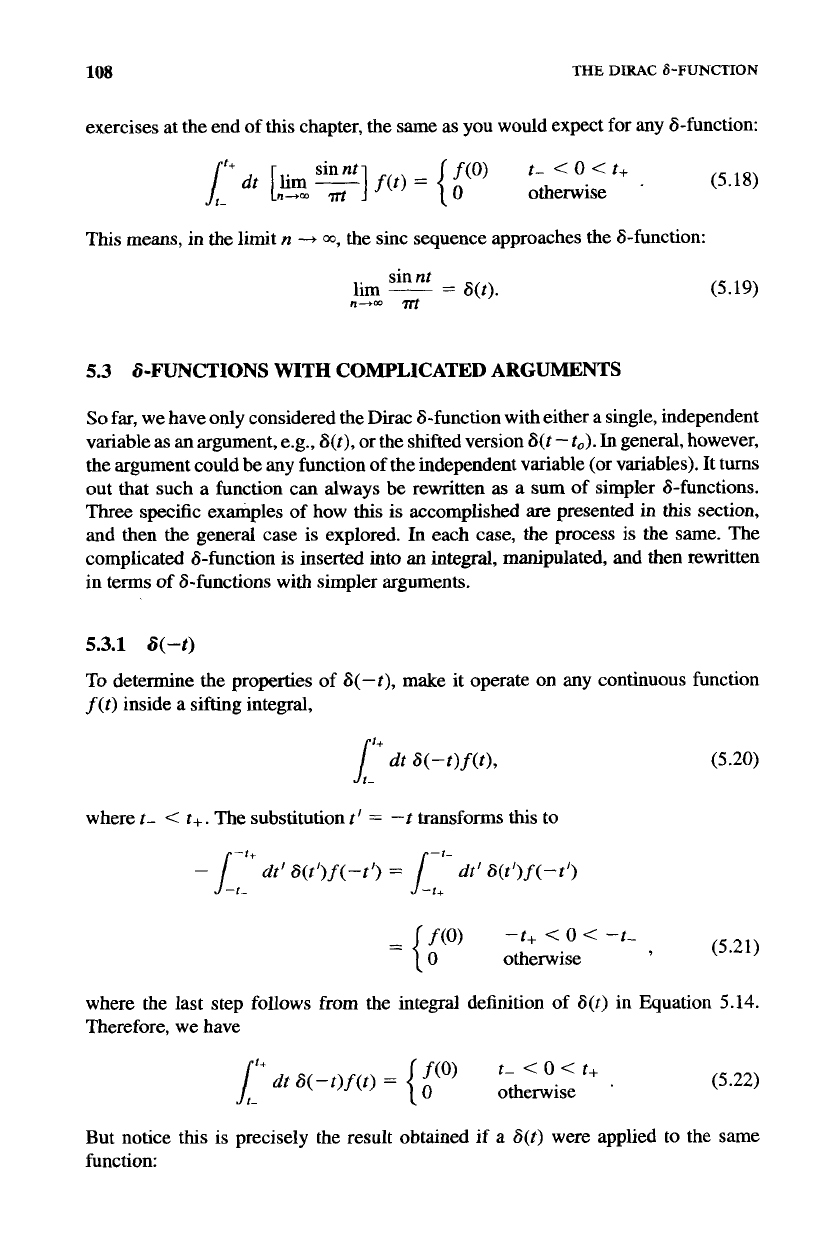
shown in Figure
5.1
1
and
is
defined by
sin
nt
Sinc:
6,(t)
=
-.
9l-t
(5.17)
Notice, however, that as
n
---f
m
this
&(t)
does
not approach zero for all
t
#
0,
so
the
sinc
sequence does not have the characteristic infinitely narrow, infinitely tall peak
that we have come to expect.
How,
then,
can
we claim
this
sequence approaches a
&function?
The answer
is
that the sinc function approaches the &function behavior from a
completely different route, which can only
be
understood in the context of the integral
definition of the &function.
In
the limit as
n
+
w,
the sinc function oscillates infinitely
fast except at
t
=
0.
Thus, when the sequence is applied
to
a continuous function
f(t)
in a sifting integral, the only contribution which is not canceled out by rapid
oscillations comes from the point
t
=
0.
The result is, as you will prove in one of the
7cin
Figure
5.11 The Sinc Sequence Function
108
THE
DIRAC
&FUNCTION
exercises at the end of
this
chapter, the same as you would expect for any &function:
This means, in the limit
n
-+
a,
the sinc sequence approaches the &function:
sin
nt
lim
-
=
6(t).
n-w
n-t
(5.18)
(5.19)
5.3
&FUNCTIONS WITH COMPLICATED ARGUMENTS
So
far, we have only considered the Dirac 6-function with either a single, independent
variable
as
an argument, e.g.,
6(t),
or the shifted version
8(t
-
to).
In
general, however,
the argument could be any function of the independent variable (or variables). It
turns
out that such a function can always be rewritten
as
a
sum
of simpler &functions.
Three specific examples of how
this
is accomplished
are
presented in
this
section,
and then the general case is explored.
In
each case, the process
is
the same. The
complicated 6-function is inserted into an integral, manipulated, and then rewritten
in
terms
of 6-functions with simpler arguments.
5.3.1
s(-t)
To
determine
the
properties of
8(-t),
make it operate on any continuous function
f(t)
inside a sifting integral,
(5.20)
where
t-
<
t+.
The substitution
t'
=
-t
transforms
this
to
-
1;;
dt'
6(t')
f
(-t')
=
sJ_:-
dt'
8(t')f(-t')
(5.21)
where the last step
follows
from
the integral definition
of
6(t)
in Equation
5.14.
Therefore. we have
-t+
<
0
<
-t-
otherwise
=
t-
<
0
<
ti
otherwise
j-'+
dt
s(-t)f(t)
=
{
fo)
(5.22)
But notice
this
is precisely the result obtained if a
8(t)
were applied to the same
function:
109
S-FUNCTIONS
WITH
COMPLICATED ARGUMENTS
t-
<
0
<
t+
otherwise
.
lt
dt
s(t)f(t)
=
{
i")
(5.23)
Remember, by definition, anything that behaves like a 6-function inside an integral
is a &function,
so
S(-t)
=
i3(t).
This implies the &function is an even function.
5.3.2
S(at)
Now consider another simple variation
6(at),
where
a
is any positive constant. Again,
start with a sifting integral in the form
(5.24)
With a variable change
oft'
=
at,
this
becomes
so
that
t-
<
0
<
t+
otherwise
l-'+
dt
f(t>&(at)
=
{
L(0)"
(5.26)
Notice again, this is just the definition of the function
6(t)
multiplied by the constant
l/a,
so
Wx)
=
S(x)/a
a
>
0.
(5.27)
This derivation was made assuming a positive
a.
The same manipulations can be
performed with a negative
a,
and combined with the previous result, to obtain the
more general expression
6(ax)
=
6(n)/lal.
(5.28)
Notice that
our
first example,
6(t)
=
8(-t),
can
be derived from Equation
5.28
by
setting
a
=
-
1.
5.3.3
S(tZ
-
2)
As
a bit more complicated argument for the Dirac &function, consider
6(t2
-
aL).
The argument
of
this function goes to zero when
t
=
fa
and
t
=
-a,
which seems
to imply two &functions.
To
test this theory, place the function in the sifting integral
lr+
dt
f(t)6(t2
-
a2).
(5.29)
110
THE
DIRAC
6-FUNCTION
There can
be
contributions to
this
integral only at the zeros of the argument
of
the 6-function. Assuming that the integral range includes both these zeros, i.e.,
t-
<
--a
and
t+
>
+a,
this
integral becomes
dt f(t)6(t2
-
a2)
+
1
+a+€
dt f(t)6(t2
-
a2),
(5.30)
fa-€
which is valid for any value of
0
<
E
<
a.
NOW
t2
-
a2
=
(t
-
a)(t
+
a),
which near the two zeros can be approximated by
(5.31)
(t
+
a)(-2a)
(t
-
a)(+k)
t
--t
-a
t
---f
+a
.
t2
-
a2
=
(t
-
a)(t
+
a)
=
Formally,
these results
are
obtained by performing a Taylor series expansion
of
t2
-
a2
about
both
t
=
-a
and
t
=
+a
and keeping terms up to the first order. The Taylor
series expansion
of
t2
-
a2
around an arbitrary point
to
is, to first order, given by
to).
(5.32)
It=t',
In
the limit as
E
-+
0,
Integral
5.30
then becomes
-a+€
+a+€
la-c
dtfW(-W
+
4)
+
la-,
dt f(tP(k(t
-
a)).
(5.33)
Using the result from the previous section, 6(at)
=
6(t)/lal,
gives
(5.34)
1
1
2a
1'
dt
f(t)6(t2
-
a2)
=
--(-a)
+
-f(+a).
2a
Therefore,
S(t2
-
a2)
is
equivalent to the sum
of
two 6-functions:
1 1
2a
2a
6(t2
-
a2)
=
-S(t
-
a)
+
-6(t
+
a),
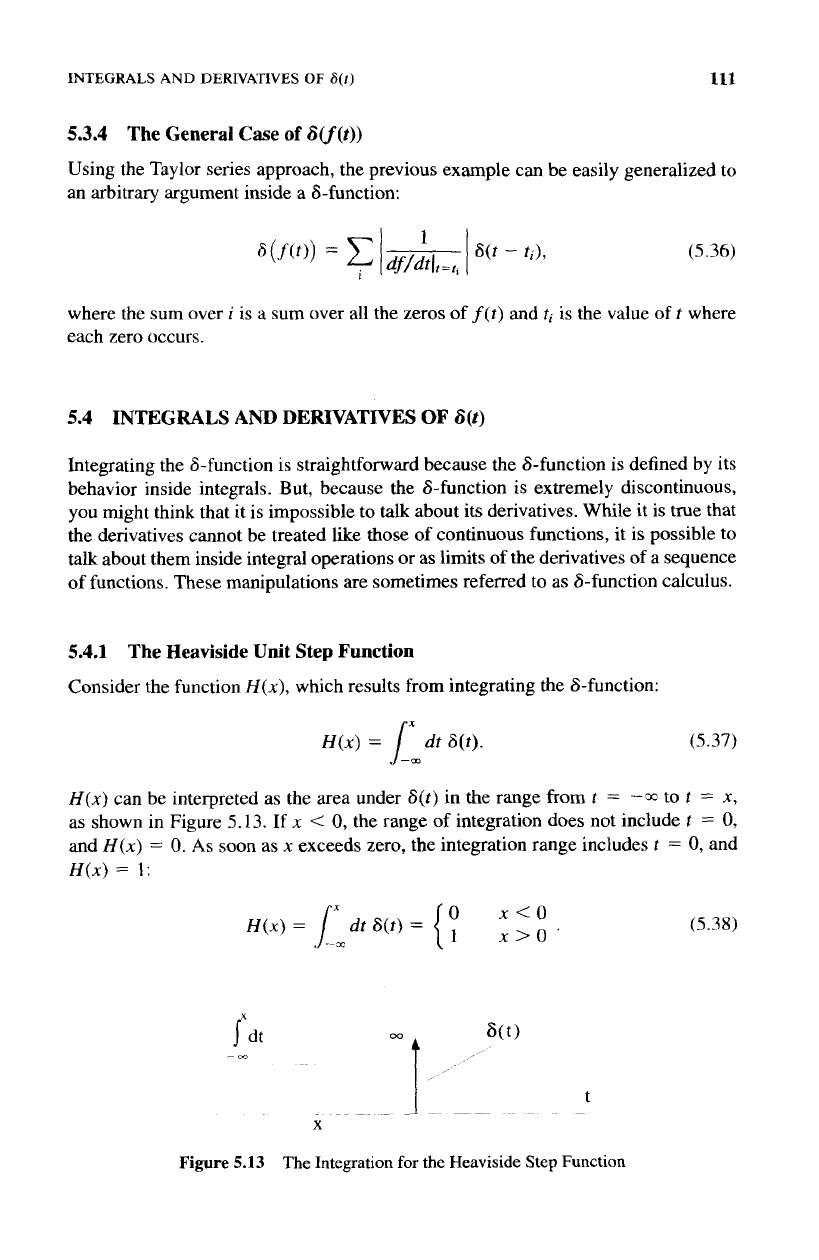
as shown in Figure
5.12.
6(x2
-
a2)
00
03
area
=
1/2a
i
-'
X
area
=
1/2a
-
1,-
a
-a
The
Plot
of
S(x2
-
a2)
~~~~
____
~~
_~~_
-
~ ~~ ~
-
Figure
5.12
(5.35)
INTEGRALS
AND
DERIVATIVES
OF
6(r)
111
5.3.4
The General Case
of
Scf(t))
Using the Taylor series approach, the previous example can be easily generalized to
an arbitrary argument inside a 8-function:
(5.36)
where the sum over
i
is
a
sum over all the zeros
of
f(t)
and
ti
is
the value oft where
each zero occurs.
5.4
INTEGRALS AND DERIVATIVES
OF
S(t)
Integrating the &-function
is
straightforward because the &function is defined
by
its
behavior inside integrals. But, because the &function is extremely discontinuous,
you might think that
it
is impossible to
talk
about its derivatives. While it is true that
the derivatives cannot be treated like those
of
continuous functions, it is possible
to
talk about them inside integral operations or
as
limits of the derivatives of a sequence
of functions. These manipulations are sometimes referred to
as
&function calculus.
5.4.1
Consider the function
H(x),
which results from integrating the &function:
The Heaviside
Unit
Step Function
H(x)
=
dt
s(t).
.I_a
(5.37)
H(x)
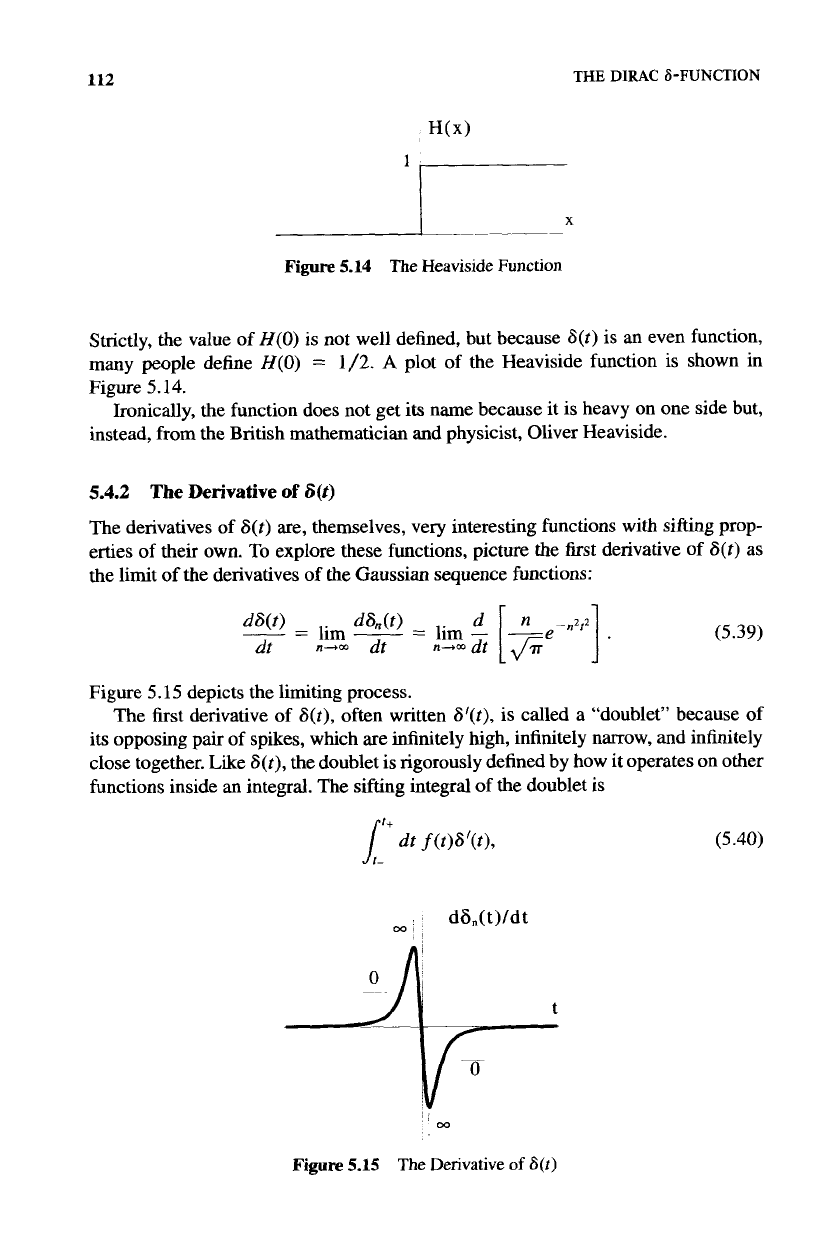
can be interpreted
as
the area under 8(t) in the range
from
t
=
--m
to
t
=
x,
as shown
in
Figure
5.13.
If
x
<
0,
the range
of
integration does not include
t
=
0,
and
H(x)
=
0.
As
soon as
x
exceeds zero, the integration range includes
t
=
0,
and
H(x)
=
1:
0 x<0
H(x)
=
[=dt
6(t)
=
{
x>0'
f
dt
6(t>
t
~
~~
X
Figure
5.13
The
Integration for
the
Heaviside
Step Function
(5.38)
112
THE
DIRAC
&FUNCTION
Figure
5.14
The Heaviside
Function
Strictly, the value of
H(0)
is not well defined, but because
S(t)
is
an
even function,
many people define
H(0)
=
1/2.
A
plot of the Heaviside function is shown in
Figure
5.14.
Ironically, the function does not get its name because it is heavy on one side but,
instead, from the British mathematician and physicist, Oliver Heaviside.
5.4.2
The Derivative
of
S(t)
The derivatives of
a(?)
are, themselves, very interesting functions with sifting prop-
erties
of
their own.
To
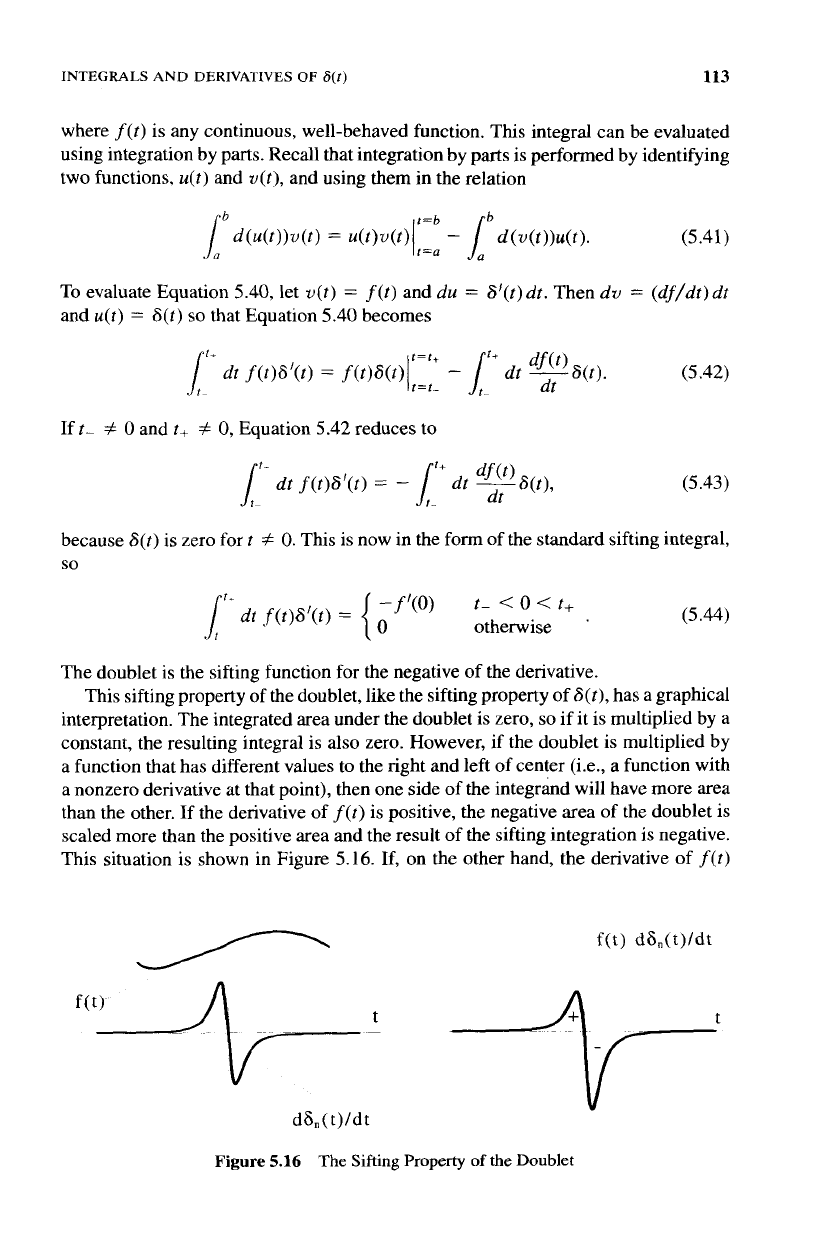
explore these functions, picture the first derivative of
S(t)
as
the limit
of
the derivatives of the Gaussian sequence functions:
(5.39)
Figure
5.15
depicts the limiting process.
The first derivative
of
8(t),
often written
S‘(t),
is called a “doublet” because
of
its opposing pair
of
spikes, which are infinitely high, infinitely narrow, and infinitely
close together. Like
S(t),
the doublet is rigorously defined by how it operates on other
functions inside
an
integral. The sifting integral
of
the
doublet
is
l-t+
dt
f
(t)a‘(t),
(5.40)
d6,( t)/dt
-,
Figure
5.15
The Derivative
of
s(t)
INTEGRALS
AND
DERIVATIVES
OF
6(r)
113
where
f(t)
is any continuous, well-behaved function. This integral can be evaluated
using integration by parts. Recall that integration by parts is performed by identifying
two functions,
u(t)
and
v(t),
and using them in the relation
ib
d(u(t))v(t)
=
~(t)v(t)(‘=~
-
lb
d(v(t))u(r).
(5.41)
To evaluate Equation
5.40,
let
v(t)
=
f(t)
and
du
=
s’(t)dt.
Then
dv
=
(df/dt)dt
and
u(t)
=
6(t)
so
that Equation
5.40
becomes
f=a
If
t-
#
0
and
t+
f
0,
Equation
5.42
reduces to
(5.43)
because
6(r)
is zero
for
t
#
0.
This is now in the form of the standard sifting integral,
so
(5.44)
The doublet is the sifting function for the negative of the derivative.
This sifting property
of
the doublet, like the sifting property of
S(t),
has a graphical
interpretation. The integrated area under the doublet is zero,
so
if it is multiplied by a
constant, the resulting integral is also zero. However, if the doublet is multiplied by
a function that has different values to the right
and
left of center (i.e., a function with
a nonzero derivative at that point), then one side of the integrhd will have more area
than the other. If the derivative
of
f(t)
is positive, the negative area of the doublet is
scaled more than the positive area and the result of the sifting integration is negative.
This situation is shown in Figure
5.16.
If, on the other hand, the derivative of
f(t)
f(t)
d6,(t)/dt
/
Figure
5.16
The
Sifting Property
of
the
Doublet
114
THE
DIRAC &FUNCTION
is negative, the positive
area
of the doublet is enhanced more than the negative area,
and the sifting integration produces
a
positive result.
Similar arguments can
be
extended to higher derivatives of the &function. The
appropriate sifting property is arrived at by applying integration by parts a number
of times, until the integral is placed in the form of Equation
5.44.
5.5
SINGULAR
DENSITY FUNCTIONS
One of the more common uses of the Dirac 6-function is to describe density functions
for singular distributions. Typically, a distribution function describes a continuous,
“per unit volume” quantity such
as
charge density, mass density, or number density.
Singular distributions
are
not continuous, but describe distributions that are confined
to
sheets, lines,
or
points. The example of the density of a point mass was briefly
described earlier in
this
chapter.
5.5.1
Point
Mass
Distributions
The simplest singular mass distribution describes a point of mass
m,
located at the
origin of a Cartesian coordinate system, as shown in Figure
5.4.
The mass density
function
p,(x,
y,
z)
that describes this distribution must have the units of mass per
volume and must be zero everywhere, except at the origin. In addition, any volume
integral of the density which includes the origin must give a total mass of
m,,
while
integrals that exclude the origin must give zero mass. The expression
(5.45)
satisfies
all
of these requirements. Clearly it is zero unless
x,
y,
and
z
are zero.
Therefore integrating
pm
over a volume that does not include the origin produces
zero. Integrating over a volume that contains the origin results in
prn(X3
Y
9
Z)
=
moS(xP(y)S(z)
S,dr
m06(46(y)6(z)
=
[I‘dx
[:‘&
SJ‘dz
m&x)~(~)W
(5.46)
Because
dx
6(x)
=
1,
6(x)
has the inverse dimensions of its argument, or in this
case, l/length. Therefore,
m0S(x)6(y)6(z)
has the proper dimensions of mass per
unit volume.
To
shift the point mass
to
a different location than the origin, simply use shifted
6-functions:
-
-
m,.
Pm
=
mo6(x
-
-G)S(Y
-
YO)G
-
~0).
(5.47)
This
function has the proper dimensions of mass per unit volume, and
pm
is
zero
except at the point
(xo,
yo,
zo).
The integral over a volume
V
correctly produces zero
mass if
V
does not include the point
(x,,
yo,
G)
and
m,
if it does.
SINGULAR
DENSITY
FUNCTIONS
115
Consider the very same point, but now try to write the mass density in cylindrical
coordinates, i.e.,
p,(p,
4,
z).
In this system, the coordinates of the mass point are
(pO,
h,
z,)
where
Po
=
4x2
+
y,'
(5.48)
A
natural guess for
pm(p,
4,z)
might be
%S(P
-
Pm4
-
40Pk
-
70).
(5.49)
This density clearly goes to zero, unless
p
=
po,
4
=
4o
and
z
=
zo,
as
it
should.
However, because
4
is dimensionless, Equation
5.49
has the dimensions
of
mass per
unit area, which is not correct. Also, the integral over a volume
V
becomes
This is zero
if
V
does not contain the point
(po,
G),
but when
V
does contain the
point, the result is
mopo,
not
m,
as
required. This is because the
dp
integration gives
lo-€
dP PNP
-
Po)
=
Po.
(5.51)
Therefore, Equation
5.49
is not the proper expression
for
the mass density in cylin-
drical coordinates, because
it
does not have the proper dimensions, and integration
does not produce the total mass. From the discussion above, it is clear that the correct
density function is
PO+€
This example demonstrates an important point. While the point distributions
in
a Cartesian system can be determined very intuitively, a little more care must be
used with non-Cartesian coordinates. In generalized curvilinear coordinates, where
dr
=
hlh&dqldqzdq3,
the expression
for
a point mass at
(qlo,
qzO,
q30)
is
(5.53)
There is a common shorthand notation used for three-dimensional singular distri-
butions. The three-dimensional Dirac &function is defined by
(5.54)