
Kusse B.R., Westwig E.A. Mathematical Physics: Applied Mathematics for Scientists and Engineers
Подождите немного. Документ загружается.

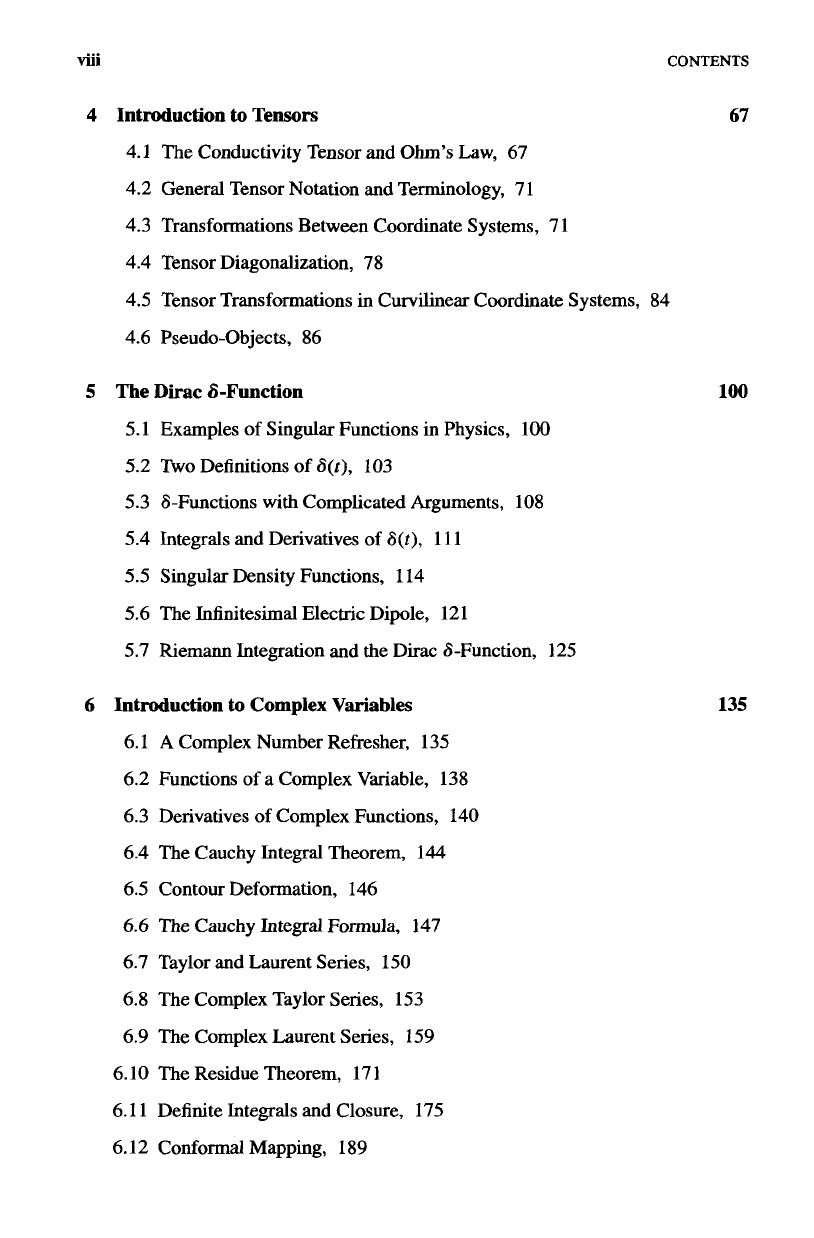
viii
CONTENTS
67
4
Introduction
to
Tensors
4.1 The Conductivity Tensor and Ohm’s Law, 67
4.2 General Tensor Notation and Terminology, 71
4.3 Transformations Between Coordinate Systems, 7 1
4.4 Tensor Diagonalization, 78
4.5 Tensor Transformations in Curvilinear Coordinate Systems,
84
4.6 Pseudo-Objects, 86
5
The
Dirac &Function
5.1 Examples of Singular Functions in Physics, 100
5.2 Two Definitions
of
&t),
103
5.3 6-Functions with Complicated Arguments, 108
5.4 Integrals and Derivatives
of
6(t), 11 1
5.5 Singular Density Functions, 114
5.6 The Infinitesimal Electric Dipole, 121
5.7 Riemann Integration and the Dirac &Function, 125
6
Introduction
to
Complex Variables
6.1
A
Complex Number Refresher, 135
6.2 Functions of a Complex Variable, 138
6.3 Derivatives of Complex Functions, 140
6.4 The Cauchy Integral Theorem, 144
6.5 Contour Deformation, 146
6.6 The Cauchy Integrd Formula, 147
6.7 Taylor and Laurent Series, 150
6.8
The Complex Taylor Series, 153
6.9 The Complex Laurent Series, 159
6.10 The Residue Theorem, 171
6.1 1 Definite Integrals and Closure, 175
6.12 Conformal Mapping, 189
100
135
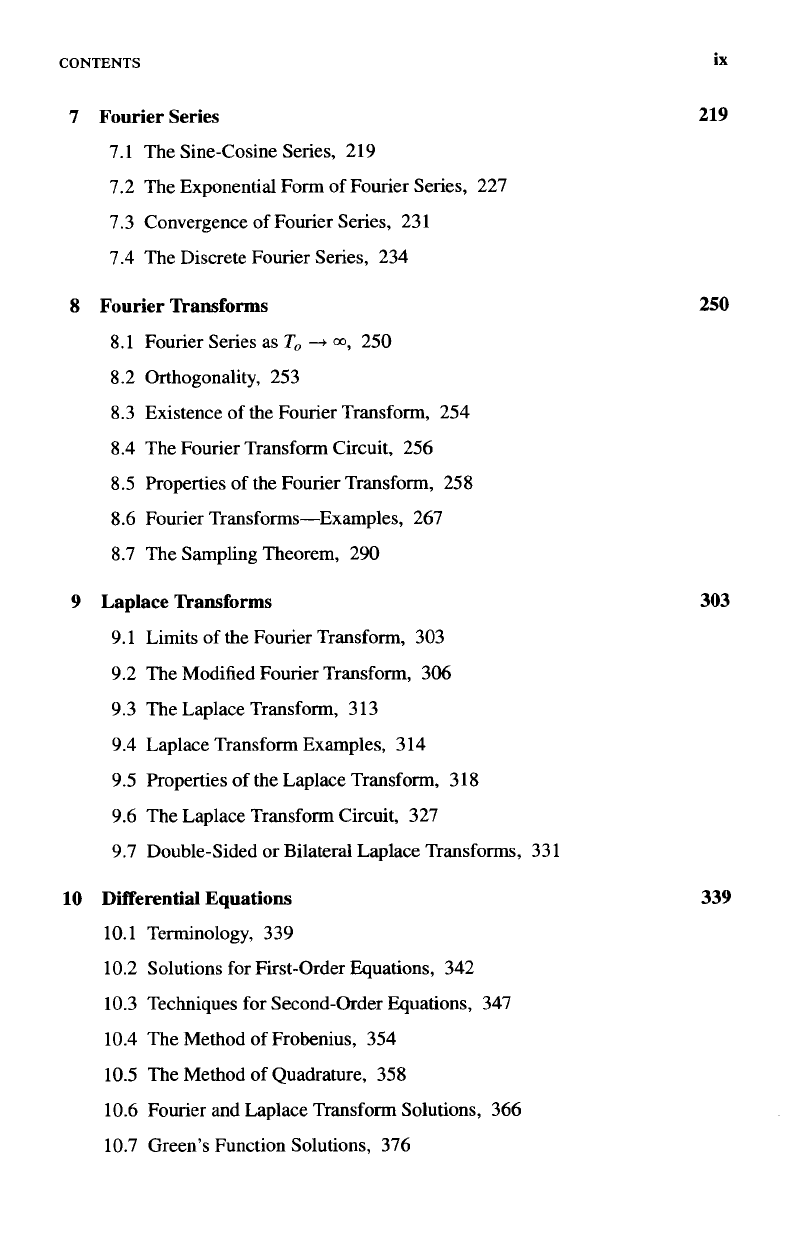
CONTENTS
7
Fourier Series
7.1 The Sine-Cosine Series, 219
7.2 The Exponential Form of Fourier Series, 227
7.3 Convergence of Fourier Series, 231
7.4 The Discrete Fourier Series, 234
8
Fourier
Transforms
8.1 Fourier Series as
To
-+
m,
250
8.2 Orthogonality, 253
8.3 Existence of the Fourier Transform, 254
8.4 The Fourier Transform Circuit, 256
8.5
Properties of the Fourier Transform, 258
8.6 Fourier Transforms-Examples, 267
8.7 The Sampling Theorem, 290
9
Laplace
Transforms
9.1 Limits of the Fourier Transform, 303
9.2 The Modified Fourier Transform, 306
9.3
The
Laplace Transform, 313
9.4 Laplace Transform Examples, 314
9.5 Properties of the Laplace Transform, 318
9.6 The Laplace Transform Circuit, 327
9.7 Double-Sided or Bilateral Laplace Transforms, 331
10
Differential
Equations
10.1 Terminology, 339
10.2 Solutions for First-Order Equations, 342
10.3 Techniques for Second-Order Equations, 347
10.4 The Method of Frobenius, 354
10.5 The Method of Quadrature, 358
10.6 Fourier and Laplace Transform Solutions, 366
10.7 Green’s Function Solutions, 376
ix
219
250
303
339
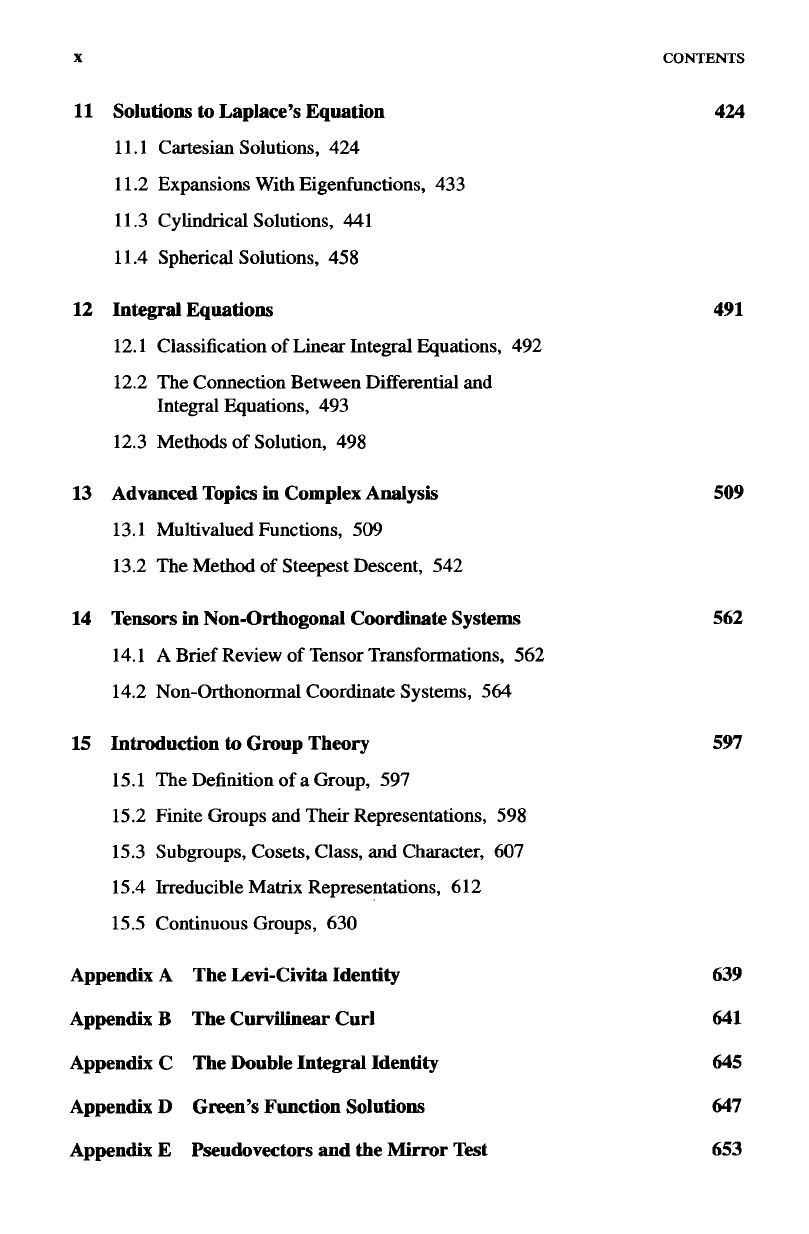
X
11
Solutions to Laplace’s Equation
11.1 Cartesian Solutions, 424
1 1.2 Expansions With Eigenfunctions, 433
11.3 Cylindrical Solutions, 441
1 1.4 Spherical Solutions, 458
12
Integral Equations
12.1 Classification of Linear Integral Equations, 492
12.2 The Connection Between Differential and
Integral Equations,
493
12.3 Methods of Solution,
498
13
Advanced Topics
in
Complex Analysis
13.1 Multivalued Functions,
509
13.2 The Method of Steepest Descent, 542
14
Tensors
in
Non-Orthogonal Coordinate Systems
14.1
A
Brief Review of Tensor Transformations, 562
14.2 Non-Orthononnal Coordinate Systems,
564
15
Introduction
to
Group Theory
15.1 The Definition of a Group, 597
15.2 Finite Groups and Their Representations, 598
15.3 Subgroups, Cosets, Class, and Character, 607
15.4 Irreducible Matrix Representations, 612
15.5 Continuous Groups, 630
Appendix
A
The Led-Cidta Identity
Appendix
B
The Curvilinear Curl
Appendiv C The Double Integral Identity
Appendix
D
Green’s Function Solutions
Appendix
E
Pseudovectors and the Mirror Test
CONTENTS
424
491
509
562
597
639
641
645
647
653
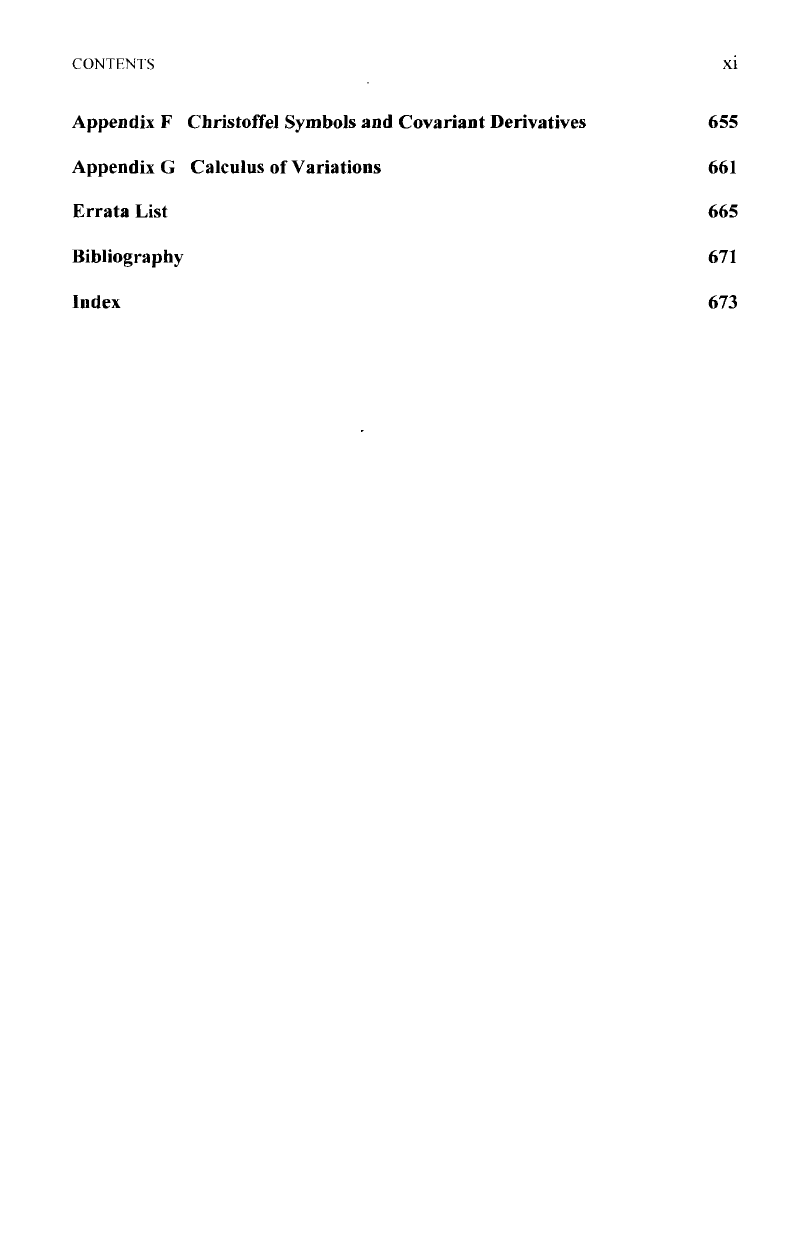
CONTENTS
xi
Appendix
F
Christoffel Symbols and Covariant Derivatives
Appendix
G
Calculus
of
Variations
Errata List
Bibliography
Index
655
661
665
671
673

This Page Intentionally Left Blank
1
A REVIEW
OF
VECTOR AND
MATRIX ALGEBRA USING
SUBSCRIPTISUMMATION
CONVENTIONS
This chapter presents a quick review of vector and matrix algebra. The intent is not
to cover these topics completely, but rather use them to introduce subscript notation
and the Einstein summation convention. These tools simplify the often complicated
manipulations
of
linear algebra.
1.1
NOTATION
Standard, consistent notation is a very important habit to form in mathematics. Good
notation not only facilitates calculations but, like dimensional analysis, helps to catch
and correct errors. Thus, we begin by summarizing the notational conventions that
will be used throughout this
book,
as listed in Table
1
.l.
TABLE
1.1.
Notational Conventions
Symbol Quantity
a
A
real number
A
complex
number
A
vector component
A
matrix
or
tensor element
An
entire matrix
A
vector
@,
A
basis vector
T
A
tensor
L
An
operator
- -
1
2
A
REWW
OF
VECTOR
AND
MATRIX
ALGEBRA
A
three-dimensional vector can be expressed
as
v
=
VX&
+
VY&,
+
VZ&,
(1.1)
where the components
(Vx,
V,, V,)
are called the Cartesian components of and
(ex.
e,,
$)
are the basis vectors
of
the coordinate system.
This
notation can
be
made
more efficient by using
subscript notation,
which replaces the letters
(x,
y,
z)
with the
numbers
(1,2,3).
That is, we define:
Equation
1.1
becomes
or
more succinctly,
i= 1,2,3
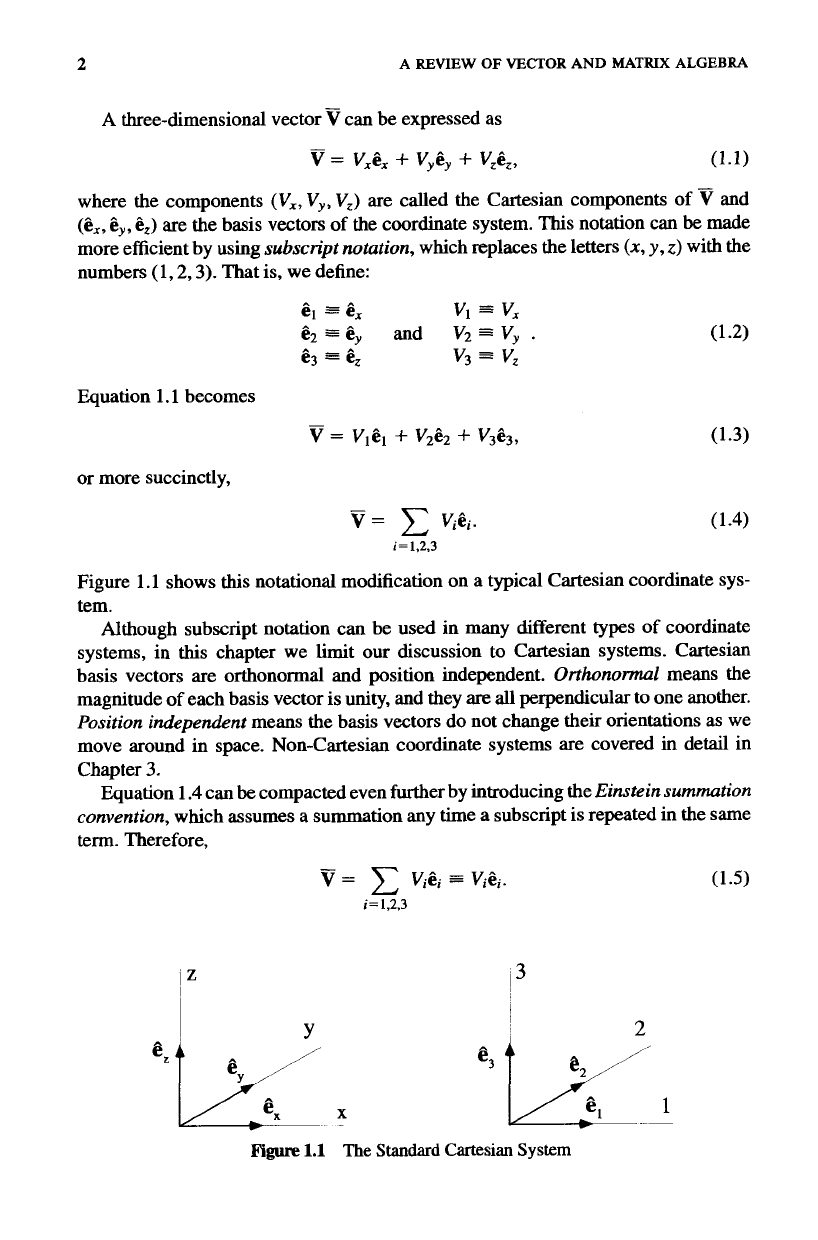
Figure
1.1
shows this notational modification on a typical Cartesian coordinate sys-
tem.
Although subscript notation can be used in many different
types
of coordinate
systems, in
this
chapter we limit
our
discussion to Cartesian systems. Cartesian
basis vectors are
orthonormal
and position independent.
Orthonoml
means the
magnitude of each basis vector is unity, and they
are
all
perpendicular to one another.
Position independent
means the basis vectors do not change their orientations as we
move around
in
space. Non-Cartesian coordinate systems are covered
in
detail in
Chapter
3.
Equation
1.4
can
be
compacted even further by introducing the
Einstein summation
convention,
which assumes a summation any time a subscript
is
repeated in the same
term. Therefore,
i=1,2,3
I
I
I
Y
I
2
Figure
1.1
The
Standard
Cartesian System
NOTATION
3
We refer to this combination of the subscript notation and the summation convention
as
subscripthummation notation.
Now imagine we want to write the simple vector relationship
This
equation is written in what we call
vector notation.
Notice how it does not
depend on a choice of coordinate system.
In
a particular coordinate system, we can
write the relationship between these vectors
in
terms of their components:
C1
=
A1
+
B1
C2
=
A2
+
B2
C3
=
A3
+
B3.
(1.7)
With subscript notation, these
three
equations can be written in a single line,
where the subscript
i
stands for any of the
three
values
(1,2,3).
As
you will see
in many examples at the end of
this
chapter, the use of the subscript/summation
notation can drastically simplify the derivation of many physical and mathematical
relationships. Results written in subscripthummation notation, however, are tied to
a particular coordinate system, and are often difficult to interpret. For these reasons,
we will convert our final results back into vector notation whenever possible.
A
matrix is a two-dimensional array of quantities that may or may not be associated
with a particular coordinate system. Matrices can
be
expressed
using
several different
types
of
notation. If we want to discuss a matrix
in
its entirety, without explicitly
specifying all its elements, we write it in
matrix notation
as
[MI.
If we do need
to
list out the elements of
[MI,
we can write them
as
a rectangular array inside a pair
of
brackets:
(1.9)
We call this
matrix array notation.
The individual element in the second row and
third column of
[MI
is written
as
M23.
Notice how the row of a given element is
always listed first, and the column second. Keep
in
mind, the array is not necessarily
square. This means that for the matrix in Equation
1.9,
r
does not have to equal
c.
Multiplication between two matrices is only possible if the number of columns
in the premultiplier equals the number of rows
in
the postmultiplier. The result of
such a multiplication forms another matrix with the same number of rows as the
premultiplier and the same number of columns
as
the postmultiplier. For example,
the product between a
3
X
2
matrix
[MI
and a
2
X
3
matrix
[N]
forms the
3
X
3
matrix
4
A
REVIEW
OF
VECTOR
AND
MATRIX
ALGEBRA
[PI,
with
the
elements given by:
7
[PI
The multiplication in Equation 1.10 can be written in the abbreviated matrix notation
as
[n/il"l
=
[PI,
(1.11)
Ml
JNJk
=
PIk,
(1.12)
We can
also
use subscripthmmation notation to write
the
same product
as
with
the
implied sum over the
j
index keeping track of the summation. Notice
j
is
in
the second position
of
the
Mtj
term and
the
first position of
the
N,k
term,
so
the summation is over the columns of
[MI
and the rows of
[N],
just as it was in
Equation
1.10.
Equation 1.12
is
an expression for the
iPh
element of the matrix
[PI.
Matrix array notation
is
convenient for doing numerical calculations, especially
when using a computer. When deriving the relationships between the various quan-
tities in physics, however,
matrix
notation is often inadequate because it lacks a
mechanism for keeping track of the geometry of the coordinate system. For example,
in a particular coordinate system, the vector
v
might
be
written as
V
=
lel
+
3e2
+
2C3.
(1.13)
When performing calculations, it is sometimes convenient to use a matrix represen-
tation of this vector by writing:
v+
[V]
=
[;I.
(1.14)
The problem with
this
notation is that there is no convenient way to incorporate the
basis vectors into the matrix.
This
is why we
are
careful to use an arrow
(-)
in
Equation 1.14 instead of an equal sign
(=).
In
this
text, an equal sign between two
quantities means that they
are
perfectly equivalent in every way. One quantity may
be substituted for the other in any expression. For instance, Equation 1.13 implies
that the quantity
1C1
+
3C2
+
2C3
can replace in any mathematical expression, and
vice-versa.
In
contrast,
the
arrow
in
Equation 1.14 implies that
[Vl
can represent
v,
and that calculations can
be
performed using it, but we must
be
careful not to directly
substitute one for the other without specifying the
basis
vectors associated with the
components of
[
Vl
.
-
-
VECTOR
OPERATIONS
5
1.2
VECTOR
OPERATIONS
In this section, we investigate several vector operations. We will use all the different
forms
of
notation discussed in the previous section in order to illustrate their dif-
ferences. Initially, we will concentrate on matrix and matrix array notation.
As
we
progress, the subscript/summation notation will be used more frequently.
can be represented using a
matrix. There are actually two ways to write
this
matrix. It can be either a
(3
X
1)
column matrix or a (1
X
3)
row matrix, whose elements are the components of the
vector in some Cartesian basis:
As
we discussed earlier, a three-dimensional vector
-
V+[V]
=
[
;]
or
v-.
[u+
=
[
V,
~2
V,
I.
(1.15)
The standard notation
[VJt
has been used to indicate the transpose of
[Vl,
indicating
an interchange of rows and columns. Remember the vector can have
an
infinite
number of different matrix array representations, each written with respect to a
different coordinate basis.
1.2.1
Vector
Rotation
Consider the simple rotation of a vector in a Cartesian coordinate system. This
example will be worked out, without any real
loss
of generality, in two dimensions.
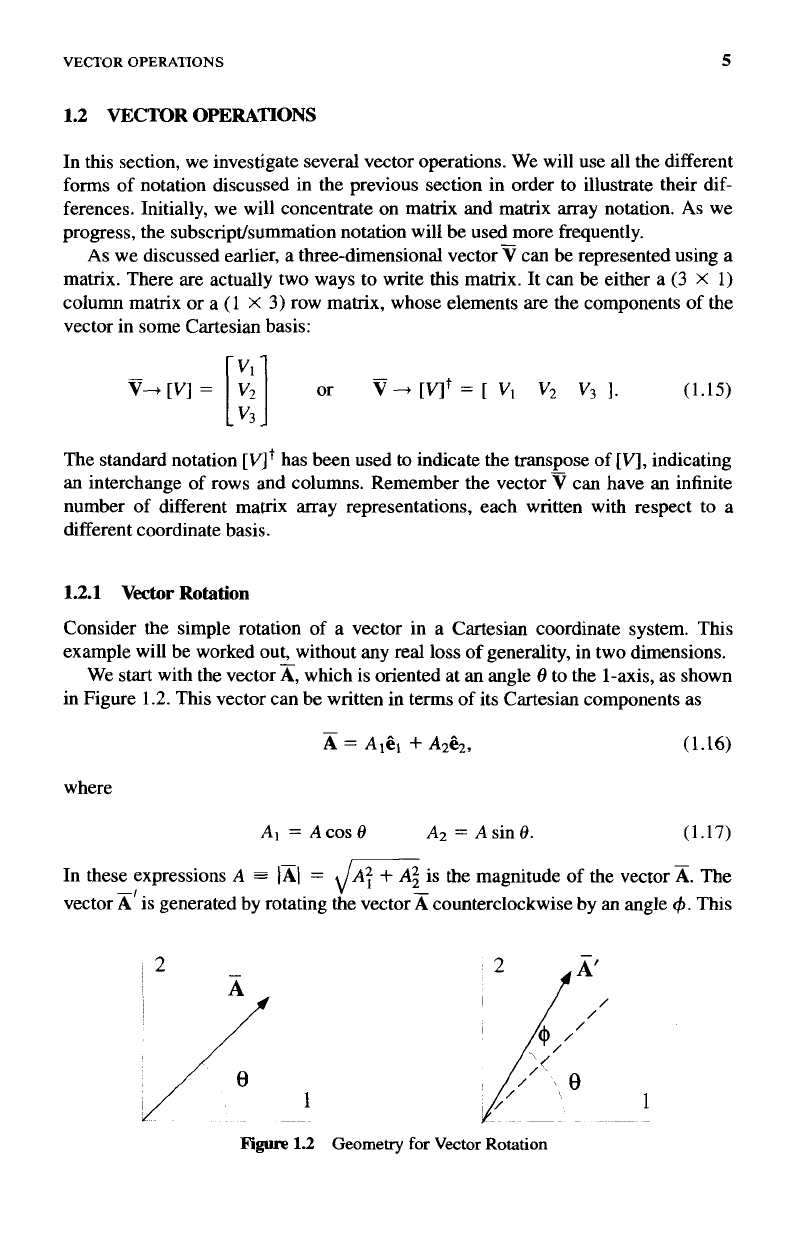
We start with the vector
A,
which is oriented at an angle
8
to
the
1-axis, as shown
in Figure
1.2.
This vector can be written
in
terms of its Cartesian components as
-
A
=
A,&
+
A&,
(1.16)
where
A~
=
ACOS~
A2
=
AsinO.
(1.17)
In these expressions
A
3
1x1
=
,/A;
+
A;
is the magnitude of the vector
A.
The
vector
A'
is generated
by
rotating the vectorx counterclockwise by
an
angle
4.
This
Figure
1.2
Geometry
for
Vector Rotation