
Kusse B.R., Westwig E.A. Mathematical Physics: Applied Mathematics for Scientists and Engineers
Подождите немного. Документ загружается.

116
THE DIRAC
6-FUNCTION
In
Cartesian coordinates,
this
is simply
S3(F
-
To)
=
6(x
-
x,)S(y
-
y,)S(z
-
z,).
(5.55)
Using this notation, the mass density of point mass located at
?,
is, regardless of the
coordinate system chosen, given by
pm(T)
=
m,63(?
-
To).
(5.56)
If there are several points with mass
mi
at
position
Ti,
the density function becomes
a sum
of
6-functions:
pm(T)
=
Crni63(T
-
Ti).
i
Integrating over a volume
V
gives
(5.57)
(5.58)
which, when evaluated,
is
simply the sum
of
all the masses enclosed in
V.
5.5.2
Sheet
Distributions
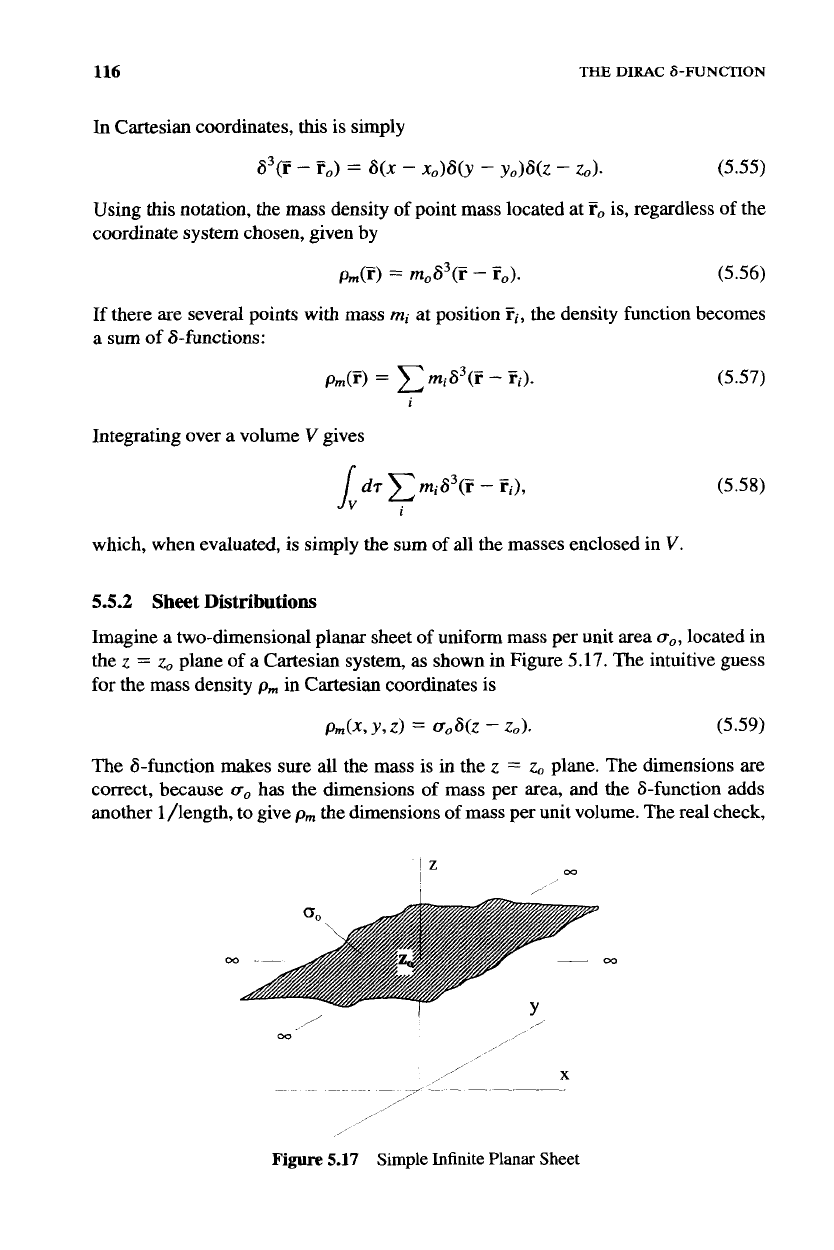
Imagine a two-dimensional planar sheet
of
uniform mass per unit area
uo,
located
in
the
z
=
z,
plane of a Cartesian system,
as
shown in Figure
5.17.
The intuitive guess
for the mass density
pm
in Cartesian coordinates is
P~(~>Y,Z)
=
aoa(z
-
~0)-
(5.59)
The &function makes sure
all
the mass is in the
z
=
z,
plane. The dimensions are
correct, because
a,
has the dimensions of mass per area, and the &function adds
another
1
/length, to give
pm
the dimensions of mass per unit volume. The real check,
I
X
,
Figure
5.17
Simple
Infitute
Planar
Sheet
SINGULAR DENSITY FUNCTIONS
117
however, is the volume integral. In order for Equation
5.59
to
be correct, an integral
of the surface mass density over some part of the sheet
S
must give the same total
mass as a volume integral
of
pm,
over a volume
V,
which encloses
S:
For the case described above, Equation 5.60 expands on both sides to
(5.60)
(5.61)
which is indeed true, because the range of the
z
integration includes the zero
of
the &function. Thus the assumption of Equation
5.59
was correct. Notice how the
&function effectively converts the volume integral into a surface integral.
Unfortunately, things
are
not always this easy. The previous example was particu-
larly simple, because the sheet was lying in the plane given by
z
=
zo.
Now consider
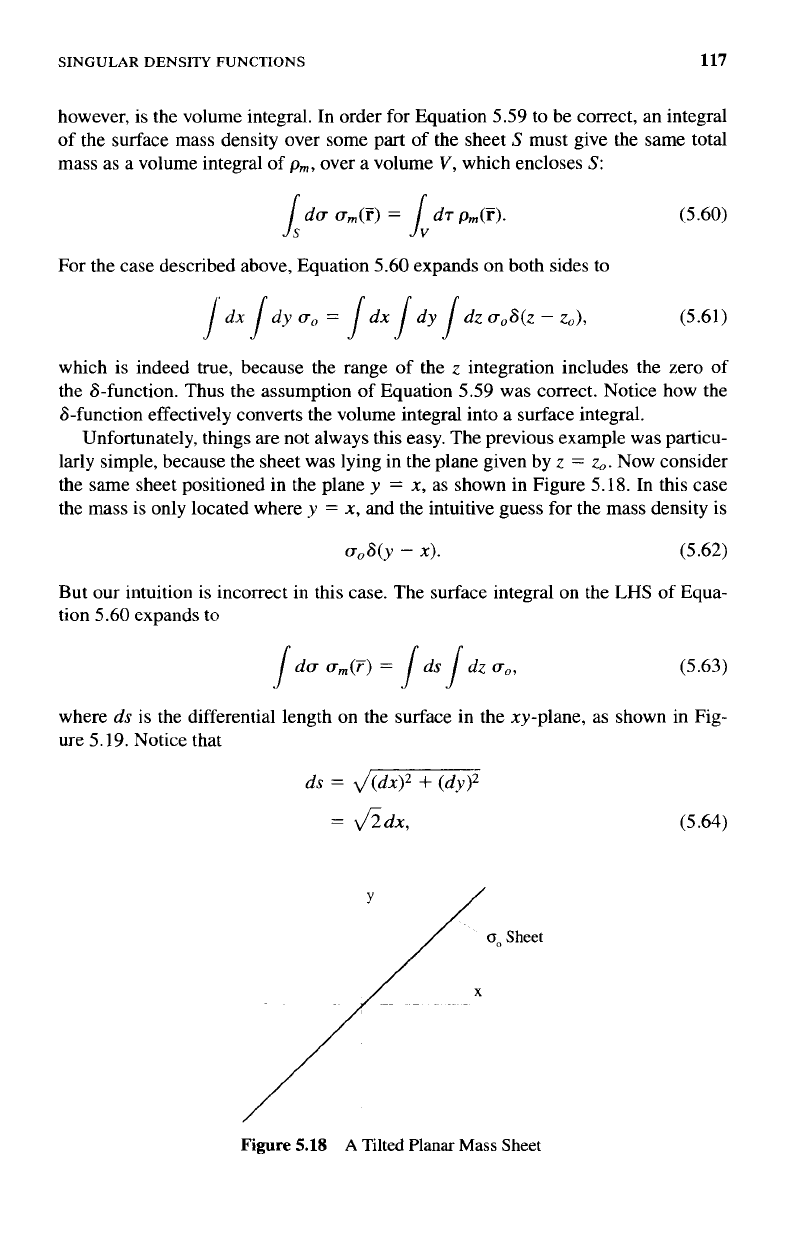
the same sheet positioned in the plane
y
=
x,
as shown in Figure
5.18.
In this case
the mass is only located where
y
=
x,
and the intuitive guess for the mass density is
-
x).
(5.62)
But
our
intuition
is
incorrect in this case. The surface integral on the
LHS
of
Equa-
tion 5.60 expands to
da
crm(T)
=
ds dz
ao,
s
JJ
(5.63)
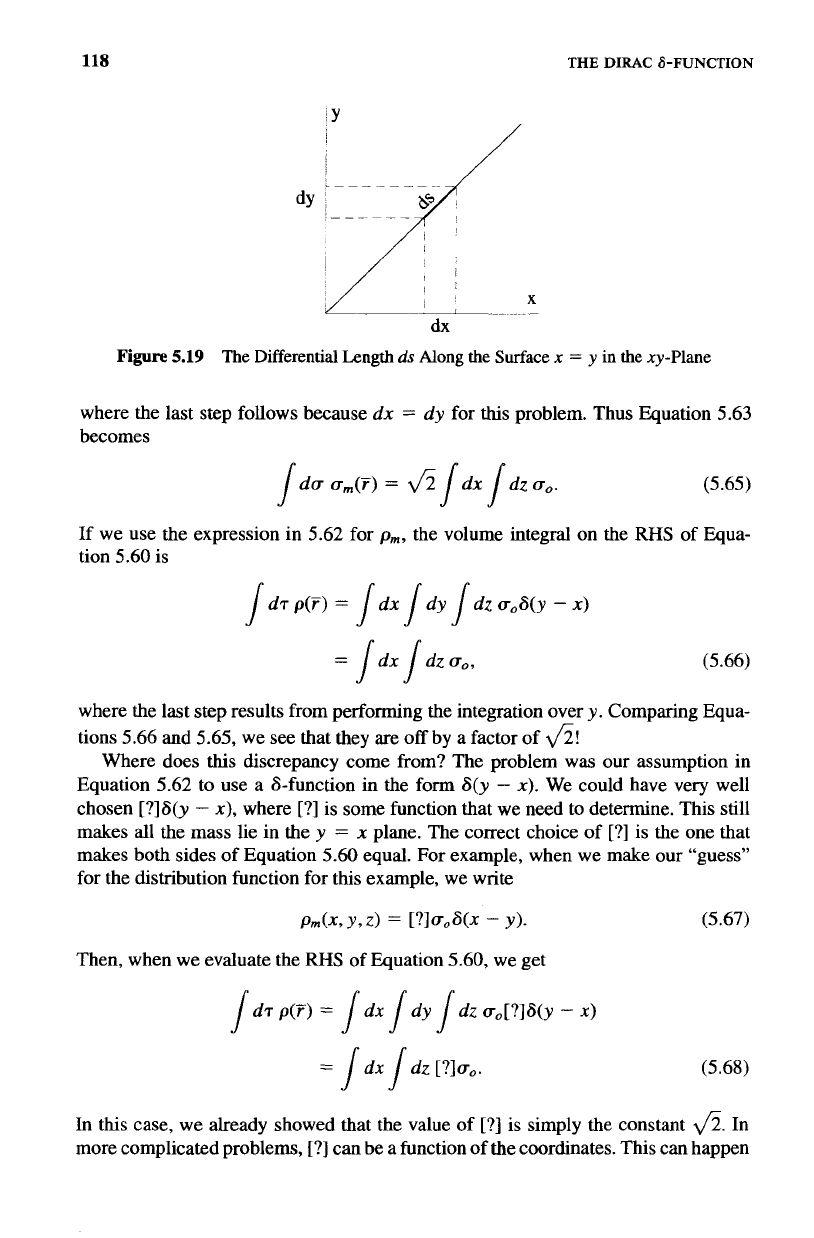
where
ds
is
the differential length on the surface in the xy-plane, as shown in Fig-
ure
5.19.
Notice that
ds
=
J(dx)*
+
(dy)2
=
hdx,
(5.64)
Y
Figure
5.18
A
Tilted
Planar
Mass
Sheet
118
THE
DIRAC
&FUNCTION
Y
dx
Figure
5.19
The
Differential
Length
ds
Along
the
Surface
x
=
y
in
the
xy-Plane
where the last step follows because
dx
=
dy
for
this
problem. Thus Equation
5.63
becomes
(5.65)
If we use the expression in
5.62
for
pm.
the volume integral on the
RHS
of Equa-
tion
5.60
is
=
Jdx/dzuo,
(5.66)
where the last step results from performing the integration over
y.
Comparing Equa-
tions
5.66
and
5.65,
we see that they
are
off
by a factor of
fi!
Where does
this
discrepancy come from? The problem was our assumption in
Equation
5.62
to use a 8-function in the form
8(y
-
x).
We could have very well
chosen
[?]8(y
-
x),
where
[?I
is some function that we need to determine. This
still
makes all the mass lie in the
y
=
x
plane. The correct choice of
[?I
is the one that
makes both sides
of
Equation
5.60
equal. For example, when we make our “guess”
for
the distribution function for this example, we write
Pm(x,
y,z>
=
“?luo6(x
-
y)-
(5.67)
Then, when we evaluate the
RHS
of Equation
5.60,
we get
(5.68)
In this case, we already showed that the value
of
[?I
is simply the constant
&.
In
more complicated problems,
[?]
can be a function of the coordinates. This can happen
SINGULAR
DENSITY
FUNCTIONS
119
if either the mass per unit area of the sheet is not constant, or
if
the sheet is not flat.
You
will see some examples of this in the next section and in the problems at the end
of this chapter.
5.5.3
Line Distributions
As
a final example of singular density functions, consider the mass per unit volume
of
a
one-dimensional wire of uniform mass per unit length
A,.
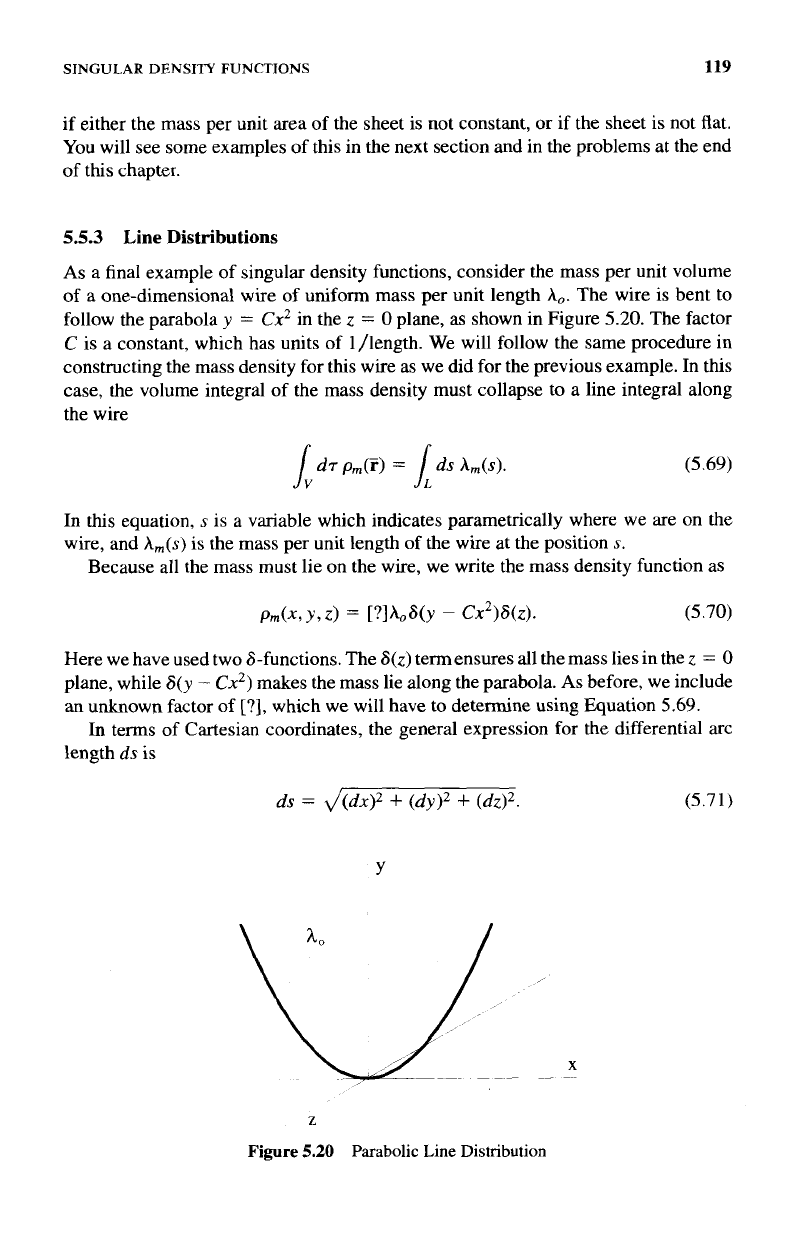
The wire is bent to
follow the parabola
y
=
Cx2
in the
z
=
0
plane,
as
shown in Figure
5.20.
The factor
C is
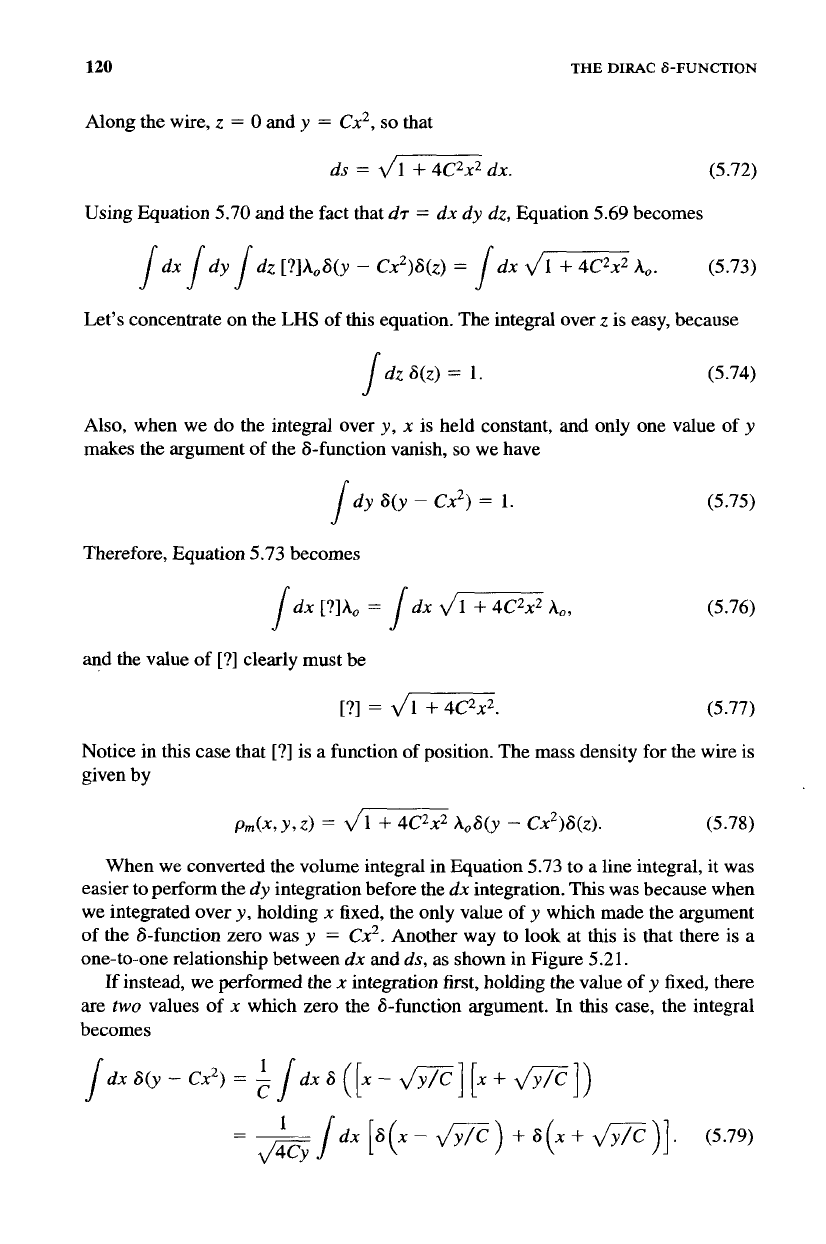
a constant, which has units of l/length. We will follow the same procedure in
constructing the mass density for this wire as we did for the previous example. In this
case, the volume integral of the mass density must collapse to a line integral along
the wire
Ld.rp,(r)
=
ds
A,(s).
(5.69)
h
In this equation,
s
is a variable which indicates parametrically where we are on the
wire, and
A,(s)
is the mass per unit length of the wire at the position
s.
Because all the mass must lie on the wire, we write the mass density function as
Here we have used two &functions. The
6(z)
term ensures all the mass lies in the
z
=
0
plane, while
S(y
-
Cx2)
makes the mass lie along the parabola.
As
before, we include
an unknown factor of
[?I,
which we will have to determine using Equation
5.69.
In terms of Cartesian coordinates, the general expression for the differential arc
length
ds
is
Y
Z
Figure
5.20
Parabolic Line Distribution
120
THE DIRAC 8-FUNCTION
Along the wire,
z
=
0
and
y
=
Cx2,
so
that
ds
=
dl
+
4C2x2 dx.
(5.72)
Using Equation 5.70 and the fact that
dr
=
dx dy dz,
Equation 5.69 becomes
/
dx
/
dy /dz
[?]A,S(y
-
Cx2)S(z)
=
dx
dw
A,.
(5.73)
S
Let’s concentrate on the
LHS
of
this
equation. The integral over
z
is easy, because
/dZS(Z)
=
1. (5.74)
Also, when we do the integral over
y, x
is held constant, and
only
one value
of
y
makes the argument
of
the &function vanish,
so
we have
/dy
s(y
-
cx2)
=
1.
Therefore, Equation 5.73 becomes
(5.75)
Jdx
[?]A,
=
/dx
dm
A,,
(5.76)
and the value of
[?I
clearly must be
[?]
=
dl
+
4c2x2.
(5.77)
Notice in this case that
[?]
is a function of position. The mass density for the wire is
given by
pm(x,y,z)
=
41
+
4c2x2
A,S(y
-
Cx2)S(z).
(5.78)
When we converted the volume integral in Equation 5.73 to a line integral, it was
easier to perform the
dy
integration before the
dx
integration.
This
was because when
we integrated over
y,
holding
x
fixed, the only value
of
y
which made the argument
of the &function zero was
y
=
Cx2.
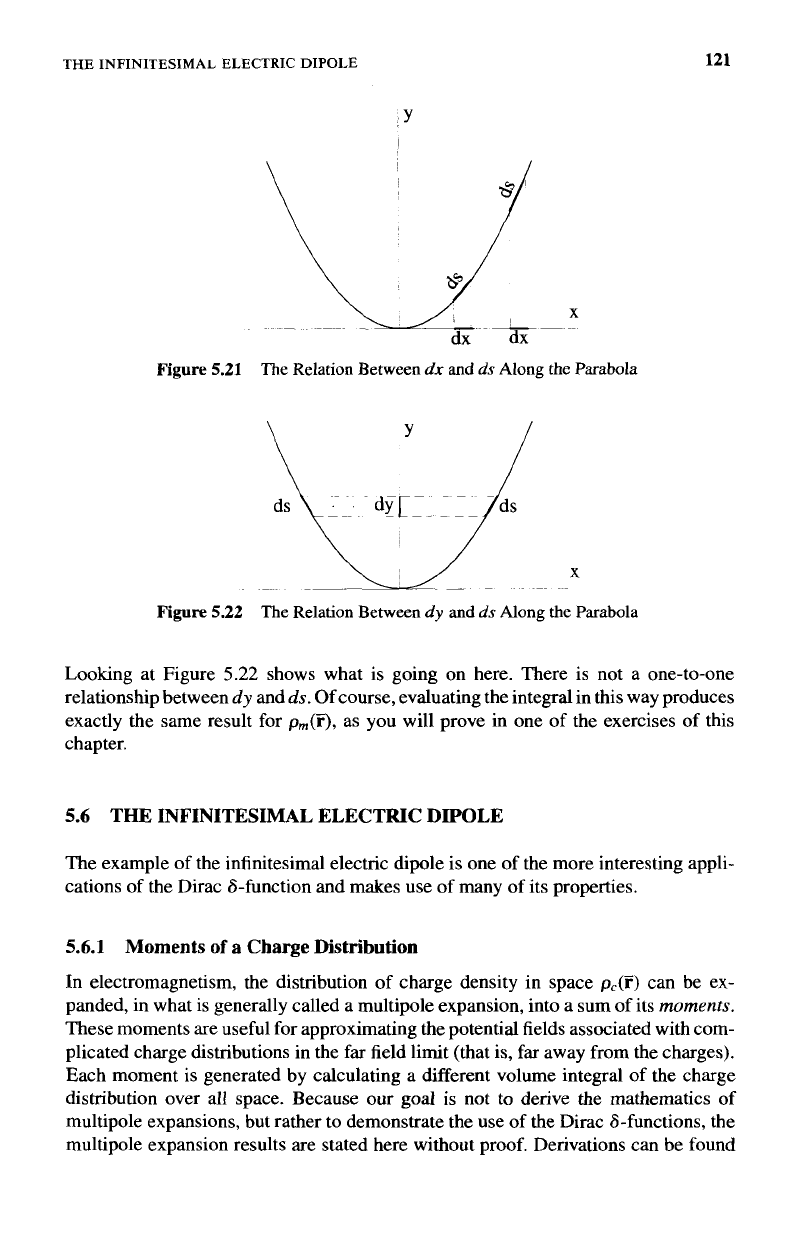
Another way to look at
this
is that there is a
one-to-one relationship between
dx
and
ds,
as shown in Figure 5.21.
If
instead, we
performed
the
x
integration first, holding the value
of
y
fixed, there
are
two
values
of
x
which zero the
&function
argument.
In
this
case, the integral
becomes
-
-
&/dx
[a(.
-
m)
4-
s(x
+
m)].
(5.79)
THE INFINITESIMAL ELECTRIC
DIPOLE
Y
121
Figure 5.21
The
Relation Between
dx
and
ds
Along
the
Parabola
Figure
5.22
The Relation Between
dy
and
ds
Along the Parabola
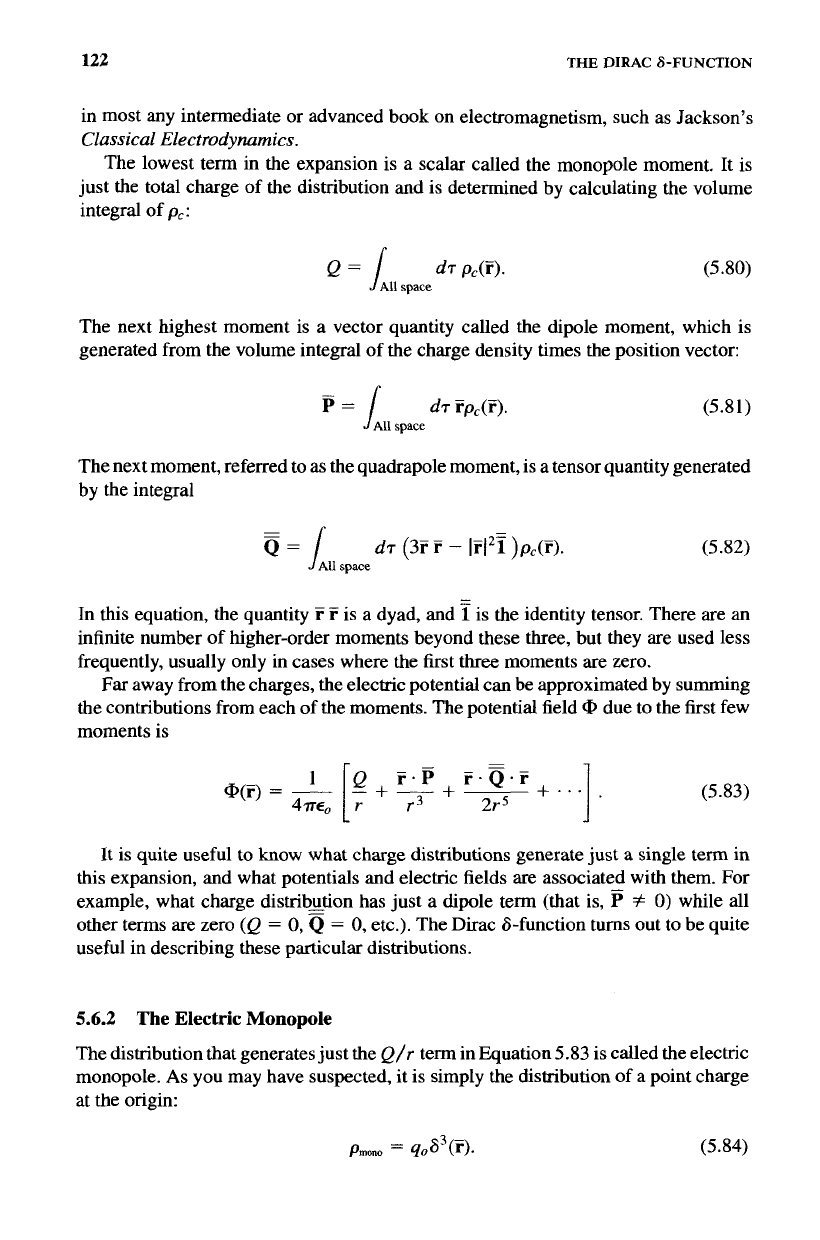
Looking at Figure
5.22
shows what is going on here. There is not a one-to-one
relationship between
dy
and
ds.
Of course, evaluating the integral in this way produces
exactly the same result for
p,(Q,
as you will prove in one of the exercises of this
chapter.
5.6
THE INFINITESIMAL ELECTRIC DIPOLE
The example
of
the infinitesimal electric dipole is one of the more interesting appli-
cations of the Dirac S-function and makes use of many of its properties.
5.6.1
Moments
of
a Charge
Distribution
In electromagnetism, the distribution
of
charge density in space
p,(F)
can be ex-
panded, in what is generally called a multipole expansion, into a sum
of
its
moments.
These moments are useful for approximating the potential fields associated with com-
plicated charge distributions in the far field limit (that is, far away from the charges).
Each moment is generated by calculating a different volume integral
of
the charge
distribution over
all
space. Because our goal is not
to
derive the mathematics of
multipole expansions, but rather to demonstrate the use of the Dirac 6-functions, the
multipole expansion results are stated here without proof. Derivations can be found
122
THE
DIRAC &FUNCTION
in most any intermediate or advanced book on electromagnetism, such as Jackson’s
Classical Electrodynamics.
The lowest term in the expansion is a scalar called the monopole moment. It is
just the total charge of the distribution and is determined by calculating the volume
integral of
pc:
(5.80)
The next highest moment is a vector quantity called the dipole moment, which is
generated from the volume integral of the charge density times the position vector:
(5.81)
The next moment, referred to
as
the quadrapole moment, is a tensor quantity generated
by the integral
Q
=
J’
dT
(3TF
-
lT12T)pc(T).
(5.82)
All
space
-
In this equation, the quantity
T
T
is a dyad, and
T
is the identity tensor. There are an
infinite number of higher-order moments beyond these three, but they are used less
frequently, usually only in cases where
the
first
three
moments are zero.
Far away from the charges, the electric potential can be approximated by summing
the contributions from each
of
the moments. The potential field
Q,
due to the first few
moments is
(5.83)
It is quite useful to know what charge distributions generate just a single term in
this expansion, and what potentials and electric fields are associated with them. For
example, what charge distribgtion has just a dipole term (that is,
#
0)
while all
other terms are zero
(Q
=
0,
Q
=
0,
etc.). The Dirac &function turns out to be quite
useful in describing these particular distributions.
5.6.2
The
Electric
Monopole
The distribution that generates just the
Q/r
term in Equation 5.83 is called the electric
monopole.
As
you may have suspected, it is simply the distribution of a point charge
at the origin:
THE
INFINITESIMAL ELECTRIC DIPOLE
Its monopole moment,
123
Q
=
d7q063(~;)
=
qo,
(5.85)
is simply equal to the total charge. The dipole, quadrapole, and higher moments of
this distribution are all zero:
All
space
P
=
/
&q0F
63(F)
=
0
AU
space
-
-
Q
=
dr
(3F
F
-
r2T
)
ti3@)
=
0.
All
space
The electric field
of
a monopole obeys Coulomb’s law:
(5.86)
(5.87)
(5.88)
5.6.3
The
Electric
Dipole
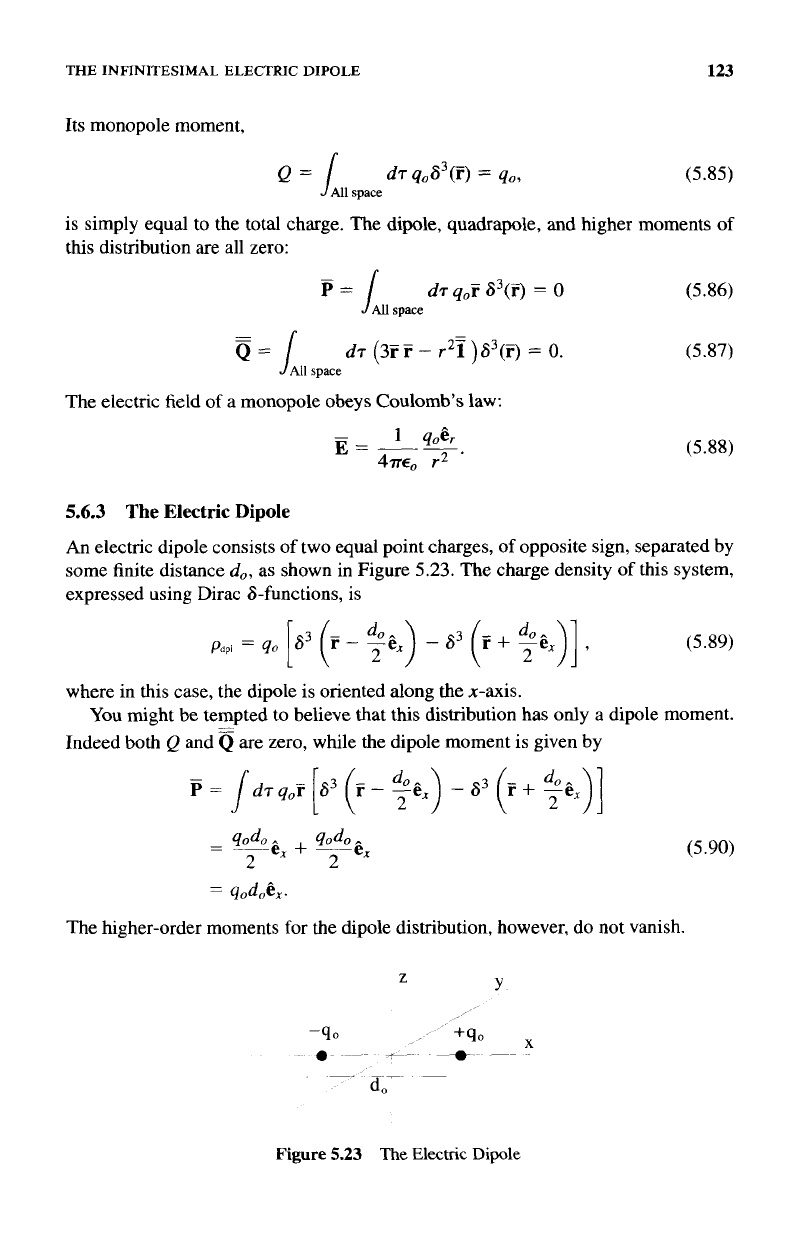
An electric dipole consists
of
two equal point charges,
of
opposite sign, separated by
some finite distance
do,
as shown in Figure
5.23.
The charge density of this system,
expressed using Dirac &functions, is
Pdpl
-
-
q0
[s3
(F
-
+GI)
-
63
(F
+
+GX)]
1
(5.89)
where in this case, the dipole is oriented along the x-axis.
Indeed both
Q
and
Q
are zero, while the dipole moment is given by
You might be tempted to believe that this distribution has only a dipole moment.
=
qodogx.
The higher-order moments for the dipole distribution, however, do not vanish.
Y
Z
(5.90)
Figure
5.23
The
Electric
Dipole
124
THE
DIRAC &FUNCTION
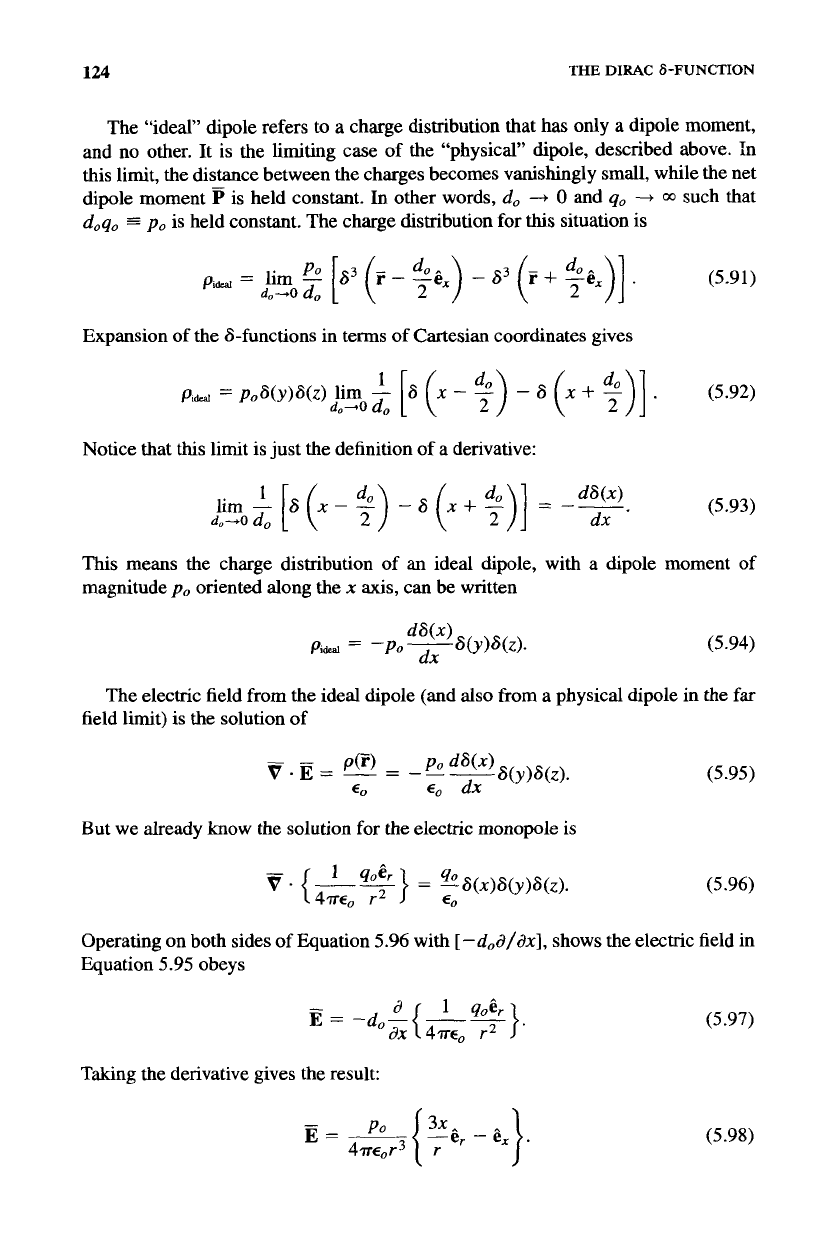
The "ideal" dipole refers to a charge dstribution that
has
only a dipole moment,
and no other. It
is
the limiting case of the "physical" dipole, described above.
In
this limit,
the
distance between the charges becomes vanishingly small, while the net
dipole moment
is held constant. In other words,
do
-+
0
and
qo
---f
60
such that
doqo
=
po
is held constant. The charge distribution for
this
situation is
(5.91)
Expansion
of
the
6-functions in
terms of
Cartesian coordinates gives
ptacal
=
po6(y)6(z)
Notice that
this
limit is just the definition of a derivative:
This
means the charge distribution of an ideal dipole, with a dipole moment
of
magnitude
po
oriented along the
x
axis,
can be written
(5.94)
The electric field from the ideal dipole (and also from a physical dipole in the
far
field limit) is the solution of
But we already
know
the solution for the electric monopole is
(5.95)
(5.96)
Operating on both sides of Equation 5.96 with
[
-dod/dx],
shows the electric field in
Equation 5.95 obeys
Taking the derivative gives the result:
(5.97)
(5.98)
RIEMANN INTEGRATION
AND
THE
DIRAC &FUNCTION
125
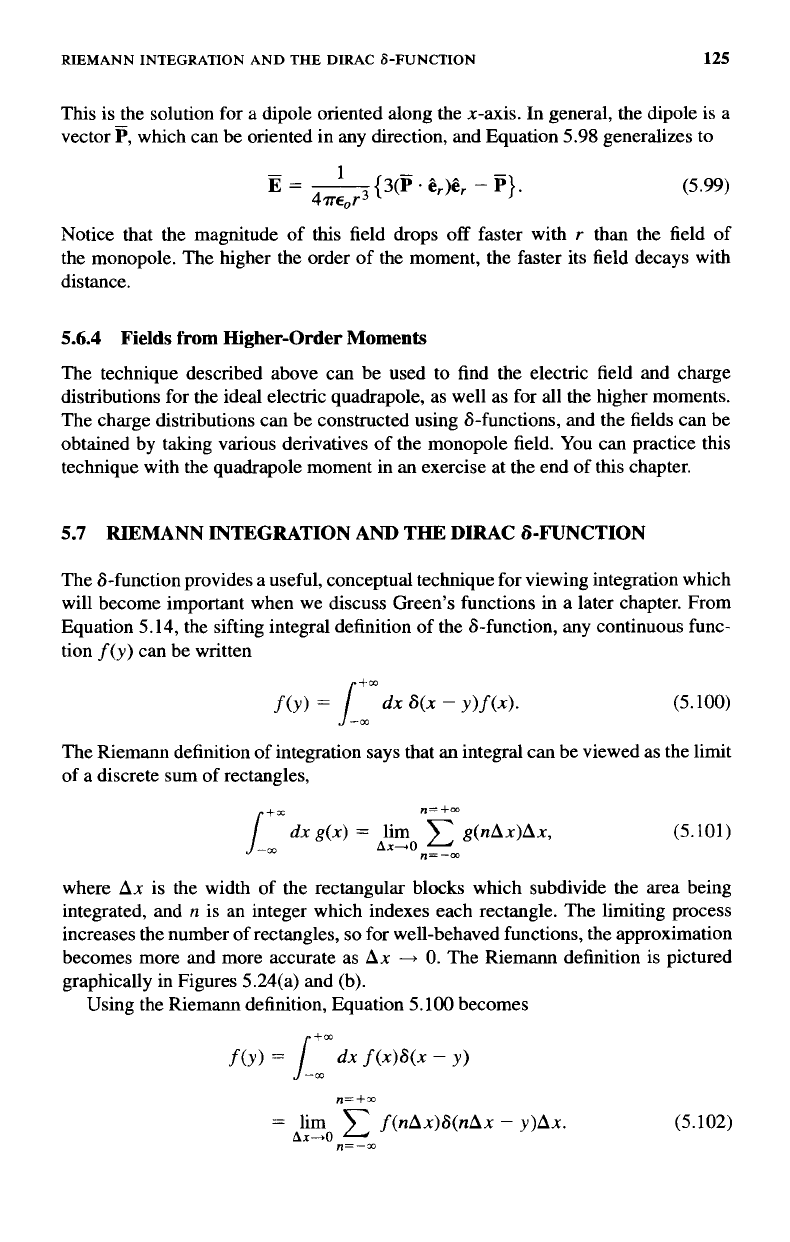
This is the solution for a dipole oriented along the x-axis.
In
general, the dipole is a
vector
P,
which can be oriented in any direction, and Equation
5.98
generalizes to
(5.99)
Notice that the magnitude of
this
field drops
off
faster with
r
than the field of
the monopole. The higher the order of the moment, the faster its field decays with
distance.
5.6.4
Fields from Higher-Order Moments
The technique described above can be used to find the electric field and charge
distributions for the ideal electric quadrapole, as well as for all the higher moments.
The charge distributions can be constructed using &functions, and the fields can be
obtained by taking various derivatives of the monopole field. You can practice this
technique with the quadrapole moment in an exercise at the end of this chapter.
5.7
RIEMANN INTEGRATION
AND
THE DIRAC &FUNCTION
The &function provides a useful, conceptual technique for viewing integration which
will become important when we discuss Green's functions in a later chapter. From
Equation 5.14, the sifting integral definition of the &function, any continuous func-
tion
f(y)
can be written
f(Y)
=
1;
dx
S(x
-
y)f(x).
(5.100)
The Riemann definition of integration says that an integral can be viewed as the limit
of a discrete sum of rectangles,
"+Z
n=
fm
(5.101)
where
Ax
is the width of the rectangular blocks which subdivide the area being
integrated, and
n
is
an integer which indexes each rectangle. The limiting process
increases the number
of
rectangles,
so
for well-behaved functions, the approximation
becomes more and more accurate as
Ax
---f
0.
The Riemann definition is pictured
graphically in Figures 5.24(a) and
(b).
Using the Riemann definition, Equation
5.100
becomes
f(Y)
=
/+-m
dx
f(x)@
-
Y)
--m
(5.102)