
Kusse B.R., Westwig E.A. Mathematical Physics: Applied Mathematics for Scientists and Engineers
Подождите немного. Документ загружается.

136
INTRODUCTION TO COMPLEX VARIABLES
Y
imag
z
--.
-
real
X
Figure
6.1
A
Plot
of
the Complex Number
z
=
x
+
iy
in
the Complex Plane
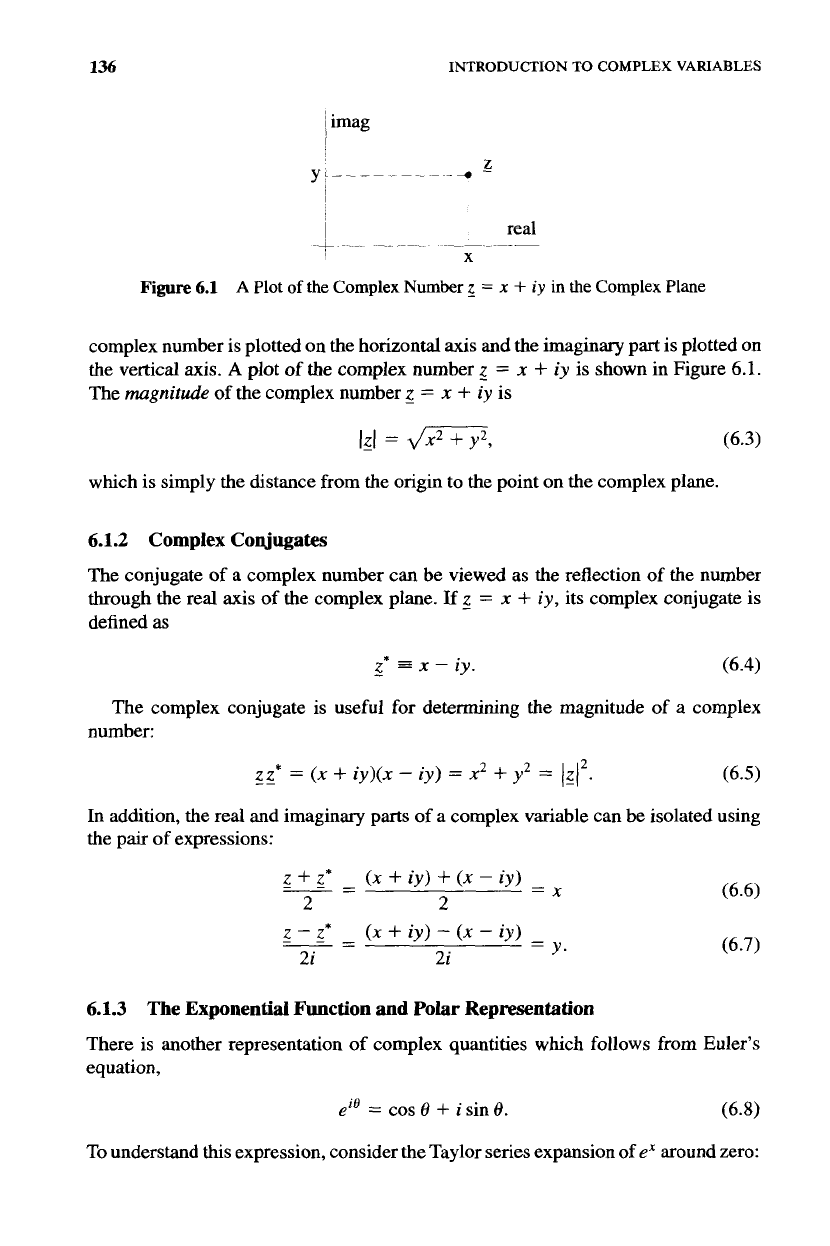
complex number is plotted on the horizontal
axis
and the imaginary part is plotted
on
the vertical axis.
A
plot of the complex number
=
x
+
iy
is shown
in
Figure 6.1.
The
magnitude
of
the complex number
z
=
x
+
iy
is
1g1
=
dW,
(6.3)
which
is
simply the distance from the origin to the point on the complex plane.
6.1.2
Complex
Conjugates
The conjugate of a complex number can be viewed
as
the reflection
of
the number
through the real axis
of
the complex plane.
If
g
=
x
+
iy,
its complex conjugate
is
defined
as
z*
3
x
-
iy.
(6.4)
The complex conjugate is useful for determining the magnitude of
a
complex
number:
(6.5)
2
zz*
=
(x
+
iy)(x
-
iy)
=
x2
+
y2
=
JzJ
.
In
addition, the real and imaginary
parts
of
a complex variable can be isolated using
the pair
of
expressions:
g
+
g*
-
(x
+
iy)
+
(x
-
iy)
-
-x
--
2
2
g
-
g*
-
(x
+
iy)
-
(x
-
iy)
=
y.
--
2i 2i
6.1.3 The Exponential Function
and
Polar
Representation
There is another representation of complex quantities which follows from Euler’s
equation,
cos
0
+
i
sin
0.
(6.8)
,iO
=
To understand
this
expression, consider the Taylor series expansion of
ex
around zero:
A
COMPLEX NUMBER REFRESHER
137
(6.9)
Now we make the assumption that this Taylor series is valid for all numbers
including
complex quantities.
Actually, we
dejne
the complex exponential function such that
it is equivalent to this series:
ezz
1
+z+
;+
z2
=_+g
z3
+
...,
-
2!
3!
4!
Now let
g
=
i0
to obtain
(iO>2
it^)^
(i~)~
2!
3!
4!
+
~ + ...
eie
=
1
+
i8
+
__
+-
(6.10)
(6.11)
Breaking this into real and imaginary parts gives
.
(6.12)
1
2!
4!
6!
The first bracketed term in Equation
6.12
is
the Taylor series expansion for cos
8,
and
the second is the expansion for sin
8.
Thus Euler's equation is proven.
Using this result, the complex variable
z
=
x
+
iy
can be written in the
polar
representation,
z
=
re''
-
=
rcos8
+
irsin8,
(6.13)
where the new variables
r
and
8
are defined by
r
=
lz_l
=
Jm
8
=
tan-'
y/x.
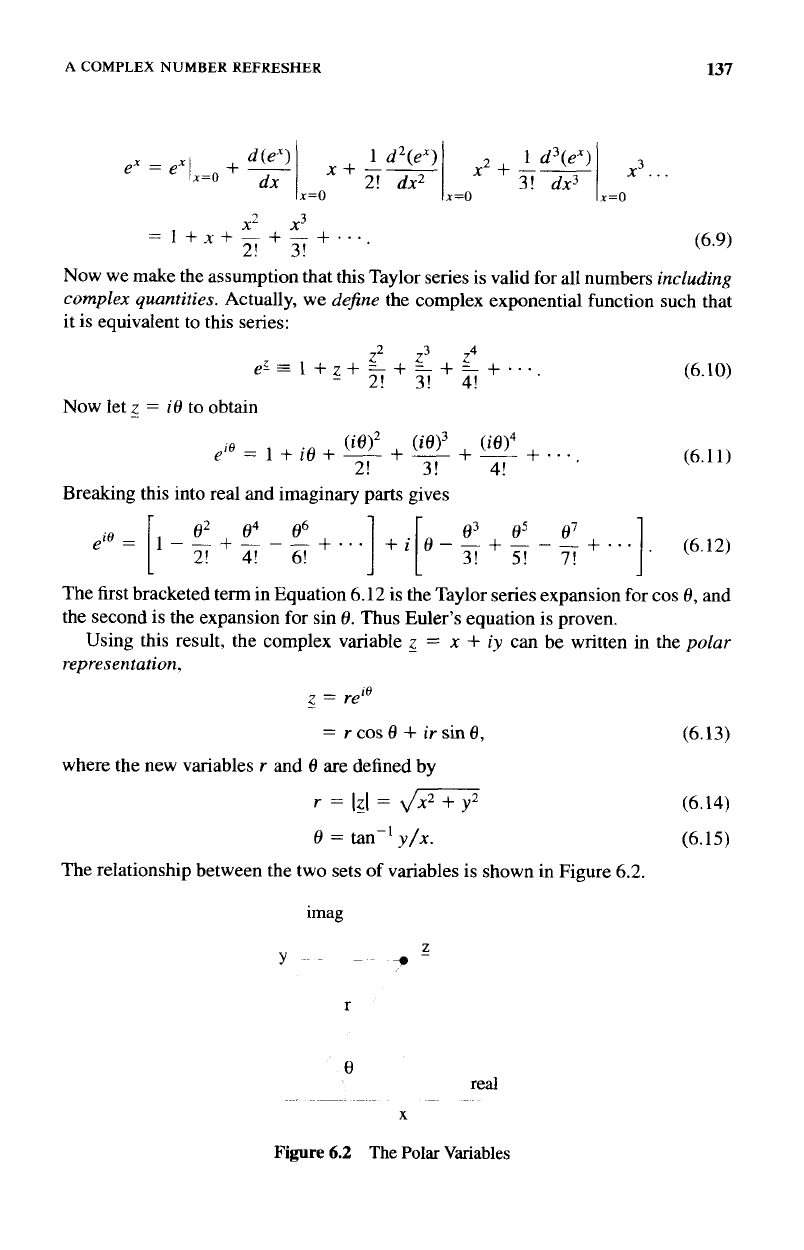
The relationship between the two sets of variables is shown in Figure 6.2.
imag
r
(6.14)
(6.15)
Figure
6.2
The
Polar
Variables
138
INTRODUCTION
TO
COMPLEX
VARIABLES
6.2
FUNCTIONS
OF
A
COMPLEX VARIABLE
Just as with real variables, complex variables can
be
related to one another using
functions. Imagine two complex variables, and
g.
A
general function relating these
two quantities can be written
as
42I
=
E(2).
(6.16)
If
y
=
u
+
iv
and
=
a-
+
zy,
then we can rewrite
this
relationship
as
where
u(x,
y)
and
v(x,
y)
are both real functions of real variables.
As
a simple example of
a
complex function, consider
the
relationshp
Expanding
z
=
x
+
iy
gives
-_
w(t)
=
(2
-
y2)
+
2zxy.
(6.19)
The functions
u(x,
y)
and
v(x,
y)
from Equation
6.17
are
easily identified
as
u(x,
y)
=
x2
-
y2
(6.20)
v(x,y)
=
2xy. (6.21)
6.2.1
Visualization
of
Complex Functions
A
relationship between
w
and
g
can
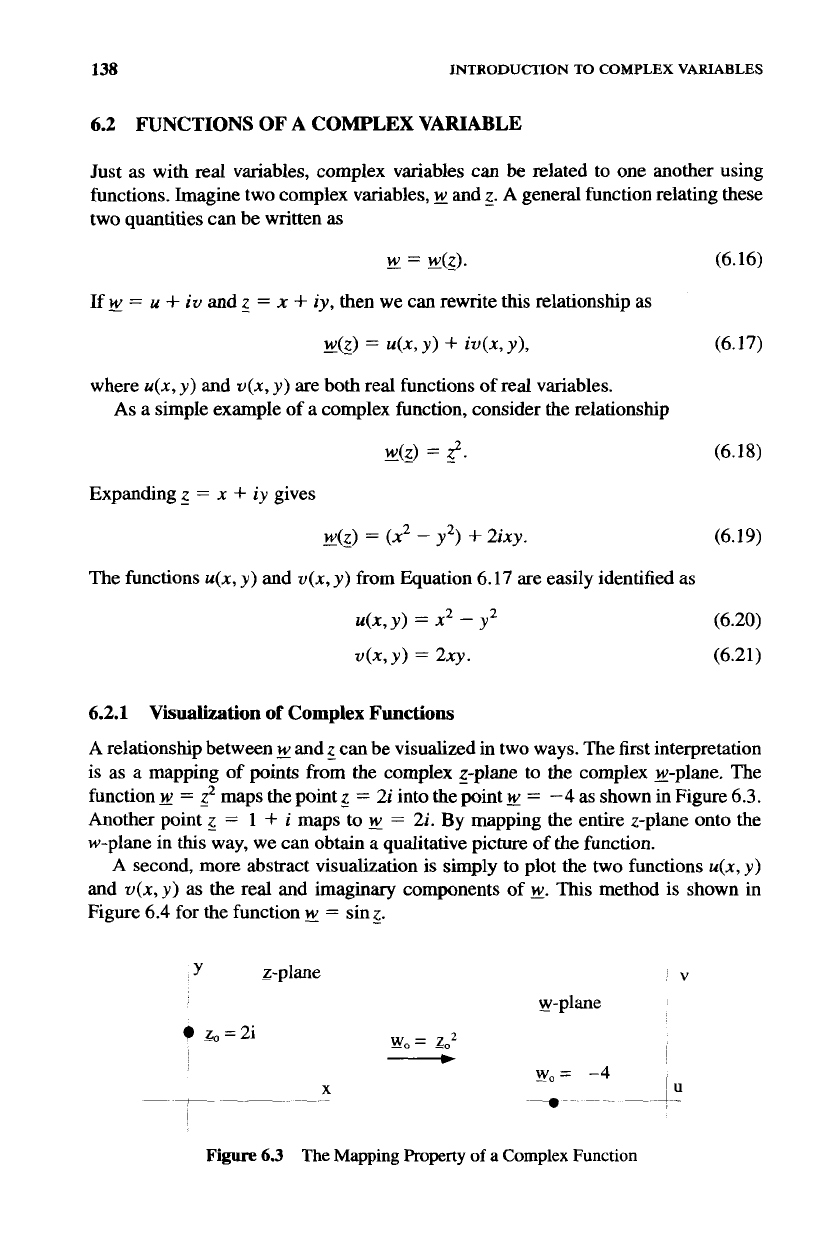
be visualized in two ways. The first interpretation
is
as
a
mapping of
points
from the
complex
?-plane to the complex w-plane. The
function
211
=
2
maps the point
_z
=
2i
into the point
421
=
-4
as shown in Figure
6.3.
Another point
z
=
1
f
i
maps to
y
=
2i.
By mapping the entire z-plane onto the
w-plane in
this
way, we can
obtain
a
qualitative picture of the function.
A
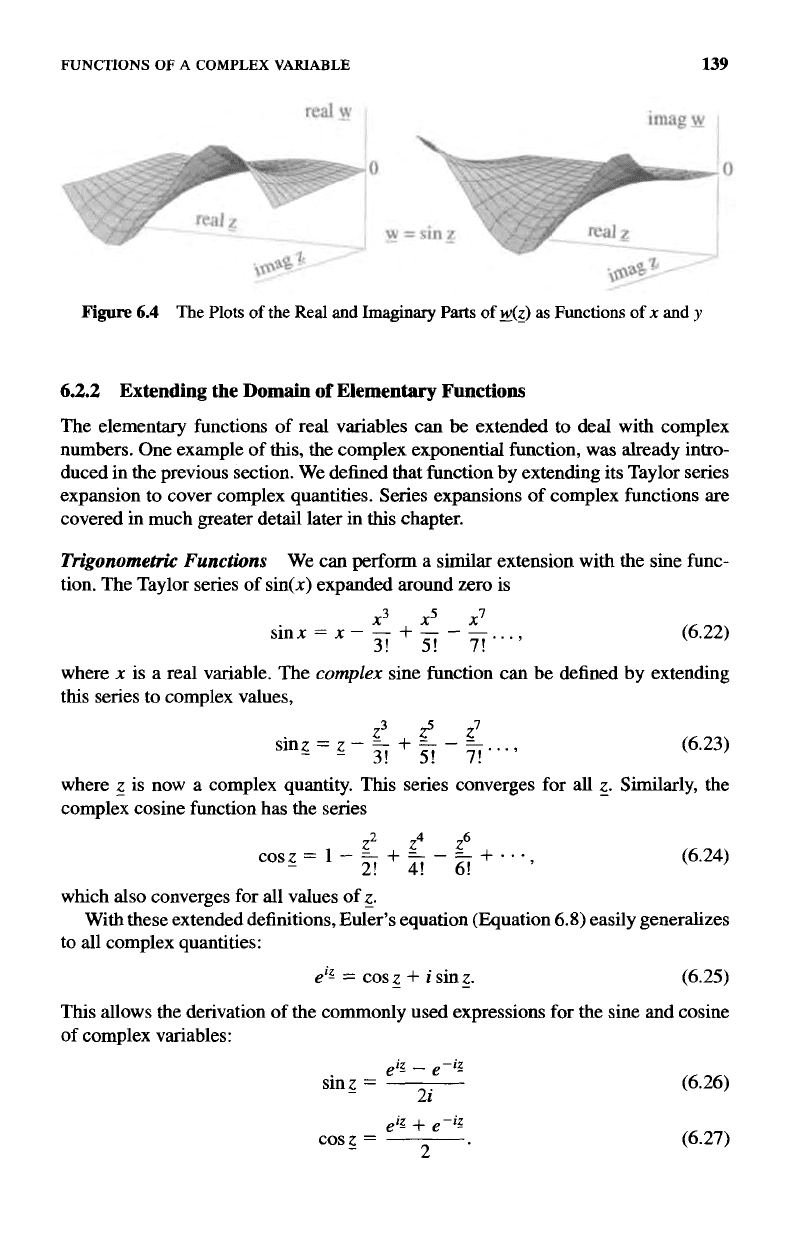
second, more abstract visualization is simply to plot the two functions
u(x,
y)
and
v(x,y)
as
the real and imaginary components of
w.
This
method is shown in
Figure
6.4
for the function
w
=
sin
z.
Y
~
z-plane
&=2i
X
.~
V
w-plane
44b
=
Lo2
wo=
-4
--.--
Figure
6.3
The Mapping Property
of
a Complex
Function
FUNCTIONS
OF
A
COMPLEX VARlABLE
139
realy
I
imagy
,
0
0
,
Figure
6.4
The
Plots
of
the
Real
and
Imaginary
Parts
of
&)
as
Functions
of
n
and
y
6.2.2
Extending
the
Domain
of
Elementary
Functions
The elementary functions of real variables can be extended to deal with complex
numbers. One example
of
this,
the complex exponential function,
was
already intro-
duced in the previous section. We defined that function by extending its Taylor series
expansion to cover complex quantities. Series expansions
of
complex functions are
covered in much greater detail later in
this
chapter.
Trigonometric Functions
We can
perform
a similar extension with the sine func-
tion. The Taylor series of
sin(x)
expanded around zero
is
(6.22)
where
x
is a real variable. The
complex
sine function can be defined by extending
this series to complex values,
where
g
is
now a complex quantity.
This
series converges for all
g.
Similarly, the
complex cosine function has the series
z2
z4
z6
cosz
=
1
-
=
+
L
-
L
+
...
-
2!
4!
6!
(6.24)
which
also
converges for all values of
g.
to all complex quantities:
With these extended definitions, Euler's equation (Equation
6.8)
easily generalizes
e'g
=
cosz
-
+
ising.
(6.25)
This
allows the derivation
of
the commonly used expressions for the
sine
and cosine
of complex variables:
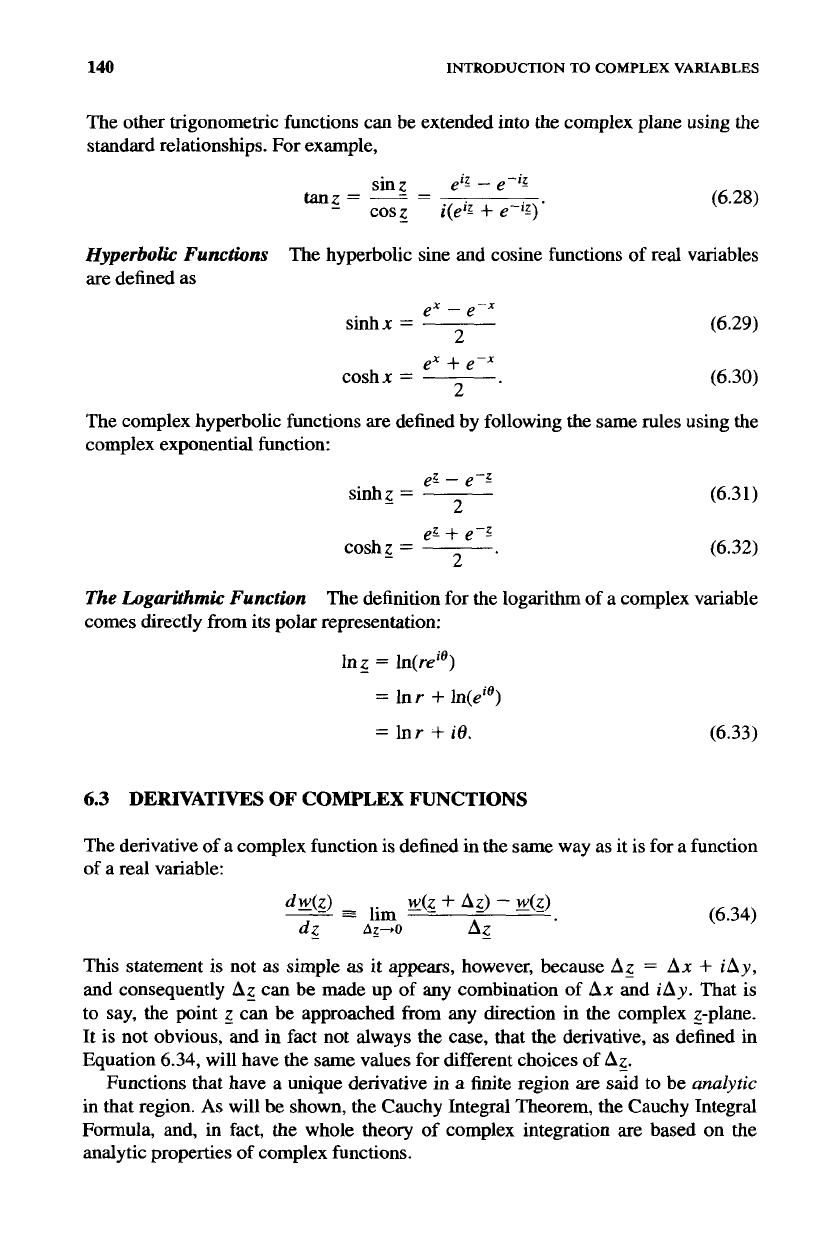
,iz
-
e-iz
2i
ei<
+
e-ig
2,
sing
=
cosg
=
(6.26)
(6.27)
140
INTRODUCTION
TO
COMPLEX
VARIABLES
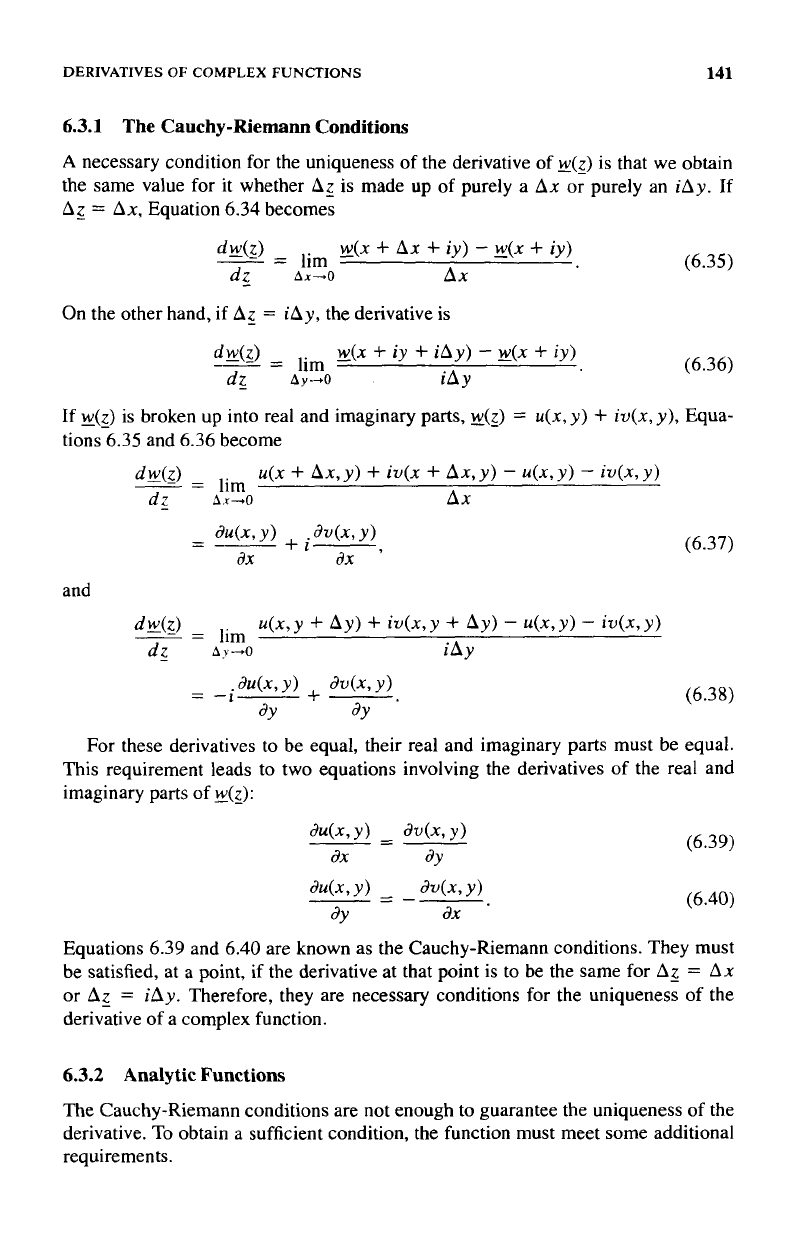
The other trigonometric functions can be extended into
&he
complex plane using the
standard relationships. For example,
(6.28)
Hyperbolic
Functions
are defined as
The hyperbolic sine and cosine functions of real variables
ex
-
e-x
2
sinhx
=
ex
+
ePx
2.
coshx
=
(6.29)
(6.30)
The complex hyperbolic functions are defined by following the same rules using the
complex exponential function:
(6.31)
(6.32)
The
Logdhmic
Function
The definition for the logarithm of a complex variable
comes directly from its polar representation:
(6.33)
6.3
DERIVATIVES OF COMPLEX FUNCTIONS
The derivative
of
a complex function is defined
in
the same way as it is for a function
of a real variable:
This statement is not as simple
as
it appears, however, because
Ag
=
Ax
+
iAy,
and consequently
Ag
can be made up of any combination of
Ax
and
iAy.
That is
to say, the point
z
can be approached
from
any direction
in
the complex z-plane.
It is not obvious, and in fact not always the case, that
the
derivative, as defined in
Equation 6.34, will have the
same
values for different choices of
Az.
Functions that have a unique derivative in a finite region are
said
to be
analytic
in that region.
As
will
be
shown, the Cauchy Integral Theorem, the Cauchy Integral
Formula, and, in fact, the whole theory
of
complex integration are based on the
analytic properties
of
complex functions.
DERIVATIVES
OF
COMPLEX
FUNCTIONS
141
6.3.1
The
Cauchy-Riemann
Conditions
A
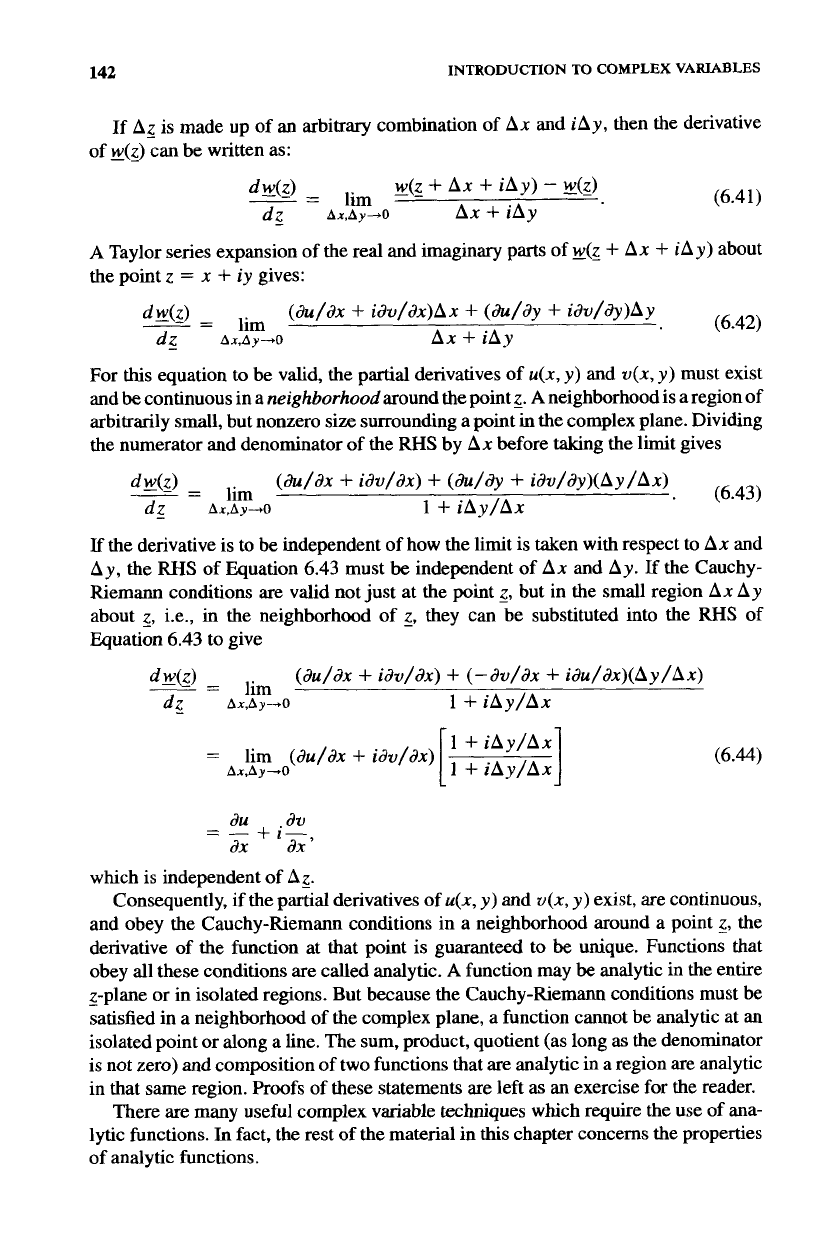
necessary condition for the uniqueness of the derivative of
~(g)
is that we obtain
the same value for it whether
AZ
is
made up of purely a
Ax
or
purely an
iAy.
If
Az
=
Ax,
Equation 6.34 becomes
w(x
+
Ax
+
iy)
-
~(x
+
iy)
(6.35)
dw(d
-
lim
-
--
dg
AX+O
Ax
On the other hand, if
AZ
=
iAy,
the derivative is
(6.36)
If
I&)
is broken
up
into real and imaginary parts,
~(2)
=
u(x,
y)
+
iu(x, y),
Equa-
tions6.35 and 6.36 become
u(x
+
Ax,
y)
+
iv(x
+
Ax, y)
-
u(x,
y)
-
iu(x,
y)
lim
dw(z)
-
-_
dz
A.r-0
Ax
and
(6.37)
(6.38)
For
these derivatives to be equal, their real and imaginary parts must be equal.
This requirement leads to two equations involving the derivatives of the real and
imaginary parts of
&):
(6.39)
(6.40)
Equations 6.39 and 6.40 are known as the Cauchy-Riemann conditions. They must
be satisfied, at a point, if the derivative at that point is to be the same for
AZ
=
Ax
or
AZ
=
iAy.
Therefore, they are necessary conditions for the uniqueness
of
the
derivative of a complex function.
6.3.2
Analytic
Functions
The Cauchy-Riemann conditions are not enough to guarantee the uniqueness of the
derivative. To obtain a sufficient condition, the function must meet some additional
requirements.
142
INTRODUCTION
TO
COMPLEX VARIABLES
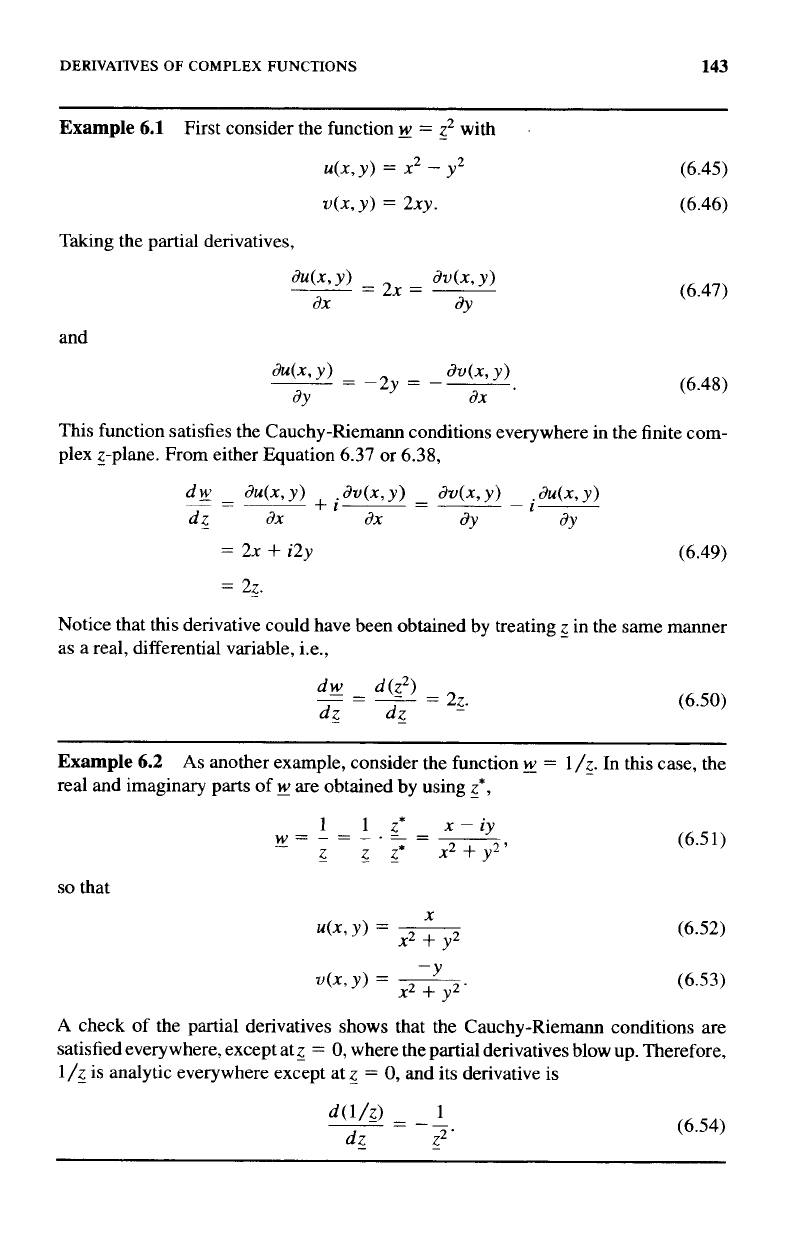
If
Az
is
made up of an arbitrary combination of
Ax
and
iAy,
then the derivative
of
~(2)
can be written as:
(6.41)
A
Taylor series expansion of the real and imaginary
parts
of
~(z
+
Ax
+
ihy)
about
the point
z
=
x
+
iy
gives:
dE(Z)
-
lim
-
w(g
+
Ax
+
iAy)
-
~(z)
-_
dg
Ax,Ay+O
Ax
+
iAy
.
(6.42)
(&/ax
+
idv/dx)Ax
+
(aU/dy
+
idv/dy)Ay
lim
dw(z)
-
--
dZ
A~,A~-o
Ax
+
iAy
For
this
equation to be valid, the partial derivatives of
u(x, y)
and
v(x,
y)
must exist
and
be
continuous in
a
neighborhood
around
the
point
g.
A
neighborhood is a region of
arbitrarily
small,
but nonzero size surrounding a point in the complex plane. Dividing
the numerator and denominator of the
RHS
by
Ax
before taking the limit gives
If the derivative is to be independent of how the limit is taken with respect to
Ax
and
Ay,
the
RHS
of Equation
6.43
must
be
independent
of
Ax
and
Ay.
If
the Cauchy-
Riemann conditions
are
valid not
just
at the point
I,
but in the small region
Ax Ay
about z, i.e., in the neighborhood of
z,
they can be substituted into the
RHS
of
Equation
6.43
to give
dW(Z)
-
lim
(&/ax
+
idv/dx)
+
(-dv/dx
+
idu/dx)(Ay/Ax)
--
dg
A~,AY-+O
1
+
iAy/Ax
1
+
iAy/Ax
1
+
iAy/Ax
=
lim
(&/ax
+
idv/dx)
Ax.Ay-0
du
dv
dx dx
+
i-,
-
_-
which
is independent of
Ag.
Consequently, if
the
partial derivatives of
u(x, y)
and
v(x,
y)
exist, are continuous,
and obey the Cauchy-Riemann conditions in a neighborhood around a point
z,
the
derivative of the function at that point is guaranteed
to
be
unique. Functions that
obey
all
these conditions
are
called
analytic.
A
function may
be
analytic in the entire
-
z-plane
or
in isolated regions. But because the Cauchy-Riemann conditions must be
satisfied in a neighborhood of the complex plane, a function cannot be analytic at
an
isolated point or along a line. The sum, product, quotient (as long as the denominator
is not zero) and composition of
two
functions that are analytic in a region are analytic
in that same region. Proofs of these statements are left as an exercise for the reader.
There
are
many useful complex variable
techniques
which require the use of ana-
lytic functions.
In
fact, the rest of the material in
this
chapter concerns the properties
of analytic functions.
DERIVATIVES
OF
COMPLEX
FUNCTIONS
143
Example
6.1
First consider the function
=
z2
with
u(x,y)
=
x2
-
y2
v(x,y)
=
2xy.
Taking the partial derivatives,
and
(6.45)
(6.46)
(6.47)
(6.48)
This
function satisfies the Cauchy-Riemann conditions everywhere in the finite com-
plex 2-plane. From either Equation
6.37
or
6.38,
dw
WX,Y)
dv(x,y)
-
d&y)
du(x,y)
dZ
dX
dX dY dY
+i----
i-
-
=
2x
+
i2y
(6.49)
=
22,
Notice that
this
derivative could have been obtained by treating
g
in the same manner
as
a real, differential variable, i.e.,
(6.50)
Example
6.2
real and imaginary parts of
w
are obtained by using
g*,
As
another example, consider the function
=
1
/z.
In this case, the
so
that
(6.51)
(6.52)
(6.53)
A
check
of
the partial derivatives shows that the Cauchy-Riemann conditions are
satisfied everywhere, except at
2
=
0,
where the partial derivatives blow up. Therefore,
1
/z
is analytic everywhere except at
z_
=
0,
and its derivative is
(6.54)
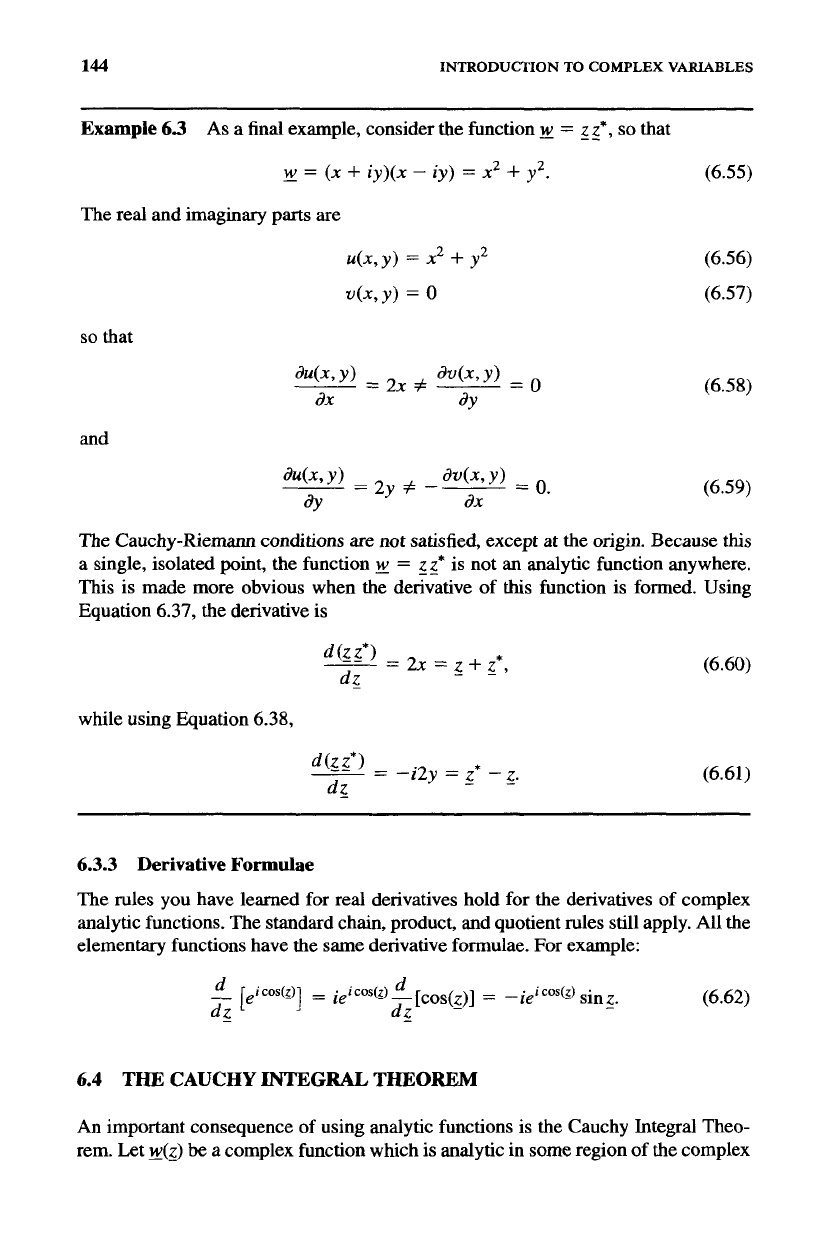
144
INTRODUCTION
TO
COMPLEX
VARIABLES
Example
63
As
a final example, consider the function
w
=
z
z*,
so
that
-
w
=
(x
+
iy>(x
-
iy)
=
x2
+
y2.
(6.55)
The real and imaginary parts are
u(x,y)
=
x2
+
y*
V(X,Y)
=
0
(6.56)
(6.57)
so
that
and
(6.58)
(6.59)
The Cauchy-Riemann conditions are
not
satisfied, except at the origin. Because
this
a single, isolated
point,
the function
w
=
zg*
is not an analytic function anywhere.
This is made more obvious when the derivative of
this
function is formed. Using
Equation 6.37,
the
derivative is
while using Equation 6.38,
(6.60)
(6.61)
6.3.3
Derivative Formulae
The rules you have learned for real derivatives hold for the derivatives of complex
analytic functions. The standard chain, product, and quotient rules still apply. All the
elementary functions have the same derivative formulae. For example:
6.4
THE
CAUCHY
INTEGRAL
THEOREM
(6.62)
An important consequence of using analytic functions
is
the Cauchy Integral Theo-
rem. Let
w(z)
be
a complex function which is analytic in some region of the complex
THE
CAUCHY
INTEGRAL THEOREM
145
imag
z-plane
n-
u
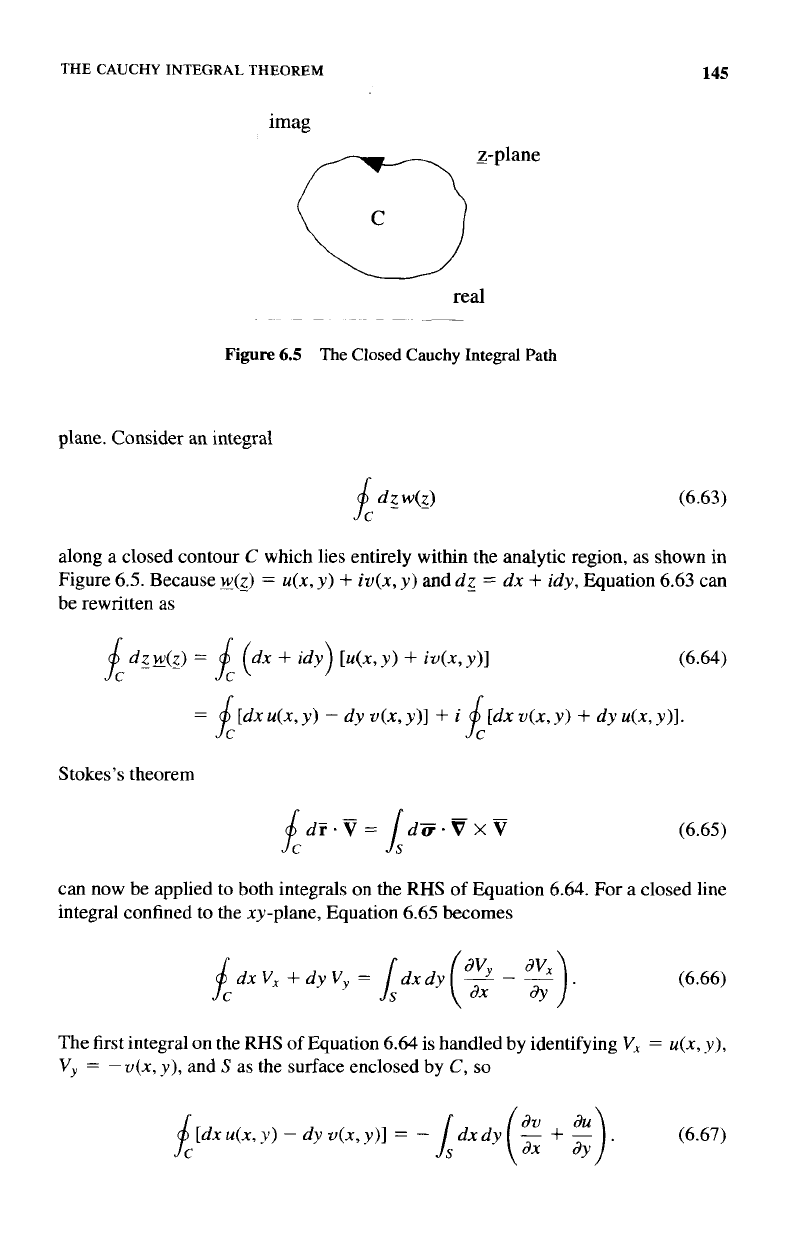
Figure
6.5
The
Closed
Cauchy
Integral
Path
plane. Consider an integral
(6.63)
along a closed contour
C
which lies entirely within the analytic region, as shown in
Figure 6.5. Because
~(g)
=
u(x, y)
+
iv(x, y)
and
dg
=
dx
+
idy,
Equation 6.63 can
be rewritten
as
Stokes’s theorem
(6.65)
can now be applied to both integrals on the
RHS
of
Equation 6.64.
For
a closed line
integral confined to the xy-plane, Equation 6.65 becomes
(6.66)
The first integral on the
RHS
of
Equation 6.64 is handled by identifying
V,
=
u(x,
y),
v
=-
v(x,
y),
and
S
as the surface enclosed by
C,
so