
Kusse B.R., Westwig E.A. Mathematical Physics: Applied Mathematics for Scientists and Engineers
Подождите немного. Документ загружается.

146
INTRODUCTION
TO
COMPLEX
VARIABLES
The second integral
of
Equation
6.64
is handled in a similar manner, by identifying
V,
=
v(x,y)
and
V,
=
u(x,
y),
so
v(x,
y)
+
dy
u(x,
y)]
=
dxdy
-
-
-
.
1
(2
:;)
(6.68)
Because
&)
is
analytic and obeys the Cauchy-Riemann conditions inside the entire
closed contour,
&/ax
=
dv/@
and
&/dy
=
-dv/dx,
and we are left with the
elegant result that
(6.69)
6.5
CONTOUR
DEFORMATION
There is an immediate, practical consequence
of
the Cauchy Integral Theorem. The
contour of an complex integral can be arbitrarily deformed through an analytic region
without changing the value
of
the integral.
Consider the integral
along the contour
C,
from
a
to
b,
drawn
as
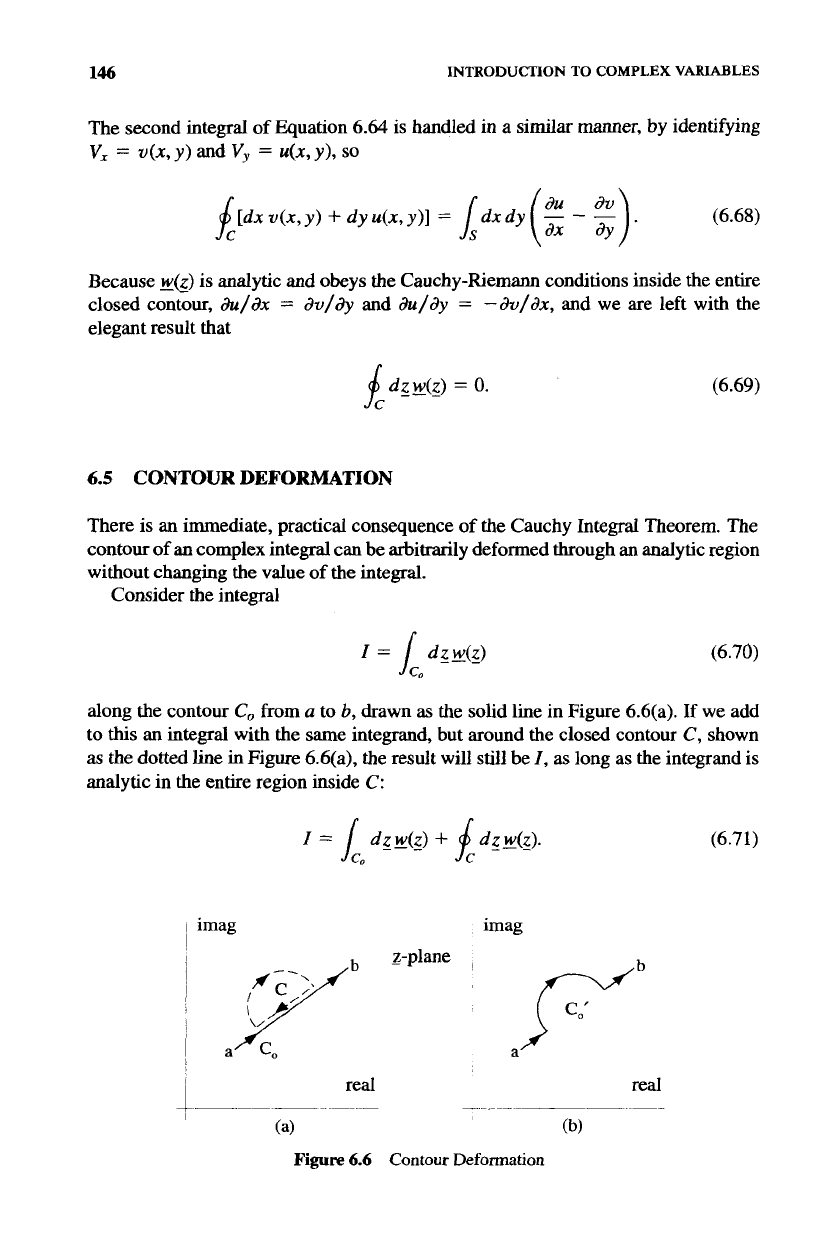
the solid line in Figure 6.6(a). If we add
to
this
an integral with the same integrand, but around the closed contour
C,
shown
as
the
dotted line in Figure
6.6(a),
the result will still be
I,
as
long
as
the integrand is
analytic in the entire region inside
C:
~
imag imag
real real
i
(6.71)
Figure
6.6
Contour
Deformation
THE CAUCHY
INTEGRAL
FORMULA
147
But notice the part
of
C
that lies along the original contour has an equal, but opposite
contribution to the value, and the contributions from the two segments cancel, leaving
the contour shown in Figure 6.qb). Therefore,
(6.72)
Deformations
of
this kind will be very handy
in
the
discussions that follow.
6.6
THE
CAUCHY
INTEGRAL FORMULA
The Cauchy Integral Formula is a natural extension
of
the Cauchy Integral Theorem
discussed previously. Consider the integral
(6.73)
where
f(z)
is analytic everywhere in the z-plane, and
C1
is a closed contour that
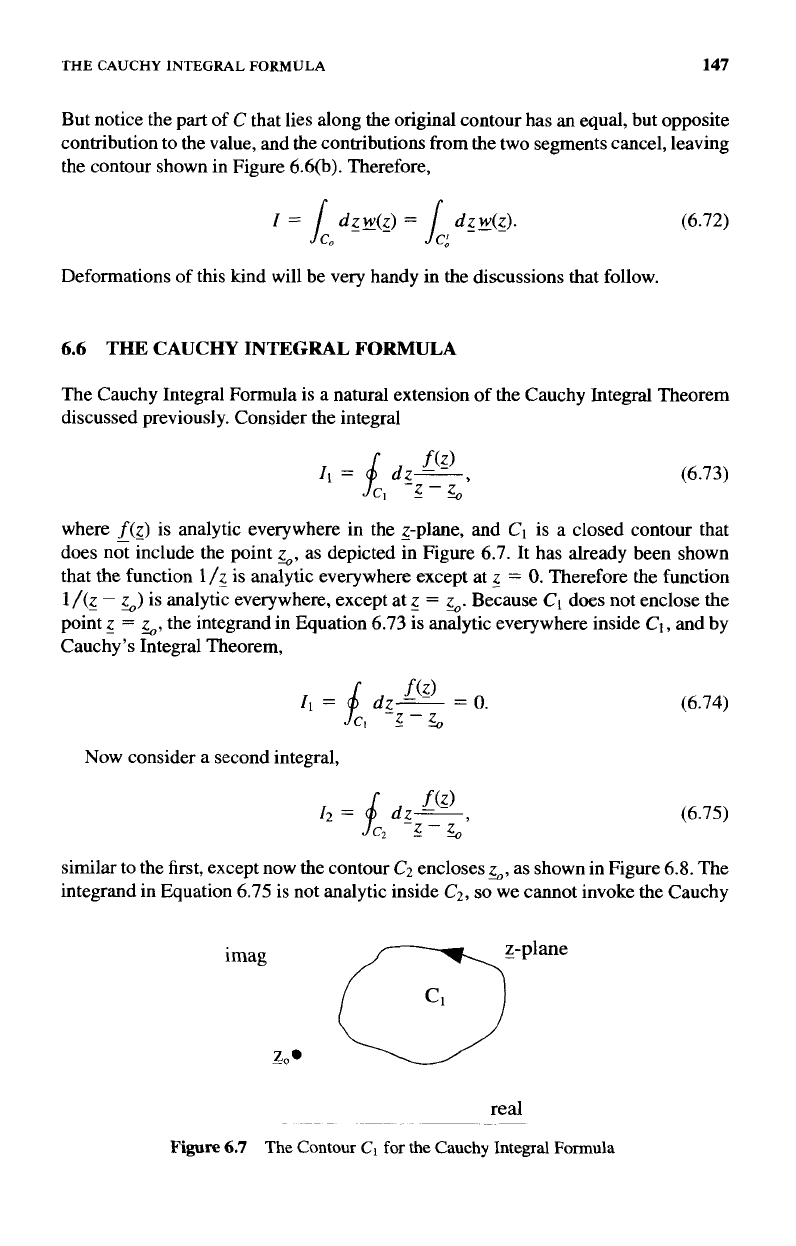
does no? include the point
G,
as depicted in Figure 6.7. It has already been shown
that the function
1
/g
is analytic everywhere except at
z
=
0.
Therefore the function
1
/(z
-
ZJ
is analytic everywhere, except at
z
=
5.
Because
CI
does not enclose the
point
z
=
L,
the integrand in Equation 6.73 is analytic everywhere inside
C1
,
and by
Cauchy’s Integral Theorem,
Now consider a second integral,
(6.74)
(6.75)
similar
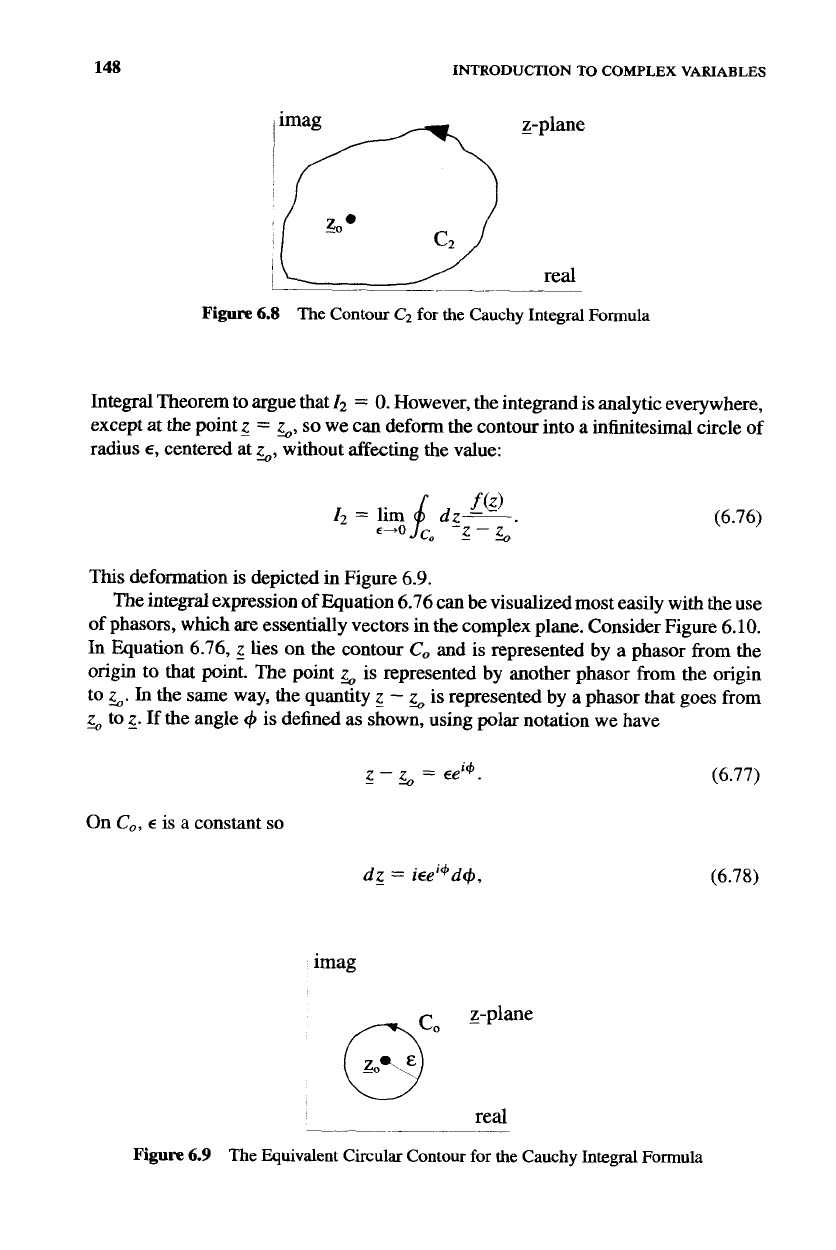
to the first, except now the contour
C2
encloses
5,
as shown in Figure 6.8. The
integrand in Equation 6.75 is not analytic inside
C,,
so
we cannot invoke the Cauchy
real
~~~ ~~ ~ ~
Figure
6.7
The
Contour
C1
for
the
Cauchy
Integral
Formula
148
INTRODUCTION
TO
COMPLEX
VARIABLES
I-
____
real
Figure
6.8
The Contour
C,
for
the
Cauchy Integral
Formula
Integral Theorem to argue that
12
=
0.
However, the integrand
is
analytic everywhere,
except at the point
z
=
5,
so
we can deform the contour into a infinitesimal circle of
radius
E,
centered at
b,
without
affecting
the value:
(6.76)
This deformation
is
depicted in Figure
6.9.
The integral expression of Equation
6.76
can be visualized most easily with the use
of phasors, which
are
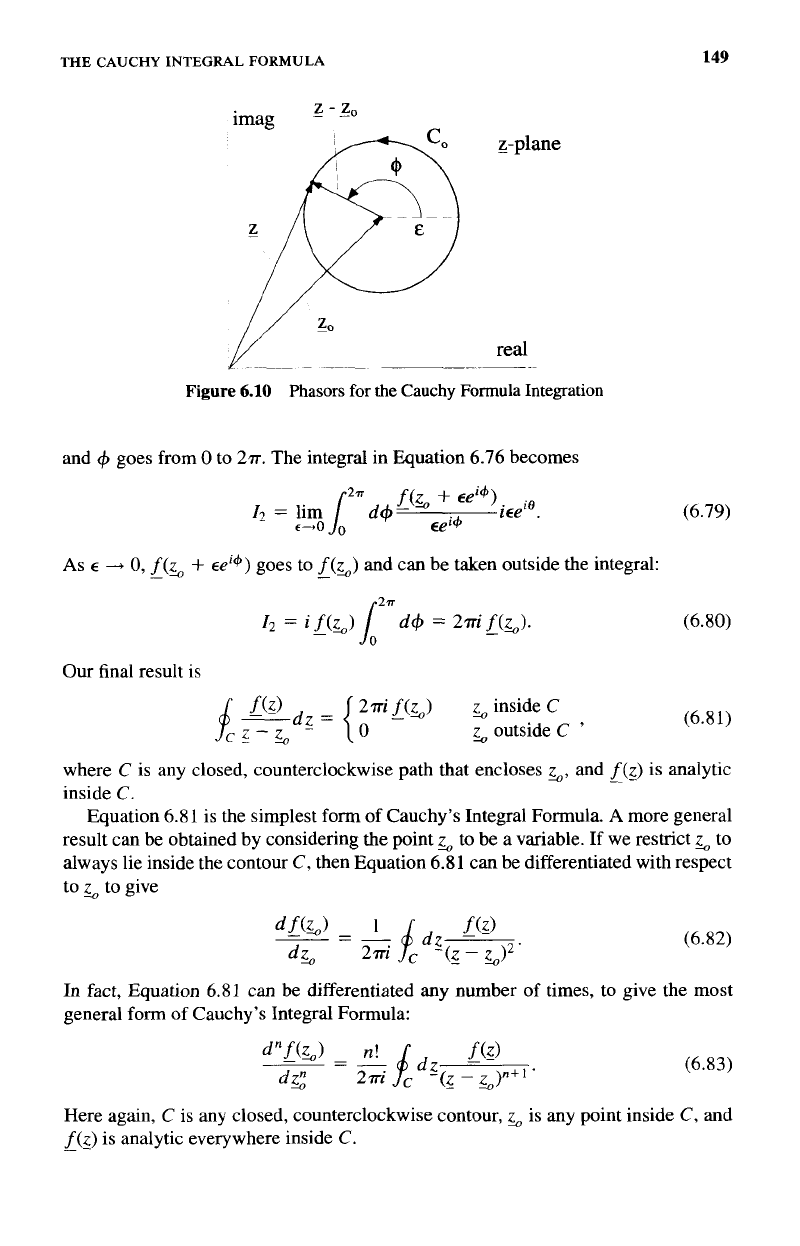
essentially vectors in the complex plane. Consider Figure 6.10.
In Equation 6.76,
z
lies on the contour C, and is represented
by
a phasor from the
origin
to
that point. The point
5
is represented by another phasor from the origin
to
L.
In
the
same way, the quantity
z
-
z,
is
represented
by
a phasor that goes from
~0
to
z.
If the angle
<b
is
defined as shown, using polar notation we have
z
-
5
=
Ee'@.
(6.77)
On
C,,
E
is
a
constant
so
(6.78)
imag
real
Figure
6.9
The
Equivalent Circular Contour
for
the
Cauchy Integral
Formula
THE CAUCHY INTEGRAL FORMULA
149
real
Figure
6.10
Phasors for
the
Cauchy Formula
Integration
and
4
goes from
0
to
27r.
The integral in Equation 6.76 becomes
(6.79)
As
E
-+
0,
f(z
+
&')
goes to
f
(z
)
and can be taken outside the integral:
-4 -4
2.n
(6.80)
Our final result is
(6.81)
where
C
is any closed, counterclockwise path that encloses
G,
and
-
f(z)
is analytic
inside
C.
Equation 6.81 is the simplest
form
of
Cauchy's Integral Formula.
A
more general
result can be obtained by considering the point to be a variable. If we restrict
z+
to
always lie inside the contour
C,
then Equation
6.81
can be differentiated with respect
to
%
to give
(6.82)
In fact, Equation 6.81 can be differentiated any number of times, to give the most
general
form
of
Cauchy's Integral Formula:
f
(z)
dg-
(6.83)
Here again,
C
is
any
closed, counterclockwise contour,
-
f(z)
is analytic everywhere inside
C.
is any point inside
C,
and
150
INTRODUCTION
TO
COMPLEX
VARIABLES
Equation 6.83 says something quite important about the nature of analytic func-
tions.
If
the value of an analytic function is known everywhere on some closed contour
C,
the value
of
that function and
all
its
derivatives
are
uniquely specified everywhere
inside
C.
6.7
TAYLOR AND LAURENT
SERIES
Just as with real functions, complex functions can be expanded using Taylor series.
An
extension of
the
standard Taylor series, called the Laurent series, is also frequently
used to expand complex functions. Series expansions play a crucial role in the theory
of
complex functions, because they provide the fundamental tools for deriving and
using the theory of residues, described
in
the
next section.
6.7.1 Convergence
Before discussing Taylor and Laurent expansions for complex functions, it is appro-
priate to say a few words about the convergence of complex series. We assume you
are already familiar with the convergence properties of real series,
so
we will not
attempt to cover that topic with any
sort
of mathematical rigor.
An infinite summation of real numbers
xn
is
said to converge to the value
S
if
OD
S
=
xn
4
A
Finite Real Number.
The series in Equation 6.84, is said to converge absolutely if
n=O
OD
(6.84)
lxnl
+
A
Finite Real Number.
(6.85)
n=O
Because
cc
m
(6.86)
n=O
n=O
absolute convergence is a more rigid requirement than convergence. That is, if a series
converges absolutely it will always converge. However, a series may converge even
though it does not converge absolutely. For example, the alternating harmonic series
(6.87)
converges to
In
2,
but the harmonic series
(6.88)
diverges.
TAYLOR AND LAURENT
SERIES
151
The ratio test can be used to establish the absolute convergence of a series.
That
is, if the terms of an infinite series satisfy
(6.89)
the series converges absolutely. Again, a series may converge even though it does not
satisfy the ratio test. There are plenty of other tests for convergence, but the ratio test
is the only one we need for our discussions.
Things are not too different when we consider infinite series of complex numbers.
A summation of complex numbers
gfl
converges to the complex value
8
if
x
-
s
=
c-fl
z
+
A Finite Complex Number.
For convergence
of
the infinite complex series, both the real and imaginary parts must
converge. That is, if we write
I,
=
x,
+
iy,
and
8
=
S,
+
iSi,
we must have
(6.90)
fl=O
CD
S,
=
xn
-+
A
Finite Real Number
m
(6.91)
n=O
Si
=
yn
+
A Finite Real Number.
n=O
The complex series defined in Equation
6.90
converges absolutely if
a'
/z,
I
-+
A Finite Complex Number.
(6.92)
n=O
Because
m
m
n=O
fl=O
and
m
m
n=O
fl=O
if the series converges absolutely, the two series in Equations 6.91 will both converge,
and consequently the original complex
series
in
Equation
6.90
must also converge.
The absolute convergence of a complex series can also be established by the ratio
test. That is, if the terms of the series satisfy
the series will converge absolutely.
(6.95)
152
INTRODUCTION
TO COMPLEX
VARIABLES
6.7.2
Taylor
and
Laurent
Series
of
Real
Functions
Before dealing with expansions for complex functions, Taylor and Laurent series for
real functions will be reviewed. Recall that the Taylor series expansion of
f(x),
a real
function of the variable
x,
around the point
no
is
m
f(x)
=
&(x
-
x,)"
=
c,
+
q(x
-
x,)
+
c*(x
-
x,)2
+
* *
.
.
(6.96)
n=O
The coefficients
can be obtained from the expression
(6.97)
and depend upon both the function
f(x)
and the expansion point
x,.
The region of
convergence of
this
series can
be
determined by using the ratio test. The series on the
RHS
of Equation 6.96 converges if
(6.98)
In
general
a
Taylor series will converge for values of
x
in a symmetric range around
x,,
given by
Ix
-
x,l
<
A,
where
A
depends upon both
the
expansion point and the
function
f(x).
A
Laurent series expansion differs from a Taylor series because of the additional
terms with negative
n
values.
An
expansion of
f(x)
around
x,
using a Laurent series
has
the
form
(6.99)
Convergence for a Laurent series is slightly more complicated
to
verify than for
a
Taylor series, because we must check the convergence
of
both
the
positive and
negative terms.
In
many cases, the negative terms of the series terminate at some
finite value
of
n,
and we only need to
worry
about the convergence of the positive
terms. For the general case, however, we can perform two ratio tests, one for the
positive terms and one for the negative terms. Clearly, if there are any terms with
negative
n
values, the series cannot converge at
x
=
x,.
In general, a Laurent series
will converge in a symmetric range of
x
given by
Amin
<
Ix
-
x,l
<
A,,,
where
Amin
and
A-
are the minimum and maximum allowed distances from the expansion
point.
THE COMPLEX TAYLOR SERIES
153
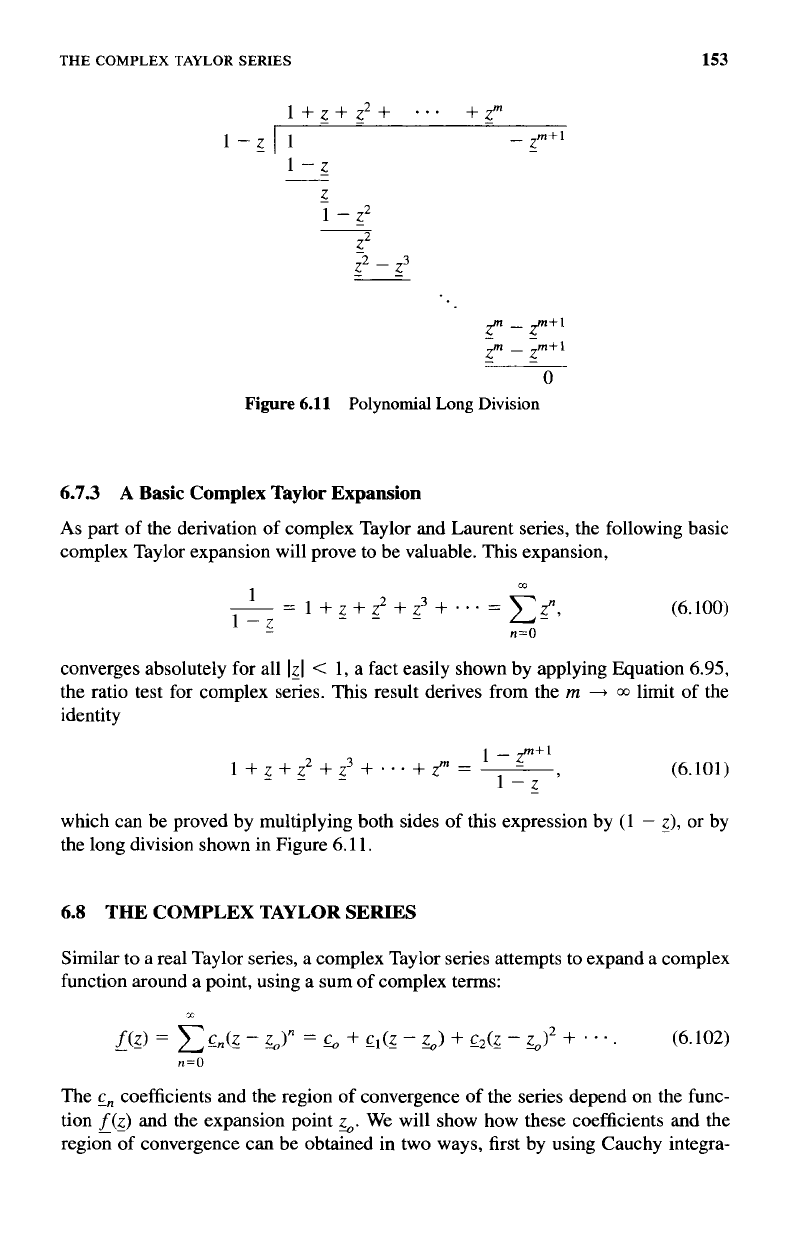
z"
-
z""
Zm
-
zm+l
-
0
Figure 6.11
Polynomial
Long
Division
6.7.3
A
Basic Complex Taylor Expansion
As
part of the derivation
of
complex Taylor and Laurent series, the following basic
complex Taylor expansion will prove to be valuable.
This
expansion,
m
(6.100)
converges absolutely for all
IzI
<
1, a fact easily shown by applying Equation 6.95,
the ratio test for complex series.
This
result derives from the
rn
+
cc
limit of the
identity
(6.101)
which can be proved by multiplying both sides
of
this expression by
(1
-
z),
or by
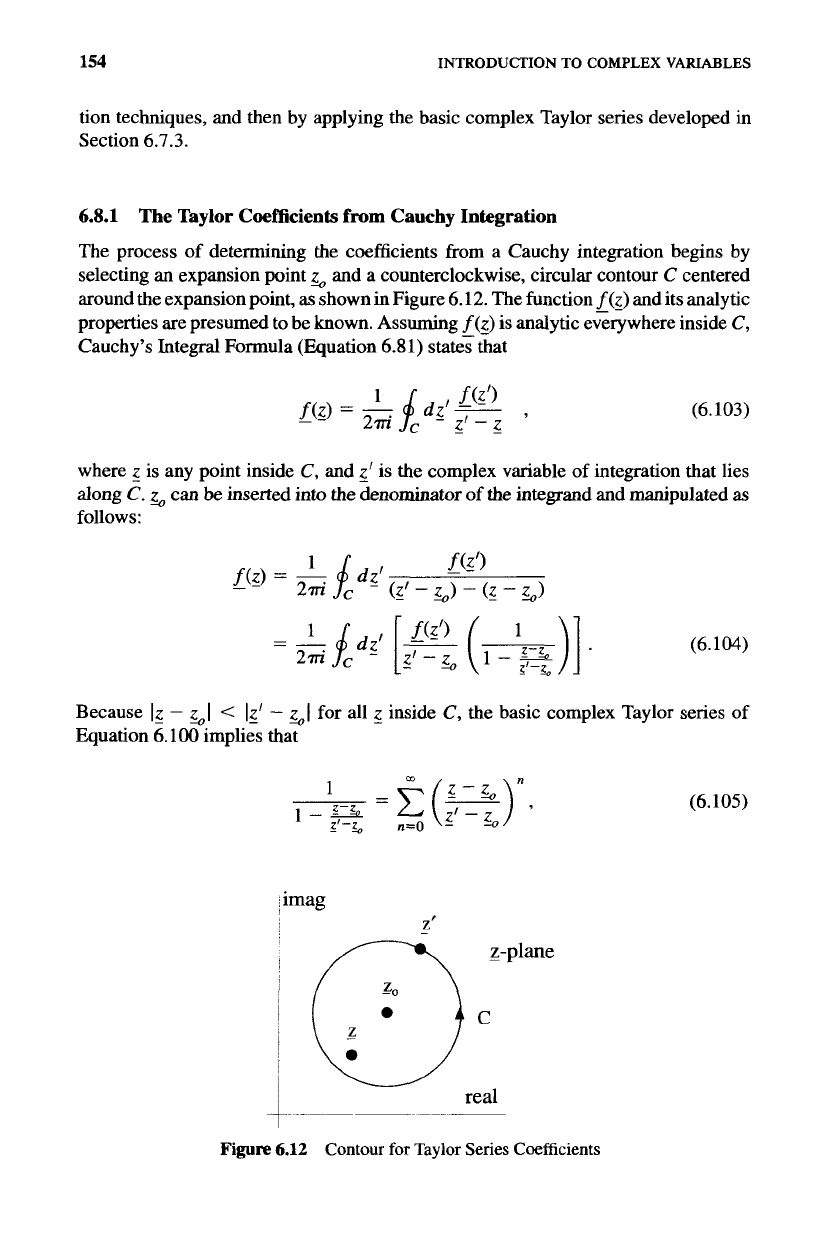
the long division shown in Figure 6.1
1.
6.8
THE
COMPLEX TAYLOR SERIES
Similar to a real Taylor series, a complex Taylor series attempts to expand a complex
function around a point, using a sum of complex terms:
z
(6.102)
2
-
f(z)
=
Ccn(g
-
zJn
=
&
+
c1(z
-
ZJ
+
c&
-
5)
+
.
.
. .
n=O
The
c,
coefficients and the region of convergence of the series depend on the func-
tion
f(g)
and the expansion point
z.
We
will show how these coefficients and the
region of convergence can be obtained in two ways, first by using Cauchy integra-
154
INTRODUCTION
TO
COMPLEX
VARIABLES
tion techniques, and then by applying the basic complex Taylor series developed in
Section 6.7.3.
6.8.1
The process
of
determining the coefficients
from
a Cauchy integration begins by
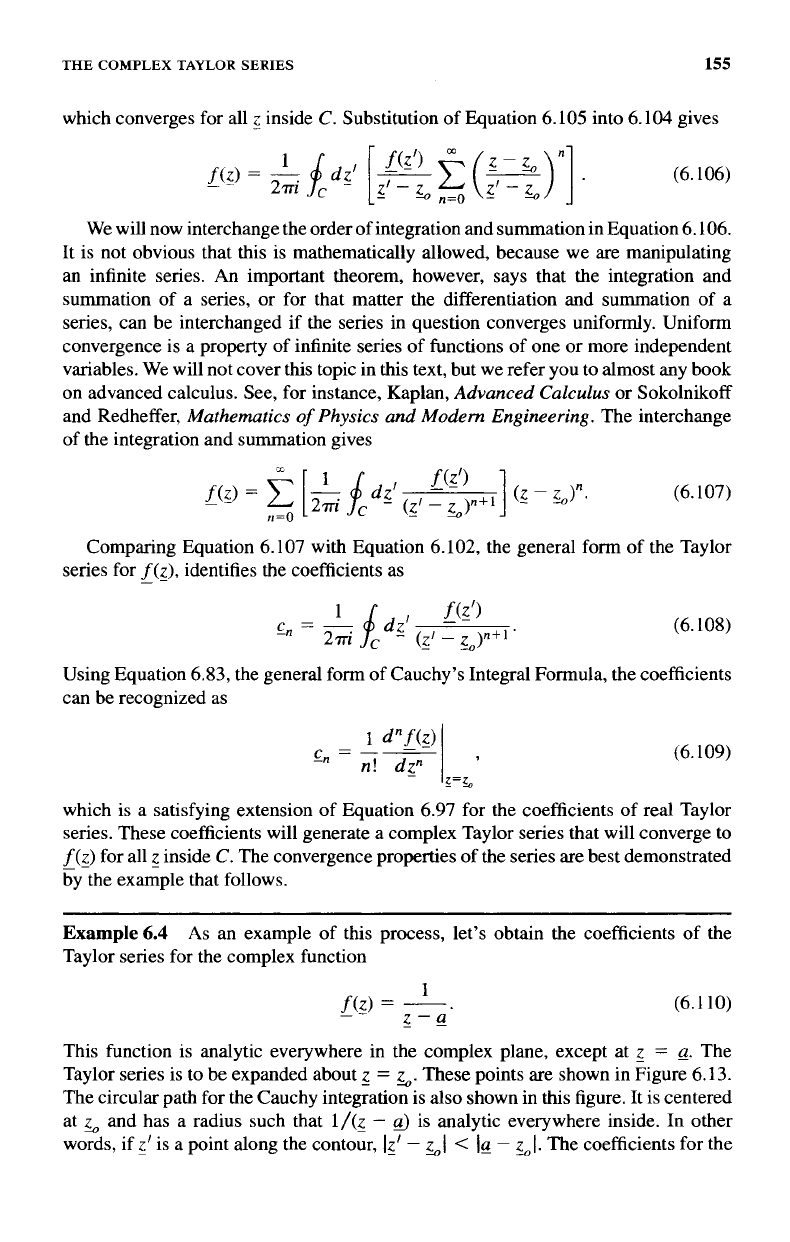
selecting an expansion point
%
and a counterclockwise, circular contour
C
centered
around the expansion point,
as
shown
in
Figure 6.12. The function
f(z)
and its analytic
properties are presumed
to
be known. Assuming
f(z)
is analytic everywhere inside
C,
Cauchy’s Integral
Formula
(Equation 6.81)
state;
that
The
Taylor
Coefficients
from
Cauchy Integration
(6.103)
where
z
is any point inside
C,
and
z/
is the complex variable of integration that lies
along
c.
5
can
be
inserted into the denominator
of
the integrand and manipulated
as
follows:
(6.104)
Because
Iz
-
51
<
Iz’
-
Equation 6.100 implies that
for all
z
inside
C,
the basic complex Taylor series
of
imag
z’
z-plane
(-Jc
real
(6.105)
Figure
6.12
Contour
for
Taylor
Series
Coefficients
THE COMPLEX TAYLOR SERIES
155
which converges for all
z
inside
C.
Substitution of Equation 6.105 into 6.104 gives
(6.106)
We will now interchange the order of integration and summation in Equation 6.106.
It is not obvious that this is mathematically allowed, because we are manipulating
an infinite series.
An
important theorem, however, says that the integration and
summation of a series, or for that matter the differentiation and summation of a
series, can be interchanged if the series in question converges uniformly. Uniform
convergence is a property of infinite series of functions of one or more independent
variables. We will not cover this topic in this text, but we refer you to almost any book
on advanced calculus. See, for instance, Kaplan,
Advanced Calculus
or Sokolnikoff
and Redheffer,
Mathematics
of
Physics and Modem Engineering.
The interchange
of the integration and summation gives
Comparing Equation 6.107 with Equation 6.102, the general form of the Taylor
series for
f(z),
identifies the coefficients as
-
(6.108)
Using Equation 6.83, the general form of Cauchy’s Integral Formula, the coefficients
can be recognized as
(6.109)
which is a satisfying extension of Equation 6.97 for the coefficients of real Taylor
series. These coefficients will generate a complex Taylor series that will converge to
f(z)
for all
g
inside
C.
The convergence properties of the series are best demonstrated
by the example that follows.
Example6.4
As
an example of this process, let’s obtain the coefficients of the
Taylor series for the complex function
(6.110)
This function is analytic everywhere in the complex plane, except at
z
=
a.
The
Taylor series is to be expanded about
z
=
z,.
These points are shown in Figure 6.13.
The circular path for the Cauchy integration is also shown in
this
figure. It is centered
at
z,
and has a radius such that 1/(z
-
4
is analytic everywhere inside. In other
words, if
z’
is a point along the contour,
lz’
-
<
la
-
51.
The coefficients for the