
Kusse B.R., Westwig E.A. Mathematical Physics: Applied Mathematics for Scientists and Engineers
Подождите немного. Документ загружается.

156
INTRODUCTION TO
COMPLEX
VARIABLES
._a
Sinmilnritv
zI
'*
z-plane
I
-
\
\
\
\
\
\
I
\
I
\
/
\ /
=-I--
-I_
circle
I
'\
\
,
/'
red
Figure
6.13
The
Complex Plane for Determining
the
Taylor
Coefficients
for
l/(z
-
UJ
.__/
Taylor series can now be obtained
from
Equation 6.109
as
c
=_A
g=%
--n
=-
(
)n+'
a-J
so
that
(6.111)
(6.1 12)
This
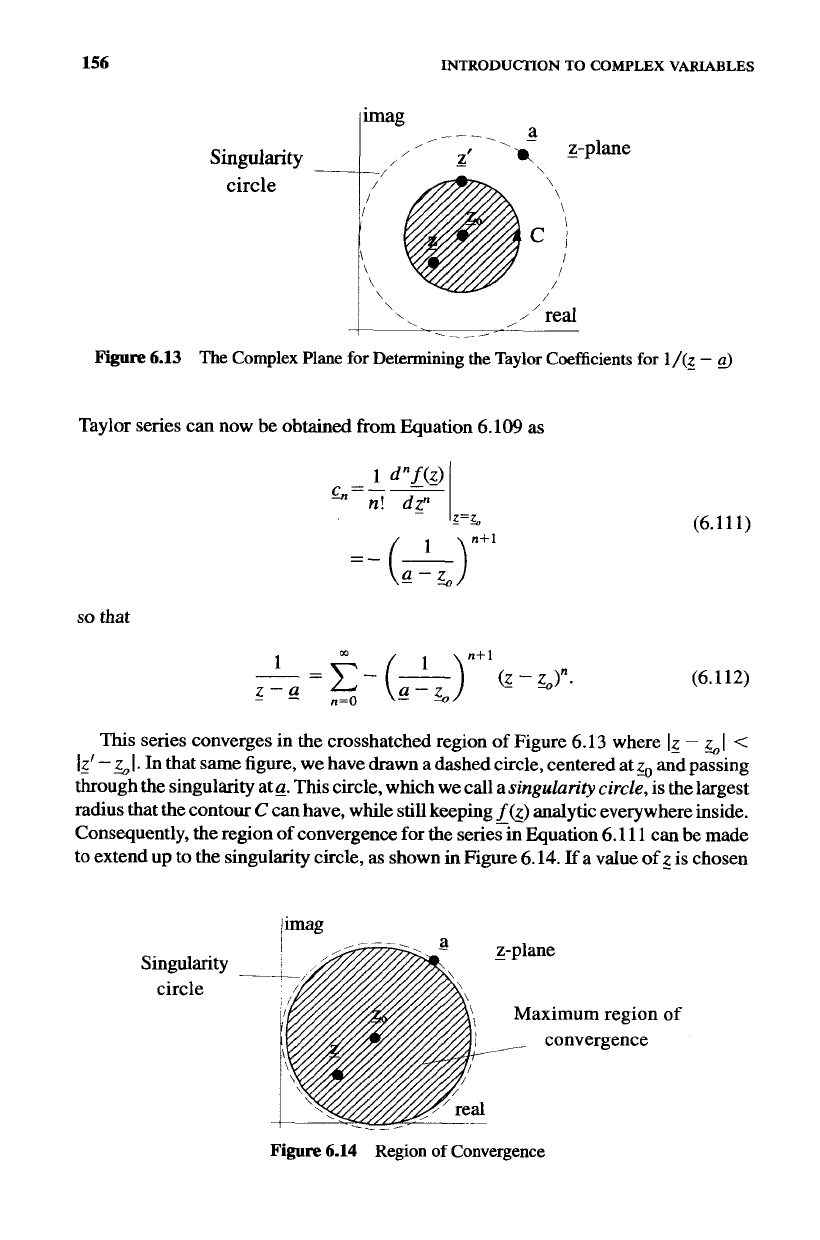
series converges in the crosshatched region
of
Figure 6.13 where
Iz
-
z,
I
<
ig'
-
5
I.
In
that same figure, we have drawn
a
dashed circle, centered at
%
and passing
through the singularity at
a.
This
circle, which we
call
a
singularity circle,
is the largest
radius that the contour
C
can have, while still keeping
f(g)
analytic everywhere inside.
Consequently, the region
of
convergence
for
the serierin Equation 6.1 1 1 can be made
to
extend up to the singularity circle,
as
shown
in Figure
6.14.
If
a
value
of
z
is chosen
$mag
-
z-plane
Maximum region
of
convergence
';
Figure
6.14
Region
of
Convergence
THE COMPLEX TAYLOR
SERIES
157
real
Figure
6.15
The Dependence
of
the Convergence Region
that lies inside this singularity circle, and is inserted into the
LHS
of Equation 6.112,
we will obtain the same finite value that we get from inserting
this
same
g
into the
RHS.
On the other hand, if we select a point outside of the singularity circle, and
use it in the same equation, the
LHS
will give a finite number, while the
RHS
will
diverge.
If we have a more complicated function, with more than one nonanalytic point, the
region of convergence is inside the smallest of all the singularity circles.
Also,
notice
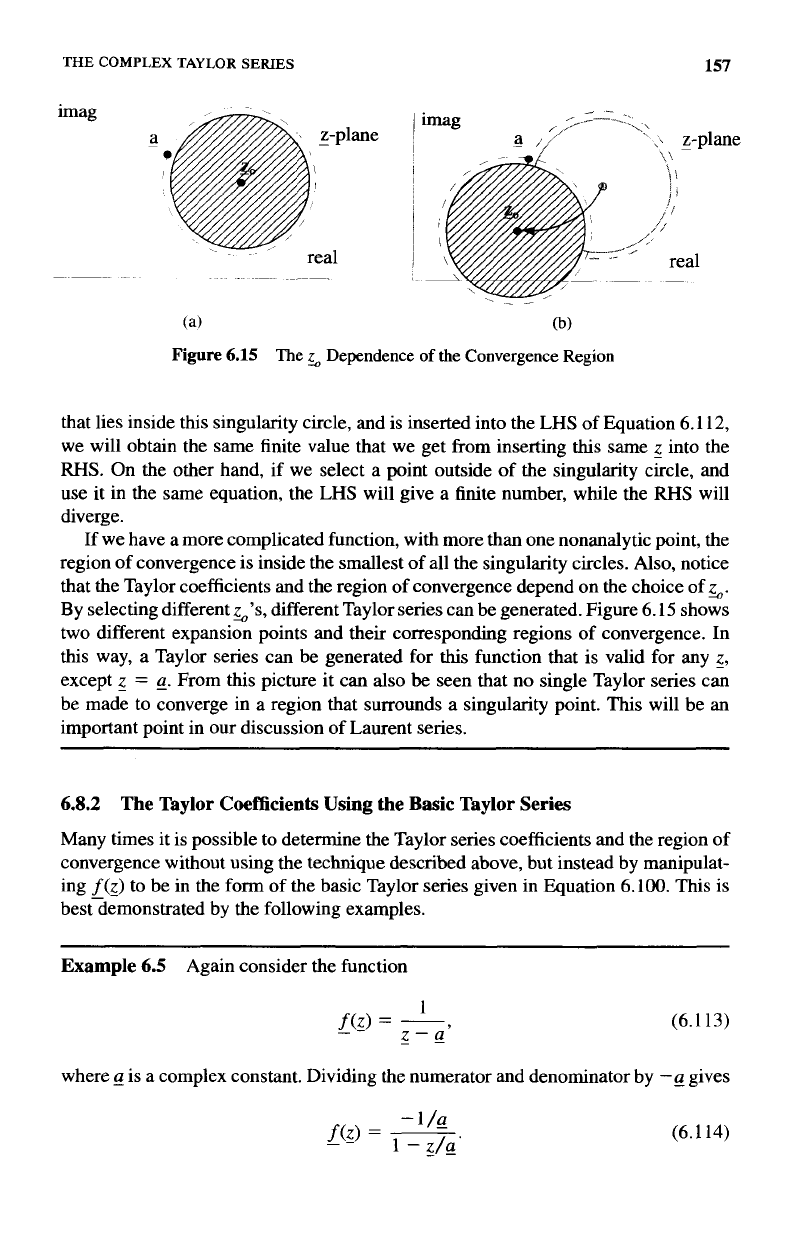
that the Taylor coefficients and the region of convergence depend on the choice of
5.
By selecting different
~’s,
different Taylor series can be generated. Figure 6.15 shows
two different expansion points and their corresponding regions
of
convergence.
In
this way, a Taylor series can be generated for
this
function that is valid for any
Z,
except
z
=
a.
From
this
picture it can
also
be
seen that no single Taylor series can
be made to converge in a region that surrounds
a
singularity point.
This
will be an
important point in our discussion of Laurent series.
6.8.2
The Taylor Coefficients
Using
the Basic Taylor Series
Many times it
is
possible to determine the Taylor series coefficients and the region of
convergence without using the technique described above, but instead by manipulat-
ing
f(g)
to be in the form of the basic Taylor series given in Equation 6.100. This is
bestdemonstrated by the following examples.
Example
6.5
Again consider the function
(6.1 13)
where
a
is
a
complex constant. Dividing the numerator and denominator by
-a
gives
(6.1
14)
158
INTRODUCTION
TO
COMPLEX VARIABLES
As
long
as
lg/gl
<
1, the denominator can
be
expanded using Equation 6.100
to
give
-
-'
[I
+
5
+
(z)2+
(5)3+
-
a
..a].
(6.115)
g-a
a
aa
But
Equation 6.115 is already in the form of a complex Taylor series, with an
expansion point around the origin:
m
with
n+l
G
=
-(:)
(6.1 16)
(6.1
17)
Convergence of
this
series
can
be
checked by a ratio test
(6.118)
n-im
which gives the condition
IZI
<
la/,
(6.119)
which you might have guessed from the condition on the series expansion used in
Equation 6.1 15.
Notice the convergence region is a circle centered at the expansion point with a
radius
of
Igl.
This
confirms the previous discussion which led
to
Figure 6.14.
Example
6.6
expanded about an arbitrary point
6
=
5.
The
series
must
take the form
Now let's seek a Taylor series for the same function, but
this
time
+m
(6.120)
If
we manipulate the function
as
follows:
(6.121)
--
1
-
1
=
(2)
(+
1
g-a
(g-z,)-@-zJ
a-z,
1-z
we can use the same technique as before, and write
with the region
of
convergence
(6.123)
THE
COMPLEX
LAURENT
SERIES
159
which is the same region depicted in Figure
6.14.
Thus we find the coefficients for
this expansion are
(6.124)
Once again, the series converges in a circular region centered at
5.
The conver-
gence radius is the distance from the expansion point
to
the nonanalytic point
a.
Notice that these are the same coefficients
and
region of convergence we obtained
using the Cauchy integration approach.
6.9
THE COMPLEX LAURENT
SERIES
A
complex Laurent series has the form
(6.125)
and is distinguished from a Taylor series because it contains negative
n
terms.
As
with the Taylor series, the coefficients and the region of convergence depend upon
the function
f(g)
and the expansion point
5.
These coefficients and the region of
convergence for the Laurent series will be obtained from a Cauchy integral approach,
and also by using the basic complex Taylor series developed in Equation
6.100.
Laurent series are useful when
an
expansion is desired that converges in a region
surrounding a nonanalytic point of
-
f(z).
6.9.1
Imagine we wanted to generate a series expansion for the function
1
/(z
-
a)
about
5,
as we did in the previous section, but this time,
we
want an expansion which is valid
in a region outside of the singularity circle of
g.
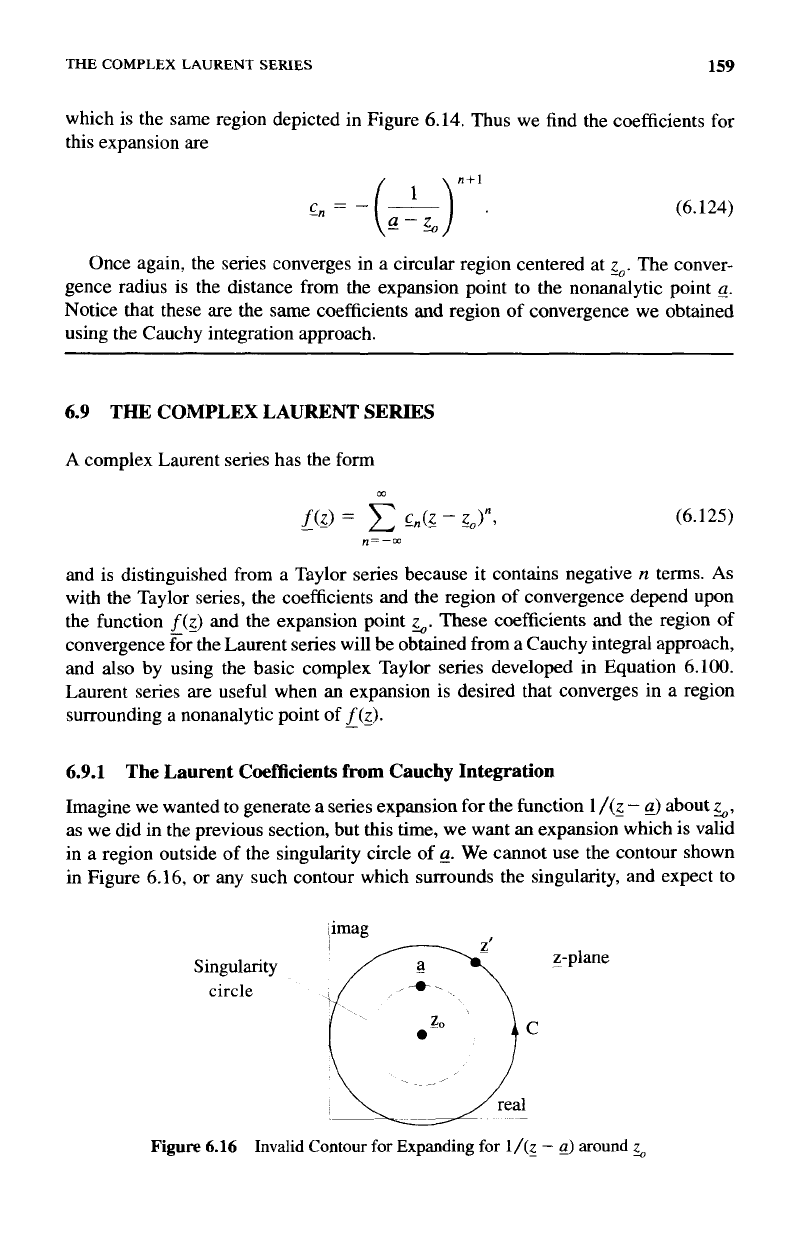
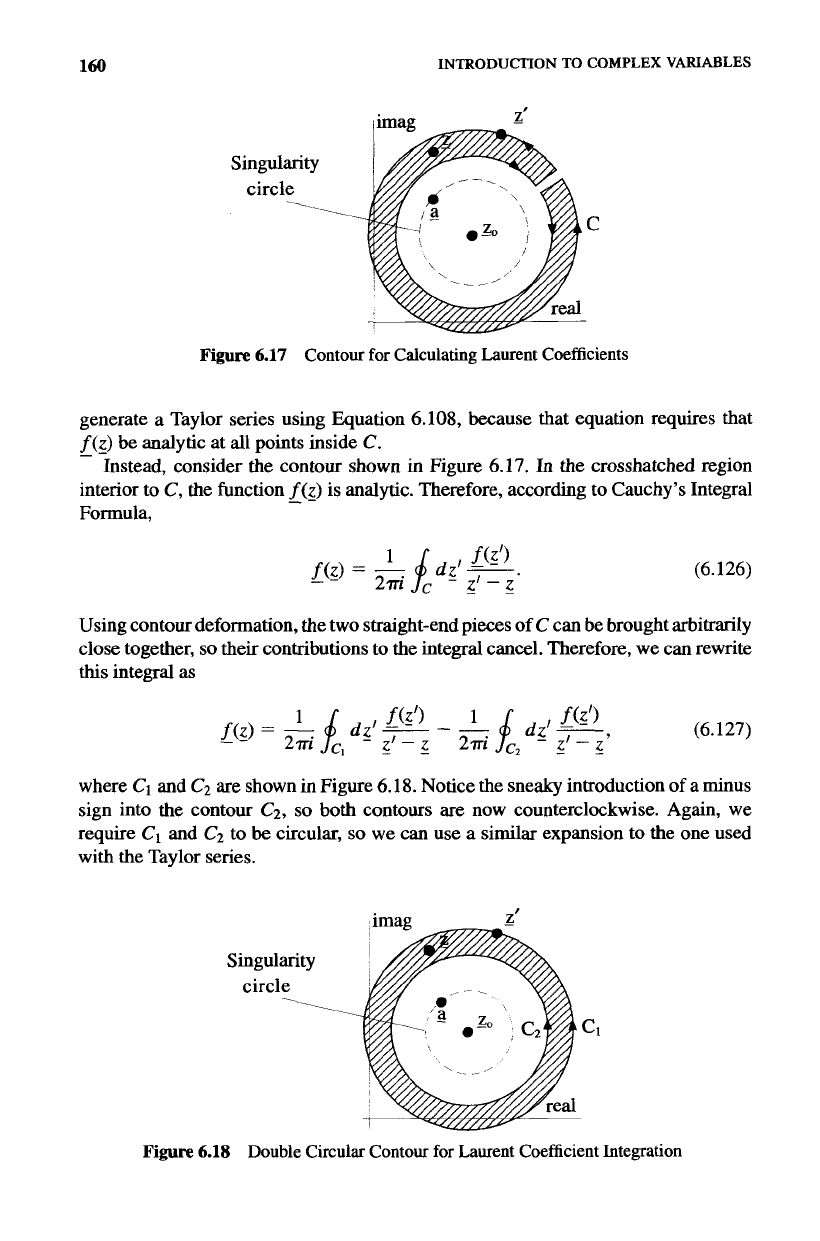
We cannot use the contour shown
in Figure 6.16, or any such contour which surrounds the singularity, and expect to
The
Laurent Coefficients
from
Cauchy Integration
Singularity
circle
-
z-plane
Figure
6.16
Invalid
Contour
for
Expanding
for
1/(1
-
a)
around
5
160
INTRODUCTION
TO
COMPLEX VARIABLES
Singularity
circle
1
1..
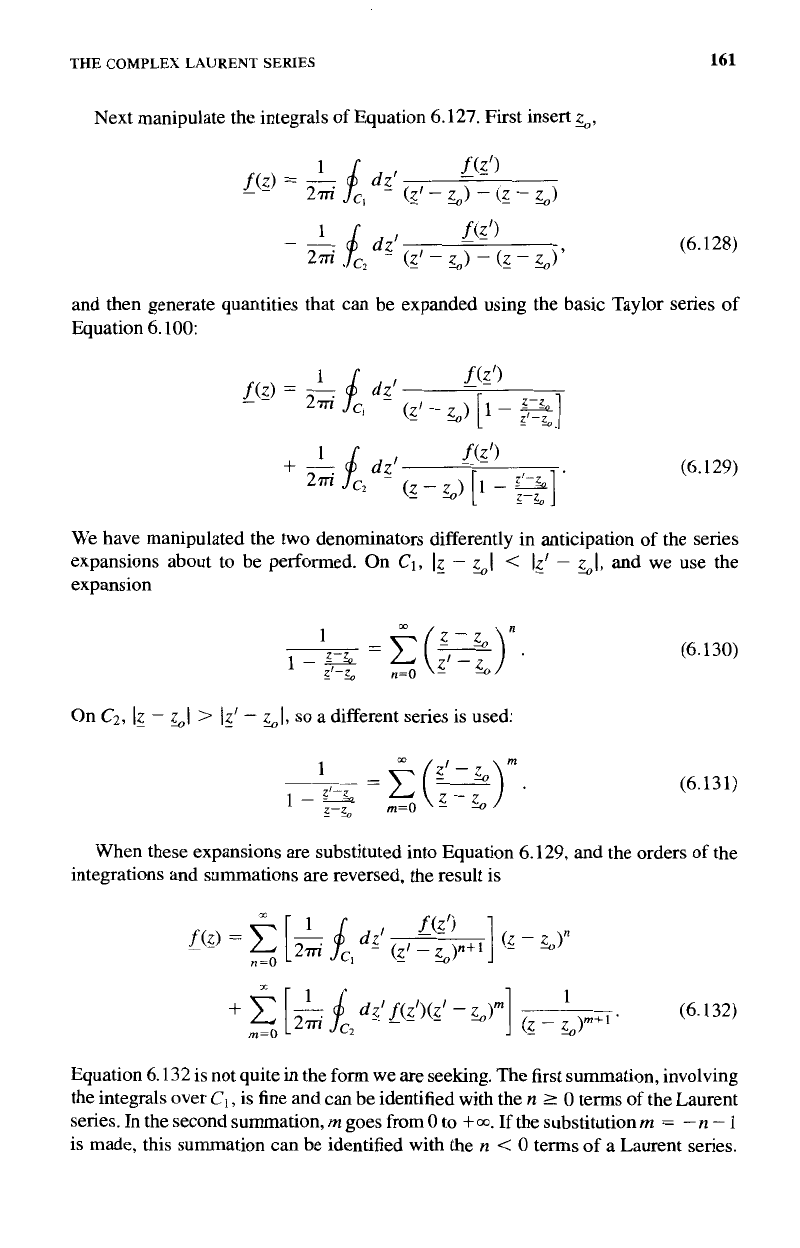
Figure
6.17
Contour for Calculating Laurent Coefficients
generate a Taylor series using Equation
6.108,
because that equation requires that
-
f
(z)
be analytic at
all
points inside C.
Instead, consider the contour shown in Figure
6.17.
In
the crosshatched region
interior to
C,
the function
-
f(z)
-
is analytic. Therefore, according to Cauchy's Integral
Formula,
(6.126)
Using contour deformation, the two straight-end pieces of
C
can be brought arbitrarily
close together,
so
their contributions to the integral cancel. Therefore, we can rewrite
this
integral
as
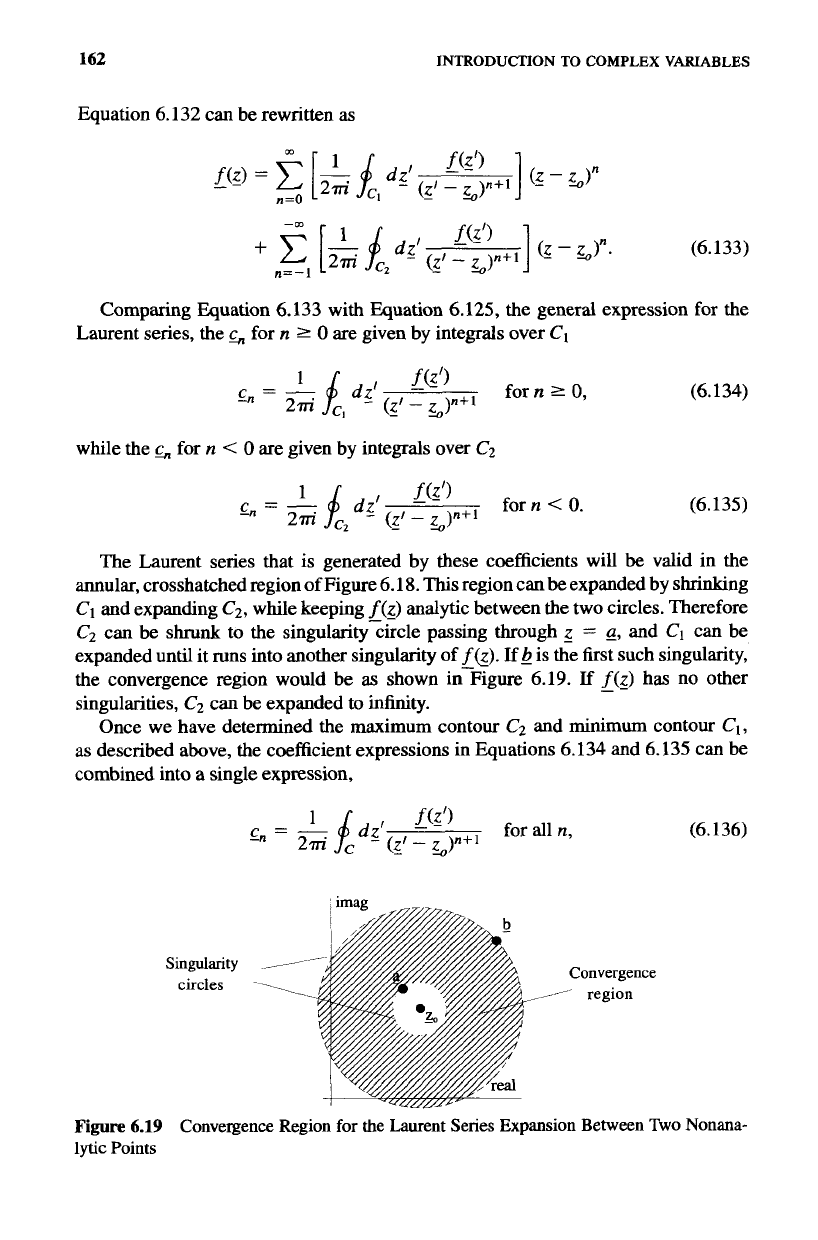
where
C1
and C2
are
shown
in
Figure
6.18.
Notice the sneaky introduction
of
a minus
sign into the contour C2,
so
both contours
are
now counterclockwise. Again, we
require C1 and C2 to
be
circular,
so
we can use
a
similar expansion to the one used
with the Taylor series.
Figure
6.18
Double Circular Contour for Laurent Coefficient Integration
THE
COMPLEX LAURENT SERIES
161
Next manipulate the integrals of Equation 6.127. First insert
G,
(6.128)
and then generate quantities that can be expanded using the basic Taylor series
of
Equation 6.100:
(6.129)
We have manipulated the two denominators differently in anticipation
of
the series
expansions about to be performed. On
C1,
Iz
-
51
<
Iz’
-
GI,
and we use the
expansion
(6.130)
On
C,,
12
-
GI
>
Jz’
-
51,
so
a different series is used:
m
(6.13 1)
1
When these expansions are substituted into Equation 6.129, and the orders of the
integrations and summations are reversed, the result is
Equation 6.132 is not quite in the form
we
are seeking. The first summation, involving
the integrals over
C1,
is
fine and can be identified with the
n
2
0
terms of the Laurent
series. In the second summation,
m
goes from
0
to
+
m.
If the substitution
m
=
-
n
-
1
is
made, this summation can be identified with the
n
<
0
terms of a Laurent series.
162
INTRODUCTION
TO
COMPLEX
VARIABLES
Equation 6.132 can be rewritten
as
--m
(z
-
ZJ".
(6.133)
Comparing Equation 6.133 with Wuation 6.125, the general expression for the
Laurent series, the for
n
2
0
are given by integrals over
C1
while the
for
n
<
0
are given by integrals over
C2
(6.134)
(6.135)
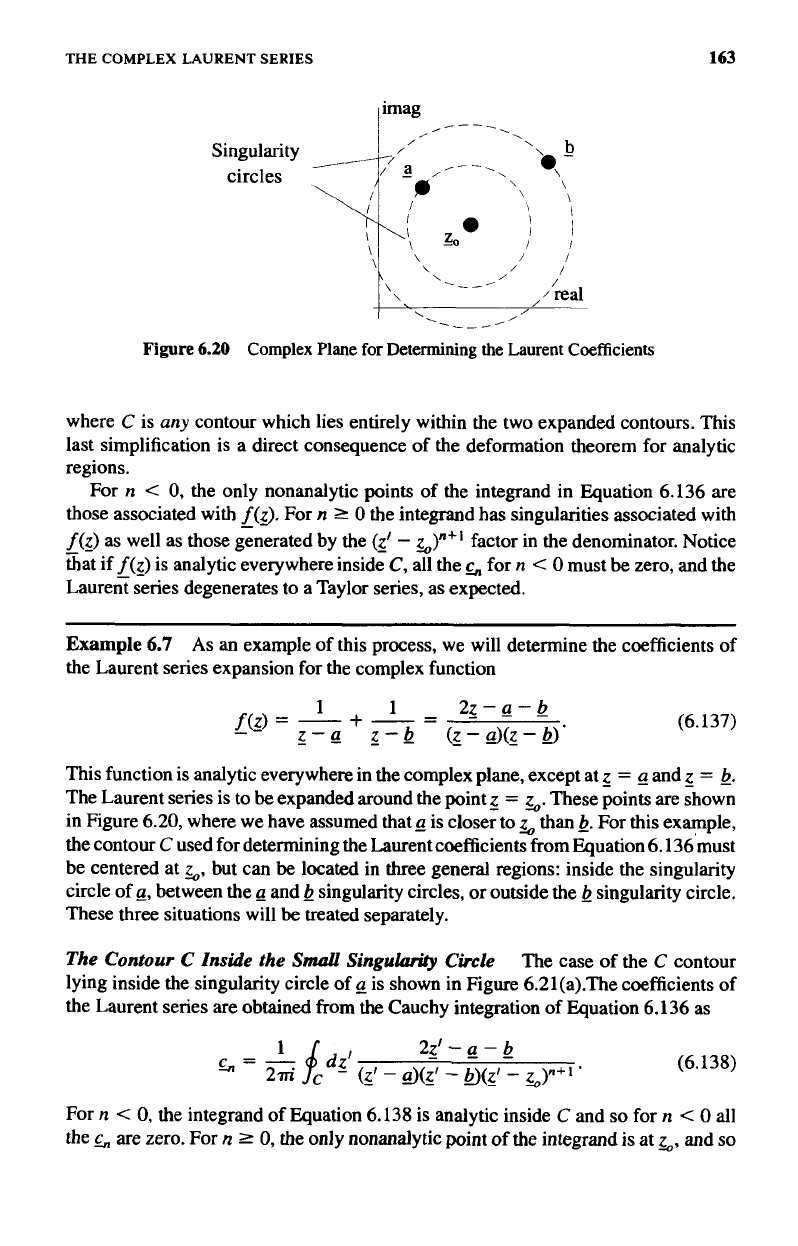
The Laurent series that is generated by these coefficients will
be
valid in the
annular, crosshatched region of Figure 6.18.
This
region can
be
expanded by shrinking
C1
and expanding
C2,
while keeping
f(g)
analytic between the two circles. Therefore
C2
can be
shrunk
to the singularitycircle passing through
g
=
a,
and
C1
can be
expanded until it runs into another singularity off(@.
Ifb
is the first such singularity,
the
convergence region would be
as
shown in-igure 6.19.
If
-
f
(g)
has no other
singularities,
C,
can be expanded to infinity.
Once we have determined the maximum contour
C,
and minimum contour
C1,
as
described above, the coefficient expressions in Equations 6.134 and 6.135 can be
combined into a single expression,
(6.136)
Figure
6.19
lytic
Points
Convergence Region
for
the
Laurent
Series
Expansion Between
Two
Nonana-
THE COMPLEX LAURENT SERIES
163
1
imag
Singularity
circles
Figure
6.20
Complex Plane for Determining
the
Laurent Coefficients
where
C
is
any
contour which lies entirely within the two expanded contours.
This
last simplification is a direct consequence of the deformation theorem for analytic
regions.
For
n
<
0,
the only nonanalytic points
of
the integrand in Equation 6.136 are
those associated with
f(&
For
n
2
0
the integrand has singularities associated with
-
f(z)
as well as those generated by the
(2'
-
&)"+'
factor in the denominator. Notice
that if
f(z)
is analytic everywhere inside
C,
all the
c
for
n
<
0
must
be
zero, and the
LaureG series degenerates
to
a Taylor series, as expected.
Example
6.7
As
an example of this process, we will determine the coefficients
of
the Laurent series expansion for the complex function
(6.137)
This function is analytic everywhere in the complex plane, except at
z
=
a
and
z
=
b.
The Laurent series is to
be
expanded around the point
z
=
L.
These points are shown
in Figure 6.20, where we have assumed that
a
is closer
to
L
than
b.
For this example,
the contour
C
used for determiningthe Laurent coefficients from Equation 6.136'must
be centered at
G,
but can
be
located in three general regions: inside the singularity
circle
of
a,
between the
g
and
b
singularity circles, or outside the
b
singularity circle.
These three situations will
be
treated separately.
The Contour
C
Inside the
Small
SingurcVity Circle
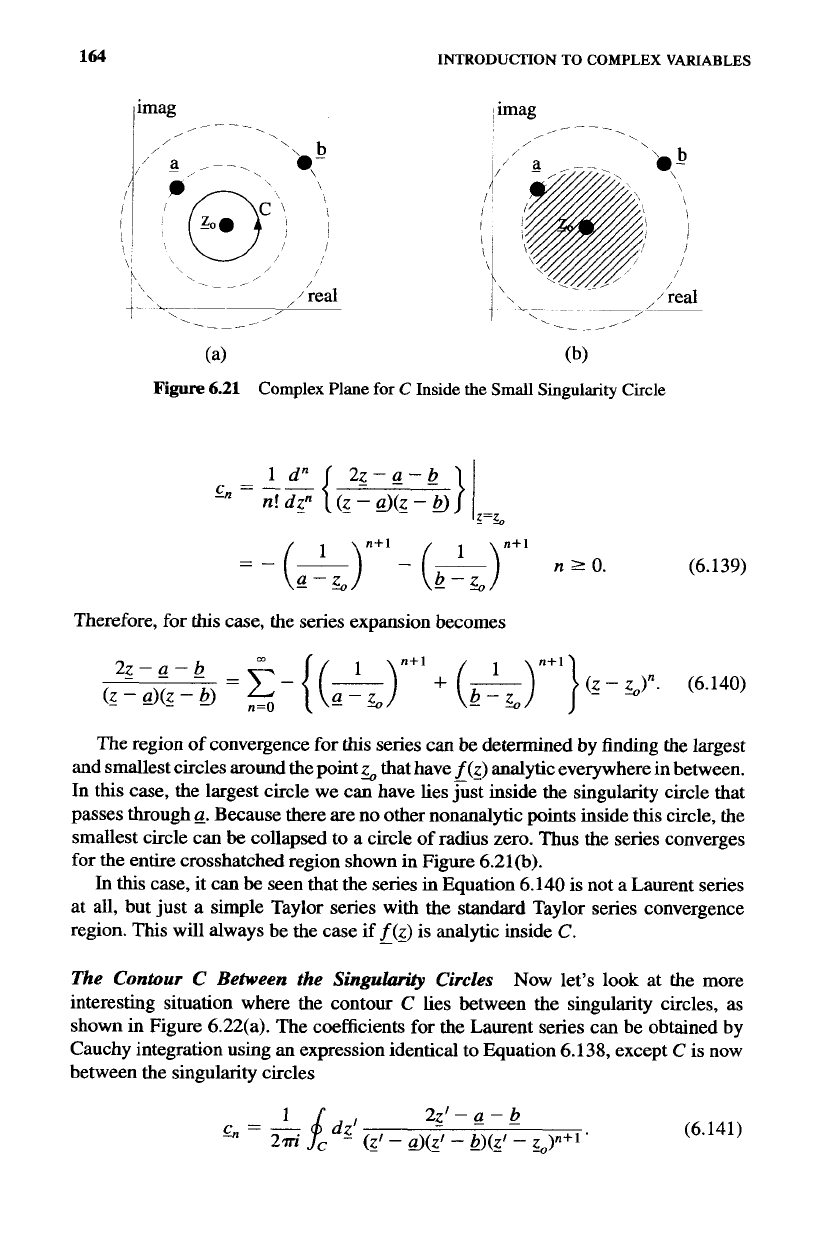
The case of the
C
contour
lying inside the singularity circle of
g
is shown in Figure 6.21(a).The coefficients of
the Laurent series are obtained from the Cauchy integration of Equation 6.136 as
(6.138)
For
n
<
0,
the integrand of Equation 6.138 is analytic inside
C
and
so
for
n
<
0
all
the
are
zero.
For
n
2
0,
the
only nonanalytic point of the integrand is at
L,
and
so
164
INTRODUCTION
TO
COMPLEX VARIABLES
n
2
0.
(6.139)
n+l
Therefore, for
this
case, the series expansion becomes
The region of convergence for
this
series can be determined by finding the largest
and smallest circles around the point
5
that have
f(z)
analytic everywhere in between.
In this case, the largest circle we can have lies Gst inside the singularity circle that
passes through
a.
Because there are no other nonanalytic pints inside
this
circle, the
smallest circle can
be
collapsed to a circle of radius zero. Thus the series converges
for the entire crosshatched region shown in Figure 6.21(b).
In
this
case, it can be seen that the series in Equation 6.140 is not a Laurent series
at
all,
but just a simple Taylor series with the standard Taylor series convergence
region.
This
will always be the case
if
f(g)
is analytic inside
C.
-
The Contour C Between the
SingurcUity
Circles
Now let's
look
at the more
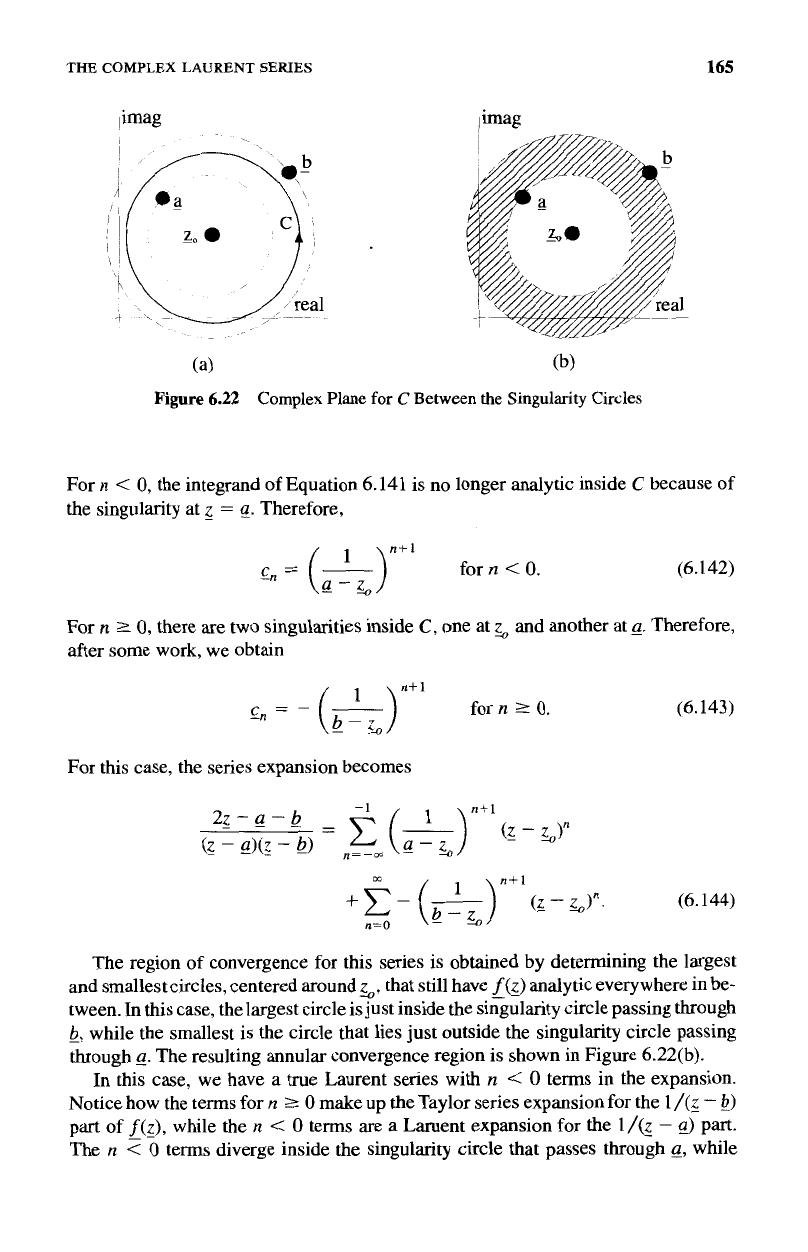
interesting situation where the contour
C
lies between the singularity circles, as
shown
in
Figure 6.22(a). The coefficients for the Laurent series can be obtained
by
Cauchy integration using an expression identical to Equation 6.138, except
C
is
now
between the singularity circles
THE COMPLEX LAURENT
SERIES
165
1
imag
I
hag
(a)
(b)
Figure
6.22
Complex Plane
for
C
Between the Singularity Circles
For
n
<
0,
the integrand of Equation 6.14 1 is no longer analytic inside
C
because of
the singularity at
g
=
a.
Therefore,
for
n
<
0.
1
cn
=
(7)
a-G
(6.142)
For
n
2
0,
there are two singularities inside
C,
one at
5
and another at
a.
Therefore,
after some work, we obtain
(6.143)
For this case, the series expansion becomes
The region of convergence for this series is obtained by determining the largest
and smallest circles, centered around
L,
that still have
f(z)
analytic everywhere in be-
tween. In
this
case, the largest circle is just inside the singularity circle passing through
-
b,
while the smallest
is
the circle that lies just outside the singularity circle passing
through
a.
The resulting annular convergence region is shown in Figure 6.22(b).
In this case, we have a true Laurent series with
n
<
0
terms in the expansion.
Notice how the terms for
n
2
0
make up the Taylor series expansion for the 1
/(z
-
b)
part of
f(&
while the
n
<
0
terms are a Lament expansion for the l/(z
-
a)
part.
The
n
7
0
terms diverge inside the singularity circle that passes through
LZ,
while