
Kusse B.R., Westwig E.A. Mathematical Physics: Applied Mathematics for Scientists and Engineers
Подождите немного. Документ загружается.

176
INTRODUCTION
TO
COMPLEX
VARIABLES
1
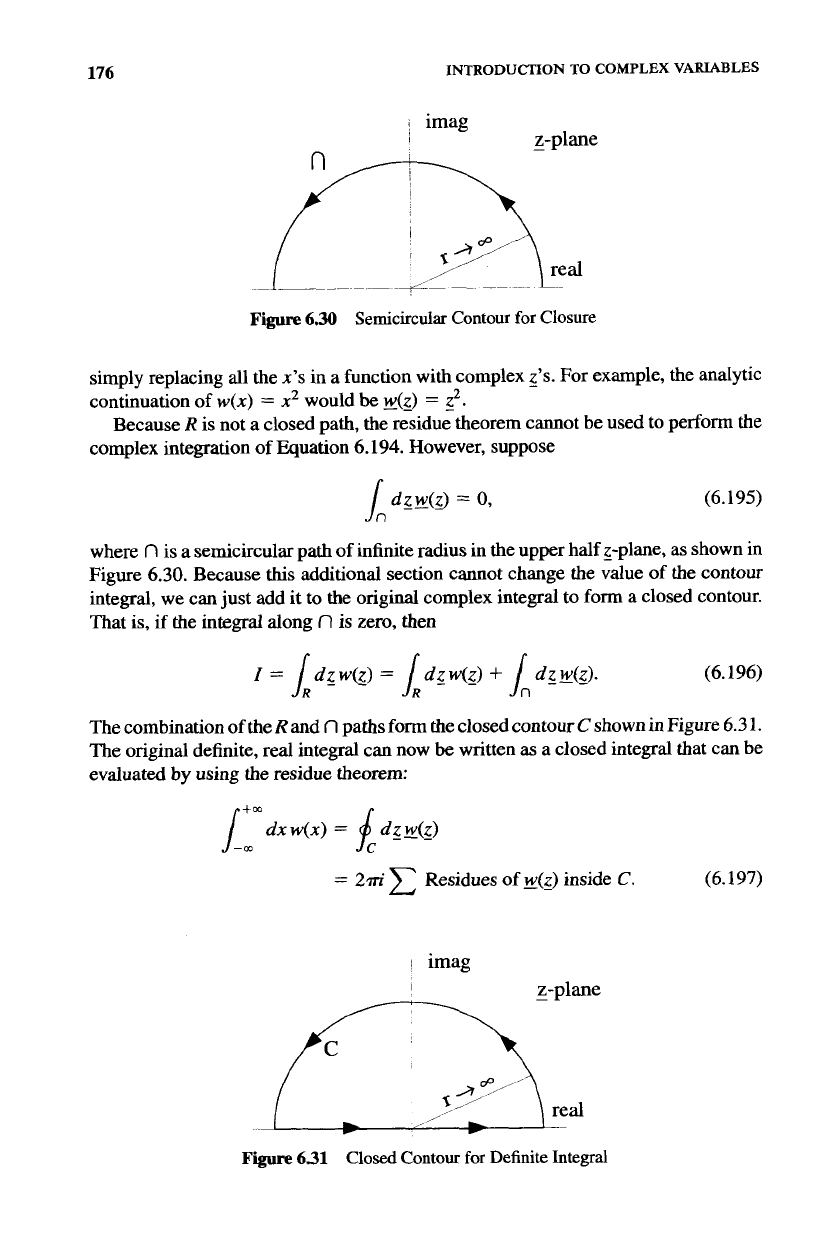
Figure
6.30
Semicircular Contour
for
Closure
simply replacing all the
x’s
in a function with complex
g’s.
For example, the analytic
continuation
of
w(x)
=
x2
would
be
211(2)
=
g2.
Because
R
is not a closed path, the residue theorem cannot be used to perform the
complex integration of Equation 6.194. However, suppose
where
n
is a semicircular path of infinite radius in the upper half g-plane, as shown in
Figure 6.30. Because
this
additional section cannot change the value
of
the contour
integral, we can just add it to the original complex integral to form a closed contour.
That is,
if
the integral along
is
zero, then
(6.196)
The combination
of
the
R
and
fl
paths
form
the closed contour
C
shown
in
Figure 6.3
1.
The original definite, real integral can now be written
as
a closed integral that can be
evaluated
by
using the residue theorem:
dx
w(x)
=
f
dgw(g)
c
=
2m’
Residues of
~(g)
inside
C.
(6.197)
~
imag
Figure
631
Closed
Contour
for
Definite Integral
DEFINITE
INTEGRALS
AND
CLOSURE
177
The technique
of
adding a section of contour to form a closed contour is referred
to as closure. In the discussion above, closure was accomplished by adding a coun-
terclockwise, infinite radius semicircular path
in
the upper half plane. Sometimes
closure is accomplished by a similar semicircular path in the lower half plane. Clo-
sure is most often performed with semicircles, but there are cases where rectangles
or other shapes are necessary.
6.11.1
As
mentioned, for Equation
6.197
to be valid, the integral along
n
must be zero.
This integration can be viewed as a semicircular contour, as shown in Figure 6.30, in
the limit of the radius approaching infinity. If we let
r
be the radius of the semicircle,
then on
n
Conditions for Closure
on
a
Semicircular
Path
where
0
<
8
<
T
for a semicircle in the upper complex plane.
To
move along
fl,
dg
=
ire"d8, (6.199)
and the integral on
n
becomes
(6.200)
Thus to successfully use closure in the form described in the previous section,
~(z)
must obey
Using Equation 6.201 can be a little unwieldy, but a more usable condition can be
derived by using the inequality
(/dz&)I
5
Idzf(g)I.
(6.202)
which holds for any complex integral. Applying this to Equation 6.201, and noting
leiel
=
1,
gives
5
7~
lim
[
rWmx],
(6.203)
r-m
where
W,,,
is the largest value of
Iw(g)l
on the interval
0
<
8
<
T.
This
gives us
a
useful result.
If
Wmx
shrinks
to zero faster than
l/r,
then the contribution of the
fl
178
INTRODUCTION TO COMPLEX
VARIABLES
contour necessarily must vanish. Notice, it is not enough that
I&)l
-+
0
as
r
---$
m.
Because of the extra factor
of
r.
lw(g)I
must go
to
zero faster than
1/r.
Example
6.10
As
an
example of
this
closure technique, consider the real integral,
(6.204)
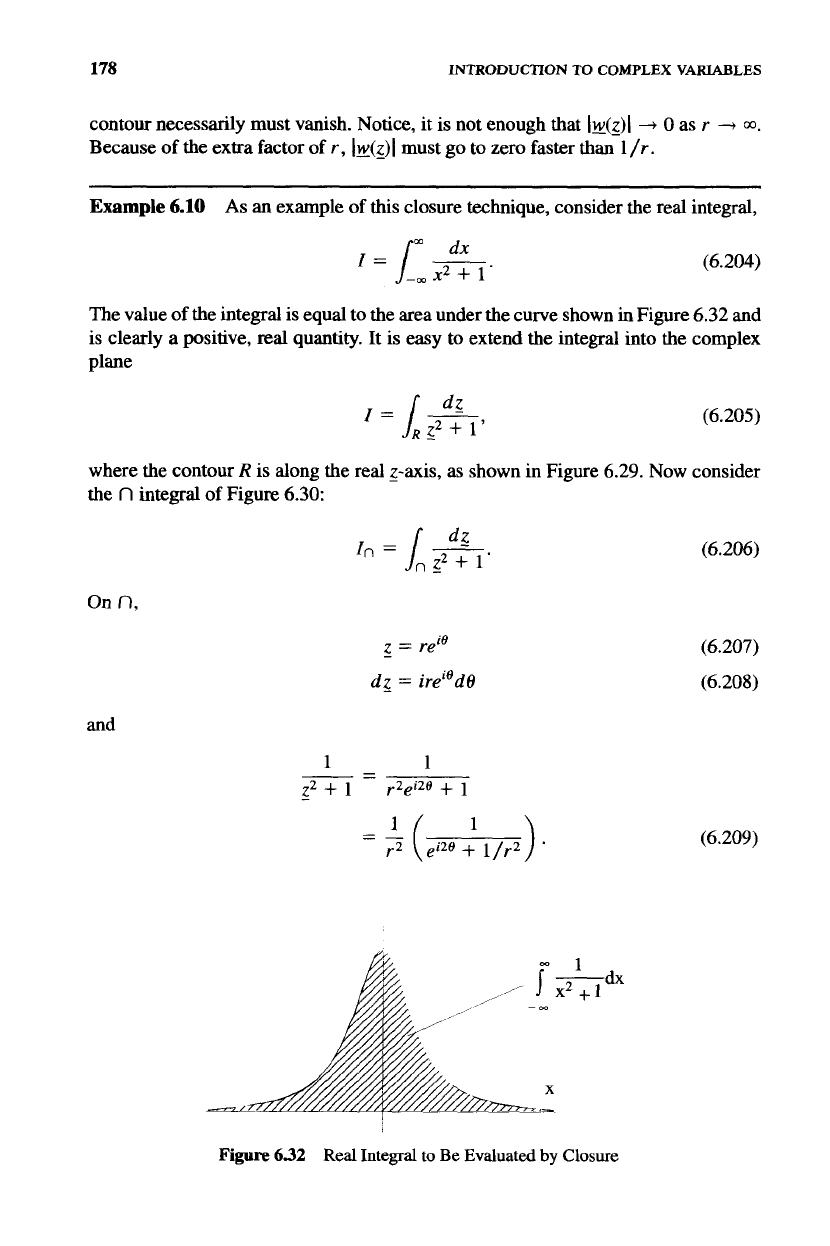
The value
of
the integral is equal to the area under the curve shown in Figure 6.32 and
is clearly
a
positive, real quantity. It is easy to extend the integral into the complex
plane
(6.205)
where the contour
R
is along the real _z-axis, as shown
in
Figure 6.29. Now consider
the
fl
integral of Figure
6.30:
On
n,
and
(6.206)
(6.207)
(6.208)
(6.209)
Figure
632
Real Integral to Be Evaluated by
Closure
DEFINITE INTEGRALS
AND
CLOSURE
179
-1.
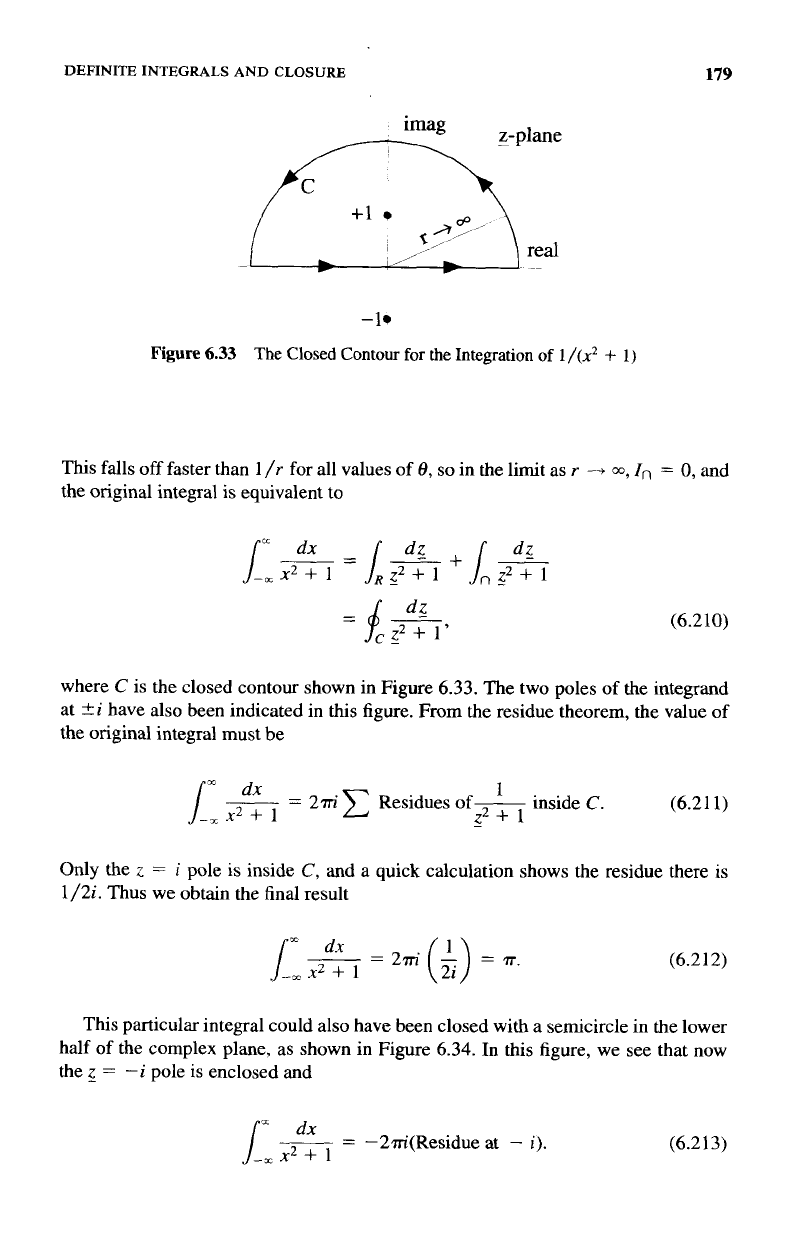
Figure
6.33
The Closed Contour
for
the Integration
of
l/(x2
+
1)
This
falls
off
faster than
1
/r
for all values of
6,
so
in the limit as
r
-+
m,
Z,
=
0,
and
the original integral is equivalent to
(6.210)
where
C
is the closed contour shown in Figure
6.33.
The two poles of the integrand
at
2
i
have also been indicated in
this
figure. From the residue theorem, the value
of
the original integral must be
Jm
dx
-
1
-
2m Residues of- inside
C.
-=
x2
+
1
22
+
1
Only the
z
=
i
pole
is
inside
C,
and a quick calculation shows the residul
1/2i.
Thus
we obtain the final result
dx
- -
2n-i
(&)
=
T.
I
x2
+
1
(6.21
1)
there
is
(6.212)
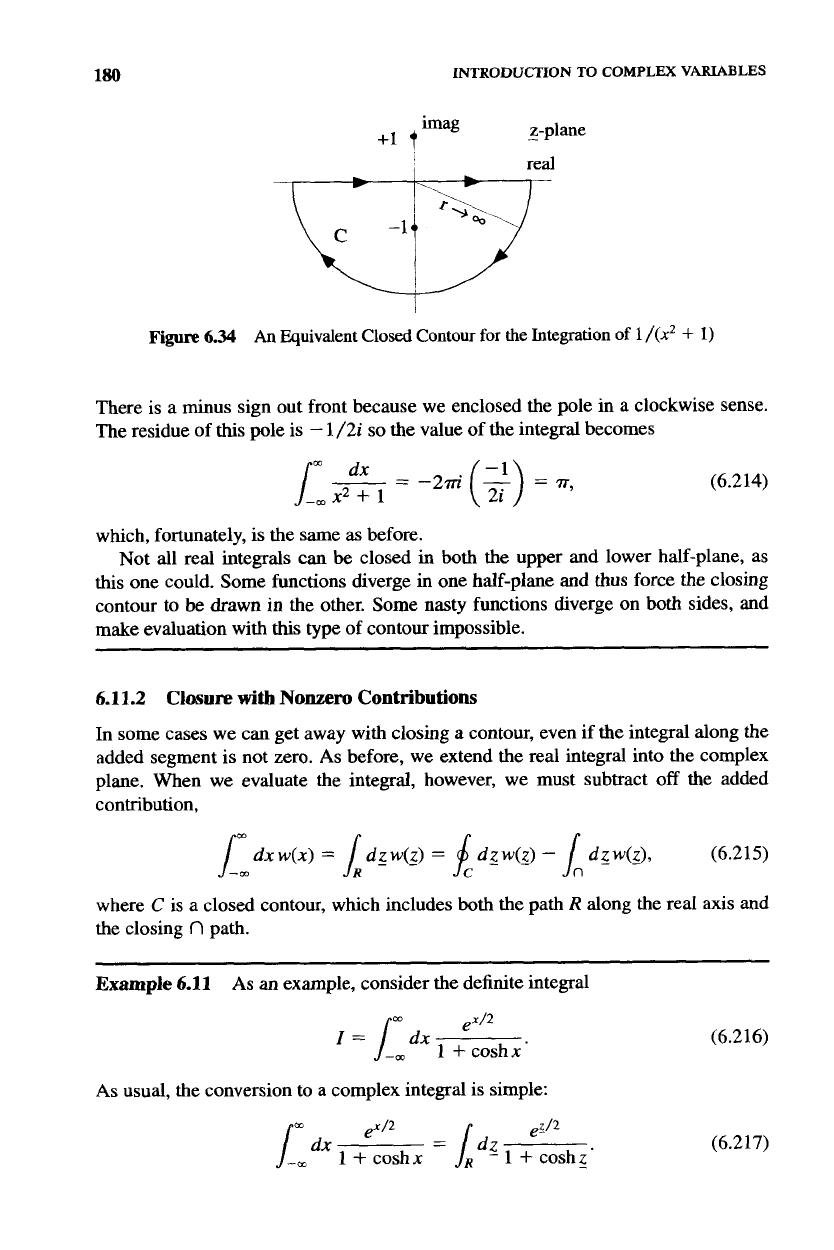
This particular integral could also have been closed with a semicircle
in
cie lower
half of the complex plane, as shown in Figure
6.34.
In this figure, we see that now
the
z_
=
-i
pole
is
enclosed and
JE
L
- -
-2m’(Residue at
-
i).
-=
x2
+
1
(6.213)
180
INTRODUCTION
TO
COMPLEX
VARIABLES
+I
pag
-
z-plane
real
I
Figure
6.34
An
Equivalent
Closed
Contour for the Integration
of
1
/(x2
+
1)
There
is
a
minus
sign out front because we enclosed the pole in a clockwise sense.
The residue of
this
pole
is
-
1
/2i
so
the value of the integral becomes
(6.214)
which, fortunately,
is
the same
as
before.
Not all real integrals can
be
closed in both the upper and lower half-plane, as
this one could. Some functions diverge in one half-plane and thus force
the
closing
contour
to
be
drawn in the other. Some nasty functions diverge on both sides, and
make evaluation with
this
type of contour impossible.
6.11.2
Closure
with
Nonzero
Contributions
In
some cases we can get away with closing
a
contour, even
if
the integral along the
added segment is not zero.
As
before, we extend the real integral into the complex
plane. When we evaluate the integral, however, we must subtract
off
the added
contribution,
where
C
is a closed contour, which includes both the path
R
along the real axis
and
the closing
fl
path.
Example
6.11
As
an example, consider the definite integral
,XI2
1
+coshx'
As
usual, the conversion to a complex integral is simple:
,x/2
,212
Smrdx
1
+
coshx
=
Jdq
1
+
coshg'
(6.216)
(6.217)
DEFINITE INTEGRALS AND
CLOSURE
181
If we
try
to close the contour with an infinite radius semicircle on either side
of
the
real axis, we run into problems, because the complex integrand does not vanish as the
radius approaches infinity. This can be seen most easily by evaluating the integrand
along the imaginary axis, i.e.,
z
=
iy,
where we find
(6.2
1
8)
Notice as
y
3
?=,
the
RHS
of Equation 6.218 oscillates. Therefore, closing the
contour with a semicircular loop as we did in the previous section will not work.
By examining the poles of
this
function, you can see another big problem with using
the infinite semicircular contour.
A
pole occurs every place where
z
=
+(2n
+
1)ir
for all integer values
of
n.
That means there are an infinite number of poles along the
imaginary axis which would be enclosed by such a contour.
A
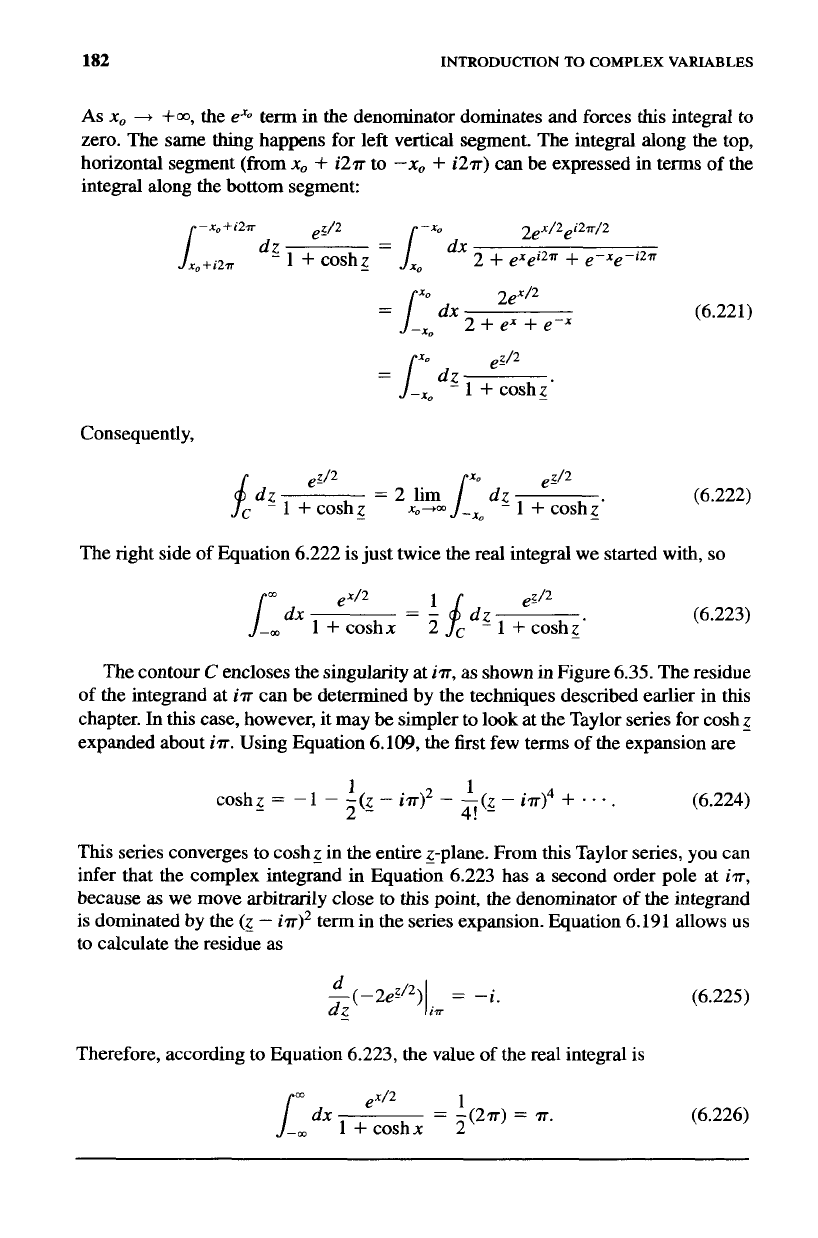
better method is to close the contour as shown in Figure 6.35, and then take
the limit
xo
+
m.
This contour encloses only a single pole, the one at
g
=
ir.
The
integral around the contour
C,
in this limit, has four parts:
For the right vertical segment,
z
=
x,
+
iy
and
dg
=
idy,
so
x0+r2Tr
&/2
2?r
lo
dzl
+coshg
imag
+27c
1
I
I
Ic
i
-x<, +xo
Figure
6.35
Contour
for
Integration
of
ex/*/(
1
+
cosh
x)
(6.219)
(6.220)
182
INTRODUCTION TO COMPLEX VARIABLES
As
x,,
--f
+m,
the
exe
term in the denominator dominates and forces
this
integral
to
zero. The same thing happens for left vertical segment. The integral along the top,
horizontal segment (from
x,,
+
i2m
to
-x,,
+
i2m)
can be expressed in terms of the
integral along the bottom segment:
-x0+i27r
ed2
"
1
+
coshz
(6.221)
Consequently,
r
The right side
of
Equation
6.222
is just twice the real integral we started with,
so
(6.223)
The contour
C
encloses the singularity at
im,
as
shown in Figure
6.35.
The residue
of
the
integrand at
i.rr
can be determined by the techniques described earlier in
this
chapter.
In
this
case, however, it may
be
simpler to
look
at the Taylor series for cosh
z
expanded about
im.
Using Equation
6.109,
the
first
few terms of the expansion are
1
1
2-
4!
-
coshg
=
-
1
-
-(z
-
-
-(z
-
i7~)~
+
.
.
*
.
(6.224)
This
series converges to coshg in the entire 6-plane. From
this
Taylor series,
you
can
infer that the complex integrand
in
Equation
6.223
has a second order pole at
ir,
because
as
we move arbitrarily close
to
this
point, the denominator of the integrand
is
dominated by the
(g
-
i~)~
term
in
the series expansion. Equation
6.191
allows
us
to calculate the residue as
Therefore, according to Equation
6.223,
the value
of
the real integral is
ex/2
1
=
-(27T)
=
7T.
Ldx
1
+
coshx
2
(6.225)
(6.226)
DEFINITE INTEGRALS AND CLOSURE
imag
Poles of
w(z)
183
imag
imag imag
Figure
6.36
Closure Results
from Contour Deformation
6.11.3
Another View
of
the Closure
Process
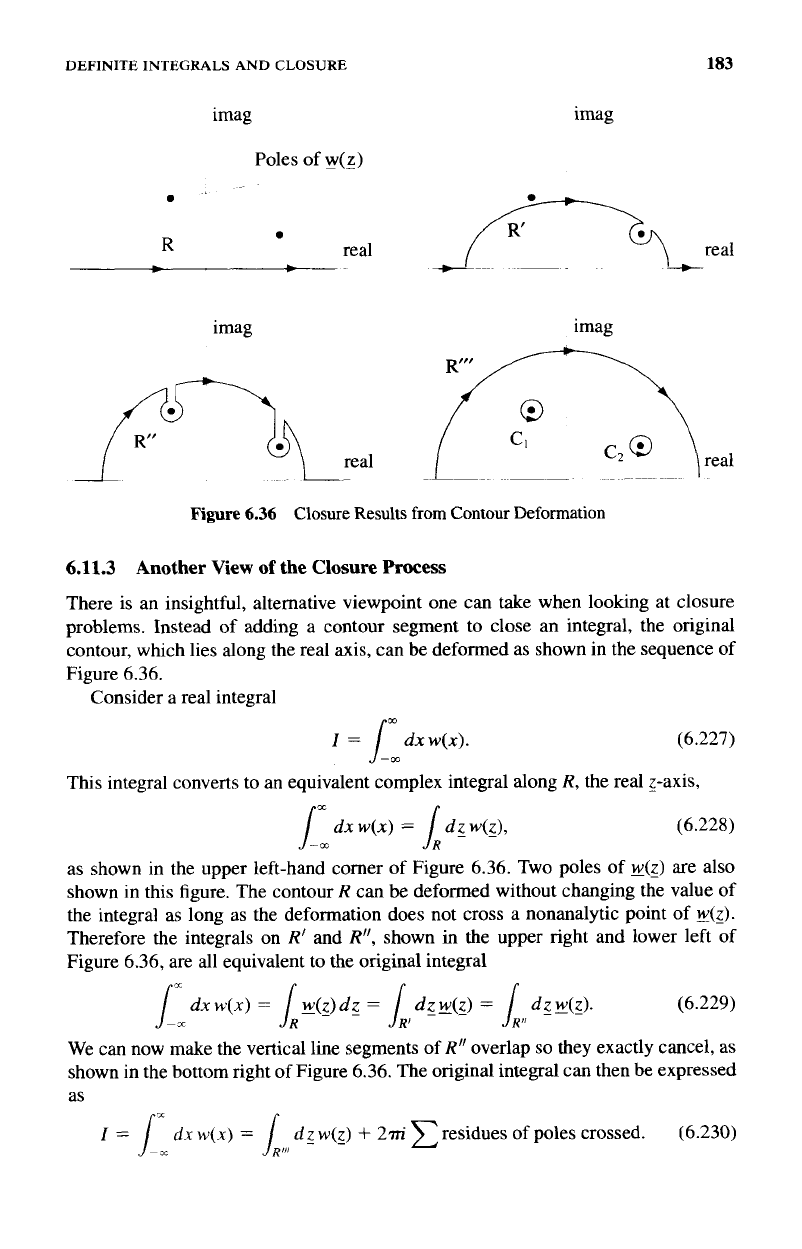
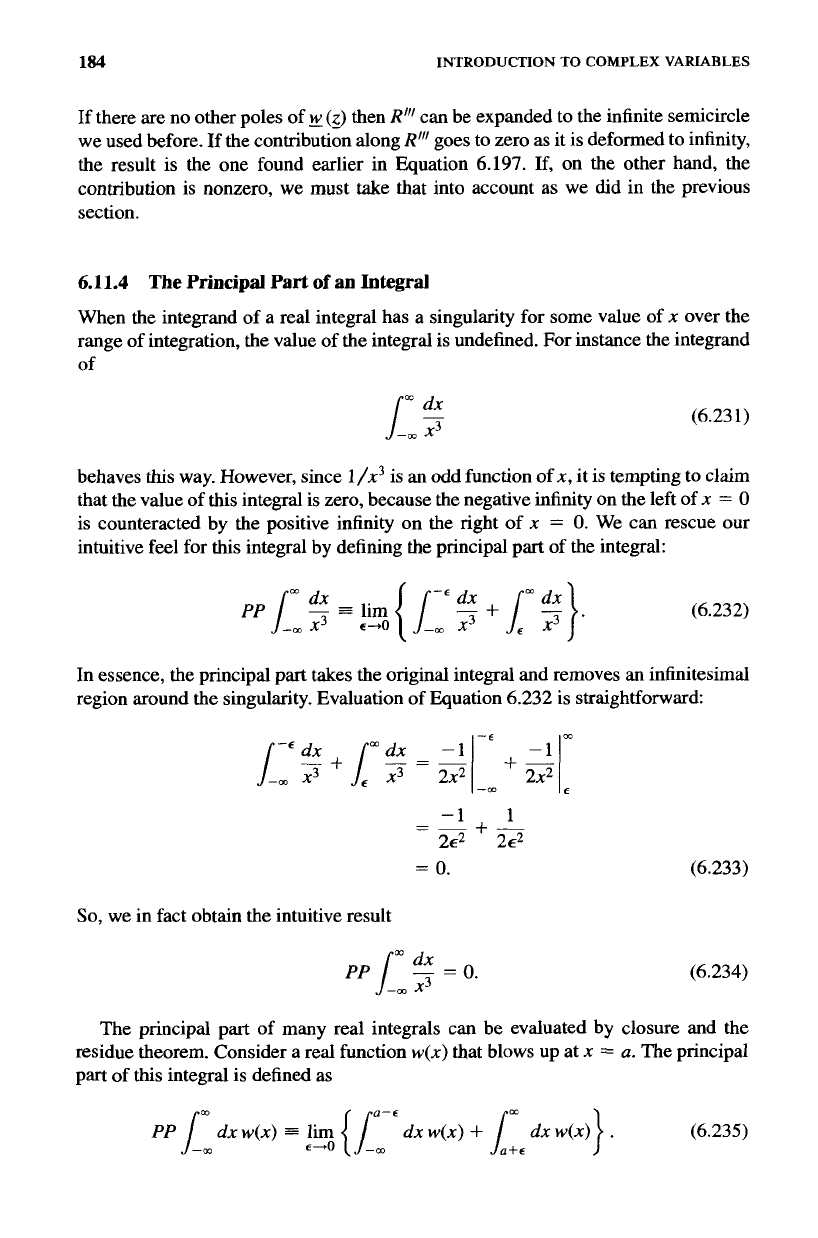
There is an insightful, alternative viewpoint one can take when looking at closure
problems. Instead of adding a contour segment to close an integral, the original
contour, which lies along the real axis, can be deformed as shown in the sequence of
Figure 6.36.
Consider a real integral
m
I
=
Lm
dxw(x).
(6.227)
This integral converts to an equivalent complex integral along
R,
the real Z-axis,
(6.228)
as shown in the upper left-hand comer of Figure 6.36. Two poles
of
~(g)
are also
shown in this figure. The contour
R
can
be
deformed without changing the value of
the integral as long
as
the deformation does not cross a nonanalytic point of
&).
Therefore the integrals on
R’
and
R”,
shown in the upper right and lower left of
Figure 6.36, are all equivalent to the original integral
(6.229)
We can now make the vertical line segments
of
R”
overlap
so
they exactly cancel, as
shown in the bottom right of Figure 6.36. The original integral can then be expressed
as
I
=
1;
dx
w(x)
=
dz
w(z)
+
2m-i
residues of poles crossed. (6.230)
184
INTRODUCTION TO COMPLEX VARIABLES
If there are no other poles of
w
(5)
then
R”’
can be expanded to the infinite semicircle
we used before.
If
the contribution along
R”’
goes to zero as it is deformed to infinity,
the result is the one found earlier in Equation
6.197.
If,
on the other hand, the
contribution is nonzero, we must take that into account
as
we did in the previous
section.
6.11.4
The
Principal Part
of
an
Integral
When the integrand
of
a real integral has a singularity for some value of
x
over the
range of integration, the value of the integral is undefined. For instance the integrand
of
dx
Lm
2
(6.231)
behaves
this
way. However, since
l/x3
is
an
odd function
of
x,
it is tempting to claim
that the value of
this
integral is zero, because the negative infinity on
the
left of
x
=
0
is counteracted by the positive infinity on the right of
x
=
0.
We can rescue our
intuitive feel for
this
integral by defining
the
principal part of the integral:
(6.232)
In essence, the principal part takes
the
original integral and removes
an
infinitesimal
region around the singularity. Evaluation of Equation
6.232
is straightforward:
-1
1
2€2
2€2
+-
-
--
=
0.
(6.233)
So,
we in fact obtain
the
intuitive result
PPs_rm$
=
0.
(6.234)
The principal part
of
many real integrals can be evaluated by closure
and
the
residue theorem. Consider a real function
w(n)
that blows up at
x
=
Q.
The principal
part of
this
integral is defined
as
dn w(x)
=
!%
{/re
dx w(x)
+
dn
w(x)}
.
(6.235)
a+€
DEFINITE INTEGRALS AND CLOSURE
imag
-
z-plane
PP
real
--
a-&
a
afE
Figure
6.37
Principal
Part
Integration
in
the
Z-Plane
This is equivalent to
an
integral done in the complex
g
plane,
185
(6.236)
where
PP
is a path
of
integration along the real z-axis from
(-m,
a
-
E)
and
(a
+
E,
m),
in the limit
of
E
--f
0,
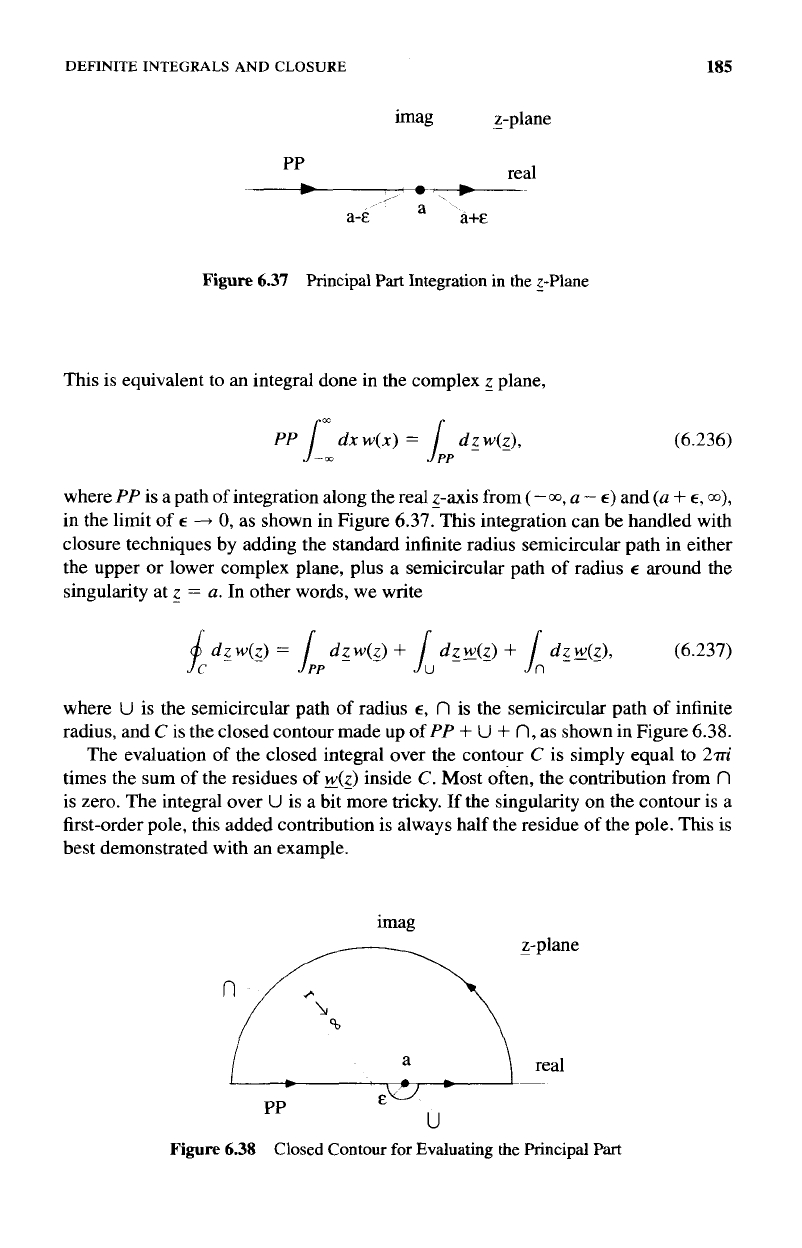
as shown in Figure
6.37.
This
integration can be handled with
closure techniques by adding the standard infinite radius semicircular path in either
the upper or lower complex plane, plus a semicircular path
of
radius
E
around the
singularity at
z
=
a.
In other words, we write
where
U
is the semicircular path
of
radius
E,
n
is the semicircular path of infinite
radius, and
C
is the closed contour made up of
PP
+
U
+
n,
as shown in Figure
6.38.
The evaluation
of
the closed integral over the contour
C
is simply equal to
2m'
times the sum
of
the residues of
~(z)
inside
C.
Most often, the contribution from
fl
is zero. The integral over
U
is a bit more tricky. If the singularity on the contour is
a
first-order pole, this added contribution is always half the residue of the pole.
This
is
best demonstrated with an example.
imag
~
z-plane
real
Figure
6.38
Closed
Contour for Evaluating
the
Principal
Part